The Massive Taxi Queues At Paddington
I took this picture at Paddington in the late morning.
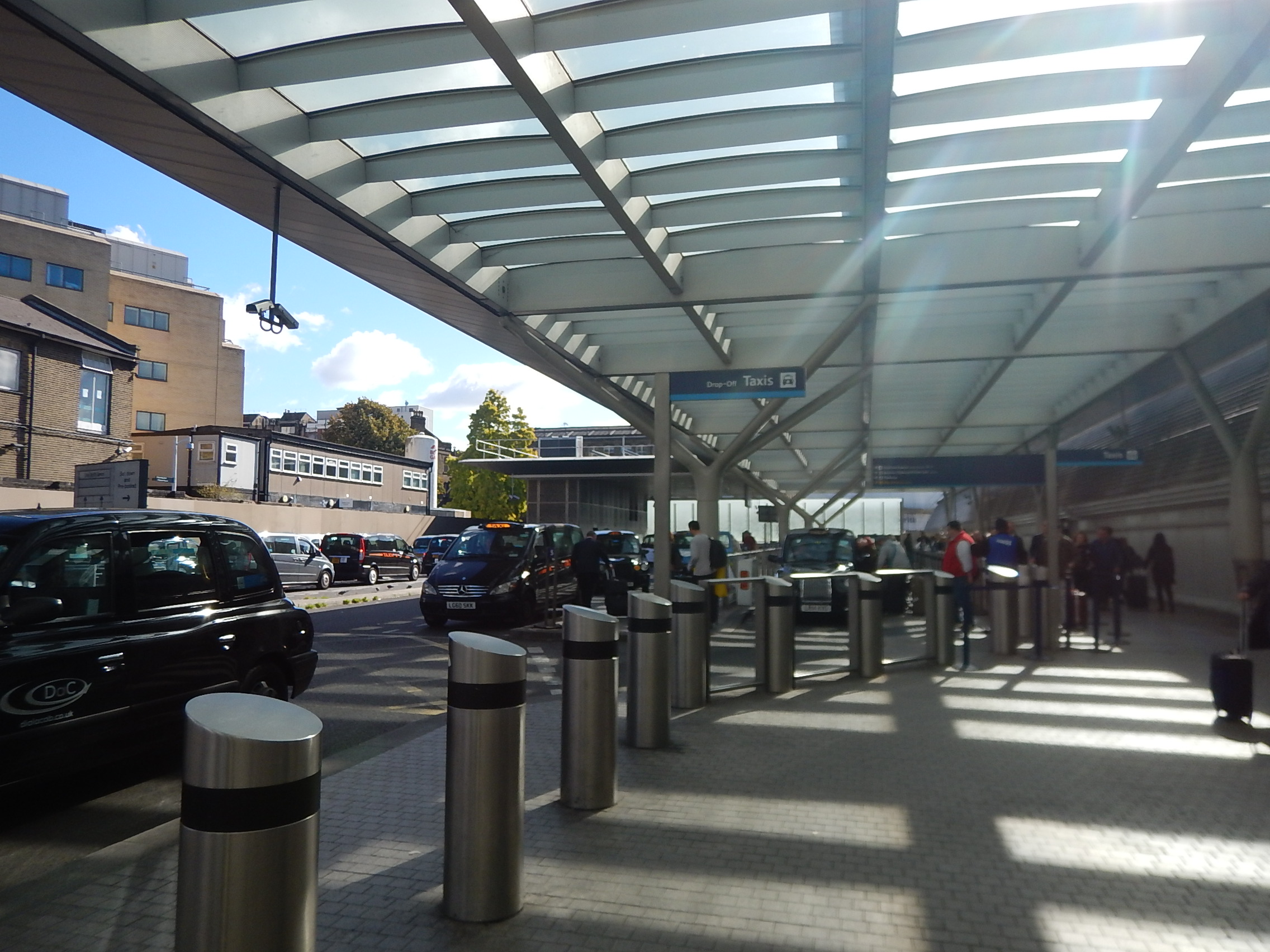
There were masses of passengers with heavy cases queuing for the taxis.
I suspect all had been conned into coming into London on the overpriced Heathrow Express.
Roll on, Crossrail!
Should The Elizabeth Line Be Extended To Ascot?
The idea for this post came from an article in the October 2018 Edition of Modern Railways, that was entitled Windsor Link Railway Gains Momentum.
The article talks about the benefits of the Windsor Link Railway.
Property Development And Landscaping
Ever since I read about the Windsor Link Railway, I thought it would create or free-up sites in Windsor for property development.
I even wrote about this in Is This One Of The Most Valuable Sites For New Development In The UK?.
The article details or suggests the following.
- Around twenty-one acres, which would include the two existing station sites could be developed.
- The Windsor and Eton Riverside station, which Grade II Listed, could be developeed into a boutigue hotel on the river.
- The gardens in the centre of Windsor could be extended.
The article also suggests that the property development could pay for the whole scheme.
Reducing Traffic In Windsor
Windsor is full of tourist coaches and other traffic.
The proposed railway would have.
- A single sub-surface station in the middle of the town.
- Twelve trains per hour (tph) through Windsor, in a single-track tunnel.
- Areinstated Royal Curve at Slough to create a route between Reading and Windsor.
- A Park-and-Ride by the M4 at Chalvey.
- A journey between Waterloo and Windsor of around fifty minutes, with four tph.
- Slough would be the Northern terminal, either in the current station or West of the town in the Trading Estate.
- It should be noted that six-car Aventras similar to Crossrail’s Class 345 trains, would probably hold a thousand passengers.
If a railway like that didn’t cut traffic going into Windsor, then nothing will.
Western Access To Heathrow
The Windsor Link Railway could also serve Heathrow Terminal 5.
The article states that this would probably need a double-track tunnel, so provision should be made in the initial scheme.
Crossrail trains could also use the link to extend Crossrail to Reading via Windsor.
- The Royal Curve at Slough would be rebuilt.
- The new Windsor station would need to be able to handle two hundred metre long trains.
- Trains would serve both Heathrow Central and Terminal 5.
- Trains wouldn’t need a terminal platform at Heathrow Terminal 5 station.
But the biggest benefit (or even curse!) would be to connect Windsor to Central London.
Wider Connectivity
George Bathurst; the scheme’s proposer envisages trains from Windsor to the following places.
- Heathrow
- High Wycombe via Bourne End.
- Reading
- Waterloo
- Woking
In one throwaway remake this is said.
The WLR connection to Heathrow could also be used (with dual-voltage stock) for extending the Elizabeth Line westwards, to Ascot for example.
This would need a chord at Staines, which I wrote about in Heathrow Southern Railway’s Proposed Chord At Staines.
Hence the title of this post!
The Heathrow Southern Railway And The Windsor Link Railway
I wrote about the interaction of the two proposals to access Heathrow from the West and South in Heathrow Southern Railway And The Windsor Link Railway.
This was my original conclusion.
Co-operation could be beneficial to both projects.
I have not changed my conclusion, although I have updated the related post.
Heathrow’s Destinations In The West And South
Taken together the two proposals; Heathrow Southern Railway and Windsor Link Railway, will or could offer the following destinations.
- Basingstoke – Heathrow Southern Railway – Extension to Heathrow Express
- Guildford – Heathrow Southern Railway – Extension to Heathrow Express
- High Wycombe – Windsor Link Railway – Possible via Bourne End!
- Reading – Windsor Link Railway – Possible Extension to Crossrail!
- Slough – Windsor Link Railway – Possible Extension to Crossrail!
- Staines – Heathrow Southern Railway – Extension to Crossrail
- Weybridge – Heathrow Southern Railway – Local Service
- Windsor – Windsor Link Railway – Possible Extension to Crossrail!
- Woking – Heathrow Southern Railway – Extension to Heathrow Express
I can see two high-capacity stations at Terminal 5 and Windsor capable of handling upwards of ten tph in both directions, feeding services all over the area, bringing passengers, workers and freight to Heathrow.
A Crossrail Extension To Ascot
I’ll now look at this in detail.
The Route
As I said earlier this would need the reinstatement of the chord at Staines station.
This map from carto.metro.free.fr shows former route of the chord as a dotted line.
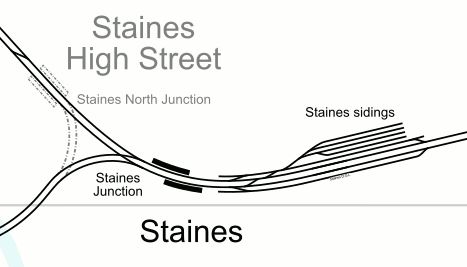
Would it be possible to get one of Crossrail’s two hundred metre long trains around a rebuilt chord?
From Staines, it would be an easy run up the Waterloo-Reading Line, with calls at the following stations.
- Egham
- Virginia Water
- Longcross
- Sunningdale
All appear to be stations capable of taking long trains.
Current Service
Currently, there are two services on this route.
2 tph – Waterloo and Reading
2 tph – Waterloo and Weybridge, which branches off at Virginia Water.
Benefits Of Extending To Ascot
At present Heathrow Terminal 5 is planned to get just two tph from Crossrail. But as Terminal 5 is the busiest terminal at Heathrow by a large margin, surely it needs more services than this.
I also think, that the ideal number of services between Staines and Ascot should be at least four tph.
If two tph ran through Heathrow Terminal 5 to Ascot, this would mean the following.
- There would be at least four tph on services between Staines and Ascot.
- Travellers would have a wider choice of London terminals.
- Travellers would be have direct access to all terminals and HS2 at Old Oak Common.
There would also probably be less road traffic into Heathrow.
Why Stop At Ascot?
Although, George Bathurst suggested Ascot as a terminus, why not continue all the way to Reading station?
Stations on the route are.
- Martins Heron
- Bracknell
- Wokingham
- Wnnersh
- Winnersh Triangle
- Earley
Note that Reading station has three third-rail electrified platforms to handle trains from Ascot, Guidford, Staines and Waterloo.
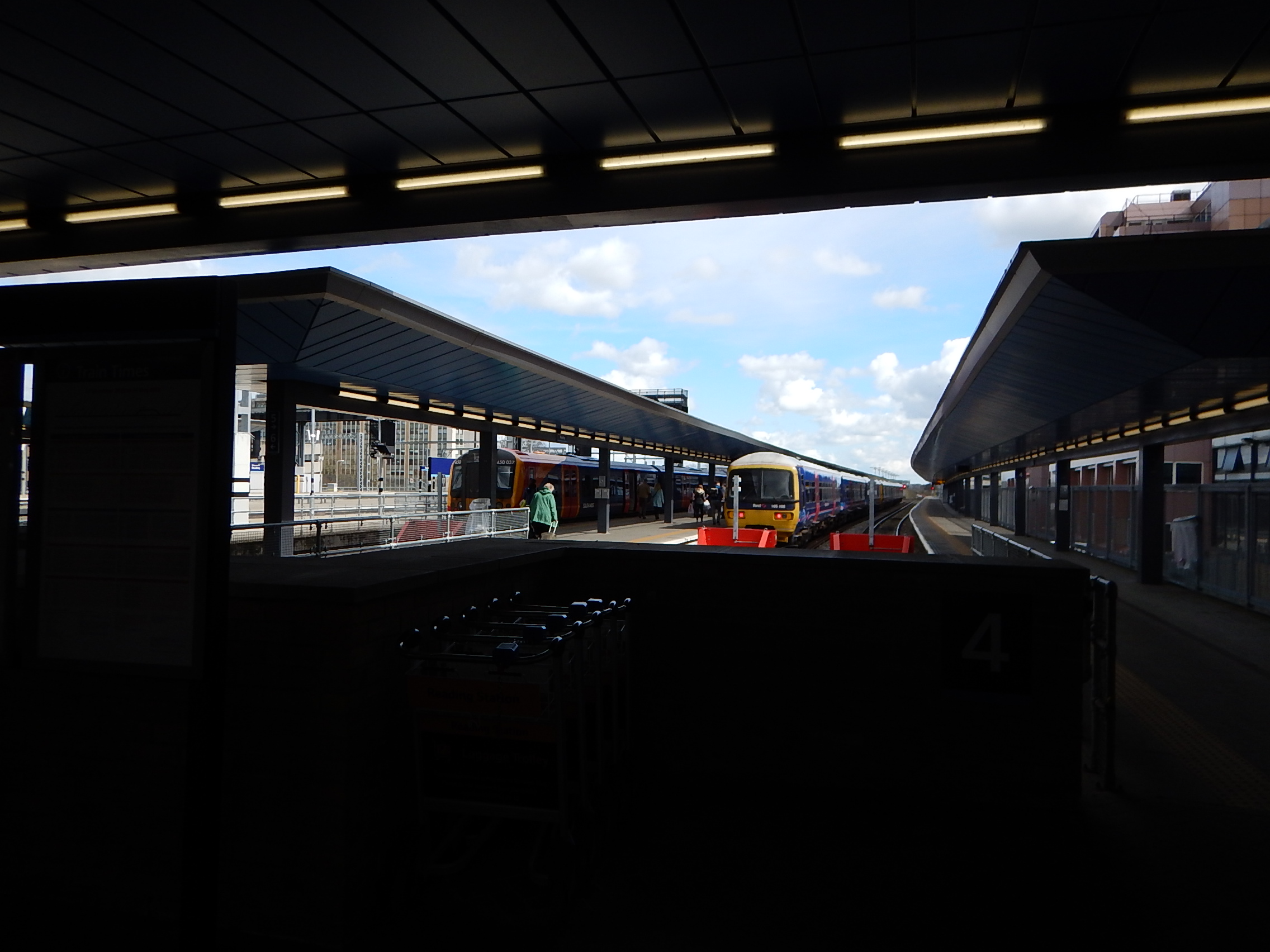
Note the train in the platform is a Great Western Railway train to Gatwick, which in a couple of years will be run by tri-mode Class 769 trains.
As the platforms only handle four tph, there is plenty of capacity to turn extra trains.
I can’t see any reason, why if Crossrail is extended to Ascot, it shouldn’t be extended to Reading.
Especially, as all the benefits I talked about earlier to Ascot would also apply to terminating at Reading.
Conclusion
I believe that an extension of Crossrail to Ascot would be worthwhile, but that it should continue to Reading.
Piccadilly Capacity Study Commissioned
The title of this post is the same as that of an article in the October 2018 Edition of Modern Railways.
This is the first paragraph.
New NR Chief Executive Andrew Haines has commissioned work to understand options for capacity through platforms 13 and 14 at Manchester Piccadilly.
It was originally planned to build two extra tracks, with additional platforms between Manchester Piccadilly and Deansgate stations, to improve the capacity over the Ordsall Chord.
But various engineers and politicians have suggested that Digital Signalling may be an alternative solution.
Speaking to the House of Commons Transport Committee, Mr. Haines said.
We might be better off replacing some of those fleets of trains with trains which have more doors.
Boarding is slow all across the North and I suspect Mr. Haines has studied the problem.
He also added.
He had commissioned work to understand if 15 trains per hour could be delivered through platforms 13 and 14 without major infrastructure works.
I don’t think that Network Rail would waste money on a study, if they didn’t think that 15 trains per hour (tph) were not possible.
Consider.
- Thameslink and Crossrail will soon be running 24 tph through Central London in four directions.
- The East London Line currently runs 16 tph in a tunnel that was opened only thirteen years after the Liverpool and Manchester Railway.
- Trains designed for short dwell times and easy boarding and unloading, as suggested by Mr. Haines would obviously help.
Platforms and the related access at Manchester Piccadilly, Manchester Oxford Road and Deansgate stations would need to be improved.
But that would be a smaller number of affordable projects.
Conclusion
I do think Andrew Haines has a mind that doesn’t believe in boxes, so his ideas won’t go down well with those with big-spending conservative ideas like most rail union leaders, some rail company bosses and the Mayor of Manchester.
An Illustration Of Why The Greenford Branch Needs Four Trains Per Hour
I wanted to ride the Greenford Branch to photograph a Class 165 train in the livery of Great Western Railway.
So I took one of TfL Rail’s Class 345 trains to West Ealing station.
By the time, that I’d climbed over the bridge and walked to Platform 5 to catch the Class 165 train to Greenford, the train had just left.
So I then spent a miserably cold thirty minutes in a fierce wind on a station without a shelter, whilst I waited for the next train.



In that time, when I took these pictures, two passenger trains in each direction stopped in the station.
Crossrail
When Crossrail finally opens, West Ealing station is going to get ten trains per hour (tph) in both directions, which will terminate in the West at Heathrow Terminal 4, Heathrow Terminal 5, Maidenhead and Reading.
Passengers interchanging with the Greenford Branch will enjoy the thirty minute wait.
Airport Workers
I have been told several times by train staff and airport workers that getting to Heathrow Airport somtimes needs a car, as the buses are hard to find.
Nothing has been said about Crossrail running through the night, but as Thameslink runs to Gatwick, I wouls suspect this will happen.
And if Crossrail runs through the night, surely the humble Greenford Branch should do the same.
Conclusion
Plans should be developed to get the Greenford Branch running at four tph, throughout the day and perhaps two tph, when Crossrail is running through the night.
What Is Happening (Or Not!) At West Ealing Station?
I took these pictures at West Ealing station a few days ago.

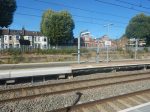



There appears to be no work going on to finish the station for Crossrail.
There has also been no announcement about what is happening to the Greenford Branch.
Surely, if the bay platform were to be electrified, it would be the ideal place to charge a battery shuttle train to Greenford station.
Thoughts On The Lateness Of Crossrail
This article on the BBC is entitled Crossrail Delay: New London Line Will Open In Autumn 2019.
This is the first paragraph.
London’s £15bn Crossrail project is to open nine months after its scheduled launch to allow more time for testing.
I spent most of my working life, writing software for the planning and costing of large projects and despite never having done any serious project management in anger, I have talked to many who have, both in the UK and around the world.
So what are my thoughts?
Crossrail Is A Highly-Complex Project
The project involves the following.
- A 21 km double-track tunnel under London.
- New Class 345 trains
- Four different signalling systems.
- Rebuilt stations at West Drayton, Hayes & Harlington, Southall, West Ealing, Ealing Broadway. Acton Main Line, Forest Gate, Manor Park, Ilford
- Refurbished stations at Hanwell, Maryland, Seven Kings, Goodmayes, Chadwell Heath, Romford, Gidea Park, Harold Wood, Brentford and Shenfield.
- Major interchanges with existing stations at Paddington, Bond Street, Tottenham Court Road, Farrington, Liverpool Street, Whitechapel and Stratford.
- New stations at Custom House, Canary Wharf, Woolwich and Abbey Wood.
Some parts are easy, but a lot are very difficult.
A Shortage Of Specialist Workers
I believe that certain factors could be reducing the pool of workers available to Crossrail.
Less workers than needed would obviously slow the project.
Having to pay more than budgeted to attract or keep workers will also raise costs.
My thoughts on what is causing a possible shortage of specialist workers follow.
Crossrail-Related Development
If you own a site or a building, near to one of Crossrail’s stations, then your property will substantially increase in value, when the line opens.
Walk past any of the Crossrail stations in Central London and some further out and you will see towers sprouting around the station entrance like crows around a road-kill.
Developers know how to cash-in on the best thing that has happened to them since the Nazis flattened acres of Central London.
New sites are also being created over several Crossrail stations including Moorgate, Farringdon (2 sites), Tottenham Court Road (2 sites), Bond Street (2 sites) and Paddington.
But do all these extensive developments, mean that there are not enough sub-contractors, specialist suppliers, electricians, chippies, air-conditioning engineers, plumbers and other trades to do all the work available in London?
I also suspect a developer, building an office block to the world’s highest standard could pay better and faster, than a Crossrail supplier under pressure.
Underground Working
Working underground or in mining is dangerous.
In the 1960s, women were totally banned from working below the surface.
It must have been around 1970, when I met one of ICI’s archivists; Janet Gornall, who a few years previously had organised storage of their masses of historical documents, in the company’s salt mine at Winsford. The mine is still used for document storage, by a company called Deepstore.
Health & Safety found out that Janet would be supervising and indexing the storage underground, so that if any document was required, they could be easily retrieved. This caused them to give the scheme a big thumbs down.
Questions were even asked in the House of Commons, but nothing would change Health & Safety’s view
In the end a simple solution was found..
- As the boxes came up from London they were piled up in a large building on the surface, in the position Janet wanted them underground.
- The pile of boxes was then moved underground and stacked in exactly the same way.
- Nowadays, anybody can work underground, but they must have training and be certified for such work.
Crossrail thought the number of certified underground workers might not be enough, so they set up the Tunnelling and Underground Construction Academy (TUCA) at Ilford. This article on the Crossrail web site is entitled A Legacy To The Construction Industry.
Some points about TUCA.
- It is now part of Transport for London.
- It was funded by Crossrail and the Skills Funding Agency.
- TUCA is Europe’s only specialist soft-ground tunnelling training facility.
I wrote about TUCA in Open House – TUCA, after a visit in 2012.
I was told on my visit, that the Swiss have a similar facility for rock tunnelling and that there were plans for both academies to work together.
Trainees from all over the world would get training in an exotic Swiss mountain and then go on to enjoy the wonders of Ilford.
But at least they’ll be safe workers for all types of tunnelling.
I do wonder if some of the Crossrail delays has been caused by a lack of properly trained underground workers, as now the tunnelling is completed, many have moved on to the next project.
Thames Tideway Scheme
The Thames Tideway Scheme is a £4billion scheme to build a massive sewer under the Thames to clean up the river.
Many Crossrail engineers, tunnellers and workers are now working on the new scheme.
Brexit
Stuttgart 21 is one of numerous mega-projects in Europe.
Many of the workers on Crossrail were originally from Europe and now with the uncertainties of Brexit, some must be moving nearer home, to work on these large European projects.
Well-Paid Jobs In Sunnier Climes
Don’t underestimate, the effect of the Beast From The East last winter.
Skilled personnel have always gone to places like the Middle East to earn a good crust.
With Crossrail under pressure, how many of these key workers have gone to these places for the money?
Conclusion
I wouldn’t be surprised to find that a shortage of specialist workers is blamed for the delays.
In the BBC article, there is this quote
We are working around the clock with our supply chain and Transport for London to complete and commission the Elizabeth line.
Fairly bland, but does the supply chain include specialist suppliers and workers, which are under severe pressure from other projects to perform various works?
It’s probably true that there is only a finite pool of these companies, tradesmen and workers and at least some of the best will have been lured away.
Station Problems
In this article in the Architects Journal, which is entitled Crossrail Delayed Until Autumn 2019, this is said.
Crossrail then revealed in February that it had overspent its budget for the year to 30 March 2018 by £190 million.
At the time TfL said works at Whitechapel station, designed by BDP, and Farringdon station, designed by AHR, were completed later than expected, and there were delays to work at Weston Williamson’s Woolwich station and John McAslan + Partners’ Bond Street station.
I’ll look at Whitechapel station as an example.
You don’t need to be an expert to figure out that Whitechapel station is running late.
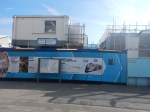

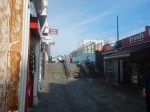

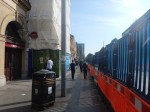

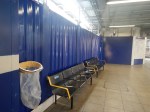
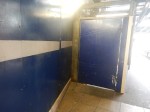
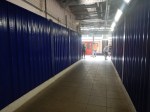


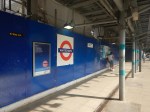
Look at all the blue hoardings.
- I know this only shows what is visible to the public.
- The Crossrail platforms deep underground could be ready.
- The main entrance to the station is still shrouded in plastic.
- The escalators to get down to Crossrail, will be between the two District/Metropolitan Line platforms.
This Google Map shows the area of Whitechapel station.
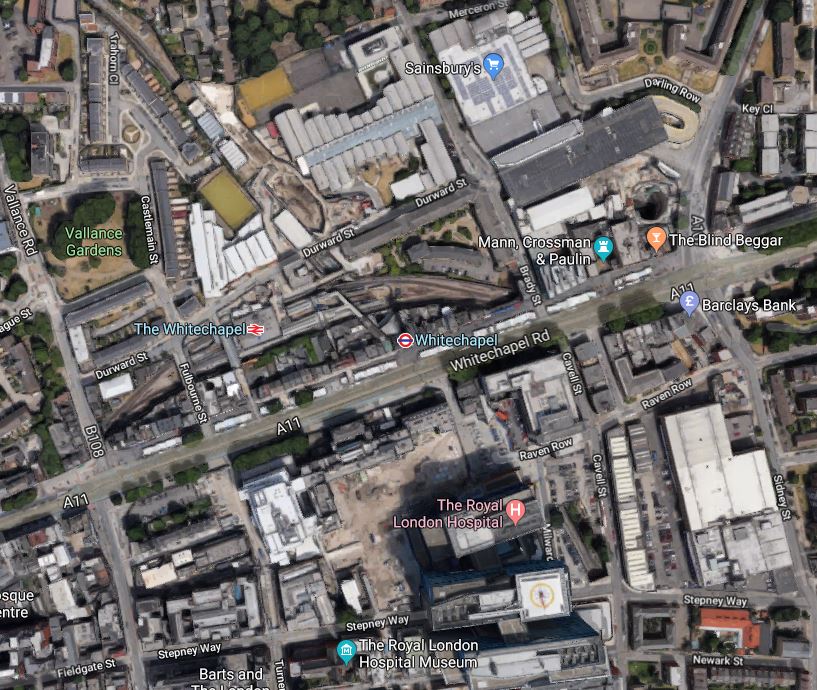
Note how the site is hemmed in, by important buildings including a Sainsburys supermarket and Swanlea School.
See An Innovative Use Of The School Holidays, for an insight about how the builders of the station coped with the lack of space.
I also feel that Whitechapel is an incredibly complex station to build.
- It is crossed by two important railways; the District/Metropolitan Line and the East London Line.
- Innovative techniques from the coal mining industry had to be used to dig the escalator tunnel.
- Whitechapel will be the station, where passengers change between the two Eastern branches.
I do wonder, whether a different design would have been easier to build.
For instance, could Sainsburys have been paid to shut their superstore and that site used to build the station?
But Crossrail has chosen a design and now they must build it.
The New Class 345 Trains
The new Class 345 trains for Crossrail are an almost totally new design called Aventra by Bombardier, that I believe has been specifically created to make the operation of Crossrail as efficient as possible.
The trains must have something about them, as since launch they have attracted five more substantial orders, from five different operators.
The introduction into service of the Class 345 trains, has been reasonably straightforward, but not without some issues.
But I do question, the launching of Aventra trains solely on a line as complex as Crossrail.
Would it have been easier to have built the Class 710 trains first and thoroughly debugged them on the Gospel Oak to Barking Line.
But then that electrification was late.
Four Types Of Signalling
Crossrail needs trains to have four different types of signalling.
- CBTC – Communications-Based Train Control
- ETCS – European Train Control System
- AWS – Automatic Warning System
- TPWS – Train Protection & Warning System
I know that as Crossrail runs on other lines with these signalling and going to a single system like ETCS would need to the changing of signalling systems on much of the railways in the South-East and the trains that use them.
It appears that there are problems for the trains running into Heathrow and one of the reasons for the Crossrail delayed opening, is to allow more time to test the trains and the signalling.
From my experience of writing complex software systems, where my software needed to interface with two operating systems, I know that you can never put too much time into testing complex systems.
So where is the dedicated test track, where trains can simulate the signalling of Crossrail routes, day in and day out?
I believe that not enough time and money was allocated to test this complex system.
Crossrail has found out the hard way.
Europe Has A Lack Of Train Test Tracks
A lot of European nations are ordering new trains and the UK is probably ordering more than most.
Reading the railway stories on the Internet, there are lots of stories about trains being brought into service late. And not just in the UK, but in Germany and Italy for example.
Crossrail identified that there was a need for a training academy for underground workers.
Did anybody do the calculations to make sure, there was enough test tracks for all the trains being built in Europe?
However, it does look as though Wales is coming to rescue Europe’s train makers, as I describe in £100m Rail Test Complex Plans For Neath Valley.
I suspect Crossrail wish this test complex had been completed a couple of years ago.
A Shortage Of Resources
For successful completion of projects on time and on budget, there must be enough resources.
I believe that, when the lateness and overspend on Crossrail is analysed, shortage of resources will be blamed.
- Shortage of people and suppliers, that has not been helped by other projects taking advantage of new opportunities offered by Crossrail.
- Shortage of space for work-sites at stations.
- Shortage of places to fully test trains and signalling.
I suspect that the last will be the most serious.
Hugo Rifkind On A Late Crossrail
In an excellent article in today’s copy of The Times entitled Leavers Have A Cheek Trying To Block HS2, Hugo Rifkind says this about Crossrail.
You think we’ll remember, 50 years from now. that Crossrail took six months longer than expected?
Rubbish. London will rest on it like a spine and boggle that we ever managed without.
I think Rifkind is right.
Will Hutton
Will Hutton has written this article in the Guardian, which is entitled Don’t Moan About Crossrail. Once Complete, It Will Be A Rare Triumph In Our Public Realm.
He says this.
Let’s sing a different tune. The railway line, more than 60 miles long, linking Reading and Heathrow in the west to Shenfield and Abbey Wood in the east – adding 10% to London’s commuter rail capacity – and set to carry around 200 million passengers a year, will be a fantastic achievement. Its 13-mile-long tunnels run more than 100ft under the capital’s streets, navigating everything from underground sewers to the deep foundations of skyscrapers with superb engineering aplomb. The longstanding reproach is that Britain can’t do grand projects. Crossrail, now christened the Elizabeth line, is proof that we can.
He then goes on to criticise the structure of the construction project, the salaries paid and the current Government.
But I suspect that in a few yeas time, Hutton, Rifkind and myself could have a quiet pint and say Crossrail got it right.
Current Developments That Will Help Bridge The Delay
It’s not as if, no new transport developments won’t happen in the time before Crossrail eventually opens in Autumn 2019.
Trains Providing More Capacity
These trains will be providing extra capacity.
- New Class 717 trains will be running on the services to and from Moorgate station.
- New Class 710 trains will be running on the Gospel Oak to Barking Line.
- New Class 710 trains will be running on the Lea Valley Lines to Cheshunt, Chingford and Enfield Town stations.
- New Class 710 trains will be running on the Watford DC Line.
- Cascaded Class 378 trains and new Class 710 trains will be running extra services on the original circular service of the London Overground.
- More Class 345 trains will be providing all of Crossrail’s services to Heathrow and Shenfield.
- New Class 720 trains or something similar or older, will be providing four trains per hour (tph) between Stratford and Meridian Water stations.
Note that before the end of 2019, nearly a hundred new trains will be delivered.
New And Rebuilt Stations
There will be some new or rebuilt stations.
- Acton Main Line
- Forest Gate
- Gidea Park
- Hayes & Harlington
- Manor Park
- Maryland
- Meridian Water
- Northumberland Park
- Tottenham Hale
- West Drayton
- West Ealing
- West Hampstead
This list may contain other stations.
Underground Improvements
There will also be Underground improvements.
- The Central Line Improvements Programme will increase capacity and reliability on the Central Line.
- The Metropolitan Line is being upgraded with new signalling.
- Up to ten Underground stations may be made step-free before the end of 2019.
The improvements to the Central and Metropolitan Lines, through Central London will compensate for the delaying of Crossrail’s core tunnel.
A Few Questions
I have to ask questions.
Will The High Meads Loop Be Used?
This would provide an excellent interchange between the following services.
- Local services to Hertford East and Bishops Stortford stations, including the new STAR service, along the West Anglia Main Line.
- Stansted Express and Cambridge services to and from Stratford.
- Fast Greater Anglia services to Chelmsford, Colchester, Southend and further, along the Great Eastern Main Line.
- Crossrail services between Liverpool Street and Shenfield.
- Central Line services.
There is also only a short, but tortuous walk to the Jubilee Line for London Bridge and Waterloo stations and Central London.
Based on the experience of the Wirral Loop under Liverpool, which handles sixteen tph, I believe that the High Meads Loop could handle a substantial number of trains, that instead of using the crowded lines to Liverpool Street station, would use the new uncrowded route from Tottenham Hale to Stratford via Lea Bridge station.
Moving services to Stratford from Liverpool Street would also free up platforms at the major terminus, which could be used to provide extra services on the Great Eastern Main Line.
The extra capacity might also enable the lengthening of the Crossrail platforms at Liverpool Street to be extended, so they could take full-length Class 345 trains.
No new extra infrastructure would be required at Stratford, although in future, a platform to connect the loop to Stratford International station would be nice.
I will be very surprised if the High Meads Loop is not used creatively in the future.
Will Some New Pedestrian Tunnels At Stations Like Liverpool Street And Paddington Be Opened?
I use Moorgate and Liverpool Street stations regularly.
There are blue walls everywhere, behind which the Crossrail infrastructure is hiding.
I do hope Crossrail and Transport for London are looking at the possibilities of using completed infrastructure to create new walking routes in stations to ease congestion.
Conclusion
Crossrail was designed to be opened in four phases over two years.
I am drawn to the position, that because of various resource shortages and the testing of trains, perhaps the project could have been arranged as perhaps a series of smaller projects delivered over a longer period of time.
Walking The Crossrail Route Between Farringdon And Moorgate Stations
I took these pictures on the route between Farringdon and Moorgate stations via Barbican station.








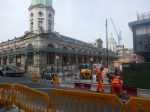

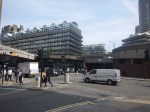

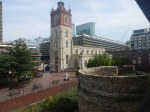







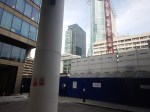


Note.
- The massive amount of new development along the route.
- The new site for the Museum of London.
- Smithfield Market, which surely will be developed or refurbished.
- The large amount of housing in the Barbican Estate.
- The new office developments surrounding Moorgate station.
To me, one of the most interesting developments, is the creation of new walkways across the Barbican Estate and through the new office developments to link Batrbican and Moorgate stations to London Wall and walking routes going towards St. Pauls, Bank and the River.
Crossrail will serve the City indirectly using a modicum of walking in at a pleasant height away from the traffic.
Should The Moorgate Lines Be Transferred To Transport for London?
This article in Rail Magazine, is entitled TfL Targets Transfer Of Govia Thameslink Services.
One of the services, targeted by Transport for London (TfL) are the Great Northern services into Moorgate station from Hertford North, Stevenage and Welwyn Garden City stations.
I know the line into Moorgate and the various branches well, as I’ve used them in different forms, since I was about eleven.
The section between Moorgate and Finsbury Park stations is often referred to as the Northern City Line.
I wrote about these lines in a series of posts linked to A North London Metro.
The biggest problem, I find with the lines, is the quality of the trains and the stations. But there are other issues that will also effect these services, which I detail in the following sections.
Trains
The current Class 313 trains are some of the oldest on the UK rail network, as they were built around 1976, which makes them only a couple of years older than London Overground’s Class 315 trains.
I ride in both fleets regularly and although both show their age, those on the Overground appear to have had a lot more TLC.
It’s almost as if GTR doesn’t care about the Northern reaches of their Network.
In some ways, when the Lea Valley Lines were managed by Greater Anglia from Norwich, it was the same Out-Of-Site-Out-Of Mind attitude.
Both operators are changing these elderly fleets by the end of next year.
- London Overground’s Class 315 trains with new Class 710 trains.
- GTR’s Class 313 trains with new Class 717 trains.
My worry about moving the Moorgate services to the London Overground would be about the transfer of the new trains, although TfL do have some cards in their favour.
- The Class 717 trains are designed for the rather unusual operating conditions of the Northern City Line.
- Siemens have a contract to build and maintain the Class 717 trains.
- TfL have recently signed a big deal with Siemens, for the New Tube for London.
- The current Class 313 trains are single-manned.
I would hope that the trains and their crews would not be too difficult to transfer to the London Overground.
Stations
Many of the stations like Essex Road are tired and need serious work, which would start with a good deep clean. Is it the same Out-Of-Site-Out-Of Mind attitude?
Highbury & Islington Station
These pictures show Highbury & Islington station.
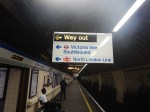
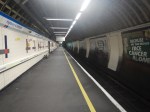



The decor needs a serious refresh.
If I want to go to say Hertford North or Welwyn Garden City, the easiest way is to go via Highbury & Islington station and get a direct train.
Until a few months ago, there used to be no way to buy a ticket at the station.
- The destination is outside my Freedom Pass area.
- I can’t use Oyster or contactless card at the destination.
- There is no ticket machine to buy a ticket.
- There is no ticket office.
However, the latest Underground ticket machines have solved the problem
When you consider that Highbury & Islington station is the fourteenth busiest station in the UK and that it handles more passengers in a year, than Cannon Street, Charing Cross, Edinburgh Waverley and Manchester Piccadilly, the station is a disgrace.
Are other stations as passenger unfriendly?
Crossrail
Crossrail will seriously affect the services into Moorgate station.
Consider the following.
- Changing to and from Crossrail at Moorgate will become a preferred route for many passengers.
- Moorgate is a short walk to much of the City of London.
- Moorgate and Liverpool Street will be one massive interconnected station.
- The new Class 717 trains will attract passengers, if they are better than Thameslink’s terrible Class 700 trains.
- Between Moorgate and Alexandra Palace stations could have a frequency as high as twelve trains per hour (tph), that runs all day.
- The Victoria Line doesn’t connect to Crossrail, but it does have a cross-platform interchange at Highbury & Islington station with the Northern City Line.
- The Piccadilly Line doesn’t connect to Crossrail or serve the City of London, but it will soon have a much-improved connection to the Northern City Line at Finsbury Park station.
Predicting the number of passengers on the services into Moorgate will become one of those classic extremely-difficult multi-variable problems.
Journeys Will Change
As an example of a changed journey take the case of someone living in Walthamstow wanting to go to Heathrow.
Currently, the easy route is.
- Victoria Line to Finsbury Park – 9 minutes
- Piccadilly Line to Heathrow Central – 64 minutes.
This is a total time of 73 minutes.
After Crossrail opens the high-frequency route will be.
- Victoria Line to Highbury & Islington – 12 minutes.
- Northern City Line to Moorgate – 10 minutes.
- Crossrail to Heathrow Central – 33 minutes
This is a total time of 55 minutes.
Thameslink
Thameslink hasn’t been designed with improving the local services on the East Coast Main Line in mind and GTR are hoping that the new trains to and from Moorgate, will provide enough capacity.
As it might be hoped that the new trains on the Moorgate services will be an improvement on the dreadful Thameslink Class 700 trains, with ironing board seats and no wifi, power sockets or tables, will passengers be swapping their London terminal to Moorgate with its better trains and connections?
Hertfordshire
Thirteen of the thirty-one stations served from Moorgate are in Hertsfordshire.
What will that County Council’s reaction be to a transfer of the Moorgate routes to the London Overground?
Relationship With The Underground And Overground
The route between Finsbury Park and Mootgate stations used to be part of the Underground and there are several interchanges between the route and the Underground and Overground.
- Bowes Park station is an out-of-station interchange with Bounds Green station on the Piccadilly Line.
- Harringay station is an out-of-station interchange with with Harringay Green Lanes station on the Gospel Oak to Barking Line.
- Finsbury Park station is an interchange with the Piccadilly and Victoria Lines.
- Highbury & Islington station is an interchange with East London, North London and Victoria Lines.
- Old Street is an interchange with the Northern Line.
- Moorgate is an interchange with the Circle, Hammersmith & City, Metropolitan and Northern Lines, in addition to Crossrail from the end of this year.
When the new Class 717 trains, with their increased frequency of at least four tph, start running, it will be a new high frequency Metro for the London boroughs of Barnet, Enfield, Haringey and Islington.
Future
I can see various changes adn additions to this line in the future.
ETCS On The East Coast Main Line
ETCS is being installed on the East Coast Main Line to increase capacity. It would appear that trains running to Welwyn Garden City station, will need to have ETCS installed.
As the new Class 717 trains are similar to the Class 700 trains, which use ETCS in the Thameslink core between St. Pancras and Blackfriars stations, fitting the system to the trains, shouldn’t be a problem.
But fitting ETCS to all the Class 717 trains, would mean that installing and using ETCS on the routes into Moorgate station would not be a difficult enterprise.
If this were to be done, would trains between Moorgate and Finsbury Park stations be able to attain the Thameslink frequency of twenty-four tph?
I can’t see why not!
Faster Running On The East Coast Main Line
In Call For ETCS On King’s Lynn Route, I talked about an article in Edition 849 of Rail Magazine, with the same title, where I said this.
In addition to ETCS, which could improve capacity on the East Coast Main Line, they would also like to see journey time reductions using trains capable of running at 125 mph or faster on the King’s Lynn to Kings Cross route.
Faster limited-stop 125 mph trains from Cambridge, Kings Lynn and perhaps, Peterborough to King Cross would surely increase capacity and might even help with the double-track bottleneck of the Digswell Viaduct.
One of the problems is that Thameslink’s Class 700 trains are only capable of 100 mph.
They are just not fast enough.
With 125 mph running limited stop into Kings Cross or Thameslink, will this free up capacity on the slow line and perhaps allow extra services from London to Welwyn Garden City station. They can’t go further North because of the Digswell Viaduct, unless the trains use the Hertford Loop Line.
I’m pretty certain that introducing 125 mph trains to Cambridge, Kings Lynn and Peterborough could open up more csapacity for services on the Great Northern route.
Increased Capacity At Moorgate
Crossrail will connect to the routes into and through a rebuilt Moorgate station.
- This connection will attract more passengers.
- Crossrail provides connection to Canary Wharf, the West End, Paddington station and Heathrow.
- The rebuilt station will also provide high-capacity step-free connections to the Central, Circle, Hammersith & City and Northern Lines.
- There will hopefully be better access to walking routes through the City of London.
Looking at the plans for the massive double-ended Liverpool Street-Moorgate station on Crossrail, it would appear that, the station complex is being rebuilt for a large increase in passengers.
Currently, the frequency to and from Moorgate station is around ten tph, which is handled on two platforms.
Consider.
- Brixton and Walthamstow Central stations on the Victoria Line, handle 36 tph with two platforms and Automatic Train Operation (ATO).
- The East London Line will be handling twenty tph Between Dalston Junction and Surrey Quays stations, by the end of next year.
- The Class 717 trains will have a better performance than the current Class 313 trains.
- The signalling could probably be updated and ATO added as I indicated earlier
I would suspect that a frequency upwards of at least sixteen tph to and from Moorgate could be possible.
I’d like to know, what capacity was assumed in the design of the rebuilt Moorgate station, to make sure, the station was future-proofed for all possible services.
Increased Frequencies
All stations between Liverpool Street and Shenfield have had a frequency of ten tph, as long as I can remember and this frequency will be increased to twelve tph, when Crossrail opens.
Alongside this, the frequencies of four tph to and from Hertford North and Welwyn Garden City look measly!
The Hertford Loop Line has three possible terminals; Gordon Hill, Hertford North and Stevenage, all of which could handle four tph. If all were used, this would give these frequencies.
- 12 tph – Finsbury Park to Gordon Hill
- 8 tph – Gordon Hill to Hertford North
- 4 tph – Hertford North to Stevenage.
If what I said earlier is correct and that sixteen tph is possible into Moorgate, then this would still allow the current frequency of four tph to Welwyn Garden City.
Twenty tph into Moorgate would allow an increased frequency of eight tph to Welwyn Garden City, which would match the frequency to Hertford North.
Park-And-Ride
There is a need for at least one parkway station on the Great Northern route.
GNER were intending to provide one at Hadley Wood station.
Parliament held a debate in January 2000 about this and you can read the debate here on the Parliament web site. Generally, MPs were not in favour.
Stevenage has also been proposed for a parkway station and I think this is much more likely.
Incorporation Into The Tube Map
There will soon be calls for the Southern part of the route to be shown on the Tube Map.
Conclusion
I can see serious investment will be needed at stations on the Great Northern route and especially on the deep-level Northern City Line.
It is also likely, that more trains could be needed. Especially, if twenty tph were run through to moorgate.
Do GTR have the will and the resources to invest in this line?
I doubt it, as it is probably seen as an irrelevant backwater, by GTR’s so-called management.
Given the close connection of this route to Crossrail and the Underground and that fifty-eight percent of the stations are in Greater London, then Transport for London would seem to be an ideal owner for this route.
By Class 345 Train To Shenfield
This morning, I took one of Crossrail’s Class 345 train between Liverpool Street and Shenfield.
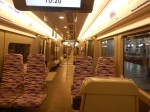
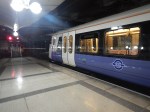
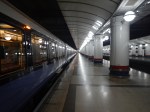
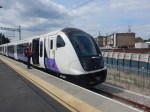
Even these initial trains, which are a couple of cars short of a full train, are a long walk from end-to-end.
I actually followed the driver, who was changing ends, by walking along the platform.
Two school parties of young children had arrived on the train, and she took time out from her walk, to chat to a couple of teachers and some of the children.
If you look at the second and last pictures, you’ll notice a door on the side of the cab. But the driver left and entered the train through the passenger compartment. In the last picture another driver is entering the train.He was perhaps taking over the train.
So it does seem, that drivers are happy to enter and leave the train, via the passenger compartment, which it appears they will be doing in the New Tube for London.
From Farringdon To Tottenham Court Road Station
After photographing the artwork at the new Barbican entrance to Farringdon station, I went to the current station entrance with the aim of getting to Tottenham Court Road station.
Obviously, when Crossrail opens, this will be a single-station hop on Crossrail, but there is no obvious quick way as present.
So out of curiosity, I asked one of the station staff, what is the recommended route.
She said, that the easiest way is to walk to Chancery Lane station and take the Central Line.
I also asked her why Thameslink, which is so much part of Farringdon station and will be such an important route at the station after Crossrail opens.
She said, but that’s National Rail.
So I walked to Chancery Lane.

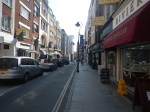



It was a very hot day and uphill. But I made it without difficulty.
Crossrail will certainly make my journey easier, but I can’t help feeling that some journeys from Farringdon are better done using Thameslink.
Consider the following journeys.
Farringdon To London Bridge
Currently, I would do this journey using Thameslink, but what will Transport for London want us to do?
- Use Crossrail to Moorgate and get the Northern Line.
- Use Crossrail to Bond Street and get the Jubilee Line.
- Use Crossrail to Whitechapel and get the Jubilee Line.
I shall still use Thameslink.
Farringdon To Victoria
Currently, I would do this journey using Thameslink to Blackfriars and then get the Circle or |District Lines.
I suspect that Transport for London would recommend one of these.
- Use the Circle Line all the way. Easy but long.
- Go to Kings Cross on the Circle or Metropolitan Lines and get the Victoria. Not the easiest with a heavy case.
I shall continue to use Thameslink.
The New Museum Of London
The new Museum of London will be built close to Farringdon station.
I think, it will end up as one of London’s top museums.
But is it easy to get to the British Museum, National Gallery,Tate Modern and all those other museums in South Kensington.
The British Museum will be just a stop on Crossrail, when that opens, but for the others Thameslink will play a part.
For these routes and other reasons, Thameslink must be on the Tube Map.
 The Anonymous Widower