World’s First Energy Island Starts Taking Shape – Video
The title of this post, is the same as that of this article on offshoreWIND.biz.
This is the sub-heading.
The first of the 23 caissons being built for Princess Elisabeth Island in Vlissingen, the Netherlands, is almost finished and will be immersed in the North Sea this summer. The artificial Belgian energy island is a world first.
Note.
- This web site is the web site of Belgium’s Princess Elisabeth energy island.
- This YouTube video describes the Princess Elisabeth island.
The video shows the importance of this project, that will have interconnectors to both the UK and Denmark, and connections to a large number of offshore wind farms.
These two paragraphs describe the roll-out of the caissons.
When the caissons are ready, a semi-submersible vessel will transport them further down the harbour, where they will be placed in the water and temporarily stored. They will then be moved to their final location in the North Sea this summer, weather permitting.
The caissons will form the outer walls of the energy island. The island itself will be created using approximately 2.3 million square metres of sand, extracted locally. The island will be finished in late 2026, when the electrical equipment can start to be installed. Contracts for this will be tendered this year.
These pictures show four Pheonix Caissons from Mulberry Harbours that are used as a museum in The Netherlands.
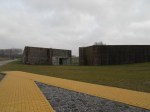
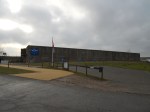

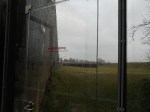
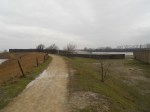


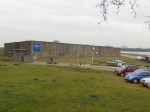
Nothing is new! But at least the Belgians won’t have to tow their caissons across the Channel under enemy fire.
A Video Description Of Princess Elisabeth Island
This web site is the web site of Belgium’s Princess Elisabeth energy island.
This YouTube video describes the Princess Elisabeth island.
From the video the following can be determined.
- The Princess Elisabeth island is 45 km. from the Belgian coast.
- An interconnector to the UK could come ashore at the site of the decommissioned Bradwell nuclear power station.
- An interconnector to Denmark could come ashore in Southern Jutland, just North of where the Viking Link connects to Denmark.
This map clipped from the video shows the location of Princess Elisabeth island.

Note.
- Belgium is shown in red.
- Istend is in the middle of the straight Belgian coast.
- The red dot between Belgium and the UK is Princess Elisabeth island.
- The interconnector to the UK could feasibly go to Bradwell.
- The interconnector to Denmark could go via a wind farm, which would explain the kink.
- Could the kink point be at the Dogger Bank, where there could be 20 GW of wind farms?
Has Belgium made a bid to dominate European energy distribution?
This Google Map shows the Belgian and English coast lines.
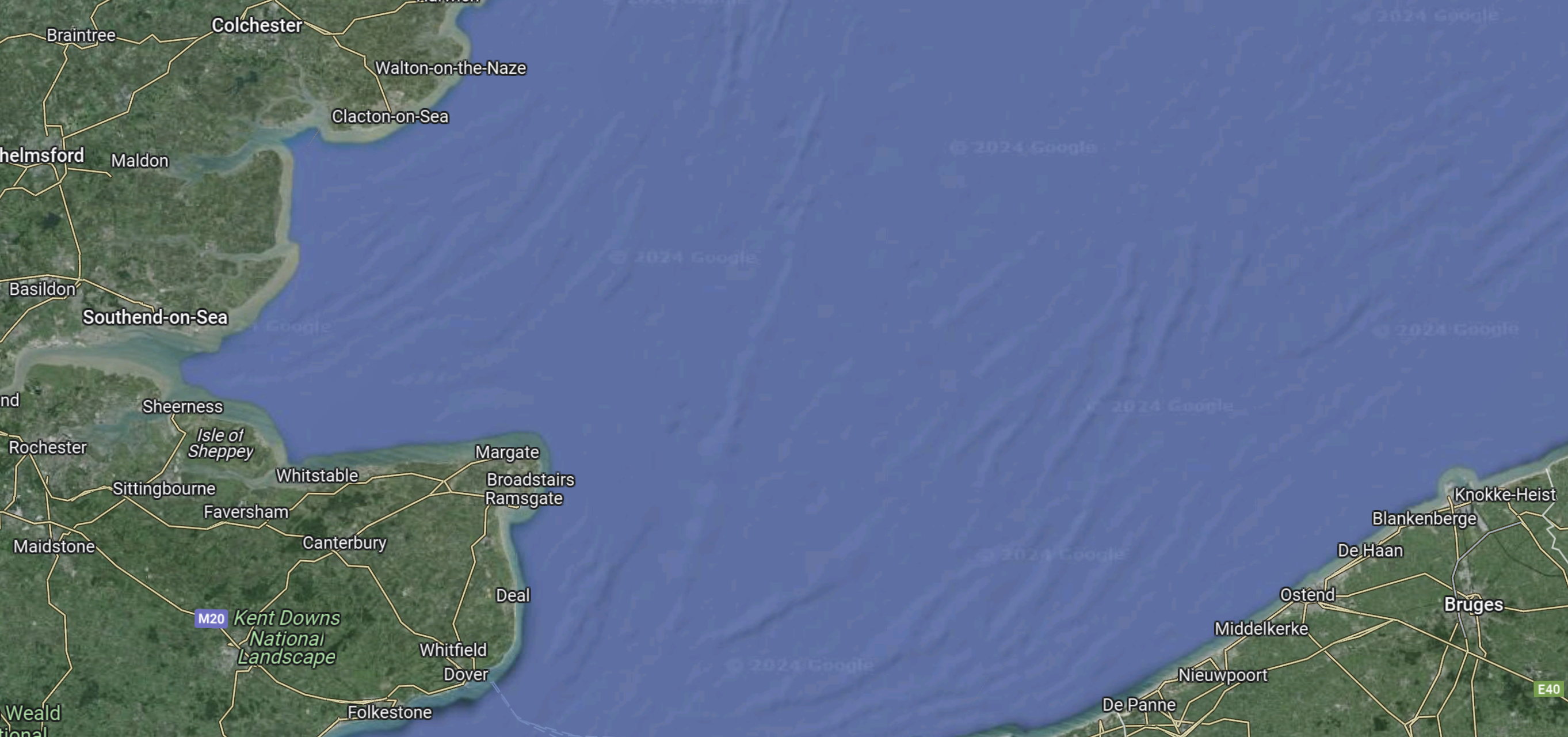
Note.
- Bradwell is on the coast to the North-East of Southend-on-Sea.
- As it used to be a nuclear power station site it still has an electricity connection to the grid.
- The Princess Elisabeth island is 45 km. from the Belgian coast at Ostend.
I estimate that a Bradwell and Princess Elisabeth island interconnector would be about 150 miles.
Denmark Exploring Multiple Platforms As Alternative To Building Artificial Island
The title of this post, is the same as that of this article on offshoreWIND.biz.
This is the sub-heading.
After concluding that the current concept of its North Sea Energy Island would be too expensive for the State, the Danish government, the transmission system operator (TSO) Energinet, and other relevant agencies are now looking into the concept for the island to be established on several large platforms.
I feel this could be a sensible decision, as it would fit well with a modular approach to the building of offshore wind farms.
Suppose, the floating turbines used by a company like Ørsted were all similar. This would surely simplify management of their portfolio of wind farms.
If it works for floating wind turbines, surely, it would work for substations, electrolysers and other offshore hardware.
Conclusion
Artificial energy islands may seem an impressive way to go, but I suspect that the modular approach using standard components, that either sit on the sea bed or float may be a more affordable and faster way to build offshore wind farms.
Denmark And Germany Sign Bornholm Energy Island Agreement, First Legally Binding Cooperation On Joint Offshore Renewable Energy Project In EU
The title of this post, is the same as that of this article on offshoreWIND.biz.
This is the sub-heading.
German Federal Minister for Economic Affairs and Climate Action, Robert Habeck, and Danish Minister for Climate, Energy and Utilities, Lars Aagaard, have signed an agreement for the Bornholm Energy Island in the Baltic Sea. This is the first legally binding cooperation agreement in Europe on a joint offshore energy project under the EU Renewable Energy Directive.
Bornholm is a Danish island between Denmark, Germany and Sweden, as this map shows.

Note.
- Malmo is in Sweden.
- Copenhagen is in Denmark.
- Germany is in the South-West corner of the map.
Bornholm is the island in the North-East corner of the map.
This paragraph gives the bare details of the generation and transmission capacities.
Bornholm Energy Island, located in the Danish sector of the Baltic Sea, will facilitate connecting at least 3 GW of offshore wind generation capacity to the grid by the early 2030s. The electricity will then be transported via new grid connections to Germany (2 GW ) and to the Danish mainland (1.2 GW).
The great advantage of an energy island, is that the electricity can be sent both ways according to where it is needed.
Some of the energy islands that have been proposed also include energy storage and/or hydrogen production.
This web site gives more details of the Bornholm Energy Island.
Under a heading of Why Build Energy Islands?, these reasons are given.
- Environment and climate
- Energy security in Europe
- Inspiration for the world
Under a heading of What is an Energy Island?, this is said.
An energy island makes it possible to establish large wind farms at sea far from the coast. The energy produced by the wind turbines is sent via cables to the energy island, from where it is sent out to consumers. On Bornholm, a high-voltage facility must therefore be established on the island which can receive and distribute the electricity. After that, green power can be sent from Bornholm to millions of consumers in Denmark and Germany. Bornholm’s Regional Municipality is working hard to seize the energy island’s potential for job creation and local business growth, and in turning Bornholm into the green business beacon and transport hub for green fuels in the Baltic Sea.
I suppose it could be argued that in the UK, Orkney and Shetland are already energy islands and will become more so in years to come.
Energy islands, whether real or man paid certainly seems to be a concept that is growing in populatity, with several being developed.
Shell Joins VindØ Energy Island Consortium
The title of this post, is the same as that of this article on offshoreWIND.biz.
This is the sub-heading.
Global energy major Shell is joining the VindØ consortium which is aiming to take a leading role in developing and building Denmark’s first energy island.
This paragraph outlines the project.
The island will be able to connect 10 GW of offshore wind to Denmark and other neighboring countries, plus host an innovation zone with potential for large-scale Power-to-X production and energy storage. It would include accommodation and operation and maintenance services from onsite harbour facilities.
It looks spectacular in the visualisation.
Belgians To Start Building World’s First Artificial Energy Island Next Year (VIDEO)
The title of this post, is the same as that, of this article on offshoreWIND.biz.
This is the sub-heading.
Belgian offshore construction companies Jan De Nul and DEME, through their consortium TM EDISON, have won the tender for the construction of the Princess Elisabeth Island in their home country and the first artificial energy island in the world.
And this first paragraph outlines the project.
The artificial island, which will be built some 45 kilometres off the Belgian coast and will occupy an area of approximately five hectares above the waterline, will serve as the link between the offshore wind farms in the country’s second, 3.5 GW Princess Elisabeth offshore wind zone and its onshore high-voltage grid.
Initial plans don’t seem to be putting any wind turbines or solar panels on the island.
The most impressive part of the article is the video, which shows how the island will be constructed.
To some people of my age, the construction of the island will seem familiar, as the island will be built in a similar way to the Mulberry harbours of World War II.
A few years ago, I went inside some of the giant Pheonix caissons in The Netherlands, where they were initially used to plug the dykes after the North Sea Flood of 1953. They are now a museum of the floods called the Watersnoodmuseum.
Engineering is repeating itself.
Danes Talk 62 MW Offshore Wind Turbines For North Sea Energy Island
The title of this post, is the same as that of this article on Offshore Energy.
The Danes may talk 62 MW, but that four times larger than one of the biggest today, that I wrote about in Vestas 15 MW Prototype Turbine Produces First Power.
This paragraph says a bit more about the 62 MW turbine.
According to the DEA’s framework document for the draft plan for the strategic environmental assessment (SEA), this could be a 500-metre-tall wind turbine with a rotor diameter of 480 metres and a capacity of up to 62 MW.
This turbine is bigger in terms of capacity, than than some whole farms.
The Belgians Go Large
This press release from Elia Group is entitled Elia Presents Its Plans For An Energy Island, Which Will Be Called The Princess Elisabeth Island.
These two paragraphs outline the project.
In the presence of federal ministers Tinne Van der Straeten (Energy) and Vincent Van Quickenborne (North Sea), system operator Elia has presented its draft plans for what will be the world’s first artificial energy island.
The Princess Elisabeth Island will be located almost 45 km off the Belgian coast and will serve as the link between the offshore wind farms in the second offshore wind zone (which will have a maximum capacity of 3.5 GW) and its onshore high-voltage grid. The energy island will also be the first building block of a European offshore electricity grid that will serve as a central hub for new interconnectors with the UK and Denmark. The island is an innovative tour de force that once again puts Belgium on the map as a pioneer in offshore energy.
Note, that Princess Elisabeth is the heir apparent to the Belgian throne.
I have some thoughts.
Will The Wind Turbines Float Or Have Fixed Foundations?
Consider.
- 3.5 GW of wind farms will probably need around 220 wind turbines.
- Most of the large wind farms in the seas around the UK, that are below about 50 miles from the shore are on fixed foundations.
- The seas around East Anglia and Belgium are probably fairly similar.
I suspect that using today’s technology, the turbines will have fixed foundations.
But floats with two or more turbines , that generate more electricity per square kilometre may be developed.
Will Hydrogen Be Generated On The Island?
This could happen and I don’t see why not.
Tankers could even dock on the island to transport the hydrogen.
Could The Island Service Floating Wind Turbines?
All that is needed, is sufficient depth of water and a large crane.
It is a possibility!
Will There Be A UK Interconnector To Princess Elisabeth Island?
The press release says this.
The energy island will also be the first building block of a European offshore electricity grid that will serve as a central hub for new interconnectors with the UK and Denmark.
There could be interconnectors all over the North Sea linking wind farms and energy islands to the UK, France, Belgium, The Netherlands, Germany, Denmark and Norway.
We’d all be in it together.
Conclusion
This is a very ambitious project.
UK National Grid In Talks To Build An Energy Island In The North Sea
The title of this post, is the same as that of this article on the New Scientist.
This is the first paragraph.
UK company National Grid has revealed it is in talks with two other parties about building an “energy island” in the North Sea that would use wind farms to supply clean electricity to millions of homes in north-west Europe.
These are my thoughts.
An Artificial Island on the Dogger Bank
The idea of the North Sea Wind Power Hub in the area of the Dogger Bank has been around for a few years and has a comprehensive Wikipedia entry.
Wikipedia says that it would be an artificial island on the Dutch section of the Dogger Bank and the surrounding sea could eventually host up to 110 GW of wind turbines.
North Sea Wind Power Hub Programme
The Dutch and the Danes seems to have moved on and there is now a web site for the North Sea Wind Power Hub Programme.
The home page is split into two, with the upper half entitled Beyond The Waves and saying.
The incredible story of how the Netherlands went beyond technical engineering as it had ever been seen before. Beyond water management. To secure the lives of millions of inhabitants.
I have met Dutch engineers, who designed and built the Delta Works after the North Sea Floods of 1953 and I have seen the works all over the country and it is an impressive legacy.
And the lower half of the home page is entitled North Sea Wind Power Hub and saying.
Today, climate policy is largely national, decoupled and incremental. We need a new approach to effectively realise the potential of the North Sea and reach the goals of the Paris Agreement. We take a different perspective: harnessing the power of the North Sea requires a transnational and cross-sector approach to take the step-change we need.
Behind each half are two videos, which explain the concept of the programme.
It is a strange web site in a way.
- It is written totally in English with English not American spelling.
- The project is backed by Energinet, Gasunie and TenneT, who are Danish and Dutch companies, that are responsible for gas and electricity distribution networks in Denmark, Ger,many and The Netherlands.
- There are four sections to the web site; Netherlands, Germany, Denmark and North Sea.
It is almost as if the web site has been designed for a British company to join the party.
Hubs And Spokes In North Sea Wind Power Hub Programme
If you watch the videos on the site, they will explain their concept of hubs and spokes, where not one but several energy islands or hubs will be connected by spokes or electricity cables and/or hydrogen pipelines to each other and the shore.
Many electrical networks on land are designed in a similar way, including in the UK, where we have clusters of power stations connected by the electricity grid.
The Dogger Bank
The Dogger Bank is a large sandbank in a shallow area of the North Sea about 100 kilometres off the east coast of England.
Wikipedia says this about the geography of the Dogger Bank.
The bank extends over about 17,600 square kilometres (6,800 sq mi), and is about 260 by 100 kilometres (160 by 60 mi) in extent. The water depth ranges from 15 to 36 metres (50 to 120 ft), about 20 metres (65 ft) shallower than the surrounding sea.
As there are Gunfleet Sands Wind Farm and Scroby Sands Wind Farm and others, on sandbanks in the North Sea, it would appear that the engineering of building wind farms on sandbanks in the North Sea is well understood.
The Dogger Bank Wind Farm
We are already developing the four section Dogger Bank Wind Farm in our portion of the Dogger Bank and these could generate up to 4.8 GW by 2025.
The Dogger Bank Wind Farm has its own web site, which greets you with this statement.
Building the World’s Largest Offshore Wind Farm
At 4.8 GW, it will be 45 % larger than Hinckley Point C nuclear power station, which is only 3.3 GW. So it is not small.
The three wind farms; Dogger Bank A, B and C will occupy 1670 square kilometres and generate a total of 3.6 GW or 0.0021 GW per square kilometre.
If this density of wind turbines could be erected all over the Dogger Bank, we could be looking at nearly 40 GW of capacity in the middle of the North Sea.
Interconnectors Across The North Sea
This Google Map shows the onshore route of the cable from the Dogger Bank Wind Farm.
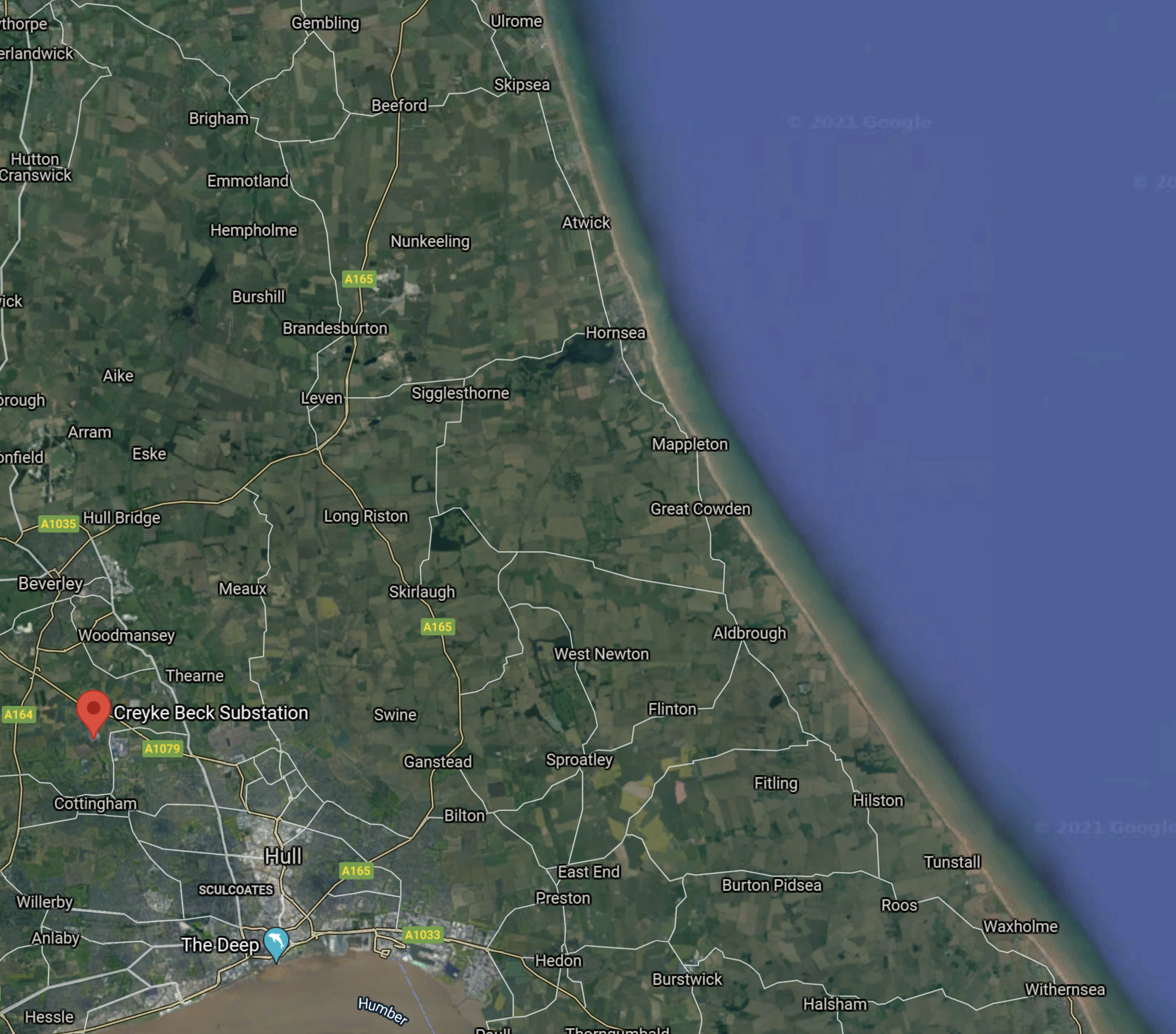
Note.
- Hull and the River Humber at the bottom of the map.
- The red arrow which marks Creyke Beck sub station, where the cable from the Dogger Bank Wind Farm connects to the UK electricity grid.
- At the top of the map on the coast is the village of Ulrome, where the cable comes ashore.
The sub station is also close to the Hull and Scarborough Line, so would be ideal to feed any electrification erected.
I would assume that cables from the Dogger Bank Wind Farm could also link the Wind Farm to the proposed Dutch/Danish North Sea Wind Power Hub.
Given that the cables between the wind farms and Creyke Beck could in future handle at least 4.8 GW and the cables from the North Sea Wind Power Hub to mainland Europe would probably be larger, it looks like there could be a very high capacity interconnector between Yorkshire and Denmark, Germany and The Netherlands.
It almost makes the recently-opened North Sea Link to Norway, which is rated at 1.4 GW seem a bit small.
The North Sea Link
The North Sea Link is a joint project between Statnett and National Grid, which cost €2 billion and appears to have been delivered as planned, when it started operating in October 2021.
So it would appear that National Grid have shown themselves capable of delivering their end of a complex interconnector project.
Project Orion And The Shetlands
In Do BP And The Germans Have A Cunning Plan For European Energy Domination?, I introduced Project Orion, which is an electrification and hydrogen hub and clean energy project in the Shetland Islands.
The project’s scope is described in this graphic.
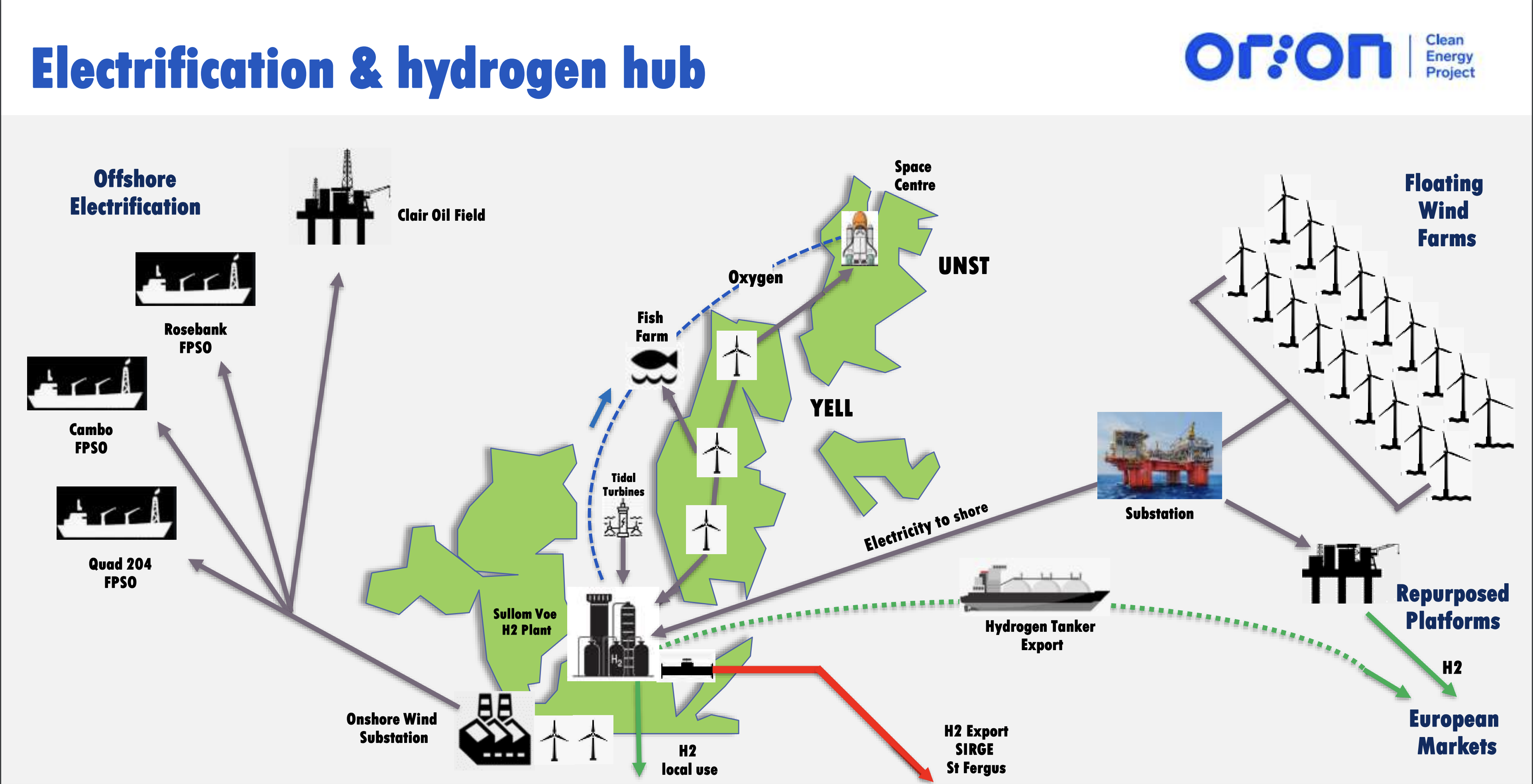
Note that Project Orion now has its own web site.
- Could the Shetlands become an onshore hub for the North Sea Power Hub Programme?
- Could Icelink, which is an interconnector to Iceland be incorporated?
With all this renewable energy and hydrogen, I believe that the Shetlands could become one of the most prosperous areas in Europe.
Funding The Wind Farms And Other Infrastructure In The North Sea
In World’s Largest Wind Farm Attracts Huge Backing From Insurance Giant, I described how Aviva were funding the Hornsea wind farm.
I very much believe that City of London financial institutions will be able to finance a lot of the developments in the North Sea.
After all National Grid managed to find a billion euros in a sock drawer to fund their half of the North Sea Link.
Electrifying The North Sea: A Gamechanger For Wind Power Production?
The title of this section, is the same as that of this article on Engineering and Technology Magazine.
This article in the magazine of the IET is a serious read and puts forward some useful facts and interesting ideas.
- The EU is targeting offshore wind at 60 GW by 2030 and 300 GW by 2050.
- The UK is targeting offshore wind at 40 GW by 2030.
- The article explains why HVDC electricity links should be used.
- The major players in European offshore wind are the UK, Belgium, the Netherlands, Germany, and Denmark.
- The foundations for a North Sea grid, which could also support the wider ambitions for a European super-grid, are already forming.
- A North Sea grid needs co-operation between governments and technology vendors. as well as technological innovation.
- National Grid are thinking hard about HVDC electrical networks.
- By combining HVDC links it can be possible to save a lot of development capital.
- The Danes are already building artificial islands eighty kilometres offshore.
- Electrical sub-stations could be built on the sea-bed.
I can see that by 2050, the North Sea, South of a line between Hull and Esbjerg in Denmark will be full of wind turbines, which could generate around 300 GW.
Further Reading
There are various articles and web pages that cover the possibility of a grid in the North Sea.
- National Grid – Interconnectors
- The Guardian – National Grid In Talks Over Plan For Energy Island In North Sea
- The Times – National Grid Planning ‘Energy Island’ In North Sea
I shall add to these as required.
Conclusion
I am coming to the conclusion that National Grid will be joining the North Sea Wind Power Hub Programme.
- They certainly have the expertise and access to funding to build long cable links.
- The Dogger Bank wind farm would even be one of the hubs in the planned hub and spoke network covering the North Sea.
- Only a short connection would be needed to connect the Dogger Bank wind farm, to where the Dutch and Danes originally planned to build the first energy island.
- There may be other possibilities for wind farm hubs in the UK section of the North Sea. Hornsea Wind Farm, which could be well upwards of 5 GW is surely a possibility.
- Would it also give access to the massive amounts of energy storage in the Norwegian mountains, through the North Sea Link or Nord.Link between Norway and Germany.
Without doubt, I know as a Control Engineer, that the more hubs and spokes in a network, the more stable it will be.
So is National Grid’s main reason to join is to stabilise the UK electricity grid? And in turn, this will stabilise the Danish and Dutch grids.
Denmark To Build ‘First Energy Island’ In North Sea
The title of this post, is the same as that of this article on the BBC.
This is the first three paragraphs
A project to build a giant island providing enough energy for three million households has been given the green light by Denmark’s politicians.
The world’s first energy island will be as big as 18 football pitches (120,000sq m), but there are hopes to make it three times that size.
It will serve as a hub for 200 giant offshore wind turbines.
It seems to follow the bigger-is-better offshore principle, I talked about in Crown Estate’s Auction Of Seabed For Wind Farms Attracts Sky-High Bids.
The BBC article says this about the energy generation of the island and its turbines.
The new island would supply an initial 3 gigawatts, rising to 10 over time.
For comparison the coal-fired Fiddlers Ferry power station on the banks of the Mersey near Widnes was a 2 gigawatt station and the nuclear Hinkley Point C will hopefully generate 3.2 GW.
These are my thoughts.
The Location Of The Island
According to the BBC, the Danes are being secretive about the location of the island, but the BBC does say this about the location of island.
While there is some secrecy over where the new island will be built, it is known that it will be 80km into the North Sea. Danish TV said that a Danish Energy Agency study last year had marked two areas west of the Jutland coast and that both had a relatively shallow sea depth of 26-27m.
According to Wikipedia, Denmark has a sizeable offshore gas industry and I did wonder, if the island would be built near to a large worked out field, so that the field could be used for one of the following.
- Store hydrogen produced on the island from surplus electricity.
- Store carbon dioxide produced on the mainland.
But the gas fields are further than 80 km. from the shore being closer to where Danish, German, Dutch and British waters meet.
Hydrogen And The Island
In ITM Power and Ørsted: Wind Turbine Electrolyser Integration, I talked about a joint project between, electrolyser company; ITM Power of the UK and turbine manufacturer and developer; Ørsted of Denmark.
The post was based on this press release from ITM Power.
These were points from the press release.
- Costs can be saved as hydrogen pipes are more affordable than underwater power cables.
- It also stated that wind turbines produce DC electricity and that is ideal for driving electrolysers.
So will the island be connected to the mainline by a hydrogen gas line?
- Cost will play a big part.
- I don’t like the concept of electrical cables on the sea floor,
- Gas pipes have been laid everywhere in the North Sea.
- A hydrogen connection might better support different types of future turbines.
- If there is a worked-out gas-field nearby, the hydrogen can be stored offshore until it is needed.
I think it is a distinct possibility.
Hydrogen could be generated in one of two ways.
- Wind turbines based on the ITM Power/Ørsted design could generate the hydrogen directly and a gas network could deliver it to the island.
- Conventional turbines could generate electricity and an electrical network could deliver it to the island, where a large electrolyser would convert water into hydrogen.
Both methods would be better suited to a hydrogen connection to the mainland.
Connection To Other Islands
The Dutch are already talking about a North Sea Wind Power Hub on their section of the Dogger Bank.
So could we see a network of islands in the Southern North Sea?
- Some like the Danish island would support a network of wind turbines.
- Some would store energy as hydrogen in worked-out gas fields.
- Some would store captured carbon dioxide in worked out gas fields.
- Some would supply hydrogen to onshore hydrogen and carbon dioxide networks like HumberZero.
- Islands could be linked by electrical cables or gas pipelines.
- Gas pipelines would allow both hydrogen or carbon dioxide to be stored or moved
The North Sea could become the largest power station in the continent of Europe, or even the world.
 The Anonymous Widower