Offshore Wind Could Help Create ‘Electric Shipping Highway’ Across Europe, Study Says
The title of this post, is the same as that of this article on offshoreWIND.biz.
This is the sub-heading.
Offshore wind farms, energy islands, ports and proposed “Offshore Power Zones” could together form the foundation of an integrated maritime energy system capable of supporting large-scale vessel electrification across Northern Europe, according to a study by Maersk’s Stillstrom, Baltic Energy Island and the Port of Roenne.
This is a map from the report.
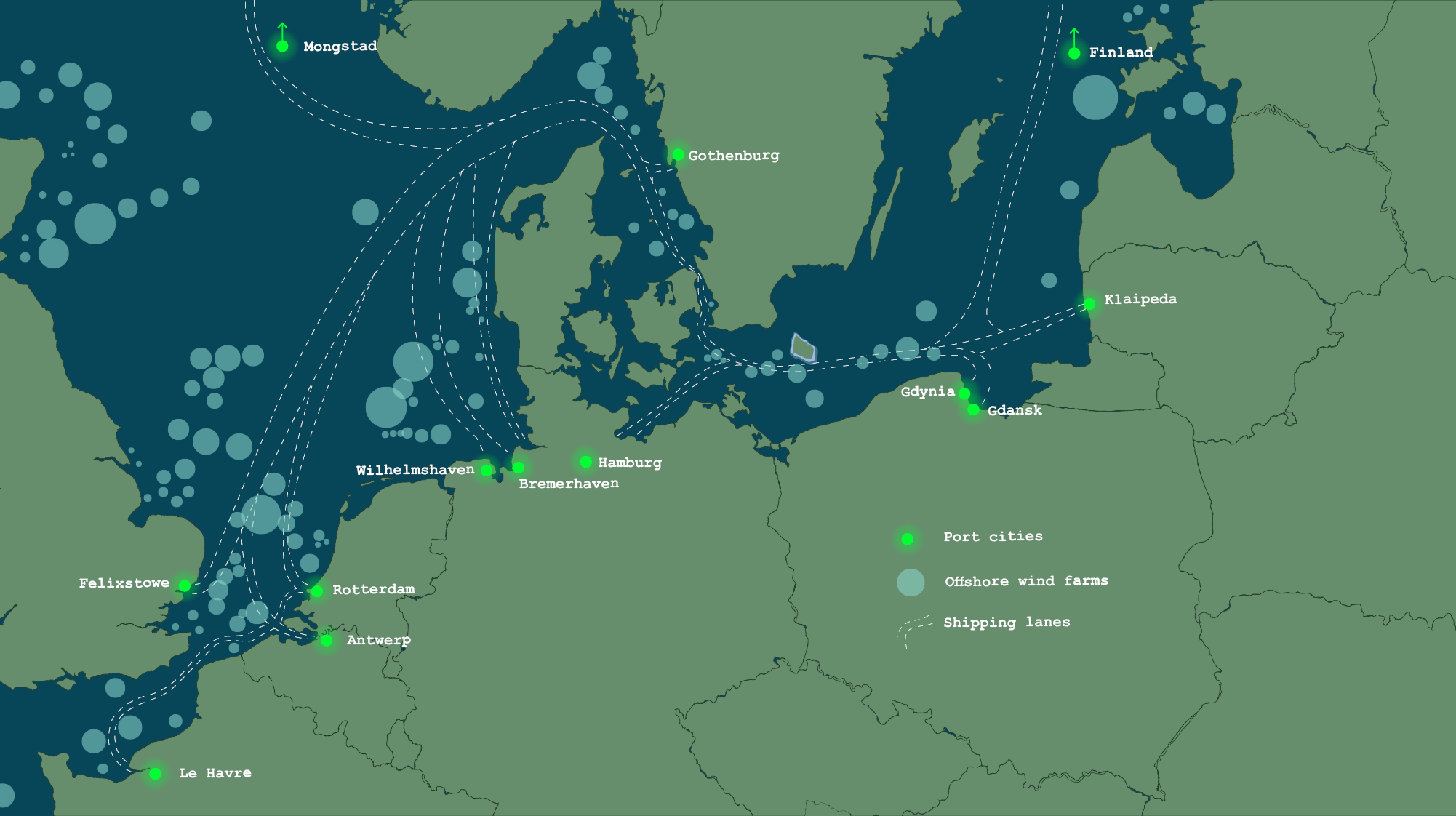
Note.
- In Investment in Grain LNG, I talked about Centrica and Grain LNG Terminal, Centrica’s plans for the terminal, which include bunkering.
- London Gateway and Immingham are two substantial ports on the East side of England.
Are English ports, except for the notable exception of Felixstowe, not shown on the map, because of Brexit?
These two paragraphs add some detail.
According to the findings, it is estimated that around 37,000 cargo vessels pass Bornholm each year, consuming approximately 3 million tonnes of marine fuel and emitting around 10 million tonnes of CO₂ annually. Full electrification of this traffic is estimated to require about 17 TWh of electricity per year, potentially replacing roughly EUR 2 billion in fossil fuel imports with domestically generated renewable power.
The whitepaper also introduces the concept of Offshore Power Zones (OPZs), developed by Stillstrom, which involves vessels accessing offshore wind-generated electricity at sea for battery charging or hotel loads. The report sees these zones linked with electrified ports to form an “electric shipping highway” stretching from the English Channel through the North Sea into the Baltic Sea.
Note that Bornholm is between Sweden and Germany.
Denmark And Germany Sign Bornholm Energy Island Agreement, First Legally Binding Cooperation On Joint Offshore Renewable Energy Project In EU
The title of this post, is the same as that of this article on offshoreWIND.biz.
This is the sub-heading.
German Federal Minister for Economic Affairs and Climate Action, Robert Habeck, and Danish Minister for Climate, Energy and Utilities, Lars Aagaard, have signed an agreement for the Bornholm Energy Island in the Baltic Sea. This is the first legally binding cooperation agreement in Europe on a joint offshore energy project under the EU Renewable Energy Directive.
Bornholm is a Danish island between Denmark, Germany and Sweden, as this map shows.

Note.
- Malmo is in Sweden.
- Copenhagen is in Denmark.
- Germany is in the South-West corner of the map.
Bornholm is the island in the North-East corner of the map.
This paragraph gives the bare details of the generation and transmission capacities.
Bornholm Energy Island, located in the Danish sector of the Baltic Sea, will facilitate connecting at least 3 GW of offshore wind generation capacity to the grid by the early 2030s. The electricity will then be transported via new grid connections to Germany (2 GW ) and to the Danish mainland (1.2 GW).
The great advantage of an energy island, is that the electricity can be sent both ways according to where it is needed.
Some of the energy islands that have been proposed also include energy storage and/or hydrogen production.
This web site gives more details of the Bornholm Energy Island.
Under a heading of Why Build Energy Islands?, these reasons are given.
- Environment and climate
- Energy security in Europe
- Inspiration for the world
Under a heading of What is an Energy Island?, this is said.
An energy island makes it possible to establish large wind farms at sea far from the coast. The energy produced by the wind turbines is sent via cables to the energy island, from where it is sent out to consumers. On Bornholm, a high-voltage facility must therefore be established on the island which can receive and distribute the electricity. After that, green power can be sent from Bornholm to millions of consumers in Denmark and Germany. Bornholm’s Regional Municipality is working hard to seize the energy island’s potential for job creation and local business growth, and in turning Bornholm into the green business beacon and transport hub for green fuels in the Baltic Sea.
I suppose it could be argued that in the UK, Orkney and Shetland are already energy islands and will become more so in years to come.
Energy islands, whether real or man paid certainly seems to be a concept that is growing in populatity, with several being developed.

