Funding Injection For Smart Central Heating Project
The title of this article is the same as that of this article in The Scotsman.
This is the first two paragraphs.
East Lothian-based thermal energy storage specialist Sunamp and energy supplier OVO have secured seven-figure funding to develop a commercially viable smart central heating system.
The project brings together OVO’s intelligent energy management platform, called VCharge, with Sunamp’s super compact “heat batteries” which are said to store four times more heat than hot water tanks of a similar size.
This sounds like an interesting concept from Sunamp and OVO.
This video from Fully Charged, shows Sunamp’s thermal batteries in action.
I believe we’ll be seeing more of thermal batteries!
Exciting Renewable Energy Project for Spennymoor
The title of this post is the same as that of this article on the Durham University web site.
This is the first paragraph.
In January 2016, local residents Alan Gardner, Cllr Kevin Thompson and Lynn Gibson from the Durham Energy Institute at Durham University, met a team of academics to explore the advantages renewable energy and specifically the use of geothermal resources could bring to Spennymoor.
And this is the last.
Durham University is one of the world leaders in this research field. Spennymoor now has an opportunity to be at the forefront of that research. What the outcomes will eventually be is unknown at this stage but being able to explore the opportunity by the best in the business is encouraging.
Charlotte Adams mentioned in the article is the academic, who did the presentation I saw yesterday and talked about in Can Abandoned Mines Heat Our Future?.
Everybody, who lives in a mining area, should read this article and show it to everyone they know.
Funding Nemo: £600m Power Cable Connects UK And Belgium
The title of this post is the same as this article in The Guardian.
This is the first paragraph.
A £600m cable connecting the UK and Belgium’s energy systems is about to be switched on, becoming the first of a new generation of interconnectors that will deepen the UK’s ties to mainland Europe just as it prepares to leave the EU.
It runs between Richborough in Kent and Zeebrugge in Belgium and is the fifth interconnector to be connected to Great Britain.
Other interconnectors connect to Ireland, Northern Ireland, France and the Netherlands.
In Large Scale Electricity Interconnection, I discuss the rest of the interconnectors, that are being constructed or planned.
We could see up to fifteen in operation in a few years.
As to Nemo, it was originally thought that the UK would be importing energy from Belgium, but as Belgium needs to service its nuclear power stations and will be shutting them in the next few years, the power will sometimes be flowing the other way. Especially, as more large wind farms come on stream in the UK!
It is my view that Icelink could change everything and Belgium’s possible future power shortage, makes Icelink far more likely.
Wikipedia describes the interconnector between Iceland and Scotland like this.
At 1000–1200 km, the 1000 MW HVDC link would be the longest sub-sea power interconnector in the world.
As more interconnectors are built between the UK and the Continent, including a possible link between Peterhead in North-East Scotland to Stavanger in Norway, which is called NorthConnect, the UK will begin to look like a giant electricity sub-station, that connects all the zero-carbon power sources together.
- Denmark will supply wind power.
- France will supply nuclear power.
- Iceland will supply hydro-electric and geothermal power.
- Norway will supply hydro-electric power.
- The UK will supply nuclear and wind power.
Other sources like wind power from France and Ireland and tidal and wave power from the UK could be added to the mix in the next decade.
The Consequences For Gas
Our use of gas to generate electricity in Western Europe will surely decline.
If projects, like those I discussed in Can Abandoned Mines Heat Our Future?, come on stream to provide heat, the role of gas in providing heating in housing and other buildings will decline in the UK.
We also shouldn’t forget the role of hydrogen, which could also replace natural gas in many applications. It would be created by electrolysis of water or as a by-product of some industrial processes.
Hydrogen could also become a valuable way of storing excess electricity produced by tidal, wave and wind power.
It is unlikely, we will develop a totally gas-free economy, as methane is a valuable chemical feedstock to produce other chemical products we need.
Conclusion
Not many people will be sorry, except for President Putin and a few equally nasty despots in the Middle East.
Can Abandoned Mines Heat Our Future?
The title of this post, is same as that of the title of a public lecture I attended at The Geological Society this afternoon.
This page on the Geological Society web site, gives a summary of the lecture and details of the speaker; Charlotte Adams of Durham University.
The Concept
The basic concept is simple.
- Abandoned coal mines had their pumps turned off when they are closed and the worked areas have flooded with water, that is now at temperatures of around 12 to 20°C.
- As fifteen billion tonnes of coal have been extracted from UK coalfields, that is a lot of space to flood. An estimate of around two billion cubic metres is given.
- This means that the water holds somewhere between 27.9 and 46.5 GWH of energy in the form of heat.
- Heat pumps would be used to upgrade the temperature of this water, to provide hot water at useful temperatures for space heating.
For those unfamiliar with the concept of a heat pump, Wikipedia gives a good explanation, of which this is the first paragraph.
A heat pump is a device that transfers heat energy from a source of heat to what is called a heat sink. Heat pumps move thermal energy in the opposite direction of spontaneous heat transfer, by absorbing heat from a cold space and releasing it to a warmer one. A heat pump uses a small amount of external power to accomplish the work of transferring energy from the heat source to the heat sink.
In connection with this project, the heat source is the warm water in the mines and the heat sink is the water that is circulated to heat the buildings.
Wikipedia goes on to say this.
In heating mode, heat pumps are three to four times more effective at heating than simple electrical resistance heaters using the same amount of electricity. However, the typical cost of installing a heat pump is also higher than that of a resistance heater.
Wikipedia also has a section, which descries the use of heat pumps in district heating.
It should also be noted, that as with lots of technology, heat pumps are much improved, from the one I installed in a swimming pool in the 1980s.
Gas Is Replaced By Renewable Energy
The electricity to drive the heat pumps could be derived from renewable sources such as hydroelectric, solar, wave or wind.
Effectively, the system is using intermittent sources of electricity to create a constant source of heat suitable for space heating.
Would The Mines Run Out Of Heat Or Water?
As I understand it, the water in the mine will continue to be heated by the heat in the mines. The father of a friend, who came with me to the lecture was a coal miner and my friend confirmed it was hot in a coal mine.
The water will of course continue to flood the mine and the water pumped to the surface will probably be returned.
So the system will continue to supply heat for space heating.
How Long Will The System Supply Heat?
The system has the following characteristics.
- It is electro-mechanical.
- It is powered by electricity.
- Water is the heat transfer medium.
- Additives like anti-freeze will probably be applied to the water used for heat transfer.
There is no reason the system can’t be designed, so that it supplies heat for many years with regular maintenance and updating.
How Does The System Compare To Bunhill 2 Energy Centre?
In Bunhill 2 Energy Centre, I described Islington’s Bunhill 2 Energy Centre which uses heat generated in the Northern Line of the London Underground to provide district heating.
I am fairly sure that a lot of similar technology will be used in both applications.
This page on Wikipedia is entitled London Underground Cooling.
There is a section, which is entitled Source Of The Heat, where this is said.
The heat in the tunnels is largely generated by the trains, with a small amount coming from station equipment and passengers. Around 79% is absorbed by the tunnels walls, 10% is removed by ventilation and the other 11% remains in the tunnels.
Temperatures on the Underground have slowly increased as the clay around the tunnels has warmed up; in the early days of the Underground it was advertised as a place to keep cool on hot days. However, over time the temperature has slowly risen as the heat sink formed by the clay has filled up. When the tunnels were built the clay temperature was around 14ºC; this has now risen to 19–26ºC and air temperatures in the tunnels now reach as high as 30ºC.
So one big difference is that the Underground is warmer than the mine and this should make it a better heat source.
I feel that engineers on both projects will benefit from the ideas and experience of the others.
Would Infrastructure Funds Back This Technology?
In the UK, there are several infrastructure funds set up by companies like Aberdeen Standard, Aviva, Gresham House and L & G.
In World’s Largest Wind Farm Attracts Huge Backing From Insurance Giant, I explained why Aviva had invested nearly a billion pounds in wind farms to support pensioners and holders of their insurance policies.
Comparing the risk of using abandoned mines to heat buildings and that of offshore wind turbines generating electricity, my engineering knowledge would assign a greater risk to the turbines, providing both were built to the highest possible standards.
It’s just the onshore and offshore locations and the vagaries of the weather!
I think it is true to say, that infrastructure funds will back anything, where there is an acceptable long-term income to be made, commensurate with the costs and risk involved.
But then Government or any public or private company or organisation should not pay over the odds for the energy delivered.
Conclusion
Charlotte Adams in her lecture, asked if abandoned mines can heat our future.
The answer could well be yes, but there are other sources of heat like the London Underground, that can also be used.
Bunhill 2 Energy Centre
I took these pictures as I walked up City Road.




This used to be the site of the short-lived City Road station on the Northern Line. It can’t have been very significant in the 1970s, as C and myself would probably have passed it several times a week and I can’t remember it.
There are more details on this page of the Borough of Islington web site, which is entitled Bunhill Heat Network.
This is said about Phase 2 of the project.
Phase 2 of the Bunhill Heat and Power network involves building a new energy centre at the top of Central Street, connecting the King’s Square Estate to the network and adding capacity to supply a further 1,000 homes.
The core of the new energy centre is a 1MW heat pump that will recycle the otherwise wasted heat from a ventilation shaft on the Northern Line of the London Underground network, and will transfer that heat into the hot water network. During the summer months, the system will be reversed to inject cool air into the tube tunnels.
Note.
- A 1MW heat pump can supply enough hot water heat upwards of a thousand homes.
- Could you heat your house for an average of 1kW?
- The King’s Square Estate is being refurbished and is hundreds of homes.
- The heat pump can also be used to cool the Northern Line in the summer.
I shall look forward to seeing over Bunhill 2 Energy Centre, when and if, it is opened to the public, as the first centre was during Open House 2013. I described that visit in The Bunhill Energy Centre.
China-Backed Coal Projects Prompt Climate Change Fears
The title of this post, is the same as that of this article on the BBC.
These are the first three paragraphs.
As levels of greenhouse gases reach a new record, concerns are growing about the role of China in global warming.
For years, the increase in the number of Chinese coal-fired power stations has been criticised.
Now environmental groups say China is also backing dozens of coal projects far beyond its borders.
I have been against coal as a fuel for at least fifty years.
Initially, it was for three reasons.
- Growing up in the 1950s and 1960s, there regularly seemed to be a serious coal-mining disasters like Aberfan and Katowice.
- My health had been seriously affected by London’s domestic coal fires.
- I also believed that nuclear power could supply us with affordable energy.
Also at Liverpool University, I met so many students, who were from mining areas, with horror stories of the health of miners.
Over the last couple of decades, I’ve gone very much against the building of large nuclear power stations, although I do feel that small modular nuclear reactors may have a place.
But the growth of wind and solar power has convinced me that with the addition of energy storage, we can manage without coal.
Obviously, the Chinese and Donald Trump think differently.
It should be noted that we are an island and if sea levels rise we will suffer, whereas China and the United States are large land masses with plenty of places to develop.
Trump and Xi Jinping need to be reeducated.
Could Hydrogen Replace Natural Gas In Domestic Properties?
This post was suggested by this article on the Chronicle Live, which is entitled Thousands of Tyneside Homes Could Be Fuelled By Hydrogen Under £22bn Plan.
This is the first three paragraphs.
Thousands of homes across Tyneside and the wider North East could be converted to run on hydrogen in an effort to hit climate change targets.
The H21 North of England report, published today, has called for more than 700,000 homes across Tyneside and Teesside to be converted to run on hydrogen by 2034.
The moves have been proposed by Northern Gas Networks, which supplies gas to the North East, and its North West and Midlands counterpart Cadent, in association with Norwegian energy company Equinor.
It would be feasible to convert houses from natural gas to hydrogen.
In fact, there is a small proportion of hydrogen in natural gas anyway.
But just because it is feasible, it doesn’t mean it is a good idea.
Who Pays?
Consumers would feel, that they shouldn’t pay any more.
Conversion
I remember being converted from town to natural gas in the 1970s.
We only had an ancient gas cooker and conversion was not a problem, but what will happen, if your boiler or cooker is not convertible?
New Technologies
I don’t like gas cookers, so in my current house, I only have a four-year-old modern boiler, so houses like mine wouldn’t be a problem.
Also according to various people, I’ve met, the trend in cookers is to go to induction appliances, which would take a variable out of the conversion equation.
I see lots of new housing and other construction, advertised as low energy, with high insulation levels and solar panels everywhere.
Add in innovative district heating systems and I can see new housing being built without the need of a gas supply.
This must surely be safer, as gas does seem to cause a lot of deaths in homes.
Just Say No!
So what happens, if you say no and your area is being converted to hydrogen?
Do you lose your gas supply?
Creation Of The Hydrogen
This article on the Internet is entitled Northern Gas Networks: One Company’s Ambitious Plan To Cut Carbon Emissions For An Entire Nation.
This is said about the creation of the hydrogen.
The first step is getting access to enough hydrogen. The most widely used method to produce hydrogen is steam-methane reforming, which involves reacting methane (CH4) with high-temperature steam (H2O), which creates carbon dioxide (CO2) and hydrogen (H2). But hydrogen isn’t a clean fuel if that carbon dioxide is put into the atmosphere. So the reactor which produces hydrogen will have to be paired with carbon capture and storage, a process where carbon dioxide is captured before it enters the air, and then pumped underground for safe, permanent storage.
Companies, politicians and academics have been waffling on about carbon capture and storage for decades and I believe at the present time, it is one of those technologies, which is akin to burning large numbers of fifty pound notes.
I do think that at some point in the future, a clever chemist will design a chemical plant, where carbon dioxide goes in one end and sheets, rods or components of carbon fibre, graphene or other carbon form come out the other end.
In my view it is much better to not create the carbon dioxide in the first place.
The obvious way is to use surplus wind power to electrolyse water and produce hydrogen. It is a clean process and the only by-product is oxygen, which no-one has yet flagged up as dangerous.
Conclusion
The objective of this project may be laudable, but there is a lot of development and thinking that needs to be done.
Huge Solar Farm Plan
The title of this post is the same as that of a small article in today’s copy of The Times.
This is said.
Plans for Britain’s largest solar farm have been submitted to the government. Cleeve Hill Solar Park between Whitstable and Faversham in Kent would be five times bigger than the present largest solar farm, in Wiltshire, and provide enough clean energy to power more than 91,000 homes. A ruling is expected by the end of 202.
According to this page on the OVO Energy web site, the average household in the UK used 3,940 kWh in 2014.
This is 0.45 kWh per hour.
On this figure, the 91,000 houses would use 358.4 GWH
Compare this output with the 240 MW of the world’s first nuclear power station at Calder Hall, which opened in 1956, which in a year would generate 2104 GWH
Cleeve Hill Solar Park has a web site, which together with other sites gives more details of the project.
- The project has an area of 360 hectares.
- The project will be connected to the grid using an existing sub-station, that is used to connect the London Array wind farm in the Thames Estuary to the grid.
- The solar panels are laid close together to create the maximum amount of electricity.
On this information it looks like a solar farm in the UK, which is the size of 360 football pitches, can generate a sixth of the power of the world’s first and admitted small nuclear power station.
The web site also includes this informative schematic of a typical solar farm.
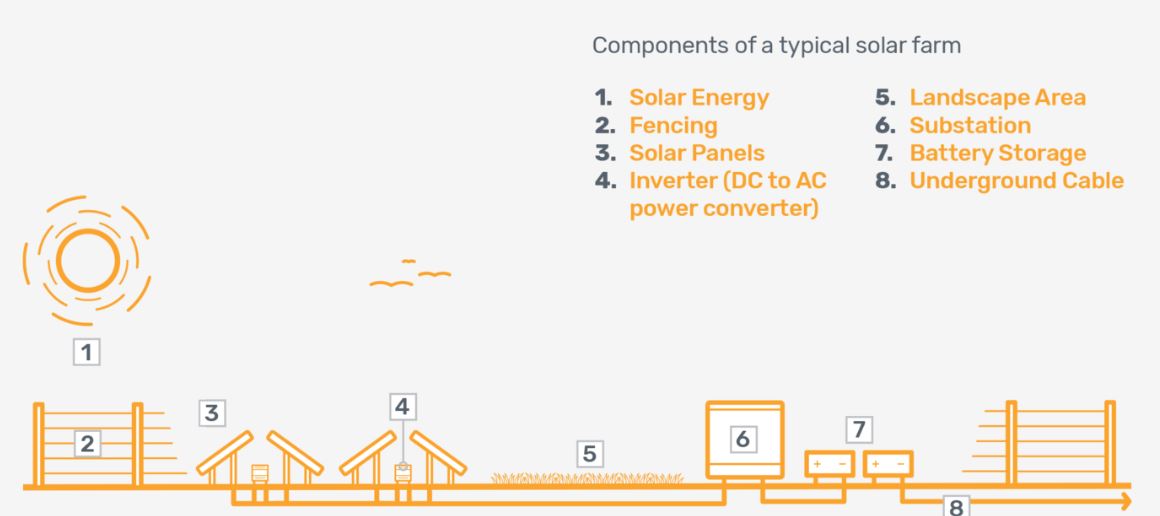
Note that battery storage is included, which I find significant.
- Battery or some other form of energy storage would be used to smooth the peaks and troughs of generation and use.
- Is it significant that it shares a sub-station that is used to connect wind turbines to the grid?
- So will the solar panels charge the batteries and then this energy will be sent to the grid, when the wind isn’t blowing?
The battery would be sized accordingly and calculating the size required is a the sort of problem that needs some comprehensive mathematical modelling.
- Using past sun and wind data, it would be possible to predict likely weather on a day-to-day basis.
- This data would be fed into a mathematical model of the wind and solar farms, with different sizes of batteries.
- A battery size would be chosen, that didn’t allow 91,000 houses in Kent to be without power.
But don’t worry, if you live in Kent, as there are other power stations nearby that could step in.
Having run mathematical models for complicated systems since the late 1960s, I know that this problem is within the capabilities of today’s mathematicians and computers.
The Potential Power Of The Cleeve Hill Solar Farm
The Internet entry for Solar Power In The UK has a section called Solar Potential, where this is said.
London receives 0.52 and 4.74 kWh/m² per day in December and July, respectively. While the sunniest parts of the UK receive much less solar radiation than the sunniest parts of Europe, the country’s insolation in the south is comparable with that of central European countries, including Germany, which generates about 7% of its electricity from solar power. Additionally, the UK’s higher wind speeds cool PV modules, leading to higher efficiencies than could be expected at these levels of insolation.
I’ll start by looking at December.
The solar array at Cleeve Hill will be 360 hectares, which need to be converted to square metres. A hectare is roughly the size of a football pitch like Wembley or 100 metres x 100 metres.
So I can say the following.
- The area of the Cleeve Hill solar farm is 3,600,000 square metres.
- If I assume that Cleeve Hill gets the same amount of sunlight as London, I can say that on each day in December the solar farm will receive an average of 0.52 * 3,600,000 kWh or 1872 MWh of solar energy.
- I have found web sites that say that the best solar panels are twenty percent efficient, which means that on an average December day 374.4 MWh will be generated.
- This is 4.11 kWh for each of the 91,000 households.
Looking at July, I can say the following.
- If I assume that Cleeve Hill gets the same amount of sunlight as London, I can say that on each day in July the solar farm will receive an average of 4.74 * 3,600,000 kWh or 17064 MWh of solar energy.
- Using the same twenty percent efficiency, which means that on an average July day 3412.8 MWh will be generated.
- This is 37.5 kWh for each of the 91,000 households.
I have created an Excel Workbook, that shows the energy generation for a 360 hectare solar farm, through a year.
- I obtained the insolation rates from this page on the Contemporary Energy web site.
- Other data came from Cleeve Hill Solar Farm.
- All parameters can be changed are and at the first part of the workbook.
- It is in Word 97 format
Click this link to download.
Drilling Starts For ‘Hot Rocks’ Power In Cornwall
The title of this post is the same as that of this article on the BBC.
For as long as I can remember, there have been plans to tap the ‘hot rocks’ under Cornwall for heat and convert it into electricity.
Geothermal power is used in many places around the world.
The Wikipedia entry is worth a read and the Utility-Grade Stations section has this paragraph.
The largest group of geothermal power plants in the world is located at The Geysers, a geothermal field in California, United States. As of 2004, five countries (El Salvador, Kenya, the Philippines, Iceland, and Costa Rica) generate more than 15% of their electricity from geothermal sources.
This is also said.
Enhanced geothermal systems that are several kilometres in depth are operational in France and Germany and are being developed or evaluated in at least four other countries.
As the Cornish project appears to have a degree of EU funding, it looks like Cornwall is one of the four other countries.
The BBC also had a report on the Cornish drilling this morning. They made a point to say that this project has nothing to do with fracking.
Fracking is an emotive project, but we seem to forget that a lot of the engineering and drilling techniques used in the process are also used in other applications, like obtaining fresh water and drilling very deep holes, as is proposed in Cornwall.
It is also enlightening to look at this Wikipedia entry, which describes geothermal power in Germany.
This is said about the sustainability of the power source in Germany.
n the same year (2003) the TAB (bureau for technological impact assessment of the German Bundestag) concluded that Germany’s geothermal resources could be used to supply the entire base load of the country. This conclusion has regard to the fact that geothermal sources have to be developed sustainably because they can cool out if overused.
Based on this, I can understand the enthusiasm for using the technique in Cornwall.
On the BBC this morning, it was said that the Cornish borehole could produce enough electricity for 3,000 homes.
A page on the OVO Energy website, says this.
Household electricity use in the UK dropped under 4,000kWh for the first time in decades in 2014. At an average of 3,940kWh per home, this was about 20% higher than the global average for electrified homes of 3,370kWh.
At 4,000 kWh a year, a home would use an average of 0.46 kW per hour.
This means that to run 3,000 houses needs 1.4 MW per hour.
A typical price of a kWh of electricity is thirteen pence excluding VAT, which means that this plant could earn around £178 per hour or £1.6million a year.
A Project Video
Access the project video here.
Conclusion
I feel that geothermal power could have a promising future in Cornwall.
A Detailed Layout Drawing For A Class 345 Train
Someone has requested this using a Freedom of Information request.
Click to access the detailed layout drawing for a Class 345 train.
The formation of a Class 345 train is as follows.
DMS+PMS+MS1+MS3+TS(W)+MS3+MS2+PMS+DMS
Note.
- Eight cars have motors and only one doesn’t.
- The train is composed of two identical half-trains, which are separated by the TS(W) car.
- There are four wheelchair spaces in the TS(W) car.
There is also other information on the drawing.
- 454 seated passengers.
- 1046 standing passengers calculated using a density of 4.025/m² of available floor standing area.
- 4 wheelchair spaces.
- 1500 passengers total
- 51 priority spaces compliant with PRM-TSI
- Trailer car length is 22,500 mm.
- Driver car length is 23,615 mm.
- Train length is 203,380 over mm. body ends.
There’s more information, based on what I read off the end of a train in Weight And Dimensions Of A Class 345 Train.
I estimated the weight of a nine car train to be 328.40 tonnes.
Kinetic Energy Of A Full Class 345 Train
I will assume the following
Train weight is 328.4 tonnes.
It is jam-packed with 1,500 passengers, with an average weight of 90 Kg. with their baggage.
Passenger weight is 13.50 tonnes
This gives a total train weight of 341.9
Calculating the kinetic energy for various speeds gives.
30 mph – 8.5 kWh
50 mph – 23.7 kWh
75 mph – 53.4 kWh
90 mph – 76.9 kWh
I used Omni’s Kinetic Energy Calculator.
Currently, the cost of a kWh of electricity is about fifteen pence to domestic customers, so accelerate a full Class 345 train to 90 mph, costs at that rate around £11.50.
The Deep Resource web site gives various conversion factors.
- A kilogram of coal can be converted into 8.1 kWh.
- A litre of diesel can be converted into 10 kWh.
- A kilogram of hydrogen can be converted into 33.6 kWh.
It’s so easy to do these calculations today, as you can find little calculators and information all over the Internet.
 The Anonymous Widower