HS4Air Between Gatwick Airport And Ashford
This map clipped from the Expedition Engineering web site, shows the route of HS4Air between Gatwick Airport and Ashford International station.
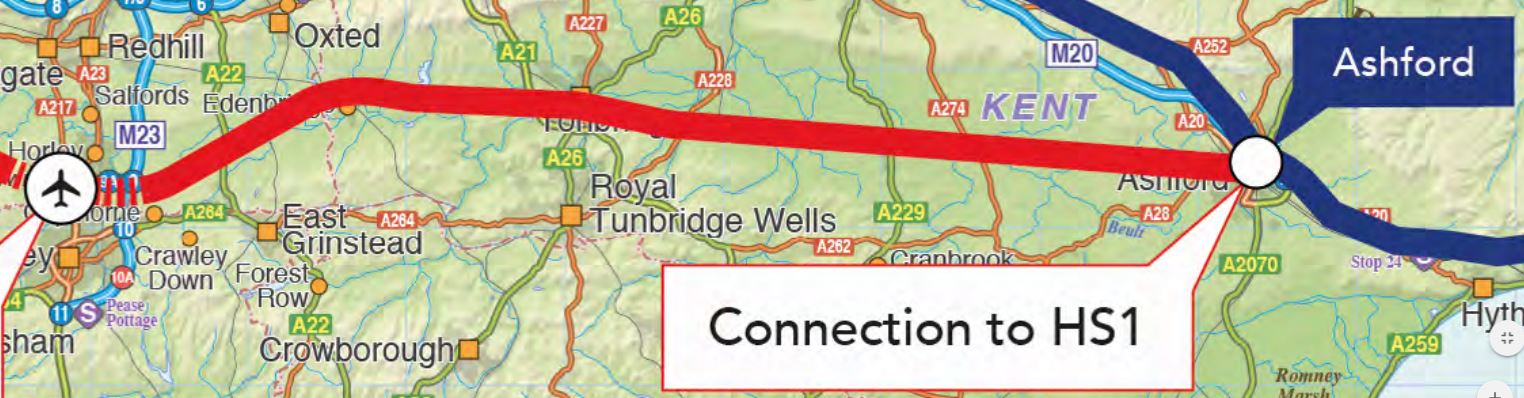
The route reuses the existing railway between Ashford International and Edenbridge (Kent) stations.
From Gatwick Airport To Edenbridge
This Google Map shows the countryside between Gatwick and Edenbridge.
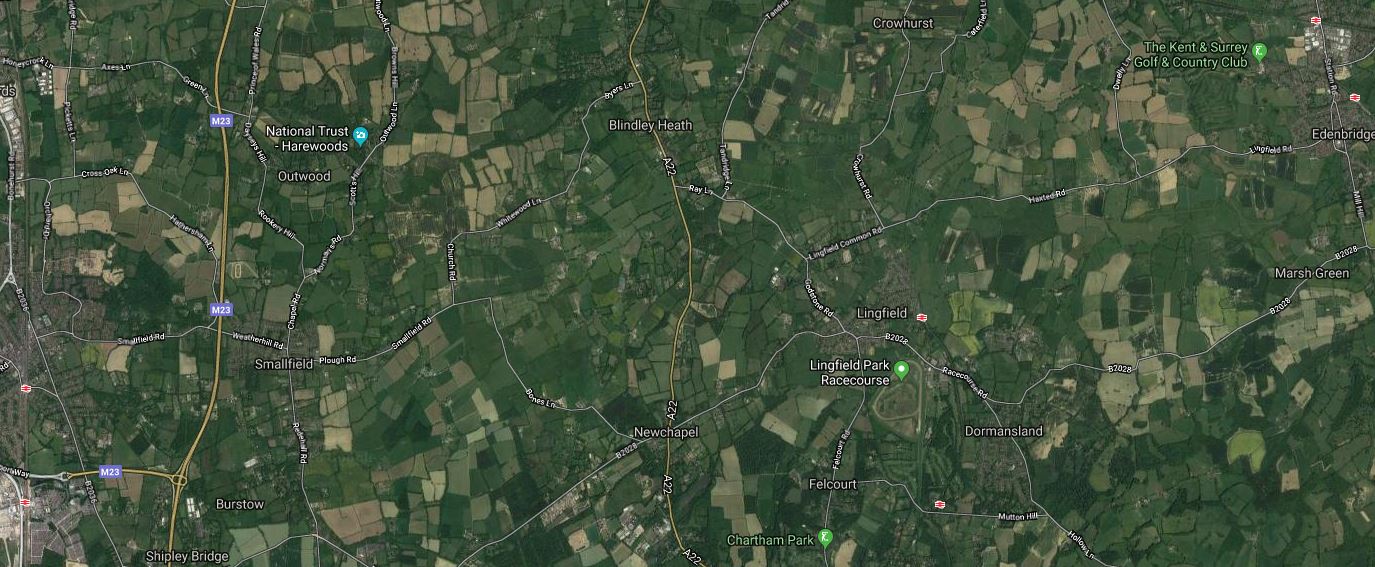
According to the first map, the Gatwick Tunnel emerges to the East of the M23 Motorway, which runs North-South down the left side of the map.
It probably emerges South of the Airport spur from the M23 and then it would travel on the surface to Edenbridge (Kent) station, which is in the North East corner of the map.
It looks to be a very challenging route, although there are several industrial sites scattered between the M23 and Lingfield, which is perhaps halfway between the motorway and Edenbridge.
This Google Map shows Edenbridge (Kent) station with the Redhill-Tonbridge Line passing through.
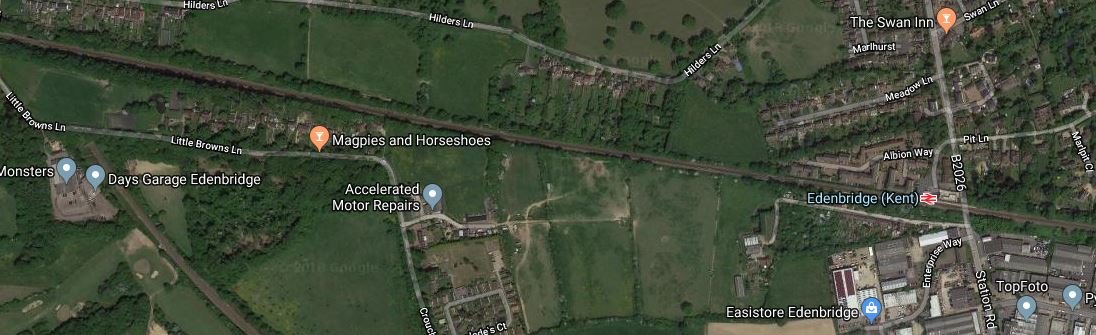
It would appear that the engineering could be reasonably attainable, but getting the natives on-side might not be so easy.
It’s not as though the residents between Edenbridge and Gatwick will get much benefit from HS4Air.
From Edenbridge To Ashford
This line has the following characteristics.
- It is around forty miles long.
- It is almost straight.
- It is double track.
- There are several stops.
- There is a maximum speed of 100 mph
It doesn’t appear to have many more than about four trains per hour (tph) in both directions.
Very little has been said about how HS4Air will transform the line, except that it will be upgraded to a high speed line.
The only information of value is that Ashford to Gatwick will take 25 minutes.
How far would a train go in that time at various speeds?
- 100 mph – 42 miles
- 125 mph – 52 miles
- 140 mph – 58 miles
As the route between Edenbridge and Gatwick is probably around a dozen miles, it would appear that a well-designed 125 mph route could enable the time quoted by HS4Air.
Local Stations On The High Speed Line
I’ll take Penshurst station as an example.
This Google Map shows the station.

Note that it is very simple with a platform on each line.
Currently, it gets a single tph in both directions.
HS4Air would probably mean that at least another four tph, passed through the station at 125 mph.
It could be argued that this could cause safety problems.
On the other hand, there are many stations in the UK, where local trains stop and expresses go through at 125 mph.
Platform-edge doors would be a difficult and expensive solution, but why not make access to the platform only possible, when a train is stopping?
Looking at Penshurst station, this station also needs some more facilities, like a fully accessible footbridge.
Conclusion
The Gatwick to Ashford section can be converted into a 125 mph route, which would give a time of 25 minutes between the two stations.
However, I do think there will have to be a lot of political leverage to get it built.
HS4Air Between Heathrow And Gatwick Airports
In terms of the number of trains, the route between Heathrow and Gatwick Airports could be one of the businest section of HS4Air.
This map clipped from the Expedition Engineering web site, shows the route of HS4Air between the two airports.
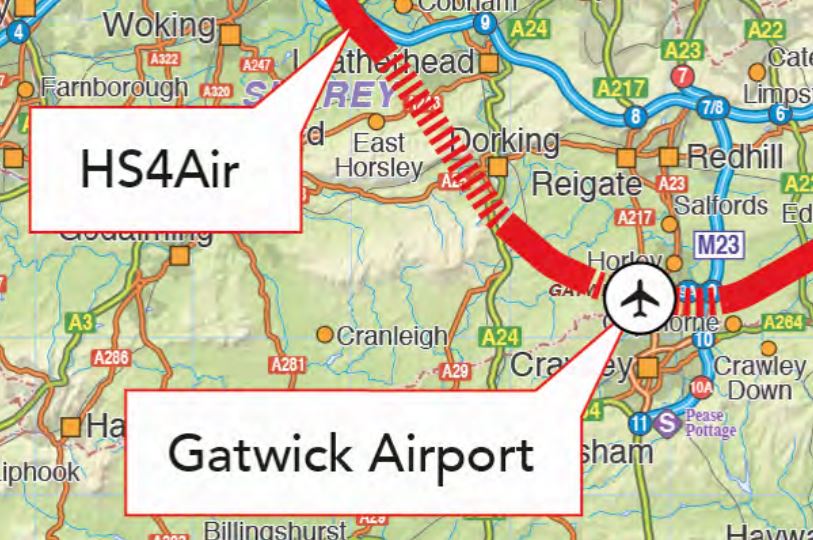
Note that in addition to the tunnels under the two airports, there is another tunnel through sensitive parts of Surrey.
Heathrow Southern Railway And The Southern Portal Of HS4Air’s Heathrow Tunnel
This Google Map shows the first section of the route South from Heathrow.

The two motorways are.
- The M25 goes roughly North-South.
- The M3 goes roughly East-West
I said in HS4Air’s Connections To HS2, The Great Western Main Line And Heathrow, that it appears that HS4Air’s Heathrow Tunnel will emerge somewhere just South of where the motorways meet.
The station in the South-East corner is Addlestone on the Chertsey Branch Line.
Follow the line Northward and Chertsey station is visible.
Heathrow Southern Railway intend to use this branch as part of their proposal to create access from the South into Heathrow.
From Chertsey, their route would follow to the East of the M25 and then use a short East-West tunnel to connect into Heathrow Terminal 5.
This Google Map shows the Chertsey Branch Line, where it crosses the M25.
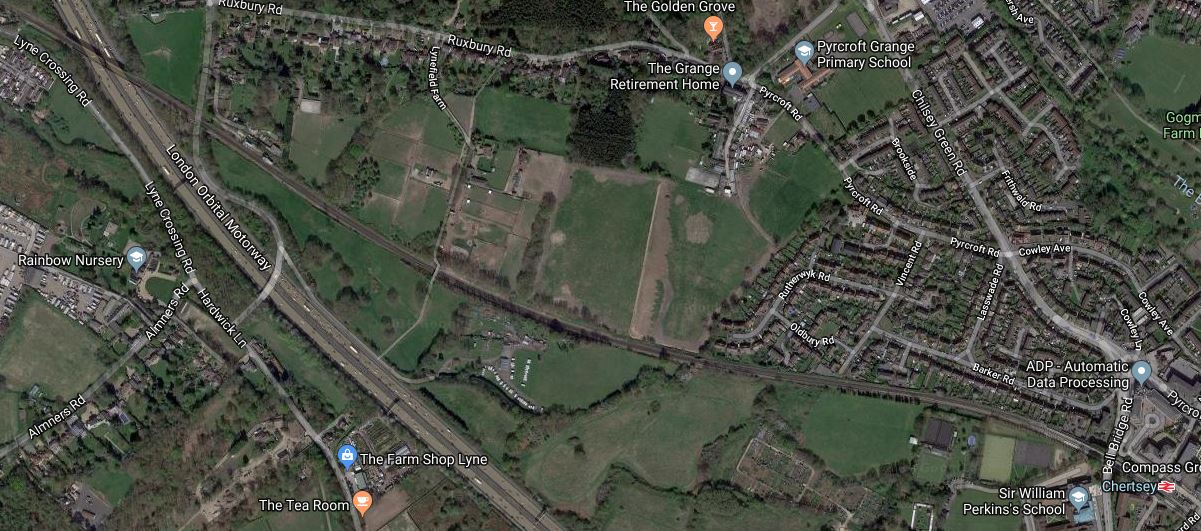
The Chertsey Branch Line goes diagonally across the map from Chertsey station in the South-East corner to the North-West corner.
A Junction just before the Chertsey Branch crosses the M25 would connect to the new railway running on the East side of the M25, towards Heathrow.
So that HS4Air and the Heathrow Southern Railway avoid each other, it would appear that the Southern portal of HS4Air’s Heathrow Tunnel must be to the South of the Chertsey Branch.
Onward To Junction 11 Of The M25
If HS4Air, then followed the M25, it could probably be squeezed in as far as a short distance past Junction 11.
This Google Map shows the section of the M25 around junction 11.
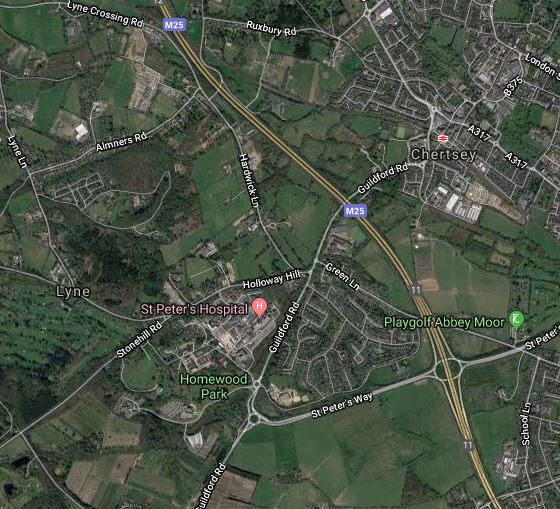
Junction 11 to 12 Of The M25
The first map, shows HS4Air following the M25 and passing over the M25/A3 junction.
This Google Map shows the area around the M25/A3 junction.
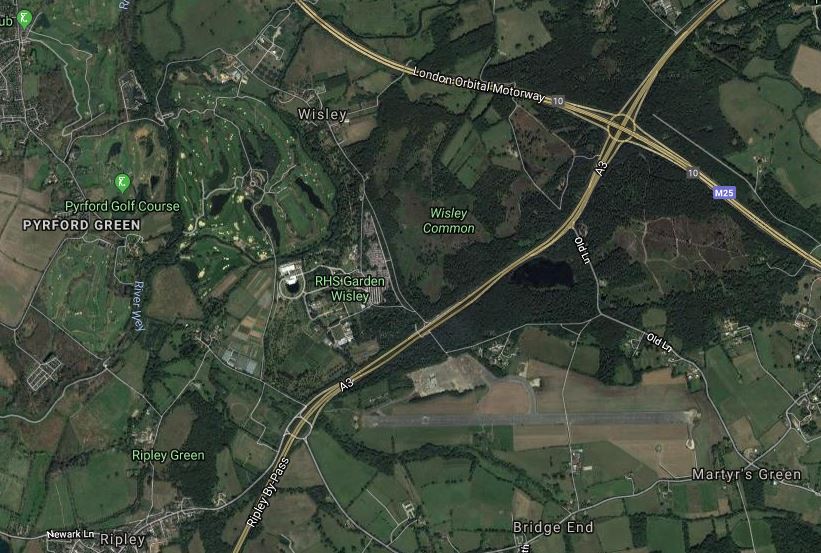
The junction between the M25 and the A3 is clearly visible.
On either side of the A3, as it goes South of the junction are the RHS Garden Wisley and Wisley Airfield.
I doubt that HS4Air will go anywhere near the Garden, but the airfield might well be the place, where the tunnel under the North Downs has its Northern portal.
The problem is how does HS4Air get between Junctions 11 for the A320 and Junction 10 for the A3 along the M25.
This Google Map shows the section of the M25.

Junction 11 is in the top-left of the map and Junction 10 is in the bottom right.
- I have flown my helicopter along the route and in places there is not much space on either side of the road.
- The road runs through housing in places.
- The road is very busy.
- The distance between the junctions 10 and 11 is 3.6 miles.
This page on the Highways England web site, says that the road is to be converted into a four lanes each way smart motorway.
Expedition Engineering obviously have a plan to get the motorway and a double-track high speed railway through this difficult section.
The Surrey Tunnel
I said earlier that the Northern Portal of the |Surrey Tunnel will be on or in the vicinity of Wuisley Airfield.
Putting maps together and taking an educated guess, I wonder if the Southern portal is on this map, which shows an area South of Dorking.
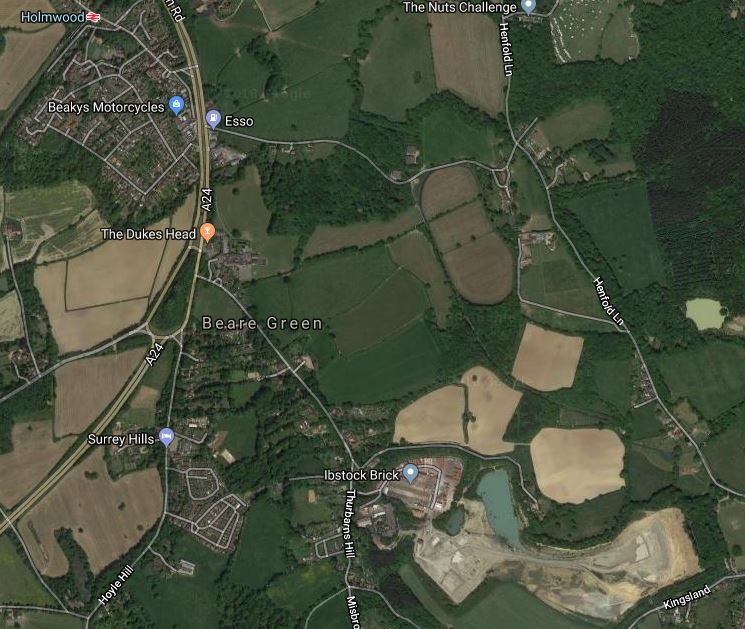
Note the Ibstock brick works. Could this be the site?
This Google Map shows its relationship to Gatwick Airport.

The distance is about nine miles, from the brick works in the top left of the map to the Airport.
According to the first map in this post, the route is mainly on the surface
Conclusion
The route is challenging, but I’m pretty sure, that it can be created.
How Would HS4Air Affect The Western Rail Approach to Heathrow?
The Western Rail Approach to Heathrow (WRAtH), is a proposed new rail route to Heathrow from Reading and Slough.
It has a similar objective to HS4Air’s connection to the Great Western Main Line at Iver.
Both railways would connect Reading and Slough to stations in the Airport.
But in my view the HS4Air approach has several advantages.
- HS4Air connects to both Heathrow and Gatwick airports and Ashford, whereas WRAtH only connects to Heathrow.
- It would connect high speed trains from Bristol, Cardiff, Oxford, South Wales and the West of England to Heathrow, Gatwick and Ashford for Continental services.
- As an example a direct Cardiff-Ashford service would take three hours twenty minutes.
- Trains would be faster, with an operating speed between Reading and Heathrow of at least 140 mph.
But perhaps most importantly, HS4Air could be a totally privately-funded project.
Conclusion
I feel Network Rail’s proposal for a Western Rail Approach to Heathrow is not needed, if HS4Air is built.
HS4Air And Heathrow Airport’s Third Runway
HS4Air will pass under Heathrow Airport in a tunnel, where there will be a new station.
Look at how Crossrail hasn’t resulted in major demolition in Central London.
For this and other reasons, I believe that HS4Air can be built underneath the Airport without affecting what Heathrow do on the surface.
The only effect that a possible third runway and an extra terminal at Heathrow, would be minor changes to the route of the tunnel and the layout of the station.
But I suspect that HS4Air will be built, so that it is totally future-proofed for all possible developments at Heathrow.
On the other hand, HS4Air might have effects on Heathrow Airport.
- Passengers from the North of England would be more likely to come by high speed train from Birmingham and Manchester.
- Passengers from South Wales and the West of England would be more likely to come by high speed train from Bristol and Cardiff.
- The transfer between Heathrow and Gatwick would be less than twenty minutes. HS4Air claim just fifteen.
- If there was sufficient demand there could be a Heathrow-Gatwick shuttle every 10-15 minutes.
Just as some of these effects will be positive for Heathrow, they will also be positive for Gatwick.
Conclusion
I am led to the conclusion, that some politicians, who are seriously against a third runway at Heathrow, could manage to get the runway blocked or delayed for a decade, by citing HS4Air and Gatwick as a viable alternative.
But that won’t matter, as Gatwick will build the much-needed runway for the South-East and it will be less than twenty minutes from Heathrow.
Plans Revealed For £10bn High-Speed Railway To Connect Britain’s Busiest Airports, HS1 and HS2
The title of this post is the same as this article on Global Rail News.
This is the first two paragraphs.
Developers are submitting plans for a new high-speed line to the UK’s Department for Transport (DfT) in response to a call for market-led proposals.
Named ‘HS4Air’, the proposed £10 billion railway will connect HS1 at Ashford to HS2 North West of London with stops at Heathrow and Gatwick airports and a spur connection to the Great Western main line.
This map from Expedition Engineering shows the route.

To minimise environmental disruption, the following should be noted.
- There is a North-South tunnel under Heathrow Airport.
- HS4Air follows the M25 to the South-West of London.
- Several miles of the route between Heathrow and Gatwick is in tunnel to the West of Horsham.
- There is a West-East tunnel under Gatwick Airport.
- The Ashford to Tonbridge Line would become part of HS4Air.
There will also be stations at Ashford, Tonbridge, Gatwick and Heathrow.
This further diagram from Expedition Engineering shows the various possible routes.
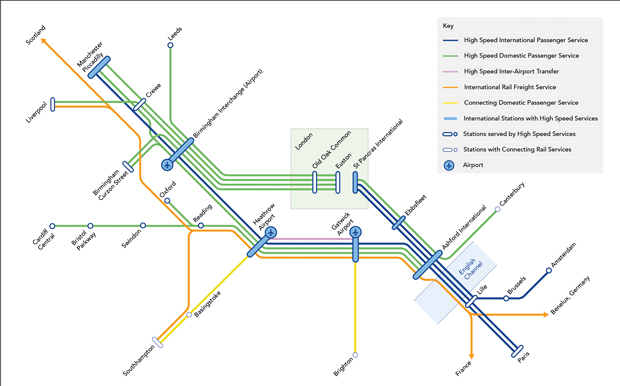
Note the following about HS4Air.
- Four major airports; Gatwick, Heathrow, Birmingham and Manchester, will be connected to the Channel Tunnel.
- Wikipedia suggests, that the line could be extended to a reopened Manston Airport.
- A Paris to Manchester passenger service via Gatwick, Heathrow and Birmingham, is proposed.
- High-speed connecting services from Cardiff, Oxford and Manchester to Ashford are proposed.
- HS2’s major interchanges of Birmingham International and Crewe, are served.
- Freight routes from Liverpool and Southampton to the Channel Tunnel will be enabled.
It looks a good basis to connect the rest of the UK to the services through the Channel Tunnel.
The article also gives some sample journey times.
- Ashford-Gatwick: 25 minutes
- Manchester-Heathrow: 1 hour 10 mins
- Heathrow-Gatwick: 15 minutes;
- Cardiff-Heathrow: 1 hour 40 mins
- Birmingham-Paris: 3 hours
- Manchester-Paris: 3 hours 40 minutes (My Estimate)
Intriguingly, the Manchester-Paris time, is the same as Eurostar’s current time between London and Amsterdam.
Conclusion
The plan seems to be well-thought out and it gives a good increase in connectivity from Wales, the West Country and the Midlands and North of England to Heathrow, Gatwick and the Channel Tunnel.
But I can see a few problems.
- Will the residents of the North Downs accept a high-speed railway through their area?
- If freight routes from Liverpool and Southampton to the Channel Tunnel are established, will residents object to masses of noisy freight trains?
- Will there be pressure for more tunnels?
On the other hand Expedition Engineering are saying that needed extensions to the UK’s electricity grid can be laid underground along the same route.
Dalston To Gatwick And Back For £6.15
This could be one of the best travel bargains for those like me, who have the privilege of a Freedom Pass.
I can use my pass, as far as East Croydon or West Croydon stations, but I must buy a ticket or use contactless to get to Gatwick Airport.
So I use the following route.
- London Overground to West Croydon station using my Freedom Pass.
- London Tramlink to East Croydon station using my Freedom Pass.
- Thameslink or Southern to Gatwick using a contactless credit card.
I paid £3.10 for the last leg.
These pictures show my journey to Gatwick.









Note that as my flight on Friday was early, I was staying the the Premier Inn, where I watched the World Cup 2018, before taking an early bath and an early bed.
The only problem was finding how to get from the shuttle to the Premier Inn at the Gatwick North Terminal.
Coming back, was just a two-legged journey.
- Thameslink to London Bridge station using the ticket I bought on the way out and my Freedom Pass.
- A 141 bus to just outside my house from the forecourt of London Bridge to just outside my house using my Freedom Pass.
I paid £3.05 for the ticket between Gatwick and East Croydon.
The Journey Could Be Improved
I do this journey a lot of times, especially as it is an easy way to the South Coast.
- Getting to Victoria will continue to be difficult, until there is a comprehensive rebuild of Highbury and Islington station.
- I could go to St. Pancras and get Thameslink, but there are time restrictions on using a Freedom Pass early in the morning.
- I could get a 141 bus to London Bridge, but going South seems a lot longer than coming North due to traffic, road works and bus frequency.
So what would I do to improve things?
The Overground Should Go To East Croydon Not West Croydon Station
Often, when I do the journey to West Croydon, the train is almost empty from perhaps Penge West station.
So do passengers from the East London Line wanting to go to Croydon choose a train to East Croydon?
- East Croydon has a cornucopia of services going all over the South.
- West Croydon has only a few services and no long distance ones.
- There are no intermediate stations between either station and Norwood Junction station.
- East Croydon is the hub station of London Tramlink.
- There is only a tram service going East at West Croydon.
- To get a tram to Wimbledon at West Croydon, it is a long walk, which is badly signposted.
What is needed is a dedicated Overground platform at East Croydon station.
- One platform could handle six trains per hour (tph)
- It would create a simple one-change link between Gatwick Airport, Brighton and other South Coast destinations to East London and especially Whitechapel station, for the Eastern branches of Crossrail.
I know space is difficult, but I suspect that there is a solution somewhere.
Refurbish The Class 700 Trains
The Class 700 trains have only been in service for about two years, but when you travel on one after using another train, you realise their inadequacies.
- The seats are worse than most and certainly not up to the standard of those on Electrostars, like the Class 377 train, I took to Gatwick.
- There is no wi-fi.
- There are no power sockets to charge a mobile phone or laptop.
- Tables don’t exist in most of Standard Class.
- There’s nowhere to put a drink.
- Some drivers, who worked for East Midlands Trains told me, that they are not fast enough for the Midland Main Line.
They are crap design of the highest class. They certainly don’t say “Welcome to the UK”, to arriving passengers at Gatwick.
But I do believe the trains can be sorted, as the Class 707 trains are better.
Extend The Freedom Pass Area
A Freedom Pass works to any station in Fare Zone 6, with a few extensions like Shenfield station using TfL Rail and Watford Junction station using the Overground.
I don’t think that the area, where the Freedom Pass can be used for free, should be extended, but the technology must exist to link a Freedom Pass with a credit or debit card, so that all journeys within the Oyster contactless area are charged appropriately.
I’m surprised that this or something like it hasn’t been implemented yet, as surely it could be an encouragement for Freedom Pass holders to vote for a Mayoral candidate.
Conclusion
Travelling to Gatwick will get easier and more comfortable.
£250m Bypass Will Destroy Woodland
The title of this post, is the same as that of an article in today’s copy of The Times.
This is the first paragraph.
A four-mile bypass will be built partly in the South Downs National Park under a plan that conservation groups fear will set a precedent for development in other protected areas.
This map shows the route of the proposed bypass.
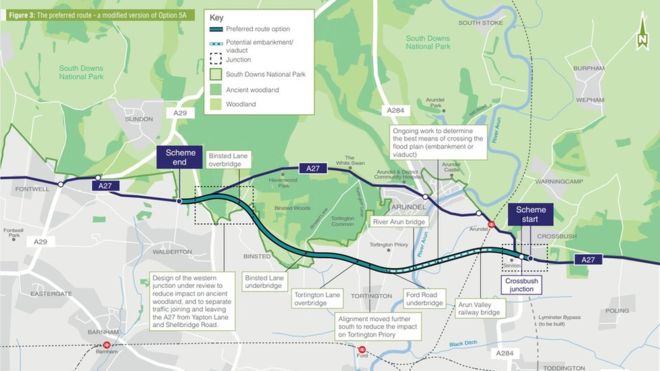
The route may be the best solution, but I believe we need to be more radical.
Overcrowded and inadequate roads exist all along the South Coast of England and in many other scenic places in the UK.
I think we need to develop a philosophy to solve the problems of roads in these crowded places.
Building a four-mile bypass at Arundel, may be needed, but we should do many other things to ease traffic congestion and improve transport capacity.
So what do I believe we should do?
We could introduce negative measures like road pricing or other restrictions, but I believe there are positive things we could do.
Broadband
You might think, what has broadband got to do with reducing the need to build roads.
I believe that as more houses and businesses get very high speed broadband, this will reduce the number of journeys taken.
Mobile Phone Coverage
I am not sure, what effect excellent mobile phone coverage will have on traffic, but it certainly will have one.
Cycling
We will all be cycling more and one of the consequences of excellent mobile phone coverage will be the growth of park-it-anywhere bike schemes like ofo and Mobike.
I think a few years time, many short distance journeys will be done by bicycle.
But expect some Luddite councils to legislate against ofo, Mobike and their ilk!
Rail
Fast forward five years and a train journey in an area like along the South Coast or in East Anglia or the West Country, will be very different.
- Digital signalling will increase the capacity of all lines and mean that most stations will have at least four trains per hour (tph) in both directions.
- Digital signalling will also allow more routes.
- Advances in train design will mean that journeys are faster.
- Ticketing will use contactless bank cards or mobile phone payment systems.
- Trains will be a much more comfortable and work-friendly experience, with wi-fi, 4G and power sockets.
- Track layouts will be improved and level crossings will be removed., to allow trains to operate more efficiently.
- Improved information on trains and stations.
- The improved dwell times of modern trains, will allow new stations to be added without degrading services.
The biggest development along the South Coast, will be an improved service between Ashford and Portsmouth/Southampton/Bournemouth.
- Existing tracks will be used, with the addition of short stretches of new track at possibly Brighton and Eastbourne.
- Line speeds will be at least 100 mph.
- Most stations will have a Turn-Up-And-Go four tph service.
There will also be other improved routes to and from London and Gatwick Airport for many of the coastal towns.
This improvement in rail services will be impossible with a rail company like Govia Thameslink Railway providing services.
- They are more conservative, than the RMT.
- They look after their core commuter traffic, at the expense of other passengers.
- The franchise is just too big.
However, digital signalling will allow Open Access Operators to compete and create new services geared to customers needs.
Thameslink
The current Thameslink service will have the following characteristics, when it is completed in December 2019.
- Twenty-four tph through London.
- A well-designed track layout at Bermondsey that unlocks London’s North-South railway.
- Services at a level of at least two tph to many stations in Kent, Surrey and Sussex.
- A set of uncomfortable Class 700 trains, designed by a moronic civil servant in the Department of Transport.
The major Thameslink upgrade was designed totally without vision and charisma.
However, the basics and possibilities are there to do the following.
- Increase the frequency to thirty tph through the Central London core.
- Increase the frequency on the Brighton Main Line through Gatwick, substantially, by using digital signalling.
- Rebuild the trains, with what passengers need.
- Add extra services all along the South Coast.
- Develop a massive rail-air interchange station at Gatwick.
I believe that Gatwick could develop into the busiest station in the UK.
I also think, that anybody going between London and the South Coast, will have a frequency of at least four tph from their local station, using either a direct service or a single change at Gatwick.
Freight
This Google Map shows the A27 through Arundel.

Note the number of trucks on the roads.
Where are they going?
The bypass would get the trucks out of Arundel, but would it just encourage more to use the South Coast route as a bypass for the crowded M25?
We need a proper philosophy for freight in this country.
- As much freight as possible should be by rail.
- Trucks should be for short distance or specialist needs only.
Does Southampton Docks have good enough access to the UK rail network?
I think not, especially as it would be very difficult to increase freight traffic through Southampton Central station, due to the restriction of the double-track Southampton Tunnel.
Conclusion
There is a lot to do, before we spend £250million n a bypass.
More Thameslink Trains Serving The East Coast Main Line From May 20th 2018
The National Rail timetable is now showing the following new Thameslink trains serving the East Coast Main Line.
There will be two trains per hour (tph) between Peterborough and Horsham.
- XX:26 and XX:56 – Peterborough
- XX:08 and XX;38 – Finsbury Park
- XX:00 and XX:30 – London Bridge
- XX:08 and XX:38 – Horsham
Note.
- Trains take two hours and 45 minutes.
- Stops include Huntingdon, St. Neots, Hitchin, Steveange and Finsbury Park, to the North of the Thames.
- The trains call at St. Pancras Thameslink, Farringdon, City Thameslink and London Bridge in the core.
- Stops include East Croydon, Gatwick Airport, Three Bridges and Crawley to the South of the Thames.
- The first train is 05:24 from Peterborough.
Trains generally leave Horsham at XX:25 and XX:55.
There will be one tph between Cambridge and Brighton.
- XX:54 at Cambridge
- XX:52 – Finsbury Park
- XX:15 – London Bridge
- XX:19 – Brighton
Note.
- Trains take two hours and 25 minutes.
- Stops include Royston, Hitchin, Steveange and Finsbury Park, to the North of the Thames.
- The trains call at St. Pancras Thameslink, Farringdon, City Thameslink and London Bridge in the core.
- Stops include East Croydon, Gatwick Airport, Three Bridges and Haywards Heath to the South of the Thames.
- The first train is 05:54 from Cambridge.
Trains generally leave Horsham at XX:07.
But going to Gatwick, I might go to Finsbury Park, where I can now get three trains per hour to the Airport.
- XX:08 taking around 70 minutes
- XX:38 taking around 70 minutes
- XX:52 taking around 52 minutes
But coming back, I would take the first train to London Bridge, from where I’d get a 141 bus to just outside my door.
Are The Trains Acceptable?
For my journey of an hour to Gatwick, the trains are just about acceptable.
But, in some ways, I think that passengers from Cambridge and Peterborough will only use Thameslink to South of East Croydon occasionally, as over two hours in a Class 700 train, is an experience, passengers will be reluctant to repeat.
I would do the following.
- Add wi-fi and power sockets.
- Add a few tables to make some groups of four seats, suitable for families.
- Add seat-back tables.
- Make the seats more comfortable.
I’d love to have five minutes with the idiot who signed off the order for these trains, which must be the worst new trains on the UK network. Perhaps, that’s not being harsh enough. I suspect they could be the worst new trains in the world!
I’ve had better passenger comfort in a Pacer, that I wrote about in Is This Really A Pacer In A New Outfit?.
But that journey was only between Rotherham and Sheffield, not say Cambridge and Gatwick.
Between Heathrow And Gatwick Airports Using Heathrow Southern Railway
I have received a few messages asking how the Heathrow Southern Railway would help travellers get between Heathrow and Gatwick Airports.
How Many Passengers Would Actually Transfer Between The Two Airports?
This question would definitely be filed under pieces of string.
The direct route using Crossrail and Thameslink will take under two hours, with a change at Farringdon.
- There are several major tourist attractions close the the Crossrail/Thameslink route; Oxford Street, British Museum, St. Paul’s, River Thames, Tate Modern, Tower of London and Tower Bridge, for those unencumbered by baggage.
- Will Farrington develop into a joint terminal for both airports?
- How many passengers, will want to have a day of rest and recuperation in the best city in the world?
- How many travellers to and from Europe, the North and Scotland will switch to the long distance trains at Kings Cross and St. Pancras stations?
Passengers wanting to avoid London could use the Waterloo – Heathrow service proposed by Heathrow Southern Railway and change at Clapham Junction.
- The proposed Waterloo – Heathrow service will be four trains per hour (tph)
- It would probably run at an appropriate frequency at night, just like Gatwick Express and Thameslink.
- Passengers would change at Clapham Junction between Gatwick and Heathrow services.
- I estimate, that the Clapham Junction route, could be quicker than the Crossrail/Thameslink route, at perhaps an hour and twenty minutes.
- Clapham Junction station is step-free, but the bridge could be made more passenger-friendly.
Until, I get firm evidence to the contrary, I have a strong feeling that not many passengers will want to a faster service thanthe one, these two routes offer.
What About The Workers?
There must be people in the aviation industry, who need to go regularly to both airports for the purposes of work.
If you were in that class of worker, you might choose to live, somewhere that was convenient for both airports.
I suspect that this valuable group will be well-served by services from Clapham Junction.
- Clapham Junction to Heathrow – 30 minutes
- Clapham Junction to Gatwick – 25 minutes
Feeder times to Clapham Junction using direct trains include.
- Balham – 6 minutes
- Canada Water – 29 minutes
- East Croydon – 11 minutes
- Epsom – 28 minutes
- Peckham Rye – 19 minutes
With four tph, the maximum wait at Clapham Junction would be fifteen minutes.
Clapham Junction Will Become An Even Bigger Hub
Heathrow Southern Railway will make Clapham Junction station, an even more important hub.
- It is about thirty minutes away from both Heathrow and Gatwick Airports.
- Large numbers of stations have direct connections to Clapham Junction in under thirty minutes.
- The Northern Line could be extended from Battersea to Clapham Junction.
- Clapham Junction station is proposed to be on Crossrail 2.
- Clapham Junction is at the centre of an extensive bus network.
It would certainly be very convenient to live close to Clapham Junction station, if you needed to go to both airports regularly.
But improvements are needed at the station.
Changing Trains
The Wikipedia entry for Clapham Junction station says this.
The station is also the busiest UK station for interchanges between services.
I use Clapham Junction regularly as an interchange, if say I’m going from Dalston Junction to Gatwick, Reading or Windsor. It can be a sprint up the stairs, and a rush across the bridge, before a careful decent to the platform.
A typical change from Platform 1/2 to 5/6 took me two and a half minutes, in the middle of the morning.
Changing trains could be improved.
These pictures show the step-free bridge at Clapham Junction

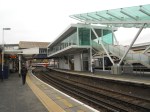
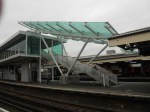

Note.
- Lighting is not of a high quality.
- It is quite wide, but not as wide as the new bridge at Reading.
- There are lifts to most platforms, but they could be bigger.
- Reading has an up and down escalator for each platform. Surely the busiest station in the UK, deserves the same.
- It is cluttered with retail outlets, which could be reduced in number or placed on the platforms.
If I was the CEO of Heathrow Southern Railway, I’d rebuild this bridge, as doing that might attrack more passengers for Heathrow to use the proposed new service.
Information
Clapham Junction is well organised, with trains for a particular destination generally leaving from the same platform or pair of platforms.
They even have a board that gives this information in detail..
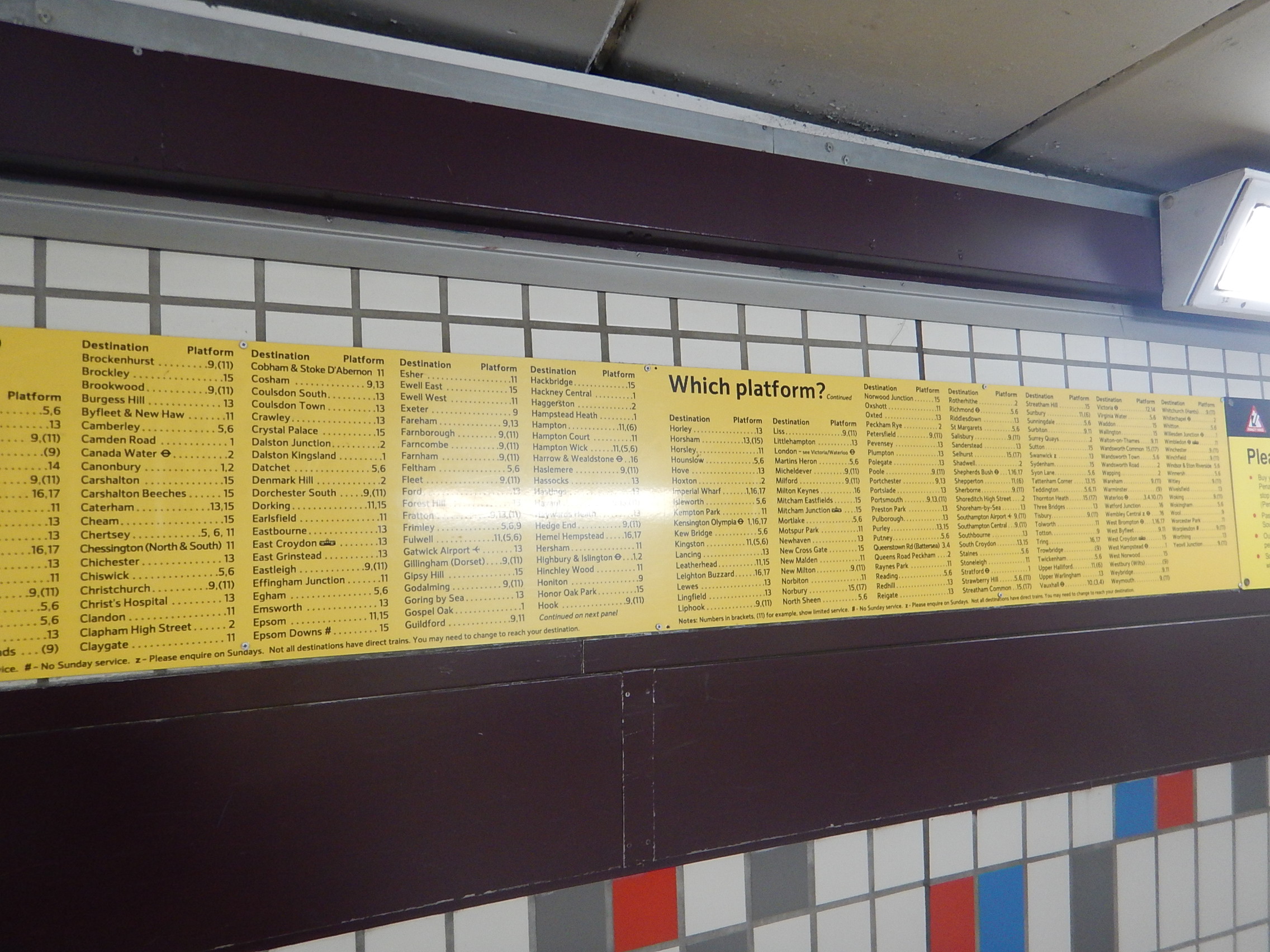
But it’s now 2018 and we can do much better.
There would also need to be large, clear signs everywhere to Gatwick, Heathrow, Victoria and Waterloo!
Timetable Improvements
I took a train from Clapham Junction to Feltham and although there are six tph, I had to wait sixteen minutes for a train.
It’s just that in an hour, there are four short intervals and two long ones.
Improvements need to be made, so that the timetable is more passenger friendly.
Some Platform Reorganisation
This map from carto.metro.free.fr shows the track layout at Clapham Junction station.
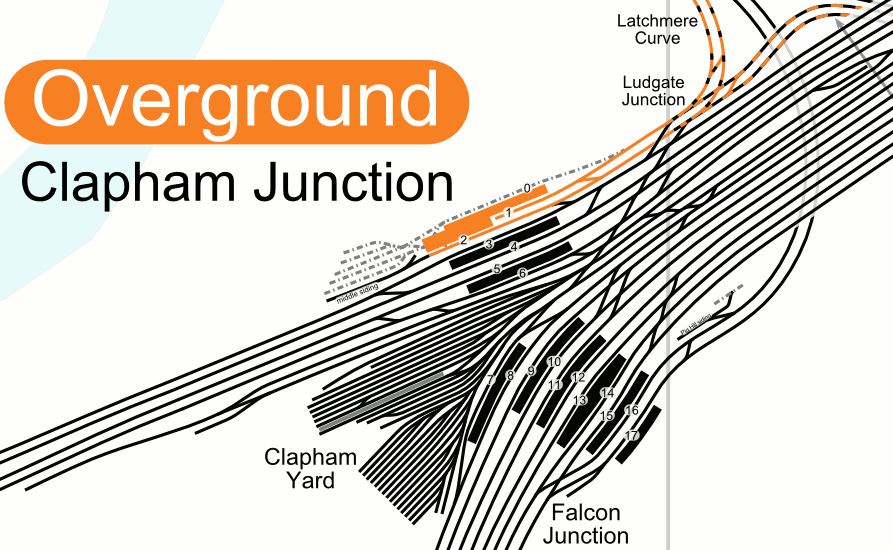
It looks to me, that that terrible engineer; Topsy had a big hand in the design.
Note.
- Tracks and platforms in orange are the London Overground.
- Trains to Heathrow will probably use Plstforms 5 or 6, as do the Reading and Windsor services.
- Trains from Heathrow will probably use Plstforms 3 or 4, as do the Reading and Windsor services.
- Heathrow, Reading and Windsor are to the West.
- Platforms 3 to 11 are for services to and from Waterloo.
- Platforms 12 to 15 are for services to and from Victoria.
- Services to and from Gatwick will use these platforms.
- Platforms 16 and 17 are for West London Line services.
It looks to me, that it might be possible to reorganise the platforms so that Heathrow and Gatwick services weren’t at opposite end of the bridge.
Or should the bridge be made wide enough for a travelator?
West London Line Services
The West London Line has two main passenger services.
- 4 tph – London Overground between Clapham Junction and Stratford, which uses Platform 1
- 1 tph – Southern between Milton Keynes Central and East Croydon, which have virtually sole use of Platforms 16 and 17.
If possible, an increase in frequency on this line would surely help many travellers get to and from London’s two main airports.
- London Overground are planning to add two extra tph between Clapham Junction and Stratford in 2018.
- London Overground will match this in 2019, with another two tph between Clapham Junction and Dalston Junction via the South London Line.
This is going to make Southern’s one tph service between Milton Keynes Central and and East Croydon pathetic, especially as the route will eventually serve Old Oak Common with connections to Crossrail and HS2.
Chris Gibb recommended that this service , should be transferred to the London Overground in the Gibb Report. I wrote about it in Gibb Report – East Croydon – Milton Keynes Route Should Be Transferred To London Overground.
If nothing else the current service which uses two platforms at Clapham Junction for a one tph service, which doesn’t run on Sundays, is a waste of resources at Clapham Junction.
.Conclusions
I have come to the following conclusions.
- If Clapham Junction station is improved, Heathrow Southern Railway will create a faster route to Gatwick.
- Clapham Junction station will become a major hub station feeding London’s two major airports.
It gives very large numbers of passengers a quicker route to the airports.
I also think it could be advantageous for Heathrow Southern Railway to contribute to the upgrading of Clapham Junction station.

