Underground Hydrogen Storage Pilot Gets Funding Boost
The title of this post is the same as that of this article on Energy Live News.
This is the sub-heading.
New hydrogen storage tech could boost grid resilience and emissions cuts
These first three paragraphs add some details.
National Gas and Gravitricity have secured £500,000 from Ofgem to develop a new type of underground hydrogen storage.
The H2FlexiStore system, designed by Edinburgh-based energy storage firm Gravitricity, aims to store up to 100 tonnes of green hydrogen in lined geological shafts.
The technology, which could see a demonstrator built in 2026, is intended to offer a flexible, resilient solution to future hydrogen network needs.
The article also has an excellent graphic.
Note that it takes 55.2 MWh of electricity to generate a tonne of hydrogen, so a hundred tonnes of hydrogen would store 5.52 GWh of electricity as hydrogen.
Zenobē Lands Financing For 400MW Eccles Project
The title of this post, is the same as that of this article on Solar Power Portal.
This is the sub-heading.
Battery energy storage system (BESS) developer/operator Zenobē has announced that it has successfully financed its Eccles BESS project in Scotland, in one of the biggest finance rounds in European history.
These two paragraphs add more details.
The total debt raised for the 400MW/800MWh project was £220 million, which the company says is one of the largest finance raises for a standalone BESS project ever made in Europe. The funding was provided by a group of lenders organised by National Westminster Bank and KKR Capital Markets Partners LLP. Additionally, Zenobē has announced that construction on the Eccles BESS—the company’s largest battery project to date—has begun.
The Eccles BESS is the final part of the firm’s £750 million investment in Scotland. Zenobē’s Blackhillock BESS, a 200MW/400MWh project located near Inverness, recently began commercial operations, and is set to expand to 300MW/600MWh later this year.
Zenobe seem to be able to finance these projects, without too much difficulty.
Construction seems to have started. But then, I suspect there are wind turbines in the vScottish Borders already lined up to use the batteries.
This Google Map shows an Eccles substation.
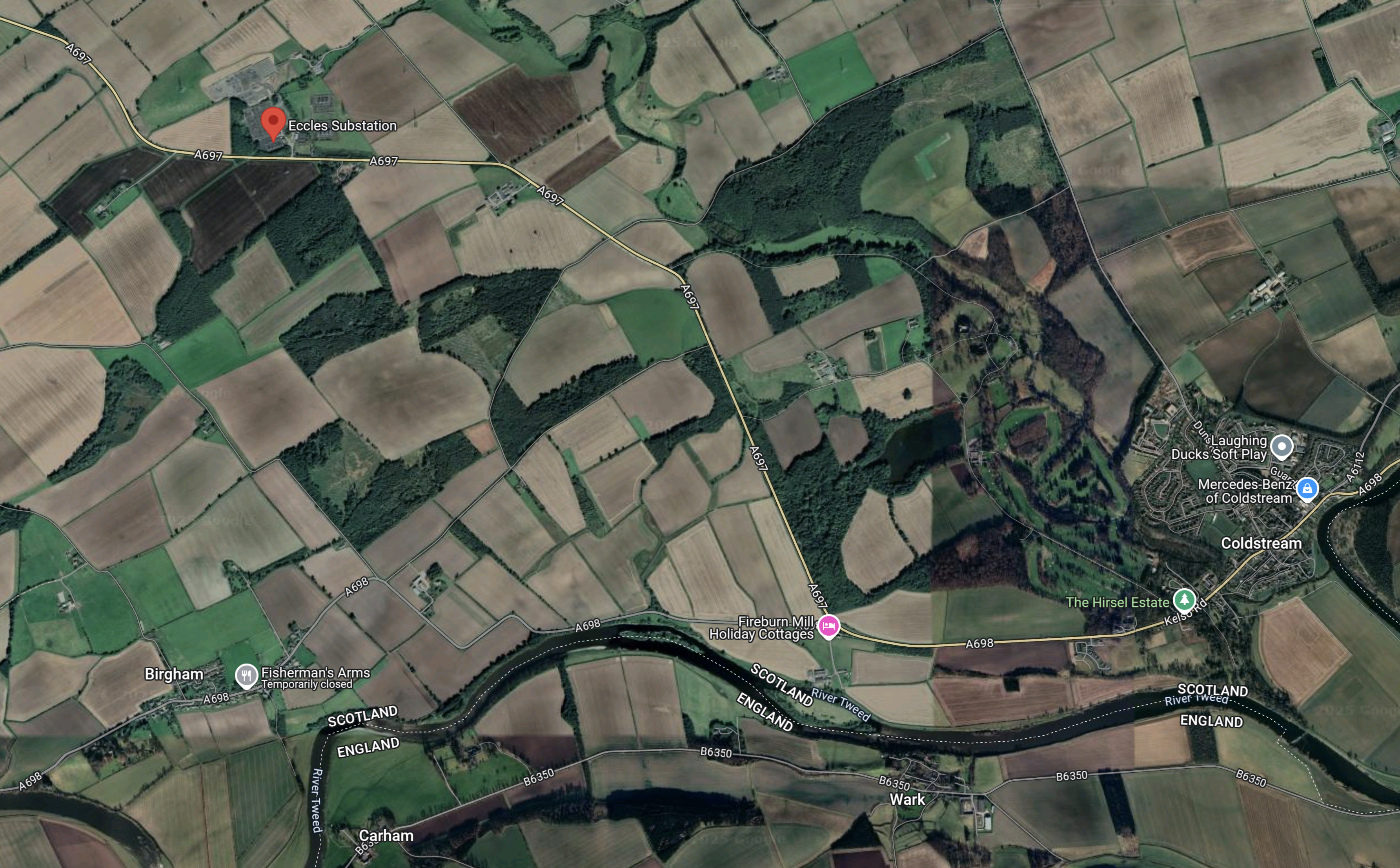
Note.
- The Eccles substation is marked by the red arrow.
- The town at the East edge of the map is Coldstream.
- The England-Scotland border is clearly marked.
This second Google Map shows a closer view of the Eccles substation.
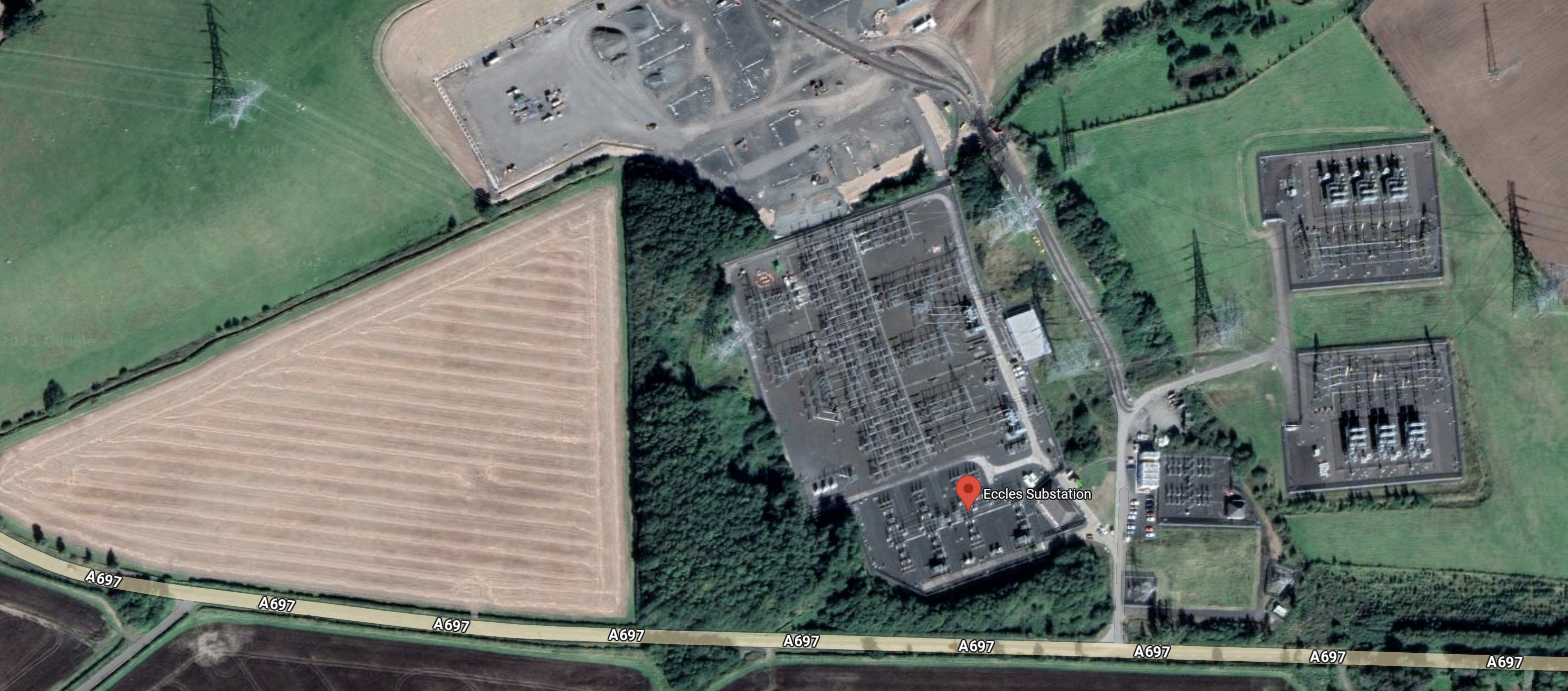
Note.
- t looks to be a substantial substation.
- There would appear to be plenty of space for a large battery.
- It is close to the A 597 road for the delivery of heavy equipment.
I suspect this substation could be the location of the battery.
It’s also right in the heart of Scottish onshore wind territory.
It is also according to the Solar Power Portal a £220 million project.
A project of this size will deliver substantial benefits in terms of work to the local community.
It will likely have a community benefit fund or something similar.
So you would expect the project would be welcomed into the local area.
But you would be wrong, if this article on the BBC, which is entitled Village ‘Heart Ripped Out’ By Battery Site Plans, is typical of the feeling about the batteries.
This is the sub-heading.
A rural community in the Borders is warning that Scotland’s renewable energy revolution is coming at a cost.
These three paragraphs add more detail.
Residents of Leitholm – a village between Coldstream and Greenlaw – claim the heart is being ripped out of their community with the arrival of battery storage facilities.
If all six proposed facilities are approved, more than 200 acres of farmland will be turned over to concreted compounds within a three-kilometre radius of their village.
Retired nursery owner Seonaid Blackie said: “This is not the place it used to be – people are worried sick.”
The residents view is balanced by industry expert Professor John Irvine, from St Andrew’s University, believes energy storage has a vital role to play in reaching net-zero targets.
My view is what is needed is an energy storage system, that can be built substantially underground.
If you look at large Battery Energy Storage Systems (BESS), they are best described as container parks.
We need energy storage systems, that fit in a single tennis court, rather than thirty football pitches.
Gravitricity is one possibility, who are also Scottish, who store energy using weights in disused mine shafts.
The French system; DELPHY is also a vertical system for storing hydrogen in a custom-built hole.
Practically, I believe the solution adopted will be to spread the batteries out and spend money on surrounding them with trees and other camouflage.
Europe’s Biggest Battery Storage Project Goes Live In Scotland
The title of this post, is the same, as this article in The Times.
This is the sub-heading.
Zenobe’s site at Blackhillock can store surplus generation for when the wind doesn’t blow and the sun doesn’t shine
These are the first two paragraphs.
Europe’s biggest battery storage project has entered commercial operation in Scotland, promising to soak up surplus wind power and prevent turbines being paid to switch off.
Zenobe said the first phase of its project at Blackhillock, between Inverness and Aberdeen, was now live with capacity to store enough power to supply 200 megawatts of electricity for two hours. It is due to be expanded to 300 megawatts by next year.
I believe we can do better, than install large lithium-ion batteries.
We need to get the pumped storage like Coire Glas, the liquid air like Highview Power and the gravity batteries like Gravitricity going as fast as we can.
They are more environmentally friendly than Tesla’s lithium ion tiddlers and a second generation liquid air battery appears to be 200 MW and 2.5 MWh, so they can supply 200 MW for 12.5 hours.
The Blackhillock battery can do just two hours.
Two of them working as a pair, with a 1 GW wind farm, are as big as a small modular nuclear reactor, so could do the same job, with respect to power supply, using machinery and tank designs, that have been used for decades.
I suspect, that like 1960s coal-fired power stations, they would keep running for fifty years and be simply recycled as steel, copper and other scrap.
Highview Power could make Bishops Stortford famous!
UK Government Sets 8-Hour Minimum For LDES Cap-And-Floor Sheme
The title of this post, is the sa,e as that of this article on Energy Storage News.
This is the sub-heading.
The UK government has published a Technical Decision Document confirming crucial aspects of its long duration electricity storage (LDES) cap-and-floor scheme, which includes increasing the minimum duration required from six hours to eight
These paragraphs give full details.
The document, released by regulator Ofgem on 11 March, details the final overarching rules and requirements for the scheme as well as how it will be implemented, though significant detail still remains to be worked out.
The scheme will provide a cap-and-floor revenue protection for 20-25 years that will allow all capital costs to be recoverable, and is effectively a subsidy for LDES projects that may not be commercially viable without it. Most energy storage projects being deployed in the UK today are lithium-ion battery energy storage systems (BESS) of somewhere between 1-hour and 3-hour in duration (very occasionally higher).
One of the most significant new details of the scheme is that, following industry feedback, the minimum duration for projects to qualify has been increased from six hours to eight hours of continuous rated power.
The ‘continuous rated power’ aspect prevents shorter duration projects from bidding in a smaller section of their MW capacity in order to act like an 8-hour system.
Another interesting detail pointed out by several commentators is that the cap is a ‘soft’ one, meaning it will allow extra revenue to be shared between developers and consumers. Exact details on the ratio are yet to be determined.
As a Graduate Control Engineer from Liverpool University in the 1960s, I hope that the move from a six to eight hours minimum duration is feasible.
I wasn’t dealing with power systems, but with multi-vessel chemical plants.
These are my thoughts.
The biggest project, I was dealing with a few years later in the 1970s, was the modeling of all the the reservoirs and pipelines by the Water Resoures Board.
As the supply side of the water industry hasn’t had too many issues with the volume of water supplied, I feel that the main modelers must have done a reasonable job.
Six To Eight Hours Of Continuous Operation
The article says this about uprating from six to eight hours of continuous operations.
All the systems that have been proposed for cap-and-floor operation, seem to have some form of physical storage.
- Energy Dome appears to have tents of carbon dioxide.
- Energy Vault uses stacks of heavy weights.
- Form Energy has tanks of rust.
- Gravitricity has huge weights in disued mine shafts.
- Highview Power has large tanks of liquid air.
- Pumped storage hydro has two lakes, that hold water.
- Rheenergise has two large tanks, of a water-based slurry.
So to go from six to eight hours will hopefully just need some more storage.
Highview Power appears to use similar gas tanks to those used to store natural gas or hydrogen.
This image clipped from Highview’s web site, shows large tanks for liquified gas storage.
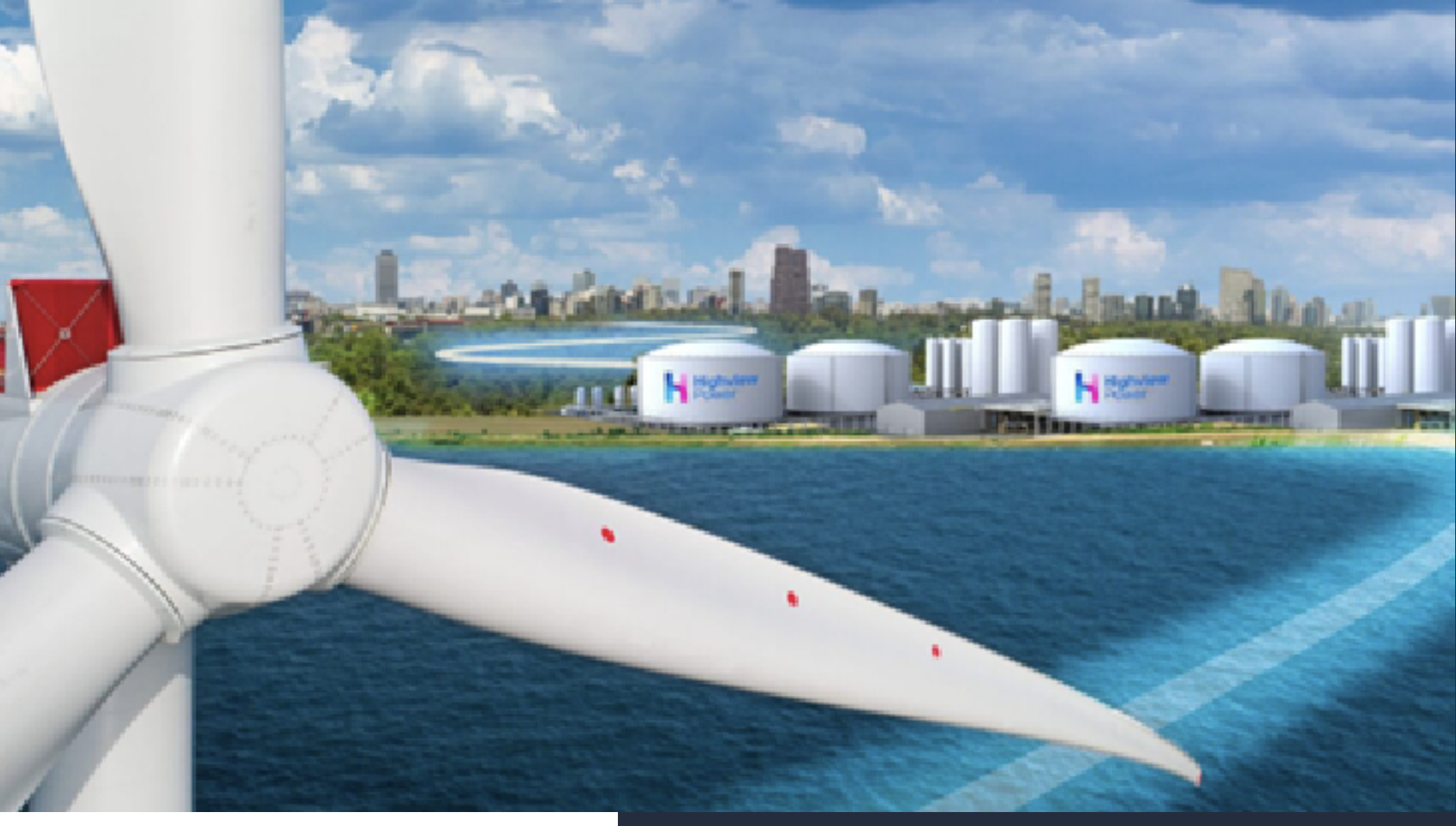
With tanks like these, which can hold GW-equivalents of liquid air, Highview could be building batteries with storage to rival the smaller pumped storage hydroelectric power stations. They are already talking of 200 MW/2.5 GWh systems, which would have a 12.5 hour continuous rating and would probably need two to three tanks.
Coire Glas Pumped Storage
I’ll use Coire Glas pumped storage hydro electric power station as an example.
As currently planned SSE’s Cioire Glas pumped storage hydroelectric power station is 1.5 GW/30 GWh, so it has a a 20 hour continuous rating.
In The UK’s Pumped Storage Hydroelectricity, I gave a rough estimate of the pumped storage hydroelectricity systems in operation or planed as nearly 11 GW/224GWh.
The Soft Cap
The article says this about a soft cap.
Another interesting detail pointed out by several commentators is that the cap is a ‘soft’ one, meaning it will allow extra revenue to be shared between developers and consumers. Exact details on the ratio are yet to be determined.
I seem to remember that when I was modeling a larger multi-vessel chemical plant at ICI, I was using sharing between vessels, to get the system to operate on a PACE-231R analog computer.
So I suspect a soft cap is possible.
Europe’s Mines Look To Gravity Energy Storage For Green Future
The title of this post, is the same as that of this article on Global Mining Review.
This is the sub-heading.
Mine owners across Europe are looking at a new form of underground energy storage to offer a low carbon future as operations wind down.
These are the first four paragraphs.
Active deep mine operators in Slovenia, Germany, The Czech Republic and Finland are all examining how underground gravity energy storage – provided by Edinburgh firm Gravitricity – could offer green opportunities to mining communities facing a downturn in employment.
Gravitricity has developed a unique energy storage system, known as GraviStore, which uses heavy weights – totalling up to 12 000 t – suspended in a deep shaft by cables attached to winches.
This offers a viable alternative future to end of life mine shafts, which otherwise face costly infilling and mine decommissioning costs.
They have teamed up with energy multinational and winch specialist ABB alongside worldwide lifting specialists Huisman to commercialise the technology for mine operators.
Note.
- Four projects are mentioned.
- It appears to be less costly, than infilling.
- Gravitricity have teamed with ABB and Huisman, who are two of Europe’s specialist in this field.
- You can’t have too much energy storage.
The article is worth a full read.
Conclusion
Gravitricity’s simple idea could be a big winner.
National Gas To Trial Gravitricity’s H2 Storage Solution
The title of this post, is the same as that of this article on The Engineer.
This is the sub-heading.
Gravitricity’s H2FlexiStore system for underground hydrogen storage could see a pilot built in 2025 after National Gas secured Ofgem funding to explore the technology.
There is then a graphic, which gives a good visual explanation.
The patented system uses lined geological shafts to store up to 100 tonnes of pressurised hydrogen at 220 bar, equivalent to about 3.33GWh of energy. Unlike natural storage such as salt caverns and disused gas fields, the shafts can be sited anywhere. Gravitricity has previously stated its preference for co-locating the storage near to renewable generation and potential major consumers of hydrogen such as heavy industry.
I can see that this simple system can have a lot of diverse uses.
In Centrica Completes Work On 20MW Hydrogen-Ready Peaker In Redditch, I talked about how Centrica had refurbished a decommissioned peaker plant.
One of these stores would keep a 20 MW peaker plant running for a week.
It would also work well with a HiiROC hydrogen system.
Gravitricity Weighs Up One Of Europe’s Deepest Mines
The title of this post, is the same as that of this article on The Engineer.
This is the sub-heading.
Scotland’s Gravitricity is set to deploy its underground energy storage technology at Pyhäsalmi Mine in central Finland, Europe’s deepest zinc and copper mine.
These two paragraphs outline the scheme.
Located about 450km north of the Finnish capital Helsinki, the Pyhäsalmi Mine extends 1,444m below the Earth. With mine operations at Pyhäsalmi winding down, the local community set up a development company to explore redevelopment projects around the mine’s infrastructure, including energy storage.
Gravitricity is set to deploy its GraviStore energy storage technology in a 530m deep auxiliary shaft. GraviStore can utilise off-peak electricity by raising heavy weights in the mine shaft, releasing the energy back on to the grid during high demand by lowering the weights. It’s claimed the 2MW scheme at Pyhäsalmi will provide grid balancing services to the Finnish network.
There is also this quote from Martin Wright,who is Gravitricity’s executive chairman.
This project will demonstrate at full scale how our technology can offer reliable long life energy storage that can capture and store energy during periods of low demand and release it rapidly when required.
This full-scale project will provide a pathway to other commercial projects and allow our solution to be embedded into mine decommissioning activities, offering a potential future for mines approaching the end of their original service life.
Can it be that Gravitricity is finally on its way?
Gresham House Energy Storage Sets GBP80 Million Fundraise
Gresham House Energy Storage Fund must be doing something right, as similar headlines are used in half-a-dozen places on the Internet and they regularly seem to be raising more money.
But then, as a Graduate Control Engineer and a previous owner of half a finance company, I’ve always thought raising money to build batteries was a good idea.
My only niggle with Gresham House, is that I would have thought by now, they would have put some money into building one of the excellent new technology batteries that are coming through.
The storage fund or some of its employees, may of course have contributed to some of the crowdfunding for these new technologies, all of which I feel have a good chance of being a success.
Note.
- Energy Dome is Italian and all the others are at least fifty percent British.
- Most of the British batteries have had backing from the UK government.
- All these batteries are environmentally-friendly.
- None of these batteries use large quantities of rare and expensive materials.
- Energy Dome even uses carbon dioxide as the energy storage medium.
In addition, in Scotland, there is traditional pumped storage hydro-electricity.
Project Iliad
This article on renews.biz has a slightly different headline of Gresham House To Raise £80m For US Battery Buildout.
This is the first two paragraphs.
Gresham House Energy Storage Fund is seeking to raise £80m through a share placing.
The new equity raised will primarily be used to finance 160MW of solar with co-located four-hour battery projects in California, US, known as Project Iliad.
The article then gives a lot of financial details of Project Iliad and Gresham House.
Will Gresham House be backing co-located solar/battery projects in the UK?
- In Cleve Hill Solar Park, I write about a co-located solar/battery project in Kent.
- This press release from National Grid is entitled UK’s First Transmission-Connected Solar Farm Goes Live, which also describes a co-located solar/battery project, being built near Bristol.
These two projects are certainly serious and could be pathfinders for a whole host of co-located solar/battery projects.
WillGresham House back some of this new generation?
Boralex Commissions BESS At Wind Farm In France In EU-Supported Demonstration Project
The title of this post, is the same as that of this article on Energy Storage News.
These two paragraphs outline the project.
Canada-based renewable energy firm Boralex has turned on a 3.3MWh battery storage unit attached to a wind farm in France.
The battery storage project has been installed at the site of the Plouguin wind farm, an 8MW generating facility in the Finistere department of Brittany, northwest France.
Note.
- The project was co-financed by the European Union through its European Regional Development Fund (ERDF).
- The project was launched to demonstrate the technical feasibility of a hybrid wind-plus-storage project.
- Boralex added in its announcement that the project will contribute to the stability of the French electricity grid.
There will be a lot of projects like this in the future.
This paragraph makes an interesting point about using batteries with solar and wind power.
Wind farms are less frequently hybridised with energy storage than solar PV because of the larger minimum project size and less predictable variability, with sharper peaks meaning heavier battery cycling and potentially faster degradation.
My control engineering knowledge and experience says that larger power sources and those that are highly variable will need batteries with more capacity for the same stability and quality of power output.
This sounds to me like a very good reason for developing larger and more affordable batteries, like those of Cheesecake Energy, Energy Dome, Gravitricity and Highview Power.
It also probably means that to stabilise several gigawatts of wind power, you need a very large amount of storage, that can only be provided by pumped storage hydroelectricity.
Conclusion
A very large amount energy storage is going to be needed.
Projects like these are essential to make sure we use them to their full possibilities.
Gravity-Based Green Energy Storage Tech Pioneer Eyes US Mineshafts
The title of this post, is the same as that of this article on Recharge News.
This is the sub-heading.
Gravitricity and IEA Infrastructure Construction to seek funding under government scheme for projects at ex-mining sites.
These are the first two paragraphs.
A pioneer in gravity-based energy storage technology aims to make its US debut after linking with a major American construction group.
Gravitricity, which uses giant weights hung in deep shafts to store energy, will partner with IEA Infrastructure Construction to jointly seek US funding for projects at former mines.
I wonder how many other companies will go chasing the money, that President Biden has put on offer in the US?
 The Anonymous Widower