Zinc8 Seem To Be A Surprisingly Open Company
Several energy storage companies, that I have looked at for this blog are secretive companies.
In The Mysterious 150-hour Battery That Can Guarantee Renewables Output During Extreme Weather, where I pointed at an online article of the same name, the secrecy is in the headline. Look at the web site of the company involved; Form Energy and it reminds me of a term used in the 1970s and 1980s to refer to non-existent software – vapourware. Or one of my older favourite phrases – All fur coat and no knickers.
I have developed disruptively innovative software and other products and understand, the need for secrecy. But there is a need for a balance between secrecy and information.
As an example, one of the products, I have highlighted here, could be ideal for one of the followers of this blog. They will be investigating the product, as I have found enough information to enable them to decide, that contacting the company will not be a waste of time.
Some companies in innovative energy storage development like Highview Power and Hydrostor have posted informative YouTube videos about their technology, but others just rely on the same endlessly repeated phrases.
When I looked at the Zinc8 web site, I thought they were another company dealing in the same phrases, as there are two on the home page.
- Zinc8 is redefining long-duration energy storage.
- The leader in zinc-air battery technology.
But they are a lot more open, than the home page might suggest.
Looking up zinc-air battery on Wikipedia, gives a lot of information, that is understandable. This is the introductory paragraph.
Zinc–air batteries (non-rechargeable), and zinc–air fuel cells (mechanically rechargeable) are metal–air batteries powered by oxidizing zinc with oxygen from the air. These batteries have high energy densities and are relatively inexpensive to produce. Sizes range from very small button cells for hearing aids, larger batteries used in film cameras that previously used mercury batteries, to very large batteries used for electric vehicle propulsion and grid-scale energy storage.
I instantly thought, if a technology can be both non-rechargeable and rechargeable and useable in applications from hearing aids to vehicle propulsion and grid-scale energy storage, the technology must have something. I also worked in a non-ferrous metals factory as a teenager and know that zinc is easy to handle.
I then looked at their technology page
- There is a detailed explanation of the technology.
- They stress their patents and certification.
- They show how a system can be expanded.
- They list the major technological advantages of the system. Robust, safe, scalable etc.
- They claim 20,000 operating life hours and 8+ operating hours.
They also finish off by giving an energy capacity cost of $45 per kWh.
I tend to think, that they have found a quirk in zinc-air technology, that they are exploiting, by some good old-fashioned innovative engineering.
I shall be watching Zinc8 and the other zinc-air battery start-ups.
The Mysterious 150-hour Battery That Can Guarantee Renewables Output During Extreme Weather
The title of this post, is the same as that of this article on Recharge.
The article talks starts by talking about Form Energy, who I wrote about in 150 Hours Of Storage? Company Says That’s True To Form.
As to Form Energy’s technology, they say that there is speculation, that sulphur is the main ingredient.
The article, then lists other technologies, that are under development to store energy.
- Zinc8 – The headline on their web-site is Zinc8 is redefining long-term energy storage.
- Highview Power – Who seem to be close to commercial operation.
- Siemens Gamesa ETES – Hot rock storage now under test in Hamburg.
- Stiesdal Storage Technology GridScale – Under development
- Malta’s molten salt system – See Malta Energy Storage System Is Looking Forward To First Pilot
There’s certainly no lack of entrants for the contest to provide long-term energy storage.
The article is a summary of both Form Energy and the others in the field.
Dr. Gerhard Cromme Joins Highview Power’s Board of Directors
The title of this post, is part of the title of this press release from Highview Power.
This is the introductory paragraph.
Highview Power, the global leader in long-duration energy storage solutions, is pleased to announce that Dr. Gerhard Cromme, former Chairman of the Supervisory Board at Siemens AG and ThyssenKrupp AG, will join its Board of Directors.
I think this could be a game-changing appointment.
Cheesecake Energy Receives Investment From The University Of Nottingham
The title of this post, is the same as that of this article on NewsAnyway.
This is the introductory paragraph.
Cheesecake Energy Limited (CEL) today announced it has received investment from the University of Nottingham to support UK-wide pilot programmes for the company’s energy storage solution.
Thse two paragraphs are a brief description of the company, their technology and what they do.
Cheesecake Energy Limited is a fast-growing startup developing energy storage at 30-40% lower cost than the current market leader, lithium ion batteries. Its system uses compressed air and thermal energy storage to achieve high efficiency, long lifetime and dramatically lower environmental impact.
Founded in 2016, the company has already established itself within the Nottingham, and wider East Midlands energy ecosystem — having secured initial interest from local councils and bus services for pilot programmes. The company is currently designing a 150 kW / 750 kWh prototype system for completion in Q4 2020 which will be deployed with a local bus depot for charging of electric buses using renewable energy.
This is the home page of their web site, which proudly announces.
The Greenest Battery In The World
We’ll see and hear that slogan many times in the next few years.
A few of my thoughts on the company.
Cheesecake Energy’s Technology
Cheesecake Energy says it uses compressed air and thermal energy storage to achieve high efficiency, long lifetime and dramatically lower environment impact.
Three other companies also use or may use compressed air to store energy.
- Highview Power – See Highview Power To Build Europe’s Largest Battery Storage System
- Form Energy – See Will The Real Form Energy Please Stand Up!
- Hydrostor – See Hydrostor Announces Australia’s First CompressedAir Energy Storage Project Secures Funding From Arena And South Australia Renewable Technology Fund
As Cheesecake appear to be using a thermal energy storage, have they found a unique way to create another type of compressed air storage?
Battery Sizes
How do the sizes of the three companies batteries compare?
- Cheesecake Energy prototype – 150 kW – 750 kWh – five hours
- Form Energy for Great River Energy – 1MW – 150 MWh – 150 hours
- Highview Power for Vermont – 50MW – 400 MWh – 8 hours
- Hydrostor for South Australia – 50+MW – 4-24+ hours
The Cheesecake Energy prototype is the smallest battery, but Highview Power built a 750 KWh prototype before scaling up.
Note.
- The first figure is the maximum power output of the battery.
- The second figure is the capacity of the battery.
- The third figure is the maximum delivery time on full power.
- The capacity for Hydrostor wasn’t given.
The figures are nicely spread out, which leas me to think, that depending on your power needs, a compressed air battery can be built to satisfy them.
Charging Electric Buses
Buses like this Alexander Dennis Enviro200EV electric bus are increasingly seen in the UK.




And they all need to be charged!
Cheesecake Energy say that their prototype will be deployed with a local bus depot for charging of electric buses using renewable energy.
- An electric bus depot should be a good test and demonstration of the capabilities of their battery and its technology.
- Note that according to this data sheet of an Alexander Dennis Enviro200EV, which is a typical single-decker electric bus, the bus is charged by BYD dual plug 2×40kW AC charging, which gives the bus a range of up to 160 miles.
- With a 150 kW output could Cheesecake’s prototype charge two buses at the same time and several buses during a working day?
- Would DC charging as used by Vivarail’s charging system for trains be an alternative?
To me, it looks like Cheesecake are showing good marketing skills.
I do wonder if this size of charger could make the finances of electric buses more favourable.
Suppose, a bus company had a fleet of up to a dozen diesel single-decker buses running services around a city or large town.
- How much would they spend on electricity, if they replaced these buses with electric ones?
- Would being able to use cheaper overnight energy to charge buses in the day, be more affordable?
- Would electric buses run from renewable electricity attract passengers to the services?
These arguments for electric buses would also apply for a company running fleets of vans and small trucks.
To me, it looks like Cheesecake are showing good engineering/marketing skills, by designing a product that fits several markets.
150 Hours Of Storage? Company Says That’s True To Form
The title of this post, is the same as that of this article on Power Magazine.
It is very much a must-read about the emerging technology of high-capacity and long term energy storage, with particular reference to Highview Power and Form Energy.
The article fills out a lot of what I wrote in Will The Real Form Energy Please Stand Up!
I also feel that there’s also an old kid on the block, when it comes to long term energy storage and that is new methods of deploying pumped storage, that I wrote about in The New Generation Of Pumped Storage Systems.
Will The Real Form Energy Please Stand Up!
Form Energy appears to be a start-up, that claims it has the solution to low-cost long-term energy storage.
The home page of their web site is little more than this headline.
We are developing long duration energy storage systems to enable a fully renewable, affordable and reliable electric system.
And a few links to press releases and a link marked See How.
I clicked it and got this page, with this mission statement.
We are going about this by developing a new kind of battery that would eliminate the need for coal and gas entirely, and allow for a 100% renewable, carbon free grid.
They say this about the technology.
Form Energy has identified and is developing a novel approach that is low-cost, safe, and scalable. This battery would allow for a 100% renewable, carbon free grid.
And this about the software.
Form Energy offers a software solution to the industry that models the efficiency and cost-saving benefits of using Form’s long duration storage and identifies value to the entire electricity ecosystem.
Now that I can understand.
When I was writing software, I wrote any number of models in project management, finance and engineering systems and I don’t doubt, that they have developed a sophisticated software system, that can model a large electricity network.
It would allow the following.
- Predictions to be made for the future, based on historic data and schedules for new plant coming on stream.
- It would have a graphical interface, so that changes to the power network could be performed quickly and easily.
- It would predict the size and capacities of Form Energy’s batteries, that would be needed.
- It could be used to model ways out of a serious breakdown in part of the grid.
I suspect that National Grid in the UK, EDF in France and other national equivalents, have been running such software systems for many years.
A Deal With Great River Energy
Does this press release on their web site, which is entitled Form Energy Announces Pilot with Great River Energy to Enable the Utility’s Transition to an Affordable, Reliable and Renewable Electricity Grid, give any more details about Form Energy’s technology?
This paragraph lays out the basics of the deal with Great River Energy.
Form Energy, a company developing ultra-low-cost, long-duration energy storage for the grid, today announced it signed a contract with Minnesota-based utility Great River Energy to jointly deploy a 1MW / 150MWh pilot project to be located in Cambridge, MN. Great River Energy is Minnesota’s second-largest electric utility and the fifth largest generation and transmission cooperative in the U.S.
The next paragraph gives a few details of the battery.
This system will be the first commercial deployment of Form Energy’s proprietary long-duration energy storage system. Form Energy’s aqueous air battery system leverages some of the safest, cheapest, most abundant materials on the planet and offers a clear path to transformationally low-cost, long-duration energy storage. The project with Great River Energy will be a 1-MW, grid-connected storage system capable of delivering its rated power continuously for 150 hours, far longer than the two to four hour usage period common among lithium-ion batteries being deployed at utility-scale today. This duration allows for a fundamentally new reliability function to be provided to the grid from storage, one historically only available from thermal generation resources.
A battery capable of storing 150 MWh and capable of delivering 1 MW for 150 hours is certainly impressive.
More About The Deal
This article on Green Tech Media is entitled Long Duration Breakthrough? Form Energy’s First Project Tries Pushing Storage To 150 Hours.
A few points from the article.
- Bill Gates, Macquarie Capital and Eni are backers of Form Energy.
- The aim is to have the plant online in 2023.
- Great River Energy depends heavily on Coal Creek power station, which is a 1151 MW lignite-fired power station, which is to be shut down in the second half of 2022.
- Form expect their battery to be competitive with lithium-ion on a per KW basis.
- A battery takes up about an acre.
- Batteries have a twenty-year life.
The article also says that Form is not sharing many details of its technology.
Can Great River Energy Replace The Power From Coal Creek With Wind Turbines And A 150 MWh Battery?
Consider these points from the Green Tech Media article and Wikipedia.
- Coal Creek power station provides half of Great River Energy’s needs.
- Coal Creek power station is rated at 1151 MW,
- Coal Creek power station will shut in 2022.
- Great River Energy intends to add 1,100 MW of wind turbines.
- North Dakota, South Dakota and Minnesota seem to be states where it is worth reaping the wind.
So can all this power and the disruption of shutting Coal Creek power station be balanced by one relatively small 180 MWh battery?
I have modelled systems as complex as this in finance, project management and process engineering and if Form Energy have done their modelling to a very detailed level and they say that a 1MW/180 MWh system will be big enough, then I’ll go along with that!
In my long experience of mathematical modelling of complex systems, the answer at the end, is often not what many expect.
So the answer must be extensively tested.
What Technology Are Form Using?
The press release about the deal with Great River Energy mentions an aqueous air battery system!
Water and air are not exotic materials and are readily available in most parts of the world. I would suspect that the only way to store large amounts of energy in air is to liquify it, as Highview Power is doing in their CRYOBattery. But where does the water come in?
Could both companies be following different routes using similar properties of two of the greenest and most abundant substances on the planet?
I also know from a very beneficial personal financial experience, that aqueous-air mixes have unusual properties.
Highview Power liquify air and then use a turbine to recover the energy.
Are Form also using liquified air and then using a different method based on the unusual properties of aqueous-air mixes to recover the energy?
I can’t wait for the secret of their technology to emerge!
A Comparison Of Form Energy And Highview Power
The Wikipedia entry for Highview Power, says this about their capabilities and what they are proposing to deliver.
It has permission for a commercial-scale 50 Megawatt/250 Megawatt-hour plant in England, building upon its earlier 5 Megawatt and 350 Kilowatt pilot plants. It plans to develop a 50MW plant/400MWh (eight hours of storage) in Vermont
Is 5 MW for eight hours more impressive than 1 MW for one hundred and fifty hours?
- Highview Power’s proposed Vermont battery is not far short of three times the size of Form’s Great River battery.
- Highview Power’s battery can supply five times the maximum current, than Form’s.
- Liquid air storage is very scalable, as you just add more tanks. I wouldn’t be surprised to see systems storing around a GWh of electricity.
- Could Highview’s battery supply 2 MW for two hundred hours? I suspect it could!
If it was a relay race, I would think that Highview Power are ahead after the first leg.
The following legs will be interesting.
- Both companies have backers with enormous pockets.
- Form have disclosed they have sophisticated modelling software.
- Form seem to have a firm order.
- Highview Power are in a country, that in the next couple of years will bring vast amounts of wind power on-line.
- Great River will have a power shortage, when Coal Creek lignite-fired power station is closed.
But above all the world needs terra-watt hours of affordable, zero-carbon energy storage.
Highview Power And Railway Electrification
In Encore Joins Highview To Co-Develop Liquid Air Energy Storage System In Vermont, I gave brief notes about a proposed Highview Power CRYOBattery in Vermont.
- The system will supply 50 MW for eight hours.
- The total capacity will be 400 MWh.
Other articles have suggested, that the system could be built on the site of a demolished coal-fired power station, which still has a good connection to the electricity grid.
In other words, I believe that a CRYOBattery can be considered to be a small 50 MW power station.
- It could be charged by local excess renewable energy during the day.
- It could be charged by excess renewal energy from the electricity grid during the night, when there can be large amounts of wind energy, that needs a home.
- Intelligent control systems, would balance the output of the CRYOBattery to the needs of the electricity grid.
It would be used in very much the same way as gas-turbine power-stations are used in electricity grids all over the world.
The Braybrooke Feeder Station
The National Grid is providing a feeder station at Braybrooke to support the Midland Main Line electrification.
This page on the Harbough Rail Users site is entitled Electrification Substation Plan for Braybrooke.
It gives this description of the sub-station.
Electrification of part of the Midland Main Line has moved a tentative step closer with the plans being prepared by National Grid for a feeder substation at Braybrooke, just outside Market Harborough. The location is where a high-voltage National Grid power-line crosses over the railway and the plan is for a substation and associated equipment plus an access road from the A6. The substation is due to be completed by October 2020 and is intended to feed the power supply for the Corby line pending electrification of the main line through Market Harborough.
This Google Map shows the rough area, where it will be located.
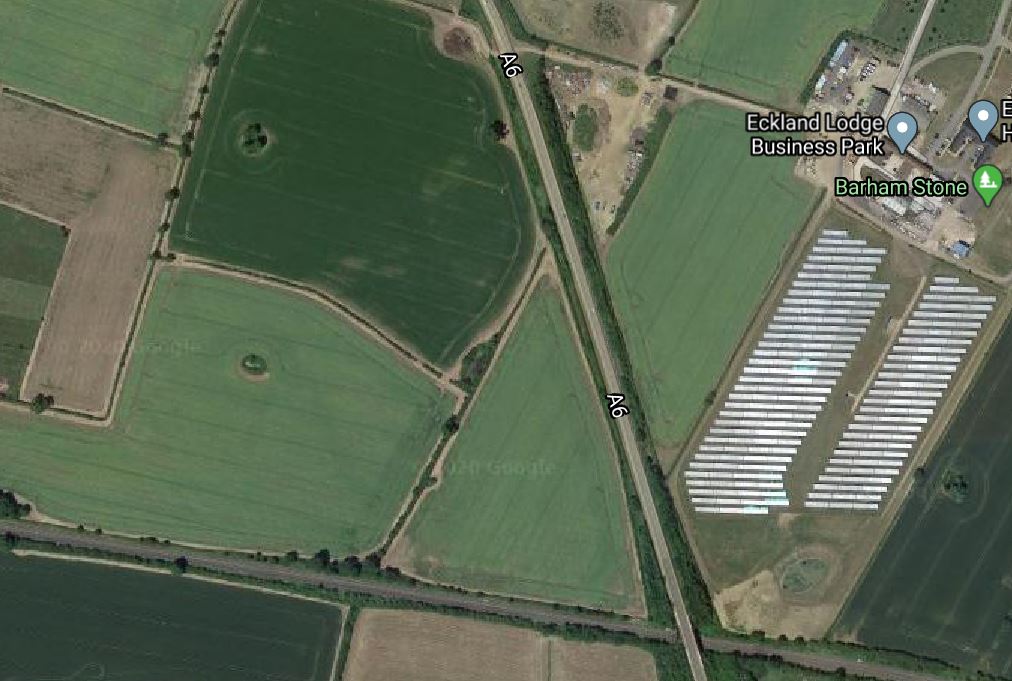
Note.
- The A6 crossing the Midland Main Line.
- The solar farm in the South-facing field, which has a 3MW capacity, according to the Eckland Lodge Business Park web site.
- Various planning documents say the transformers on the substation will be 400/25 kV units.
- This means that the power-line in the area must be a 400 kV.
Unfortunately, I can’t pick out the line of 400 kV pylons marching across the countryside. But they are rather large.
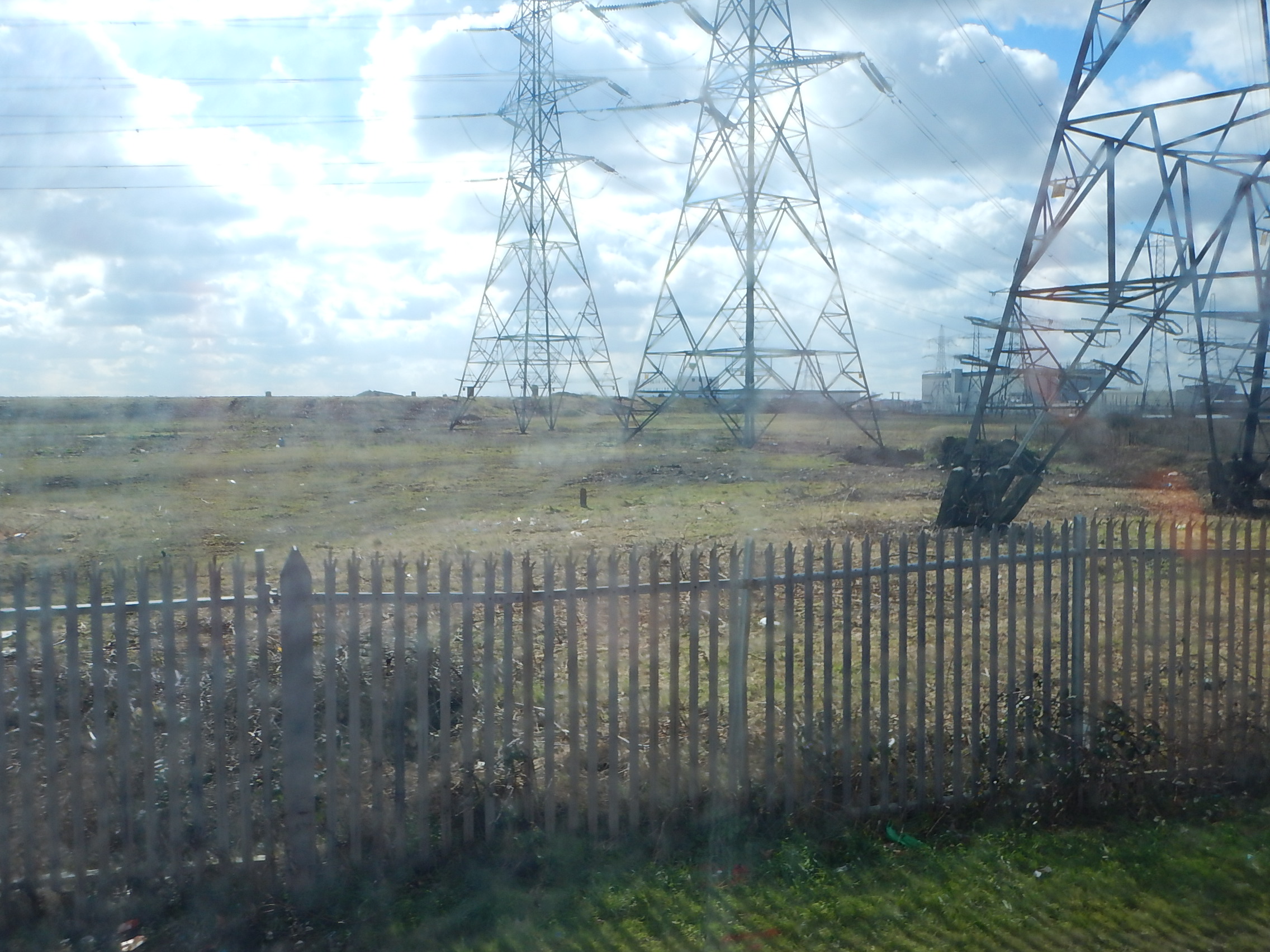
The pictures show a group of 400 kV pylons near Barking.
- The Midland Main Line at Braybrooke certainly seems to be getting a solid supply of electricity.
- It was originally planned, that the electrification would go all the way, but it was cut back to Kettering and Corby a couple of years ago.
- But to power, the electrification to Corby, it is being extended all the way to Braybrooke, so that the electrification can act as a giant extension lead for the Corby Branch Line.
The page on the Harborough Rail Users Site says this.
The Braybrooke substation is still planned, however, and the DfT has advised that the bi-mode trains will be able to switch power mode at speed. They would therefore be able to continue running electrically north from Kettering as far as Braybrooke before ‘pan down’
It would appear, that the end of the electrification will be at Braybrooke, but the sub-station seems to have enough power to extend the electrification further North if that is ever planned.
I also think, that is rather an efficient and affordable solution, with very little modification required to the existing electricity network.
But not all electricity feeds to railway electrification have a convenient 400 kV line at a handy site for installing all the needed transformers and other electrical gubbins.
How Much Power Will Needed To Be Supplied At Braybrooke?
This can probably be dismissed as the roughest or rough calculations, but the answer shows the order of magnitude of the power involved.
Consider.
- Braybrooke must be sized for full electrification of the Midland Main Line.
- Braybrooke will have to power trains North of Bedford.
- If there is full electrification of the Midland Main Line, it will probably have to power trains as far North as East Midlands Parkway station, where there is a massive power station.
- Trains between Bedford and Market Harborough take thirty minutes.
- Trains between Bedford and Corby take around thirty minutes.
- Four trains per hour (tph) run between Bedford and Market Harborough in both directions.
- The system must be sized to handle two tph between Bedford and Corby in both directions.
- The power output of each Class 360 train, that will be used on the Corby route is 1,550 kW, so a twelve-car set will need 4.65 MW.
- I can’t find the power output of a Class 810 train, but an InterCity 125 with similar performance has 3.4 MW.
- A Class 88 bi-mode locomotive has a power output of 4 MW when using the electrification.
I estimate that Braybrooke could have to support at least a dozen trains at busy times, each of which could need 4 MW.
Until someone gives me the correct figure, I reckon that Braybrooke has a capacity to supply 50 MW for trains on the Midland Main Line.
A Highview Power system as proposed for Vermont, would have enough power, but would need a lot more storage or perhaps local wind or solar farms, to give it a regular charging.
Riding Sunbeams
Riding Sunbeams are a company, who use solar power to provide the electricity for railway electrification.
I’ll let their video explain what they do.
It’s a company with an idea, that ticks a lot of boxes, but would it be able to provide enough power for a busy electrified main line? And what happens on a series of rainy or just plain dull days?
Highview Power
Could a Highview Power energy storage system be used?
- To store electricity from local or grid electrical sources.
- To power the local electrification.
If required, it could be topped up by affordable overnight electricity, that is generated by wind power.
The Highview Power system could also be sized to support the local electricity grid and local solar and wind farms.
Conclusion
I think that Riding Sunbeams and Highview Power should be talking to each other.
Highview Power Keeping Up Momentum
The title of this post is the same as that of this article on Gas World.
This is the introductory paragraph.
It’s full steam ahead for Highview Power as the energy storage provider’s CEO and President today updated on operations.
It does look thatHighview are optimistic since their partnership with Sumitomo Heavy Industries was announced, that I wrote about in Japanese Giant Sumitomo Heavy Invests In Liquid-Air Energy Storage Pioneer.
I am optimistic too!
- Highview’s system uses no difficult technology or rare materials.
- The system can provide large amounts of storage, which we are going to need with all the wind farms we are developing.
- From my Control Engineering and mathematical modelling experience, I believe, these systems can be used to boost power, where it is needed, in the same way gas-fired power stations do.
But above all, Highview Power has created a standalone energy storage system for the Twenty-First Century, that catches the needs and moods of the Age!
Our energy system is changing and it not expressed any better, than in this article on Physics World, which is entitled Does The UK Need 40 GW Of Firm Capacity?
This is the opening sentence.
Whether it comes from nuclear plants or fossil fuel-fired power stations with carbon capture and storage (CCS), the UK will need 30-40 GW of new “firm” low-carbon baseload generation by 2050 to meet the net-zero emissions target, Greg Clark reportedly said.
I don’t think that the country will allow any Government of the UK to build that much nuclear capacity and I have my doubts about the feasibility of large scale CCS. I also don’t think, the public will allow the building of large coal-fired power stations, even with CCS. And they don’t like nuclear either!
On Wikipedia, Wind Power in the UK, says this about the current Round 3 of proposals for wind farms.
Following on from the Offshore wind SEA announced by the Government in December 2007, the Crown Estate launched a third round of site allocations in June 2008. Following the success of Rounds 1 and 2, and important lessons were learnt – Round 3 was on a much bigger scale than either of its predecessors combined (Rounds 1 and 2 allocated 8 GW of sites, while Round 3 alone could identify up to 25 GW).
If you think UK politics is a lot of wind and bluster, that is pussy-cat’s behaviour compared to the roaring lions around our shores.
Wikipedia then lists nine fields, with a total power of 26.7 GW, but some are not being built because of planning.
But we ain’t seen noting yet!
Wikipedia says this about Round 4.
Round 4 was announced in 2019 and represented the first large scale new leasing round in a decade. This offers the opportunity for up to 7GW of new offshore capacity to be developed in the waters around England and Wales.
The Agreements for Lease will be announced in 2021.
Wikipedia then makes these points.
- Nuclear power stations have funding and technical problems.
- Since the Fukushima nuclear disaster public support for new nuclear has fallen
- The UK government increased its previous commitment for 40 GW of Offshore wind capacity by 2030, in the Queen’s Speech in December 2019.
- In 2020, this represents a 355% increase in ten years.
- It is expected the Crown Estate will announce multiple new leasing Rounds and increases to existing bidding areas throughout the 2020-2030 period to achieve the governments aim of 40 GW.
- The Scottish Government has plans to chip in 6 GW.
I will add these feelings of my own
- I have ignored the contribution, that better wind-power technology will make to get more GW for each billion pounds of investment.
- I can see a day, in the not too distant future, when on a day in the summer, no electricity in the UK comes from fossil fuel.
- There will be a merging between wind power and hydrogen generation, as I described in ITM Power and Ørsted: Wind Turbine Electrolyser Integration.
- Traditional nuclear is dead, although there may be applications for small nuclear reactors in the future.
- In parallel to the growth of wind power, there will be a massive growth of solar power.
But we will need to store some of this energy for times when the wind isn’t blowing and the sun isn’t shining.
- Pumped storage hydroelectric schemes, as at Electric Mountain in Snowdonia may have a part to play as I described in The New Generation Of Pumped Storage Systems. But sadly, the UK doesn’t have the terrain for another 9.1 GWh scheme.
- A lot of electricity will be converted to hydrogen to power industrial processes and augment and possibly replace natural gas in the UK’s gas network.
- Some electricity will be stored in batteries in houses and vehicles, when it is most affordable and used, when it is more expensive.
- Companies and funds, like Gresham House Energy Storage Fund will fund and build storage facilities around the UK.
- Traditional lithium-ion batteries require a lot of expensive raw materials controlled by the Chinese!
- But if we develop all these options, and generate tens of GWs using renewables, the UK will still need a substantial amount of GW-scale affordable energy storage systems.
It is my belief, that Highview Power is the only practical GW-scale affordable energy storage system.
My only worry about their system, is that the idea could be ripped off, by an unscrupulous country with a solid process plant industry!
To Revive Economy, Think Infrastructure
The title of this post is the same as that of this article on CommonWealth.
This is the sub-title.
It worked in the Great Recession and it can work now.
The author is talking about Massachusetts in 2008, but I’m sure it would work in the UK and other countries in 2020.
Projects I would bring forward in the UK.
- Build lots of wind farms, both onshore and offshore.
- Build energy storage. I would go for Highview Power.
- Use wind energy to generate hydrogen for industrial processes. ITM Power in Rotherham, have the technology.
- Build a refuelling network for hydrogen-powered cars, buses, trucks and other vehicles.
- Add new rail stations to the network, where needed.
- Update all possible rail, tram, light rail and Underground stations so they are step-free.
- Build the electrified Huddersfield and Leeds upgrade to the TransPennine Route.
- Expand the Blackpool Tram, the Edinburgh Tram, the Manchester Metrolink, Merseyrail, the Nottingham Express Transit, the Sheffield Supertram, the Tyne and Wear Metro and the West Midlands Metro.
- Extend the Docklands Light Railway West to Charing Cross, Euston, St. Pancras and Victoria.
I would setup a construction pipeline, so all areas of the country got a share of the new infrastructure.
We must be bold.
 The Anonymous Widower