Bamboo Sleepers Aimed At Middle Eastern Railways
The title of this post, is the same as that on this article on the Railway Gazette.
Sounds surprising, but the company founder and CEO, gives these advantages.
Avraham says that bamboo sleepers bring advantages in railway construction and renewal because the material does not require additional after-treatment with substances such as creosote in order to provide long term protection. It is also naturally impervious to insect infestation. This means the risk of soil and groundwater contamination from chemicals is minimised compared to alternative materials.
They are going to launch production with 50,000 tonnes of raw bamboo.
Solar Freeze
I found this simple idea on an awards web-site.
Solar Freeze is designed to solve this problem.
In much of the developing world, postharvest losses are as high as 80% and the cold‐storage chain is virtually non‐existent due to the high cost of equipment and spotty electricity. Because fresh produce can perish in a matter of days under ambient temperatures, temperature control alone can extend the shelf life by weeks or even months.
And this is their solution.
Solar Freeze is pioneering mobile cold storage units powered by renewable energy for rural smallholder farmers, to help them reduce the huge challenge of post-harvest loss in much of the developing world, postharvest losses are as high as 80% and the cold-storage chain is virtually non-existent due to the high cost of equipment and spotty electricity.
I do like the term spotty electricity!
They’ve come up with products like this mobile solar-powered cold room.
I’ve also found this video.
This is the sort of help and innovation, that a lot of the world needs.
Smartphone-Based Testing Device Cuts Time And Cost Of Diagnostics
The title of this post is the same as that of this article on The Engineer.
This is the sub-title of the article.
An inexpensive and sensitive smartphone-based testing device for viral and bacterial pathogens could reduce the pressure on testing laboratories during a pandemic.
These are a few important points from the article.
- The device has been developed by researchers and engineers at the University of Illinois.
- They are aiming for a $50 price.
- They started looking for a solution to look for viral and biological pathogens in horses.
- Tests work with a nasal or blood sample.
- Tests take about half-an-hour.
If this device can be productionised, so that millions can be turned out for their target price, this will be a major weapon in the fight against COVID-19.
Apparently, there is a great advantage of using horses in the trials of the device. The horse pathogens are harmless to humans, so it lowers the risk to researchers.
Thirsty High-Rollers … Mining’s Heavy Haulers Prime Candidates For Hydrogen Conversion
The title of this post, is the same as that of this article on ecogeneration.
You understand, what the author means about mining’s heavy haulers, when you open the article.
This paragraph describes their carbon emissions.
One large scale dump truck, depending on the haul road it is using, will use between 100 and 140 litres of diesel per 100km. These vehicles operate all day every day except for maintenance down time. That’s between 260kg and 360kg of CO2 per 100km per truck.
Large open pit mines have tens of these vehicles operating continuously, so the numbers build up very quickly.
The author then goes on to say why, that converting these vehicles to green hydrogen makes a lot of sense.
The dump trucks are already diesel/electric, which means that the diesel generator can be replaced with a hydrogen fuel cell and a battery.
Mining giant; Anglo-American will be introducing a prototype hydrogen-powered dump truck at a platinum mine in South Africa this year.
These paragraphs describe the transmission.
The vehicle, which is called a fuel cell electric vehicle (FCEV) haul truck, will be powered by a hydrogen fuel cell module paired with Williams Advanced Engineering’s scalable high-power modular lithium-ion battery system. Williams provides batteries for FIA’s E-Formula motorsport.
This arrangement will replace the existing vehicle’s diesel engine, delivering in excess of 1MWh of energy storage. The battery system will be capable of recovering energy through regenerative braking as the haul truck travels downhill.
Note that the truck has more energy storage than is proposed for a four-car battery-electric train, like the Class 756 train, which has only 600 kWh.
The author finishes with this concluding paragraph.
With the major mining companies focusing on making significant strides in decarbonisation by 2030 expect there to be more announcements such as this focusing this “low hanging fruit” for the mining industry’s to materially reduce its carbon foot print.
Reading this, I can’t help feeling that replacement of a Class 66 locomotive with a zero-carbon hydrogen-battery-electric hybrid unit could be possible.
Will Innovative Engineering Solve The PPE Gown Problem?
In the early 1970s, I worked as a programmer for various consultancies, who were doing innovative engineering. In one, which could have been Cambridge Consultants, where I worked for perhaps three months. One guy told me about a project he was working on, that was the automatic assembly of clothing.
I know more than a bit about making clothes, as my mother taught me how to knit, crochet, sew and use a sewing machine. In the early years of our marriage, I used to make dresses for C and in one instance, I made her a long heavy-weight winter coat.
So I am surprised, that innovative engineering has not come together to make hospital gowns automatically!
Let’s hope that some engineers have seen the gap in the market, and as I write, are putting together a machine, where you put material in one end and get gowns out the other. Neatly folded of course!
Automated Vegetation Monitoring Technology Deployed In Train Cabs
The title of this post, is the same as that of this article on Railway Gazette.
This is the introductory paragraph.
Transport for Wales has worked with technology company One Big Circle Ltd to fit trains with ‘smart’ cameras designed to automatically record, analyse and report lineside vegetation risks.
This is surely, a simple application of technology, that will spot vegetation problems, before they cause serious trouble.
ITM Power and Ørsted: Wind Turbine Electrolyser Integration
The title of this post is the same as that of this press release from ITM Power.
This is the introductory paragraph.
ITM Power (AIM: ITM), the energy storage and clean fuel company, is pleased to share details of a short project sponsored by the Department for Business, Energy & Industrial Strategy (BEIS), in late 2019, entitled ‘Hydrogen supply competition’, ITM Power and Ørsted proposed the following: an electrolyser placed at the wind turbine e.g. in the tower or very near it, directly electrically connected to the DC link in the wind turbine, with appropriate power flow control and water supplied to it. This may represent a better design concept for bulk hydrogen production as opposed to, for instance, remotely located electrolysers at a terminal or platform, away from the wind turbine generator, due to reduced costs and energy losses.
Some points from the remainder of the press release.
- Costs can be saved as hydrogen pipes are more affordable than underwater power cables.
- The proposed design reduces the need for AC rectification.
After reading the press release, it sounds like the two companies are performing a serious re-think on how wind turbines and their links to get energy on-shore are designed.
Will they be using redundant gas pipes to bring the hydrogen ashore?
I think, that they could go further than that!
- Imagine a very large wind farm built over a cluster of redundant gas-fields that are suitable for the storage of gas.
- The wind farm will produce hydrogen, which could be either sent to an onshore terminal or stored in one of the redundant fields.
- When hydrogen is needed onshore, it can come from the turbine/electrolysers in the wind-farm or from offshore storage.
- The pipeline to the shore would probably also be reversible and used to take carbon dioxide offshore for storage.
- If more electricity is needed onshore, the hydrogen is used as fuel for a gas-fired power station.
It sounds complicated, but hydrogen gives a lot of flexibility, as it is easily converted to and from electricity.
Controlling this network is a classic problem for Control Engineers and sophisticated computers will make sure, there is both enough electricity and gas.
The other application for combined wind turbines and electrolysers is where there is a need for moderate amounts of gas in the middle of nowhere.
Uses could include.
- Large farms all over places like East Anglia, much of North America, Australia and Serbia, where it would be used for motive power and heating.
- Islands like the Orkneys to decarbonise heating and transport and especially aviation and small ships like tugs and ferries.
- Hydrogen filling stations for trucks and other vehicles in places like the Mid West and large parts of Africa and Asia.
- Large transport depots, that switch from diesel to hydrogen might install their own combined wind turbine and electrolyser.
- Ports of all sizes will switch to hydrogen and smaller ports may well use combined wind turbines and electrolysers.
- Will isolated villages and small towns have their own combined wind turbines and electrolyser to bring a much needed gas supply?
I used to own a farm and I would certainly have looked at the technology to see, if it was worth installing.
It is my view, that combined wind turbines and electrolysers are one of those enabling technologies, that will find lots of different applications.
The Innovation Must Go On
This is a snippet I found on this news round-up on Rail Business UK.
Network Rail has issued a request for information on innovative techniques for undertaking tunnel renewals and enlargement while minimising blockades. NR said it manages 693 tunnels that are typically 150 years old; these require different and increasing levels of maintenance and renewal, but the growth of traffic means there is less access for maintenance.
Someone in Network Rail has got the engineering envelopes out again and is doing their thinking at home under lockdown, rather than in a real ale hostelry.
Companies and other organisations, should use COVID-19 as an opportunity to innovate.
Imagine the unthinkable and the downright bonkers, so long as it’s legal!
Think loony! You know it makes sense!
The New Generation Of Pumped Storage Systems
This excellent article on GreenTechMedia is entitled The 5 Most Promising Long-Duration Storage Technologies Left Standing.
One of the technologies the article discusses is pumped storage, which in the UK is used at the massive Electric Mountain in Snowdonia, which can hold 9.1 GWh of electricity and supply up to 1,800 MW of electricity when needed. That’s not bad for 1970s engineering!
The GreenTechMedia article introduces pumped storage like this.
Midcentury modern design is hot again, so why not midcentury storage technology? This gravity-based concept physically moves water from a low to a high reservoir, from which the water descends, when needed, to generate electricity. This dates from way before lithium-ion’s heyday and still provides some 95 percent of U.S. grid storage, according to the U.S. Department of Energy.
The largest pumped storage system in the US is Bath County Pumped Storage Station, which is described as the biggest battery in the world. With a storage capacity of 24 GWh of electricity and a generating capacity of 3,003 MW, it dwarfs Electric Mountain. But then the Americans have bigger mountains.
Pumped storage is a good partner for intermittent renewables like wind and solar, but in a country like the UK, the US and other countries with strong planning laws getting permission to build a large pumped storage system is not easy. We tried to build one on Exmoor, but that was abandoned.
Note that the country building the most new pumped storage systems is China, where they have mountains and planning laws, that would not be acceptable anywhere else.
But engineers have come up with a new design, described in this paragraph from the GreenTechMedia article.
The new school of pumped hydro focuses on isolated reservoirs that don’t disrupt river ecosystems; this simplifies permitting, but projects still face a decade-long development timeline and billion-dollar price tags.
It then gives two examples of proposed systems.
Gordon Butte Pumped Storage Project
The operation of the Gordon Butte Pumped Storage Project is described like this in Wikipedia.
Gordon Butte will be located on a 177 acres (0.72 km2) site, and will have access to water from Cottonwood Creek, a tributary of the Musselshell River. The facility will operate as a closed system, without actively drawing or discharging water into the watershed. It will have a 4,000 acre-foot capacity reservoir, located 1,000 feet (300 m) above the base, with a power generation capacity of about 400 MW
The smaller size must make it easier to get it built.
How much energy will Gordon Butte hold in GWh?
- A 4,000 acre-foot reservoir has a capacity of 4,933,927.42128 cubic metres.
- As a cubic metre of water weighs a tonne, the reservoir can hold 4,933,927.42128 tonnes of water at an altitude of 300 metres.
- Using Omni’s Potential Energy Calculator, this gives a potential energy of 4,032,108 KWh.
This is just over 4 GWh.
Ths facility could supply 400 MW for ten hours or 4 MW for a thousand hours!
It should be noted that Electric Mountain has an efficiency of 74-76%.
Eagle Mountain Pumped Storage Facility
Eagle Mountain Pumped Storage Facility is introduced like this on its web site.
The pumped storage hydropower project at Eagle Mountain, CA will transform a scarred brownfield site into a 1,300 Megawatt generator of green electricity that can light one million homes. The site is in a remote part of the Mojave Desert, more than 50 miles from the nearest city, Blythe, CA, and more than 60 miles from Palm Springs and the Coachella Valley. The construction of the project will create thousands of jobs and add millions of dollars to the local economy while adhering to the most rigorous environmental standards.
Note that it is turning an eyesore of the worst kind into a pumped storage facility. It’s surely better than using it for landfill!
Conclusion
Systems like these may have applications in the UK!
Could some of those massive quarries in the Peak District be converted into pumped storage systems, using the technology of my two examples?
This Google Map shows the quarries surrounding the town of Buxton.
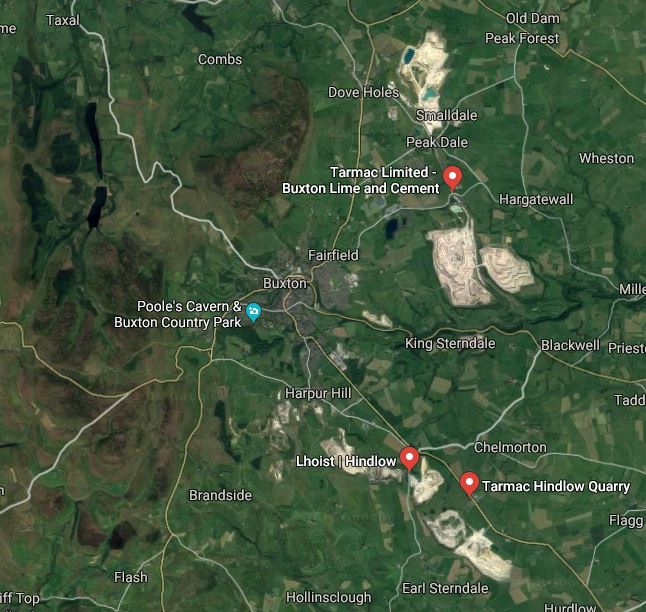
Note.
- The white areas looking almost like clouds are quarries.
- Buxton has an altitude of three hundred metres, which is the altitude of the Gordon Butte Storage Project.
- The vast Tunstead Quarry, which is four kilometres East of Buxton has an area of over one square mile.
- Tunstead Quarry has a red arrow above it marked Buxton Lime and Cement.
Could we not extract as much limestone as is possible from Tunstead and then convert it into a pumped storage system like Gordon Butte? It could have an area of 2.5 square kilometres and an altitude of nearly a thousand feet. A rough estimate, based on Gordon Butte, indicates it could store over 10 GWh.
Hopefully, better hydro-electric power engineers than myself, are looking at the quarries in the Peak District, with eyes flashing like cash registers.
There is one pumped storage project under development in the UK at the present time; Snowdonia Pumped Hydro, which obtained planning permission in 2017.
These are some characteristics.
- Situated in Snowdonia in old slate quarries at Glyn Rhonwy.
- 99.9 MW of power
- 700 MWh of storage capacity.
- 2 reversible turbines
- Start to full power in 12 seconds
- Cycle efficiency of around 81%
- Project lifespan of 125 years
- Estimated carbon saving of 50,000 tonnes per year
It is under a tenth the size to Electric Mountain, but every little helps.
I would also feel that with a 125 year life, it could be the sort of investment, that would appeal to a Pension Fund.
Ventilators On Click
Click, the BBC’s technology program has just shown an item about ventilator development.
They showed a picture of the dyson machine and video of several others.
- One created its own oxygen.
- One was designed for developing countries.
- One was designed to be a minimal size.
- One was designed to be 3D printed.
- One cost around five hundred euros.
Developments were also from several countries in addition to the UK, including Canada, France and Spain,
I think the world is on a path to get enough ventilators.
The program will be repeated in BBC Breakfast tomorrow!
 The Anonymous Widower