And Now Geothermal Rum From Cornwall!
This article on ThinkGeoenergy is entitled New Project To Bring You “Tropically” Matured Rum From Cornwall’s Geothermal Heartland.
This is the introductory paragraph.
What a product addition to the United Downs Deep Geothermal Project? Distillery startup Cornish Geothermal Distillery Company is pushing forward with plans to produce “tropically” mature rum using heat from the UK’s first geothermal power facility.
The Cornish Geothermal Distillery Company has a web site for more information.
This is a paragraph from the Think Geoenergy article.
In the release shared with us it is reported that Matthew Clifford, founder of the Cornish Geothermal Distillery Company (CGDC), has submitted outline plans for an ultra high-tech biome which would incorporate his patent-pending, carbon-neutral rum “cask maturation pods” designed by Grimshaw Architects alongside Buro Happold – globally recognised for innovative architecture that respects the planet’s resources whilst being functional and awe inspiring.
It seems to be an ambitious carbon-neutral project that could create up to a hundred jobs.
Holy Grail Of Energy Storage Receives Two Grants
The title of this post, is the same as that of this article on Off Grid Energy Independence.
This is the introductory paragraph.
RheEnergise is one of only a select handful of businesses to have been awarded grants under both the Sustainable Innovation Fund & the Small Business Research Initiative.
So what have RheEnergise developed?
The home page of their web site, is surprisingly detailed, unlike those of some other companies with new ideas, and not just energy storage companies!
This is the first paragraph on their home page.
RheEnergise is bringing innovation to pumped hydro storage. We call our new solution High-Density Hydro ™.
I think that is a good start, as although pumped hydro storage is well proven and the UK has the 1,728 MW Dinorwig Power Station, which has a storage capacity of 9.1 GWh, building new large pumped storage systems is fraught with difficulties and the technology has seen only modest innovation in the last few decades.
The next paragraph on their home page describes their innovation.
HD Hydro ™ uses our proprietary HD Fluid R-19 ™, which has 2.5x the density of water. R-19 gives RheEnergise projects 2.5x the power and 2.5x the energy when compared to water.
This means that for the same size of pumped hydro storage power station, you get 2.5 times the amount of energy storage.
Alongside a diagram of the system, the advantages of their systems is stated.
Projects can be installed on hills 2.5x lower than a project using water and still achieve the same power – for example, there are so many more hills at 150m than at 375m.
2.5x smaller, by volume, meaning dramatically lower construction costs, faster build times, easier reinstatement and easier landscaping – projects can be entirely hidden.
A very simple innovation has greatly increased the possibilities of pumped hydro storage.
The home page also gives a typical capacity.
RheEnergise projects provide 10MW to 50MW power and 2 to 10 hours of storage capacity.
These systems are in the same range as those of Highview Power, who are building a 50 MW system, with a five hour capacity at Carrington near Manchester, that I wrote about in Highview Power Breaks Ground on 250MWh CRYOBattery Long Duration Energy Storage Facility.
Both have the advantage, that they are easily scalable.
With RheEnergise’s HD Hydro ™, the size of the upper reservoir would need to be increased and with Highview Power’s CRYOBattery, more tanks for the liquid air would need to be added.
The Technology
I certainly agree with the principle behind ReEnergise, both mathematically and practically.
My interest scientifically, is what is the fluid they use?
- Pure water has a specific gravity of one and everything else is measured with respect to this.
- So aluminium, which has a specific gravity of 2.7, is 2.7 times as heavy as water.
- Many of us will be familiar with mercury, which is a metal, that is liquid at room temperature.
- Mercury has a specific gravity of 13.56.
It puzzles me, how someone has created a liquid, almost as heavy as aluminium, that can be pumped and handled like water, as it would need to be, to make a pumped storage system work.
Microwaves Could Turn Plastic Waste Into Hydrogen Fuel
This headline from this article in The Times could be the headline of the day!
Although thinking about it, it wouldn’t be a good idea to put all your plastic waste in the microwave and switch it on. It might catch fire or even worse create lots of hydrogen in your kitchen, which could be followed by a mini-Hindenburg disaster in the kitchen.
These are the introductory paragraphs.
From the yellowed bottles in landfill to the jellyfish-like bags clogging the oceans, plastics pollution is an apparently intractable problem.
Yet, chemists lament, it shouldn’t be. Within this waste there is something extremely useful, if only we could access it: hydrogen. Now a British team of scientists believes it has found a way to get at it, and do so cheaply, thanks to tiny particles of iron and microwaves.
If their system works at scale they hope it could be a way of cheaply converting useless plastic into hydrogen fuel and carbon.
Don’t we all want to believe that this impossible dream could come true?
Some Background Information
Some of the things I talk about will be technical, so I will have a bit of a preamble.
Hydrogen; Handling And Uses
Because of pre-World War Two airships, which tended to catch fire and/or crash, hydrogen has a bad reputation.
I used to work as an instrument engineer in a hydrogen plant around 1970. To the best of my knowledge the plant I worked in is still producing hydrogen in the same large building at Runcorn.
Hydrogen is one of those substances, that if you handle with care, it can be one of the most useful elements in the world.
It is a fuel that burns creating a lot of energy.
The only by-product of hydrogen combustion is steam.
It is one of the feedstocks for making all types of chemicals like ethylene, fertilisers, ammonia, pharmaceuticals and a wide range of hydrocarbons.
Hydrogen is a constituent of natural gas and in my youth, it was a constituent of town gas.
Hydrogen and hydrocarbons are involved in the manufacture of a lot of plastics.
In the future, hydrogen will have even more uses like making steel and cement, and powering railway trains and locomotives, and shipping of all sizes.
Hydrocarbons
According to Wikipedia, hydrocarbons are compounds consisting entirely of atoms of hydrogen and carbon.
In a kitchen, there are several hydrocarbons.
- If you cook by gas, you will probably be burning natural gas, which is mainly methane, which is a hydrocarbon
- Some might use propane on a barbecue, which is another hydrocarbon.
- I suspect you have some polythene or polyethylene, to use the correct name, in your kitchen. This common plastic is chains of ethylene molecules. Ethylene is another hydrocarbon.
- There will also be some polypropylene, which as the name suggests is made from another hydrocarbon; propylene.
Hydrocarbons are everywhere
Plastics
I used to work in two ICI divisions; Mond at Runcorn and Plastics at Welwyn Garden City
- The forerunners of ICI Mond Division invented polyethylene and when I worked at Runcorn, I shared an office, with one of the guys, who had been involved before the Second World War. in the development of polyethylene.
- Plastics Division used to make several plastics and I was involved in various aspects of research plant design and production.
One day, I’ll post in this blog, some of the more interesting and funnier stories.
Many plastics are made by joining together long chains of their constituent molecules or monomer.
- Ethylene is the monomer for polyethylene.
- Propylene is the monomer for polypropylene.
- Vinyl chloride is the monomer for polyvinylchloride or PVC.
So how are the chains of molecules built?
- Polyethylene was made by ICI. by applying large amounts of pressure to ethylene gas in the presence of a catalyst.
- They used to make polypropylene in large reaction vessels filled with oil, using another catalyst.
I suspect both processes use large quantities of energy.
Catalysts
A catalyst is a substance which increases the rate of a chemical reaction.
Judging by the number of times, I find new catalysts being involved in chemical reactions, the following could be true.
- There are processes, where better catalysts can improve yields in the production of useful chemicals.
- There is a lot of catalyst research going on.
Much of this research in the UK, appears to be going on at Oxford University. And successfully to boot!
Velocys
It should be noted that Velocys was spun out of Oxford University, a few years ago.
- The company appears to have improved the Fischer-Tropsch process.
- They are building a waste-to-aviation biofuel plant in Lincolnshire.
- They are backed by British Airways, Shell and UK plc.
This infographic shows their process.
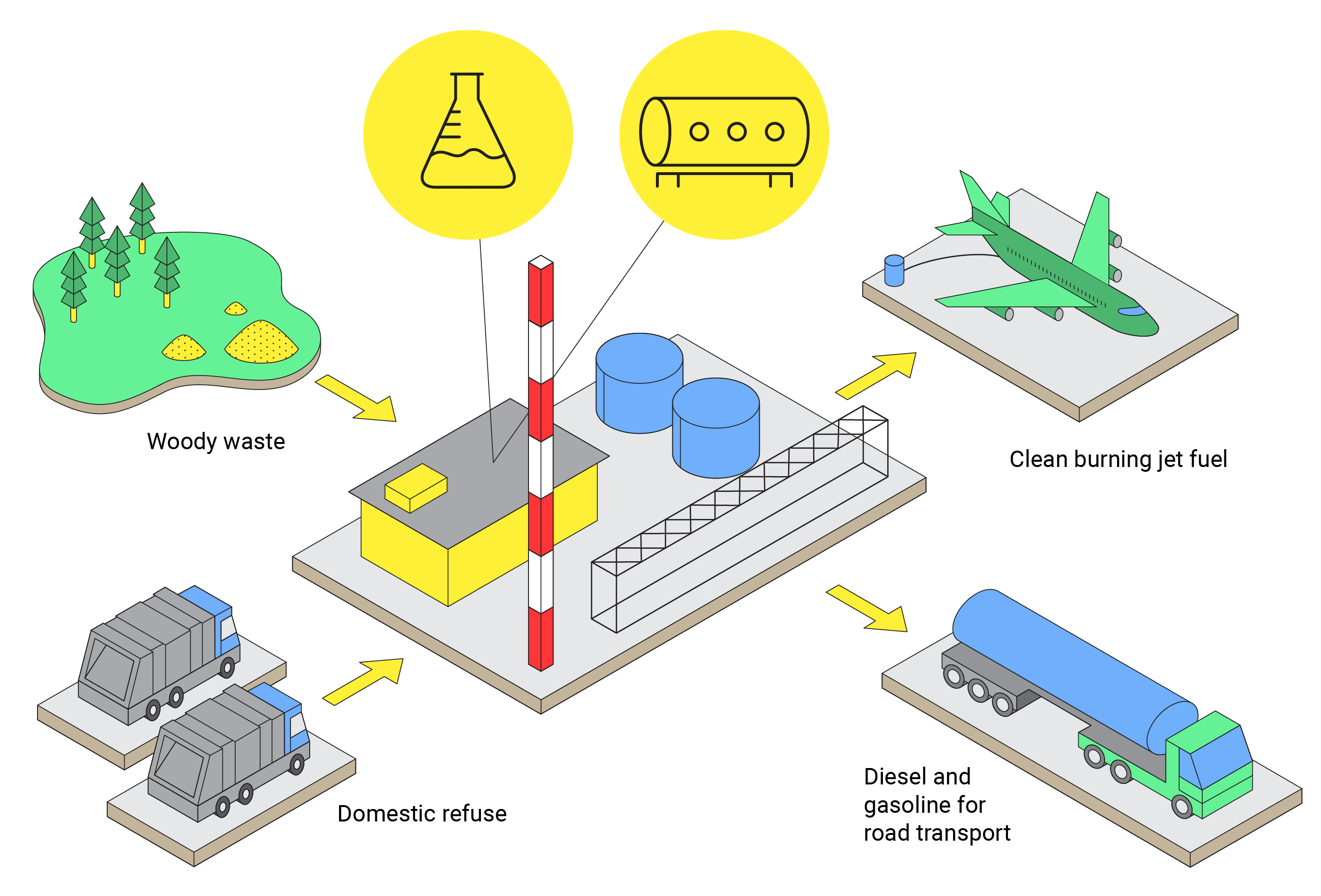
This could be a route to net-zero carbon aviation and heavy haulage.
The beauty is that there would need to be little modification to existing aircraft and trucks.
Oxford University’s Magic Process
These paragraphs from The Times article explain their process.
The clue came in research on particles of iron, and what happens when they get really small. “There’s a fascinating problem,” Professor Edwards said. “You take a bit of metal, and you break it into smaller and smaller bits. At what stage does it stop behaving like a copy of the bigger bit?”
When the particle gets below a critical size, it turns out it’s no longer a metal in the standard sense. The electrical conductivity plummets, and its ability to absorb microwaves does the reverse, increasing by ten orders of magnitude.
Professor Edwards realised that this could be useful. “When you turn on the microwaves, these things become little hotspots of heat,” he said. When he put them in a mix of milled-up plastic, he found that they broke the bonds between the hydrogen and carbon, without the expense and mess of also heating up the plastic itself.
What is left is hydrogen gas, which can be used for fuel, and lumps of carbon nanotubes, which Professor Edwards hopes might be of a high enough grade to have a use as well. The next stage is to work with industry to find ways to scale it up.
It sounds rather amazing.
Going Large!
This article from The Times on Friday, is entitled Plastic To Be Saved From Landfill By Revolutionary Recycling Plants.
These are the two introductory paragraphs.
Thousands of tonnes of plastic waste will be turned into new plastic in Britain rather than dumped in landfill sites, incinerated or sent overseas under plans for four new plants that will use cutting-edge recycling technology.
Up to 130,000 tonnes of plastic a year will be chemically transformed in the facilities, which are to be built in Teesside, the West Midlands and Perth.
It all sounds like technology, that can transform our use of plastics.
Conclusion
In the years since I left Liverpool University in 1968 with a degree in Electrical and control Engineering, it has sometimes seemed to me, that chemistry has been a partly neglected science.
It now seems to be coming to the fore strongly.
Can We Innovate Our Way Out Of Our Troubles?
One Of London’s biggest problems at the moment is the bridges across the Thames.
This article on the BBC is entitled London’s Bridges ‘Are The Capital’s Embarrassment’ and is typical of many.
Hammersmith Bridge is causing particular trouble and has been closed to all traffic for some time.
But then I saw this innovative solution to the Hammersmith Bridge problem.

Note.
- Hammersmith Bridge is still closed.
- A floating bridge has been added alongside for pedestrians and cyclists.
- The floating bridge uses parts of the old Blackfriars pier.
- There is an innovative floating pontoon, which is activated by the current, that is used in the middle of the river to transfer passengers across.
- New Civil Engineer thinks, the temporary bridge could become a tourist attraction.
The design made me smile.
SEA Electric And Toyota Team Up For Electric Trucks
The title of this post, is the same as that of this article on AuManufacturing.
These are the introductory paragraphs.
Toyota’s Hino truck division has announced a major foray into electric and hydrogen powered trucks, with Melbourne’s SEA Electric set to partner in the development of a new medium sized truck.
SEA Electric manufactures electric vehicle drive trains in Melbourne and has been converting Hino truck models to electric here and in the United States.
Now the company will partner with Hino in its global Project Z which will expand its range of largely diesel trucks.
It appears that electric and hydrogen powered vehicles are being developed.
This paragraph describes the powertrain.
Running the SEA Drive 120 a powertrain, it is mounted on on a cab/chassis platform. The 1470Nm electric motor and 136kWh battery pack delivers range of up to 350km (220 miles), and a typical breakeven period of less than 4 years.
They also claim to have eliminated the need for a battery cooling system.
Conclusion
I am drawn to these conclusions.
It seems that there are scores of small companies all over the world developing battery and hydrogen power systems for trucks, buses and trains.
As with SEA Electric and Hino, big manufacturers are often happy to tie up with smaller technology companies to create new products.
Another Product From Hyperdrive Innovation
My Google Alert for Hyperdrive Innovation has picked up this article on Yahoo, which is entitled RBW EV Roadster Is An Electric Take On The Classic MGB.
This is a paragraph from the article.
Managing Director Peter Swain said: “Our patented system places the electric motor at the rear of the car and Hyperdrive Innovation’s lithium-ion battery technology under the bonnet, which gives perfectly balanced weight distribution. Not only does this give the driver much better handling of the car, retaining that sports car feel, but it also affords maximum battery volume to be housed.
As Hyperdrive Innovation are a partner in Hitachi’s Regional Battery Train, does the MGB go like an electric train?
If I still drove a car, I would buy one.
Having driven a few classic roadsters in my time, what is said about the handling of the car is probably true and I could envisage a small manufacturer building a roaster to that design from scratch.
I used to work with a former Engineering Director of Lotus Cars. After his stories about the great Colin Chapman, I’m sure that fertile brain would now be designing an electric roaster to fit the niche of the classic Lotus Seven and Lotus Elan.
- Simple, but strong, steel or aluminium chassis.
- Fibreglass body
- Battery in the front.
- If the battery was well-forward, it would improve crashworthiness in a head on crash.
- Rear wheel drive.
We are uniquely positioned in the UK, with our motor racing heritage to design and build such a car in the UK.
Green Tugboats? ‘Revolutionary’ Hydrogen Ship Engine Unveiled In Belgium
The title of this post, is the same as that of this article on Business Green.
This is the first paragraph.
A “revolutionary” hybrid ship engine powered by green hydrogen and diesel has been unveiled today in Belgium, with developers claiming the innovation could cut CO2 emissions from ships, trains and electricity generators by up to 85 per cent.
The engine has been given the name BeHydro.
The first order has been received by the developers; ABC, for two 2MW dual fuel engines that will be installed on a hydrogen-powered tug for the Port of Antwerp.
Motors up to the size of 10 MW are under development.
This is the last sentence of the article.
In theory, any large diesel engine can be replaced by a BeHydro engine. The hydrogen future starts today.
It is a quote from the CEO of one of the companies involved.
Conclusion
This is a development to follow.
The BeHydro engine, with its dual-fuel approach, is claimed to cut carbon emissions by 85 %.
In the Wikipedia entry for ABC or Anglo Belgian Corporation, there is a section called Products. This is a paragraph.
The engines are found in use on large river barges such as those found on the Rhine, coastal freighters, fishing boats, ferries, tugboats (which typically use 2 engines), and other ships. Other applications include electricity generation, and pumping engines, engines for cranes, and locomotives (including the Belgian Railways Class 77 and Voith Maxima), as well as dual fuel (gas/oil) DZD engines.
I feel that that the BeHydro engine will keep the company busy.
Energy Storage Takes On Weird New Forms As Sparkling Green Future Takes Shape
The title of this post, is the same as that of this article on CleanTechnica.
The first section is entitled Gravity-Enabled Energy Storage Tested By Scotland’s Gravitricity and explains it well.
It then writes an interesting aside about pairing a Gravitricity system, with an idea from GE, in a section, which is entitled A Wind Power & Energy Storage Twofer, Maybe.
GE were proposing a lattice-style wind-turbine tower, so why not put a Gravitricity system inside?
Hence the maybe in the section title!
I can imagine an office or residential tower with a Gravitricity system built into the lift core in the centre of the building. Top the building with solar panels or wind turbines and you’re going some way towards a building that could be self-sufficient in energy.
Putting two and two together, so they add up to five, is the best way to improve efficiency.
The last section is entitled How To Do Energy Storage Without Any Energy Storage.
As I have never played a computer game, I don’t understand it, but it is based on research at two reputable universities; Delft University of Technology (TU Delft) in the Netherlands and Northwestern University in the US.
Conclusion
We will be seeing weirder and weirder ideas for energy generation and storage in the future.
New Energy Storage “Water Battery” Breakthrough: Look Ma, No Underground Powerhouse
The title of this post, is the same as that of this article on CleenTechnoca.
Pumped hydro storage as used at Dinorwig power station or Electric Mountain in the UK is a good way to store electricity.
But it is expensive to build and one of the major costs is building a large underground powerhouse. This is Wikipedia’s description of the construction of the powerhouse at Dinorwig.
Twelve million tonnes (12,000,000 long tons; 13,000,000 short tons) of rock had to be moved from inside the mountain, creating tunnels wide enough for two lorries to pass comfortably and an enormous cavern 51 metres (167 ft) tall, 180 metres (590 ft) long, and 23 metres (75 ft) wide[10] known as “the concert hall”. The power station comprises 16 kilometres (9.9 mi) of tunnels, one million tons of concrete, 200,000 tons of cement and 4,500 tons of steel.
That is big, but on the other hand, it reportedly paid for itself in two years.
According to the article, a company called Obermeyer Hydro Inc has come up with a new design of pumped storage turbine., which eliminated the need for an underground powerhouse.
- Cost savings of 45 % are claimed.
- Reading the full article, I get the impression, that a radical redesign of the reversible turbine will be a game-changer.
- I suspect, it could be of benefit in small countries like the UK, where pumped storage is expensive and faces strong opposition in certain areas.
It is also significant, that this appears to be successful innovation in an area, where it was thought we had reached the ultimate design.
Hitachi Rail To Acquire Perpetuum In Digital Expansion
The title of this post, is the same as that of this article on Railway Gazette.
This is the first two paragraphs.
Hitachi Rail Ltd has agreed to acquire Southampton-based condition monitoring specialist Perpetuum as part of a strategy to strengthen the use of digital technology in rail operations.
Established as a university spin-off less than a decade ago, Perpetuum developed the use of bogie-mounted self-powered vibration sensors to monitor the condition of rolling stock. Wireless equipment fitted to around 3 000 vehicles operating across three continents sends back real-time data about the performance of wheelsets, gearboxes, motors and bogies.
It seems to me, that Hitachi have bought an interesting company.
Let’s hope they develop the technology, but keep that development in Southampton.
 The Anonymous Widower