Can ‘Enhanced Rock Weathering’ Help Combat Climate Change?
The title of this post, is the same as that of this article on the BBC.
This is the sub-heading.
In a quarry surrounded by the din of heavy machinery Jim Mann crouches down and picks up a handful of tiny black rocks.
These three sentences introduce Jim and his magic dust.
“This is my magic dust,” he says with a smile, gently rubbing them between his fingers.
He’s holding pieces of basalt. It’s a hard volcanic rock that is neither rare nor particularly remarkable.
But through a process known as ‘enhanced rock weathering’ it could help to cool our overheating planet.
This Google Map shows Orrock Quarry, where the basalt is mined.
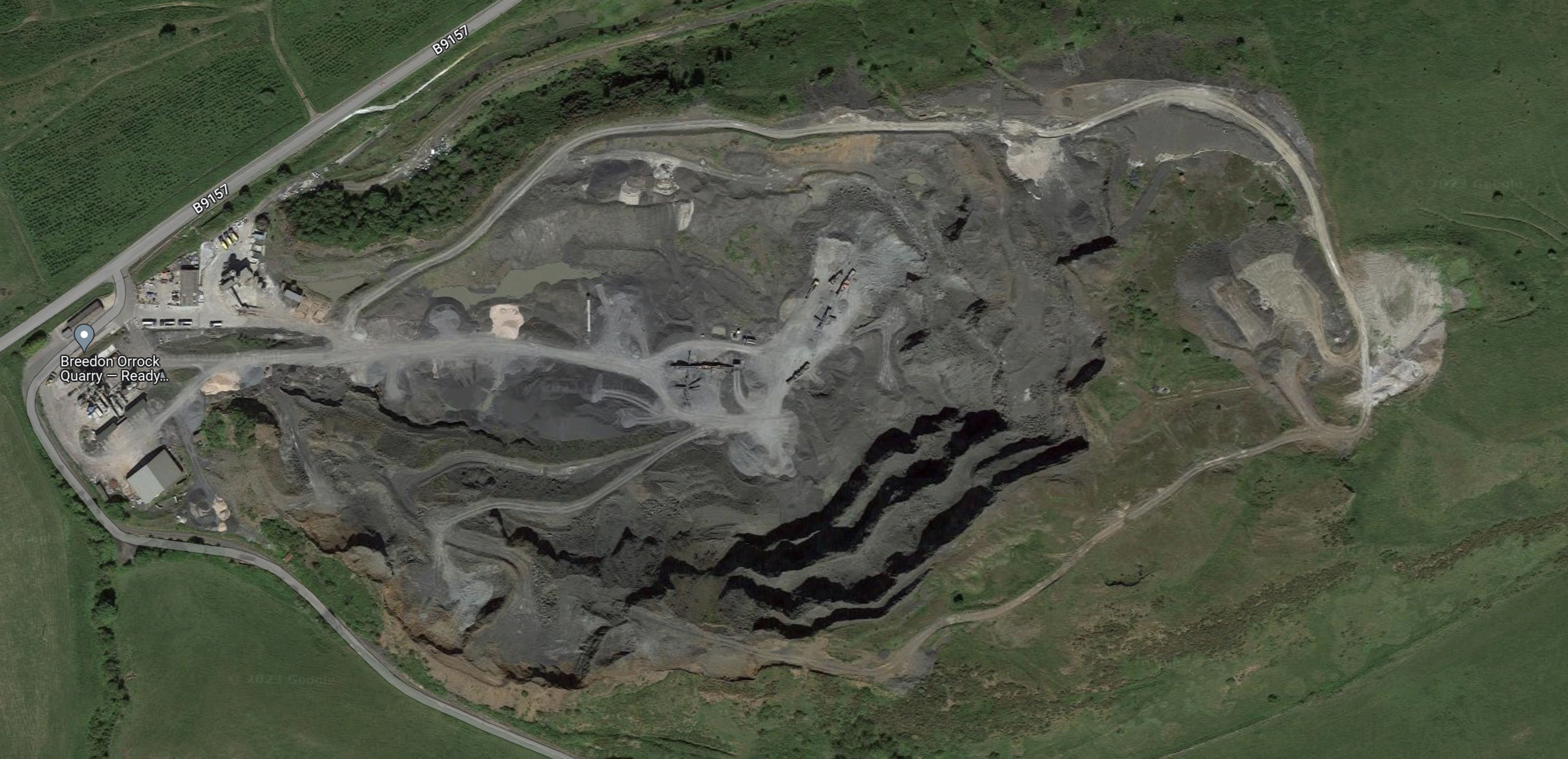
The article then gives a simple explanation of enhanced rock weathering.
When one of the companies, I’d backed won a green design award it was presented by David Bellamy. I remember having a very radical conversation with him, about some of the projects, where he’d been an advisor.
Some might have dismissive views about Jim Mann’s work as being too good to be true, but when I see the chemistry, I suspect,I’ll find it to be sound.
It would be a very interesting process to mathematically model!
£77 Million Investment For UK Heavy Duty And Commercial Vehicle Projects
The title of this post is the same as that of this press release from the Advanced Propulsion Centre.
These are the projects.
Ford to design, develop, and build a fleet of 8 hydrogen fuel cell powered Transit vans, with the latest advances in technology
£8 million awarded by government, matched by industry to a total £16.3 million.
This research project will design and develop a hydrogen fuel cell-powered version of the Ford Transit van, with a Ford Dagenham estate facility re-purposed for upfitting of the vehicle. By bringing the manufacturer, vehicle operator and supply chain businesses together, this project aims to establish a business case for the wider rollout of hydrogen Light Commercial Vehicles.
Project partners include: Ocado, BP, Cygnet Texkimp, Cambustion, Viritech.
Note.
- I suspect Ocado will do the road testing.
- BP will probably supply the hydrogen.
- Cygnet Texkimp are a company based in Northwich and is a leading global provider of fibre handling and converting technology. Have they developed a machine for knitting hydrogen fuel tanks?
- Cambustion‘s Engineering Services team provides powertrain development and testing services to a range of global clients from our Cambridge, UK base.
- Viritech’s web site has a mission statement of Rewiring the DNA of Hydrogen Powertrains.
Ford seem to have assembled a team of all the talents.
Wrightbus to develop a new world-leading zero-emission battery and hydrogen fuel-cell electric, multi-axle vehicles
£6.4 million awarded by government, matched by industry to a total £12.7 million.
This project will produce a new, market-leading platform for battery and fuel cell electric driven buses. Whilst demand is growing for zero-emission vehicles, there are currently few options available for heavy, multi-axle vehicles like large buses.
Project partners include: Queens University Belfast, Grayson Thermal Systems, Hutchinson Engineering, Translink.
Note.
- Grayson Thermal Systems are based in Birmingham and specialise in providing HVAC for vehicles and especially zero-carbon ones.
- Hutchinson Engineering are based in Widnes and invest in state-of-the-art machinery and technology to give our customers the most advanced, cost-effective solutions in design, fabrication and manufacturing.
- Translink provides public transport in Northern Ireland.
It looks like Wrightbus have excellent partners.
ULEMCo creating a zero-emission hydrogen fuel cell range extender for prototype ambulance, fire engine and road sweepers
£3.9 million awarded by government, matched by industry to a total £7.9 million.
This project will develop a hydrogen fuel cell range extender for electric vehicles used for special purposes, such as ambulances, fire engines and street sweepers. The zero-emissions range extender will be based on existing, proven technology from the Toyota Mirai, and demonstrate how zero emissions vehicles can be used in a wide range of specialised and challenging settings.
Project partners include: Altair Engineering, Emergency One, Technical Services Ltd, Oxon Fire & Rescue Services
Note.
- ULEMCo are based in the Liverpool City Region and it is very much in Liverpudlian DNA to repurpose something that works. Hence the use of The Toyota technology.
- Altair Engineering is a multinational engineering and technology company.
- Emergency One is a Scottish manufacturer of fire engines and emergency vehicles.
- Technical Services Ltd, who are based in Cleckheaton, supply thermal management systems and solutions.
- Oxon Fire & Rescue Services will obviously be doing the testing.
In Hydrogen-Powered Ambulance Drives Into Glasgow Ahead Of London Trial, I wrote about a prototype hydrogen-powered ambulance, that was built by ULEMCo and industry partners, that was shown at COP26.
Is this project turning the prototype into a system, that can be manufactured in large volumes?
Bramble Energy developing a hydrogen double-deck bus, using innovative, low-cost fuel cell technology
£6.3 million awarded by government, matched by industry to a total £12.7 million.
This project will demonstrate a fuel cell/battery hybrid powertrain on a double-decker bus. This novel product will be cheaper than the equivalents currently available for large vehicles like buses and uses innovative new electronics and energy recovery technologies.
Project partners include: University of Bath, Equipmake, Aeristech
Note.
- Bramble Energy‘s Printed Circuit Board Fuel Cell (PCBFC™) is a patent protected, revolutionary design which leverages existing manufacturing routes from the printed circuit board industry to offer a cost-effective, scalable hydrogen fuel cell solution.
- Equipmake are based at Snetterton in Norfolk.
- In Equipmake Hybrid To Battery Powered LT11, I describe Equipmake’s conversion of a New Routemaster to battery operation.
- Aeristech are based in Crawley and have developed a range of award-winning compressors for Tier-1, OEMs and other customers.
- Is the compressor needed to pump a mixture of hydrogen and air through the fuel cell?
I have a feeling, that this could be a very revolutionary design.
BorgWarner developing hydrogen combustion systems for heavy-duty commercial transport
£4.9 million awarded by government, matched by industry to a total £9.8 million.
This project aims to speed up the rollout of hydrogen-burning internal combustion engines, as an alternative to diesel. Hydrogen is a clean fuel, producing only water when burned. Project Cavendish will develop new fuel and air management systems, so that existing heavy duty diesel technologies can be repurposed to use hydrogen as fuel.
Project partners include: Mahle, Cambustion, Hartridge
Note.
- BorgWarner is a large American automotive supplier.
- Mahle is a large German automotive supplier.
- Cambustion‘s Engineering Services team provides powertrain development and testing services to a range of global clients from our Cambridge, UK base.
- Since the brand formation in 1930 Hartridge, who are based in Buckingham, has become a world leader in diesel fuel injection test equipment.
- Project Cavendish is obviously named after Henry Cavendish, who discovered hydrogen.
In Ricardo Supports Industry Leaders To Develop Innovative Dedicated Hydrogen Engine, I talk about another project involving BorgWarner. Is Project Cavendish a follow-on from the original project or a new one?
Leyland Trucks scaling up the production of electric trucks through innovations in automation and advanced testing
£2.6 million awarded by government, matched by industry to a total £5.1 million.
By better use of automation and advanced testing, Leyland Trucks aim to increase productivity and step up their production of battery electric trucks. A ‘digital twin’ of the Leyland production line will be set up, meaning any changes can be run in simulation before being rolled out physically.
Project partners include: Expert Tooling, HSSMI
Note.
- Leyland Trucks is one of Britain’s leading manufacturing companies. It is PACCAR’s established centre for light and medium duty truck design, development and manufacture. The company is based in Leyland.
- Expert Technologies are specialists in delivering industrial automation solutions. The company is based in Coventry.
- HSSMI is a sustainable manufacturing consultancy.
As I have done a lot of simulation in my time, I’m very much in favour of digital twins.
JLR leading a consortium research project to develop a high-efficiency and highly integrated 800V inverter designed and built in the UK
£6.3 million awarded by government, matched by industry to a total £12.6 million.
This project will explore and develop technology for inverters – a key component in electric vehicles. As well as developing a best-in-class product, this work will support the growth of a UK supply chain in components for electric vehicles.
Project partners include: University of Bristol, Custom Interconnect Ltd, API Capacitors Ltd
Note.
- JLR is Jaguar Land Rover.
- Custom Interconnect is an advanced electronics manufacturing company, which is based in Andover.
- API Capacitors is the UK’s leading designer and manufacturer of high quality power capacitors for power electronic applications. The company is based in Great Yarmouth.
I suspect this invertor will have several applications.
Conclusion
The grants seem to have been widely spread around the UK.
Fugro To Monitor Offshore Wind Biodiversity By Using eDNA Samples
The title of this post, is the same as that of this article on offshoreWIND.biz.
This is the sub-heading.
Dutch geo-data specialist company Fugro has launched the BeWild project, aimed at measuring biodiversity at offshore wind farms.
I have a feeling that this fishing-for-DNA technique could have lots of uses, including some very unusual ones.
The article is worth a detailed read and Fugro and their partners certainly seem to be doing a full investigation.
These three paragraphs list the partners and the things they will provide or research.
Support will be provided by Wageningen University which will focus on the DNA sequencing methodology of marine eDNA, researching the governance of these new forms of automated data collection to provide guidance on the design principles for the expansion of nature-inclusive wind energy infrastructures.
Additionally, Stichting de Rijke Noordzee will explore how to integrate biodiversity monitoring with regular asset inspection; Mecal – ATS will develop an improved scour protection system with the potential to enhance biodiversity; Seekable will optimise cable burial monitoring solution; and CrossWind will provide access to an operational wind farm for testing and investigations.
The BeWild project is being developed with the Mission-driven Research, Development, and Innovation (MOOI) subsidy from the Ministry of Economic Affairs and Climate, and implemented by the Netherlands Enterprise Agency (RVO).
It certainly appears very comprehensive.
Gazelle Wind Power Unveils Third Generation Floating Offshore Wind Platform Technology
The title of this post, is the same as that, of this press release from Gazelle Wind Power.
There is a visualisation in the press release and it looks very different.
This is the first paragraph.
Gazelle Wind Power (Gazelle), the developer of a modular floating offshore wind platform, is unveiling third generation technology this week at WindEurope 2023 in Copenhagen, Denmark. The company’s enhanced design further refines Gazelle’s solution to address the primary challenges facing the offshore wind industry—such as cost, supply chain bottlenecks, and sustainability—by providing a lightweight, cheaper design that minimizes the impact on fragile marine environments while using existing port infrastructure.
It looks like they’ve set themselves a tough set of objectives.
These are a few points from the press release.
- A one-gigawatt offshore wind farm using Gazelle’s solution would save 71 kt of steel and reduce emissions of approximately 100 kt of carbon dioxide.
- The company’s platform can be quickly and simply installed at project sites because it requires no specialist cranes or vessels.
- The platform’s unique geometry provides reduced draft in port, which means it floats higher in the water enabling the use of shallow ports.
- Through industrial innovation, the platform components can be adjusted to accommodate all forecasted offshore wind turbine sizes, including the current 15MW or greater capacities.
- Our platform can be produced anywhere in the world, supporting job creation through regionalized manufacturing.
When I look back on how offshore oil and gas platforms changed in the North Sea over a couple of decades, I’m not surprised to see this innovative design.
I wish the company the best of luck. But I don’t think they’ll need it!
Cheesecake Energy Collects £9.4m Government Funding
The title of this post, is the same as that of this article on UKTN.
These two paragraphs outline how they will use the grant.
Cheesecake Energy will use the government funding to install its energy storage solution as a microgrid in Colchester to help with local grid limitations.
University of Nottingham spinout Cheesecake Energy’s installation will collect energy made by a solar farm with a capacity of 8MW and a central heat pump that supplies a district heat pump network.
Cheesecake Energy have been on my list of possible successful energy storage systems for some time and this sounds like a very neat application for energy storage.
Cheesecake Energy bill themselves on their web site as The World’s Greenest Battery, which is a big claim to make.
This outline of their technology is given on their Our Technology page.
Cheesecake Energy’s eTanker energy storage system is a stationary, medium to long-duration energy storage solution which delivers cheap, reliable, efficient energy storage in a modular, containerised package.
The technology stores energy in the form of heat and pressurised air, re-tasking ex-service truck engines to become zero-emission electrical power-conversion machines for putting energy into storage and recovering it from storage. The resulting system does not use diesel or any fuel. It is safe, straightforward to operate, has a lifetime of up to 25 years and can deliver turnaround efficiencies of around 70%.
I like the idea of using recycled truck engines at the heart of the system.
Conclusion
The World’s Greenest Battery could be right!
ESB Invests In Floating Offshore Wind Mooring Tech
The title of this post, is the same as that of this article on offshoreWIND.biz.
This is the sub-heading.
Ireland’s Electricity Supply Board (ESB) has announced that it will invest in Dublin Offshore Technology (DOT), a company specialising in floating offshore wind mooring technology
These three paragraphs, outline the new relationship.
DOT has developed a technology solution for floating offshore wind mooring systems which provides significant design improvements for the wind farm, the company said.
The optimised mooring system delivers these benefits using locally-sourced materials tried and tested in the offshore environment with no degradation over the full lifetime of the wind farm, according to the Irish energy company.
By partnering with DOT, ESB will be able to leverage its expertise and resources to accelerate the development and delivery of its floating wind project portfolio.
In 13 Offshore Wind Projects Selected In World’s First Innovation And Targeted Oil & Gas Leasing Round, I wrote about how ESB and DOT were working together on Malin Sea Wind.
This update on the Dublin Offshore web site describes the Malin Sea Wind project.
In the early days of North Sea oil and gas, I saw relationships like these form and blossom. You could argue that the success of the project management system; Artemis, that I wrote, benefitted from close relationships with major oil companies and large international engineering companies.
History is just repeating itself.
Centrica Business Solutions Begins Work On 20MW Hydrogen-Ready Peaker In Redditch
The title of this post, is the same as that as this news item from Centrica Business Systems.
This is the sub-heading.
Centrica Business Solutions has started work on a 20MW hydrogen-ready gas-fired peaking plant in Worcestershire, as it continues to expand its portfolio of energy assets.
These three paragraphs outline the project.
Centrica has purchased a previously decommissioned power plant in Redditch, and is set to install eight UK assembled containerised engines to burn natural gas.
Expected to be fully operational later this year, the peaking power plant will run only when there is high or peak demand for electricity, or when generation from renewables is low. The Redditch project will have the capacity to power the equivalent of 2,000 homes for a full day when required, helping to maintain stability and reliability on the grid.
The engines will also be capable of burning a blend of natural gas and hydrogen, futureproofing the site and helping the UK transition towards a decarbonised energy system.
- The original power station had Rolls-Royce generators.
- Cummins and Rolls-Royce mtu and possibly other companies can probably supply the dual fuel generators.
- Cummins have received UK Government funding to develop hydrogen-powered internal combustion engines.
- This press release from Cummins, which is entitled Dawn Of A New Chapter From Darlington, gives more details on Cummins’ plans for the Darlington factory and hydrogen.
Given that Cummins manufactured sixty-six thousand engines in Darlington in 2021 and it is stated that these containerised engines will be assembled in the UK, I feel, that these engines may be from Cummins.
Centrica’s Plans
This paragraph in the Centrica Business Systems news item, outlines their plans.
The Redditch peaking plant is part of Centrica’s plans to deliver around 1GW of flexible energy assets, that includes the redevelopment of several legacy-owned power stations, including the transformation of the former Brigg Power Station in Lincolnshire into a battery storage asset and the first plant in the UK to be part fuelled by hydrogen.
As Redditch power station is only 20 MW, Centrica could be thinking of around fifty assets of a similar size.
Brigg Power Station
The Wikipedia entry for Brigg Power station gives these details of the station.
- The station was built in 1993.
- It is a combined cycle gas turbine power station.
- The primary fuel is natural gas, but it can also run on diesel.
- It has a nameplate capacity of 240 MW.
Brigg power station is also to be used as a test site for hydrogen firing.
This news item from Centrica is entitled Centrica And HiiROC To Inject Hydrogen At Brigg Gas-Fired Power Station In UK First Project.
These paragraphs from the news item explains the process.
The 49MW gas fired plant at Brigg is designed to meet demand during peak times or when generation from renewables is low, typically operating for less than three hours a day. Mixing hydrogen in with natural gas reduces the overall carbon intensity.
It’s anticipated that during the trial, getting underway in Q3 2023, no more than three per cent of the gas mix could be hydrogen, increasing to 20% incrementally after the project. Longer term, the vision is to move towards 100% hydrogen and to deploy similar technology across all gas-fired peaking plant.
HiiROC’s proprietary technology converts biomethane, flare gas or natural gas into clean hydrogen and carbon black, through an innovative Thermal Plasma Electrolysis process. This results in a low carbon, or potentially negative carbon, ‘emerald hydrogen’.
Because the byproduct comes in the form of a valuable, solid, pure carbon it can be easily captured and used in applications ranging from tyres, rubbers and toners, and in new use cases like building materials and even as a soil enhancer.
It looks to me, that HiiROC are using an updated version of a process called pyrolysis, which is fully and well-described in this Wikipedia entry. This is the first paragraph.
The pyrolysis (or devolatilization) process is the thermal decomposition of materials at elevated temperatures, often in an inert atmosphere. It involves a change of chemical composition. The word is coined from the Greek-derived elements pyro “fire”, “heat”, “fever” and lysis “separating”.
Pyrolysis is more common than you think and is even used in cooking to do things like caramelise onions. This is a video of a chef giving a demonstration of caramelising onions.
On an industrial scale, pyrolysis is used to make coke and charcoal.
I came across pyrolysis in my first job after graduating, when I worked at ICI Runcorn.
ICI were trying to make acetylene in a process plant they had bought from BASF. Ethylene was burned in an atmosphere, that didn’t have much oxygen and then quenched in naphtha. This should have produced acetylene , but all it produced was tonnes of black soot, that it spread all over Runcorn.
I shared an office with a guy, who was using a purpose-built instrument to measure acetylene in the off-gas from the burners.
When he discovered that the gas could be in explosive limits, ICI shut the plant down. The Germans didn’t believe this and said, that anyway it was impossible to do the measurement.
ICI gave up on the process and demolished their plant, but sadly the German plant blew up.
It does look like HiiROC have tamed the process to be able to put hydrocarbons in one end and get hydrogen and carbon black out the other.
I wonder how many old and possibly dangerous chemical processes can be reimagined using modern technology.
It certainly appears that Centrica are not holding back on innovation.
Conclusion
I’ve never run a large electricity network. Not even a simulated one.
But I’m fairly sure that having a large number of assets of different sizes, that can be optimised to the load and the fuel available, creates a more reliable and efficient network.
Heavy energy users may even have their own small efficient power station, that is powered by gases piped from the local landfill.
Windeed’s Floater Solution Gets Bureau Veritas Nod
The title of this post, is the same as that of this article on offshoreWIND.biz.
This is the sub-heading.
Bureau Veritas has granted Approval in Principle (AiP) to Sweden-based Windeed for its low-weight and low-acceleration floater solution for offshore wind turbines.
These three paragraphs fill in more details.
The AiP is a significant milestone in the development of Windeed’s technology, which could offer competitive prices and lower levelised cost of energy (LCOE) compared to other solutions on the market due to its industrialised manufacturing process, the developer said.
Bureau Veritas provided testing and assessment to ensure the solution is safe, reliable, and ready for deployment.
The approval in principle is a testament to the quality and innovation of the company’s technology.
I have been waiting some months for a new more efficient float for offshore wind turbines and then Gazelle Power Systems and Windeed turn up with designs on the same day.
Pictures of Gazelle’s design are available on their web site, but Windeed’s web site is text only, although it does say this.
Our purpose is to provide superior technology and industrialization of floating offshore wind power, lowering costs and environmental impact, to meet the need of more and clean energy.
I wouldn’t be surprised to see other designs!
First Demonstration Of Low-Cost Green Hydrogen Tech Launched By Advanced Ionics
The title of this post, is the same as that of this article on Hydrogen Fuel News.
Advanced Ionics has announced its Early Access Program, sponsored by the Repsol Foundation. This program will be a paid pilot study. Their low-cost green hydrogen production processes are powered by the Symbion electrolyzer technology, which uses process waste heat and is up to 50% more efficient than other technologies. Through the Early Access Program, Advanced Ionics hopes to provide customers with confidence in the potential of its technology. The program is part of an effort from the foundation to support entrepreneurships spearheading industrial decarbonization tech.
Note.
- At a first glance this looks promising.
- Electrolysis and waste heat is suggesting high temperature electrolysis, which appears to be more efficient.
- I suspect that the Repsol Foundation has plenty of funds.
- Advanced Ionics have a comprehensive web site.
I shall add this to my list of electrolyser technology to watch.
Apollo to Work On Celtic Sea Multi-Connection Offshore Substations
The title of this post, is the same as that of this article on offshoreWIND.biz.
This is the sub-heading.
Celtic Sea Power has awarded the Aberdeen-based engineering consultants, Apollo, with the pre-FEED contract for the 400 MW Pembrokeshire Demonstration Zone Multi-connection Offshore Substation (PDZ MOS) and 2x 1 GW MOSs targeting The Crown Estate Refined Area of Search (RAoS) A offshore Wales
This is the first paragraph.
Located 19 kilometres off the Pembrokeshire coast, the PDZ MOS project is designed to allow offshore renewable energy technology developers easy access to a consented test site complete with a grid connection to prove their technology in the offshore environment.
Sounds like the sort of infrastructure that is needed, so you can tow up your experimental floating wind turbine, secure it and just plug it in.
 The Anonymous Widower