Invinity’s New Flow Battery Aimed At Enabling ’24/7 Solar’ For The Grid
The title of this post, is the same as that of this article on Solar Power Portal.
These three paragraphs outline the story.
New vanadium redox flow battery (VRFB) technology from Invinity Energy Systems makes it possible for renewables to replace conventional generation on the grid 24/7, the company has claimed.
Anglo-American flow battery company Invinity launched its new product, Endurium, today. It follows around three years of R&D, testing, and prototyping, during which Invinity has partnered with Siemens Gamesa on technology development.
Designed for high energy throughput with unlimited cycling and with at least a 50% reduction in the footprint required for installation at project sites, the company said it could cost-competitively tackle present-day energy storage markets and emerging long-duration energy storage (LDES) opportunities alike.
This looks like it could be a bit of a breakthrough.
After reading this article, it would appear that traditional lithium-ion battery energy storage systems (BESS) now have another competitor along with Highview Power’s liquid air battery.
Gresham House Energy Storage Sets GBP80 Million Fundraise
Gresham House Energy Storage Fund must be doing something right, as similar headlines are used in half-a-dozen places on the Internet and they regularly seem to be raising more money.
But then, as a Graduate Control Engineer and a previous owner of half a finance company, I’ve always thought raising money to build batteries was a good idea.
My only niggle with Gresham House, is that I would have thought by now, they would have put some money into building one of the excellent new technology batteries that are coming through.
The storage fund or some of its employees, may of course have contributed to some of the crowdfunding for these new technologies, all of which I feel have a good chance of being a success.
Note.
- Energy Dome is Italian and all the others are at least fifty percent British.
- Most of the British batteries have had backing from the UK government.
- All these batteries are environmentally-friendly.
- None of these batteries use large quantities of rare and expensive materials.
- Energy Dome even uses carbon dioxide as the energy storage medium.
In addition, in Scotland, there is traditional pumped storage hydro-electricity.
Project Iliad
This article on renews.biz has a slightly different headline of Gresham House To Raise £80m For US Battery Buildout.
This is the first two paragraphs.
Gresham House Energy Storage Fund is seeking to raise £80m through a share placing.
The new equity raised will primarily be used to finance 160MW of solar with co-located four-hour battery projects in California, US, known as Project Iliad.
The article then gives a lot of financial details of Project Iliad and Gresham House.
Will Gresham House be backing co-located solar/battery projects in the UK?
- In Cleve Hill Solar Park, I write about a co-located solar/battery project in Kent.
- This press release from National Grid is entitled UK’s First Transmission-Connected Solar Farm Goes Live, which also describes a co-located solar/battery project, being built near Bristol.
These two projects are certainly serious and could be pathfinders for a whole host of co-located solar/battery projects.
WillGresham House back some of this new generation?
UK Government Grants £30 Million For Long Duration Energy Storage Projects
The title of this post, is the same as that of this article on Solar Power Portal.
These two paragraphs outline the grants and their recipients.
The UK Department for Energy Security and Net Zero (DESNZ) is providing £30 million in grants for three long-duration energy storage (LDES) projects using novel energy storage technologies.
The three projects awarded funding are from Synchrostor, Invinity Energy Systems and Cheesecake Energy. Synchrostor and Cheesecake Energy are to receive £9.4 million each to fund thermal energy storage systems and Invinity Energy Systems receiving £11 million to develop a vanadium flow battery.
The UK Government seems to give out a lot of these grants for research and development purposes and from feedback I have received from recipients and also by applying my own experience, I am of the opinion, that they are spending tax-payers money more in a wise, rather than a foolish direction.
Cheesecake Energy
I wrote about Cheesecake Energy’s grant in Cheesecake Energy Collects £9.4m Government Funding.
The Government’s press release says this about Cheesecake’s grant.
Cheesecake Energy Ltd, Nottingham, which will receive £9.4 million to test their FlexiTanker technology which stores electricity using a combination of thermal and compressed air energy storage and uses a reversible air compression / expansion train to charge and discharge. They will then install pilot units at 2 sites within a microgrid development in Colchester.
If this project proves successful, it surely is one that can be duplicated in many places.
I have had my eye on Cheesecake Energy for some time and this could be their breakthrough.
Invinity Energy Systems
I first wrote about Invinity Energy Systems in UK’s Pivot Power Sees First Battery On Line By 2021.
The Government’s press release says this about Invinity’s grant.
Invinity Energy (UK) Limited, Scotland, which will receive £11 million to develop and manufacture their 7MW, 30MWh 4-hour Vanadium Flow Battery (VFB), the largest in the UK. Invinity will manufacture the 30 MWh VFB at the Company’s factory in West Lothian, Scotland. The location of the plant will be confirmed in due course.
In this article on renews.biz, which is entitled Invinity Wins Funds For 30MWh UK Battery, these two paragraphs introduce the project.
Invinity Energy Systems plc has today been awarded £11m in funding by the Department for Energy Security and Net Zero to build what it says is the largest grid-scale battery ever manufactured in the UK.
The £11m in funding will come from the Longer Duration Energy Storage Demonstration (LODES) Competition, with funding matched by Invinity’s, as yet unnamed, project partner.
These are other points from the article.
- It will be a fast-response 30MWh battery.
- The battery will be assembled at Bathgate in Scotland.
- It will operate as a stand-alone energy storage asset.
- It will be connected to the National Grid.
- Invinity’s vanadium flow batteries are an alternative to lithium-ion.
The aim is to go live by 2025.
This paragraph indicates the differences between a vanadium flow battery and a traditional lithium ion one.
Invinity said this battery is safer as they cannot catch fire, more durable as they do not degrade with use and are almost completely recyclable at the end of their 25+ year life, reducing environmental impacts and disposal costs for project owners.
I believe that there will come a point, when fully-developed vanadium flow batteries, will become very attractive for financial reasons to the successful energy storage funds like Gresham House and Gore Street.
If the UK government’s funding hastens the day, when energy storage funds feel that these new-fangled vanadium flow batteries are a safe investment, then it is money well spent.
It is not as though the money is going to an early start-up, as this page on the Invinity Energy Systems web site indicates at least a dozen installations.
This project for an as yet unnamed customer, which has a capacity of 30 MWh, is probably much bigger and the Government help is probably very much welcomed.
SynchroStor
SynchroStor was new to me, today.
The Government’s press release says this about SynchroStor’s grant.
Synchrostor, Edinburgh, Scotland, which will receive £9.4 million to build a Pumped Thermal Energy Storage (PTES) grid-connected demonstration plant operating at 1MW, with the ability to charge and discharge for a period of 10 hours, longer than current battery technology.
This page named Technology on their web site, explains their technology, both with words and diagrams.
It is probably the most complex technologies of the three batteries, but I don’t think that will be a problem.
Conclusion
The Government has given grants to three different storage technologies.
If all goes well three good sizable pilot plants will be created and those companies like Centrica, Gore Street, Gresham House, National Grid, Ørsted, SSE and others, will be able to judge, which system is best for their needs.
Ministerial Roundtable Seeks To Unlock Investment In UK Energy Storage
The title of this post, is the same as that of this press release from Drax.
These are the first two paragraphs.
Business leaders have met with UK Energy Minister the Rt Hon Greg Hands MP to discuss how the government could unlock significant investment in vital energy storage technologies needed to decarbonise the power sector and help ensure greater energy independence.
The meeting was organised by the Long-Duration Electricity Storage Alliance, a new association of companies, progressing plans across a range of technologies to be first of their kind to be developed in the UK for decades.
This press release, which I found on the Drax website, has obviously been produced by the four companies; Drax, Highview Power, Invinity Energy Systems and SSE Renewables.
Greg Hands MP, who is the Minister of State for Business, Energy and Clean Growth said this.
The Long-Duration Electricity Storage Alliance is a key part of our plan to get the full benefit from our world-class renewables sector. Government have already committed £68 million of funding toward the development of these technologies.
“This will support the UK as we shift towards domestically-produced renewable energy that will boost our energy security and create jobs and investment.
The three CEOs and a director from SSE, make statements about what they are doing and what they need from Government, which are all worth reading.
- Drax still needs planning permission for its flagship project at Cruachan, that is called Cruachan 2.
- SSE are saying that the massive 30 GWh Coire Glas pumped hydro scheme has full planning permission and is shovel-ready.
- Drax and SSE appear to be in favour of Cap and Floor regimes to support long term energy storage.
- Highview Power and Invinity Energy Systems appear very optimistic.
- Finance for capital cost is not mentioned. As billions will be needed for some of these schemes and the returns are very predictable, I assume that it has been promised.
After reading this press release fully, I too am optimistic.
Conclusion
I feel sure, that a sensible plan will evolve fairly soon, which will involve these four companies and possibly some others.
“Game-Changing” Long-Duration Energy Storage Projects To Store Power In Hydrogen, Compressed Air And Next-Gen Batteries Win UK Government Backing
The title of this post, is the same as that of this press release from EDF.
These are the first two paragraphs.
EDF UK has received £2 million in funding from the Department for Business, Energy & Industrial Strategy (BEIS) to support four innovative methods of storing energy for longer periods of time.
The four longer-duration energy storage demonstration projects will help to achieve the UK’s plan for net zero by balancing the intermittency of renewable energy, creating more options for sustainable, low-cost energy storage in the UK.
These are the projects.
Tech Transfer And Modification Of Metal Hydride Storage Used In Fusion Sector For Hydrogen (Protium) Storage
The project is described like this in the press release.
The first project will store electricity as hydrogen in a chemical form using depleted uranium hydride (UH3). The project will utilise Urenco’s depleted uranium liability – a waste product from fuel production and reprocessed spent MOX fuel – to safely store hydrogen as UH3, which has approximately twice the volumetric energy density as liquid H2. The project will see EDF R&D lead a consortium combining expertise in engineering and materials from University of Bristol, operating metal hydride storage at UKAEA and handling depleted uranium from Urenco.
Sounds like a good project. Especially, as it finds a use for Urenco‘s depleted uranium.
Pivot Power
Pivot Power, part of EDF Renewables, will work on two projects.
- Delivering Power On Demand From Solar PV Using 40MWh Vanadium Flow Battery Storage System
- Accelerate Commercialisation Of Zinc-Based Battery Storage
The first project was described in Longer Duration Energy Storage Demonstration Programme, Stream 1 Phase 1: Details Of Successful Projects.
This is what EDF says about the two projects which are linked.
Pivot Power, part of EDF Renewables, will support the delivery of two demonstration projects. The first project, delivered in partnership with Invinity Energy Systems plc (AIM:IES), will establish the feasibility of developing one of the UK’s largest storage-enabled solar power resources. If selected, Phase Two of this project, which includes a utility-scale 10 MW / 40 MWh Invinity Vanadium Flow Battery, would receive funding under the programme.
Pivot Power will also work alongside e-Zinc, with support from Frontier Economics, to ‘metalize energy’, deploying breakthrough technology that stores energy in zinc, an inexpensive and widely available metal that has a high energy density.
I’m a believer in storing energy in zinc, until it is proven, it’s not a good method.
The final project was also described in Longer Duration Energy Storage Demonstration Programme, Stream 1 Phase 1: Details Of Successful Projects.
The EDF press release adds this.
The final project will explore how electricity, converted into compressed air, can be stored in EDF’s existing gas storage facilities, where EDF Thermal Generation and R&D will partner with io consulting and Hydrostor.
I have a good feeling about this project.
Longer Duration Energy Storage Demonstration Programme, Stream 1 Phase 1: Details Of Successful Projects
The title of this post, is the same as that of this document from the UK Government.
This is the introduction.
Stream 1 aims to accelerate commercialisation of innovative longer duration energy storage projects through to actual demonstrations. During Phase 1, projects will be expected to mobilise their proposed technologies to prepare for potential deployment on the UK energy system.
These are the projects.
Ballylumford Power-to-X
This is the description of this project in Northern Ireland.
B9 Energy Storage will receive £986,082 to mobilise a 20MW membrane free electrolyser green hydrogen project. Using otherwise curtailed wind power, hydrogen produced will be stored in local underground salt caverns for later use as a fuel in transport and electricity sectors, creating a full-cycle hydrogen economy (production, storage, distribution and usage) on site.
Note.
Ballylumford power station is a 600 MW gas-fired power station, that provides half of Northern Ireland’s electricity.
A 20 MW electrolyser will produce just under nine tonnes of hydrogen per day.
This Google Map shows the location of the power station opposite the port of Larne.
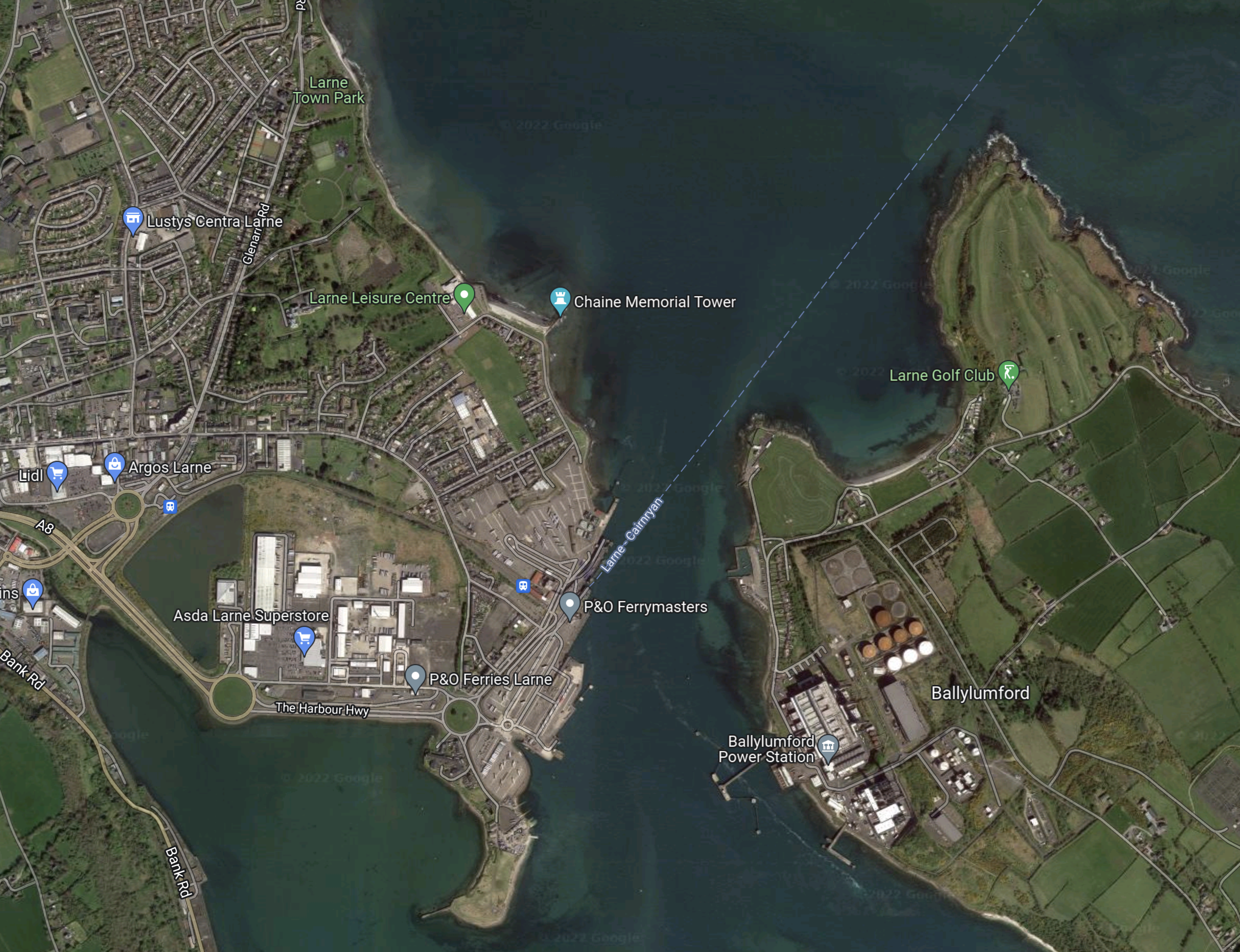
Note.
Ballylumford power station is clearly visible to the East of the channel towards the bottom of the map.
Ballylumford is also the Irish end of the HVDC Moyle interconnector from Scotland, which has a capacity of 500 MW.
Ballylumford would appear to have enough power for a large electrolyser.
Salt Beds In Northern Ireland
This document on the British Geological Survey web site is entitled Geological Storage In Northern Ireland.
The document discusses Irelands energy needs and gives a good description of using compressed air energy storage in salt caverns.
Then these two paragraphs describe the salt bed in Northern Ireland compare them to other deposits under Great Britain.
Thick halite deposits, found both onshore in Northern Ireland and immediately offshore in the North Channel, offer potential for salt cavern storage facilities. The salt deposits occur as bedded deposits with minor halokinesis (geological movement of salt) forming salt swells rather than pillows or domes so that the height of any cavern may be restricted by bed thickness. Pure salt beds tend to be thin (approximately 100-250 metres maximum thickness) compared to those used elsewhere and the presence of significant insoluble impurities and minor intrusive dolerite dykes or sills may reduce their suitability.
The Larne and Carrickfergus area of County Antrim is the only part of the whole island where thick salt beds occur. Elsewhere in the UK parts of Cheshire, Lancashire, Teesside, Humberside and Dorset have similar, or thicker, developments of salt beds and gas storage facilities are either in construction, or are already in operation.
It would appear that the thick salt beds in the Larne and Carrickfergus area could be suitable for gas storage.
Ballylumford might actually be on top of the salt beds, as Carrickfergus is a few miles to the South.
On a personal note, I used to work for ICI Mond Division and during that time and immediately afterwards, I met many people, who had been into the salt mines and worked with boreholes extracting the salt and the one thing everybody said about the salt mine, was that water must not get in.
Membrane-Free Electrolysis
I saw this in operation when I worked at ICI Mond. Most of their hydrogen and chlorine was produced using the main Castner-Kellner process at Castner-Kellner works in Runcorn. That is a nasty process that uses a lot of mercury, which got into the air and plant operators’ bodies.
But ICI also had a much smaller plant, where they used simple electrolysers, that had a metal cell, with a concrete top, with the anode and cathode going through the concrete into the brine. I seem to remember that its main purpose was to provide mercury-free hydrogen, chlorine and sodium hydroxide. I can remember seeing workers rebuilding the cells, as was done on a regular basis.
These were membrane free electrolysers and had been running successfully for many years.
Searching the Internet for “membrane free electrolyser” I found a company in Doncaster called CPH2.
The home page on their web site declares
Clean Power Hydrogen are the manufacturers of the unique Membrane-Free Electrolyser
Turning to the About page, this is said.
Being passionate about hydrogen as clean energy for the future, we wanted to find an alternative to PEM electrolysers as these had barriers to adoption. We realised that the cleanest way to produce hydrogen was by membrane-free water electrolysis, and in doing so, it would be a less expensive and more robust technology.
Dr. Nigel Williamson and Joe Scott established CPH2 (Ireland) in 2012 with the ambition to help clean up the environment for our children and future generations. Entering the green technology sector; a high growth and profitable market, they developed a Membrane-Free Electrolyser™ to produce hydrogen faster, more reliably, and more cost-effectively than other electrolysers.
They also have the ambition to be leading developer and manufacturer of green hydrogen technologies and an Irish connection.
My experience says that their technology will work. Especially, with the application of modern materials.
Have the Government backed the Ballylumford Power-to-X project, as they can back two promising technologies with one grant?
GraviSTORE
This is the description of this project.
Gravitricity Limited will receive £912,410.84 to design their multiweight energy store demonstrator project, which will store and discharge energy by lifting and lowering multiple weights in a vertical underground shaft.
Note.
- I like the Gravitricity concept and have invested through crowdfunding.
- The project will be based on a brownfield site in Northern England.
- Gravitricity’s current demonstrator in Edinburgh, which I wrote about in Gravitricity Celebrates Success Of 250kW Energy Storage Demonstrator, only uses a single weight, but this project talks about multiple weights.
According to other sources on the Internet, the demonstrator will have a storage capacity of 4 MWh and will be built on a brownfield site.
Will we see Gravitricity coming to a disused deep coal mine near you?
Long Duration Offshore Storage Bundle
This is the description of this project.
Subsea 7 Limited and FLASC B.V. will receive £471,760.00 to further develop the Long Duration Offshore Storage Bundle which will store energy as a combination of pressurised seawater and compressed air, using an innovative hydro-pneumatic technology.
Note.
- Subsea 7 Limited are a subsea engineering, construction and services company serving the offshore energy industry, domiciled in Luxembourg with headquarters in London.
- According to their web site, FLASC B.V. is a spin-off of the University of Malta, established in The Netherlands in 2019.
On the page on the FLASC web site, which is labelled The Technology, this is said.
FLASC is an energy storage device that can be integrated directly into a floating offshore platform. Energy is stored using a hydro-pneumatic liquid piston, driven by a reversible pump-turbine.
Charging Mode: electricity is used to pump water into a closed chamber containing pre-charged air.
Discharging Mode: the pressurised water is released through a hydraulic turbine to generate electricity.
FLASC leverages existing infrastructure and supply chains, along with the marine environment itself as a natural heatsink, resulting in a safe, reliable and cost-effective solution.
There is also this video.
The news page on the FLASC web site is a comforting read.
My knowledge of modelling vessel systems for chemical plants, tells my brain to like it.
Vanadium Flow Battery Longer Duration Energy Asset Demonstrator
This is the description of this project.
Invinity Energy Systems will receive £708,371 to demonstrate how a 40 MWh Vanadium Flow Battery could deliver long duration storage-enabled power on demand from UK-based solar generation.
Note.
- I wrote about Invinity Energy Systems in UK’s Pivot Power Sees First Battery On Line By 2021.
- Invinity Energy Systems was formed by a merger of RedT and Avalon Battery.
- The project appears to be located at Bathgate in Scotland.
This picture from EdF shows a large vanadian flow battery.
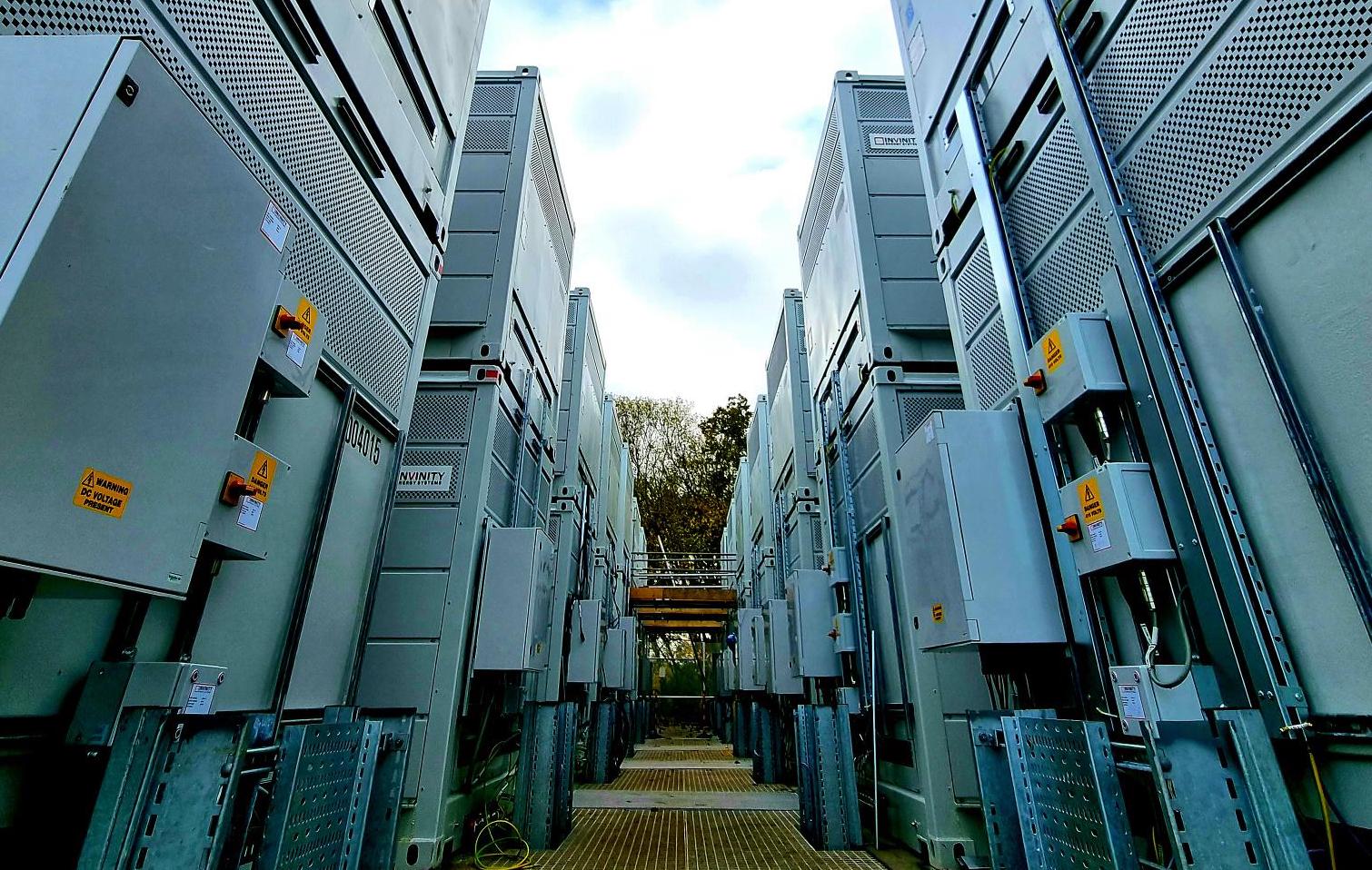
Invinity Energy Systems flow battery at Energy Superhub Oxford
If this project works out, vanadium flow batteries would be a good replacement for lithium-ion batteries.
Cheshire Energy Storage Centre
This is the description of this project.
io consulting will receive £1 million to enable its consortium to develop an electricity storage facility which could use mothballed EDF gas cavities in Cheshire utilising Hydrostor’s Advanced Compressed Air Energy Storage technology
Note.
- This is another project based on salt caverns.
- I wrote about Canadian company; Hydrostor in Gigawatt-Scale Compressed Air: World’s Largest Non-Hydro Energy-Storage Projects Announced.
- Hydrostor have received at least one large order for their system.
I have put Hydrostor on my list of tecnologies that should make it.
Conclusion
This is a well-balanced list of projects.
I would rate success as follows.
- Ballylumford Power-to-X – 60 %
- GraviSTORE – 80 %
- Long Duration Offshore Storage Bundle – 60 %
- Vanadium Flow Battery Longer Duration Energy Asset Demonstrator – 70 %
- Cheshire Energy Storage Centre – 80 %
But then all these projects are a bit of a gamble
UK’s Pivot Power Sees First Battery On Line By 2021
The title of this post, is the same as that of this article on Argus Media.
The article is a review of what is happening in the UK and this is the introductory paragraph.
UK firm Pivot Power is now targeting a 2021 start for its first two 50MW lithium-ion battery storage projects, while a 50MW liquid air energy storage project and another 50MW battery recently announced they were targeting completion by 2022.
The article gives several pieces of information about Pivot Power.
- Their two batteries are at Kemsley and Cowley.
- The two batteries appear to be running late.
- The company has a portfolio of forty projects with s total size of 2 GW.
- The Cowley battery will be co-located with a 2MW/5MWh Vanadium flow battery operated by storage firm redT.
- Pivot Power is owned by EdF.
Good to see redT involved, although they seemed to have merged with Avalon Battery to form Invinity Energy Systems. The new web site describes them as the world’s leading vanadian-flow battery company.
This page on the web site is the Press Release about the merger.
This paragraph from the Press Release, describes where vanadium flow batteries fit in the market.
Vanadium flow batteries are a form of heavy-duty, stationary energy storage, used primarily in high-utilisation applications such as being coupled with industrial scale solar generation for distributed, low-carbon energy projects. This sort of application requires daily, heavy use and is well suited to flow battery technology, which is expected to become a £3.5bn market by 2028.
I don’t know much about vanadium-flow technology, but this company could probably be added to a list of companies, who might make it.
 The Anonymous Widower