Official Quits After Dispute Over Trump’s Eisenhower Sword Gift To King Charles
The title of this post, is the same as that of this article on the BBC.
This is the sub-heading.
The director of the Dwight D Eisenhower Presidential Library has stepped down after a dispute with the Trump administration over gifting a sword in its collection to King Charles, according to the BBC’s US partner, CBS News.
These three paragraphs add more detail to the story.
Todd Arrington, the head of the library in Kansas, resigned on Monday after declining to remove an original sword from the library’s collection to give to the King during President Donald Trump’s visit to the United Kingdom last month, CBS reported, citing anonymous sources.
Charles was instead gifted a replica during Trump’s UK visit, Buckingham Palace said at the time.
In an interview with CBS News, Arrington said he was told to “Resign – or be fired”.
Trump had better watch himself, as the United States has armies of lawyers and I’m sure that the unfortunate Mr. Arrington will have some legal offers, he will find great advantage in accepting.
SeAH Steel Holdings’ UK Monopile Factory To Launch With Major Offshore Wind Deals
The title of this post is the same as that of this article on the CHOSUN Daily.
These three paragraphs give more details.
SeAH Wind, the British offshore wind structure subsidiary of SeAH Steel Holdings, is set to begin commercial operations at its local plant next month, bolstering annual revenue growth projected to reach billions of dollars. The facility has received a total investment of £900 million ($1.1 billion or 1.6 trillion won), and the company has already secured orders surpassing the plant’s construction costs, ensuring a solid foundation for stable operations, according to industry sources.
Located in Teesside, northeastern England, the plant is in the final stages of equipment installation and test production ahead of its commercial launch. The facility has an annual production capacity of up to 400,000 metric tons of monopiles—cylindrical steel structures welded from thick steel plates—which serve as seabed foundations for offshore wind turbines.
The £900 million SeAH Wind plant was established with support from various group affiliates. SeAH Steel Holdings founded SeAH Wind in the UK in 2021, initially investing approximately 400 billion won ($274 million or £217 million) in the facility. Additional funding was secured through capital increases, with contributions from SeAH Steel Holdings, its steel pipe subsidiary SeAH Steel, and overseas branches, including U.S.-based SeAH Steel America and South Korea-based SeAH Steel International.
As the UK’s sole offshore wind monopile supplier, SeAH Wind has attracted significant attention. On Feb. 13, King Charles III visited the plant to inspect its production facilities, underscoring its strategic role in the country’s renewable energy sector.
The plant is making monopiles for the Hornsea 3 and Norfolk Vanguard wind farms.
Crown Estate To Spend £1.5bn On New Laboratories
The title of this post, is the same as that of this article on The Times.
These three paragraphs introduce the Crown Estate’s plan.
The Crown Estate is to spend £1.5 billion over the next decade building more laboratories nationwide and will start by redeveloping the old Debenhams store in Oxford city centre.
The King’s property company, which looks after the royal family’s £16 billion historic land portfolio, will invest £125 million to buy the former department store and will turn it into laboratory space.
The building has been empty for omore than three years, having closed down in early 2021 after Debenhams collapsed during the pandemic. The Crown has bought a long leasehold of the store from DTZ Investors, the freeholder, which is keeping the street-level retail units. Subject to planning, construction is expected to start at the site next year, with the labs expected to be fully operational in 2027 or 2028.
This looks very much like a smaller version of British Land’s plan for the Euston Tower, which I wrote about in British Land Unveils Plans To Transform London’s Euston Tower Into A Life Sciences And Innovation Hub.
These are my thoughts.
Helping Start-Ups
I have been involved with perhaps half a dozen start-up ventures. Two were very successful and the others generally scraped along or just failed.
One common theme, was the lack of small convenient premises, where perhaps up to a dozen people could work.
- I don’t know Oxford well, but I would assume that the Debenhams site, is good for public transport and cycle parking.
- I also hope there’s a good real ale pub nearby, for some productive group thinking!
If this venture from Crown Estate helps start-ups to get over the first difficult hurdle, then it will be a development to be welcomed.
Location, Location, Location
It has been said, that the three most important things in property development are location, location and location.
This 3D Google Map shows the approximate location of the Debenhams building.

Note.
- The red arrow indicates a pub called the Wig and Pen , which is on the opposite side of George Street to the Debenhams building.
- The railway with its excellent connections runs North-South down the Western edge of the map.
- I estimate that walking distance to the station is about 500-600 metres.
I shall be going to Oxford in the next couple of days to take some pictures of the building and the walk.
We Can’t Have Too Many Laboratories
The British and the sort of people we attract to these isles seem to be born innovators and inventors.
My father’s male line is Jewish and my paternal great-great-great-grandfather had to leave his home city of Königsberg in East Prussia for the sole reasons he was eighteen, male and Jewish. As both Königsberg and London, were on the trading routes of the Hanseatic League, he probably just got on a ship. As he was a trained tailor, he set up in business in Bexley.
My mother’s male line is Huguenot and somewhere in the past, one of her ancestors left France for England. My grandfather was an engraver, which is a common Huguenot craft. Intriguingly, my mother had very French brown eyes.
Why did my ancestors come here?
It was probably a choice between escape to the UK or die!
This Wikipedia entry, which us entitled History of the Jews in Königsberg, gives a lot of detail.
Note.
- My ancestor left Königsberg around 1800.
- He probably brought my coeliac disease with him.
- In 1942, many of the Jews remaining in Königsberg were sent to the Nazi concentration camps.
- About 2,000 Jews remain in Königsberg, which is now Kaliningrad in Russia.
I am an atheist, but some years ago, I did a computing job for a devout Orthodox Jewish oncologist and he felt my personal philosophy was very much similar to his.
This Wikipedia entry, which is entitled Huguenots, gives a brief history of the Huguenots.
Whatever you’re attitude to immigration, you can’t deny these facts.
- Immigration increases the population.
- As the population increases, we’re going to need more innovation to maintain a good standard of living.
- Just as we need more places to house immigrants, we also need more places, where they can work.
- Immigration brings in those with all types of morals, sexualities and intelligences.
- Like the Jews and Huguenots of over two centuries ago, some emigrants will dream of using their skills and intelligence to start a successful business.
- It is likely, that some immigrants, who came here to study, might also want to stay on and seek employment here, using the skills they’ve learned and acquired. Some may even start successful businesses.
I also wonder, if immigration is difficult, does this mean, that the intelligent and resourceful are likely to be successful migrants. I heard this theory from a Chinese lady, who started her immigration to the UK, by swimming from mainland China to Hong Kong.
I feel, that unless we are prepared to ban immigration completely, not allow students to come here and study and be prepared to accept our current standard of living for the future, then we will need more laboratories and suitable places for entrepreneurs to start new businesses.
Conclusion
The Crown Estate appears to be getting more entrepreneurial.
In UK Unveils GBP 50 Million Fund To Boost Offshore Wind Supply Chain, I describe how they6 are using funds to accelerate the building of wind farms in theCetic Sea.
Has the King changed the boss or the rules?
Or have they employed a world-class mathematical modeller?
It is my experience, that modelling financial systems, can bring surprising results.
Third Rail Or Batteries Could Replace Southern Diesel Trains
The title of this post, is the same as that of this article on Railway Gazette International.
I first wrote about the Uckfield Branch eight years ago, in Future-Proofing The Uckfield Branch.
Since then I have written about this branch several times and I have also read several articles in the railway press.
These are some of my posts.
- Discontinuous Electrification Using IPEMUs – April 30th, 2016
- Will Innovative Electrification Be Used On The Uckfield Line? – August 24th, 1917
- Battery Trains On The Uckfield Branch – August 26th, 2018
- Battery Electrostars And The Uckfield Branch – September 30th, 2019
- Alstom Hydrogen Aventras And The Uckfield Branch – November 12th, 2021
- Electroflex Battery EMU Plan To End Southern Diesel Operation – January 22nd, 2020
- Uckfield Third Rail Is NR Priority – May 2nd, 2022
- Southeastern Keen On Battery EMUs – August 12th. 2023
It is an utter disgrace that no decision has been made in eight years about how to decarbonise to Uckfield.
The Railway Gazette article says this about third-rail electrification.
GTR is one of two operators participating in a Rail Safety & Standards Board project reviewing the safety, legal and regulatory issues around third rail electrification infill projects. This is looking at whole transport system safety, project and economic risks.
Bi-monthly South of England Diesel Replacement Programme meetings are held by DfT, Network Rail and GTR to review progress and options for third rail electrification of the Uckfield line or battery train trials. This includes reviewing the lessons learned from the use of bi-mode trains by GWR and LNER, and the failed attempt to deploy tri-mode Class 769 units on GWR’s North Downs services.
Could it just be that there is such fear that there will be a major incident, where several people are killed, that third-rail electrification is always turned down, by the Office of Road and Rail?
The Railway Gazette article also says this about battery trains, under a heading of Batteries Viable.
In the absence of electrification, GTR says battery powered trains are also a viable option for its diesel routes. Batteries can be charged while trains are running on electrified lines or through a rapid recharging facility at a terminus, although additional infrastructure and electrical upgrades may be needed.
I suspect that after a few teething troubles, Merseyrail would agree.
Hydrogen is also dismissed with this paragraph.
GTR has considered hydrogen but says it can only be considered a net zero-compliant fuel if it is produced from low or zero-carbon energy sources. It is also relatively inefficient with studies indicating an efficiency rate of around 35% to 40%.
It looks to me, that battery-electric trains are a viable solution.
So would it not be a good idea to take the decision to create a battery-electric prototype from a four-car Electrostar or a Class 350 train, so that the final decision can be taken after everybody on the committee has have a ride first?
Better still, why not stage a competition, where manufacturers, leasing companies or remanufacturers can build a four-car train and enter.
Allow the public to ride in them and then see what is best against a range of criteria.
The King could even get involved, as he’s probably one of the few people left, who rode the original British Rail BEMU between Aberdeen and Ballater, to get to Balmoral.
British Gas Joins Forces With Samsung To Help Customers Power Smarter Energy Use
The title of this post, is the same as that of this press release from Centrica.
This is the sub-heading.
British Gas and Samsung have today announced the exciting first step in a long-term venture – aimed at helping customers better manage their energy use and increase the adoption of low carbon heating technologies in homes across Britain.
These are the first two paragraphs.
The collaboration will see British Gas integrate with Samsung’s SmartThings app to help customers optimise their home appliances to use energy when the cost and demand are lower. This is now possible through the integration of SmartThings Energy and British Gas’ PeakSave demand flexibility scheme informing customers (by sending notifications via their smartphone, TV or other compatible devices) of the best times to use household appliances to save money.
The PeakSave scheme includes PeakSave Sundays, running every Sunday until the end of February with half-price electricity from 11am to 4pm for British Gas customers and PeakSave Winter events which encourages customers to move their electricity use out of peak times when there is high demand on Britain’s energy grid.
As a Graduate Control Engineer, I believe that this could make optimising your energy use much easier.
- It would surely be a lot easier to check usage on your phone rather than a smart meter, when you perhaps cook a ready meal, so that you can see if your microwave or traditional cooker is cheapest.
- Suppose you and everybody, who lives with you are out for supper and British Gas want to cut off your gas for a reward, you can make an appropriate decision.
- Hopefully, if you have the right controls, you’ll be able to switch lights and appliances off and on.
The possibilities are endless.
I shall certainly be looking at the reviews of this app.
There is a section in the press release called Scaling Up Low Carbon Heating Opportunities, where this is said.
The collaboration will also help support customers in their journey to decarbonising their homes by introducing smart technologies in a way that is simple and empowering. From early 2024, British Gas will include Samsung heat pumps in its offering to British households to support the UK’s commitment to reach net zero by 2050.
The venture will see specially trained British Gas surveyors and engineers working with consumers to explain the benefits of heat pumps and then conducting the installations on-site. Samsung will be supporting workforce training as part of their efforts to upskill the heating industry to ensure there are enough installers to service the expected growing demand.
British Gas also offers customers the chance to purchase heat pumps through flexible financing methods. This, combined with the recently increased UK Government Boiler Upgrade Scheme grant of £7,500, creates an attractive package of financing options to help people make the transition more affordable.
Various plumbers, who I would trust, have given me different views about heat pumps.
I suspect the Samsung’s SmartThings app might be able to simulate your energy usage with or without the heat pump, as it would know your energy use with your current boiler.
I was doing similar calculations for chemical plants in the early 1970s at ICI, using a PACE 231-R computer.

Consider.
- It may look rather old fashioned, but it could solve a hundred simultaneous differential equations in one go.
- Two similar computers linked together were the analogue half of NASA’s moon mission simulator.
- Without these wonderful machines, NASA would not have been able to re-calculate the dynamics of Apollo 13 and the mission would be remembered as a disaster, rather than the first space rescue.
The average current smart phone has more computing power than a PACE 231-R.
What’s In It For Samsung?
I have a Samsung television, but unfortunately it has a screen fault because of age. So if I had the Samsung app and liked it, I might buy another Samsung TV.
Similarly, the app might give me a financial reason to buy a Samsung heat pump.
Samsung will sell more equipment.
What’s In It For Centrica?
Centrica would appear to be a loser, as bills will fall and they could be paying customers to not use energy.
But they are surely hoping that their market share will increase and I’m sure Samsung will give them a commission.
What’s In It For The Consumer?
Hopefully, they’ll get lower energy bills.
But also they might get a lot of convenience controlling their appliances and heating.
Conclusion
Using energy is becoming a computer game with monetary rewards.
Is the deal between Centrica/British Gas and Samsung another deal that has been brought to fruition by the Korean President’s visit to the UK?
It looks like this is the third recent deal signed between UK and Korean companies, after these two.
- South Korea, UK Strenghten Offshore Wind Ties
- UK And South Korea Help Secure Millions For World’s Largest Monopile Factory
I suspect, there might be a few more deals, if Charles and Camilla really turned on the charm.
In Mersey Tidal Project And Where It Is Up To Now, I wrote about talks between Liverpool City Council and Korea Water about a tidal barrage of the Mersey. This project must surely be a possibility!
This is said in the Wikipedia entry for Korean Air under Fleet Plans.
At the Association of Asia Pacific Airlines Assembly in 2018, Korean Air announced that it was considering a new large widebody aircraft order to replace older Airbus A330, Boeing 747-400, Boeing 777-200ER and Boeing 777-300. Types under consideration for replacement of older widebody aircraft in the fleet include the Boeing 777X and Airbus A350 XWB. At the International Air Transport Association Annual General Meeting (IATA AGM) in Seoul, Chairman Walter Cho said Korean Air’s widebody order is imminent and it is considering an extra order of Airbus A220 Family including developing version, Airbus A220-500.
Note.
- Airbus A350 XWB have Welsh wings and Rolls-Royce engines.
- Airbus A220-500 are made in Canada with wings and composite parts from Belfast. Rolls-Royce may have a suitable engine.
Could a deal have something in it for the UK?
Although Korea has its own SMR program, I wonder, if there could be a link-up between Korean industry and Rolls-Royce over SMRs?
South Korea, UK Strengthen Offshore Wind Ties
The title of this post, is the same as that of this article on offshoreWIND.biz.
This is the sub-heading.
The Republic of Korea (ROK) and the UK have signed a memorandum of understanding (MoU) concerning cooperation on offshore wind energy
These three paragraphs outline the MoU.
The UK and ROK already have a proven relationship in offshore wind, with large-scale investments in the UK’s supply chain and in the development of ROK’s offshore wind sector.
This MoU emphasises the will to build on this existing cooperation to accelerate deployment, address barriers to trade, and encourage mutual economic development through regular government-to-government dialogue and business-to-business cooperation, according to the partners.
The participants will support the UK and ROK’s offshore wind deployment by sharing experience and expertise from their respective sectors.
These are my thoughts.
The British And The Koreans Have A Long Record Of Industrial Co-operation
My own experience of this, goes back to the last century, where one of the biggest export markets for Artemis; the project management system, that I wrote was South Korea.
We had started with Hyundai in Saudi Arabia, where the Korean company was providing labour for large projects.
I can remember modifying Artemis, so that it handled the Korean won, which in those days, came with lots of noughts.
The Korean, who managed their Saudi projects returned home and luckily for us, wanted a system in Korea.
Paul, who was our salesman for Korea, used to tell a story about selling in Korea.
Our Korean friend from Hyundai had setup a demonstration of Artemis with all the major corporations or chaebols in Korea.
Paul finished the demonstration and then asked if there were any questions.
There was only one question and it was translated as “Can we see the contract?”
So Paul handed out perhaps a dozen contracts.
Immediately, after a quick read, the attendees at the meeting, started to sign the contracts and give them back.
Paul asked our friendly Korean, what was going on and got the reply. “If it’s good enough for Hyundai, it’s good enough for my company!”
The King Played His Part
King Charles, London and the UK government certainly laid on a first class state visit and by his references in his speech the King certainly said the right things.
I always wonder, how much the Royal Family is worth to business deals, but I suspect in some countries it helps a lot.
With Artemis, we won two Queen’s Awards for Industry. Every year the monarch puts on a reception to which each company or organisation can send three representatives. I recounted my visit in The Day I Met the Queen.
For the second award, I suggested that we send Pat, who was the highest American, in the company.
Later in his career with the company, when he was running our US operations, Pat. found talking about the time, he met the Queen and Prince Philip, very good for doing business.
I wonder how many business and cooperation deals between the UK and Korea, will be revealed in the coming months.
This Deal Is Not Just About The UK And Korea
This paragraph widens out the deal.
In addition, participants accept to promote business activities and facilitate opportunities for UK and ROK companies to collaborate in ROK and the UK, as well as joint offshore wind projects in third countries, according to the press release from the UK Government.
An approach to some countries without the usual bullies of this world may offer advantages.
Has One Secondary Deal Already Been Signed?
This paragraph talks about a recent deal between BP, Dutch company; Corio and the South Koreans.
The news follows the recent announcement from South Korea’s Ministry of Trade, Industry and Energy that two UK companies, Corio Generation and BP, submitted investment plans for offshore wind projects in South Korea totalling about EUR 1.06 billion.
This deal was apparently signed during the state visit.
There’s A Lot Of Wind Power To Be Harvested
These last two paragraphs summarise the wind potentials of the UK and Korea.
The UK has the world’s second-largest installed offshore wind capacity, with a government target to more than triple this capacity by 2030 to 50 GW, including 5 GW of floating offshore wind.
Back in 2018, the South Korean Government set a 2030 offshore wind target of 12 GW in its Renewable Energy 3020 Implementation Plan, which was reaffirmed by the now-former South Korea’s president Moon Jae-in in 2020. Since 2022, it has been reported that the country has a target of reaching 14.3 GW of offshore wind power by 2030.
Note that the UK’s population is almost exactly 30 % bigger than Korea’s.
So why will the UK by 2030, be generating three-and-half times the offshore wind power, than Korea?
Twenty days ago, I wrote UK And Germany Boost Offshore Renewables Ties, where I believe the sub-plot is about long-term power and energy security for the UK and Germany.
Long term, the numbers tell me, that UK and Irish seas will be Europe’s major powerhouse.
Australia’s Offshore Wind Market Could Significantly Benefit from Collaboration with UK Suppliers, Study Says
The title of this section, is the same as that of this article on offshoreWIND.biz.
This is the sub-heading.
A new study has been launched that highlights significant opportunities for the UK to share its wind farm expertise with Australia’s emerging offshore wind market
These three paragraphs outline the study.
The Australian Offshore Wind Market Study, conducted by Arup, evaluates potential Australian offshore wind markets and analyses the strengths, weaknesses, and opportunities for UK support.
Key findings indicate that the Australian offshore wind market could “substantially” benefit from collaboration with the UK suppliers, given the UK’s 23 years of experience and its status as the second largest offshore wind market globally, boasting 13.9 GW of installed capacity as of 2023, according to the UK Government.
Currently, Australia has over 40 offshore wind projects proposed for development.
I believe that the Australians could be a partner in the deal between the UK and Korea, as all three countries have similar objectives.
Conclusion
The Korean and German deals. and a possible Australian deal should be considered together.
Each country have their strengths and together with a few friends, they can help change the world’s power generation for the better.
- Just as the UK can be Europe’s powerhouse, Australia can do a similar job for South-East Asia.
- Any country with lots of energy can supply the green steel needed for wind turbine floats and foundations.
I would have felt the Dutch would have been next to join, as their electricity network is solidly connected to the UK and Germany. But after this week’s Dutch election, who knows what the Dutch will do?
No Shortcuts In Evia Aero’s Path To Being Europe’s First Green Regional Airline
The title of this post, is the same as that of this article on FutureFlight.
This is the first paragraph.
The closer you examine the task of establishing a green airline, the clearer it becomes that it does not begin and end with sourcing net zero carbon aircraft. Evia Aero is a case in point in that while the German start-up has made provisional commitments to a pair of electric aircraft developers, for now, it is more preoccupied with getting a somewhat daunting operational ecosystem in place.
The article is an interesting read and certainly follows this old joke about aviation.
If you want to make a small fortune in aviation, start with a large fortune.
The article is mainly drawn from an interview with the founder of Evia Aero; Florian Kruse and these are some of his thoughts.
On Sustainability
This paragraph talks about a truly sustainable aviation company.
First you have to be sure that you can operate as a truly sustainable aviation company,” Evia Aero founder Florian Kruse told FutureFlight. The Bremen-based venture plans to invest in photovoltaic (PV) solar energy plants at the airports it intends to serve to fulfill its commitment to being self-sufficient in green energy, which could include electricity and hydrogen fuel. The next step will be installing the required refueling and recharging facilities.
I’ll agree with that objective, but is it an affordable commitment?
On An Air Operator Certificate
This paragraph talks about an Air Operator Certificate.
Only when these tasks are well advanced, probably in 2024, will Evia Aero secure the air operator certificate it needs to launch commercial scheduled services in Europe. The company has yet to determine whether it will establish an operation from scratch or acquire an existing AOC holder.
Having seen a friend struggle to get an airline going, I wonder, if existing AOC holders will have an advantage in getting fully certified.
Why Not Start A Traditional Airline And Transition To A Green One?
This was Florian Kruse’s answer.
Some people ask us why we don’t just start operating normal [fossil-fuel-burning] aircraft today and then make a transition [to net zero],But we don’t think that works. The only way to be successful in this is to be green with everything from the start.
But by his choice of the Britten-Norman Islander, Florian is taking a conservative route with a proven small airliner, that has been flown into hundreds, if not thousands, of airfields all over Europe and the wider world.
I suspect too, that a lot of experienced Islander pilots from all over the world, will want to add these aircraft to their log book. So recruitment of top quality pilots will not be a problem!
Refuelling And Maintenance
This is said about refuelling and maintenance.
In this regard, Evia Aero’s strategy isn’t based purely on a sustainability agenda. It views the plans for refueling and maintenance as key parts of its revenue stream.
Does this mean, it will be supplying support services to other operators of zero-carbon aircraft?
It should be remembered that the business model of some companies is based heavily on a business aircraft. Will these companies change their philosophy or change the aircraft?
One company that used business jets to sell construction equipment in the past was JCB. Prospective customers would be flown to the UK for demonstrations at their test site near the factory. GEC also used to use their business jet creatively.
The Eviation Alice, which Evia Aero intend to fly, will also be available in a six-seat business configuration.
I can imagine many companies using zero-carbon business aircraft creatively and to send the right message to customers and green activists, who haven’t been friendly in the past.
Thinking about this, as I type, I think that zero-carbon business aircraft could be a significant sector of the zero-carbon aircraft market. It would also appeal to many politicians, royalty, innovative business me and women and the very rich.
In the case of King Charles, I suspect a six-seat Eviation Alice or similar based at Northolt Airport would cost less to run than the Royal Train.
Pricing
This is said on pricing.
It believes (passengers) will pay a premium to access airfields in locations across northern Europe that are not well served by road and rail links.
I’ll go with that, as many years ago, I needed to go to Stavanger for a day or so from Ipswich. So I flew Air Anglia from Norwich in a Bandeirante, rather than go from Heathrow with a change at Oslo.
Backing And Expertise
This is a paragraph from the FutureFlight article.
Evia Aero is not without expertise as it seeks to put these building blocks in place. One of its backers, Energiequelle, is involved in a business that owns and operates PV plants in Finland and Germany. Its leadership team also includes Gerd Weber, CEO of regional airline OLT, and the chair of its advisory board is Axel Trampnau, who previously ran the carrier Germania.
That seems reasonably strong.
If Energiequelle live up the mission statement on their web site, they could be particularly useful.
Hydrogen-Powered Islanders
This is said about their purchase of conversion kits for Islanders to be converted to hydrogen power.
Under current plans, the first aircraft in the Evia Aero flight will be nine-passenger Britten-Norman Islanders under a plan being advanced by Cranfield Aerospace Solutions (CAeS) to convert the piston-powered models to hydrogen propulsion. Evia Aero expects these aircraft to be ready to enter service in 2026 and has agreed to buy 15 of the conversion kits.
The Islander may have flown nearly sixty years ago, but nearly 1300 have been built and they are still being manufactured, so there should be plenty available from conversion and spare parts shouldn’t be a problem.
Cranfield Aerospace Solutions, is a spin-out of Cranfield University and the article says this about an ongoing project between CAeS and Evia Aero.
In 2022, the new airline signed a wider agreement with CAeS covering a provisional order for 10 hydrogen-powered 19-seat aircraft. The companies have not yet determined whether these would be conversions of existing aircraft or a clean-sheet design. Under the UK’s Project Fresson, CAeS is working on plans for new 19- and 75-seat zero-emissions regional airliners.
CAeS look like another serious contender in the zero-carbon airliner market.
Eviation Alice
This is said about the Eviation Alice.
Evia Aero has signed a memorandum of understanding covering provisional orders for 25 of Eviation’s nine-passenger, all-electric Alice aircraft. It expects to add the first of these to its fleet in 2028, a year after the U.S.-based manufacturer now says it aims to complete type certification, initially with the FAA.
Note.
- Alice is running two years behind the Islander.
- Certifying the Islander should be easier as it is an existing airliner.
I could see the earlier delivery and entry into service of the Islander, being used to develop the business.
Range And Routes
This is said about range and routes.
With either of these aircraft, Evia Aero will be launching its services with the equipment providing a modest payload and range. The Cranfield Islanders will be able to fly up to around 200 kilometers (109 nm), while Eviation last year reduced its range projections from 440 to 250 nm, citing the limitations of current battery technology.
Kruse accepts these limitations, while already laying plans to add subsequent 19-seat aircraft to his fleet. He showed FutureFlight route maps for both aircraft including planned destinations extending along the North Sea and Channel coasts from Denmark through Germany and the Benelux countries and into France and the UK.
- The range isn’t that long.
- It is 629 kilometres between Evia Aero’s base at Bremen and Southend.
- Schiphol is closer at 89 kilometres with Groningen at 147 kilometres.
But the interesting one is Heligoland at 139 kilometres.
Heligoland
This Google Map shows the archipelago.
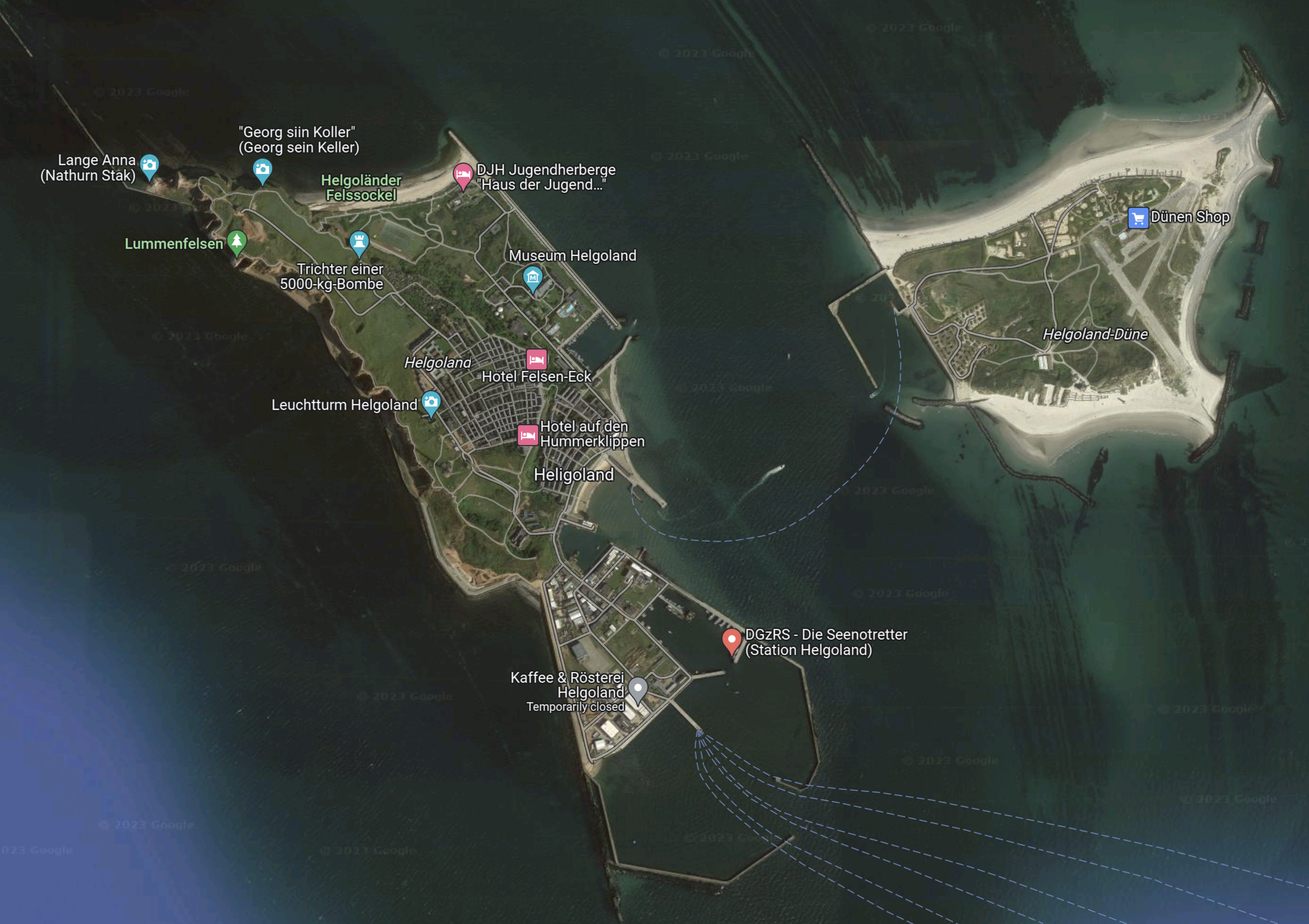
Note.
- Heligoland is the island in the West.
- Düne is the island in the East.
- You can just pick out the characteristic pattern of Heligoland Airport‘s three concrete runways.
Why would anybody want to go to a rock in the North Sea?
This article on the Guardian, which is entitled Heligoland: Germany’s Hidden Gem In The North Sea, gives lots of reasons, including.
- History.
- It is a regular day trip from the German coast by ship.
- It used to be British.
- It could be at the heart of offshore wind developments.
But for German day-trippers, it’s probably the attraction of the island being duty-free.
It could be a nice little earner for an airline based in Bremen and it would be within the range of the Islanders.
A Pattern Of German Islands
This Google Map shows the German corner of the North Sea.
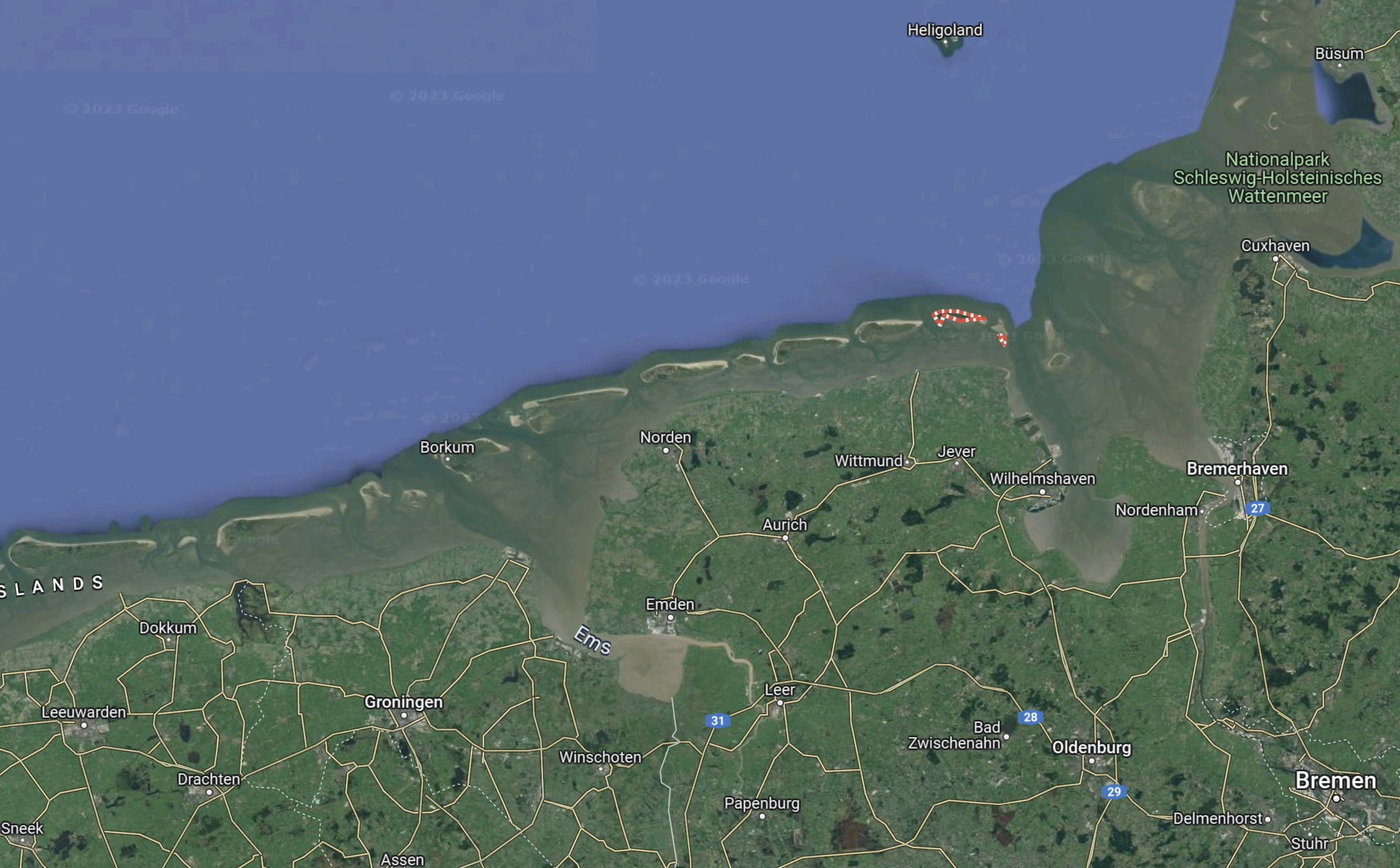
Note.
- The island of Heligoland at the top of the map.
- Bremen in the South-East corner of the map.
- The string of islands along the German and Dutch coasts.
- The red area marks out the most-Easterly island of Wangerooge.
This Google Map shows Wangerooge in detail.
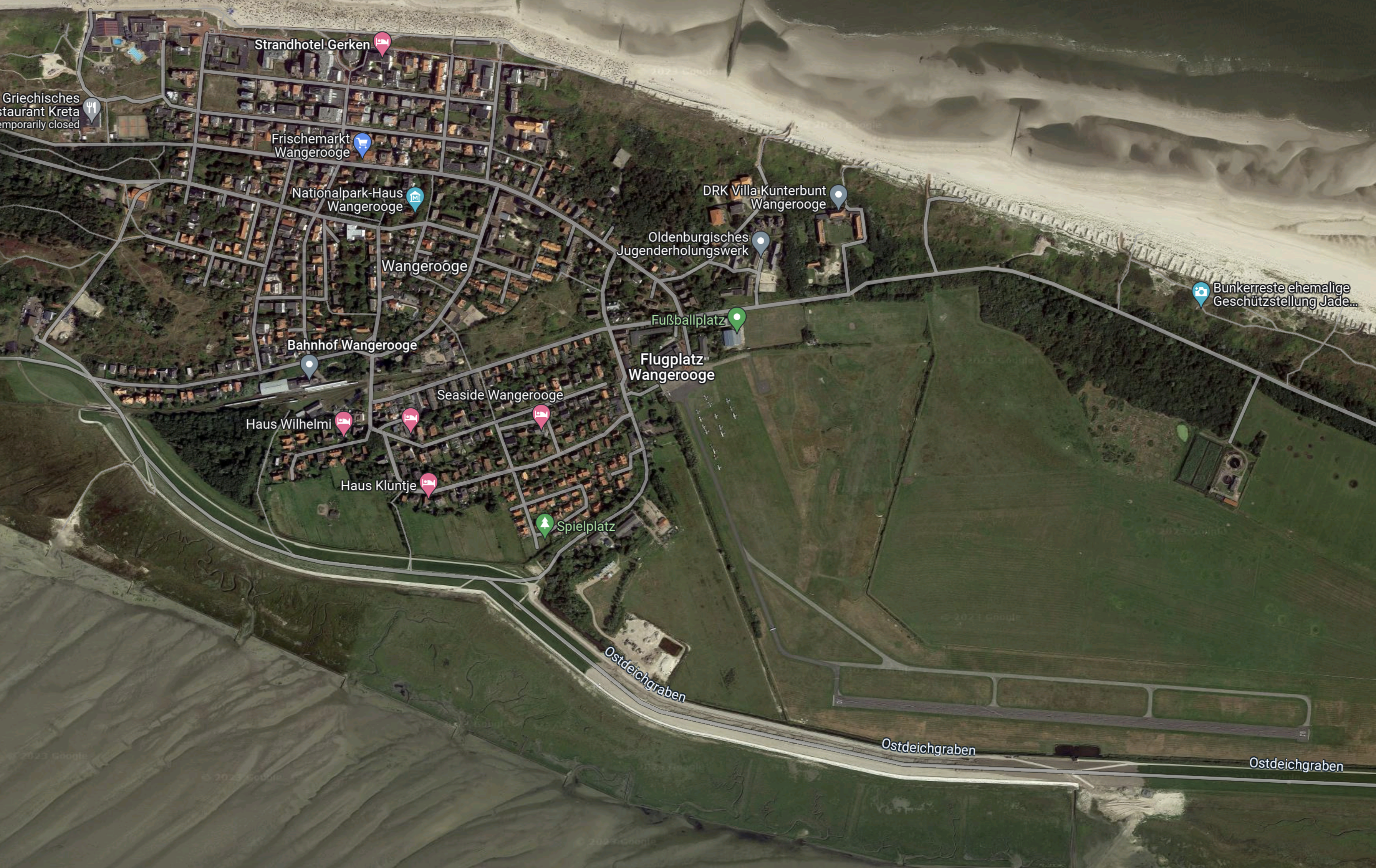
Flugplatz Wangerooge is in the South-East corner of the map.
- It has an 850 metre asphalt runway.
- The island appears to have a sizeable beach.
- The island has a population of around 1200.
The Wikipedia entry for Wangerooge says this about the character of the island.
In order to guarantee a relaxed atmosphere, cars are prohibited on the island. The island can be reached by ship from Harlesiel, or it can be reached by plane via its airfield, regular service being offered from Harlesiel, Bremen, or Hamburg. The ferries leave at different times every day according to the tide. As on most East Frisian Islands, a small narrow gauge railway line, the Wangerooge Island Railway, connects the harbor to the main village.
The Wikipedia entry, for the Wangerooge Island Railway gives a lot of detail about what looks to be a fascinating railway, including this opening paragraph.
The single track Wangerooge Island Railway (Wangerooger Inselbahn) is an unelectrified narrow gauge railway with a track gauge of 1,000 mm (3 ft 3+3⁄8 in) located on the East Frisian island of Wangerooge off the northwestern coast of Germany. It is the most important means of transport on the island and is the only narrow gauge railway operated today by the Deutsche Bahn.
I must visit next time, I go to Hamburg.
Working towards the West the next airfield, I can find is on Langeoog, which is shown in this Google Map.
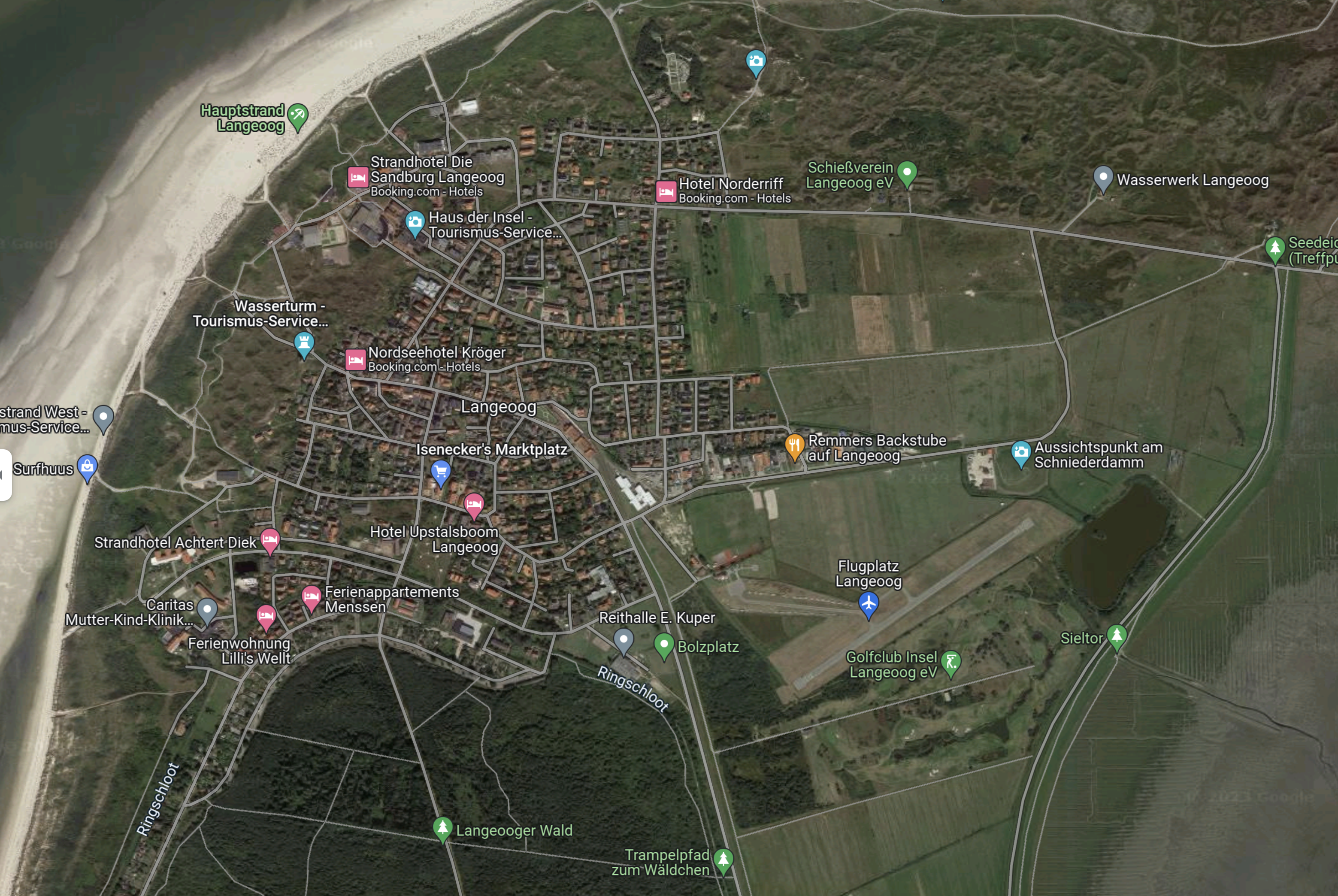
Flugplatz Langeoog is marked by the blue arrow towards the South-East corner of the map.
Working towards the West the next airfield, I can find is on Nordeney, which is shown on this Google Map.
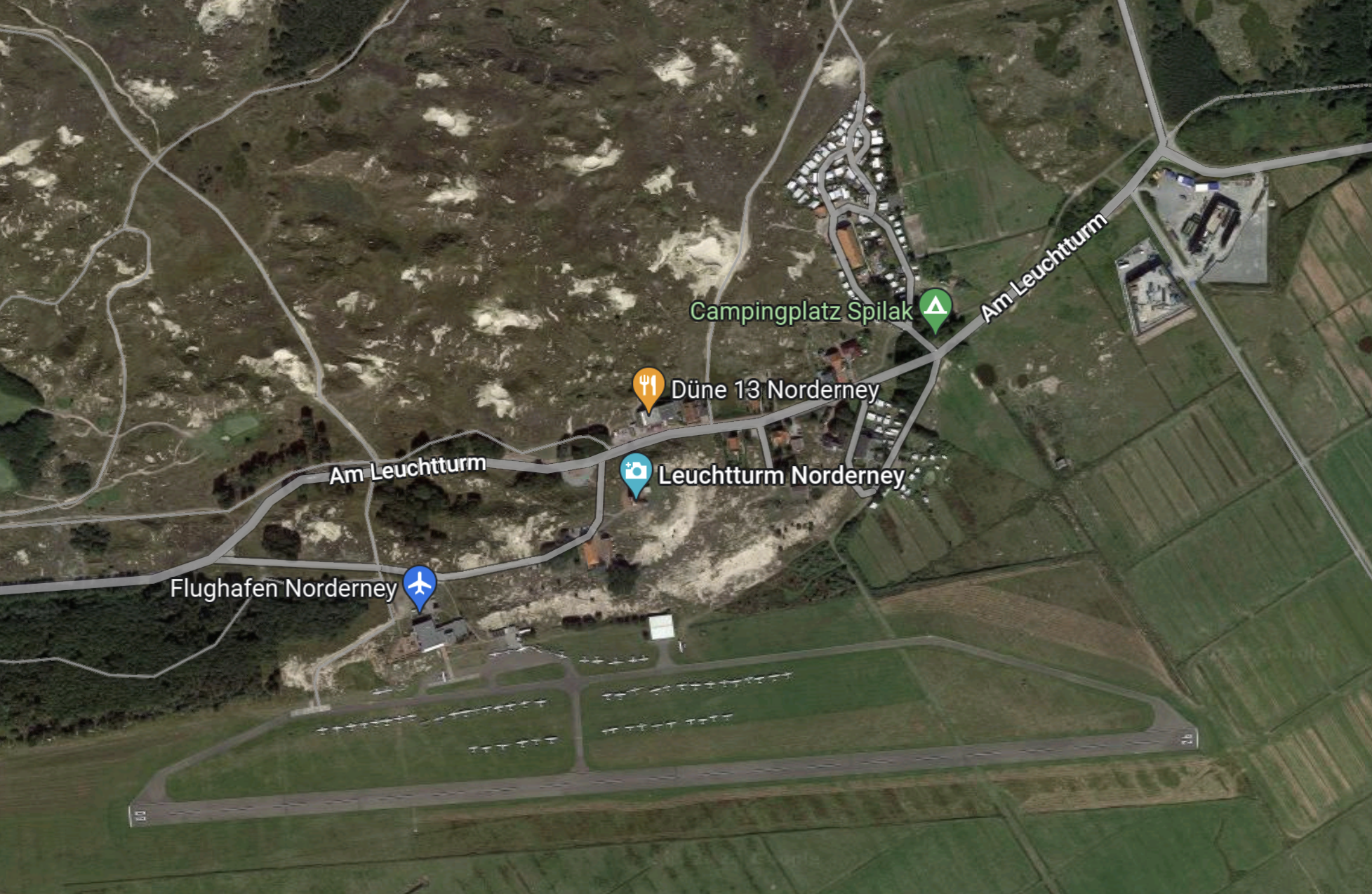
Flughaven Nordeney is at the bottom of the map.
It has a 1000 metre runway and judging by the planes on the map, it is very busy.
Continuing West brings me to the Eastern end of the island of Juist, which is shown on this Google Map.
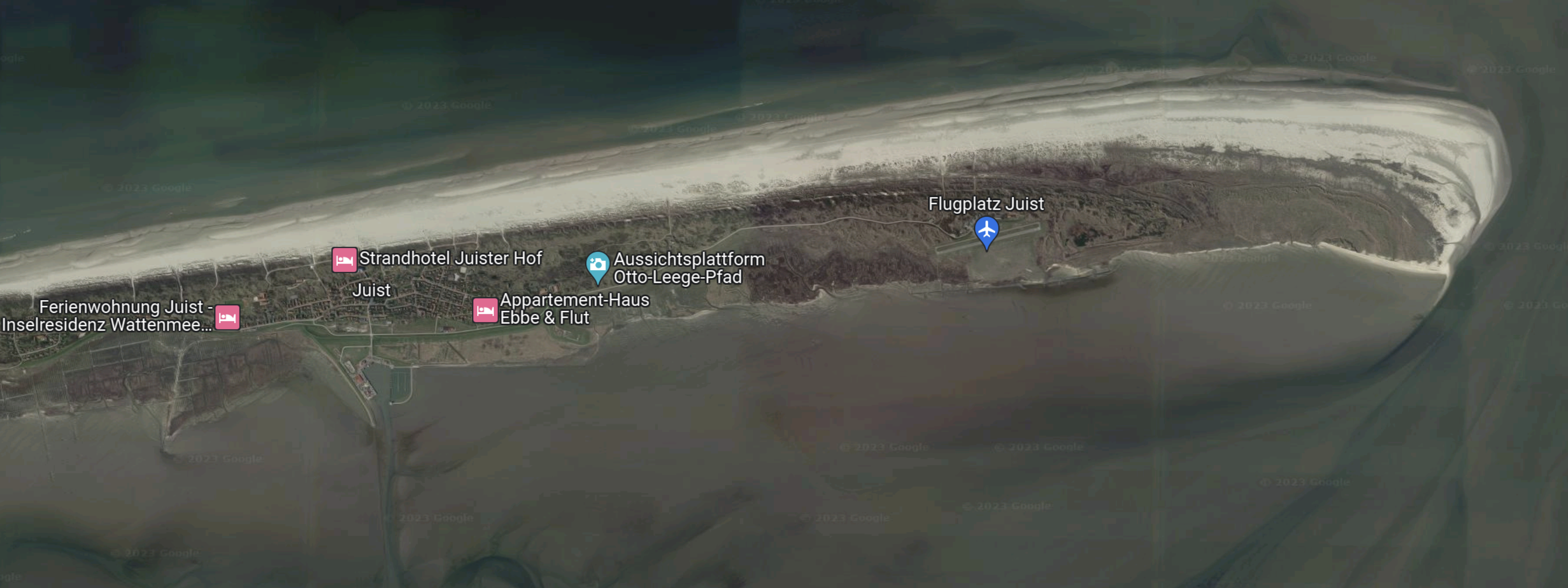
Flugplatz Juist is indicated the rightmost blue arrow. This extract from the Wikipedia entry, illustrates the importance of this airfield.
As of 2013, the airfield had up to 500 takeoffs and landings on weekends, the second most aircraft movements in the state of Lower Saxony, after Hannover Airport. The airfield is a critical piece of infrastructure for the island, due to ferry traffic being dependent on the tides.
The airfield was also the first on the East Frisian Islands to have a paved runway
Continuing West brings me to Borkum, which is shown on this Google Map.
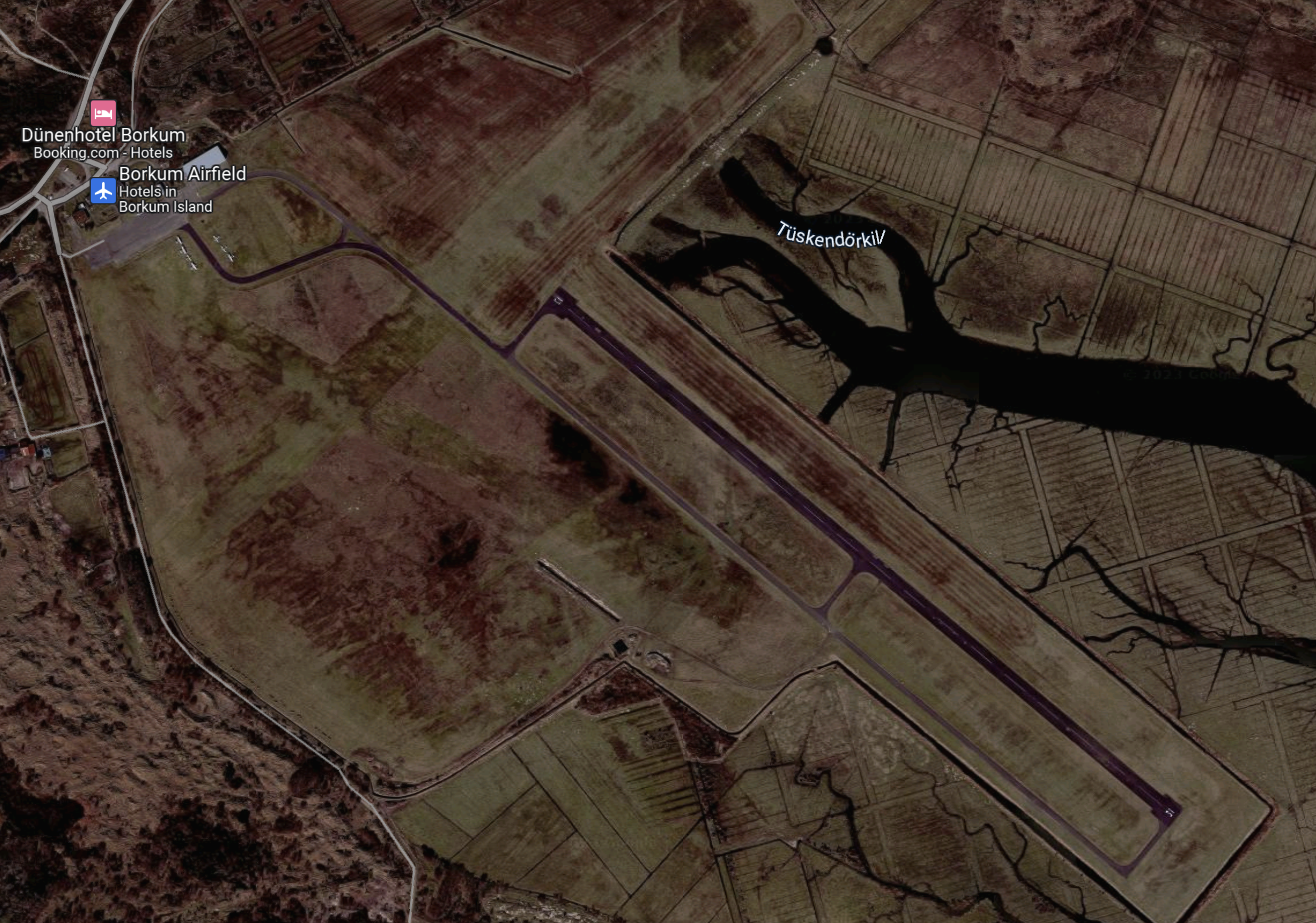
Note.
Borkum Airport is in the Eastern half of the map.
- It has a 1000 metre asphalt runway.
- Borkum has a population of around 5000.
On this brief exploration of the German East Frisian Islands, I have been surprised to find five airfields; Borkum, Juist, Langeoog, Nordeney and Wangerooge.
- All seem to have asphalt or concrete runways.
- Were these runways built as part of a plan to improve transport to the islands, as it appears the tides make the ferries a bit variable?
It also appears that the islands are totally or at least partially car-free.
On one island I noticed that the taxis are horse-drawn carriages.
So does this all fit well with the philosophy of Evia Aero of flying zero-carbon aircraft?
I suspect it does.
I also think, that Evia Aero’s thinking has been influenced by recent events in the area, which I talked about in From Groningen To Leer By Train.
- To put it simply, a freighter called the Emsmoon, demolished the Freisenbrücke, which carries the Groningen and Bremen railway over the River Ems.
- Zero-carbon aircraft flying between Groningen and Bremen would be a viable and quicker and more comfortable alternative to the bus I took.
I wonder if Evia Aero are planning a service between Groningen and Bremen.
- Groningen and Bremen is 147 kilometres.
- Islanders can cruise at 240 kph.
- The service could call at the five intermediate airports.
- I would reckon, that the service would take about an hour between Groningen and Bremen.
- The aircraft would be refuelled at Groningen and Bremen.
- I am fairly certain that two planes could run an hourly service.
I also suspect that the ticketing could be run by an app and if there were no passengers wanting to get on or off at an intermediate stop, then the plane would continue to the next stop, which would save fuel. If a passenger missed a plane, there would be only a wait of an hour until the next one.
Get this right and if it proves successful, then extra services could be added, to create a true Turn-Up-And-Go air service.
Landing And Take-Off Performance
This is a paragraph from the FutureFlight article.
Both the Islander and the Alice offer short takeoff and landing performance that will allow them to get in and out via limited runways in small communities. In the case of the Islander, which has been in service for several decades, it will even be able to operate from grass landing strips.
Every little helps.
Islanders can also use sand runways, as they do at Barra.
Refueling The Islanders
This image of the hydrogen-powered Islander was clipped from the Cranfield Aerospace Solutions’ home page.

Consider.
- Many years ago, I had fun with a farmer friend moving a lot of apples in boxes, that were destined for Aspall Cyder with his forklift. The machine was powered by gas in a cylinder strapped horizontally behind the driver.
- We ran out of gas halfway through and it was a simple matter of disconnecting the bottle and connecting another.
- Drop tanks have been used in military aircraft for almost a hundred years.
- Universal Hydrogen refuels its hydrogen-powered aircraft by changing a fuel capsule.
Look at the above picture and note the two green cylinders under the wings.
- Could they be two hydrogen tanks for the aircraft?
- They appear to have some aerodynamic features. Could this reduce drag, but increase lift?
- Could they be cylinders for the hydrogen fuel?
- If they are fuel cylinders, is it possible for one or two people and/or possibly a special truck to easily swap an empty one for a full one?
Fast refuelling would allow the aircraft to work hard.
Connecting To Major Hubs
My proposed East Frisian Islands service, only connects to Groningen and Bremen on the mainland.
- Schiphol and Groningen Airports are only 93 kilometres apart.
- Bremen and Hamburg Airports are only 103 kilometres apart.
After refuelling, flying on without a change of plane to a major hub would be possible.
Channel Hops
This is said about range.
With either of these aircraft, Evia Aero will be launching its services with the equipment providing a modest payload and range. The Cranfield Islanders will be able to fly up to around 200 kilometers (109 nm), while Eviation last year reduced its range projections from 440 to 250 nm, citing the limitations of current battery technology.
The only hops, I can find less than two hundred kilometres are.
- Calais and Manston – 61 kilometres
- Calais and Lydd – 71 kilometres
- Calais and Southend – 111 kilometres
- Le Touquet and Lydd – 69 kilometres
- Le Touquet and Manston – 94 kilometres
- Le Touquet and Southend – 134 kilometres
- Ostend and Manston – 107 kilometres
- Ostend and Lydd – 138 kilometres
- Ostend and Southend – 210 kilometres
- Cherbourg and Southampton – 147 kilometres
Note.
- Manston and Southend are probably the two best British airports, as they have or will have a rail connection.
- Only Le Touquet has a railway station close to the airport on the European side.
I do suspect, that Eurostar could kill channel-hopping, by adding extra services.
Possible Markets
The methodology developed at Bremen, could probably be applied to other services around Europe and the wider world.
This is a paragraph from the FutureFlight article.
Evia Aero, which Kruse said is already in talks with as many as 30 regional airports about possible air services, is also eyeing the Nordic countries, the UK’s islands, and parts of southern Germany as target markets. Norway with its mountainous coastline seems a promising early adopter for short flights in net zero aircraft, not least because the country’s government plans to ban conventional aircraft on domestic routes from 2030.
The low noise of the electric aircraft might make them acceptable, where other aircraft have been rejected in the past.
Conclusion
T think Evia Aero plans are sound, but I do wonder whether the freighter trashing the railway got Florian Kruse and his friends thinking.
Will The Queen Enable One Last Important Result?
Would it be too much to hope, that the world leaders coming to the Queen’s funeral, might find that swapping their uplifting memories creates goodwill that helps to solve at least one of the pressing problems of the world?
 The Anonymous Widower