Budget 2020: Egyptian Temple In Leeds Could Be Surprise Beneficiary Of Rishi Sunak’s Yorkshire Deal
The title of this post is the same as that of this article on iNews.
This is the introductory paragraph.
An iconic Victorian flax mill designed to look like an Egyptian temple could be the unexpected beneficiary of Rishi Sunak’s Budget windfall amid a proposal to turn it into a northern arm of the UK’s national library.
Sunak is contributing twenty-five million. to the conversion of the Grade One-Listed Temple Works.
Conclusion
I wondered where he would use some of the Government’s money in Yorkshire and this would appear to be where he has!
It is my belief, that this is the sort of bold plan we need to execute in this country!
Chaos Between London And Leeds
On Tuesday, I had booked myself between Kings Cross and Leeds on the 11:03 LNER train. My idea was to do a short round trip to Harrogate from Leeds before going across the Pennines to Manchester and sign in to my hotel, before going to see Ipswich play at Rochdale in the evening.
But it all went wrong, as someone decided to commit suicide and was hit by a train at Grantham.
Finally, I got to Leeds at around two, which was too late to carry out my plan.
- I just missed a Harrogate train and it was getting too dark for photographs.
- I eventually got a very crowded TrainsPennine Express to Manchester Victoria.
- My supper was just a gluten-free egg and waterfresh sandwich from Marks and Spencer.
At least, I’d only paid just under thirty pounds for my First Class ticket to Leeds, which was only six pounds more than I paid to cross the Pennines.
Conclusion
This is the second time recently, after Did Someone Try To Steal The Electrification?, when I’ve been seriously delayed by problems on the railways, which are nothing to do with the trains or train companies.
Staff at LNER told me that suicides are common in November, as Christmas approaches.
Short of putting a security guard every hundred metres along the railway, I don’t think there’s a certain way of stopping these incyursions.
Is There Going To Be Full Electrification Between Leeds And Huddersfield?
This article on Rail Technology Magazine is dated 23/08/19 and is entitled Network Rail Reveals Detailed £2.9bn Upgrade Plans For TransPennine Route and it prompted me to write this post of the same name.
The Rail Technology Magazine article talks about a comprehensive upgrade to the Huddersfield Line is planned that includes.
- Improvement between Huddersfield and Westtown
- Grade separation or a tunnel at Ravensthorpe
- Rebuilding and electrification of eight miles of track.
- Possible doubling the number of tracks from two to four.
- Improved stations at Huddersfield, Deighton, Mirfield and Ravensthorpe.
I have now found this document on the Network Rail web site, which is entitled Huddersfield to Westtown (Dewsbury).
This statement is included under proposals.
Electrification of the railway from Huddersfield to Ravensthorpe – and right through to Leeds.
Because there is a dash in the words, has electrification to Leeds, been a recent addition?
It certainly doesn’t fit with the Rail Technology Magazine article.
It also doesn’t fit with this article on the BBC, which is dated 20/08/19 and is entitled Detailed TransPennine £2.9bn Rail Upgrade Plans Unveiled.
Electrification is mentioned in the second paragraph.
Network Rail has also announced it intends to electrify the line between Huddersfield and Dewsbury and double the number of tracks from two to four.
And in the sixth paragraph.
Network Rail said the proposed major overhaul and electrification work would be carried out on an 8-mile (13km) section of the route, with the “first round” of consultations starting with those living closest to the railway.
The two news sites seem to have used the same source.
The BBC also uses this map, that I have copied from the Network Rail document
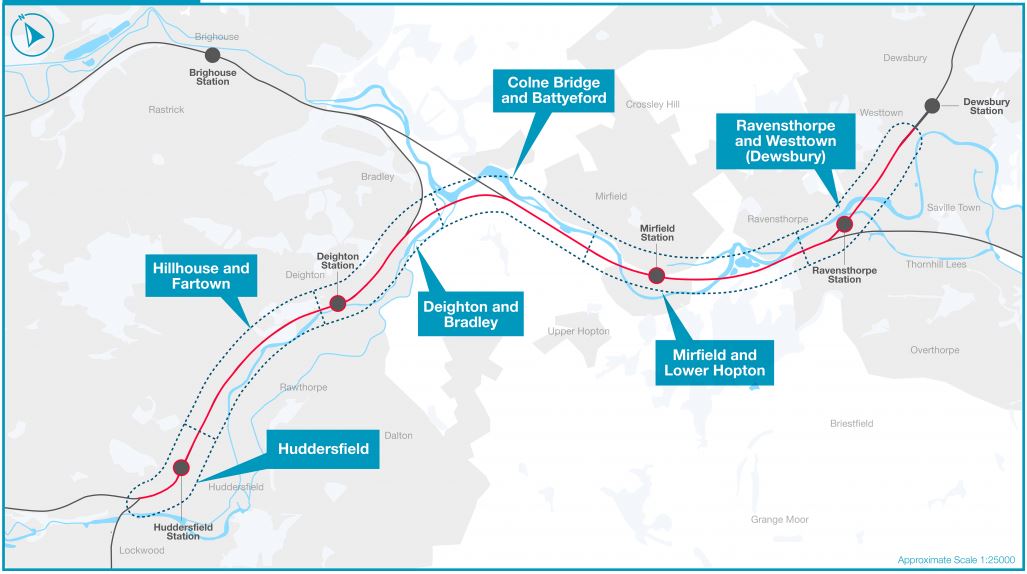
Note the railway lines shown in red. Are these the ones to be electrified? As they go from Huddersfield to Westtown, I think the answer is probably in the affirmative.
I seems to me, that Rail Technology Magazine and the BBC are using a common source and could it be an earlier version of the Network Rail document.
But the map, I have shown, shows the electrification only going as far as Westtown, despite coming from a document, that states twice that the electrification is going as far as Leeds.
It is certainly sloppy documentation.
Track Layouts
This document on the Digital Railway web site is dated 16/08/18 and is entitled Transpennine Route Upgrade SDO1 ETCS – Analysis.
Significantly, it is written by the Digital Railway – Joint Development Group (JDG), which consists of representatives of Siemens, Hitachi, ARUP and Network Rail.
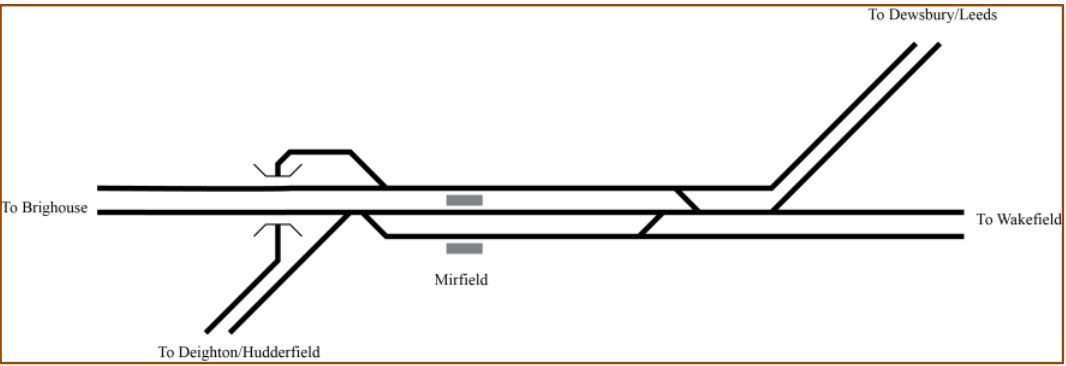
It is mainly about using digital signalling called ETCS on the Transpennine Route, but it does give these track layouts between Huddersfield and Dewsbury.
This is the current layout.
There is also this full four-track layout, which I assume was the original plan.
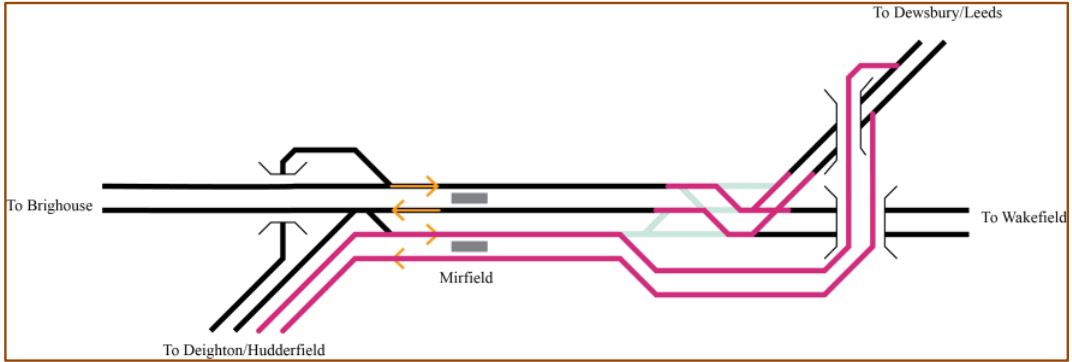
It is more complicated and involved the building of bridges in the area of Ravensthorpe station.
There is also a reduced four-track layout, which I assume was developed as the track analysis progressed.
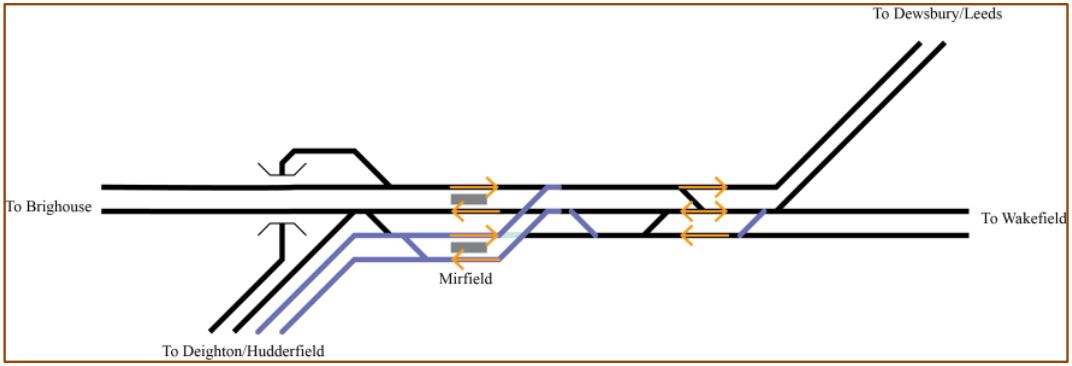
It is not a massive upgrade from the current layout.
As I see it, if the reduced layout can handle the required number of services, it has major advantages over the full scheme.
- There are no changes to track layout between Ravensthorpe and Dewsbury stations.
- Rebuilding Ravensthorpe station should be a smaller project.
- The current and reduced layout have three tracks between Mirfield and Ravensthorpe stations.
- There are no expensive new bridges to be built.
To make the scheme work there is a small amount of bi-directional running on the centre track, which is made possible by using digital signalling on the route.
Track Usage
By using bi-directional running on the centre track between Ravensthorpe and Mirfield stations, which is controlled by ETCS, the track layout is simplified, with three tracks instead of four.
- Slow trains from Huddersfield to Dewsbury will dive under the Brighouse lines and call in/pass Platform 1 at Mirfield station before going straight on to Ravensthorpe and Dewsbury. This is as trains do now.
- Slow trains from Dewsbury to Huddersfield will use the centre track from East to West and call in/pass Platform 2 at Mirfield station before turning South-West on to Huddersfield. This is as trains do now.
- Fast trains from Huddersfield to Dewsbury will call in/pass Platform 3 at Mirfield station and then cross over to the top track and go straight on to Ravensthorpe and Dewsbury.
- Fast trains from Dewsbury to Huddersfield will use the centre track from East to West and call in/pass Platform 4 at Mirfield station before turning South-West on to Huddersfield.
- Trains from Brighouse to Wakefield will call in/pass Platform 1 at Mirfield station and then cross to the centre track and go straight on to Wakefield. This is as trains do now.
- Trains from Wakefield to Brighouse will use the centre track from East to West and call in/pass Platform 2 at Mirfield station and go straight on to Brighouse.
Note.
- Platforms at Mirfield station are numbered 1 to 4 from the North
- The slow lines between Mirfield and Huddersfield are shown in black.
- The fast lines between Mirfield and Huddersfield are shown in blue.
- Passengers can use Platforms 1/2 as a cross-platform interchange between slow Huddersfield-Leeds and Brighouse-Wakefield services.
I also think it likely, that the proposed layout will improve the timetable.
Does The Reduced Layout Produce A Cost Saving?
In one of the first jobs I did at ICI Plastics Division, I simulated a chemical process on an analogue computer. My mathematics showed they could use much smaller vessels, which meant the height of the plant could be reduced by a few metres. I remember the engineer in charge of the project being very pleased, when he told me, that height costs money.
- The reduced layout removes three bridges, which must mean a cost saving.
- There is probably less track to lay
The negative is that digital signalling with ETCS must be installed through the area. This is going to be installed on the UK network, so it probably needs little more than shuffling the installation order.
On balance, when all things are considered, I suspect if the reduced layout can be used, there will be substantial cost savings on the project.
Problems At Morley Station
Morley station is two stations after Dewsbury station on the route towards Leeds.
Unusually for Wikipedia, the entry for Morley station has a large section entitled Current Problems.
This is the first two paragraphs.
The increase in demand, combined with growth elsewhere on the line, means that overcrowding in the morning peak, particularly for commuters heading towards Leeds, is becoming more of an issue.
Despite this commuter growth little has been done to bring this station into the 21st century. For example, only one platform is accessible for disabled passengers, there is insufficient parking, access routes to and from the station are often overgrown with weeds, and there are frequent drainage problems which all combine to make the station not as pleasant as other stations in West Yorkshire. In 2012 a “Friends of Morley station” group was formed, and is addressing some of these issues. Work to improve the car park and drainage commenced in February 2013.
To make matters worse, the station is 10-15 minutes walk from the centre of Morley with poor bus and taxi connections.
Would the following help the Friends of Morley Station?
- Longer trains.
- More frequent trains.
- Faster trains to Leeds
- Better bus services.
Electric trains would help solve the first three.
White Rose Station
There are plans to build a new White Rose station in the next couple of years at the White Rose Centre..
This would be between Morley and Cottingley stations.
This station will surely increase the passenger numbers on the Huddersfield Line.
Have Network Rail Designed The Electrification Between Dewsbury And Leeds?
This electrification has been off and on more times, than the lights in an average kitchen, so I suspect there is a workable plan dating from the last century amongst many others.
Would Extending Electrification To Leeds Provide The Power?
Electrification needs a good connection to the National Grid to provide the power needed to run the trains.
The short eight-mile electrification, as originally proposed could probably have been fed from one end; Huddersfield or Dewsbury.
Both locations would need new sub-stations, with Huddersfield possibly needed in the future to power the wires all the way to Manchester.
Leeds is already fully-electrified with electric expresses to Doncaster and London and several electric local services.
So is the easiest and most affordable way to power the eight-mile electrification between Huddersfield and Westtown to run an extension cable between Leeds and Dewsbury?
Network Rail had a similar problem on the Midland Main Line, which I wrote about in Welcome For Extension Of Midland Electrification.
National Grid had provided a power connection near Market Harborough for the Midland Main Line electrification, which was then cancelled North of Kettering North Junction, leaving the electrification to Corby without a power supply.
The problem is being solved, by extending the electrification to Market Harborough and connecting the wires to the power there.
I do wonder, that the most affordable way to power the Huddersfield and Westtown electrified line is to electrify all the way to Leeds and connect to the power there.
Conclusion
Improving services on the Huddersfield Line between Huddersfield and Leeds is going to be very necessary in the next few years, as passenger numbers will surely grow, due to new housing, increased commuting and the opening of White Rose station.
- New or refurbished four-car electric trains would provide more capacity, increased frequencies and faster services,
- Digital signalling with ETCS would allow more trains to run smoothly.
It appears to me, that to electrify all of the Huddersfield Line between Huddersfield and Leeds would be a good idea, if the money can be found.
Has that money been found by developing a more affordable track layout for the proposed TransPennine Upgrade between Huddersfield and Westtown?
But also using the power at Leeds and electrifying all the way between Huddersfield and Leeds, seems to be a bloody great tail, that is wagging the dog of electrification.
Further Electrification
Providing a fully-electrified route between Huddersfield and Leeds, would leave just two sections of the main TransPennine route without electrification.
- Stalybridge and Huddersfield over Saddleworth Moor and through the Standedge Tunnels.
- Leeds and the Northbound East Coast Main Line.
I don’t know about the planning and difficulty of the first route, but from my helicopter the engineering shouldn’t be too difficult, with the exception of the elecxtrification of the Standedge Tunnels, although Wikipedia seems optimistic about the electrifying the main twin-bore tunnel.
During the 2000s, Network Rail proposed reinstating rail traffic through the 1848 and 1871 tunnels to increase capacity on the Leeds-Manchester trans-Pennine route, but after a re-appraisal after the decision to electrify the trans-Pennine line, it was reported in 2012 that reinstatement was unnecessary.
In addition, could it be, that Manchester with lots of electric trains can provide enough power at Stalybridge, where an updated power connection has been recently installed, to power electric trains between Manchester and Huddersfield?
, The second has been planned for years and has a string of advantages.
- Speed up services between Leeds and Newcastle and Scotland.
- Allow LNER to run electric trains between London and Scotland via Leeds.
- Create an electrified route between Neville Hill Depot and York.
- Create an electrified diversion through Leeds for the East Coast Main Line
This section should be electrified for operational reasons on the East Coast Main Line.
A Final Conclusion
Network Rail’s plans seem to have evolved under analysis to be as follows.
- Limited four-tracking and updated track between Huddersfield and Westtown.
- Digital signalling with ETCS between Huddersfield and Leeds.
- Full electrification between Huddersfield and Leeds
- Power for the electrification from Leeds.
Could it even cost less than the allocated £2.9billion?
Will HS2 And Northern Powerhouse Rail Go For The Big Bore?
Different Versions Of This Post
The original post was published on the 25th August 2019.
It has been updated on the 21st November 2020 to reflect changes made to High Speed Two (HS2).
It has been updated on the 13th January 2023 for piggy-back freight trains.
The Merging Of High Speed Two And Northern Powerhouse Rail
It looks to me that there will be increasing links and merging between High Speed Two (HS2) and Northern Powerhouse Rail (NPR).
This report on the Transport for the North web site, is entitled At A Glance – Northern Powerhouse Rail.
Proposals and possibilities include.
- NPR will have a Western terminal at a new station in Liverpool City Centre.
- HS2 trains would access Liverpool and Manchester via a junction between HS2 and NPR at High Legh.
- There will be six trains per hour (tph) between Liverpool and Manchester via Manchester Airport.
- The route between Manchester and Manchester Airport is planned to be in tunnel.
- There will be six tph between Manchester and Leeds.
In addition, Boris has made positive noises about a high speed line between Manchester and Leeds being of a high priority.
So will the planners go for the logical solution of a High Speed tunnel between Manchester Airport and Leeds?
- There could be a theoretical capacity of perhaps 18 tph, which is the design capacity of High Speed Two.
- Speeds of up to 125 mph or more could be possible. The Gottard Base Tunnel has an operating speed for passenger trains of 125 mph.
- Stations could be at Manchester Airport, Manchester Piccadilly/Piccadilly Gardens/Victoria, Huddersfield, Bradford and Leeds.
- West of Manchester Airport, the route appears easier and the tunnel would emerge close to the airport. High Speed Two is planning that the tunnel emerges just to the North of the Airport and that the station is below ground level.
- East of Leeds the tunnel would join up with existing routes to Doncaster, Hull, Newcastle and York.
- Freight trains would be allowed at speed of up to 100 mph.
I believe such a tunnel could be built without disrupting existing rail services and passengers. Remember building Crossrail’s tunnels in London was an almost invisible process.
It would result in two rail systems across Northern England.
- Upgraded Classic Rail Routes
- The Big Bore
My thoughts on the two systems follow.
Upgraded Classic Rail Routes
This could include improvements such as these,
- Extra passing loops.
- Selective electrification
- Improved stations
- Comprehensive in-cab digital signalling
- More paths for passenger and freight trains.
Which could be applied to routes, such as these.
- The Huddersfield Line
- The Chat Moss Line
- The Calder Valley Line
- The Hope Valley Line
- The Dearne Valley Line
- The Selby Line
- The Midland Main Line North Of Clay Cross
In addition, there could be the reopening of some closed or freight routes to passenger trains.
This article on Rail Technology Magazine is entitled Network Rail Reveals Detailed £2.9bn Upgrade Plans For TransPennine Route.
It is a comprehensive upgrade that includes.
- Improvement between Huddersfield and Westtown, which is near Dewsbury
- Grade separation or a tunnel at Ravensthorpe
- Rebuilding and electrification of eight miles of track.
- Possible doubling the number of tracks from two to four.
- Improved stations at Huddersfield, Deighton, Mirfield and Ravensthorpe.
This project would be a major improvement to the Huddersfield Line.
In Sheffield Region Transport Plan 2019 – Hope Valley Line Improvements, I talked about planned improvements to the Hope Valley Line, which should begin in the next couple of years.
These improvements are given in detail under Plans in the Wikipedia entry for the Hope Valley Line.
The Hope Valley Improvements will cost in the region of tens of millions of pounds and Wikipedia sums up the benefits like this.
These changes to allow three fast trains, a stopping train and freight trains each hour were also supported in a Transport for the North investment report in 2019, together with “further interventions” for the Northern Powerhouse Rail programme.
It seems like good value to me!
So could we see other multi-million and billion pound projects created to improve the classic routes across the Pennines?
Projects would be fully planned and the costs and benefits would then be assessed and calculated.
Then it would be up to the Project Managers to devise the optimal structure and order in which to carry out all the projects.
I wouldn’t be surprised to see the following techniques used.
- Discontinuous electrification to avoid bridge reconstruction.
- Intelligent, hybrid diesel/electric/battery trains from Bombardier, CAF, Hitachi or Stadler, capable of 125 mph running and changing mode at speed.
- Modular digital signalling
- Factory built stations and step-free bridges.
- Removal of all level crossings.
- All stations updated for step-free access between train and platform.
The objectives would be as follows.
- More train paths, where needed.
- Faster line speed.
- Less running on diesel.
- Fast station stops.
Hopefully, the upgrading could be done without too much disruption.
Remember though, that disruption to existing users during a project, is most likely down to bad project management.
The Big Bore
The Central Core tunnel of Crossrail between Royal Oak and East London, was virtually a separate project before Crossrail’s stations and much of other infrastructure was built.
I believe that digging the tunnel first gave a big advantage, in that it could be constructed as an independent project, provided that the logistics of delivering the components and removing the junk was done efficiently.
But it did mean that travellers wouldn’t see any benefits until the project was almost complete.
HS2 and NPR are different in that they also envisage upgrading these routes.
- The Huddersfield Line
- The Chat Moss Line
- The Calder Valley Line
- The Hope Valley Line
- The Dearne Valley Line
- The Selby Line
- The Midland Main Line North Of Clay Cross
Only the Huddersfield Line is directly affected by the Big Bore.
Effectively, the Big Bore will provide a by-pass route for passenger trains between Leeds and West of Manchester Airport, to take the fast trains of HS2 and NPR underneath the congested classic lines.
In Changes Signalled For HS2 Route In North I said this about a tunnel between Leeds and Manchester.
To get a twenty-five minute time between Leeds and Manchester with a ten minute frequency, which I believe is the minimum service the two cities deserve, would be like passing a whole herd of camels through the eye of a single needle.
The Swiss, who lets face it have higher hills, than we have in Northern England would create a new route mainly in tunnel between the two cities, with perhaps an underground station beneath the current Grade I Listed; Huddersfield station.
The transport for the North report suggests Bradford Low Moor station, as an intermediate station, so why not Bradford Low Moor and Huddersfield stations?
Note that the Gotthard Base Tunnel, which opened a couple of years ago, deep under the Alps, is about the same length as a Leeds and Manchester tunnel, and cost around eight billion pounds.
It would be expensive, but like Crossrail in London, the tunnel would have big advantages.
- It could be built without disrupting current rail and road networks.
- It would have a capacity of up to thirty tph in both directions.
- Unlike Crossrail, it could handle freight trains.
- It would unlock and join the railway systems to the East and West.
I believe, it would be a massive leap forward for transport in the North of England.
It would be a very big project and probably one of the longest rail tunnels in the world.
Comparison With The Gotthard Base Tunnel
But surely, if a small and rich nation like Switzerland can build the Gotthard Base Tunnel, then we have the resources to build the Big Bore between Manchester Airport and Leeds.
Consider these facts about the Gotthard Base Tunnel.
- It is two single track bores.
- Each bore has a track length of around 57 kilometres or 35 miles.
- The tunnel may be deep, but it is direct and level.
- The maximum speed is 250 kph or 160 mph.
- The operational speed for passenger trains is 200 kph or 125 mph.
- The operational speed for freight is 100 kph or 62 mph.
- It can take the largest freight trains.
To make numbers even more impressive it is joined to the shorter Ceneri Base Tunnel, to provide an even longer route.
Manchester Airport And Leeds Direct
Now consider Manchester Airport and Leeds.
- The current rail distance is 56 miles.
- There are stops at Manchester Piccadilly, Manchester Oxford Road, Manchester Victoria and Huddersfield stations.
- Journey time is eighty minutes.
But the direct distance is only 68 kilometres or forty-three miles.
Surely if the Swiss can blast and dig two 57 km. single-track rail tunnels through solid rock, we can go eleven kilometres further with all the recent experience of tunnelling around the world.
The lengths of the various legs would be as follows.
- Manchester Airport and Manchester – 14 km.
- Manchester and Huddersfield – 35 km.
- Huddersfield and Bradford – 17 km.
- Bradford and Leeds – 13 km
Trains running on the various legs at 200 kph, which is the cruising speed of a 1970s-built InterCity 125, could take the following times for the various legs.
- Manchester Airport and Manchester – 4.2 minutes
- Manchester and Huddersfield – 10.5 minutes
- Huddersfield and Bradford – 5.1 minutes
- Bradford and Leeds – 13 km – 3.9 minutes
Leeds and Manchester Airport would be under thirty minutes apart, even allowing two minutes each for the three stops.
Looking at NPR between Liverpool and Hull, times could be as follows.
- Liverpool and Manchester – 26 minutes
- Manchester and Leeds – 20 minutes
- Leeds and Hull – 38 minutes
Or a Coast-to-Coast time of under ninety minutes.
Train Frequencies
HS2 is being designed to handle eighteen tph, although slower intensive railways in the UK can handle up to twenty-four tph.
At the current time or certainly in a few years time, the theoretical maximum frequency through the Big Bore should be between these two figures. I will assume at least eighteen tph in this post.
The At A Glance – Northern Powerhouse Rail report talks about the following frequencies.
- Liverpool and Manchester via Manchester Airport – Six tph.
- Manchester and Leeds – Six tph
- Leeds and Hull – Two tph
This is all so lacking in ambition. It is like building a new high capacity road and only allowing those with status to use the road.
If Leeds and Manchester Airport can handle eighteen tph, why not use some of it to create an Express Metro under the Pennines?
To me, if the Big Bore is built, nothing short of twelve tph or a train every five minutes is acceptable, at Liverpool, Manchester Airport, Manchester, Huddersfield, Bradford and Leeds stations.
The extension to Hull could be reduced to perhaps six tph, but with the upgrading of the Hull and Leeds Line to perhaps 140 mph, I’d be bold and create a true TransPennine Express;
Hull and Liverpool every five minutes would be the ultimate Marketing Man’s dream.
The Underground Stations
Manchester Airport, Manchester, Huddersfield, Bradford and Leeds would all be through stations deep underground.
- They would be connected to the surface by lifts and escalators.
- Some entrances to the stations would connect to existing stations and others might emerge in City squares like Manchester’s P:iccadilly Gardens.
- Most stations would be just two platforms, as all trains would pass through on either side of a large underground concourse.
- Bay platforms could be added as required.
- All stations would have platform edge doors.
- Passengers would be able to reverse direction by just walking across the concourse.
Stations would build on the lessons learned from Crossrail. But then NPR is closer to Crossrail than a Classic High Speed Line.
Weston Williamson’s Vision For Manchester Piccadilly Station
I wrote about this in The Rival Plans For Piccadilly Station, That Architects Say Will ‘Save Millions’.
I believe that this is the way to create an underground station.
The Terminal Stations
The two main terminal stations for NPR and trains running through the Big Bore would be the proposed High Speed station at Liverpool and the existing Hull station.
But one other terminal station is being created; Edinburgh.
I have been going to Edinburgh station to and from England for perhaps thirty years and the capacity of the station has constantly increased.
Recent developments have been an extended Platforms 5 and 6, that can take the longest LNER trains.
I wouldn’t be surprised to find out that with the application of digital signalling, that there is capacity for at least eight tph between Edinburgh and Newcastle.
There would certainly be capacity for at least two tph between Liverpool and Edinburgh via Manchester Airport, Manchester, Huddersfield, Bradford, Leeds, York and Newcastle.
In the East the other possibilities for terminals are Doncaster, Newcastle and York.
- I would discount Newcastle, as it lacks capacity and its location would make it difficult to add more.
- Doncaster has good connectivity and space, but do Leeds and Hull offer similar connectivity?
So that leaves Hull, Edinburgh and York, as the only Eastern terminals.
In the West, there is probably a need to connect to the Northern section of the West Coast Main Line (WCML).
- Glasgow Central is probably the obvious terminal, but it would need an extra connection at the junction of HS2, NPR and WCML at High Legh.
- If necessary Preston could be used, as it has space and lots of connectivity.
- Why not use Blackpool North, as it sits on a large site and is fully electrified. It could certainly take four tph?
- A lot of the things I said for Blackpool, also apply to Chester, which would give a gateway to Mid and North Wales!
The trains through the Big Bore could fan out at both the East and West.
Tunnel Size
As Manchester will be served by High Speed Two’s Full-Size trains from Birmingham and London, both Manchester stations will need to be built to accept these trains.
I feel that the whole tunnel between Manchester Airport and Leeds, should be built to the High Speed Two size, so that it can accept the largest possible passenger and freight trains, in the future.
That would obviously include the ability to handle piggy-back freight trains.
Integration Of HS2 and NPR
The At A Glance – Northern Powerhouse Rail report is proposing this and it looks that the following HS2 services could be possible between Euston and Manchester.
- Two tph – Euston and Hull via Old Oak Common, Manchester Airport, Manchester, Huddersfield, Bradford and Leeds
- Two tph – Euston and Edinburgh via Old Oak Common, Manchester Airport, Manchester, Huddersfield, Bradford, Leeds, York and Newcastle.
Note.
- Manchester Airport, Manchester, Huddersfield, Bradford and Leeds would all have four tph to and from London, by the Western arm of HS2’s Y.
- If in addition there were two tph between Liverpool and Hull and Liverpool and Edinburgh, this would mean four tph from the Big Bore of NPR to both Hull and Edinburgh.
- None of these core services need to terminate in the Big Bore.
I very much feel that integrating HS2 and NPR is the way to go.
Could We See A High Speed Northern Metro?
If we assume that the Big Bore could handle the HS2 frequency of at least eighteen tph, then it would be possible to create a high speed service across the Pennines with the following Metro-like frequencies.
- Liverpool and Hull – 4 tph
- Liverpool and Edinburgh – 2 tph
- Glasgow and Hull – 2 tph
- London Euston and Hull – 2 tph
- London Euston and Edinburgh – 2 tph
- London Euston and Glasgow – 2 tph
This would result in the following frequencies
- Liverpool – 6 tph
- Glasgow – 4 tph
- London Euston – 4 tph
- Manchester Airport – 12 tph
- Manchester – 12 tph
- Huddersfield – 12 tph
- Bradford – 12 tph
- Leeds – 12 tph
- Hull – 8 tph
- York – 4 tph
- Newcastle – 4 tph
- Edinburgh – 4 tph
What would these frequencies do for train travel in the North of England?
Freight
The Gotthard Base Tunnel has been designed so that both freight and passenger trains can use the route.
There is a need for extra freight capacity across the country and I wonder if freight trains could use the Big Bore.
I estimate that the Big Bore would be 68 kilometres if bored straight and level between West of Manchester Airport and Leeds.
Lets assume it is seventy kilometres or 43.5 miles.
So times, through the tunnel at various average speeds would be.
- 125 mph – 21 minutes
- 110 mph – 23.7 minutes
- 100 mph – 26.1 minutes
- 90 mph – 29 minutes
- 80 mph – 32.6 minutes
- 62 mph (Gotthard Base Tunnel speed for freight) – 42 minutes.
Could it be mandated that freight trains can use the tunnel, if they could maintain a particular speed?
Consider.
- A 125 mph train with stops at Manchester Airport, Manchester, Huddersfield, Bradford and Leeds would probably take thirty minutes to transit the tunnel.
- A freight train running at 90 mph would take more or less the same time.
- Fifteen tph would mean a train every four minutes.
- Automatic control of all trains in the tunnel would be a possibility. It appears to work on the much more complicated Thameslink.
I think with the following conditions, one or even two freight trains per hour, in addition to the passenger trains, can pass through the Big Bore in each direction.
- The locomotives have the performance of at least the Class 93 locomotive, which is currently being built.
- Freight trains can be hauled through at a minimum speed, which could be between 90 and 110 mph.
- The passenger trains and train and platform staff work together to produce very short station dwell times.
- All passenger trains are identical.
- Station platforms are designed so that passengers can leave and enter the trains rapidly.
It will be a Big Bore with a capacity to match!
What About Sheffield?
I haven’t forgotten Sheffield, but I think it could be linked across the Pennines by another route.
Under the upgrades for Northern Powerhouse Rail, it is proposed that services between Sheffield and Leeds become 4 tph in 25 minutes along the Dearne Valley Line.
Does Boris Know More Than He Lets On?
The headline on the front cover of Issue 885 of Rail Magazine is Boris Backs New Pennine Railway.
There is also a sub-heading of PM commits to Leeds-Manchester line.
Boris didn’t apply any substance to the speech, except to say that it will be funded.
Conclusion
I believe that my naïve analysis in this post shows that a TransPennine tunnel is possible.
But I believe that the right tunnel could have one big advantage.
Suppose it was built to handle the following.
- A capacity of eighteen tph, which is the same as High Speed Two.
- An operating speed of 140 mph or more. The Gotthard Base Tunnel has a maximum operating speed of 160 mph.
- High Speed Two’s Full-Size trains.
- The largest freight trains.
It would be future proofed for longer than anybody could envisage.
There are also other smaller advantages.
- It would by-pass a lot of difficult areas.
- It would cause very little aural and visual disruption.
- If it were designed with care, it would not affect the flora and fauna.
- As with the Swiss tunnel, it could be dug level, which would save energy and allow trains to run faster.
- It could be running twelve tph between Leeds and Manchester Airport via Bradford, Huddersfield and Manchester Piccadilly.
- Existing surface railways at the Eastern end could serve Cleethorpes, Darlington, Doncaster, Edinburgh, Hull, Middlesbrough, Newcastle, Scarborough, Sheffield and York
- Existing surface railways at the Western end could serve Barrow, Blackpool, Carlisle, Chester, Glasgow, Liverpool. North Wales, Preston and Wigan.
It would be more like Thameslink for the North turned on its side, rather than Crossrail for the North.
Sheffield Region Transport Plan 2019 – A New Station At Barnsley Dearne Valley
This station will be to the East of Barnsley in the vicinity of the village of Goldthorpe.
In Changes Signalled For HS2 Route In North, I used this map of the proposed High Speed Two and Northern Powerhoiuse routes in East Yorkshire.
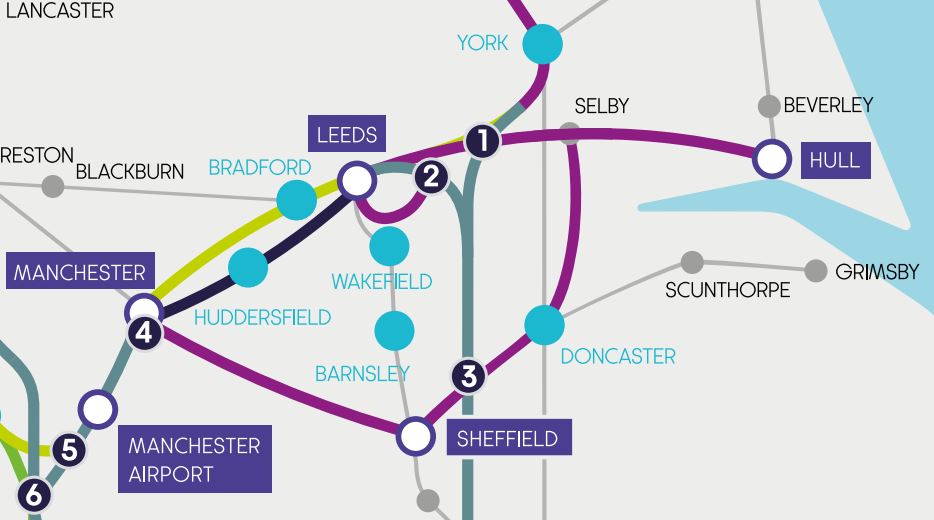
Note, these points about High Speed Two.
- It by-passes Sheffield and Barnsley and enters Leeds from the East, via Junction 2.
- It goes via Junction 1 to link up with the East Coast Main Line to York, Newcastle and Edinburgh.
- It links to the Leeds and Hull route at Junction 1.
- It has a Southern route via Chesterfield directly into Sheffield.
The current main route between Sheffield and Leeds is the Wakefield Line.
- It is thirty nine miles long.
- It is not electrified, except North of Wakefield Westgate station
- Trains stop at Meadowhall, Rotherhall Central, Swinton, Bolton-on-Dearne, Goldthorpe, Thurnscoe, Moorthorpe, Fitzwilliam, Sandal & Agbrigg, Wakefield Westgate and Outwood.
- Services take an hour and thirteen minutes
- The route is not very busy, with only, a total of around 4-6 trains per hour (tph) in both directions.
The Northern Powerhouse Rail improvements will see four tph between Sheffield and Leeds
- Journey times will be twenty-eight minutes.
- Some trains will extend past Sheffield to London St. Pancras.
- These fast services will probably stop less often.
- They will probably be backed up by stopping trains at perhaps two tph.
- I suspect the trains will be 125 mph bi-mode trains with batteries.
- I doubt there will be full electrification, as train developments will achieve the same objectives, in a more affordable manner.
- There will be full digital signalling to increase the capacity.
So where does the proposed Barnsley Dearne Valley station fit in?
- It will be on both the Wakefield Line and High Speed Two.
- It will have fast local trains between Leeds and Sheffield at four tph.
- It will have High Speed Two services between London and Leeds via East Midlands Hub at a frequency of at least two tph.
- It will have High Speed Two services between London and Newcastle via East Midlands Hub and York at a frequency of st least two tph.
- As I wouldn’t be surprised to see a Turn-Up-And-Go service on major legs of High Speed Two, will Barnsley Dearne Valley have four tph?
- Stopping trains to and from Sheffield could be at a frequency of four tph and be tram-trains.
The station would be a quality one, with ,lots of parking.
Barnsley would be welcomed to the Twenty-First Century.
I also believe, that the Wakefield Line could be improved, sooner rather than later.
I have flown my virtual helicopter along the route between Rohterham Central and Fitzwilliam stations.
- It is at least double-track all the way.
- It would appear to be fairly straight.
- There is plenty of room on either side, so third and possibly fourth tracks could be added.
- There are no level crossings and very few bridges.
- The stations are simple, but could be easily upgraded to full step-free access.
- Electrification could be a lot easier than some of the TransPennine routes.
So one way to give early benefits could be.
- Electrify between Sheffield and Fitzwilliam.
- Improve line speed to at least 100 mph and possibly 110-125 mph.
- Make all stations step-free.
- Build the Wakefield Line station at Barnsley Dearne Valley.
- East Midlands Railway could run two tph between Leeds and Sheffield using 125 mph bi-mode trains, with stops at Barnsley Dearne Valley, Swinton and Rotherham Central.
- Perhaps one tph could be between Leeds and London.
- Extend the Sheffield tram-train to Barnsley Dearne Valley.
I don’t think much of the engineering would be difficult and an opening date of 2023 would probably be possible.
The proposal would give these advantages.
- Twenty-eight minutes journeys between Leeds and Sheffield at a frequency of four tph.
- One or possible two tph between Leeds and London calling at Barnsley Dearne Valley and Rotherham Central.
- Extension of Leeds local electric trains to Barnsley Dearne Valley.
- A four tph tram-train service between Sheffield and Barnsley Dearne Valley.
- A direct service between Barnsley Dearne Valley and Doncaster is also a possibility.
The idea of a station at Barnsley Dearne Valley is a brilliant idea.
TfGM Announces Contactless Payments On Metrolink Trams
The title of this post, is the same as that of this article on Rail Technology Magazine.
This is the first paragraph.
Passengers will be able to ‘touch-in’ using their contactless cards on Manchester Metrolink trams from July 15, Transport for Greater Manchester (TfGM) announced today.
I shall be there with my contactless credit card on Monday week, to check that this is not fake news.
I look forward to the day, when Liverpool, Manchester, Sheffield and Leeds are all one contactless card area for trams, trains and buses.
When you consider that the combined area will be smaller than Greater London’s contactless area and that the distance between Lime Street and Leeds or Sheffield, is less than Reading to Shenfield, which will be contactless when Crossrail opens, the problems can’t be technological.
If the leaders of the four major Northern cities can agree this advance in ticketing, they will do more for the North, than any other short-term transport development will achieve.
University Buys Land For ‘Game-Changing’ High-Speed Rail Institute In Leeds
The title of this post is the same as that of this article on Rail Technology Magazine.
I have read the article and feel it is an important development, as it will be co-located with High Speed Two’s rolling stock depot in Leeds.
Will Elland Road Stadium Ever Get a Railway Station?
The traffic getting to Elland Road for the match between Leeds United and Ipswich Town was horrendous. But then the crowd was over 34,000!
You can see Elland Road stadium as you come into Leeds on the trains from London, and this Google Map shows the relation between the rail line and the stadium.

My friend actually parked her car alongside the rail line and we walked to the ground along Elland Road.
I took these pictures from where we parked.



Development is happening between the railway and the stadium including a new ice rink.
So will a new station be built on this line, if Leeds United won promotion to the Premier League?
This article in Rail Technology Magazine is entitled Plans For Three New Leeds Railway Stations Unveiled. It says that a new station at theWhite Rose Shopping Centre could be built.
This Google Map shows Elland Road Stadium and the White Rose Shopping Centre and the two rail lines in the area.

Note.
- The line through Cottingley station is the Huddersfield Line.
- Cottingley station is currently the nearest station to Elland Road Stadium.
- The Huddersfield Line passes alongside the White Rose Shopping Centre.
- The Huddersfield Line is not electrified.
After the traffic, I saw at the match, something needs to be done.
TransPennine Improvements
The Huddersfield Line will be improved to form part of a strategy for 125 mph trains across the Pennines.
The map from Wikipedia shows the lines between Leeds and Batley stations, that go through Cottingley.

Note.
- The White Rose Centre is probably near the closed Churwell station.
- The four kilometre long Morley Tunnel, which if it is in good condition could be reasonably easy to electrify.
- After Batley the route diverges and serves nemerous towns in the area like Bradford, Brighouse, Halifax and Huddersfield.
There is surely scope for a comprehensive and frquent service to the West of Leeds.
A Digitally-Signalled Trans-Pennine Route
The complexity of the routes around Leeds must be a nightmare to operate.
In this article on Rail Technology Magazine, which is entitled Grayling Commits £5m To Install Digital Signalling On TransPennine Route, the Transport Minister advocates the use of digital signalling to increase capacity and stability on the line.
Having waited at Leeds station to get a train to Guiseley, operation of the suburban routes in Leeds seems to be incredibly complicated and I suspect difficult for both passengers and the operators.
The Ordsall Chord will give Manchester a cross-city route, so could digital signalling open up an East-West route across Leeds and thread it through all the long distance services serving Leeds?
New stations at Apperley Bridge, Kirkstall Forge, Leeds-Bradford Airport, Thorpe Park and White Rose Shopping Centre would all fit this pattern and I believe digital signalling could be the key to making it work, with four trains per hour to each terminus.
More Suburban Electrification In Leeds
In some ways the most important stretch of electrification needed in Leeds would be the route from Neville Hill depot to York, as this would add the following.
- Ease movements of trains between York and the depot.
- Improve the performance of services between Liverpool and Newcastle via Manchester, Huddersfield, Leeds and York.
- Allow electric services from Thorpe Park to destinations on the other side of the city.
There must be an exceedingly good reason, why this route has not been electrified.
Conclusion
Leeds could expand the Metro dramatically by doing the following.
- Running services through two through platforms in Leeds station.
- Building several new stations.
- Electrifying between Neville Hill depot and York.
- Using digital signalling.
- Obtaining some bi-mode trains. Even Class 769 trains would do the job.
The network of lines around Leeds could give Leeds a Metro of a very high standard, at a very affordable cost.
London Businesses Endorse Calls For ‘Crossrail for the North’
The title of this post is the same as that of this article on Rail Technology Magazine.
This is said.
A statement from the London Chamber of Commerce and Industry (LCCI) admitted that travelling in the north was a “tortuous, time-consuming experience” and that improved travel in the region needed to be seen as a top future priority by the government.
But perhaps this is this most telling statement, from the LCCI’s Policy Director.
It is interesting to note that the distance between Leeds and Liverpool is roughly the same as the whole length of London Underground’s Central Line – yet that northern journey can sometimes nearly take double the time,
The London Chamber of Commerce and Industry have a very valid point.
Some typical journeys between Liverpool and Leeds.
- Liverpool to Newcastle train – One hour twenty-eight minutes
- Liverpool to Scarborough train – One hour forty-six minutes
And across London from Ealing Broadway to Stratford
- Central Line – 53 minutes – Actual
- Crossrail – 27 minutes – Predicted
I would read the following into these figures.
- Why does a Scarborough service take twenty minutes longer than a Newcastle one?
- Creating a new route can create substantial saving of time.
This suggests to me a two phase approach to creating a better service across the North.
In the first phase new trains, track and signalling improvements and more efficient operation, are used to cut the time as much as possible.
In The Pressure For More Rail Electrification, I speculated that the following times could be possible.
- Liverpool to Manchester Victoria – 30 minutes
- Manchester Victoria to Huddersfield – 28 minutes
- Huddersfield to Leeds – 22 minutes
When the following are done.
- Liverpool to Manchester Victoria could be speeded up by a couple of minutes, after the addition of the fourth track at Huyton.
- According to the time table, most dwell times are reasonable, but nine minutes is allowed at Manchester Victoria.
- Manchester Victoria to Stalybridge electrification is completed.
- All trains that can’t cruise at 100 mph are removed from the route.
One, three and four are already underway and if the track were to be improved across Chat Moss, which currently has a 75 mph speed limit, I reckon that a reliable time of 60-70 minutes would be possible with a Class 800 train.
This would use electrification between Liverpool and Stalybridge and diesel from there to Leeds.
But even with selective electrification between Stalybridge and Leeds, the sort of times the North needs will not be attained.
Some form of new route will be needed in phase two of speeding up trains between Liverpool and Leeds.
 The Anonymous Widower