BBC Click On Batteries
This weekend’s Click on the BBC is a cracker and it’s all about batteries.
Electric Mountain
It starts with pictures of the UK’s largest battery at Dinorwig Power Station or Electric Mountain, as it is colloquially known.
The pumped storage power station was completed in 1984 and with a peak generating capacity of 1.6 GW, it was built to satisfy short term demand, such as when people make a cup of tea in advert breaks in television programs. Under Purpose of the Wikipedia entry for Dinorwig Power Station, there is a very good summary of what the station does.
To build Dinorwig was a wonderful piece of foresight by the CEGB, over forty years ago.
Would environmentalists allow Dinorwig Power Station to be built these days?
That is a difficult question to answer!
On the one hand it is a massive development in an outstanding area of natural beauty and on the other Dinorwig and intermittent power sources like solar and wind power, is a marriage made in heaven by quality engineering.
As solar and wind power increase we will need more electric mountains and other ways of storing considerable amounts of electricity.
Close to Electric Mountain, another much smaller pumped storage power station of 100 MW capacity is being proposed in disued slate quarries at Glyn Rhonwy. This article on UK Hillwalking, is entitled Opinion: Glyn Rhonwy Hydro is Causing a Stir.
The article was written in 2015 and it looks like Planning Permission for the new pumped storage power station at Glyn Rhonwy has now been given.
The UK’s particular problem with pumped storage power stations, is mainly one of geography, in that we lack mountains.
However Electric Mountain is in the top ten pumped storage power stations on this list in Wikipedia.
I doubt in today’s economy, Electric Mountain would be built, despite the fact that it is probably needed more than ever with all those intermittent forms of electricity generation.
The Future Of Pumped Storage Technology
But if you read Wikipedia on pumped-storage technology, there are some interesting and downright wacky technologies proposed.
I particular like the idea of underwater storage, which if paired with offshore wind farms could be the power of the future. That idea is a German project called StEnSea.
Better Batteries
Click also talks about work at the Warwick Manufacturing Group about increasing the capacity of existing lithium-ion batteries for transport use by improved design of the battery package. Seventy to eighty percent increases in capacity were mentioned, by a guy who looked serious.
I would reckon that within five years, that electric vehicle range will have doubled, just by increments in chemistry, design and manufacture.
Batteries will also be a lot more affordable.
Intelligent Charging
Warwick Manufacturing Group are also working on research to create an intelligent charging algorithm, as a bad charging regime can reduce battery life and performance.
I rate this as significant, as anything that can improve performance and reduce cost is certainly needed in battery-powered transport.
The program reclons it would improve battery performance by ten percent in cars.
Surely, this would be most applicable to buses or trains, running on a regular route, as predicting energy use would be much easier, especially if the number of passengers were known.
In Technology Doesn’t Have To Be Complex, I discussed how Bombardier were using the suspension to give a good estimate of the weight of passengers on a Class 378 train. I suspect that bus and train manufacturers can use similar techniques to give an estimate.
So a bus or train on a particular route could build a loading profile, which would be able to calculate, when was the optimum time for the battery to be charged.
As an example, the 21 bus, that can be used from Bank station to my house, is serviced by hybrid new Routemasters. It has a very variable passenger load and sometimes after Old Street, it can be surprisingly empty.
Intelligent charging must surely offer advantages on a bus route like this, in terms of battery life and the use of the onboard diesel engine.
But is on trains, where intelligent charging can be of most use.
I believe that modern trains like Aventras and Hitachi’s Class 800 trains are designed to use batteries to handle regenerative braking.
If you take a Class 345 train running on Crossrail, the battery philosophy might be something like this.
- Enough energy is stored in the battery at all times, so that the train can be moved to a safe place for passenger evacuation in case of a complete power failure.
- Enough spare capacity is left in the battery, so that at the next stop, the regnerative braking energy can be stored on the train.
- Battery power would be used where appropriate to reduce energy consumption.
- The control algorithm would take inputs from route profile and passenger loading.
It may sound complicated, but philosophies like this have been used on aircraft for around forty years.
Reusing Vehicle Batteries In Homes
Click also had detailed coverage about how vehicles batteries could be remanufactured and used in homes. Especially, when solar panels are fitted.
Other Batteries
On the on-line version, the program goes on to look at alternative new ideas for batteries.
Inside Electric Mountain
The on-line version, also gives a tour of Electric Mountain.
Conclusion
The future’s electric, with batteries.
We Need More Electricity
Everything we do, seems to need more and more electricity.
- We are greening our transport and every electric train, car, bus and truck will need to be charged.
- Unless it is hydrogen-powered, in which case we’ll need electricity to split water into hydrogen and oxygen.
- Computing and the Internet needs more electricity and is leading to companies putting server farms in countries like Iceland, where there are Gigawatts of low-cost electricity.
- We’re also using more energy hungry equipment like air-conditioning and some household appliances.
- And then there’s industry, where some processes like metal smelting need lots of electricity.
At least developments like LED lighting and energy harvesting are helping to cut our use.
Filling The Gap
How are we going to fill our increasing energy gap?
Coal is going and rightly so!
A lot of nuclear power stations, which once built don’t create more carbon dioxide, are coming to the end of their lives. But the financial and technical problems of building new ones seem insoluble. Will the 3,200 MW Hinckley Point C ever be built?
That 3,200 MW size says a lot about the gap.
It is the sort of number that renewables, like wind and solar will scarcely make a dent in.
Unfortunately, geography hasn’t donated us the terrain for the massive hydroelectric schemes , that are the best way to generate loe-carbon electricity.
Almost fifty years ago, I worked briefly for Frederick Snow and Partners, who were promoting a barrage of the River |Severn. I wrote about my experiences in The Severn Barrage and I still believe , that this should be done, especially as if done properly, it would also do a lot to tame the periodic flooding of the River.
The Tilbury Energy Centre
An article in The Times caught my eye last week with the headline of Tilbury Planned As Site Of UK’s Biggest Gas-Fired Power Station.
It said that RWE were going to build a massive 2,500 MW gas-fired power station.
This page on the RWE web site is entitled Tilbury Energy Centre.
This is from that page.
RWE Generation is proposing to submit plans to develop Tilbury Energy Centre at the former Tilbury B Power Station site. The development would include the potential for a Combined Cycle Gas Turbine (CCGT) power station with capacity of up to 2,500 Megawatts, 100 MW of energy storage facility and 300MW of open Cycle Gas Turbines (OCGT). The exact size and range of these technologies will be defined as the project progresses, based on an assessment of environmental impacts, as well as market and commercial factors.
The development consent application will also include a 3km gas pipeline that will connect the proposed plant to the transmission network which runs to the east of the Tilbury power station. The proposed CCGT power station would be located on the coal stock yard at the site of the former power station, but would be physically much smaller than its predecessor (a coal/biomass plant).
I will now look at the various issues.
Carbon Dioxide
But what about all that carbon dioxide that will be produced?
This is the great dilemma of a gas-powered power-station of this size.
But the advantage of natural gas over coal is that it contains several hydrogen atoms, which produce pure water under combustion. The only carbon in natural gas is the one carbon atom in methane, where it is joined to four hydrogen atoms.
Compared to burning coal, burning natural gas creates only forty percent of the carbon dioxide in creating the same amount of energy.
If you look at Drax power station, which is a 3,960 MW station, it produces a lot of carbon dioxide, even though it is now fuelled with a lot of imported biomass.
On the other hand, we could always eat the carbon dioxide.
This document on the Horticultural Development Council web site, is entitled Tomatoes: Guidelines for CO2 enrichment – A Grower Guide.
This and other technologies will be developed for the use of waste carbon-dioxide in the next couple of decades.
The great advantage of a gas-fired power station, is that, unlike coal, there are little or no impurities in the feedstock.
The Site
This Google Map shows the site, to the East of Tilbury Docks.
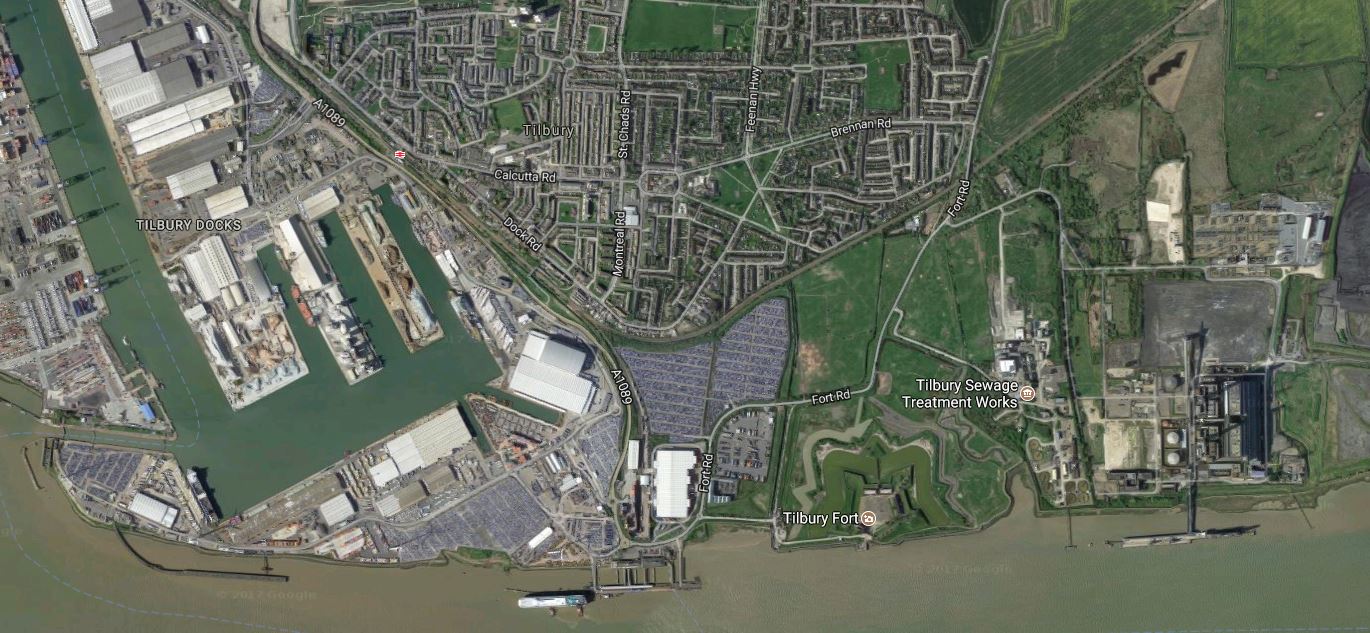
Note that the site is in the South East corner of the map, with its jetty for coal in the River.
These pictures show the area.
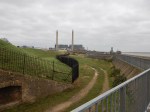
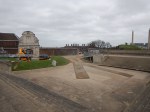

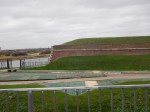
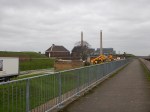
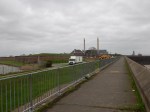
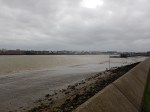

The CCGT power station would be built to the North of the derelict Tilbury B power station. I’ll repeat what RWE have said.
The proposed CCGT power station would be located on the coal stock yard at the site of the former power station, but would be physically much smaller than its predecessor (a coal/biomass plant).
Hopefully, when complete, it will improve the area behind partially Grade II* Listed Tilbury Fort.
Another development in the area is the Lower Thames Crossing, which will pass to the East of the site of the proposed power station. As this would be a tunnel could this offer advantages in the design of electricity and gas connections to the power station.
What Is A CCGT (Combined Cycle Gas Turbine) Power Station?
Combined cycle is described well but in a rather scientific manner in Wikipedia. This is the first paragraph.
In electric power generation a combined cycle is an assembly of heat engines that work in tandem from the same source of heat, converting it into mechanical energy, which in turn usually drives electrical generators. The principle is that after completing its cycle (in the first engine), the temperature of the working fluid engine is still high enough that a second subsequent heat engine may extract energy from the waste heat that the first engine produced. By combining these multiple streams of work upon a single mechanical shaft turning an electric generator, the overall net efficiency of the system may be increased by 50–60%. That is, from an overall efficiency of say 34% (in a single cycle) to possibly an overall efficiency of 51% (in a mechanical combination of two cycles) in net Carnot thermodynamic efficiency. This can be done because heat engines are only able to use a portion of the energy their fuel generates (usually less than 50%). In an ordinary (non combined cycle) heat engine the remaining heat (e.g., hot exhaust fumes) from combustion is generally wasted.
Thought of simply, it’s like putting a steam generator on the hot exhaust of your car and using the steam generated to create electricity.
The significant figures are that a single cycle has an efficiency of say 34%, whereas a combined cycle could be possibly as high as 51%.
In a section in the Wikipedia entry called Efficiency of CCGT Plants, this is said.
The most recent[when?] General Electric 9HA can attain 41.5% simple cycle efficiency and 61.4% in combined cycle mode, with a gas turbine output of 397 to 470MW and a combined output of 592MW to 701MW. Its firing temperature is between 2,600 and 2,900 °F (1,430 and 1,590 °C), its overall pressure ratio is 21.8 to 1 and is scheduled to be used by Électricité de France in Bouchain. On April 28, 2016 this plant was certified by Guinness World Records as the worlds most efficient combined cycle power plant at 62.22%. The Chubu Electric’s Nishi-ku, Nagoya power plant 405MW 7HA is expected to have 62% gross combined cycle efficiency.
There is also a section in the Wikipedia entry called Boosting Efficiency, where this is said.
The efficiency of CCGT and GT can be boosted by pre-cooling combustion air. This is practised in hot climates and also has the effect of increasing power output. This is achieved by evaporative cooling of water using a moist matrix placed in front of the turbine, or by using Ice storage air conditioning. The latter has the advantage of greater improvements due to the lower temperatures available. Furthermore, ice storage can be used as a means of load control or load shifting since ice can be made during periods of low power demand and, potentially in the future the anticipated high availability of other resources such as renewables during certain periods.
So is the location of the site by the Thames, important because of all that cold water.
But surely using surplus electricity to create ice, which is then used to improve the efficiency of the power produced from gas is one of those outwardly-bonkers, but elegant ideas, that has a sound scientific and economic case.
It’s not pure storage of electricity as in a battery or at Electric Mountain, but it allows spare renewable energy to be used profitably for electricity generators, consumers and the environment.
The location certainly isn’t short of space and it is close to some of the largest wind-farms in the UK in the Thames Estuary, of which the London Array alone has a capacity of 630 MW.
Wikipedia also has a section on an Integrated solar combined cycle (ISCC), where a CCGT power station is combined with a solar array.
I can’t see RWE building a new CCGT plant without using the latest technology and the highest efficiency.
Surely the higher the efficiency, the less carbon dioxide is released for a given amount of electricity.
Building A CCGT Power Station
The power station itself is just a big building, where large pieces of machinery can be arranged and connected together to produce electricity.
To get an idea of scale of power stations, think of the original part of Tate Modern in London, which was the turbine hall of the Bankside power station, which generated 300 MW.
Turbines are getting smaller and more powerful, so I won’t speculate on the size of RWE’s proposed 2,500 MW station.
It will also only need a gas pipe in and a cable to connect the station to the grid. There is no need to use trains or trucks to deliver fuel.
Wikipedia has a section entitled Typical Size Of CCGT Plants, which says this.
For large-scale power generation, a typical set would be a 270 MW primary gas turbine coupled to a 130 MW secondary steam turbine, giving a total output of 400 MW. A typical power station might consist of between 1 and 6 such sets.
I feel that this raises interesting questions about the placement of single unit CCGT power stations.
It also means that at somewhere like Tilbury, you can build the units as required in sequence, provided the services are built with the first unit.
So on a large site like Tilbury, the building process can be organised in the best way posible and we might find that the station is expanded later.
RWE say this on their web site.
The exact size and range of these technologies will be defined as the project progresses, based on an assessment of environmental impacts, as well as market and commercial factors.
That sounds like a good plan to me!
100 MW Of Energy Storage At Tilbury
RWE’s plan also includes 100 MW of energy storage, although they say market and commercial factors could change this.
Energy storage is the classic way to bridge shortages in energy, when demand rises suddenly, as cin the classic half-time drinks in the Cup inal.
In Wikipedia’s list of energy storage projects, there are some interesting developments.
The Hornsdale Wind Farm in Australia has the following.
- 99 wind turbines.
- A total generating capacity of 315 MW.
Elon Musk is building the world’s largest lithium-ion battery next door with a capacity of 129 MwH
But those energy storage projects aren’t all about lithium-ion batteries.
Several like Electric Mountain in Wales use pumped storage and others use molten salt.
Essex doesn’t have the mountains for the former and probably the geology for the latter.
But the technology gets better all the time, so who knows what technology will be used?
The intriguing idea is the one I mentioned earlier to make ice to cool the air to improve the efficiency of the CCGT power station.
What Is The Difference Between A CCGT (Combined Cycle Gas Turbine) And An OCGT (Open Cycle Gas Turbine) Power Station?
RWE have said that they will provide 300 MW of 300MW of Open Cycle Gas Turbines, so what is the difference.
This page from the MottMacdonald web site gives a useful summary.
OCGT plants are often used for the following applications:
- Providing a peak lopping capability
- As a back- up to wind and solar power
- As phase 1 to generate revenue where phase 2 may be conversion to a CCGT
CCGT plants offer greater efficiency.
I’ve also read elsewhere, that OCGT plants can use a much wider range of fuel. Used cooking oil?
Conclusion
There is a lot more to this than building a 2,500 MW gas-fired power station.
RWE will be flexible and I think we could see a very different mix to the one they have proposed.
An Appropriate Story For Today
On Page 58, The Times has an article entitled Frictionless Flywheels Hold Balance Of Power.
This is the first two paragraphs.
Flywheels will be used to balance supply and demand on Britain’s electricity grid in a £3.5million project that could help the country to cope with more wind and solar power.
Sophisticated flywheels that can store electricity for long periods of time are to be installed next to the University of Sheffield’s battery storage facility at Willenhall near Wolverhampton, in the first project of its kind in the UK.
By using batteries and flywheels together, this makes a responsive battery that can fill in demand and overcome the degradation problems of lithium-ion batteries.
It looks a promising way of creating an affordable and reliable energy storage system.
Who needs coal? Trummkopf obviously does to buy votes!
In the United States, with its massive mountain ranges, it would be better to create construction jobs by creating hydro-based energy storage systems, as we did in the 1970s at Dinorwig and the Americans, themselves did at Bath County Pumped Storage Station a few years later.
To gauge the size of these plants, Bath County has about the same generating capacity as the UK’s largest power station at Drax, with Dinorwig being about 55% of the size.
Bath County and Dinorwig are big bastards, but their main feature, is the ability to pump water to store the energy.
Energy is like money, the best thing to do with excess is to put it in a secure storage facility.
Tram 18, Where Are You?
This article in Rail echnology Magazine is entitled Midland Metro tram shipped to Spain for battery fit-out ahead of OLE-free operation.
It describe how Tram 18 is on its way to Zaragoza to be fitted with lithium-ion batteries, so that the UK’s first battery tram can start running in 2019, after the track is laid to Victoria Square in Birmingham and the railway station in Wolverhampton.
Why Not Hydrogen-Powered Trains?
I regularly use the London bus route RV1 which runs along the South Bank between Tower Gateway and Covent Garden.
This article on the Rail Engineer web site is entitled And now Hydrogen Power – Alstom’s new fuel cell powered train.
The article is worth reading and gives a good review of what might be possible with a hydrogen-powered train.
I have a couple of reservations about hydrogen-powered vehicles.
- In the late 1960s, I worked at ICI Plastics. The Division had had a serious accident with a polythene plant a couple of years previously and there was a distinct lack of enthusiasm for highly-compressed flasmmable gases, that I share to this day.
- I also feel that, if the technology is so good, why aren’t all city buses and taxis hydrogen-powered?
Hydrogen could be the fuel of the future, but we’re possibly nowhere near its time.
This is an extract from the article.
The efficiency of the system relies on the storage of energy in the lithium-ion batteries. Fuel cells tend to work at their best if they are run continuously at reasonably constant performance. The battery stores energy from the fuel cell when not needed for traction and from regenerative braking when the train’s motors turn kinetic energy into electrical energy. In short, the batteries store the energy not immediately required, in order to supply it later, as needed.
So wouldn’t it be better to have a decent charging system for the batteries?
- Overhead electric
- Protected third rail electric
- Small diesel engine.
A system appropriate to the location could be used.
Japanese Trains With Batteries
If Bombardier in Derby and the Germans in Chemnitz (Karl Marx Stadt to Jeremy and the Corbedians) are addressing battery technology, you could be sure that the Japanese would have ideas and there is this article in Railway Gazette, which is entitled Emergency batteries for Tokyo Metro trains.
This is said.
Nippon Sharyo Series 1000 trainsets operating on Tokyo Metro’s Ginza Line have been fitted with Toshiba onboard emergency batteries so that they can reach the next station under their own power in the event of a traction supply failure.
Toshiba says the SCiB lithium-ion battery is well-suited to emergency use, being resistant to external shock, internal short circuits and thermal runaway. It recharges rapidly, has a long life and a high effective capacity over a wide range of environmental conditions.
The battery draws power from the third rail during normal operation, and can supply the traction system in the event of power outage or other emergency. It can also be used for train movements within depots.
I also said this in Bombardier’s Plug-and-Play Train,
I wouldn’t rule out that all Class 345 trains were fitted with some form of onboard energy storage.
The main reasons are all given in the article about Japanese trains.
German Trains With Batteries
One of my Google alerts found this article on Rail Journal, which is entitled DB to convert DMUs to bi-mode hybrid trains.
This is said.
GERMAN Rail (DB) has announced it is working with technical universities in Chemnitz and Dresden to develop bi-mode (diesel and electric) trains with lithium-ion battery storage. Between 2017 and 2021 DB intends to convert 13 existing Siemens class 642 Desiro Classic DMUs to hybrid bi-mode configuration.
It seems the Germans share my belief that trains with batteries are the future.
Where Are The Battery Trains? – Part 2
My Trip To Corby today got me thinking more about the reasons for the non-appearance of IPEMUs, that I wrote about in Where Are The Battery Trains?
I have released several software products in my time and I’ve made certain that when I do this, that the product is fully tested and up to the job.
I suspect that Bombardier are no different, except they are probably a lot more thorough!
Testing The IPEMU And The Batteries
This article in Rail Technology Magazine is entitled Bombardier enters key analysis phase of IPEMU and it goes on to describe the sort of work being done. This is said.
Engineers in Mannheim are comparing four battery types, including the Valence batteries used on the demonstrator.
“What we’ve seen from the trial is that there is some work that we’ve still to finish on understanding the number of batteries that we apply for a particular performance,” he said. “We are looking at the packaging design in terms of how we pack the batteries together and how we monitor the overall temperature of the batteries for service. This is all to do with closing the triangle.”
I suspect most of this battery testing is being done on an off-train test rig, as if you have at least one rig for each battery type, testing can be done in parallel.
These rigs would be fairly simple affairs, where a computer with the route profile cycles the batteries through what they’d go through on an actual train, again and again.
I wouldn’t be surprised if this testing has widened, as obviously they are looking for a battery system with these characteristics.
- Very high reliability.
- The ability to hold as much energy as possible.
- A size and weight, that would enable a complete battery to be under the floor of a train.
- An acceptable cost.
Bombardier have not said, whose batteries they are testing, except that the ones they used in the prototype from Valence are on the list.
But supposing a reputable company, came to Bombardier and said, they could modify the batteries they’ve used successfully in such-and-such an application, do you think Bombardier would dismiss them out of hand?
Of course they wouldn’t!
I think that if the IPEMU gets introduced into service, that there could be a surprise in the type and manufacturer of the batteries.
Battery Choice Before Manufacture
Some battery types would inevitably be better than others and the testing would obtain a packaging design, range and cost for each design.
The big problem for the trains, is that until you decide on the type of battery to use, you can’t finalise the design of the battery pack and start manufacture.
This testing could throw also up strengths as well as problems.
The Problem Of Range
Range on batteries, is very important, as the longer it is, the more routes become possible for an IPEMU.
I was told on the Class 379 demonstrator, that a range of sixty miles was possible with that train. In this document on the Bombardier web site, this is stated about the objectives for the IPEMU.
The target is to operate a 185 tons four-car BOMBARDIER* ELECTROSTAR* train on battery up to 120 km/h for a distance of up to 50 km, which requires battery capacity in the range of up to 500 kWh. The design solution charges the batteries with the existing line converter equipment and connects the motor converters to the batteries when the 25 kVAC overhead line is not available. The lithium-ion batteries weigh less and can charge more quickly than industrial-form batteries, such as those used in automobiles.
Hard evidence of the actual range is difficult to find, although the figure of sixty miles is quoted in this section in Wikipedia.
I will now look at four longer routes, where the IPEMU may be the solution.
1. St. Pancras to Corby and Oakham
In my trip today to Corby, I saw how Network Rail are creating a fast route to the town, which it looks like will be double-track all the way to Oakham, This would include the route over the Welland Viaduct, which would be the sort of electrification, that would be difficult for engineering, aesthetic and heritage reasons.
Given that North Northamptonshire and the surrounding area, is going to see the development of several thousand houses, it would seem to me that an ideal IPEMU should be able to reach at least Oakham from St. Pancras. As Corby is about thirty-two miles and Oakham is forty-six miles from Bedford, this would mean that to provide a service would need a IPEMU with a range of sixty-four miles to reach Corby and ninety-two to reach Oakham, respectively.
So on the face of it, Corby and Oakham would be out of the range of a train fitted with the original Valence battery pack with its range of sixty miles, unless there was some electrification onwards from Bedford.
Yesterday, I saw that the piles for the electrification were going in North of Bedford. A rough calculation shows that for a sixty mile range IPEMU to reach Corby would need tjust a few miles of electrification North from Bedford. Oakham would need nearly twenty.
2. Liverpool Street to Lowestoft
Another route talking about as an IPEMU prospect is the East Suffolk Line between Ipswich and Lowestoft. This would need a train with a range of ninety-eight miles.
But as from Bedford, there could be a section of electrification at the Southern end of the line near Ipswich and perhaps some method of charging the train at Lowestoft.
3. Paddington to Bedwyn, Newbury and Oxford
Ever since I wrote Rumours Of Battery Powered Trains, which was based on an article in the September 2015 edition of Modern Railways, which was entitled Class 387s Could Be Battery Powered, I have believed that the Thames Valley could see several service run by IPEMUs.
I wrote this in a letter to a railway magazine in a letter entitled Class 387 IPEMUs to Oxford.
This sounds like an impossible dream, but if you were running Great Western Railway, you need some crumb of comfort, to cope with the arrival of Chiltern Railways at Oxford station in December 2016.
In September 2015, there was an article in Modern Railways with the headline of Class 387s Could Be Battery Powered, that described how GWR were thinking of creating some Class 387 IPEMUs.
In April 2016 the same magazine stated that electrification to Maidenhead could be ready before the end of 2016.
So that would enable Class 387 IPEMUs to reach Reading, Henley and Marlow, by doing the last few miles on batteries.
Also min the same issue of the magazine, Roger Ford also reported that the Reading to Didcot test track could be electrified by the end of the year.
As Didcot to Oxford and back, should be within the range of a Class 387 IPEMU running on batteries, I wouldn’t be surprised to see an electric service to Oxford before 2017.
I think it is true to say that this scenario is helped by every small extra morcel of range.
4. Basingstoke to Exeter
This section of the West of England Main Line is always being touted as needing electrification, but this section at nearly a hundred and thirty-five miles is certainly too long for a first-generation IPEMU.
On the other hand, selective short section of third-rail electrification, might make this route possible.
Note.
- These four routes would give significant advantages to operators, with faster electric services to London and in the case of Oakham and Exeter, they would release high-quality diesel multiple units to provide other services.
- As all of these routes are over sixty miles, it shows how, advances in battery design, which might bring increased capacity could increase the places where IPEMUs could provide an electric train service.
So are Bombardier’s engineers working on battery designs, that will handle as many routes as possible, that would be worthwhile to run with IPEMUs?
Other Technology
I am of the opinion that other technologies will stretch the range and applications of IPEMUs.
- Automatic control of the pantograph up and down at line speed would surely be important.
- Short sections of electrification in stations, where the trains stop.
- Various aids would probably help the driver make the most of the battery capacity.
- Improved signalling and track.
I am strongly of the opinion, that we’ll see a constant improvement in the range of an IPEMU.
Conclusion
I have only talked about medium length routes in the range of upwards of sixty miles.
If you add in all of short distance uses on branch lines, I think we’ll be seeing a lot of IPEMU-equipped trains in the future.
Their current non-appearance, may just be that Bombardier want to get the train absolutely right.
If they do that and the financial case stacks up, then Bombardier could see orders for a lot of new trains.
 The Anonymous Widower