UK Infrastructure Bank, Centrica & Partners Invest £300M in Highview Power Clean Energy Storage Programme To Boost UK’s Energy Security
The title of this post, is the same as that of this news item from Highview Power.
This is the sub-heading.
Highview Power kickstarts its multi-billion pound renewable energy programme to accelerate the UK’s transition to net zero in Carrington, Manchester.
These three paragraphs outline the investment.
Highview Power has secured the backing of the UK Infrastructure Bank and the energy industry leader Centrica with a £300 million investment for the first commercial-scale liquid air energy storage (LAES) plant in the UK.
The £300 million funding round was led by the UK Infrastructure Bank (UKIB) and the British multinational energy and services company Centrica, alongside a syndicate of investors including Rio Tinto, Goldman Sachs, KIRKBI and Mosaic Capital.
The investment will enable the construction of one of the world’s largest long duration energy storage (LDES) facilities in Carrington, Manchester, using Highview Power’s proprietary LAES technology. Once complete, it will have a storage capacity of 300 MWh and an output power of 50 MWs per hour for six hours. Construction will begin on the site immediately, with the facility operational in early 2026, supporting over 700 jobs in construction and the supply chain.
Note.
- The backers are of a high quality.
- The Carrington LDES appears to be a 50 MW/300 MWh battery.
It finally looks like Highview Power is on its way.
These are my thoughts on the rest of news item.
Centrica’s Involvement
This paragraph talks about Centrica’s involvement.
Energy leader Centrica comes on board as Highview Power’s strategic partner and a key player in the UK’s energy transition, supporting Carrington and the accelerated roll-out of the technology in the UK through a £70 million investment. The programme will set the bar for storage energy systems around the world, positioning the UK as the global leader in energy storage and flexibility.
I suspect that Centrica have an application in mind.
In Centrica Business Solutions Begins Work On 20MW Hydrogen-Ready Peaker In Redditch, I talk about how Centrica is updating an old peaker plant.
In the related post I refer to this news item from Centrica Business Systems.
This paragraph in the Centrica Business Systems news item, outlines Centrica’s plans.
The Redditch peaking plant is part of Centrica’s plans to deliver around 1GW of flexible energy assets, that includes the redevelopment of several legacy-owned power stations, including the transformation of the former Brigg Power Station in Lincolnshire into a battery storage asset and the first plant in the UK to be part fuelled by hydrogen.
As Redditch power station is only 20 MW, Centrica could be thinking of around fifty assets of a similar size.
It seems to me, that some of these assets could be Highview Power’s LDES batteries of an appropriate size. They may even be paired with a wind or solar farm.
Larger Systems
Highview Power’s news item, also has this paragraph.
Highview Power will now also commence planning on the next four larger scale 2.5 GWh facilities (with a total anticipated investment of £3 billion). Located at strategic sites across the UK, these will ensure a fast roll-out of the technology to align with UK LDES support mechanisms and enable the ESO’s Future Energy Scenario Plans.
Elsewhere on their web site, Highview Power say this about their 2.5 GWh facilities.
Highview Power’s next projects will be located in Scotland and the North East and each will be 200MW/2.5GWh capacity. These will be located on the national transmission network where the wind is being generated and therefore will enable these regions to unleash their untapped renewable energy potential and store excess wind power at scale.
So will the four larger systems have a 200MW/2.5GWh capacity?
They could, but 200 MW may not be an appropriate output for the location. Or a longer duration may be needed.
Highview Power’s design gives the flexibility to design a system, that meets each application.
Working With National Grid
Highview Power’s news item, also has this sentence.
Highview Power’s technology will also provide stability services to the National Grid, which will allow for the long-term replacement of fossil fuel-based power plants for system support.
Highview Power’s technology is also an alternative to Battery Energy Storage Systems (BESS) of a similar capacity.
How does Highview Power’s technology compare with the best lithium-ion systems on price, performance and reliability?
Curtailment Of Wind Farms
Highview Power’s news item, also has these two paragraphs.
This storage will help reduce curtailment costs – which is significant as Britain spent £800m in 2023 to turn off wind farms.
Highview Power aims to accelerate the roll-out of its larger facilities across the UK by 2035 in line with one of National Grid’s target scenario forecasts of a 2 GW requirement from LAES, which would represent nearly 20% of the UK’s long duration energy storage needs. By capturing and storing excess renewable energy, which is now the cheapest form of electricity, storage can help keep energy costs from spiralling, and power Britain’s homes with 24/7 renewable clean energy.
I can see several wind farms, that are regularly curtailed would have a Highview Power battery installed at their onshore substation.
Receently, I wrote Grid Powers Up With One Of Europe’s Biggest Battery Storage Sites, which described how Ørsted are installing a 300 MW/600 MWh Battery Energy Storage Systems (BESS) at Swardeston substation, where Hornsea Three connects to the grid.
I would suspect that the purpose of the battery is to avoid turning off the wind farm.
Would a Highview Power battery be better value?
What’s In It For Rio Tinto?
I can understand, why most companies are investing, but Rio Tinto are a mining company. My only thought is that they have a lot of redundant holes in the ground, that cost them a lot of money and by the use of Highview Power’s technology, they can be turned into productive assets.
Collateral Benefits
Highview Power’s news item, also has this paragraph.
Beyond contributing to the UK’s energy security by reducing the intermittency of renewables, Highview Power’s infrastructure programme will make a major contribution to the UK economy, requiring in excess of £9 billion investment in energy storage infrastructure over the next 10 years – with the potential to support over 6,000 jobs and generate billions of pounds in value add to the economy. It will also contribute materially to increasing utilisation of green energy generation, reducing energy bills for consumers and providing significantly improved energy stability and security.
If Highview Power can do that for the UK, what can it do for other countries?
No wonder companies of the quality of Centrica, Rio Tinto and Goldman Sachs are investing.
We Don’t Make Them Like This Anymore
There was an article in The Times today about the Panama Canal and how its water system needs to be made larger.
It got me thinking about draglines and one in particular; Big Geordie.
I found these two videos of Big Geordie on YouTube.
Big Geordie had been built in Ipswich by Ransomes & Rapier in the 1950s.
This video from the 1930s shows Ransomes and Rapier’s excavators of the period.
Is This The Television Program Of The Year?
I’m just watching The Mayfair Hotel Megabuild in BBC2.
It’s fascinating and a must watch, as builders and miners expand Claridge’s Hotel up and down!
- More rooms and a penthouse on top.
- A spa and two swimming pools in the basement.
- A large number of rooms are also being refurbished.
And all while the hotel is nearly fully occupied.
I suspect that a lot of the techniques shown in the documentary have been used on the construction of the Elizabeth Line and the execution of the Bank Station Upgrade.
Work Begins In South Africa On Largest Fuel-Cell Vehicle In The World
The title of this post, is the same as that of this article on Hydrogen Fuel News.
This is an explanatory paragraph.
The Anglo American mining company in South Africa is seeking to lead the way in reducing its greenhouse gas emissions. It will be starting this effort with a 210 metric ton truck. The fuel-cell vehicle is the largest in the world and will operate at the Mogalakwena platinum mine.
These are some points from the article.
- The nuGen haul truck began as a Komatsu 930E with a diesel-electric powertrain.
- The haul truck’s traction motors are now powered by eight 100-kilowatt hydrogen fuel cell modules. The modules were provided by Ballard.
- They are complemented by a Williams Advanced Engineering lithium-ion battery pack capable of outputting 1.1MW.
- The components were integrated in Seattle by First Mode.
- The fuel-cell vehicle’s powertrain is 2MW (2,682 hp).
- That is adequate for the haul truck to keep up its rating of 300 metric tons.
- The truck and payload will reach 510 metric tons combined.
There are a lot of heavy numbers there.
There is this video from Anglo American.
Will Twiggy Save The World?
This article on the Sydney Morning Herald is entitled ‘No One’s Married To Coal’: How Forrest Is Taking On The World To Save The Climate.
The article is the story of Andrew ‘Twiggy’ Forrest’s Damascene conversion to hydrogen.
These three paragraphs sums up Andrew Forrest‘s vision and ambitions.
Forrest’s companies, including its mining arm, Fortescue, and its green energy arm, Fortescue Future Industries, would be net zero by 2030. This would necessitate inventing and then developing hydrogen-powered trucks, trains and ships. This way the mining operation would avoid burning up to a billion litres in diesel a year.
The project would include the construction of vast solar and wind power stations in the Pilbara that would create green hydrogen to first fuel the trains, trucks and ships of the iron ore empire and then for export to a clean-energy starved world. The electrolysers needed to make the hydrogen for the early phases of the plan would be built by a vast new factory in Queensland, that itself would double the global supply of the machines.
Hydrogen would soon become the world’s largest shipborne trade. The Fortescue revolution would occur at a blistering pace set by the demands of addressing global warming, and it would be done for profit, to remove the excuses of governments and businesses that objected to ambitious climate action.
Note.
- How many other companies are intending to be net-zero by 2030?
- Certainly not many Chinese, German or Russian companies.
- And how many companies have planned to achieve net-zero at a profit?
If Forrest achieves his ambitions, the world will be a much better place.
Andrew Forrest Snaps Up Pilbara And Gascoyne Cattle Stations For Green Energy Production
The title of this post, is the same as that of this article on the Australian Broadcasting Corporation.
This is the first paragraph.
Australian mining billionaire Andrew Forrest has continued his land acquisition in Western Australia, purchasing another three cattle stations in the state’s north-west to generate renewable energy.
These are some points for the article.
- Andrew Forrest’s Fortescue Future Industries has purchased three cattle stations in northern WA
- The stations will continue to run stock, and contribute to the production of green energy
- FFI says it is looking at other parts of WA to acquire land for similar projects
- The energy created will be used to decarbonise Andrew Forrest’s mining operations by 2030.
- A renewable hub of 340 wind turbines alongside solar panels will be created, which will generate 5 GW of energy.
- The possibility of offshore energy is mentioned.
- There is no mention of energy storage.
I have a few thoughts.
For A Reliable 5 GW Of Energy, Storage Is Surely Needed
I would think that this is probably understood by Fortescue Future Industries and given their ambitions for hydrogen, this must surely be part of an energy storage strategy.
Will Hydrogen Be Exported By Fortescue Future Industries From Australia?
I would expect this depends on three things.
- How much green energy is generated.
- The energy needs of Andrew Forrest’s mining companies.
- How much hydrogen can be sold in Australia.
Fortescue Future Industries will certainly have the market, if they have a surplus.
How Much Energy Will Fortescue Future Industries Generate Per Hectare?
This paragraph from the article gives useful information.
The hub would consist of 340 wind turbines alongside solar panels across Emu Creek and Uaroo Stations, in a development envelope of more than 65,000 hectares of land and a disturbance footprint of more than 10,000 hectares.
- If you look at the 65,000 hectares, as the area of the renewable energy hub, 0.77 MW is generated per hectare.
- If you look at the 10,000 hectares, as the area of the renewable energy hub, 0.5 MW is generated per hectare.
- If you look at Shell’s Scotwind E2 lease, that is 2 GW in 86,000 hectares, where 0.023 MW is generated per hectare.
So on a brief look Australia is a more efficient place for renewable energy, than the seas around the UK.
Conclusion
Andrew Forrest is developing a more detailed plan.
Australian Start-Up Eyes Disused Mine Shafts For Giga-Scale Gravity Energy Storage
Thye title of this post, is the same as that of this article on Renew Economy.
This is the first paragraph.
A newly launched Australian start-up has unveiled its own take on gravitational energy storage technology that will use super-heavy weights in legacy mine shafts to capture and release energy, with around 3GWh of potential storage capacity already identified for development.
Note.
- The company is called Green Gravity.
- I can’t find a web site.
The idea seems very much like Gravitricity.
- The energy stored seems about the same order of magnitude.
- In Disused Coal Mine Could Host Gravity Energy Storage Project, I describe how Gravitricity will be using coal mines to store energy.
Gravitricity’s ideas may be patented.
The Glenmuckloch Pumped Storage Scheme
This article on the BBC is entitled Glenmuckloch Opencast Mine Hydro Energy Scheme Approved.
- It appears to be capable of generating 400 MW.
- Energy storage capability appears to be 1.6 GWh.
- It is to be built in a disused opencast coal mine.
It is only a small scheme, but it does seem to have planning approval.
The Scheme has a web page, which is entitled Glenmuckloch Pumped Storage Hydro
- It is being promoted by Buccleuch and 2020 Renewables and respected consultants; Arup has produced this Non-Technical Summary.
- The Non-Technical Summary is a very professional document and an interesting read.
- 2020 Renewables are now part of Forsa Energy.
- It is certainly an interesting way of removing the remains of an opencast coal mine.
According to this article on the BBC, which is entitled Buyer Sought For £250m Hydro Scheme At Glenmuckloch, the project now appears to be for sale.
Whether it will sell will depend on the cost of realising the scheme, the finance and how much the scheme will earn.
Conclusion
This project appears to have stalled, but I do like the idea of using a disused mine to store energy and the engineering behind the project.
Disused Coal Mine Could Host Gravity Energy Storage Project
The title of this post, is the same as that of this article on Power Engineering International.
It does seem that Gravitricity has made a breakthrough, with the announcement of a full-size demonstration project in the Czech Republic.
- The project is based at the mothballed Staříč coal-mine in the Moravian Silesian region.
- They have backing from the European Investment Bank.
- This project will be delivered through the European Commission’s Project Development Assistance scheme.
- The Czech Republic seem to have carried out checks, with their own consultants.
It looks to me, that Gravitricity have passed the due diligence procedures of some high-powered agencies.
But this paragraph from the article must be important.
Gravitricity estimates there are around 14,000 mines worldwide which could be suitable for gravity energy storage.
If they can successfully store energy in one mine in the Czech Republic, how many of the 14,000 will be suitable for use?
I doubt it will be a small number, as mining engineers tend to be a conservative bunch and most of those mines will have been built to similar rules by similar machines and techniques.
A search of the Internet indicates that Staříč coal-mine has a depth of over a kilometre.
Using Omni’s Potential energy calculator, 12,000 tonnes and a kilometre give a figure of 32.69 MWh.
32 MWh may seem a small amount, but it would power one of these 4 MW Class 90 locomotives for eight hours.
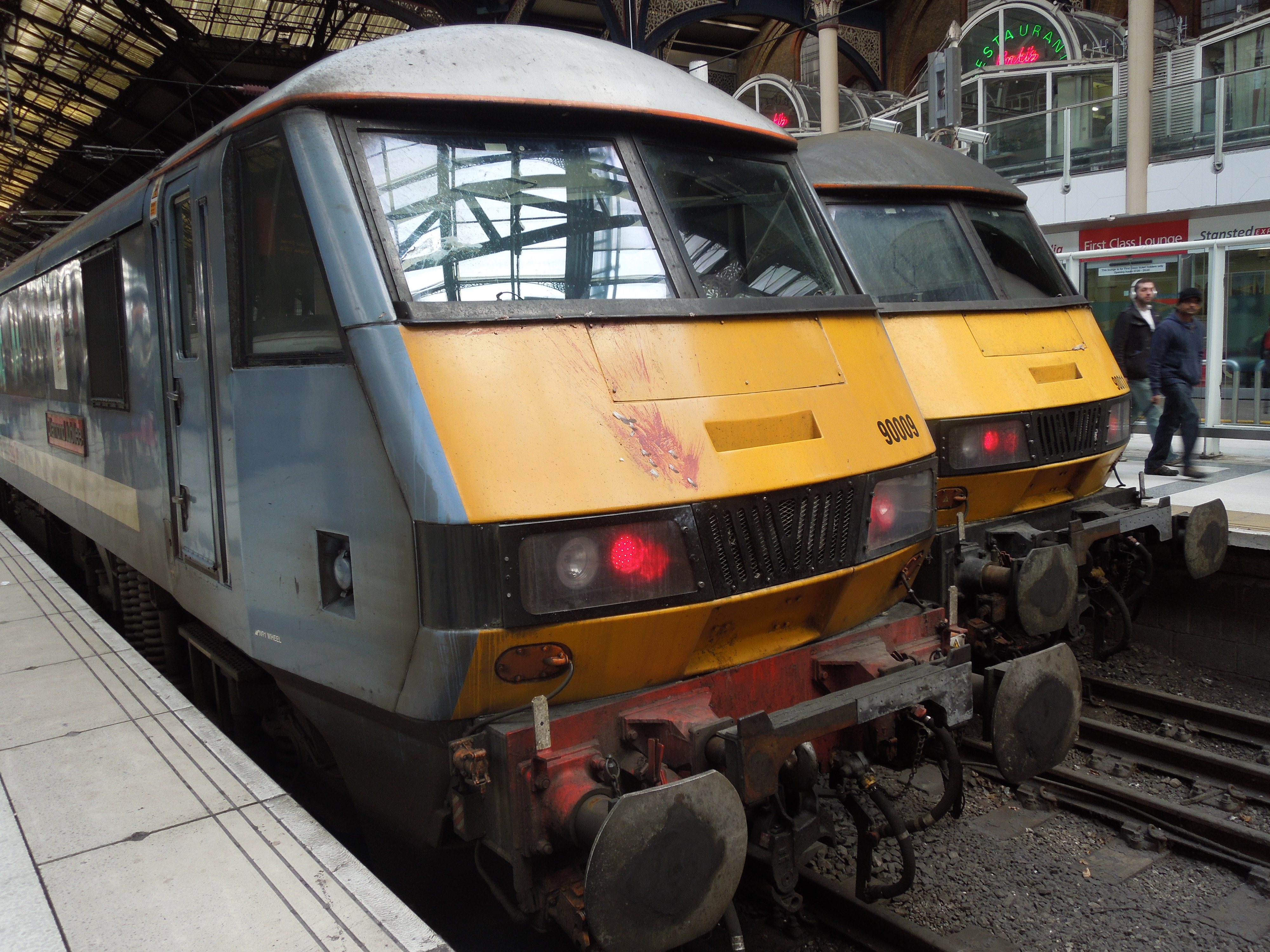
At their typical operating speed of 100 mph, whilst hauling eight coaches, they’d travel a distance of eight hundred miles or from London to Edinburgh and back!
How Defunct Coal Mines Could Heat UK Homes
The title of this post, is the same as that of this article on Mining Technology.
This is the introductory paragraph.
In a country with no operational coal mines, the UK Coal Authority has proposed to once again turn these operations to heating homes and businesses. But this time, they will not provide coal for burning. The plan, to take warm water from flooded mines, would turn an environmental problem into a community solution, and the idea is spreading.
The reason, I’m posting this is two-fold.
There was a report on this edition of Countryfile, which should be available until the end of 2022. The relevant section starts at 38.5 minutes into the program.
Charlotte Adams is featured in this report and the Countryfile program. I first came across Charlotte and her fascinating work at a lecture in 2018, which I wrote about in Can Abandoned Mines Heat Our Future?
 The Anonymous Widower