Is A Mobile Phone A Dog And Bone With Legs?
My father, who was not really a real Cockney, as you couldn’t quite hear Bow Bells from where he was born, was a regular user of rhyming slang.
I was writing a message to someone and suggested we text each other.
I then realised that I’d never heard rhyming slang for mobile phone, which led me to the title of this post.
This page supports the use of Obi Wan Kenobi.
The Bombing Of Dresden
I could not leave Dresden without commenting on the Bombing of Dresden by the Allies in World War II.
Some feel it was a war crime and many say it was justified. This is the first paragraph in the Wikipedia section describing the background to the bombing.
Early in 1945, after the German offensive known as the Battle of the Bulge had been exhausted — including the disastrous attack by the Luftwaffe on New Year’s Day involving elements of eleven combat wings of the Luftwaffe’s day fighter force — and after the Red Army had launched their Silesian Offensives into pre-war German territory, theGerman army was retreating on all fronts, but still resisting strongly. On 8 February 1945, the Red Army crossed the Oder River, with positions just 70 km from Berlin. As theEastern and Western Fronts were getting closer, the Western Allies started to consider how they might aid the Soviets with the use of the strategic bomber force. They planned to bomb Berlin and several other eastern cities in conjunction with the Soviet advance—to cause confusion among German troops and refugees, and hamper German reinforcement from the west.
It is a sensible argument, but I feel that decisions earlier in the War meant that to cause the required confusion, they had no alternative.
Churchill and others were also worried about what the Russians would do with the territory they captured. And he was right, as their colonisation and subjugation of Eastern Europe happened and it was something of which no-one can be proud.
In some ways it’s a pity that the German leaders in 1944, didn’t know how close we were to perfecting the atom bomb. But if they had,would the likes of Hitler ever surrendered? I doubt it! When you’re dealing with the really mad, all logic goes out of the window.
So could there have been an alternative to the bombing of Dresden and Leipzig?
What my father had been involved with in the war, I know not! But he was a passionate believer in the abilities of the de Havilland Mosquito. My father was well-connected in some way to John Grimston, who later became the 6th Earl of Veralem. In the 1950s and 1960s, Grimston’s company, Enfield Rolling Mills, was my father’s biggest customer. I know he was well-connected because when I needed a vacation job, my father rang the Earl and called in a favour, which got me three months extremely useful work in the Electronics Laboratory. My father did move in some unusual circles before and during the war. At one time, he was even working at the League of Nations in Geneva.
I have just read the section in Wikipedia about the Inception of the Mosquito. To say it was a struggle to get de Havilland’s wooden design accepted and then built would be an understatement. My father and others have said that there was scepticism in the Air Ministry about sending out crews to bomb Germany in a bomber with no defensive armament, which was built out of ply and balsa wood and stuck together with glue.
You have to remember that together the RAF and the USAAF lost hundreds of thousands of crew bombing Germany with four-engine heavy bombers. So was it the right policy?
One of my late friends, was a Mosquito pilot, who flew the aircraft in the RAF in the late 1940s. Several times we discussed the bombing of Germany in the 1970s. He had flown many types of aircraft, but in his view nothing compared with the amazing Mossie. The only flying problem, was an engine failure on take-off, which as a pilot with several hundred hours on a Cessna 340A, I know is a serious problem on any piston-engined twin. Luckily it never happened to either of us!
It is useful to compare the performance of a Mosquito to a B-17 Flying Fortress.
The following words are taken from the Bomber section in Wikipedia for the Mosquito.
In April 1943 it was decided to convert a B Mk IV to carry a 4,000 lb (1,812 kg), thin-cased high explosive bomb (nicknamed “Cookie”). The conversion, including modified bomb bay suspension arrangements, bulged bomb bay doors and fairings, was relatively straightforward, and 54 B.IVs were subsequently modified and distributed to squadrons of RAF Bomber Command’s Light Night Striking Force. 27 B Mk IVs were later converted for special operations with the Highball anti-shipping weapon, and were used by 618 Squadron, formed in April 1943 specifically to use this weapon. A B Mk IV, DK290 was initially used as a trials aircraft for the bomb, followed byDZ471,530 and 533.[108] The B Mk IV had a maximum speed of 380 mph (610 km/h), a cruising speed of 265 mph (426 km/h), ceiling of 34,000 ft (10,000 m), a range of 2,040 nmi (3,780 km), and a climb rate of 2,500 ft per minute (762 m)
And the Flying Fortress had a maximum speed of 287 mph, a cruise speed of 182 mph and a range of 1,738 miles with a 6,000 bomb load. In addition it needed a crew of ten, as against the Mosquito’s crew of just two.
I have seen statistics that Mosquito bombers could sometimes do two trips to Germany in one night with different crews and that they had the highest safe return rate of any Allied bombers.
So why did we not use Mosquitos to bomb Germany?
The statistics and according to my friend, the crews, were in favour, it’s just that those that made the decisions weren’t!
If we had been using a substantial number of Mosquitos, then a totally different strategy would have evolved, as the Allied Air Forces wouldn’t have lost so many experienced crew and the number of bombing raids would have increased and would have been of a much higher accuracy.
A serious mathematical analysis may or may not have been done since the war, but if it has been, it could have given surprising results.
This strategy could have meant that the destruction of Dresden and Leipzig might not have happened. If nothing else Mosquitos could almost have reached the German lines on the Eastern Front to support the Russians, from bases in South Eastern England.
As an aside here, after having visited Dresden, I have seen how the historic centre is all along the River Elbe, with the railway, which surely was an important target to disrupt traffic and cause confusion behind German lines, slightly further away from the river. As any pilot, who has flown at night by the light of the moon as I have, will tell you, rivers stand out like nothing else and it would have been very easy to find the historic centre of the city to drop bombs.
So I feel strongly, that the crude, misplaced philosophy of four-engined heavy bombers contributed to the destruction of Dresden. There were raids for which these bombers were ideal, like the destruction of dams, U-boat pens and V-missile sites, but carpet-bombing cities was not one of them!
To sum up, I have also heard arguments from former Mosquito pilots like my friend, and others, that properly used Mosquitos could have shortened the war by several months.
History Goes Round In Circles
I have just read this article on the BBC web site entitled Balloons take tech war to North Korea.
This is the first paragraph.
Some anti-North Korean activists firmly believe the best way to defeat Kim Jong-un’s regime is to break the cycle of propaganda served up every day to those living north of the border.
It got me thinking about the origins of printing with moveable type.
In some ways it was the Internet of its day, as suddenly information and books became available to anybody who could read.
My father always said that printing started to break the power of the church, as now you didn’t need a priest or monk to read the bible or learned books.
So are the balloons taking their CDs and information to North Korea, just another manifestation of everybody’s insatiable search for the truth? Let’s hope they are as successful in breaking the power of the evil regime in North Korea, as printing was in breaking the power of the Church.
Sixty Years On
I must have been about seven, when I went with my father to Earls Court to see the Printing Exhibition.
My father didn’t like deep tube lines, which I’d always put down to an experience during the Second World War.
So his route to Earls Court after parking his car outside his print works in Station Road, wasn’t to go the obvious one by Underground from Wood Green Tube station.
We walked up the hill to the train station that is now called Alexandra Palace station. In those days it was called Wood Green (Alexandra Park) and I still refer to it as Wood Green station, as the Underground one is Wood Green tube station.
From the station we took a local steam train, probably hauled by a Class N2 from the 1920s into Kings Cross. At Kings Cross it was onto a Metropolitan line train to Hammersmith and then it was back a couple of stops on the Piccadilly line to Barons Court for the exhibition.
A roundabout way compared to the way most would go. But it ewas an adventure for a seven-year-old, especially as you got to see lots of interesting machines at the exhibition.
I’d always though, as I said that something nasty in the war had put my father off the tube, but now I’m getting older, I find the older deep tube lines rather stuffy and usually plan my journeys to avoid them. As my father and I share several health problems like arthritis and catarrh, I now wonder if his avoidance of the deep lines, was because he didn’t like the atmosphere down there. You have to remember, that in the 1950s, smoking was allowed in the Underground, which certainly didn’t help matters.
Last night, I heard that Alexandra Palace was one of twenty-six stations that were going to get upgraded access. So I went to have a look.
What a change!












The pedestrian bridge across the lines will probably be fitted with lift towers and given a general upsprucing.
I particularly liked the architectural idea of the large window overlooking the tracks. There must be times when staff need to watch all platforms and this view sometimes must be better than sitting in the office watching screens.
In fact with its cafe and details, the station has the feel of a classy historic shopping arcade, all done with a modern feel. Whoever designed and rebuilt this station, has set a high bar for the hundreds of smaller stations all over the country.
So is it true to say that Crossrail 2 will be getting its first updated station in a few years and long before the new line is built?
A Visit To Risca
Risca is one of those places that I remember from my childhood. But in an unusual way.
My father was a letterpress printer and one of the type founders he used were called Riscatype and based in Risca in Wales.
It was one of my jobs from about the age of seven or so, to unpack the new type and put it away in the appropriate cases.
So as I wandered up and down the Valleys I just had to stop at Risca and Pontymister station.








This was my first visit to the area.
The visit sums up the problems with some of the Valley Lines. I took a train to Risca, expecting to get the next one back to Cardiff. But due to the nature of the service of one train per hour and the single track north of the station, the two trains cross at the station. So the outcome was that I had an hour to wait for the next train. Luckily, the pub called the Mason’s Arms was welcoming and I spent forty minutes or so, drinking a glass of well-cared-for proper cider.
Was It A Mistake To Close The Palace Gates Line?
I must be one of the few people still alive, who regularly watched trains trundle up and down the Palace Gates Line between Palace Gates and Seven Sisters stations. I’ll admit that I didn’t see many trains, as I sat in my father’s office in Station Road Wood Green on a pile of ledgers in the early 1950s. Admittedly, most trains were just a single coach pushed or pulled by an ancient tank engine, but they kept this then five-year-old amused. Some psychologists might argue, it created my life-long fascination with trains.
But think what could be happening now to East Coast Main Line freight trains travelling to or from London Gateway or the Channel Tunnel, if the line hadn’t been closed and dismantled? The Palace Gates Line was linked to the Hertford Loop, so would it be that the line was used to get freight trains through North East London?
If nothing, it shows how those in charge of the railways in the 1960s were very bad at predicting what the railways would be like fifty years on.
But now Alexandra Palace is being proposed as one of the northern terminii of Crossrail 2, with the line being in tunnel from there to Seven Sisters and then on to my local stations at Dalston Junction and the Angel.
It would not probably be the most difficult of projects to add a junction at Seven Sisters, that allowed trains using the Crossrail 2 tunnel, to have access to the Gospel Oak to Barking line.
Such access would allow freight trains to travel under North East London. But I doubt that Transport for London would want freight trains running through their tunnels. But with platform edge doors, at any intermediate stations, would this still be the problem it is now? I wonder if anybody has put a tunnel under a city big enough to take freight trains and shared the line with the city’s local passenger trains or metro? I can’t find one in Wikipedia.
But if freight can’t use the Crossrail 2 tunnels, what about a third tunnel on the same alignment?
This is probably very fanciful, but we do need some way of getting freight through East London to the railway lines to the North. One alternative would be to make the M25 five or six lanes each way!
Closing the Palace Gates Line just removed an option and closing it today if it still existed, would probably not be contemplated.
Farage Is A Putin Admirer
According to this story in The Independent, Nigel Farage is an admirer of President Putin. Here’s the first paragraph.
Nigel Farage has named Vladimir Putin as the world leader he most admires. He praised the Russian president’s skills as an “operator”, citing his “brilliant” handling of the civil war in Syria.
I can hear the loud noise as many of those who died years ago, who felt that Stalin was as dangerous as Hitler, are spinning in their graves in unison. My father, who was very much against dictators of all political persuasions, is calling me through the genes.
Would a Labour Government Target Smokers?
There are a couple of reports in cyberspace, that Andy Burnham, the shadow health secretary wants to bring in more anti-smoking legislation.
I suspect, that many non-smokers and virulent anti-smokers like myself would welcome this, but would the idiots, who still smoke?
According to the Sunday Times, Labour peers are going to try to introduce a ban on smoking in cars containing children this week. I suppose if it passed, judging by the stupidity of the average smoker the coaltion and not Labour, would get the blame.
I actually, think we should go further and ban smoking in any moving vehicle. Partly, this is based on my experience as a child of my father filling and lighting his pipe on the move. On one ocassion he set his trousers on fire!
Two Blue Plaques In Cable Street
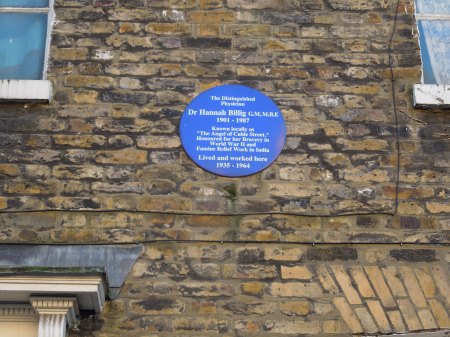
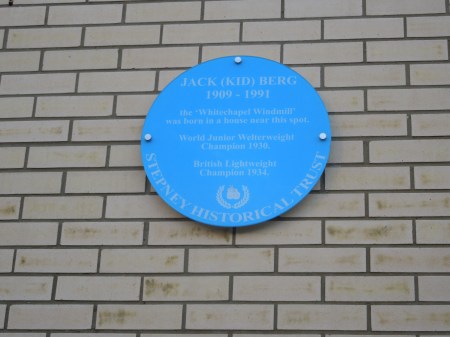
I generally note the blue plaques I pass, as I walk around. This morning, I was on the way to pick something up in the area and passed two.
The Angel Of Cable Street
Hannah Billig seems to have been a remarkable doctor. But then she was awarded a George Medal for courage and bravery in the Blitz and she was called the Angel of Cable Street.
Jack Kid Berg
This plaque to Jack Kid Berg was a hundred metres or so further on. He seemed to have had an good and long life.
I also seem to remember that along with Ted Kid Lewis he was one of my father’s sporting heroes.
New Houses That Get Flooded
In the recent heavy rain and resulting floods, I’m surprised to see how many new houses have got flooded.
My father told me never to buy a house that could be flooded and I have followed his advice and never bought a house that has ever suffered a flood.
Governments are pussy-footing around the problem, as this article shows. There should be a law, that means if any new properties flood, then the developer is responsible for fixing the problem. This would probably mean, houses were built, that were much suitable for our climate. They would probably be unsaleable to many punters, who prefer Pete Seeger‘s Little Boxes.
But hey! We have some of the best and most innovative architects in this country! The trouble is we also have a lot of very conservative people and especially politicians and planners, who think inside the box!
Incidentally, Pete Seeger is still alive at 94. Hopefully, his music is still making us think!
 The Anonymous Widower