‘I Get To Work On The Most Scenic Railway Line In The World’
The title of this post, is the same as that of this article on the BBC. It is a quote from someone in the BBC article.
This is the sub-heading.
Have you heard the one about the railway line that was threatened with closure, so lots of people started using it and it was saved?
These three opening paragraphs add some detail to the story.
Welcome to the Settle to Carlisle line, the quirky steel road through some of Britain’s most magnificent countryside.
The line starts in Leeds and passes through Shipley and Skipton, but it is the section between North Yorkshire and Cumbria that is world-famous for its views.
Heading north from Settle, the peak of Pen-y-Ghent soon looms large, with Whernside and Ingleborough following a few miles later.
The saving of the line in the 1980s, is one of those classic British tales of a fight against bureaucracy, which like all these tales involved a dog, who gets a heroic mention in the BBC article.
In the next few sections, I will detail how improvements to the rail infrastructure between Bradford, Carlisle, Lancaster, Leeds have gradually developed the rail infrastructure, so that the Settle and Carlisle Line can play an increasing part in improving the economic outlook for a large area of England.
Is The Settle And Carlisle Line In Good Condition?
Google AI gives this answer to the question in the title of this section.
Yes, the Settle-Carlisle line is in good, operational condition and is considered a vital, well-maintained part of the National Rail network.
Despite a history of threatened closures and past structural issues, major investments have secured its future, and it currently carries over 1.2 million passengers a year.
Here is the current status of the line as of early 2026:
Infrastructure Condition: Following significant repairs, including a major £2.1 million project on the Ribblehead Viaduct completed in 2021 and extensive work at Eden Brows (2017), the line’s 14 tunnels and 22 viaducts are in good condition.
Active Usage: It is regularly used by Northern passenger services and is a designated diversionary route for mainline express trains when the West Coast Main Line is closed.
Operational Status: The line is fully operational, featuring regular commuter services, tourist trains, and steam heritage charter trains.
Safety & Upgrades: While it is a historic line, the infrastructure is deemed safe.
Occasional, isolated issues (like the 2022 freight derailment near Carlisle) have been managed with swift repairs.As of early 2026, the line is heavily used, with special passenger services and 150th-anniversary celebrations planned.
It’s probably in better condition, than many houses in the UK.
What Is The Operating Speed Of The Settle And Carlisle Line?
Google AI gives this answer to the question in the title of this section.
The Settle and Carlisle Line generally operates at a maximum speed of 60 mph/97 km/h.
While historically faster, this 60 mph limit is standard for modern passenger and freight services on the route.
Usage Examples and ContextPassenger Services: Northern Rail and various chartered services, including the scenic “Staycation Express” HST 125, operate along the route.
Freight: The line is used for heavy freight, including oil, timber, and cement trains.
Diversions: The line is frequently used as a, albeit slower, alternative route (approx. 2.5 hours for Leeds-Carlisle) during major West Coast Main Line (WCML) closures.
Scenic Tourism: The line is renowned as one of England’s most scenic, carrying over a million travelers annually, with notable sights like the Ribblehead Viaduct.
The Settle And Carlisle Line Is Well Connected To The Rail Network At The Northern End
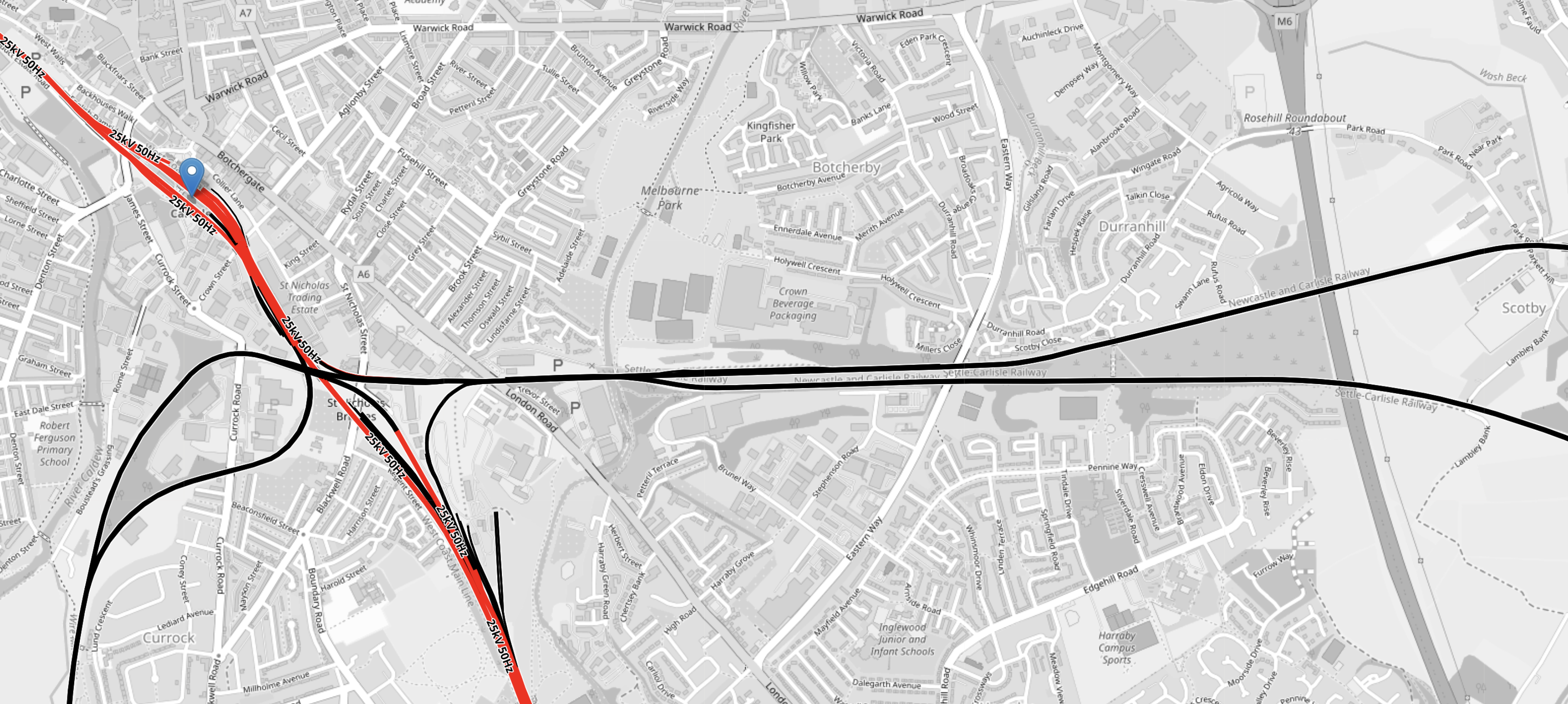
This OpenRailwayMap shows how the line connects to the West Coast Main Line and the Tyne Valley Line, to the South of Carlisle.
Note.
- Electrified lines are shown in red and lines shown in black are not electrified.
- The electrified West Coast Main Line runs diagonally across the South-West corner of the map.
- The blue arrow on this line, indicates Carlisle station.
- The Northernmost of the two black cross lines is the Tyne Valley Line between Carlisle and Newcastle.
- The Southernmost of the two black cross lines is the Settle And Carlisle Line, which goes South to Settle, Bradford Forster Square, Leeds and Settle stations.
- The line going South-West joins the Cumbrian Coast Line, which joins the West Coast Main Line at Carnforth.
It does appear that the junction South of Carlisle is very comprehensive and allows very flexible routing.
The Settle And Carlisle Line Is Well Connected To The Rail Network At The Southern End
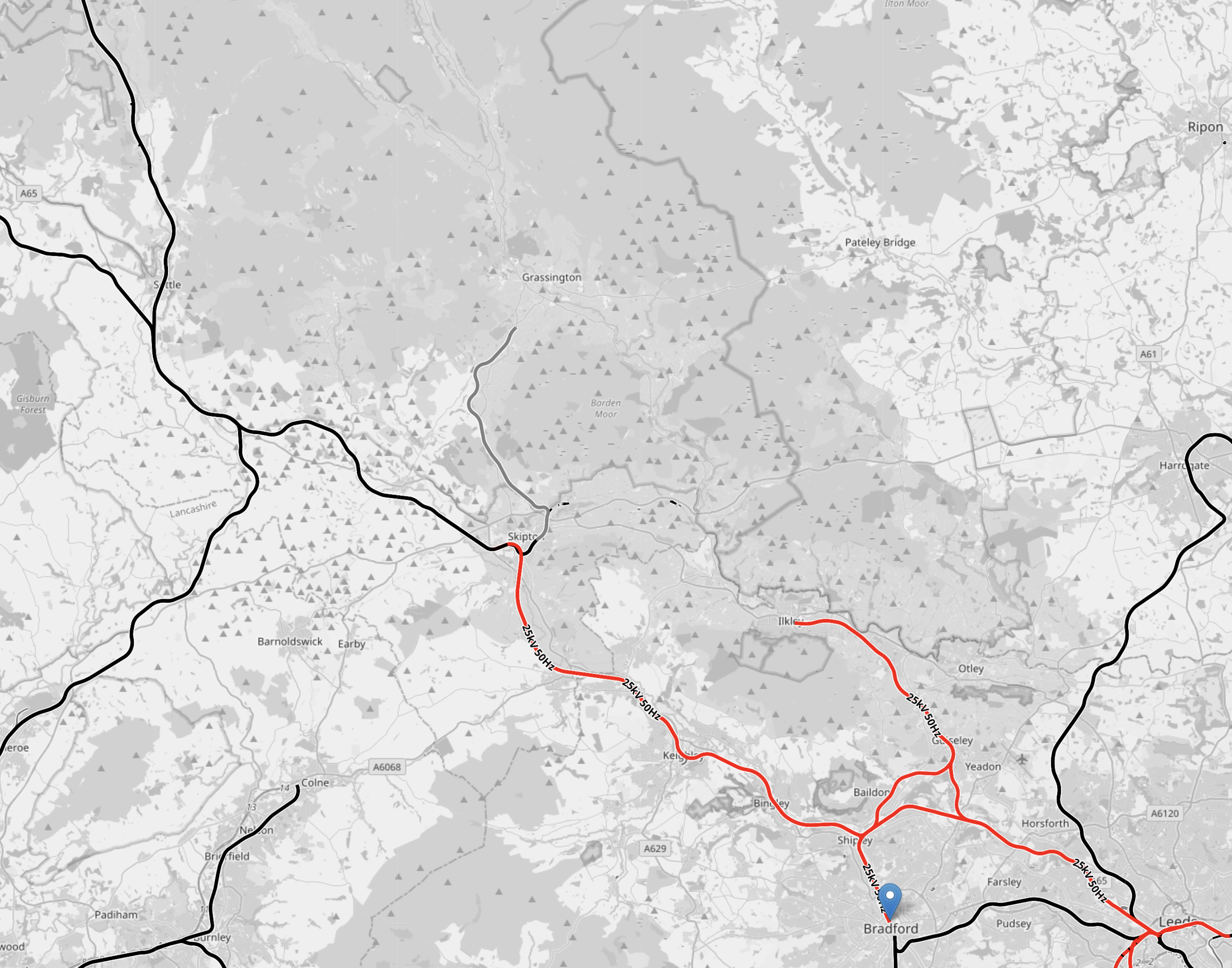
This OpenRailwayMap shows how the line connects to the West Coast Main Line and the Tyne Valley Line, to the North of Skipton.
Note.
- Electrified lines are shown in red and lines shown in black are not electrified.
- The blue arrow on this line, indicates Bradford Forster Square station.
- The fully-electrified Leeds station is in the South-East corner of the map. You can just pick out the ee of the name.
- The electrified Leeds-Bradford Line connects Bradford Forster Square and Leeds station via Shipley station and its triangular junction.
- The electrification continues in a North-Westerly direction as far as Skipton, where the red track stops.
- Electric intercity trains can run from London to Leeds, Bradford Forster Square and Skipton.
- Self-powered intercity trains can also run from London to Harrogate, which is on the line without electrification, that runs North from Leeds.
- Leeds receives a London service of two trains per hour (tph).
- Bradford Forster Square station receives a London service of one train per two hours (tp2h) via Leeds.
- Harrogate station receives a London service of 1 tp2h via Leeds.
- Skipton station receives a London service of one train per day (tpd) via Leeds.
The Leeds-Bradford area gets a frequent service to London and the South.
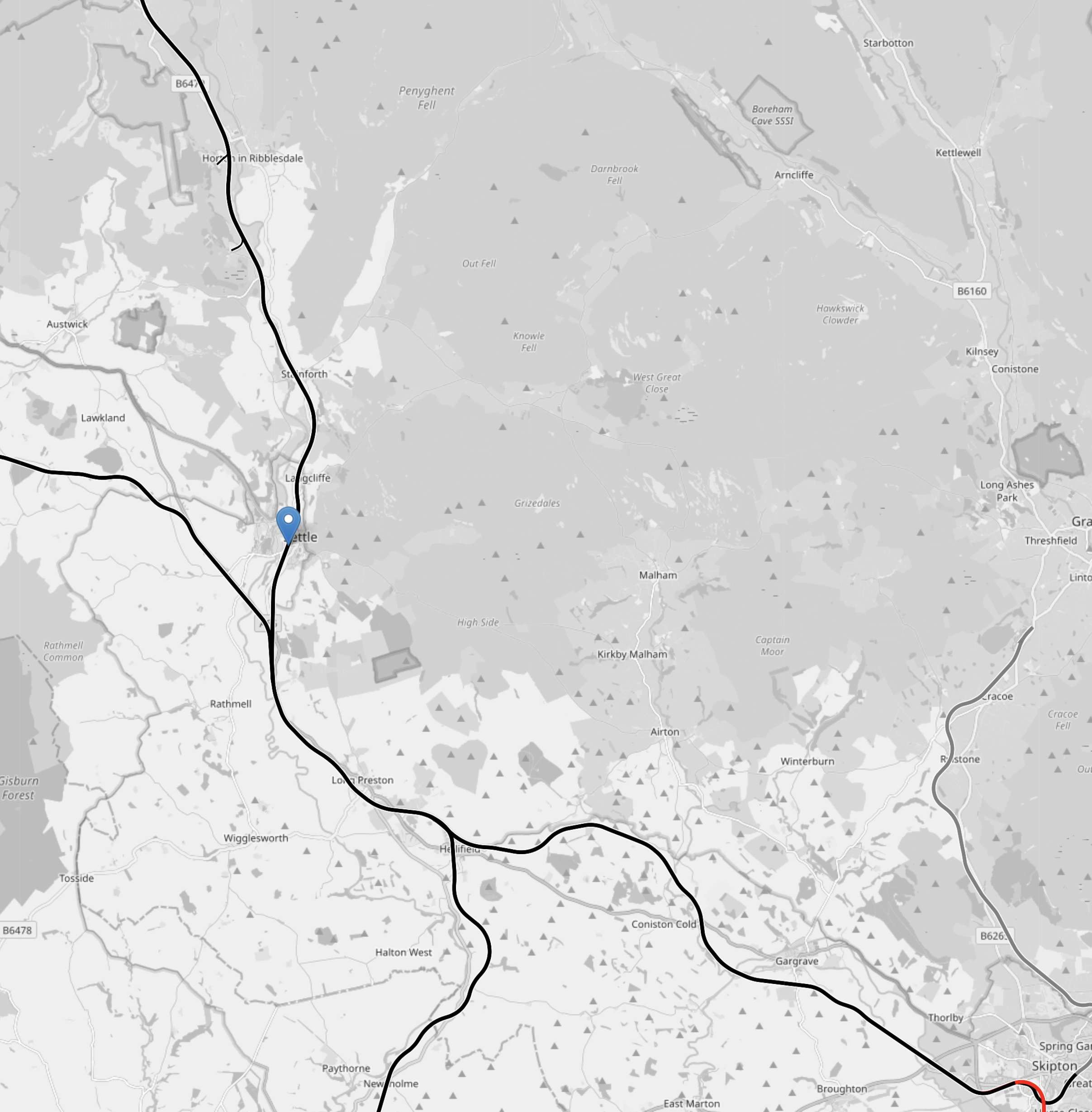
This OpenRailwayMap shows how the Settle and Carlisle Line connects to the electrification at Skipton.
Note.
- Electrified lines are shown in red and lines shown in black are not electrified.
- The only electrified lines on the map are at Skipton station in the South-East corner of the map.
- The blue arrow on this line, indicates Settle station.
- Skipton and Settle stations are 15.2 miles apart.
- Settle and Carlisle are 71.5 miles apart.
To bridge the gap in the electrification between Carlisle and Skipton, trains will need to be able to run 86.7 miles on their own power.
Bridging The Carlisle And Skipton Gap
But once the train gets to Carlisle or Skipton, the train will have the luxury of 25 KVAC overhead electrification to both power the train and charge any batteries.
In my opinion, there are three intercity trains coming into service, that could handle an 86.7 mile gap in electrification.
- East Midland Railways’s Class 810 train, which is a diesel bi-mode with lots of power, which is described in this Wikipedia entry.
- LNER’s Class 802 trains, which currently is a diesel bi-mode, that Hitachi could convert into a Hitachi Intercity Battery Train, which is described on this Hitachi web site.
- LNER’s Class 897 trains, which is a diesel tri-mode, that CAF are building in Spain and Wales, which is described in this Wikipedia entry.
In How Far Will A Hitachi Intercity Battery Train Travel Without Using The Electrification?, I answer the question for both Hitachi and CAF trains.
Surprisingly, I got the answer of a range of 120 miles for both the Hitachi and CAF trains. But could it be that Network Rail and the train companies wanted a range of 120 miles to electrify the UK rail network and so a 120 mile battery range was in the specification.
My estimate of 120 miles for Hitachi’s trains, was also confirmed by the company.
Bridging The Gaps
Some other distances, where gaps must be bridged include.
- Sheffield and South Wigston – 69.4 miles
- Holyhead and Chester – 84.4 miles
- Exeter and Basingstoke – 124,3 miles
- Fishguard Harbour and Cardiff Central – 119.1 miles
- Aberystwyth and Shrewsbury – 81.5 miles
- Bristol Temple Meads and Newbury – 70.8 miles
- Inverness and Aberdeen – 108.3 miles
- Carlisle and Glasgow Central via Dumfries – 115.9 miles
- Hereford to Didcot Junction – 96.9 miles
120 miles could be a good fit.
Could it be that that distance was the range of a steam locomotive on a full load of water?
The Updating Of Bradford Forster Square Station
This is now a four-platform station, with two platforms able to take a pair of 5-car Hitachi or the new CAF 10-car Class 397 trains.
In Bradford Forster Square Station – 20th May 2025, I describe and show pictures of the updated station.
Bradford Forster Square station now gets seven trains per day to and from London King’s Cross via Leeds.
This article on the BBC, which is entitled New Platform’s Opening Gives Bradford More Trains has this sub-heading.
A new £35m platform at Bradford’s Forster Square Station has opened – boosting rail services in the city
£35million seems a lot of money to spend to just increase the number of services between King’s Cross and Bradford, even though 2025 was the year that Bradford was UK City of Culture, but there may be valid reasons to create a new route between London and Scotland, using the Settle and Carlisle Line.
- The Settle and Carlisle Line is one of the UK’s most famous scenic routes with 20 viaducts, 14 tunnels and countless beautiful vistas along its 72 mile track.
- You put the Mona Lisa on display, not in a store.
- LNER now has battery-electric bi-mode trains, with CAF tri-mode trains due to enter service in 2028, that can both handle the 86.7 mile gap in the electrification in silence.
- The CAF trains have extra diesel power, about which CAF is not disclosing much. This to me, suggests some innovative use.
- There appear to be no flights between Leeds/Bradford Airport and Scotland.
- There appear to be no direct trains between Glasgow and West Yorkshire.
- A direct train between Glasgow and Leeds and Bradford Forster Square would add additional connectivity between Scotland and Yorkshire.
- With the cancellation of High Speed Two, we need more train paths between London and Scotland.
- Decarbonisation of aviation is difficult, but replacing fossil-fueled planes with zero-carbon trains is easier.
- A single Class 897 train can carry 569 seated passengers, which is about 3.5 times the capacity of a single Airbus A320.
- The proposed Leeds Metro would bring passengers to the new service.
- Leeds and Bradford could see an upturn in tourism.
I also think the line will not be lightly used due to its iconic status.
How Would A Leeds/Bradford And Scotland Service Call At Bradford Forster Square Station?
- Bradford Forster Square station now gets seven trains per day to and from London King’s Cross via Stevenage, Newark Northgate, Doncaster, Wakefield Westgate, Leeds and Shipley.
- There is one fewer train on Sunday.
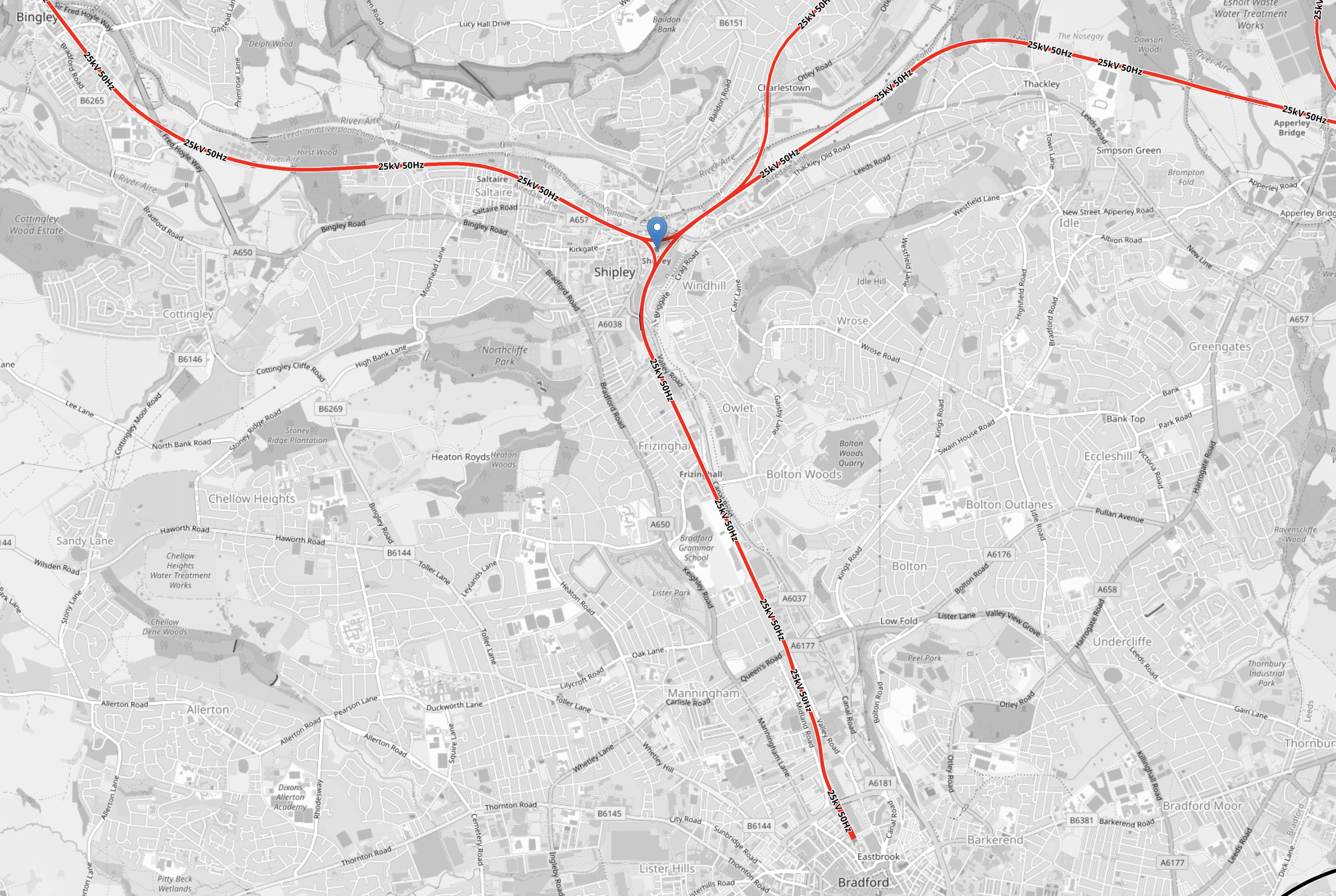
- There is a triangular junction at Shipley station, which connects the three electrified lines to Leeds, Bradford Forster Square and Skipton.
This OpenRailwayMap shows Shipley station and the triangular junction.
Note.
- All rail lines are electrified and shown in red.
- The blue arrow on this line, indicates Shipley station.
- Shipley station appears to be in the middle of the junction.
- The line going East connects to Leeds station.
- The line going South connects to Bradford Forster Square station, which is at the end of the line.
- The line going West connects to Skipton station and the Settle and Carlisle Line.
Trains returning to London would reverse out of Bradford Forster Square station and take the Eastern route through Shipley and Leeds back to London.
- An appropriate number of trains for Carlisle and Scotland, could surely just reverse out of the station and take the Western route through Skipton station and go on to the Settle and Carlisle Line.
- The trains would call at Wakefield Westgate, Leeds, Shipley, Bradford Forster Square and Skipton stations in the Leeds/Bradford conurbation.
- Other stations could be added to the route if required.
- The trains would effectively reverse direction in their call at Bradford Forster Square station.
- Going North the trains might check their battery levels in Bradford Forster Square station and use a fast-charger if necessary.
- Going South, there would be no need for charging, as the route South from Bradford Forster Square station, is already fully-electrified.
- Would the operator, use this longer stop to replace the crew with a fresh one?
It could be a simple and efficient way to run a London and Scotland service via the Settle and Carlisle Line.
What About Hull, Sheffield And York?
I’m asking this question, as Yorkshire is a large county and this article has only mentioned a few places, where people live and might need to go to London or Scotland.
In February, I wrote Northern Launches New Yorkshire Flyer Fast Service Between Leeds And Sheffield.
I’m fairly sure that Hull, York and other cities and large towns in Yorkshire already have a good regional service to Bradford Forster Square or Leeds station, which will give a good connection to the new service.
Could Dumfries Be Served By Using The Glasgow South Western Line?
This OpenRailwayMap shows the Southern part of the Glasgow South Western Line.
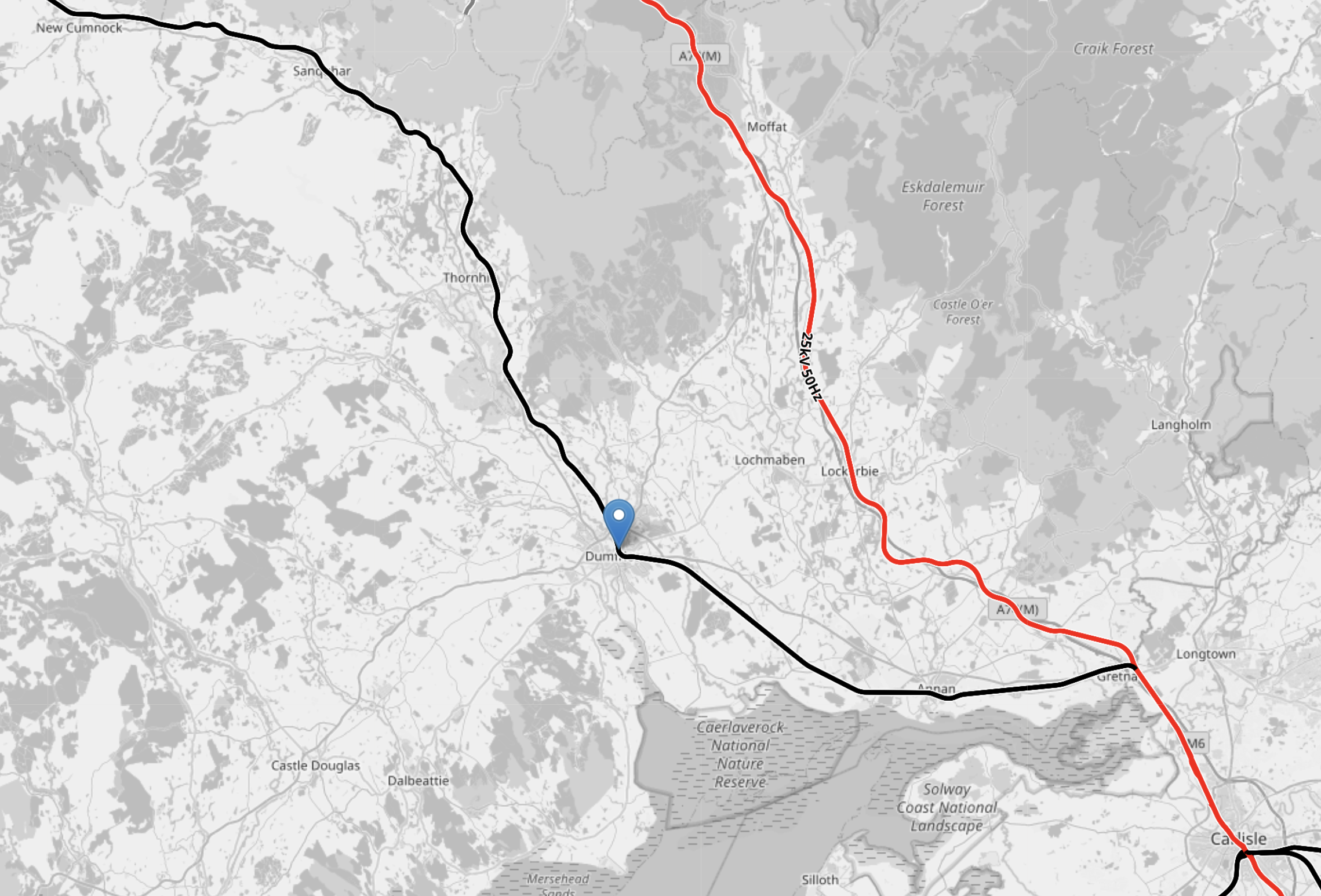
Note.
- Electrified lines are shown in red and lines shown in black are not electrified.
- The blue arrow on the black track, indicates Dumfries station on the Glasgow South Western Line.
- The red track is the West Coast Main Line.
- Carlisle is in the South-East corner of the map.
- Carlisle and Glasgow Central via Dumfries is 115.9 miles
- The Thames-Clyde Express, ran on this route until 1974.
- According to the Wikipedia entry for the Thames-Clyde Express, the train called at Dumfries and Kilmarnock stations.
From this brief look it appears that the new service could include Dumfries and should be able to serve the town on battery power.
Is More Capacity Needed On The West Coast Main Line Between Carlisle And Glasgow?
I asked Google AI, this question, to see if there is capacity.
This was the answer I received.
Yes, increased capacity and infrastructure enhancements are required on the West Coast Main Line (WCML) between Carlisle and Glasgow, as the line is currently full and unable to meet modern, growing passenger and freight demands.
Upgrades are necessary to tackle aging infrastructure, bottlenecks, and the need for more frequent services.
Key Aspects of the Need for Capacity:Full Capacity: The WCML is essentially full, with little space left for growth, despite 75 million passengers using it annually.
Freight and Passenger Growth: Passenger numbers are expected to double by 2050, and the line is a crucial artery for Anglo-Scottish freight.
Infrastructure Age: The northern section is undergoing its largest upgrade in half a century to address reliability issues.
Performance Bottlenecks: Specific locations, such as those north of Carlisle, require signaling and track improvements to prevent delays.
Proposed Upgrades: Current initiatives include a £400m investment until March 2029 for upgrades, including signalling and track renewals, though these are largely to boost reliability rather than provide a massive increase in capacity.
It looks to me, that a bit of a redesign and some use of battery trains on the Glasgow South Western Line, might squeeze a few more trains into the route.
Northern Launches New Yorkshire Flyer Fast Service Between Leeds And Sheffield
The title of this post is the same as that of this news item from Northern Trains.
This is the sub-heading.
Northern is running a new fast service which allows customers to travel between Leeds and Sheffield in 47 minutes.
These three introductory paragraphs add more detail.
Known as the Yorkshire Flyer, as it provides a quick and convenient connection between the White Rose county’s two biggest cities, the service was officially launched during an event at Leeds station earlier today.
Cutting journey times and providing more than 30,000 extra seats a week, the service will support economic growth by making it easier for people to get to work and reach new opportunities.
It used to take all Northern customers around an hour or longer to make the journey, with trains calling at various stops along the way.
These further details come from Real Time Trains.
- The trains used appear to be two-car Class 158 trains.
- The total distance is 38.7 miles.
- Between Leeds station and South Kirkby junction is electrified and a distance of 20.6 miles.
- Trains appear to leave Leeds station at xx45.
- CrossCountry services Leeds station for Sheffield at xx15 and make a similar intermediate stop at Wakefield Westgate.
- Leeds trains for Sheffield seem to leave from Platform 12 or 12A.
- Trains appear to leave Sheffield station at xx52.
- CrossCountry services leave Sheffield station for Leeds at xx22 and make a similar intermediate stop at Wakefield Westgate.
- Sheffield trains for Leeds don’t seem to have such a regular platform, as those in the other direction. But I suppose that will be improved.
Effectively, Northern and CrossCountry have paired up two services to give a two trains per hour, fast service between Leeds and Sheffield with one stop at Wakefield Westgate.
I have some further thoughts.
The Route Could Be Run By Battery-Electric Trains
Consider.
- The only part of the route that is not electrified is the 18.1 miles between South Kirkby junction and Sheffield station.
- From talking to engineers, who are working on developing battery-electric trains, a three-car train with a battery range of fifty miles is already a possibility.
- In 2015, I actually rode on a four-car battery-electric Class 379 train, that ran reliably on the Harwich branch for three months.
- Merseyrail’s battery-electric Class 777 trains probably have the performance and are working reliably on Merseyside. But they are probably a bit slow.
I believe that any number of train manufacturers would be very pleased to provide new battery-electric trains for the route.
But Siemens must be in the prime position.
- The German company has built a £200 million train factory at Goole in East Yorkshire, which is currently building London’s Piccadilly Line trains, which have batteries.
- Siemens have already delivered trains in Germany using the technology, they would use in the UK.
- The battery charging technology they would use for other routes in the UK, is described in Technology Behind Siemens Mobility’s British Battery Trains Hits The Tracks.
- Sheffield and Leeds, would make a superb test and demonstration route for battery-electric trains, as 50% of the route is fully-electrified with 25 KVAC.
- The Sheffield and Leeds route is just down the track from the Goole factory.
- I wouldn’t be very surprised, if Siemens were very keen to get a few orders close to their factory, as they would surely be easy to support.
But the clincher must be Juergen Maier, who used to be CEO of Siemens UK, and is now Chair of Great British Energy. Maier holds both British and Austrian citizenship, and was educated in Leeds and Nottingham, so hopefully, he can give this clanger-prone government some excellent advice where they need it, from his position in Great British Energy.
Could A Stop Be Made At Meadowbank Station?
This would give access to other rail routes and the Sheffield Supertram, but most of this access could also be performed at Sheffield.
Looking at the timetable of the route, I feel that there is enough slack to fit in a stop at Meadowhall, but it would need for the route to be electrified, so that the trains had faster acceleration and deceleration.
However, battery-electric trains may have the required performance.
What Maximum Speed Would The Trains Need?
Consider.
- The current Class 158 diesel trains used between Sheffield and Leeds and in many places in the UK are 90 mph trains.
- There are also a large number of Class 170 trains in the UK, that will need to be replaced and these are 100 mph trains.
- The Sheffield and Leeds route has some sections of 85 mph running.
- Train speeds are all accurately computer-controlled.
As a Control Engineer for safety and route availability reasons, I believe the trains will have a 100 mph maximum speed, but train speed will be computer controlled.
Will The Trains Be Driver-Only Operated?
I asked Google AI if Hitachi IET trains are driver only operated (DOO) and received this reply.
Hitachi Intercity Express Trains (IETs, Class 800/802) are designed for versatile operation, capable of Driver-Only Operation (DOO) using in-cab CCTV monitors for door safety checks. While they can operate without a guard, many services, particularly on GWR, still retain a guard on board for passenger service duties, even if the driver controls the doors.
So Hitachi trains can be driver-only operated and these will surely share the tracks with the trains that work the Northern Flyer.
I asked Google AI if Thameslink trains are driver only operated (DOO) and received this reply.
Yes, all Thameslink train services are Driver Only Operated (DOO). This means the driver is solely responsible for operating the doors and ensuring the safe dispatch of the train, without a guard or conductor on board to manage the doors. Through the central London core, these trains often use Automatic Train Operation (ATO).
As I believe that Siemens would be likely to win the battery-electric train order, because of proven technology, factory location and influence of Juergen Maier, Siemens certainly have the ability to produce trains, that are driver-only operated.
I believe that, whoever builds the trains, they will be capable of driver-only operation.
But if driver-only operation is to be used will be down to politics.
- Because of the situation on East West Rail, Heidi Alexander will probably be in favour.
- The Tories and Liberal Democrats will also be in favour.
- The rail unions, the left wing of the Labour Party and the Greens will be strongly against.
- Farage and Reform UK will take a very hard line to enforce driver-only operation everywhere.
The average citizen on the Northern Flyer and all the other trains in the UK, will just want a reliable train service.
Conclusion
- This would make a superb route for a battery electric train.
- No chargers or extra electrification would need to be installed.
- There wouldn’t be much work needed to be done to the platforms or the signalling.
- The trains would use standard 25 KVAC overhead electrification for charging.
- The trains would be running close to where they were built.
I believe the new service will give a large boost to the Yorkshire economy. Even before the arrival of battery-electric trains.

