Norway Plans EUR 3 Billion Subsidy For Floating Offshore Wind
The title of this post, is the same as that of this article on offshoreWIND.biz.
This is the sub-heading.
The Norwegian government has proposed NOK 35 billion (approximately EUR 3 billion) for a support scheme dedicated towards the first commercial floating offshore wind tender within the Vestavind F and Vestavind B areas.
These are the first two paragraphs.
According to the press release, the government is making progress in following up on its ambitious plan to allocate project areas for 30 GW of offshore wind by 2040.
Norway plans to conduct the next tendering round for offshore wind in 2025. After that, the government intends to hold regularly scheduled tendering rounds and state aid competitions leading up to 2040.
The original press release is called A Responsible Approach To Floating Offshore Wind.
Some politicians and green sceptics might not call three billion euros responsible.
I do suspect that Great British Energy will have to deal in this size of numbers to be able to compete with the Norwegians.
We’ll have to work hard to meet our target of 100 GW by 2040.
But at least as the UK’s target is higher, does that mean that the target should be easier. Or do we have more suitable sea?
Global Offshore Wind To Top 520 GW By 2040, Floating Wind To Play Major Role – Rystad Energy
The title of this post, is the same as that of this article on offshoreWIND.biz.
This is the sub-heading.
According to Rystad Energy, global offshore wind capacity will surpass 520 GW by 2040, with floating wind installations nearing 90 GW by that time
These are the first three paragraphs.
In 2023, the offshore wind sector saw a seven per cent increase in new capacity additions compared to the previous year, said Rystad Energy. This momentum is expected to accelerate this year, with new capacity additions expected to grow by nine per cent to over 11 GW by the end of the year.
By 2040, Europe is expected to account for more than 70 per cent of global floating wind installations. Although some project delays beyond 2030 are anticipated, there will likely be a strong push to accelerate deployment, according to Rystad Energy.
As a result, floating wind capacity is projected to approach 90 GW by 2040, led by the UK, France, and Portugal, with Asia (excluding mainland China) expected to account for 20 per cent of global installations.
Note, that Rystad Energy is an independent energy research and business intelligence company headquartered in Oslo, Norway.
Implications For Energy Storage
In Grid Powers Up With One Of Europe’s Biggest Battery Storage Sites, I talk about how the 2.9 GW Hornsea Three wind farm will have a connection to the grid, that incorporates a 300 MW/600 MWh battery.
With 520 GW of offshore wind to be installed by 2040, I suspect that energy storage companies and funds will do well.
If the 520 GW of offshore wind were fitted with batteries like the 2.9 GW Hornsea Three wind farm, there would be a need for around 60 GW of battery output, with a capacity of around 120 GWh.
I doubt, there would be enough lithium for all those batteries.
Some countries like Norway, the United States, Australia, France, Spain, Japan, India, China and others will be able to develop large pumped storage hydroelectricity systems, but others will have to rely on newer, developing technologies.
The UK will be well-placed with around 80 GWh of pumped storage hydroelectricity under development and several promising developing storage technologies.
3 GW Dogger Bank South Offshore Wind Farms Reach New Development Stage
The title of this post, is the same as that of this article on offshoreWIND.biz.
This is the sub-heading.
The UK Planning Inspectorate has accepted into the examination phase the Development Consent Order (DCO) application for the Dogger Bank South (DBS) Offshore Wind Farms developed by RWE and Masdar.
The first two paragraphs give a brief description of the wind Farm.
The DBS East and DBS West offshore wind farms, which could provide electricity for up to three million typical UK homes, are located in shallow waters on the Dogger Bank over 100 kilometres off the northeast coast of England. The acceptance of the DCO application moves the projects into the pre-examination phase, which will become subject to a public examination later in 2024.
Together, the projects will have up to 200 turbines with a combined estimated capacity of 3 GW. Investment by RWE and Masdar during development and construction is predicted to deliver an economic contribution (Gross Value Added) to the UK of almost GBP 1 billion, including GBP 400 million in the Humber region.
There is a detailed map in the article on offshoreWIND.biz.
The Next Steps
These are given in the article.
The next steps for the projects, following a successful Development Consent Order, would be to secure Contracts for Difference (CfD), followed by financing and construction, the developers said.
It certainly looks like the 3 GW Dogger South Bank Wind Farm is on its way.
These are my thoughts about the project.
The Turbines To Be Used
The article says this about the turbines.
Together, the projects will have up to 200 turbines with a combined estimated capacity of 3 GW.
This means that the turbines will be 15 MW.
In RWE Orders 15 MW Nordseecluster Offshore Wind Turbines At Vestas, I said this.
Does this mean that the Vestas V236-15.0 MW offshore wind turbine, is now RWE’s standard offshore turbine?
This would surely have manufacturing, installation, operation and maintenance advantages.
There would surely be advantages for all parties to use a standard turbine.
It’s A Long Way Between Yorkshire And The Dogger Bank
The article says it’s a hundred kilometres between the wind farm and the coast of Yorkshire.
Welcome To The Age Of Hydrogen
This is the title of this page of the RWE web site.
The page starts with this paragraph.
RWE is actively involved in the development of innovative hydrogen projects. The H2 molecule is considered to be an important future building block of a successful energy transition. RWE is a partner in over 30 H2 projects and is working on solutions for decarbonising the industry with associations and corporations like Shell, BASF and OGE. Hydrogen projects are comprehensively supported in the separate Hydrogen department of the subsidiary RWE Generation.
AquaVentus
I also suggest, that you read this page on the RWE web site called AquaVentus.
The page starts with this RWE graphic.
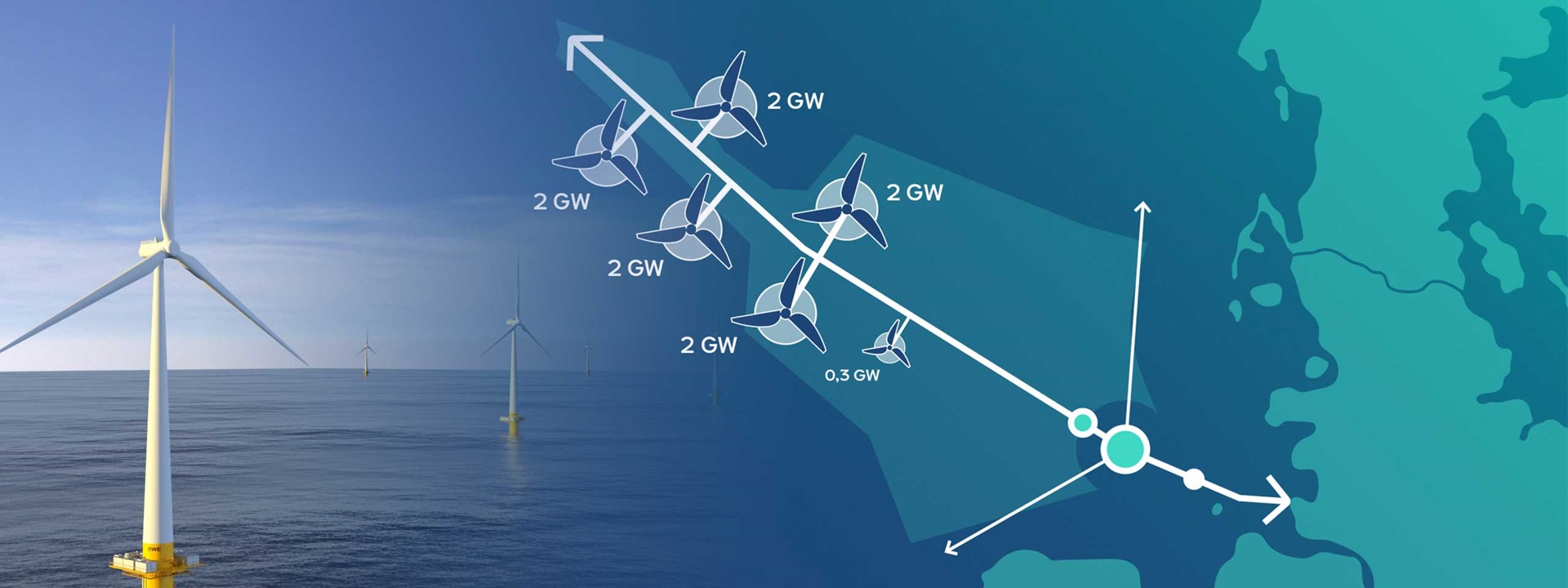
It appears that 10.3 GW of hydrogen will be created by wind farms and piped to North-West Germany.
These two paragraphs outline the AquaVentus initiative .
Hydrogen is considered the great hope of decarbonisation in all sectors that cannot be electrified, e.g. industrial manufacturing, aviation and shipping. Massive investments in the expansion of renewable energy are needed to enable carbon-neutral hydrogen production. After all, wind, solar and hydroelectric power form the basis of climate-friendly hydrogen.
In its quest for climate-friendly hydrogen production, the AquaVentus initiative has set its sights on one renewable energy generation technology: offshore wind. The initiative aims to use electricity from offshore wind farms to operate electrolysers also installed at sea on an industrial scale. Plans envisage setting up electrolysis units in the North Sea with a total capacity of 10 gigawatts, enough to produce 1 million metric tons of green hydrogen.
The page also gives these numbers.
- Total Capacity – 10 GW
- Tonnes Of Green Hydrogen – 1 million
- Members – 100 +
The web site says this about commissioning.
Commissioning is currently scheduled for early/mid 2030s.
The Germans can’t be accused of lacking ambition.
AquaVentus And The UK
This video shows the structure of AquaVentus.
I clipped this map from the video.

Note.
- There is a link to Denmark.
- There appears to be a undeveloped link to Norway.
- There appears to be a link to Peterhead in Scotland.
- There appears to be a link to just North of the Humber in England.
- Just North of the Humber are the two massive gas storage sites of Aldbrough owned by SSE and Brough owned by Centrica.
- There appear to be small ships sailing up and down the East Coast of the UK. Are these small coastal tankers distributing the hydrogen to where it is needed?
In the last century, the oil industry, built a substantial oil and gas network in the North Sea. It appears now the Germans are leading the building of a substantial hydrogen network.
AquaVentus And Aldbrough And Rough Gas Storage
Consider.
- In The Massive Hydrogen Project, That Appears To Be Under The Radar, I describe the Aldbrough Gas Storage.
- In Wood To Optimise Hydrogen Storage For Centrica’s Rough Field, I describe Centrica’s plans to turn Rough Gas Storage into the world’s largest hydrogen store.
- There is a small amount of hydrogen storage at Wilhelmshaven.
It looks like the East Riding Hydrogen Bank, will be playing a large part in ensuring the continuity and reliability of AquaVentus.
Dogger Bank South And AquaVentus
This Google Map shows the North Sea South of Sunderland and the Danish/German border.
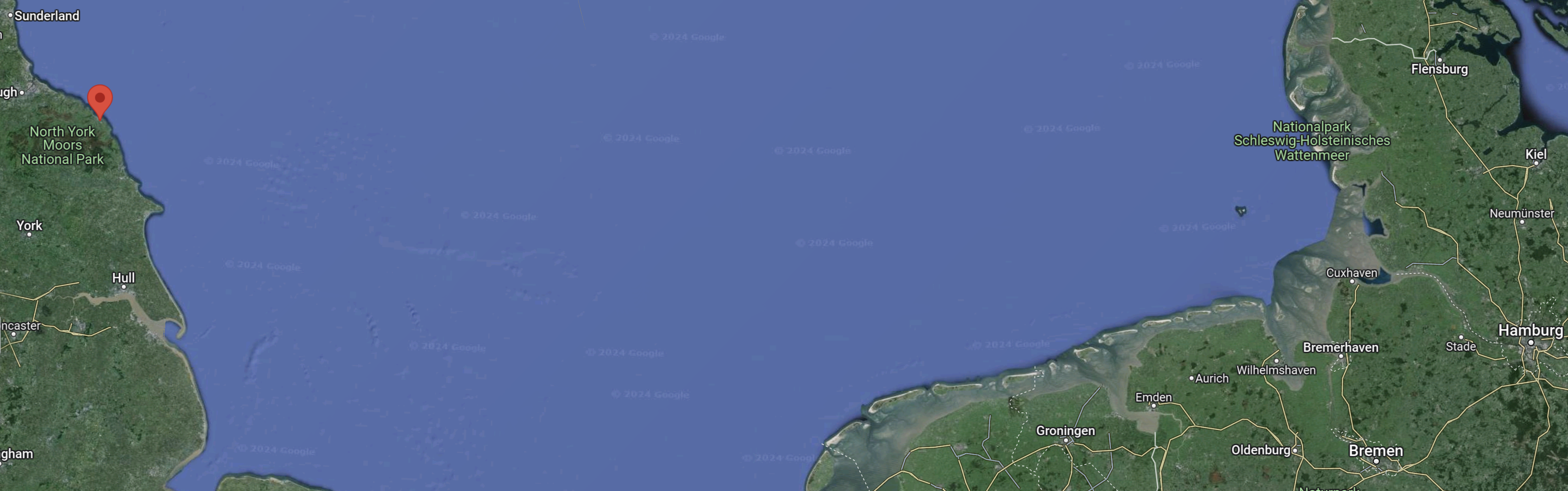
Note.
- Sunderland is in the top-left hand corner of the map.
- A white line in the top-right corner of the map is the Danish/German border.
- Hamburg and Bremen are in the bottom-right hand corner of the map.
If you lay the AquaVentus map over this map, I believe that Dogger Bank South wind farm could be one of the three 2 GW wind farms on the South-Western side of the AquaVentus main pipeline.
- Two GW would be converted to hydrogen and fed into the AquaVentus main pipeline.
- One GW of electricity would be sent to the UK.
But this is only one of many possibilities.
Hopefully, everything will be a bit clearer, when RWE publish more details.
Conclusion
I believe, that some or all of the Dogger Bank South electricity, will be converted to hydrogen and fed into the AquaVentus main pipeline.
I also believe, that the hydrogen stores in the East Riding of Yorkshire, will form an important part of AquaVentus.
Norway’s Sovereign Wealth Fund Acquires Stake In 573 MW Race Bank Offshore Wind Farm
The title of this post, is the same as that of this article on offshoreWIND.biz.
This is the sub-heading.
A consortium made up of investment funds belonging to Australia-headquartered Macquarie Asset Management and Spring Infrastructure Capital has reached an agreement to divest a 37.5 per cent stake in the 573 MW Race Bank offshore wind farm in the UK to Norges Bank Investment Management.
These four paragraphs give more details of the deal.
The stake was sold to the Norwegian sovereign wealth fund for approximately GBP 330 million (about EUR 390.6 million).
According to Norges Bank Investment Management, the fund acquired Macquarie European Infrastructure Fund 5’s 25 per cent stake and Spring Infrastructure 1 Investment Limited Partnership’s 12.5 per cent interest in the Race Bank offshore wind farm.
A Macquarie Capital and Macquarie European Infrastructure Fund 5 consortium acquired a 50 per cent stake in Race Bank during the construction phase in 2016. Macquarie Capital divested its 25 per cent stake in the wind farm in 2017.
With the deal, Arjun Infrastructure Partners will remain co-investor for 12.5 per cent of the wind farm and Ørsted will remain a 50 per cent owner and operator of Race Bank.
These are my thoughts.
The Location of Race Bank Wind Farm
This map from the Outer Dowsing Web Site, shows Race Bank and all the other wind farms off the South Yorkshire, Lincolnshire and Norfolk coasts.
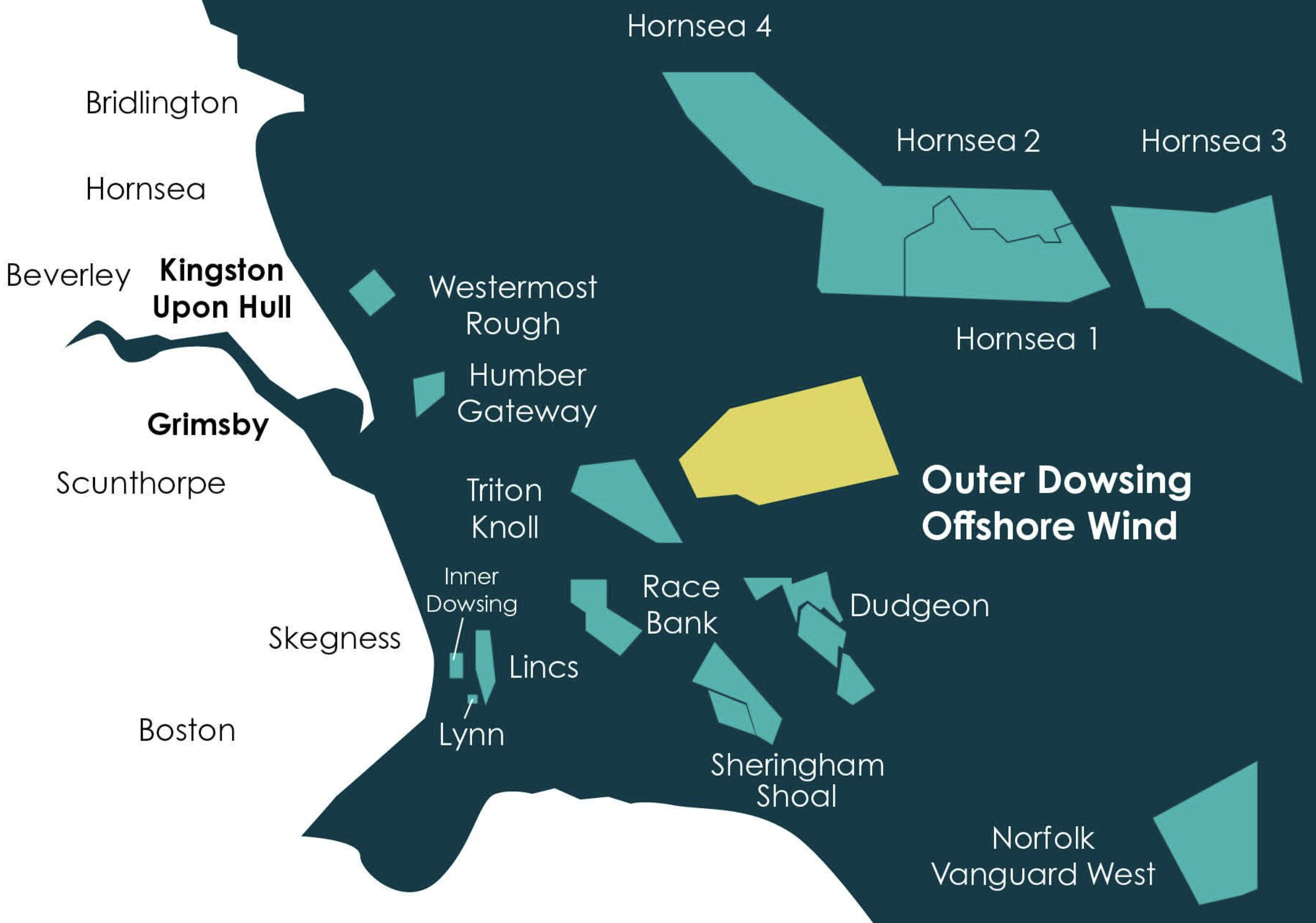
From North to South, wind farm sizes and owners are as follows.
- Hornsea 1 – 1218 MW – Ørsted, Global Infrastructure Partners
- Hornsea 2 – 1386 MW – Ørsted,Global Infrastructure Partners
- Hornsea 3 – 2852 MW – Ørsted
- Hornsea 4 – 2600 MW – Ørsted
- Westernmost Rough – 210 MW – Ørsted and Partners
- Humber Gateway – 219 MW – E.ON
- Triton Knoll – 857 MW – RWE
- Outer Dowsing – 1500 MW – Corio Generation, TotalEnergies
- Race Bank – 573 MW – Ørsted,
- Dudgeon – 402 MW – Equinor, Statkraft
- Lincs – 270 MW – Centrica, Siemens, Ørsted
- Lynn and Inner Dowsing – 194 MW – Centrica, TCW
- Sheringham Shoal – 317 MW – Equinor, Statkraft
- Norfolk Vanguard West – 1380 MW – RWE
Note.
- There is certainly a large amount of wind power on the map.
- Hornsea 1, 2 and 3 supply Humberside.
- Hornsea 4 will supply Norwich and North Norfolk.
- Norfolk Vanguard West would probably act with the other two wind farms in RWE’ Norfolk cluster.
- Ignoring Hornsea and Norfolk Vanguard West gives a total around 4.5 GW.
- There are also two 2 GW interconnectors to Scotland (Eastern Green Link 3 and Eastern Green Link 4) and the 1.4 GW Viking Link to Denmark.
I wouldn’t be surprised to see a large offshore electrolyser being built in the East Lincolnshire/West Norfolk area.
The primary purpose would be to mop up any spare wind electricity to avoid curtailing the wind turbines.
The hydrogen would have these uses.
- Provide hydrogen for small, backup and peaker power stations.
- Provide hydrogen for local industry, transport and agriculture,
- Provide hydrogen for off-gas-grid heating.
- Provide methanol for coastal shipping.
Any spare hydrogen would be exported by coastal tanker to Germany to feed H2ercules.
Do We Need Wind-Driven Hydrogen Electrolysers About Every Fifty Miles Or so Along The Coast?
I can certainly see a string along the East Coast between Humberside and Kent.
- Humberside – Being planned by SSE
- East Lincolnshire/West Norfolk – See above
- North-East Norfolk – See RWE Goes For An Additional 10 GW Of Offshore Wind In UK Waters In 2030.
- Dogger Bank – See RWE Goes For An Additional 10 GW Of Offshore Wind In UK Waters In 2030.
- Sizewell – See Sizewell C And Hydrogen.
- Herne Bay – Under construction
I can see others at possibly Freeport East and London Gateway.
TetraSpar Demonstrator Floating Wind Turbine Hits 63 Pct Capacity Factor In Norway
The title of this post, is the same as that of this article on offshoreWIND.biz.
This is the sub-heading.
Stiesdal has revealed that its TetraSpar Demonstrator, located in Norway, has reached a capacity factor of 63 per cent.
These three paragraphs give a few more details.
Since its commissioning in late 2021, the TetraSpar Demonstrator has been operational at METCentre in Norway, delivering green energy, gathering data, validating numerical models, supporting research and development projects, and serving as a living laboratory for the development of floating wind technology, said Stiesdal in a recent social media post.
To date, the demonstrator has generated more than 37 GWh of renewable energy, according to the company. The 3.6 MW Siemens Gamesa direct-drive wind turbine and very high wind speeds at the METCentre site combined to yield a capacity factor of 54 per cent, said Stiesdal.
In the first two years of operation, the availability was recorded at 97 per cent and 98.3 per cent, respectively. For 2024, the availability has increased to 99.5 per cent with a capacity factor of almost 63 per cent, according to the company.
I have some further thoughts.
Tetra Offshore Foundations For Any Water Depth
The title of this section, is the same as that of this page on the Siesdal web site.
The page gives a lot of information and says that the TetraSpar can handle water depth of over a thousand metres.
Wind Farm Capacity Factor
The Wikipedia entry for capacity factor says this about the range of wind farm capacity factors.
Wind farms are variable, due to the natural variability of the wind. For a wind farm, the capacity factor is determined by the availability of wind, the swept area of the turbine and the size of the generator. Transmission line capacity and electricity demand also affect the capacity factor. Typical capacity factors of current wind farms are between 25 and 45%. In the United Kingdom during the five year period from 2011 to 2019 the annual capacity factor for wind was over 30%.
From that paragraph, 63 % seems to be extraordinarily good.
Conclusion
The TetraSpar appears to be a powerful concept.
Aker Solutions To Pilot Floating-Wind Power Hub
The title of this post, is the same as that of this press release from Aker Solutions.
This is the sub-heading.
Aker Solutions to pilot world’s first subsea power distribution system for floating offshore wind at Norway´s METCentre
These four paragraphs describe the system and explain how it works.
Note.
Aker Solutions has signed a front-end engineering and design (FEED) contract with the Marine Energy Test Centre (METCentre) in Norway to pilot new subsea power system technology which has the potential to significantly reduce the costs and complexity of offshore wind farms.
The project will see Aker Solutions provide new power transmission technology, Subsea Collector, for the METCentre’s offshore wind test area which today consists of two floating offshore wind turbines located 10 kilometers off the southwestern coast of Karmøy, Norway. The test area will expand to seven floating offshore wind turbines from 2026.
Subsea Collector provides an alternative solution to connect multiple wind turbines electrically in a star configuration instead of the traditional daisy chain pattern, allowing for more flexibility in offshore wind farm architecture and construction. The design also allows for reduced cable length per turbine and park, as well as less vessel time and installation costs. Initial findings support total cost savings on a 1GW floating wind farm of up to 10 percent.
The main component parts of the Subsea Collector comprise a 66kV wet mate connection system provided by Benestad and subsea switchgear with supervisory control and data acquisition by subsea power and automation alliance partner, ABB. Installation will be carried out by Windstaller Alliance, an alliance between Aker Solutions, DeepOcean and Solstad Offshore. Aker Solutions will also provide the static export cable to shore.
Total cost savings of ten percent on any large project are not to be sneezed at.
I also feel that this sort of architecture will be ideal for a test centre, where configurations are probably changed more often.
Is This Better News For Offshore Wind Farm Developers?
Two months ago this article on offshoreWIND.biz was published, which was entitled Offshore Wind Developers Take A Pass On UK’s Fifth CfD Round As Maximum Bid Price Was Too Low.
This was the sub-heading.
The UK government has awarded 3.7 GW of renewable energy projects with Contracts for Difference (CfDs) in its fifth allocation round. Among the 95 new projects that secured CfDs are onshore wind, solar and tidal energy developments – and not a single megawatt of offshore wind.
These are the first three paragraphs of the article.
According to the government, the global rise in inflation and the impact on supply chains presented challenges for projects participating in this round. The government also noted that similar results have been seen in countries such as Germany and Spain.
The industry does not disagree, however, multiple players have voiced their disappointment that the government had not taken these pressures into account for this round and emphasised that the UK’s goal of having 50 GW of offshore wind and 5 GW of floating wind could now be jeopardised.
Last year, the UK awarded CfDs to 7 GW of offshore wind projects alone.
Today, articles with these titles and sub-headings were published on offshoreWIND.biz.
- 50 Developers Express Interest To Build Wind Farms Offshore Portugal
Fifty entities, including individual companies and consortia, from more than ten countries have submitted their expressions of interest to develop offshore wind projects in Portugal as the country prepares for its first auction.
2. Fugro To Survey Site For Lithuania’s First Offshore Wind Farm
Ignitis Renewables has awarded Fugro a contract to conduct a geophysical survey at Lithuania’s first offshore wind farm site.
3. Norway’s Offshore Wind Tender Attracts Seven Applications
Norway’s Ministry of Petroleum and Energy has received seven applications to participate in the tender for the Southern North Sea II offshore wind project area.
4. Project To Retrofit CTV With Hydrogen Fuel Cells Kicks Off
A project to retrofit a crew transfer vessel (CTV) with hydrogen fuel cells, to cut CO2 and NOx emissions while servicing offshore wind farms, has kicked off.
5.Terna Energy Secures Survey Permit for Wind Farm Sites Offshore Greece
Terna Energy has been granted one out of the two first exploration and survey licences issued for pilot offshore wind projects in Greece.
6. UK Increases Offshore Wind Strike Price Ahead Of Next Auction
The government of the United Kingdom has increased the maximum strike price for offshore wind projects in the next Contracts for Difference (CfD) auction by 66 per cent for fixed-bottom and by 52 per cent for floating wind projects.
All would appear to be positive stories.
- Story 1 is about success in Portugal. What are the Portuguese doing right?
- Stories 2 and 5 are about offshore wind development in new countries; Lithuania and Greece.
- Story 3 may not appear significant, but Terje Aasland, who is Norway’s Minister of Petroleum and Energy seemed pleased in the article.
- Story 4 is about development of new technology, which wouldn’t be done if the market was non-existent.
- Story 6 is surely good news for wind farm developers in the UK.
I did leave out three stories, one of which was negative and two were rather boring. But six out of nine isn’t bad.
Is it Getting Better All The Time, as The Beatles once sang?
Thoughts On The Future Of Orkney
This article on the BBC is entitled Orkney Votes To Explore ‘Alternative Governance‘
This is the sub-heading.
Orkney councillors have voted to investigate alternative methods of governance amid deep frustrations over funding and opportunities.
These paragraphs outline the story.
Council leader James Stockan said the islands had been “held down” and accused the Scottish and UK governments of discrimination.
His motion led to media speculation that Orkney could leave the UK or become a self-governing territory of Norway.
It was supported by 15 votes to six.
It means council officers have been asked to publish a report to Orkney’s chief executive on options of governance.
This includes looking at the “Nordic connections” of the archipelago and crown dependencies such as Jersey and Guernsey.
A further change which would see the revival of a consultative group on constitutional reform for the islands was accepted without the need for a vote.
My Thoughts On The Economic Future Of The Islands
The economic future of Orkney looks good.
Tourism and the traditional industries are on the up, but the islands could play a large part in renewable energy.
The West of Orkney offshore wind farm, which will be a 2 GW wind farm with fixed foundations, is being developed and a large hydrogen production hub at Flotta is being proposed, along with the development of a large quay in Scapa Flow for the assembly of floating wind farms.
The West of Orkney wind farm could be the first of several.
If the future wind farms are further from shore, they will most likely be based on floating technology, with the turbines and their floats assembled in Scapa Flow, from components shipped in from mainland UK and Europe.
Political Future
With a good financial future assured, I believe that Orkney will be able to choose where its political future lies. It could be a Crown Dependency or join Norway.
Whichever way it goes, it could be an island that effectively prints money, by turning electricity into hydrogen and shipping it to countries like Germany, The Netherlands, Poland and Sweden!
From a UK point of view, a Crown Dependency could be a favourable move.
Would Shetland follow the same route?
Offshore Hydrogen Production And Storage
Orkney is not a large archipelago and is just under a thousand square kilometres in area.
It strikes me, that rather than using up scarce land to host the large electrolysers and hydrogen storage, perhaps it would be better, if hydrogen production and storage was performed offshore.
Aker Northern Horizons
In Is This The World’s Most Ambitious Green Energy Solution?, I talk about Northern Horizons, which is an ambitious project for a 10 GW floating wind farm, which would be built a hundred kilometres to the North-East of Shetland, that would be used to produce hydrogen on Shetland.
Other companies will propose similar projects to the West and East of the Northern islands.
This map shows the sea, that could be carpeted with armadas of floating wind farms.

Consider.
- There are thousands of square miles of sea available.
- As the crow flies, the distance between Bergen Airport and Sumburgh Airport in Shetland is 226 miles.
- A hundred mile square is 10,000 square miles or 2590 square kilometres.
- In ScotWind Offshore Wind Leasing Delivers Major Boost To Scotland’s Net Zero Aspirations, I calculated that the floating wind farms of the Scotwind leasing round had an energy density of 3.5 MW per km².
- It would appear that a hundred mile square could generate, as much as nine GW of green electricity.
How many hundred mile squares can be fitted in around the UK’s Northern islands?
Three Players Pursuing Floating Offshore Wind Opportunities At Barents Sea Oil Field
The title of this post, is the same as that of this article on offshoreWIND.biz.
This is the sub-heading.
Norwegian oil and gas company Vår Energi has entered into a collaboration with a consortium consisting of Odfjell Oceanwind and Source Galileo to explore opportunities for floating offshore wind through a pilot project at a field located in the Barents Sea off Norway.
The article mentions the Goliat oil field, which is located 85 kilometres (53 mi) northwest of Hammerfest.
This Google Map shows the location of Hammerfest.

Note.
- Hammerfest is marked by the red arrow.
- Hammerfest is the northernmost town in the world with more than 10,000 inhabitants.
- The furthest North, I’ve been in Europe is to Trondheim, which is in the South-West corner of the map.
- To the East of Hammerfest Norway and Russia have a common border and beyond that is the Russian port of Murmansk.
Many years ago, my first visits to Ipswich Town were courtesy of the Official Receiver for Ipswich; John Richardson, who was my parents’ next door neighbour in Felixstowe.
John was an interesting guy, who during the Second World War had been on the Arctic convoys to Murmansk and Archangel. The Wikipedia entry for Arctic Convoys Of World War Two, gives some details.
His descriptions of the weather in the area were horrendous and it makes me wonder why the Norwegians want to extract oil in those conditions. And now generate wind power.
This is the first sentence of the article.
Vår Energi disclosed the deal on Wednesday, 26 April 2023, explaining that the project, called GoliatVind, was a pilot project to demonstrate new, Norwegian offshore wind technology.
So is it all about new technology?
Norway Has Room For 338 GW Of Offshore Wind, New Analysis Finds
The title of this post, is the same as that of this article on offshoreWIND.biz.
This is the sub-heading.
Norway has the potential to develop up to 338 GW of offshore wind in areas with a low level of conflict, according to a new analysis performed by Multiconsult and commissioned by the industry organisation Norwegian Offshore Wind, Equinor, Source Galileo, Hafslund and Deep Wind Offshore.
These two paragraphs are the main findings of the report.
The report, issued on 14 April, maps 28 areas as suitable for floating wind and 18 areas for fixed-bottom offshore wind, estimating the total potential installed capacity to be 241 GW at 5 MW/km2 and 338 GW at 7 MW/km2.
Of this, floating wind could account for 156 GW and up to 219 GW, while fixed-bottom capacity is between 85 GW and 119 GW.
So how does that figure look for the UK?
Consider.
- The UK has an Exclusive Economic Zone of 773,676 sq. kilometres.
- But if you include overseas territories, the UK’s area is 6,805,586 sq. kilometres and is the fifth largest in the world.
- Norway has an Exclusive Economic Zone of 2,385,178 sq. kilometres.
So taking the 338 GW figure for Norway and ignoring overseas territories, we could generate 109.6 GW.
 The Anonymous Widower