RWE Plans Hydrogen-Ready Combined-Cycle Gas Turbine At Gersteinwerk In Werne
The title of this post, is the same as that of this press release from RWE.
These two bullet points act as sub-headings.
- Italian-Spanish consortium commissioned to plan 800-megawatt plant
- Investment decision to be made once H2 grid connection and regulatory framework are in place and economic viability has been established
These two paragraphs introduce the project.
RWE is planning to build hydrogen-ready gas-fired power plants at the company’s power plant sites in Germany to contribute to a successful coal phase-out by 2030. Following Weisweiler in the Rhenish mining area, the company is now pressing ahead with plans for such a plant at a possible second site in Werne in the southern Münsterland region. An H2-ready combined-cycle gas turbine (CCGT) power plant with a nominal capacity of around 800 megawatts may be built at the Gersteinwerk power plant.
Following intensive technical soundings, RWE has commissioned an Italian-Spanish consortium to plan the project. Work on the planning approval process is already underway.
These are my thoughts.
The current coal-fired power station at Gersteinwerk has a capacity of 2127 MW and was built in 1984.
This is a visualisation of the two power stations.
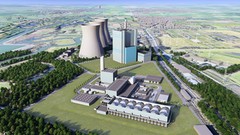
Note.
- The new gas/hydrogen-fired power station is in the foreground.
- The coal-fired power station, with its three cooling towers is behind.
This Google Map shows the site.
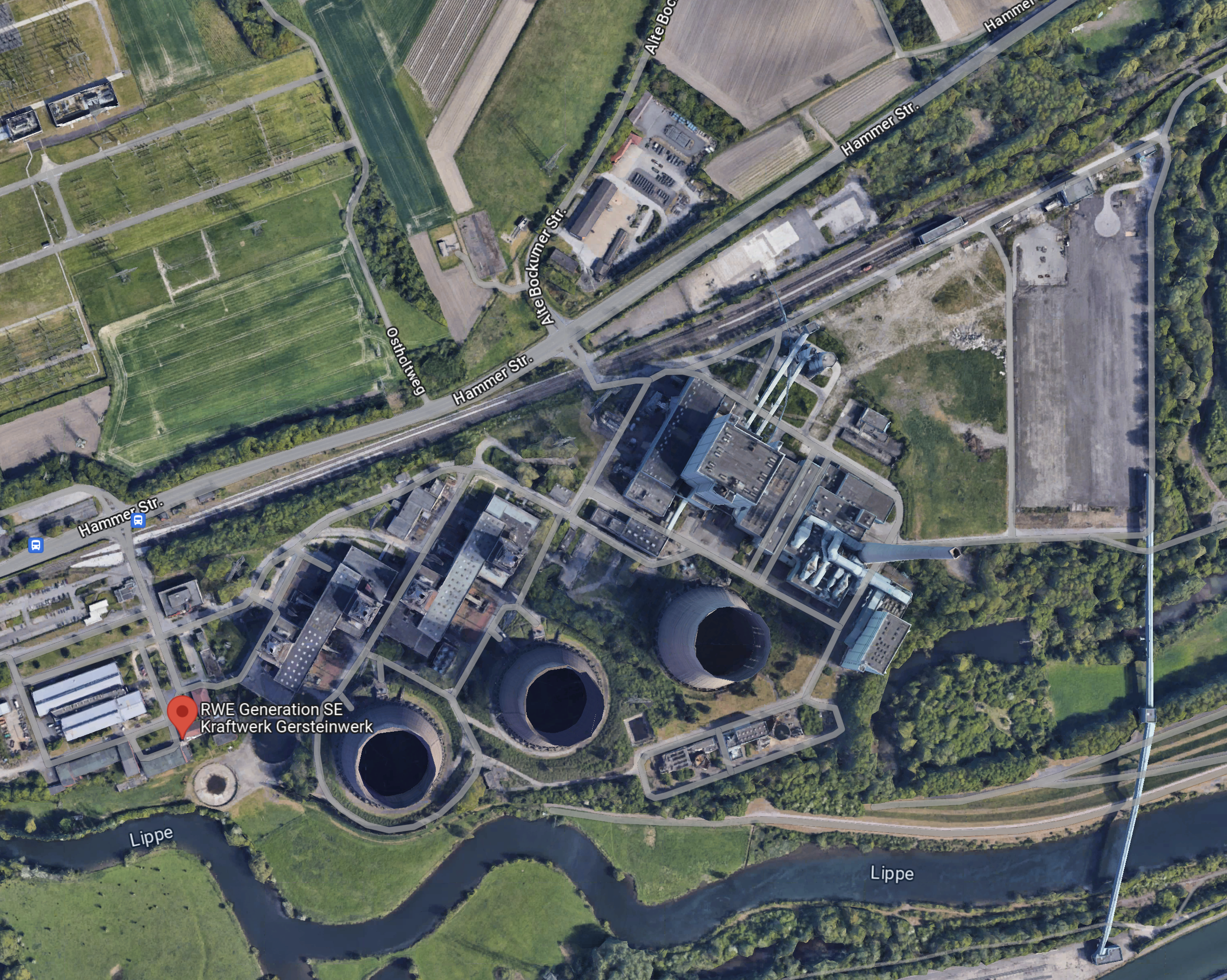
I suspect that due to the size of the original coal-fired power station, more than one hydrogen-fired power station will be needed.
Project Timeline
These paragraphs lay out the project timeline and the route to 100 % hydrogen operation.
Work on the planning process is already underway. This is the prerequisite for RWE to be able to start implementing the project as soon as an investment decision has been made.
According to current planning, the plant in Werne could start producing electricity by 2030.
At the time of commissioning, the plant should be able to use a fuel mix with at least 50 per cent hydrogen content, and it is intended to run it entirely on hydrogen at a later stage.
Germany is aiming for a coal phase-out by 2030.
The Scale Of German Power Decarbonisation
This article on Power Technology is entitled Germany To Invest €16bn In Hydrogen-Ready Gas-Fired Power Plants.
These are the first two paragraphs.
Germany’s Ministry for Economic Affairs and Climate Action (BMWK) has agreed to provide subsidies of €16bn for the construction of 10GW of hydrogen-ready gas-fired power plants.
The subsidy scheme has been significantly reduced since August 2023 when the proposal was first unveiled. A maximum of 23.8GW was anticipated at that time.
These power stations will need a lot of green hydrogen and I believe the most convenient place to source some of the hydrogen, will come from the windy waters of the UK’s North Sea.
RWE already have leases to build 7.2 GW of wind farms in UK waters.
Norway’s Sovereign Wealth Fund Acquires Stake In 573 MW Race Bank Offshore Wind Farm
The title of this post, is the same as that of this article on offshoreWIND.biz.
This is the sub-heading.
A consortium made up of investment funds belonging to Australia-headquartered Macquarie Asset Management and Spring Infrastructure Capital has reached an agreement to divest a 37.5 per cent stake in the 573 MW Race Bank offshore wind farm in the UK to Norges Bank Investment Management.
These four paragraphs give more details of the deal.
The stake was sold to the Norwegian sovereign wealth fund for approximately GBP 330 million (about EUR 390.6 million).
According to Norges Bank Investment Management, the fund acquired Macquarie European Infrastructure Fund 5’s 25 per cent stake and Spring Infrastructure 1 Investment Limited Partnership’s 12.5 per cent interest in the Race Bank offshore wind farm.
A Macquarie Capital and Macquarie European Infrastructure Fund 5 consortium acquired a 50 per cent stake in Race Bank during the construction phase in 2016. Macquarie Capital divested its 25 per cent stake in the wind farm in 2017.
With the deal, Arjun Infrastructure Partners will remain co-investor for 12.5 per cent of the wind farm and Ørsted will remain a 50 per cent owner and operator of Race Bank.
These are my thoughts.
The Location of Race Bank Wind Farm
This map from the Outer Dowsing Web Site, shows Race Bank and all the other wind farms off the South Yorkshire, Lincolnshire and Norfolk coasts.
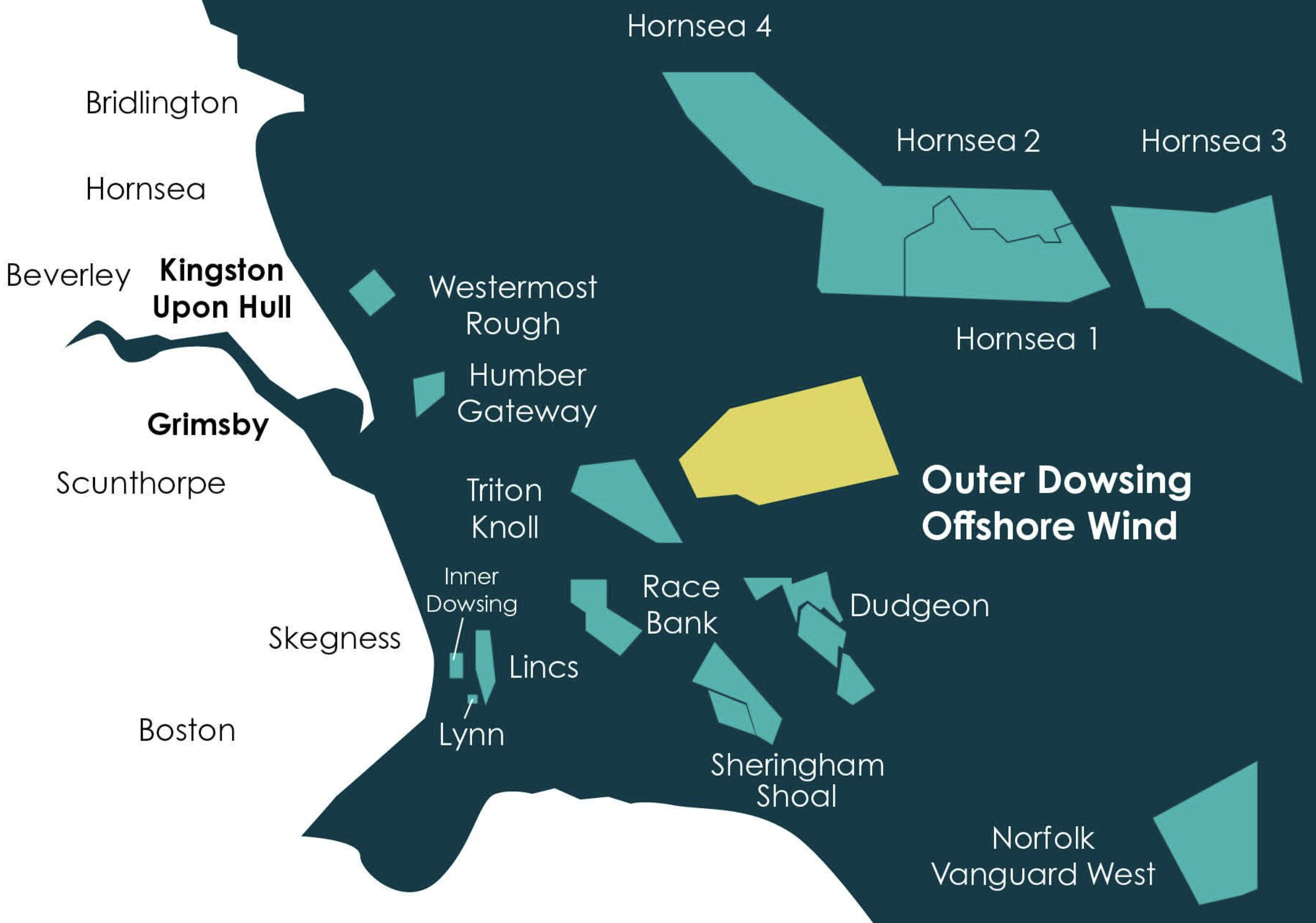
From North to South, wind farm sizes and owners are as follows.
- Hornsea 1 – 1218 MW – Ørsted, Global Infrastructure Partners
- Hornsea 2 – 1386 MW – Ørsted,Global Infrastructure Partners
- Hornsea 3 – 2852 MW – Ørsted
- Hornsea 4 – 2600 MW – Ørsted
- Westernmost Rough – 210 MW – Ørsted and Partners
- Humber Gateway – 219 MW – E.ON
- Triton Knoll – 857 MW – RWE
- Outer Dowsing – 1500 MW – Corio Generation, TotalEnergies
- Race Bank – 573 MW – Ørsted,
- Dudgeon – 402 MW – Equinor, Statkraft
- Lincs – 270 MW – Centrica, Siemens, Ørsted
- Lynn and Inner Dowsing – 194 MW – Centrica, TCW
- Sheringham Shoal – 317 MW – Equinor, Statkraft
- Norfolk Vanguard West – 1380 MW – RWE
Note.
- There is certainly a large amount of wind power on the map.
- Hornsea 1, 2 and 3 supply Humberside.
- Hornsea 4 will supply Norwich and North Norfolk.
- Norfolk Vanguard West would probably act with the other two wind farms in RWE’ Norfolk cluster.
- Ignoring Hornsea and Norfolk Vanguard West gives a total around 4.5 GW.
- There are also two 2 GW interconnectors to Scotland (Eastern Green Link 3 and Eastern Green Link 4) and the 1.4 GW Viking Link to Denmark.
I wouldn’t be surprised to see a large offshore electrolyser being built in the East Lincolnshire/West Norfolk area.
The primary purpose would be to mop up any spare wind electricity to avoid curtailing the wind turbines.
The hydrogen would have these uses.
- Provide hydrogen for small, backup and peaker power stations.
- Provide hydrogen for local industry, transport and agriculture,
- Provide hydrogen for off-gas-grid heating.
- Provide methanol for coastal shipping.
Any spare hydrogen would be exported by coastal tanker to Germany to feed H2ercules.
Do We Need Wind-Driven Hydrogen Electrolysers About Every Fifty Miles Or so Along The Coast?
I can certainly see a string along the East Coast between Humberside and Kent.
- Humberside – Being planned by SSE
- East Lincolnshire/West Norfolk – See above
- North-East Norfolk – See RWE Goes For An Additional 10 GW Of Offshore Wind In UK Waters In 2030.
- Dogger Bank – See RWE Goes For An Additional 10 GW Of Offshore Wind In UK Waters In 2030.
- Sizewell – See Sizewell C And Hydrogen.
- Herne Bay – Under construction
I can see others at possibly Freeport East and London Gateway.
Vestas’s 15 MW Wind Turbine Up At Danish Port of Thyborøn
The title of this post, is the same as that of this article on offshoreWIND.biz.
This is the sub-heading.
Vestas has completed the installation of its V236-15.0 MW offshore wind turbine in the Port of Thyborøn in Denmark, only three months after the port ordered the company’s flagship model.
This is the first paragraph.
On 8 June, the wind turbine produced its first kWh of power, a crucial step in the final verification campaign, Vestas said in a social media post.
I suspect that soon, Vestas will be accepting orders for these large turbines.
The Core Of Sunak’s Manifesto
I have a feeling, that the core of Sunak’s manifesto is a massive German project called H2ercules, which is intended to bring low-carbon hydrogen to industry in South Germany.
There will be a massive hydrogen hub at Wilhelmshaven on the North-Western coast, which is being built by Uniper, from which hydrogen will be imported and distributed.
I suspect that the Germans aim to source the hydrogen worldwide from places like Australia, the Middle East and Namibia. It would be brought from and round the Cape by tanker. The Suez route would be too risky.
But RWE, who are one of the UK’s largest electricity suppliers, are planning to deliver 7.2 GW of electricity in British waters on the Dogger Bank and North-East of Great Yarmouth.
Both wind farms would be difficult to deliver profitably to the UK, because Eastern England already has enough electricity and the Nimbies are objecting to more pylons.
I believe that RWE will build offshore electrolysers and coastal hydrogen tankers will take the hydrogen to Wilhelmshaven.
H2ercules will be fed with the hydrogen needed.
By the end of the next parliament, the Germans could be paying us substantial sums for green hydrogen, to decarbonise their industry.
Rishi Sunak hinted in his speech, that we will be exporting large amounts of energy.
Much of it will be in the form of green hydrogen to Germany.
If we need hydrogen for our industry, we would create it from some of our own wind farms.
RWE Goes For An Additional 10 GW Of Offshore Wind In UK Waters In 2030
This press release from RWE is entitled RWE And Masdar Join Forces To Develop 3 Gigawatts Of Offshore Wind Projects Off The UK Coast.
This is the last paragraph.
The UK plays a key role in RWE’s strategy to grow its offshore wind portfolio RWE is a leading partner in the delivery of the UK’s Net Zero ambitions and energy security, as well as in contributing to the UK build-out target for offshore wind of 50 GW by 2030. RWE already operates 10 offshore wind farms across the UK. Following completion of the acquisition of the three Norfolk offshore wind projects from Vattenfall announced at the end of 2023, RWE is developing nine offshore wind projects in the UK, representing a combined potential installed capacity of around 9.8 GW, with RWE’s pro rata share amounting to 7 GW. Furthermore, RWE is constructing the 1.4 GW Sofia offshore wind project in the North Sea off the UK’s east coast. RWE’s unparalleled track record of more than 20 years in offshore wind has resulted in 19 offshore wind farms in operation, with a goal to triple its global offshore wind capacity from 3.3 GW today to 10 GW in 2030.
Note.
- Nine offshore wind projects in the UK, representing a combined potential installed capacity of around 9.8 GW
- RWE are saying they intend to add 6.7 GW in 2030.
The eight offshore wind farms, that RWE are developing in UK waters would appear to be.
- Sofia – 1,400 MW
- Norfolk Boreas – 1380 MW
- Norfolk Vanguard East – 1380 MW
- Norfolk Vanguard West – 1380 MW
- Dogger Bank South – 3000 MW
- Awel y Môr – 500 MW
- Five Estuaries – 353 MW
- North Falls – 504 MW
This is a total of 9897 MW, which ties in well with RWE’s new capacity figure of 9.8 GW.
The Location Of RWE’s Offshore Wind Farms
RWE’s wind farms seem to fit in groups around the UK.
Dogger Bank
This wind farm is on the Dogger Bank.
- Dogger Bank South – 3000 MW – Planned
This wind farm would appear to be rather isolated in the middle of the North Sea.
RWE could have plans to extend it or even link it to other wind farms in the German area of the Dogger Bank.
Lincolnshire Coast
This wind farm is along the Lincolnshire Coast.
- Triton Knoll – 857 MW – 2022
As there probably isn’t much heavy industry, where Triton Knoll’s power comes ashore, this wind farm can provide the power needed in the area.
But any excess power in the area can be exported to Denmark through the Viking Link.
Norfolk Coast
These wind farms are along the Norfolk Coast.
- Norfolk Boreas – 1380 MW – Planned
- Norfolk Vanguard East – 1380 MW – Planned
- Norfolk Vanguard West – 1380 MW – Planned
These three wind farms will provide enough energy to provide the power for North-East Norfolk.
North Wales Coast
These wind farms are along the North Wales Coast.
- Awel y Môr – 500 MW – Planned
- Gwynt y Môr – 576 MW – 2015
- Rhyl Flats – 90 MW – 2009
- North Hoyle – 60 MW – 2003
These wind farms will provide enough energy for the North Wales Coast.
Any spare electricity can be stored in the 1.8 GW/9.1 GWh Dinorwig pumped storage hydroelectric power station.
Electric Mountain may have opened in 1984, but it is surely a Welsh giant decades ahead of its time.
Suffolk Coast
These wind farms are along the Suffolk Coast.
- Five Estuaries – 353 MW – Planned
- Galloper – 353 MW – 2018
- North Falls – 504 MW – Planned
These wind farms will provide enough energy for the Suffolk Coast, which except for the Haven Ports, probably doesn’t have many large electricity users.
But if the area is short of electricity, there will be Sizewell B nuclear power station to provide it.
Teesside
This wind farm is along the Teesside Coast
- Sofia – 1,400 MW – Planned
Teesside is a heavy user of electricity.
These six areas total as follows.
- Dogger Bank – 3,000 MW
- Lincolnshire Coast – 857 MW
- Norfolk Coast – 4140 MW
- North Wales Coast – 1226 MW
- Suffolk Coast – 1210 MW
- Teesside – 1,400 MW
Backup for these large clusters of wind farms for when the wind doesn’t blow will be provided as follows.
- Dogger Bank – Not provided
- Lincolnshire Coast- Interconnectors to Denmark and Scotland
- Norfolk Coast – Not provided
- North Wales Coast – Stored in Dinorwig pumped storage hydroelectric power station
- Suffolk Coast – Sizewell B and Sizewell C
- Teesside – Interconnectors to Norway and Scotland and Hartlepool nuclear power stations
Note.
- The interconnectors will typically have a 2 GW capacity.
- The 1.9 GW/9.1 GWh Dinorwig pumped storage hydroelectric power station must be one of the best wind farm backups in Europe.
There is a very solid level of integrated and connected assets that should provide a reliable power supply for millions of electricity users.
How Will Dogger Bank And The Norfolk Coast Wind Clusters Work Efficiently?
The Dogger Bank and the Norfolk Coast clusters will generate up to 3 and 4.14 GW respectively.
So what purpose is large amounts of electricity in the middle of the North Sea?
The only possible purpose will be to use giant offshore electrolysers to create hydrogen.
The hydrogen will then be transported to point of use by pipeline or tanker.
Feeding H2ercules
I described H2ercules in H2ercules.
H2ercules is an enormous project that will create the German hydrogen network.
The H2ercules web site, shows a very extensive project, as is shown by this map.

Note.
- Hydrogen appears to be sourced from Belgium, the Czech Republic, The Netherlands and Norway.
- RWE’s Dogger Bank South wind farm will be conveniently by the N of Norway.
- RWE’s Norfolk cluster of wind farms will be conveniently by the N of Netherlands.
- The Netherlands arrow points to the red circles of two hydrogen import terminals.
For Germany to regain its former industrial success, H2ercules will be needed to be fed with vast amounts of hydrogen.
And that hydrogen could be in large amounts from the UK sector of the North Sea.
Uniper’s Wilhelmshaven Hydrogen Hub
This page on the Uniper web site is entitled Green Wilhelmshaven: To New Horizons
This Uniper graphic shows a summary of gas and electricity flows in the Wilhelmshaven Hydrogen Hub.

Note.
- Ammonia can be imported, distributed by rail or ships, stored or cracked to provide hydrogen.
- Wilhelmshaven can handle the largest ships.
- Offshore wind energy can generate hydrogen by electrolysis.
- Hydrogen can be stored in underground salt caverns.
I suspect hydrogen could also be piped in from an electrolyser in the East of England or shipped in by a hydrogen tanker.
All of this is well-understood technology.
Sunak’s Magic Money Tree
Rishi Sunak promised a large giveaway of tax in his manifesto for the 2024 General Election.
As we are the only nation, who can provide the colossal amounts of hydrogen the Germans will need for H2ercules, I am sure we will be well paid for it.
A few days ago we celebrated D-Day, where along with the Americans and the Canadians, we invaded Europe.
Now eighty years later, our hydrogen is poised to invade Europe again, but this time for everybody’s benefit.
This document on the Policy Mogul web site is entitled Rishi Sunak – Conservative Party Manifesto Speech – Jun 11.
These are three paragraphs from the speech.
We don’t just need military and border security. As Putin’s invasion of Ukraine has shown, we need energy security too. It is only by having reliable, home-grown sources of energy that we can deny dictators the ability to send our bills soaring. So, in our approach to energy policy we will put security and your family finances ahead of unaffordable eco zealotry.
Unlike Labour we don’t believe that we will achieve that energy security via a state-controlled energy company that doesn’t in fact produce any energy. That will only increase costs, and as Penny said on Friday there’s only one thing that GB in Starmer and Miliband’s GB Energy stands for, and that’s giant bills.
Our clear plan is to achieve energy security through new gas-powered stations, trebling our offshore wind capacity and by having new fleets of small modular reactors. These will make the UK a net exporter of electricity, giving us greater energy independence and security from the aggressive actions of dictators . Now let me just reiterate that, with our plan, we will produce enough electricity to both meet our domestic needs and export to our neighbours. Look at that. A clear, Conservative plan not only generating security, but also prosperity for our country.
I believe that could be Rishi’s Magic Money Tree.
Especially, if the energy is exported through electricity interconnectors or hydrogen or ammonia pipelines and tankers.
Will This Be A Party Anyone Can Join?
Other wind farm clusters convenient for the H2ercules hydrogen import terminals on the North-West German coast include.
- Dogger Bank – SSE, Equinor – 5008 MW
- East Anglian – Iberdrola – 3786 MW
- Hornsea – Ørsted – 8056 MW
That totals to around 16.5 GW of wind power.
I can see offshore electrolysers producing hydrogen all around the coasts of the British Isles.
What Happens If Sunak Doesn’t Win The Election?
RWE and others have signed contracts to develop large wind farms around our shores.
They didn’t do that out of the goodness of their hearts, but to make money for themselves and their backers and shareholders.
Conclusion
I believe a virtuous circle will develop.
- Electricity will be generated in the UK.
- Some will be converted to hydrogen.
- Hydrogen and electricity will be exported to the highest bidders.
- European industry will, be powered by British electricity and hydrogen.
- Money will be paid to the UK and the energy suppliers for the energy.
The more energy we produce, the more we can export.
In the future more interconnectors, wind farms and electrolysers will be developed.
Everybody will benefit.
As the flows grow, this will certainly become a Magic Money Tree, for whoever wins the election.
Highland Council Greenlights West Of Orkney Windfarm Onshore Plans
The title of this post, is the same as that of this article on offshoreWIND.biz.
This is the sub-heading.
The Highland Council has approved the onshore plans of the 2 GW West of Orkney Windfarm project, being developed by TotalEnergies, Corio Generation, and Renewable Infrastructure Development Group (RIDG) in Scotland.
These are the first three paragraphs.
The onshore application for planning permission in principle was approved on 4 June and outlines the underground cables and electrical infrastructure required to connect the offshore wind farm to the national transmission network.
Last year, the project became the first ScotWind proposal to submit both its offshore consent application to Scottish Ministers and its onshore planning application to The Highland Council.
The onshore application provides information on proposed cable landfalls on the north Caithness coast, the project’s substation at Spittal in Caithness, and the underground cables which will extend around 25 kilometres and connect to the substation.
According to the project page of the West of Orkney wind farm web site, the target for commissioning of the wind farm is 2029.
This wind farm appears to be making a play to be the first of the ScotWind Leasing developments to be commissioned.
I have some thoughts.
Converting The Flotta Oil Terminal To The Flotta Hydrogen Hub
This first paragraph of the Wikipedia entry for the Flotta Oil Terminal, describes it like this.
The Flotta oil terminal is a major crude oil reception, processing, storage and export facility on the island of Flotta, in the south of Scapa Flow in the Orkney Islands. It receives and processes crude oil delivered by a subsea pipeline from the Piper, Claymore, Tartan and Golden Eagle platforms and associated fields. The terminal includes facilities for exporting stabilised crude oil (and formerly liquefied petroleum gases) by tanker.
It is now proposed to add the Flotta Hydrogen Hub to the Flotta Oil Terminal.
This document on the Repsol web site, describes the Flotta Oil Terminal.
- This page is the Flotta Hydrogen Hub web site.
- This page discusses, what will be done with the green hydrogen produced by electrolysis.
- The green hydrogen page, has an excellent map of the hydrogen and electricity flows to and from the Flotta Hydrogen Hub.
The Flotta Oil Terminal will be developed into a major hydrogen production and distribution facility.
UK Offshore Wind In 2030
The next general election is likely to be held in 2029, so how much wind energy will be added during the next Parliament?
The Current Position
The Wikipedia entry for the list of operational wind farms in the UK, says this.
In October 2023, there were offshore wind farms consisting of 2,695 turbines with a combined capacity of 14,703 megawatts.
Due To Be Commissioned In 2024
It would appear these wind farms will come on-line in 2024.
- Neart Na Gaoithe – 450 MW – Fixed
- Doggerbank A – 1235 MW – Fixed
- Doggerbank B – 1235 MW – Fixed
This would add 2920 MW to give a total of 17,623 MW.
Due To Be Commissioned In 2025
It would appear these wind farms will come on-line in 2025.
- Moray West – 882 MW – Fixed
- Doggerbank C – 1218 MW – Fixed
This would add 2100 MW to give a total of 19,723 MW.
Due To Be Commissioned In 2026
It would appear these wind farms will come on-line in 2026.
- Sofia – 1400 MW – Fixed
- East Anglia 3 – 1372 MW – Fixed
- East Anglia 1 North – 800 MW – Fixed
- East Anglia 2 – 900 MW – Fixed
- Pentland – 100 MW – Floating
This would add 4572 MW to give a total of 24,295 MW.
Due To Be Commissioned In 2027
It would appear these wind farms will come on-line in 2027.
- Hornsea 3 – 2852 MW – Fixed
- Norfolk Boreas – 1380 MW – Fixed
- Llŷr 1 – 100 MW – Floating
- Llŷr 2 – 100 MW – Floating
- Whitecross – 100 MW – Floating
This would add 4532 MW to give a total of 28,827 MW.
Due To Be Commissioned In 2028
It would appear these wind farms will come on-line in 2028.
- Morecambe – 480 MW – Fixed
This would add 480 MW to give a total of 29,307 MW.
Due To Be Commissioned In 2029
It would appear these wind farms will come on-line in 2029.
- West Of Orkney – 2000 MW – Fixed
This would add 2000 MW to give a total of 31,307 MW.
Due To Be Commissioned In 2030
It would appear these wind farms will come on-line in 2030.
- Ramplion 2 Extension – 1200 MW – Fixed
- Norfolk Vanguard East – 1380 MW – Fixed
- Norfolk Vanguard West – 1380 MW – Fixed
- Awel y Môr – 1100 MW – Fixed
- Berwick Bank – 4100 MW – Fixed
- Outer Dowsing – 1500 MW – Fixed
- Hornsea 4 – 2600 MW – Fixed
- Caledonia – 2000 MW – Fixed
- N3 Project – 495 MW – Fixed/Floating
This would add 15755 MW to give a total of 47.062 MW.
Capacity Summary
- 2023 – None – 14703 MW
- 2024 – 2920 MW – 17,623 MW
- 2025 – 2100 MW – 19,723 MW
- 2026 – 4572 MW – 24,295 MW
- 2027 – 4532 MW- 28,827 MW
- 2028 – 480 MW – 29,307 MW
- 2029 – 2000 MW – 31,307 MW
- 2030 – 15755 MW – 47,062 MW
Note that capacity has increased more than threefold.
If we assume the following.
- New wind farms are commissioned throughout the year.
- 14703 MW of wind power, with all our gas-fired, nuclear and onshore wind farms is enough to power the UK.
- The average capacity factor is 45 %.
- The strike price is £35/MWh.
The levels I have set are deliberately on the low side.
The amount of energy and cash flow generated by new wind farms in a year can be calculated as follows.
{Average New Capacity In Year}= ({Capacity at Year Start}+{Capacity at Year End})/2-14703
{Extra Electricity Generated In Year}= {Average New Capacity In Year}*365*24*{Capacity Factor}
{Cash Flow}={Extra Electricity Generated In Year} * {Strike Price}
The following figures are obtained.
- 2024 – 1460 MW – 5,755,320 MWh – £ 201,436,200
- 2025 – 3970 MW – 15,649,740 MWh – £ 547,740,900
- 2026 – 7306 MW – 28,800,252 MWh – £ 1,008,008,820
- 2027 – 11858 MW – 46,744,236 MWh – £ 1,636,048,260
- 2028 – 14,364 MW – 56,622,888 MWh – £ 1,981,801,080
- 2029 – 15,604 MW – 61,510,968 MWh – £ 2,152,883,880
- 3030 – 23,931.5 MW – 94,337,973 MWh – £ 3,301,829,055
Nate.
- The first column is the cumulative amount of new capacity about the 14,703 MW in December 2023.
- The second column is the extra electricity generated in the year over December 2023.
- The third column is the extra cash flow in the year over December 2023.
As the installed base of wind farms increases, the cash flow increases.
It should also be noted that there are a large number of wind farms, already pencilled in for 2031-2035.
What Will We Do With All This Extra Electricity?
We need more industries that will consume a lot of electricity, like cement, chemicals and steel.
But I suspect that the easiest thing to do, is to convert the excess electricity to hydrogen and export it to the Continent and especially the Germans by pipeline or tanker.
Conclusion
Whoever wins this year’s General Election, should have a growing source of revenue for the life of the parliament and beyond.
Reform UK leader Richard Tice To Stand In Boston And Skegness
The title of this post, is the same as that of this article on the BBC,
This is the sub-heading.
The leader of Reform UK has announced he is to stand as a candidate in Boston and Skegness at the general election.
Anr this is the first paragraph.
Richard Tice announced his intention to stand in the Lincolnshire constituency on social media on Thursday morning.
This article on The Times is entitled What are Reform UK’s Policies — And How Is The Party Polling?
The article has these two paragraphs on energy, decarbonisation and net-zero.
Energy and net zero is another major area of focus. Tice has referred to net zero as “net stupid” and wants to accelerate the granting of oil and gas licences in the North Sea.
Reform has said all existing carbon emissions targets should be abandoned, due to what it says is an unfair burden being placed on taxpayers and consumers.
I shall do some arithmetic to give a few pointers to the constituency he hopes to win.
The Boston and Skegness constituency is a large green energy hub, where in a few years electricity from various source will be collected for distribution to East Anglia and the South of England.
Currently, in operation, under construction or in planning, are the following sources of green electricity.
- Viking Link is a 1.4 GW interconnector between Bicker Fen in Lincolnshire and Denmark.
- EGL3 is a 2 GW interconnector between Lincolnshire and Peterhead in Scotland.
- EGL4 is a 2 GW interconnector between Lincolnshire and Westfield in Scotland.
- Lincs is a 270 MW wind farm.
- Lynn and Inner Dowsing is a 194 MW wind farm.
- Outer Dowsing is a 1500 MW wind farm.
- Triton Knoll is a 857 MW wind farm.
- Race Bank is a 573 MW wind farm.
Note.
- The three interconnectors can send electricity in both directions.
- The wind farms are in North-South order.
- There would appear to be space in the sea for more wind farms.
- The 950 MW Spalding gas-fired power station is available locally, when the wind is on strike.
- The owners of Spalding power station are rumoured to be putting a large battery alongside the power station.
The totals are as follows.
- 1.4 GW – Interconnector to Denmark
- 4 GW – Interconnector to Scotland
- 3.4 GW – Wind farms
- 1 GW – Gas-fired power station.
These total up to 9.8 GW of power.
Conclusion
Consider.
- It would appear that Richard Tice of Reform UK, has decided to stand in a constancy with one of the highest levels of green energy and energy security in the UK.
- It is also likely to be a constituency, which in the future will benefit from investment and employment, as more wind farms are developed in the North Sea.
It looks to me, that he’s a politician with very little mathematical ability.
Redevelopment Of Scottish Port Begins As Owner Secures GBP 400 Million For Offshore Wind Upgrade
The title of this post, is the same as that of this article on offshoreWIND.biz.
This is the sub-heading.
Haventus, the owner of the Ardersier Port in the Moray Firth, Scotland, has taken a final investment decision and kicked off construction work on redeveloping the port to serve both fixed-bottom and floating offshore wind projects. The revamped port is expected to open in the second half of 2025.
These are the first two paragraphs.
This month, Haventus was granted a GBP 100 million (approximately 117 million) joint credit facility from the Scottish National Investment Bank and UK Infrastructure Bank with GBP 50 million (approx. EUR 58.5 million) investment from each.
This follows a GBP 300 million (approx. 351 million) investment commitment by the energy investment firm Quantum Capital Group in 2023 when Haventus began the redevelopment of Ardersier Port.
This page on the Haventus web site, gives more details of the Port of Ardersier.
Included are.
- Access channel width – 160 m.
- Access channel depth – 12.4 m.
- Landside area – 350 acres.
- 420m main quay.
- 80 m Ro/Ro capable berth.
- People-friendly midges
- Green Freeport tax site designation
- More space is available if required.
There is also an informative video.
Haventus say they are delivering a world-leading energy transition facility. I can go along with that!
These are my thoughts.
The Location Of The Port of Ardersier
This Google Map shows the location of the Port of Ardersier.
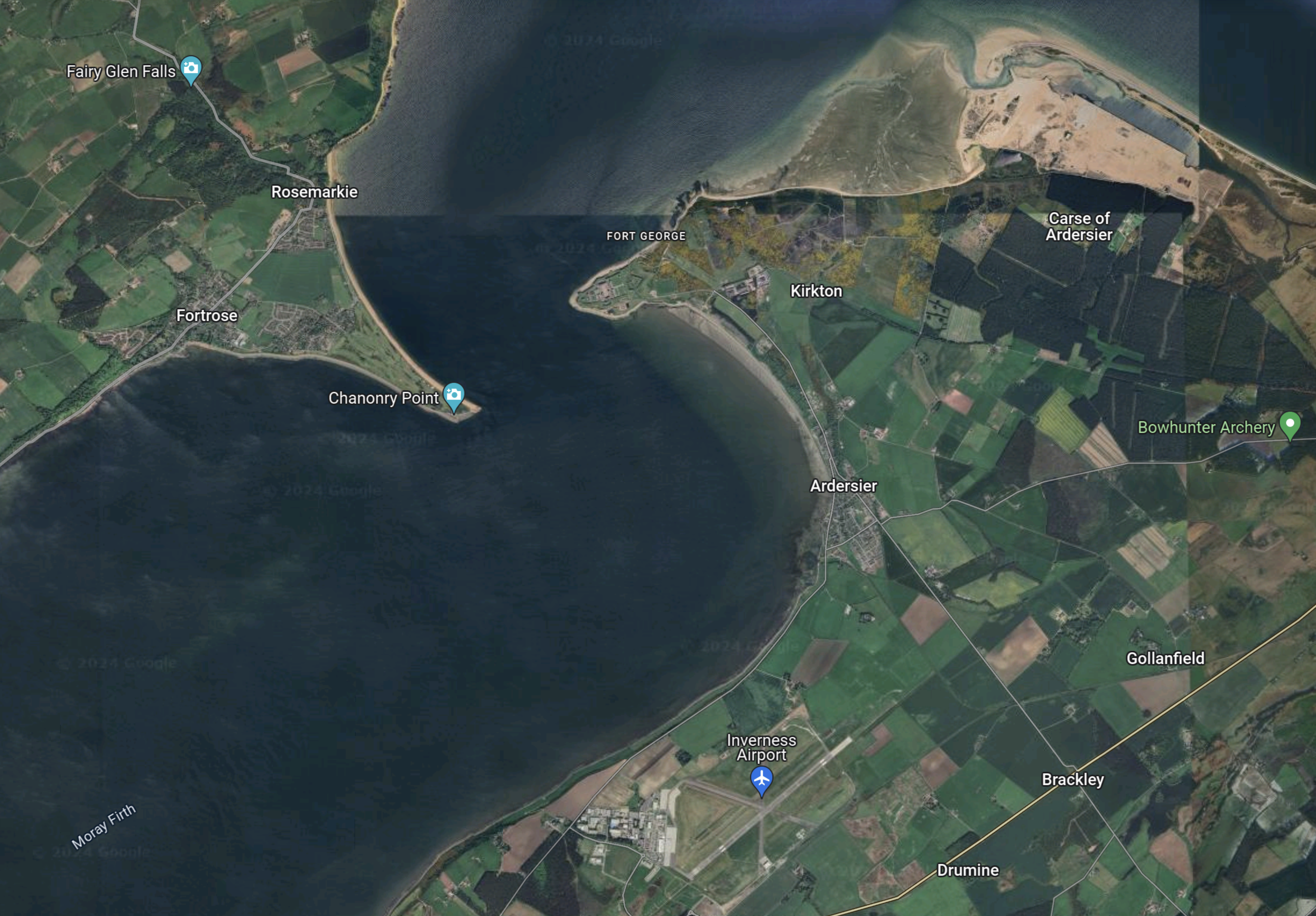
Note.
- The large expanse of water in the middle of the map is Moray Firth.
- The blue arrow at the bottom of the map indicates Inverness Airport.
- Inverness Airport, has a railway station on the Aberdeen and Inverness Line.
- The village of Ardersier is on the the Eastern bank of the Moray Firth
- The Port of Ardersier is in the North-East corner of the map.
The city of Inverness, with a population of around 48,000, is a few miles South-West of the South-West corner of the map.
Which Windfarms Will Be Built And Serviced From The Port Of Ardersier?
This map shows the various ScotWind leases, around the North of Scotland.

The numbers are Scotwind’s lease number in their documents.
These are the Scotwind wind farms to the North-East of Scotland, that could reasonably be assumed to be built and served from the Port of Ardersier.
- 7 – DEME Concessions Wind – 200 km² – 1.0 GW – Floating
- 8 – Falck Renewables Wind – 256 km² – 1.0 GW – Floating
- 9 – Ocean Winds – 429 km² – 1.0 GW – Fixed
- 10 – Falck Renewables Wind – 134 km² – 0.5 GW – Floating
- 11 – Scottish Power Renewables – 684 km² – 3.0 GW – Floating
- 12 – BayWa r.e. UK – 330 km² – 1.0 GW – Floating
These are the Scotwind wind farms to the North-West of Scotland, that could reasonably be assumed to be built and served from the Port of Ardersier.
- 13 – Offshore Wind Power – 657 km² – 2.0 GW – Fixed or Floating
- 14 – Northland Power – 390 km² – 1.5 GW – Floating
- 15 – Magnora – 103 km² – 0.5 GW – Floating
- 16 – Northland Power – 161 km² – 0.8 GW – Floating
These ten wind farms add up to 12.3 GW.
Transport
Consider.
- Obviously, heavy components will be brought in by sea, using the Ro/Ro capable berth or using a crane to unload a barge.
- Personnel will be able to fly in for the day.
- Will some visitors rom London use the Caledonian Sleeper to and from Inverness station to get a full day on site and a good night’s sleep, whilst travelling.
But I do see a problem with local traffic to and from the site.
Hydrogen Buses
This page on the Sizewell C web site, discusses how they will use hydrogen buses.
I could see the Port of Ardersier taking a leaf out of Sizewell C’s book and run hydrogen buses to Inverness, Inverness Airport and other nearby towns.
The North of Scotland certainly won’t be short of green hydrogen to power the buses.
Hydrogen
Conclusion
If you thought that the only useful wind-driven thing to come out of Scotland was bagpipes, you had better think again.
The Port of Ardersier will be the factory and operation and maintenance port for one of the largest offshore wind industries in the world.
RWE And the Norfolk Wind Farms
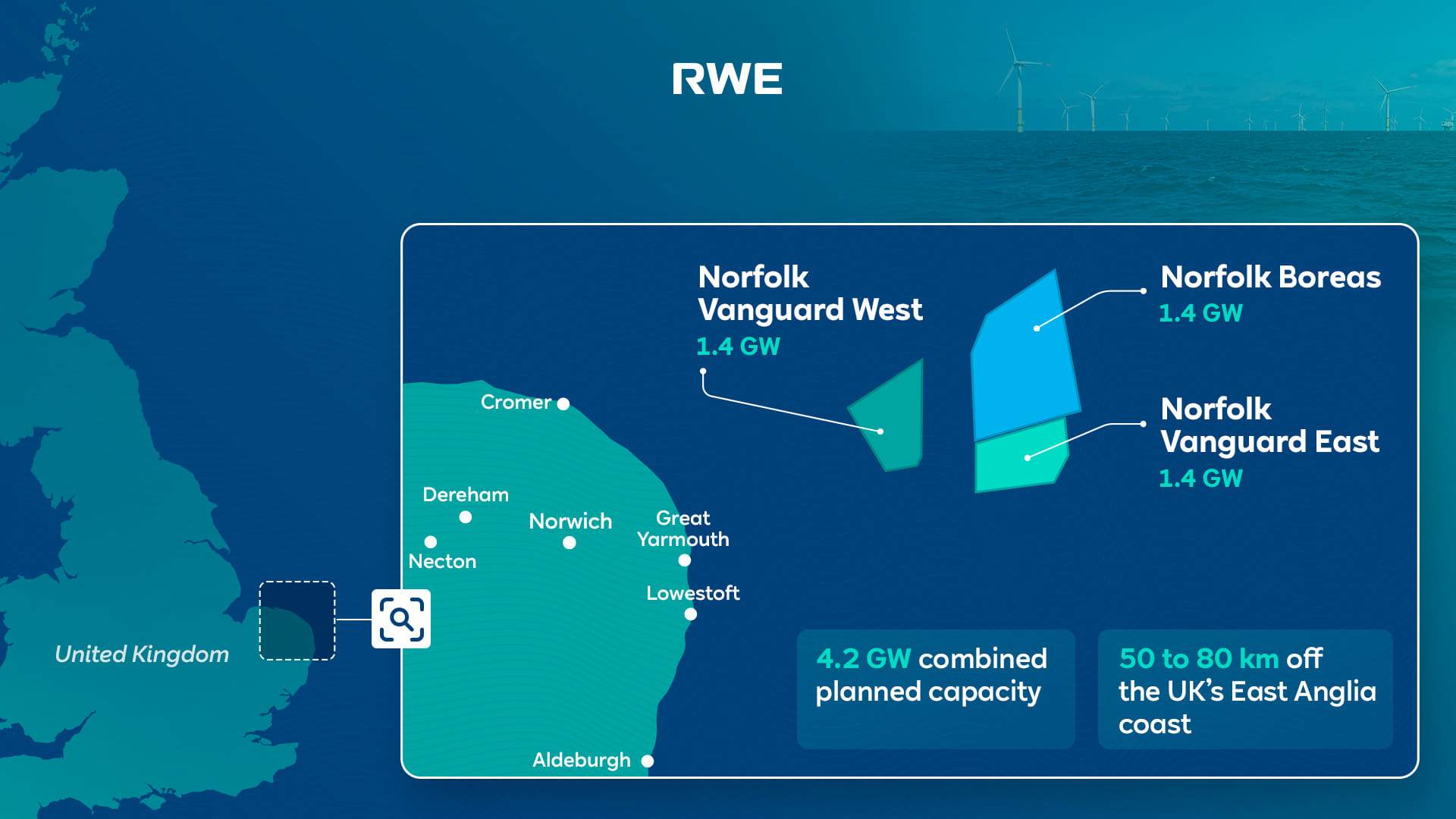
In March 2024, I wrote RWE And Vattenfall Complete Multi-Gigawatt Offshore Wind Transaction In UK, which described how Vattenfall had sold 4.2 GW of offshore wind farms, situated off North-East Norfolk to RWE.
This map from RWE shows the wind farms.
Note.
- The Norfolk Zone consists of three wind farms; Norfolk Vanguard West, Norfolk Boreas and Norfolk Vanguard East.
- The three wind farms are 1.4 GW fixed-foundation wind farms.
- In Vattenfall Selects Norfolk Offshore Wind Zone O&M Base, I describe how the Port of Great Yarmouth had been selected as the O & M base.
- Great Yarmouth and nearby Lowestoft are both ports, with a long history of supporting shipbuilding and offshore engineering.
The wind farms and the operational port are all close together, which probably makes things convenient.
So why did Vattenfall sell the development rights of the three wind farms to RWE?
Too Much Wind?
East Anglia is fringed with wind farms all the way between the Wash and the Thames Estuary.
- Lincs – 270 MW
- Lynn and Inner Dowsing – 194 MW
- Race Bank – 580 MW
- Triton Knoll – 857 MW
- Sheringham Shoal – 317 MW
- Dudgeon – 402 MW
- Hornsea 3 – 2852 MW *
- Scroby Sands – 60 MW
- East Anglia One North – 800 MW *
- East Anglia Two – 900 MW *
- East Anglia Three – 1372 MW *
- Greater Gabbard – 504 MW
- Galloper – 353 MW
- Five Estuaries – 353 MW *
- North Falls – 504 MW *
- Gunfleet Sands – 172 MW
- London Array – 630 MW
Note.
- Wind farms marked with an * are under development or under construction.
- There is 4339 MW of operational wind farms between the Wash and the Thames Estuary.
- An extra 6781 MW is also under development.
If all goes well, East Anglia will have over 11 GW of operational wind farms or over 15 GW, if the three Norfolk wind farms are built.
East Anglia is noted more for its agriculture and not for its heavy industries consuming large amounts of electricity, so did Vattenfall decide, that there would be difficulties selling the electricity?
East Anglia’s Nimbies
East Anglia’s Nimbies seem to have started a campaign against new overground cables and all these new wind farms will need a large capacity increase between the main substations of the National Grid and the coast.
So did the extra costs of burying the cable make Vattenfall think twice about developing these wind farms?
East Anglia and Kent’s Interconnectors
East Anglia and Kent already has several interconnectors to Europe
- Viking Link – Bicker Fen and Jutland – 1.4 GW
- LionLink – Suffolk and the Netherlands – 1.8 GW – In Planning
- Nautilus – Suffolk or Isle of Grain and Belgium – 1.4 GW – In Planning
- BritNed – Isle of Grain and Maasvlakte – 1.0 GW
- NeuConnect – Isle of Grain and Wilhelmshaven – 1.4 GW – Under Construction
- GridLink Interconnector – Kingsnorth and Warande – 1.4 GW – Proposed
- HVDC Cross-Channel – Sellinge and Bonningues-lès-Calais – 2.0 GW
- ElecLink – Folkestone and Peuplingues – 1.0 GW
- Nemo Link – Richborough and Zeebrugge – 1.0 GW
Note.
- Five interconnectors with a capacity of 6.4 GW.
- A further four interconnectors with a capacity of 6 GW are on their way.
At 12.4 GW, the future capacity of the interconnectors between South-East England and Europe, is nor far short of South-East English wind power.
There are also two gas pipelines from the Bacton gas terminal between Cromer and Great Yarmouth to Europe.
The Wikipedia entry for the Bacton gas terminal gives these descriptions of the two gas pipelines.
Interconnector UK – This can import gas from, or export gas to, Zeebrugge, Belgium via a 235 km pipeline operating at up to 147 bar. There is a 30-inch direct access line from the SEAL pipeline. The Interconnector was commissioned in 1998.
BBL (Bacton–Balgzand line) – This receives gas from the compressor station in Anna Paulowna in the Netherlands. The BBL Pipeline is 235 km long and was commissioned in December 2006.
It would appear that East Anglia and Kent are well connected to the Benelux countries, with both electricity and gas links, but with the exception of the Viking Link, there is no connection to the Scandinavian countries.
Did this lack of connection to Sweden make convincing the Swedish government, reluctant to support Vattenfall in their plans?
Bringing The Energy From The Norfolk Wind Farms To Market
It looks to me, that distributing up to 4.2 GW from the Norfolk wind farms will not be a simple exercise.
- Other wind farms like the 2852 MW Hornsea 3 wind farm, may need a grid connection on the North Norfolk coast.
- The Nimbies will not like a South-Western route to the National Grid at the West of Norwich.
- An interconnector to Denmark or Germany from North Norfolk would probably help.
But at least there are two gas pipelines to Belgium and the Netherlands.
RWE, who now own the rights to the Norfolk wind farms, have a large amount of interests in the UK.
- RWE are the largest power producer in the UK.
- They supply 15 % of UK electricity.
- They have interest in twelve offshore wind farms in the UK. When fully-developed, they will have a capacity of almost 12 GW.
- RWE are developing the Pembroke Net Zero Centre, which includes a hydrogen electrolyser.
RWE expects to invest up to £15 billion in the UK by 2030 in new and existing green technologies and infrastructure as part of this.
Could this be RWE’s plan?
As the Norfolk wind farms are badly placed to provide electricity to the UK grid could RWE have decided to use the three Norfolk wind farms to produce hydrogen instead.
- The electrolyser could be placed onshore or offshore.
- If placed onshore, it could be placed near to the Bacton gas terminal.
- There are even depleted gas fields, where hydrogen could be stored.
How will the hydrogen be distributed and/or used?
It could be delivered by tanker ship or tanker truck to anyone who needs it.
In Developing A Rural Hydrogen Network, I describe how a rural hydrogen network could be developed, that decarbonises the countryside.
There are three major gas pipelines leading away from the Bacton gas terminal.
- The connection to the UK gas network.
- Interconnector UK to Belgium.
- BBL to The Netherlands.
These pipelines could be used to distribute hydrogen as a hydrogen blend with natural gas.
In UK – Hydrogen To Be Added To Britain’s Gas Supply By 2025, I describe the effects of adding hydrogen to the UK’s natural gas network.
 The Anonymous Widower