London Will Still Need Crossrail 2 To Deal With HS2 Influx, London Mayor Predicts
The title of this post, is the same as that of this article on Building.
This is the first paragraph.
Sadiq Khan says he expects mothballed scheme will eventually get built.
I don’t disagree that it will eventually get built, but it will be long after both Sadiq Khan and myself have gone.
You might think, that as I live in Dalston, I would be very much in favour of Crossrail 2 being built as soon as possible.
But then, I’m a duck-and-diver and there will always be a quick route to get to Euston.
I currently use four routes regularly and coming home, if it’s late or I want to get home quickly to cook supper say, I can take a taxi for a reasonable price.
The easiest way is actually to walk about two hundred metres and get a 73 bus to directly outside Euston station.
I very much feel we need to improve access in London to High Speed Two and that this can be done by making sure several smaller projects are completed before High Speed Two opens.
Improved Underground Connections At Euston Station
This page on the High Speed Two web site, says this about the station layout and Underground connections at the rebuilt station.
HS2 will deliver eleven new 400m long platforms, a new concourse and improved connections to Euston and Euston Square Underground stations. Our design teams are also looking at the opportunity to create a new northerly entrance facing Camden Town as well as new east-west links across the whole station site.
I would suspect that connection to the Underground will have step-free options.
I wrote about Underground connections at Euston station in Ian Publishes Details Of Future Developments At Euston And Euston Square Underground Stations.
The developments certainly look comprehensive and include a new entrance in Gordon Street on the South side of Euston Road.
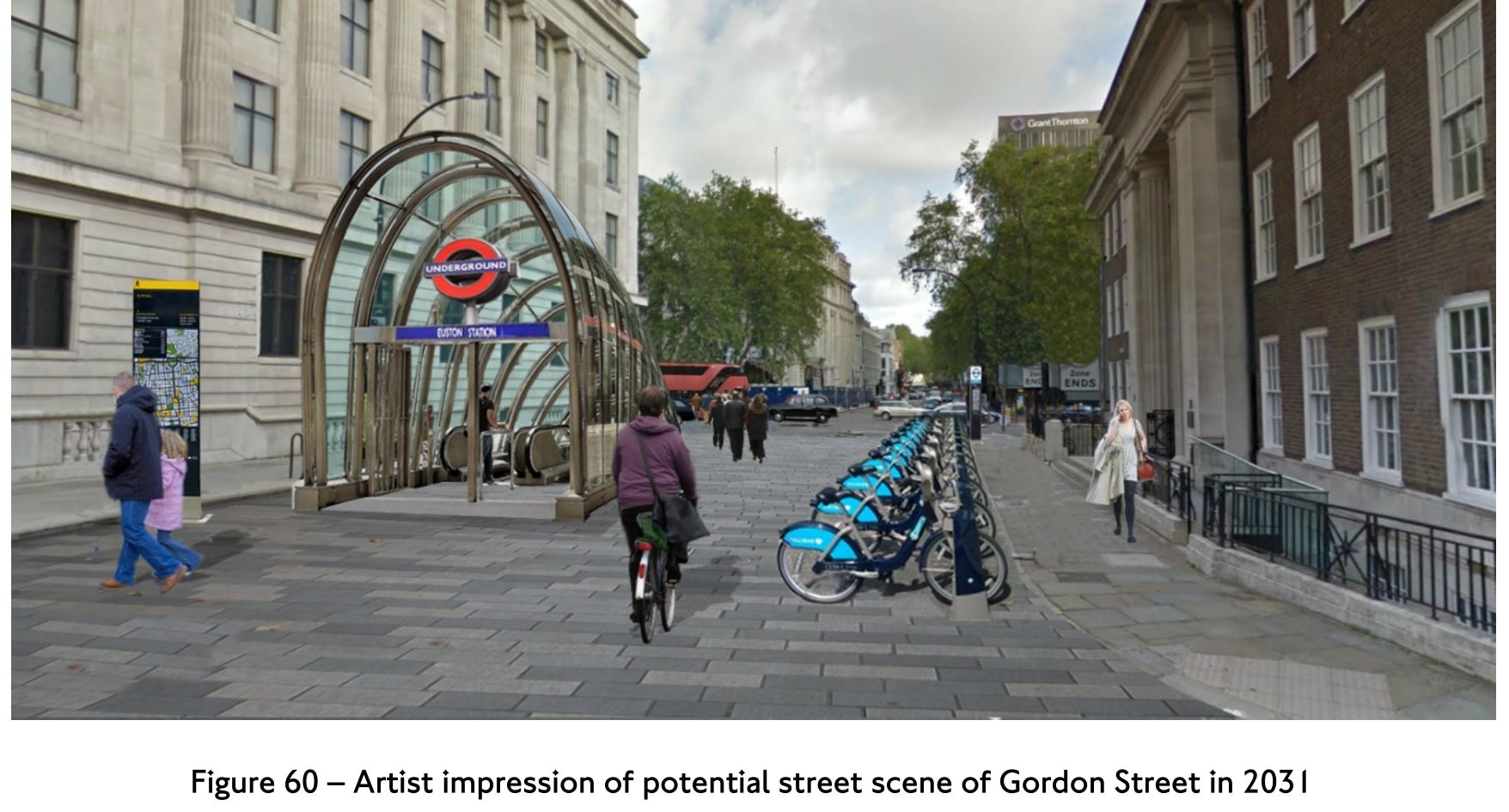
Note.
- The view is looking North.
- A tunnel from this entrance will lead to the Eastern ends of the platforms at Euston Square station, where it appears there will be at least escalator access.
- The tunnel will also lead into Euston station.
- It is a simple improvement, that shouldn’t be too challenging.
This diagram shows the layout of the tunnel.
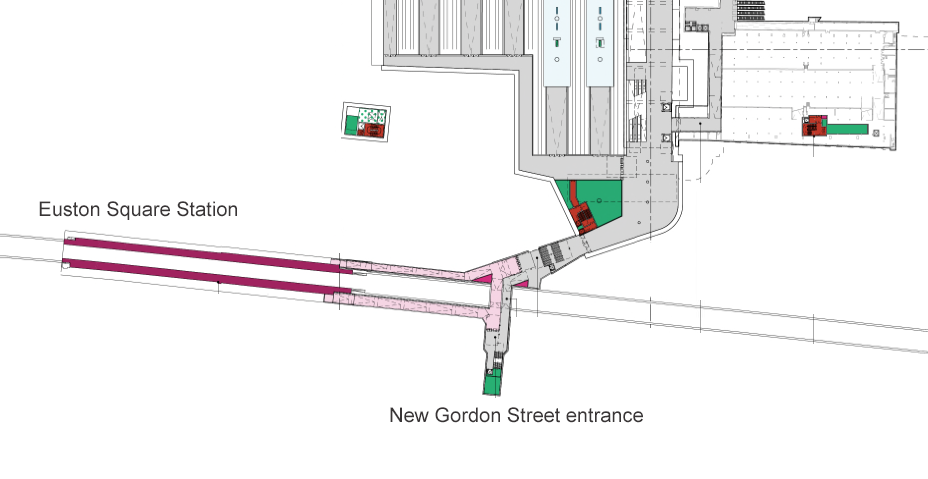
It looks to me to be a neat design, that could be installed between Gordon Street and Euston Square stations without disturbing the traffic on the busy Euston Road.
Once the subway and the Gordon Street entrance were built, there would have these benefits.
- There would be a step-free route between Euston and Euston Square stations.
- It would be a shorter walk in an air-conditioned tunnel, rather than currently along the very polluted Euston Road.
- It would be the fastest way to transfer between Euston and Kings Cross or St. Pancras stations.
- It would give excellent access to the other London terminal stations of Liverpool Street, Moorgate and Paddington.
- It would give step-free access to Crossrail at Farrington, Liverpool Street, Moorgate, Paddington and Whitechapel
- With a change at Farringdon or Liverpool Street to Crossrail, it would offer the fastest route to Canary Wharf.
- The Gordon Street entrance would improve walking routes between Euston station and University College London and other buildings on the South side of Euston Road.
I also suspect that as this project is part of the rebuilding of Euston station for High Speed Two, that it will be completed before Euston station opens for High Speed Two.
If possible, it should be built much sooner to improve access between Euston station and the sub-surface lines.
Once open, even without other improvements at Euston station, this subway would improve access to Euston station by a very substantial amount.
Camden Town Station Upgrade
In 2015, I went to see an exhibition about the proposed expansion of Camden Town station and wrote The Camden Town Station Upgrade Exhibition.
I believe this upgrade should be delivered before High Speed Two opens around the end of this decade.
But due to the financial problems of Transport for London, this project has now been kicked into the long grass.
The Wikipedia entry for Camden Town station, states that upgrading the station will take four years.
Northern Line Split
The completion of the Camden Town Station Upgrade will enable the splitting of the Northern Line into two separate lines, after the completion of the Northern Line Extension to Battersea and the Bank Station Upgrade.
- Northern Line West – Edgware to Battersea Power Station via Camden Town, Euston, Charing Cross and Waterloo.
- Northern Line East – High Barnet to Morden via Camden Town, Euston, Kings Cross, Moorgate, Bank and London Bridge.
Each branch will be running at least 24 trains per hour (tph) and will significantly increase capacity between High Speed Two and other terminal stations and the City of London.
The Northern Line should be split into two lines by the time High Speed Two opens, but with no start date in sight for the Camden Town Station Upgrade, this might not be possible.
Victoria Line Improvements
The Victoria Line or Dear Old Vicky probably won’t be able to help much, but I do think it would be feasible to improve the three most inadequate stations on the line.
- Oxford Circus station needs more capacity and step-free access.
- Highbury & Islington station needs step-free access to the deep lines to complete the station, which was only half-built in the 1960s.
- Walthamstow Central station needs to be double-ended and have step-free access.
I doubt the money can be found to carry out these improvement projects, that are essential, but very much smaller than the Camden Town Station Upgrade.
Sub-Surface Lines Improvements
The big project on the Circle, District, Hammersmith & City and Metropolitan Lines is the Four Lines Modernisation (4LM) project.
- It is an upgrade of the trains, track, electrical supply, and signalling systems.
- This will add 27 % more capacity in the Peak.
- As anybody will know, who has been to a major event at Wembley Stadium, the new S8 Stock trains, that have been running for a few years now, have an almost infinite capacity.
- Incidentally, the S8 Stock trains hold 1350 passengers, which is not far short of the 1500 that each Crossrail Class 345 train can hold.
- Euston Square station will have a step-free connection from the rebuilt Euston station complex.
Most of the Modernisation will be completed by 2023.
I believe that the sub-surface lines will become the main method to get to and from the upgraded Euston station, until Crossrail 2 is built.
- There will be direct trains to around seventy stations from Euston Square station.
- With a change at Paddington to Crossrail, there is a route to Heathrow Airport and Reading.
- With a change at Farringdon or Liverpool Street to Crossrail, there is a route to East London, Canary Wharf and South East London.
- With a change at Farringdon to Thameslink, there are routes to over a hundred stations.
- With a change at Whitechapel to the East London Line, there are routes to North, East and South London.
When you consider that the Metropolitan Line opened in 1863 and was the first passenger-carrying underground railway in the world, hasn’t it done well?
When the Euston Square station upgrade is complete, I will probably use that route to get home from Euston, changing on to a bus at Moorgate, which stops close to my house.
Old Oak Common Station
High Speed Two’s Old Oak Common station is introduced like this on this page on the High Speed Two web site.
Old Oak Common is a new super hub set to be the best connected rail station in the UK.
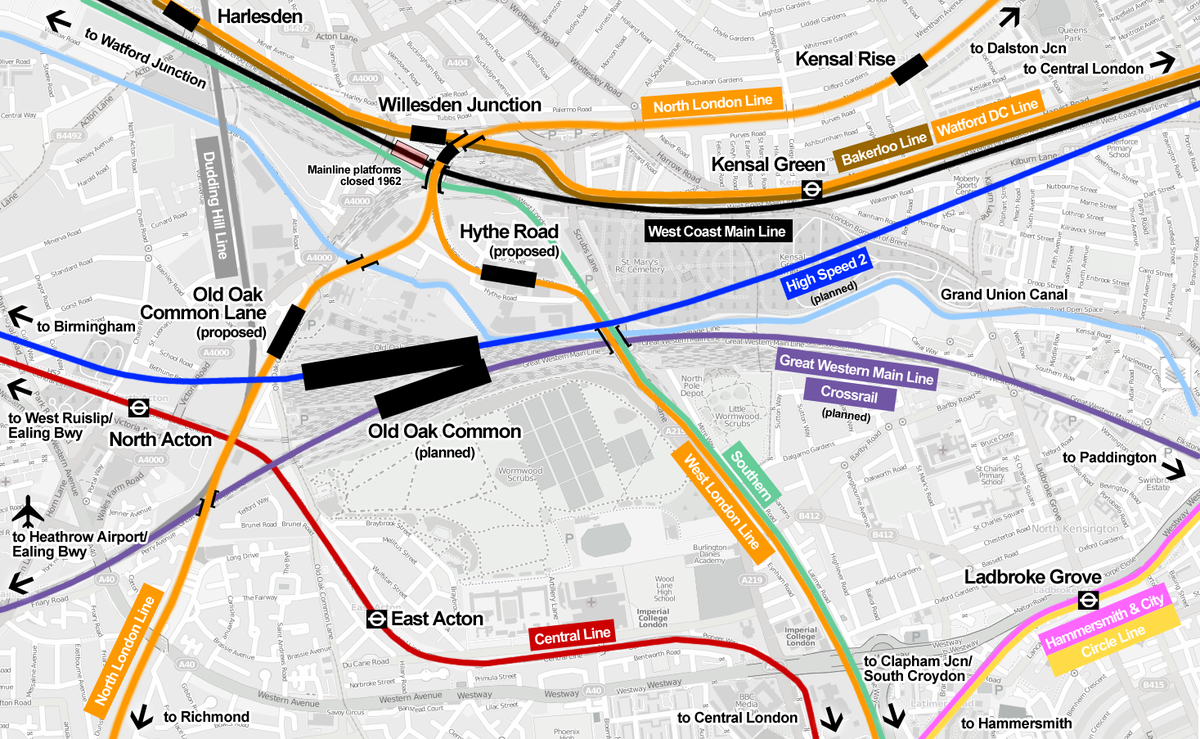
This map from Transport for London shows the various lines at the station.
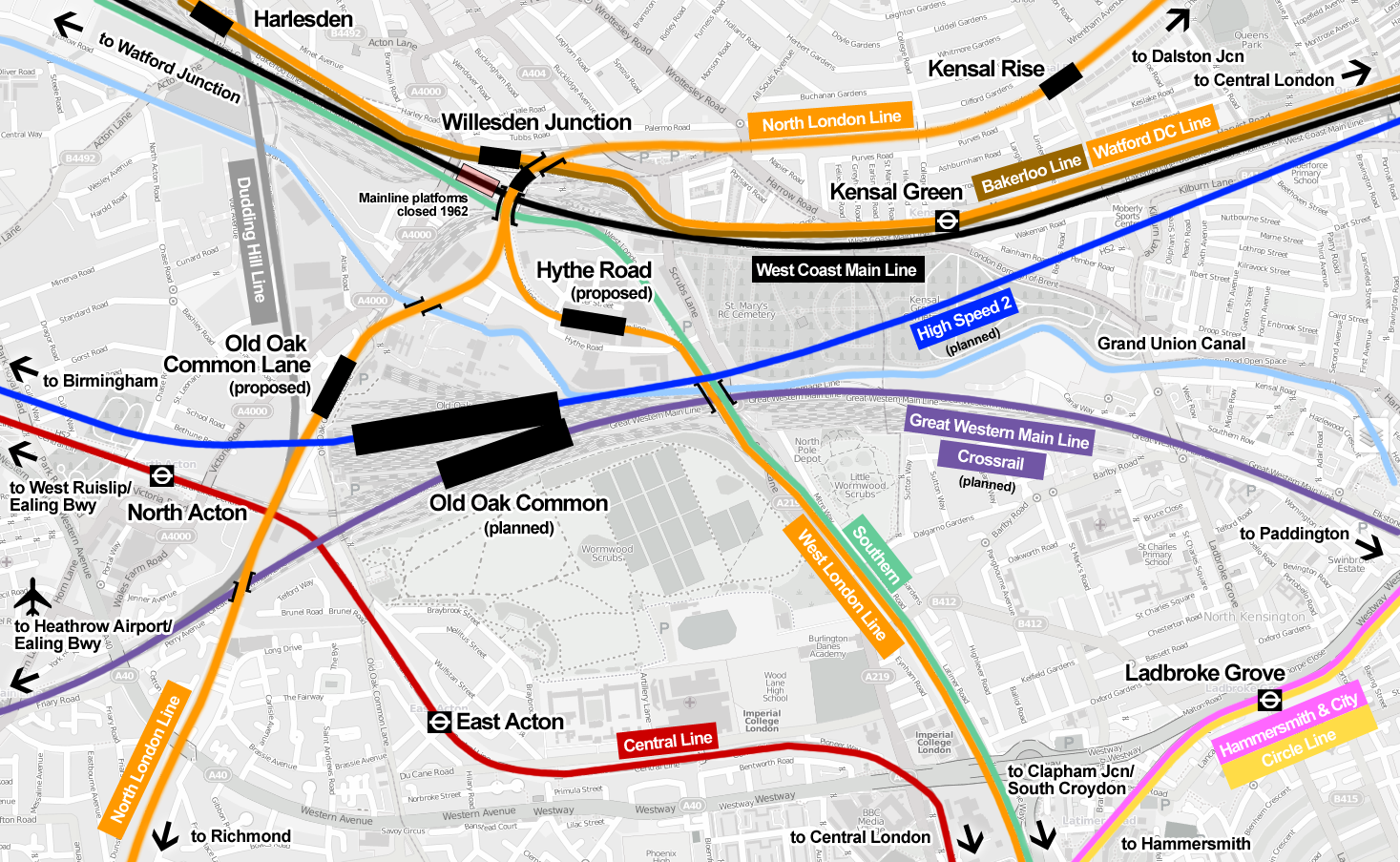
Note.
- The bright blue line is High Speed Two.
- The purple line is the Great Western Main Line and Crossrail.
- I suspect that the interchange between these three lines will be a good one.
- Will all Great Western services stop at Old Oak Common station?
- The orange lines are London Overground services, with two new stations; Old Oak Common Lane and Hythe Road close to the main Old Oak Common station.
- The green line is the Southern service between Milton Keynes and South Croydon.
- The red line is the Central Line and it could be joined to the main station.
- There are plans for a West London Orbital Railway, from Brent Cross and West Hampstead in the North to Hounslow and Kew Bridge in the West, that would call at the main Old Oak Common station.
Old Oak Common station could be well connected to most of London, through its Crossrail. London Overground and West London Orbital connections.
It is my view that these three smaller projects must be completed before the opening of High Speed Two.
- Hythe Road station
- Old Oak Common Lane station
- West London Orbital Railway.
None of these three projects would be very challenging.
Chiltern Railways And High Speed Two
Chiltern Railways already have a London Marylebone and Birmingham Moor Street service
Birmingham Moor Street station will be close to High Speed Two’s Birmingham Curzon Street station.
Plans exist for a second London terminus for Chiltern Railways close to the main Old Oak Common station.
- Could Chiltern Railways become a partner for High Speed Two on routes like between Leeds and Banbury?
- They could certainly bring passengers to Old Oak Common from Buckinghamshire, Oxfordshire and Warwickshire.
- One of my principles on High Speed Two, is that it should be a One-Nation railway.
Old Oak Common would be a very different station to Marylebone with its very useful Crossrail. London Overground and West London Orbital connections.
The terminal for Chiltern Railways at Old Oak Common is another project that should be completed before the opening of High Speed Two.
The Duality Of Euston and Old Oak Common Stations
Euston and Old Oak Common stations could almost be considered to be one station.
- All High Speed Two trains terminating or starting at Euston also call at Old Oak Common station.
- They will be just five minutes apart.
- Both stations have comprehensive networks of connections.
- Taken together the connections from both stations cover most of London and the South East.
There could be advantages for both operators and passengers.
- Would a ticket to and from London Terminals be usable at both stations?
- For some London destinations, passengers might prefer to use one terminal or the other.
- By changing at Old Oak Common to Crossrail will probably be the fastest way to Heathrow, the West End, the City, Canary Wharf and other places.
- Passengers could make the decision about the London terminal to use en route.
- Operators sometimes put the cleaning crew on the train at the last station before the terminal to save time in the turnround. The closeness of the two stations would enable this.
I think the London end of High Speed Two has been designed to make it easy for the operator and passengers.
The Losers If Crossrail 2 Isn’t Built
Crossrail 2 will provide better access to High Speed Two and the London terminals of Euston, Kings Cross, St. Pancras and Victoria for parts of London and the South East.
Victoria Line Passengers
The Victoria Line will have interchanges with Crossrail 2 at the following stations.
- Tottenham Hale
- Euston and Kings Cross St. Pancras on the Victoria Line and Euston St. Pancras on Crossrail 2
- Victoria
Note.
- Crossrail 2 will relieve capacity on the Victoria Line between Tottenham Hale and Victoria
- There will be a very comprehensive interchange at Euston St. Pancras to serve High Speed Two, Eurostar and classic lines out of Euston, Kings Cross and St. Pancras.
From what has been disclosed about the connrection between Euston and Euston Square stations transfer between Euston and Kings Cross and St. Pancras will be a lot easier than it is now.
This reworking of the poor connection to Euston Square station might take some pressure off the Victoria Line.
It might also might be possible to squeeze more trains down Dear Old Vicky.
Passengers On The Suburban Lines Into Waterloo
The suburban lines into Waterloo will go into tunnel at Wimbledon and connect directly to Victoria, Euston, St. Pancras and Kings Cross.
This will be superb access for South West London to four major London terminals.
Without Crossrail 2, passengers will have to use one of these routes to get to and from Euston.
- Change at Waterloo to the Northern Line.
- Change at Waterloo to the Bakerloo Line and then at Oxford Circus to the Victoria Line.
- Change at Vauxhall to the Victoria Line.
Could it be, that the Northern Line Extension should be extended to Clapham Junction station, as it is an aspiration over a safeguarded route under Battersea Park?
In An Analysis Of Waterloo Suburban Services Proposed To Move To Crossrail 2, I showed it was possible to run a Crossrail 2 schedule of four tph into Waterloo station, if the following were done.
- More platform capacity in Waterloo.
- Modern high-performance 100 mph trains like Class 707 trains or Aventras.
- Some improvements to track and signals between Waterloo and Wimbledon stations.
- Wimbledon station would only need minor modifications.
- A measure of ATC between Waterloo and Wimbledon stations.
This would not be a large project
Passengers In Balham And/Or Tooting
Crossrail 2 is planned to run between Wimbledon and Victoria via the following stations.
Note.
- Crossrail 2 should take pressure off the Northern Line.
- Public Opinion is against King’s Road Chelsea station. How will their cleaners, cooks and nannies get to work? Especially, as the roads in the area are already jammed by Chelsea tractors.
- The original route favoured Balham to give an interchange with National Rail. Tooting Broadway also has geological problems for the tunneling.
- On the other hand, Sadiq Khan supports the route through Tooting Broadway, which better serves his former constituency.
This Map from cartometro.com shows the rail lines in the area.
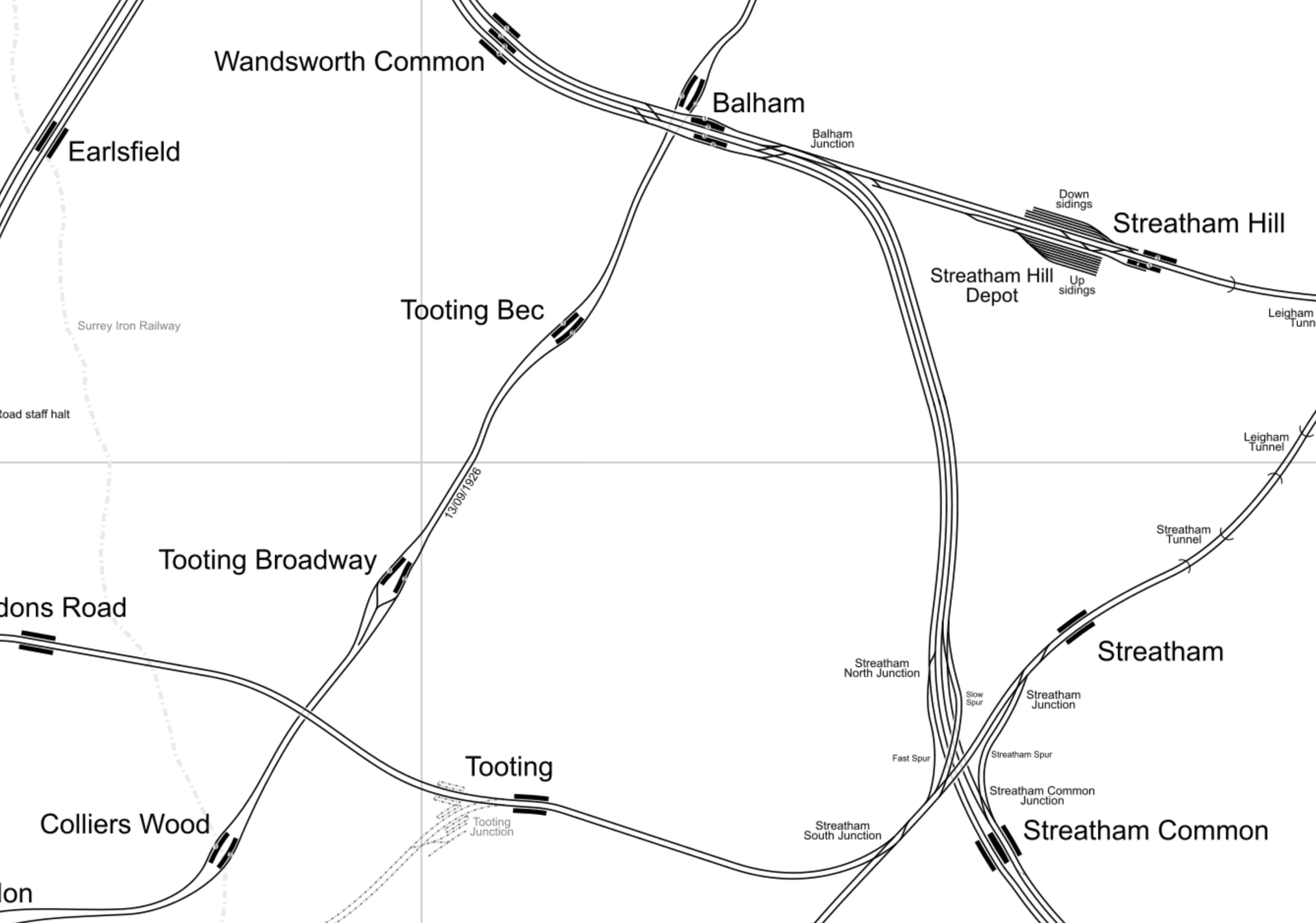
Note.
- Balham station in the North is an interchange station between the Northern Line and National Rail, with a possible four National Rail platforms.
- Tooting Broadway is a simple through station on the Northern Line.
- The next station after Wandsworth Common towards London is Clapham Junction.
- Transport for London have been advocating a new Streatham Common station, that would be an interchange between the lines through Streatham Common and those through Streatham.
- Streatham and Tooting stations are on the Wimbledon Loop Line, which only carries two tph in both directions.
Since I have been writing this blog, there have been several ideas to make better use of the National Rail lines in this area.
There was even a plan that I wrote about in 2016 called The Streatham Virtual Tube.
- Trains would run through Streatham Common, Streatham, Streatham, Hill, Balham, Wandsworth Common, Clapham Junction and into Victoria.
- Trains could also go North from Clapham Junction to Old Oak Common for High Speed Two.
- The Streatham Common Interchange would be built. This would give a useful interchange to the Wimbledon Loop Line.
- There would be four tracks through Streatham.
- A tunnel would be build to allow trains to go through both Streatham and Streatham Hill stations.
- It would have an interchange at Balham with the Northern Line.
- It could have an interchange at Clapham Junction with an extended Battersea Branch of the Northern Line.
- Suppose it had a frequency of perhaps six or even ten tph.
I think it might work, but it shows what can be done, with a bit of out-of-the-box thinking.
Passengers In Dalston And Hackney
One of the entrances to the proposed massive double-ended Crossrail 2 station at Dalston will be at the end of my road and very close to where my mother used to work and where her mother was actually born.
East London had not had major rail improvements since the 1950s and 1960s, when most of the lines into Liverpool Street were electrified and the Southbury Loop was reopened.
But since the creation of the Overground in 2007 from the remains of the ill-performing Silverlink, with the addition of new trains and ticketing and a good clean, there has been a series of smaller projects that have been completed, in and around East and North London.
- 2009 – North London Line starts running to new platforms at Stratford.
- 2009 – Stratford International station opens on High Speed One.
- 2010 – East London Line opens with services to Crystal Palace, New Cross, New Cross Gate and West Croydon stations.
- 2011 – A substantially rebuilt Stratford station opens for the Olympics
- 2012 – South London Line opens with services between Dalston Junction and Clapham Junction stations.
- 2012 – The Docklands Light Railway is extended to Stratford and Stratford International stations.
- 2014 – Hampstead Heath station gets an upgrade.
- 2015 – The Lea Valley Lines between Liverpool Street and Cheshunt, Chingford and Enfield Town stations were moved to the Overground.
- 2015 – TfL Rail begins operation between Liverpool Street and Shenfield, using new Class 345 trains.
- 2016 – Lea Bridge station reopened.
- 2016 – Second entrance to Ilford station in York Road reopened.
- 2018 – Northumberland Park station was rebuilt.
- 2019 – The Gospel Oak to Barking Line was electrified and equipped with new Class 710 trains.
- 2019 – West Hampstead station was rebuilt.
- 2019 – The new Meridian Water station opened.
- 2019 – The rebuilt White Hart Lane station opened.
- 2020 – Tottenham Hale station was rebuilt.
- 2020 – The new Class 710 trains were rolled out on the Lea Valley Lines.
Note.
- There have also numerous smaller upgrades like the addition of lifts to several stations.
- Stations between Stratford and Shenfield have been upgraded for Crossrail.
- There has also been considerable upgrades to the electrification, which in some places was not in the best of condition.
- Most lines have a frequency of four tph or more.
Some may feel that East London has done well with rail improvements in the last few years.
I would agree in some ways, but would counter by saying that before the Overground was created, East London’s were in a terrible state and their state today is a excellent example of what can be achieved by good design, planning and execution, without spending vast sums.
East London and the boroughs of Enfield, Hackney, Haringey, Newham and Waltham Forest in particular, now have a good rail network, that is going to get a lot better with the addition of Crossrail.
- The North London Line is about half a mile to the North of where I live and can walk to two stations or get a bus to another three.
- Crossrail will be a couple of miles to the South with station entrances at Moorgate, Liverpool Street, Whitechapel and Stratford.
- There are four electrified railway lines with new trains, which run North-South with connections to the two East-West lines.
- Although my quickest way to Crossrail will be a bus from close to my house to outside Moorgate station.
- I suspect that everybody in the Borough of Hackney and the Eastern part of Islington will be able to get to a Crossrail station in well under thirty minutes.
- In addition, from where I live the Gospel Oak to Barking Line runs a couple of miles North of the North London Line.
I believe that Dalston’s success over the last decade has been a collateral benefit of its comprehensive rail system, supported by lots of shiny new buses.
Does Dalston want Crossrail 2? Probably, Yes!
Does Dalston need Crossrail 2? Possibly, No!
Do other areas of large cities need Dalstonisation of their railway and bus systems? Absolutely!
I certainly don’t regret moving to Dalston!
Note that one of the reasons I’m so keen on the West London Orbital Railway is that it could do the same for North West London, as the Overground and the Lea Valley Lines have done for North East London.
Passengers Along The Lea Valley
Crossrail 2 will connect the Lea Valley Lines to Dalston and on to Central London.
It will involve the following changes to the West Anglia Main Line.
- Four-tracking of the route at least as far as Broxbourne.
- A junction South of Tottenham Hale station will connect the route to a tunnel to Dalston.
- Level crossings at Brimsdown, Enfield Lock and Cheshunt will be removed.
- Like Crossrail, stations would be substantially step-free.
- The signalling will be upgraded to full in-cab digital ERTMS signalling, that is used by Crossrail and Thameslink under London.
This would enable 10-15 tph running between Tottenham Hale and Broxbourne stations.
With all the development going on around Cambridge and possible expansion of Stansted Airport, I believe that even if Crossrail 2 is not build, then there will be pressure to four-track the West Anglia Main Line, remove the level crossings and improve the stations and signalling.
If this were to be done, then there is an interim plan that could be implemented that I wrote about, four years ago in Could A Lea Valley Metro Be Created?
I envisaged the following.
- Updating the West Anglia Main Line to four-tracks and a standard suitable for Crossrail 2.
- Using the double-track loop at Stratford as the Southern terminal, for some of the trains.
- Updating the Victoria Line stations. The major interchange at Tottenham Hale station has already been improved substantially.
- Providing an appropriate service between Stratford and Broxbourne stations.
- Terminating some Stansted and Cambridge services in the Stratford Loop, as Stratford has better connections to South London and Kent than Liverpool Street.
- Integrating Lea Valley Metro, London Overground and Greater Anglia services to Bishops Stortford, Cambridge and Hertford North stations.
Note.
- All services connect to Crossrail and the Central Line at the Southern end.
- Services to Liverpool Street connect to National Rail services, the Lea Valley Lines of the London Overground and the Circle, District and Metropolitan Lines.
- Services to Stratford connect to National Rail services, the North London Line of the London Overground and the Jubilee Line.
- Could alternate trains serve Liverpool Street and Stratford?
- Could splitting services between Liverpool Street and Stratford mean that the largest proportion of routes have just a single change?
As Transport for London and the train operating companies know where passengers want to go and actually go, I’m sure that a service pattern, that is acceptable to all could be created.
Conclusion
Crossrail 2 is quoted as being a £33 billion project.
I believe that with a good review lots of money could be saved and other smaller projects could be planned and executed to handle the expected increase in the number of passengers.
I would do the following.
- Camden Town station – Upgrade
- Chiltern Railways – Build their connection to Old Oak Common station
- Euston Station – Improve connections to Euston and Euston Square Underground stations.
- Northern Line – Extend the Battersea branch to Clapham Junction
- Northern Line – Split Into Two Lines
- Overground – Build Old Oak Common Lane and Hythe Road stations
- Southern – Build the new Streatham Common station and implement The Streatham Virtual Tube.
- South Western Railway – Run four tph on all proposed Crossrail 2 routes into Waterloo station
- Victoria Line – Upgrade Highbury & Islington, Oxford Circus and Walthamstow Central stations and increase the frequency if possible
- West Anglia Main Line – Upgrade ready for Crossrail 2 and develop the Lea Valley Metro
All of these projects would have their own benefits, whether Crossrail 2 is built or not!
Only when the needs of all passengers have been assessed in a few years, should we make a decision about Crossrail 2.
A London Overground Replacement For Southern’s East Croydon And Milton Keynes Service
In July 2017, I discussed this suggestion by Chris Gibb in Gibb Report – East Croydon – Milton Keynes Route Should Be Transferred To London Overground.
In an article, in the July 2019 Edition of Modern Railways, , which was entitled ‘710s’ Debut On Goblin, this was this last paragraph.
On the West London Line, TfL is curremtly working with the Department for Transport on options for the devolution of services originally suggested in Chris Gibb’s report on the Govia Thameslink Railway franchise, which could lead to ‘710s’ being deployed here.
It made me think, that further investigation was called for.
An Apology
I apologise, if you think I’m repeating myself.
What The Gibb Report Says
The Gibb Report, says this about the current service between East Croydon and Milton Keynes Central stations.
I believe there is an option to transfer the East Croydon – Milton Keynes operation to TfL and it’s London Overground concession in 2018.
TfL may decide to change the service, for example by not running it north of Watford Junction, or running it to an alternative southern destination other than East Croydon. They could also develop the combined West London line service to better match available capacity to demand.
They would have a number of crewing and rolling stock options, but should be able to operate the service more efficiently than GTR in the longer term, without the involvement of Selhurst.
Selhurst TMD is the depot in South London, where the current Class 377 trains are based.
A few of my thoughts.
The Trains
Using Class 710 trains as suggested in the Modern Railways article, would surely offer a suitable crewing and rolling stock option for the route, if they were based at the convenient Willesden TMD, where the fleet of up to twenty-five dual-voltage Class 710/2 trains are stabled.
The Northern Terminus
Chris Gibb suggested the service might not go past Watford Junction.
I think that could be difficult.
- The longitudinal seating of the Class 710 train, is probably not suitable for outer suburban services North of Watford.
- East Croydon to Watford Junction takes 69 minutes, which is not a good journey time to create an efficient service.
It would also appear to be tricky for a train to transfer between the West London Line and the Watford DC Line.
This map from carto.metro.free.fr shows the complicated track layout in the Willesden Junction area.
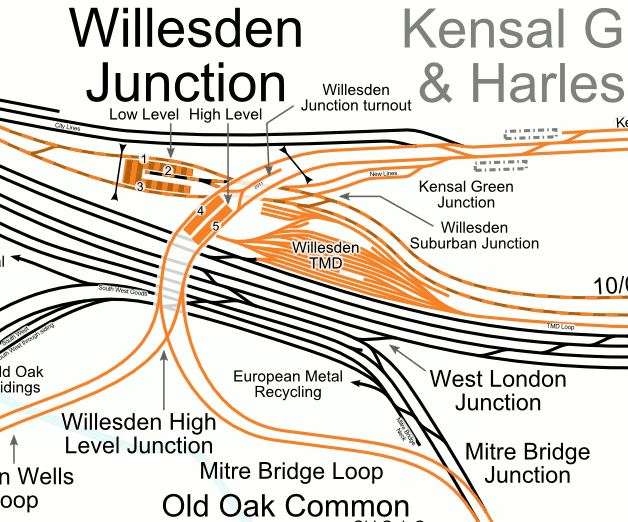
Note.
- The two Willesden Junction stations, labelled High Level and Low Level.
- The Watford DC Line, which is shown in black and orange, passing to the North of Willesden TMD. and through the Low Level station.
- The four tracks shown in black are the West Coast Main Line, with Watford to the West and Euston to the East.
- The North London Line to Richmond and the West London Line to Clapham Junction splitting at Wilesden High Level Junction.
The current service between East Croydon and Milton Keynes, is only one train per hour (tph) and uses a succession of flat junctions to take the slow lines to and from Watford.
This is not a good operational procedure and I suspect Network Rail and various train operators, would like to see it discontinued.
So if trains in a new London Overground version of the service, don’t go up the Watford DC Line or the West Coast Main Line, where do they turn back?
Note the siding to the East of the High Level platforms, which is labelled Willesden Junction Turnout.
This is regularly used to turnback London Overground services on the West London Line.
I feel that London Overground will be turning their replacement service in Willesden Junction High Level station.
Current train services at the station include.
- For passengers, who want to go further North, there is a good connection to the Watford DC Line for Wembley Central, Harrow & Wealdstone and Watford Junction stations.
- The Watford DC Line can also take you to Euston.
- The Bakerloo Line between Stonebridge Park and Elephant & Castle via Central London.
- Frequent North London Line services between Stratford and Richmond.
The station has kiosks, coffee stalls, toilets and waiting rooms.
There are certainly worse places to change trains.
The Southern Terminus
Obviously, existing travellers on the route would like to see as few changes as possible.
East Croydon station must be a possibility for the Southern terminus, as it is the currently used.
But East Croydon is a busy station and perhaps it is not a convenient station for trains to wait in the platform.
On the other hand, West Croydon station offers some advantages.
- The station has a long bay platform, which might be long enough for nine or ten cars.
- There is a separate turnback siding.
- It has space to add another bay platform, but this may have been sold to a developer.
- It already has a four tph London Overground service to Highbury & Islington station.
- Using West Croydon avoids the crowded lines to the North of East Croydon station.
It is also managed by London Overground, so the landlord would be co-operative.
How Many Trains Would Be Needed For A West Croydon And Willesden Junction Service?
West Croydon station has two possible routes, that trains could take to Willesden Junction.
- Via Norwood Junction and Clapham Junction in 55 minutes.
- Via Selhust and Clapham Junction in 45 minutes.
These times mean that a two-hour round trip between West Croydon and Willesden Junction should be possible.
Trains required for various frequencies would be as follows.
- One tph – Two trains.
- Two tph = Four trains.
- Four tph – Eight trains.
They would need to be dual voltage Class 710/2 trains, as are now running on the Gospel Oak to Barking Line.
Compare the figures with those for the current East Croydon and Milton Keynes service, which needs four pairs of four-car trains for an hourly service.
What Would Be The Frequency?
I think one, two and four tph are all possibilities!
One tph
One tph would be a direct replacement for the current service. But is it enough?
Services at West Croydon could probably share the bay platform with the existing Highbury & Islington station service.
Two tph
Two tph could be a compromise frequency.
Two tph could probably still share the current bay platform with the Highbury & Islington service.
Four tph
Four tph would be a full Turn-Up-And-Go service,
- It would probably be London Overground’s preference.
- It would give a very passenger-friendly eight tph between Willesden Junction and Clapham Junction stations.
- The two services would call at opposite sides of Clapham Junction station.
- It would give a four tph link between Croydon and High Speed Two.
- Westfield wouldn’t mind all the extra shoppers at Shepherds Bush!
But there could be downsides.
- The service could need an extra bay platform at West Croydon.
- Would it be possible to turn four tph at Willesden Junction?
- Will the train paths be available through South London.
But four tph would probably would be London Overground’s preference.
It will be interesting to see the reasons, why Transport for London choose a particular frequency.
A Trip Between Imperial Wharf And East Croydon Stations
Today, I took a trip between Imperial Wharf and East Croydon stations at around 11:30.
- The train was two four-car Class 377 trains working as an eight-car train.
- After Clapham Junction it wasn’t very busy.
- I was in the last car, which was empty, except for myself.
I came to the conclusion, that an eight-car train was too much capacity for the Southern section of the journey.
I suspect that Transport for London have detailed passenger estimates for this route, so they should be able to determine the frequency and length of replacement trains required.
The Upgraded Norwood Junction Station
In Major Upgrade Planned For Norwood Junction Railway Station, I talked about a plan to upgrade Norwood Junction station.
The idea behind the upgrade is to improve connectivity and capacity in the crowded Croydon area.
If the West Croydon and Willesden Junction service, was routed via Norwood Junction station, the upgraded station would give easy access to both East and West Croydon stations.
Conclusion
I’ve always liked Chris Gibb’s suggestion of the transfer of the service between East Croydon and Milton Keynes stations to the London Overground and I can now start to see flesh on the bones!
At the present time and until better data is available, I think the replacement service should be as follows.
- The Northern terminus should be Willesden Junction.
- The Southern terminus should be West Croydon station, where there are good tram and train connections.
- The route would be via Shepherds Bush, Kensington Olympia, West Brompton, Imperial Wharf, Clapham Junction, Wandsworth Common, Balham, Streatham Hill, West Norwood, Gipsy Hill, Crystal Palace and Norwood Junction.
- Going via Gipsy Hill, rather than the current route via Selhurst, would give access to the connectivity at Norwood Junction.
- The frequency should be four tph.
- Trains will be four- or five-car Class 710 trains.
The benefits would be as follows.
- The rail hubs of Clapham Junction, Norwood Junction, West Croydon and Willesden Junction would be connected together by a Turn-Up-And-Go service.
- The proposed four tph service would need eight Class 710 trains, whereas the current one tph service needs eight Class 377 trains. Would this be better value?
In the future with a connection to High Speed Two in the Old Oak Common area, the benefits would increase.
- There would be a simple interchange with High Speed Two.
- South London from Clapham to Croydon, would get a direct service to High Speed Two.
- There would also be a better connection to Heathrow Airport and other rail services through Old Oak Common.
I think that the connection to High Speed Two trumps everything else.
Major Upgrade Planned For Norwood Junction Railway Station
The title of this post is the same as that of this article on IanVisits.
Ian introduces his article like this.
A somewhat shabby, and yet quite busy station in South London could get a major makeover if plans by Network Rail are approved.
The proposals are part of the wider plan to clean up the mess of tracks around Croydon to boost the capacity of the lines through the area, but it is also a stand-alone project.
Ian also has this visualisation of the upgraded Norwood Junction station.
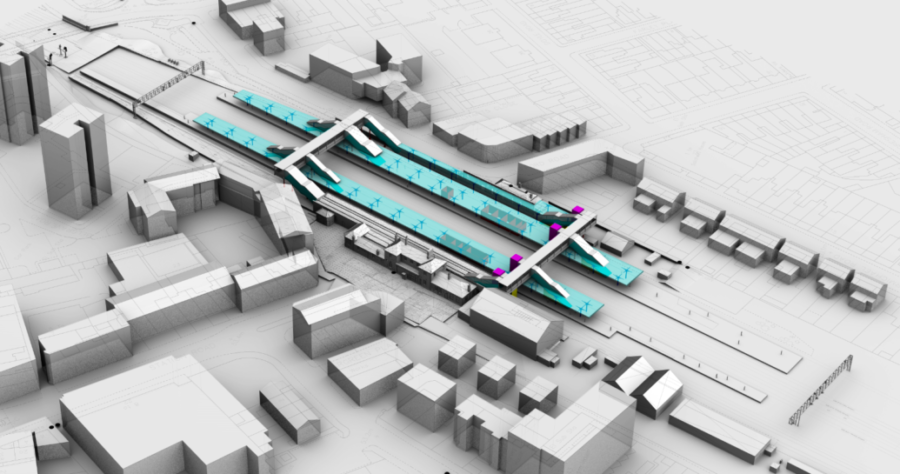
Note.
- London Bridge station is to the left with East Croydon station to the right.
- The Main station entrance is on the near side, with the Clifford Road station entrance on the far side.
- Platform 1 & 2 is the highlighted island platform on the near side.
- Platform 3 & 4 is the highlighted island platform on the far side.
It looks expensive with two step-free bridges.
Both bridges have four sets of steps to.
- The Main Station Entrance.
- The Northbound Platform 1 & 2,
- The Southbound Platform 3 & 4
- The Clifford Road Entrance.
In addition, the Southern bridge has four lifts to the two entrances and two platforms.
These pictures show the current state of the station.
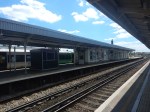
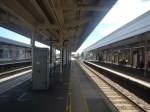
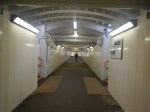
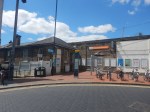
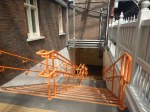
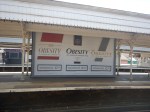
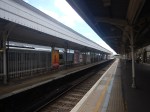
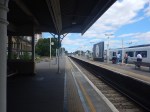
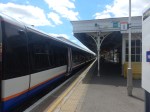
Currently, the station has three island platforms.
- They are connected by a well-lit, step-only subway.
- Some platforms are too short for twelve-car trains.
- The wooden buidings need a quality makeover. Where is Terry Stollery, when you need him?
- In the new layout, the central island platform will be removed, to allow a pair of fast lines through the station.
- One advantage of the subway is during the station upgrade, it can still be used to access the middle platforms, thus easing construction and causing less disruption for passengers.
After the upgrade, the layout will be as follows.
- Platforms 1 & 2, which are currently Platforms 2 & 3, would be for Northbound trains, with perhaps Platform 1 for stopping and Overground services and Platform 2 for limited-stop and Thameslink services.
- Platforms 3 & 4, which are currently Platforms 5 & 6, would be for Southbound trains, with perhaps Platform 3 for stopping and Overground services and Platform 4 for limited-stop and Thameslink services.
The subway will probably be closed.
Improved Train Services
For people like me, who live on the Overground, North of Norwood Junction station, hopefully it will solve the problem of getting to Gatwick Airport.
- It’ll just be a walk across the platform at Norwood Junction station, instead of a tram between West Croydon and East Croydon stations.
- In the future, would the cross-platform interchange help travellers between Crossrail and Gatwick and the South Coast?
- The Zeus of the Timetables could even make it better, by increasing the frequency of Thameslink trains between Norwood Junction and Gatwick Airport stations to match the four trains per hour (tph) between Dalston Junction and West Croydon stations.
Note that the day, I took the pictures Bedford and Highbury & Islington trains were in the current Platforms 2 & 3.
Up here in sometimes-forgotten Dalston, I’ll certainly give this new layout at Norwood Junction station, a high score, if the trains are changed to use it to advantage.
Norwood Junction Will Become A Major Interchange!
The walk-across interchange between Northbound services on platforms 1 & 2 and Southbound services on platforms 3 & 4, will mean that the station, will become the station where travellers will prefer change trains.
Suppose you were travelling from Luton to Epsom.
The Journey Planner on http://www.national.co.uk, suggests a double change at Farringdon and Carshalton, with a journey time of 1 hour and 51 minutes.
The upgraded Norwood Junction station, would allow the journey to be done in two legs.
- Luton and Norwood Junction – one hour and three minutes.
- Norwood Junction and Epsom – 29 minutes.
It could be quicker and it is a cross-platform change, where hopefully, there will be a climate-controlled waiting room and a coffee stall.
Current frequencies going North are as follows.
- Anerley – Six tph
- Balham – Two tph
- Battersea Park – Two tph
- Bedford – Two tph
- Brockley – Six tph
- City Thameslink – Two tph
- Clapham Junction – Two tph
- Crystal Palace – Two tph
- Dalston Junction – Four tph
- Farringdon – Two tph
- Flitwick – Two tph
- Forest Hill – six tph
- Gypsy Hill – Two tph
- Haggerston – Four tph
- Harlington – Two tph
- Harpenden – Two tph
- Highbury & Islington – Four tph
- Honor Oak Park – Six tph
- Leagrave – Two tph
- Hoxton – Four tph
- London Blackfriars – Two tph
- London Bridge (Non-stop) – Two tph
- London Bridge (Stopping) – Three tph
- London St. Pancras – Two tph
- London Victoria – Two tph
- Luton – Two tph
- Luton Airport Parkway – Two tph
- New Cross Gate – Six tph
- Penge West – Six tph
- Rotherhithe – Four tph
- Shadwell – Four tph
- Shoreditch High Street – Four tph
- St. Albans City – Two tph
- Streatham Hill – Two tph
- Surrey Quays – Four tph
- Sydenham – Six tph
- Wandsworth Common – Two tph
- Wapping – Four tph
- West Norwood – Two tph
- Whitechapel – Four tph
Current frequencies going South are as follows.
- Carshalton Beeches – Two tph
- Cheam – Two tph
- Coulsdon Town – Two tph
- Earlswood – Two tph
- East Croydon – Six tph
- Epsom – Two tph
- Ewell East – Two tph
- Gatwick Airport – Two tph
- Horley – Two tph
- Purley – Four tph
- Purley Oaks – Two tph
- Redhill – Two tph
- Reedham – Two tph
- Salfords – Two tph
- South Croydon – Two tph
- Sutton – Two tph
- Waddon – Two tph
- Wallington – Two tph
- West Croydon – Eight tph
In addition these services pass through.
- Bedford and Brighton – Two tph
- Cambridge and Brighton – Two tph
- London Brifge and Caterham & Tattenham Corner – Two tph
- London Bridge and Uckfield – Two tph
- Peterborough and Horsham – Two tph
It is a very comprehensive list of services and possible destinations.
I believe that if a few more trains stopped at Norwood Junction station, there could be at least two tph to every station connected to Norwood Junction station, with these higher frequencies to the more important stations.
- Bedford – Four tph
- Brighton – Four tph
- Canada Water – Four tph
- City Thameslink – Eight tph
- Clapham Junction – Four tph
- Crystal Palace – Four tph
- Dalston Junction – Four tph
- East Croydon – Eight tph
- Epsom – Four tph
- Farringdon – Eight tph
- Finsbury Park – Four tph
- Gatwick Airport – Four tph
- Highbury & Islington – Four tph
- London Blackfriars – Eight tph
- London Bridge (Non-stop) – Four tph
- London Bridge (Stopping) – Four tph
- London St. Pancras – Eight tph
- London Victoria – Four tph
- Luton – Four tph
- Luton Airport Parkway – Four tph
- St. Albans City – Four tph
- Stevenage – Four tph
- Sutton – Four tph
- Welwyn Garden City – Four tph
- West Croydon – Eight tph
- West Hampstead Thameslink – Four tph
- Whitechapel – Four tph
These frequencies could be attained, by stopping a few extra services at Norwood Junction station.
It is certainly comprehensive and getting to most important areas of Central London is direct or a single change.
- The step-free changes to Crossrail at Farringdon and Whitechapel will allow simple access to Canary Wharf, the City,, Heathrow, Paddington, the West End and all the towns and cities on the branches.
- The Bakerloo Line Extension will connect at New Cross Gate.
- The Central Line doesn’t connect
- The Circle, District, Hammersmith & City and Metropolitan lines connect at Farringdon, Kings Cross St. Pancras, London Blackfriars and Whitechapel.
- The Jubilee Line connects at Canada Water, London Bridge and West Hampstead Thameslink.
- The Northern Line connects at Kentish Town, Kings Cross St. Pancras and London Bridge
- The Piccadilly Line connects at Finsbury Park and Kings Cross St Pancras.
- The Victoria Line connects at Finsbury Park, Highbury & Islington and Kings Cross St. Pancras.
But there are some important places that are not well-connected or have difficult interchanges to Norwood Junction station.
- Euston station, High Speed Two and the West Coast Main Line.
- Cannon Street, Charing Cross and Waterloo mean a complicated interchange at London Bridge.
- The connections to Great Northern services, the North London Line and the Victoria Line at Highbury & Islington need serious improvement.
- South East London needs going to London Bridge and coming out again!
Radical thinking and serious improvement is needed.
Milton Keynes Central and East Croydon
This is a useful service for some..
It calls at Bletchley, Leighton Buzzard, Tring, Berkhamsted, Hemel Hempstead, Watford Junction, Harrow & Wealdstone, Wembley Central, Shepherd’s Bush, Kensington (Olympia), West Brompton, Imperial Wharf, Clapham Junction, Balham, Streatham Common, Norbury, Thornton Heath, Selhurst.
But, it has problems.
- It has a high level of cancellation.
- It has a totally inadequate hourly frequency.
- It has no connection to the North London Line at Willesden Junction.
- It blocks a platform at East Croydon, when it turns round.
In his report on Southern, Chris Gibb recommended that the service be the responsibility of the London Overground. I wrote about this in Gibb Report – East Croydon – Milton Keynes Route Should Be Transferred To London Overground.
To connect High Speed Two at Old Oak Common, there needs to be a four tph service between Croydon and Old Oak Common.
Transport for London are proposing a new Hythe Road station on the West London Line..
- It will be a seven hundred metre walk to the High Speed Two station. That is too long!
- There will be a bay platform to turn trains from Clapham Junction.
- Trains still won’t be able to call at Willesden Junction for the North London Line.
I think that building Hythe Road station is a bad idea.
This map shows the lines in the area.
Surely, the West London Line should have been re-routed over the Eastern end of Old Oak Common station at right angles, which would have the following benefits.
- Quick and easy interchange with High Speed Two, the Great Western Main Line and Crossrail.
- The ability to add bay platforms to terminate services.
- Sharing of station services with the other stations.
Perhaps, though this practical passenger and operator-friendly idea would have ruined the architect’s vision.
Or is it, that the current track layout to connect to the West Coast Main Line only allows crap solutions.
Surely, the amount of money being spent on High Speed Two allows the best to be done everywhere.
London Overground principles say that services must be at least four tph.
The simplest way to do this would be to extend the current Stratford and Clapham Junction service via Willesden Junction to Croydon.
- It would call at Balham, Streatham Common, Norbury, Thornton Heath, Selhurst, if it followed the current route.
- I doubt that East Croydon station could handle four tph terminating at the station.
But why not use the route taken by London Victoria and West Croydon services via Wandsworth Common, Balham, Streatham Hill, West Norwood, Gipsy Hill, Crystal Palace, and Norwood Junction, to terminate at West Croydon?
- This route calls at Norwood Junction, with all its connectivity.
- If needed, there is space for a new platform at West Croydon.
I’ve no idea, what will happen, but the upgrade at Norwood Junction station should help.
Suppose you were going between Gatwick and High Speed Two.
- The standard route will be Thameslink and Crossrail with a change at Farringdon.
- A surface route with a change at Norwood Junction could be an alternative.
The second may be more pleasurable.
Upgrading The Station
In Winner Announced In The Network Rail Footbridge Design Ideas Competition, I wrote how the competition was won by this bridge.
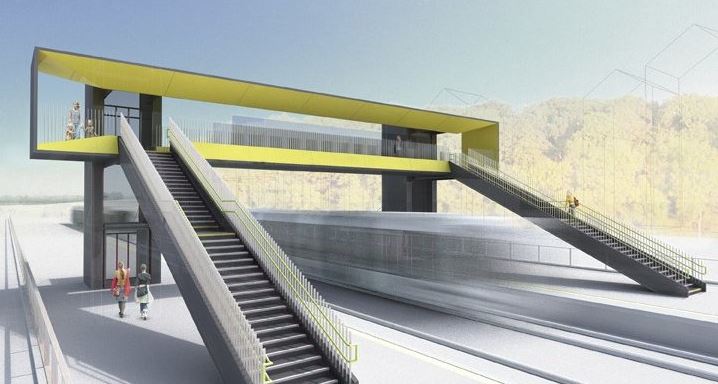
So could two factory-built bridges like this be installed at Norwood Junction station?
- The design is adaptable to multiple spans over the tracks.
- Lifts could be left out for one bridge.
- Once the site is prepared, I believe the bridges can be quickly installed, probably from a train with a crane.
- The bridge is probably more affordable, than a traditional design.
During the installation period, the existing subway can be used for platform access.
Conclusion
Obviously, I am speculating that the new footbridge system will be used at Norwood Junction station.
But the new platform and track layout at the station, will certainly improve services on these routes.
- Between East Croydon and London Bridge stations.
- Between East Croydon and the London Overground and Crossrail.
- Between the Overground and Gatwick Airport station and the South Coast.
All of the interchanges will be step-free and some will be cross-plsatform.
Are
Funding For Homes And A New Railway Station In North London
The title of this post is the same as that of this article on Ian Visits.
The government has said, that two major housing developments will be built in London beside new railway stations.
Brent Cross Thameslink
The development and the funding for Brent Cross West station is introduced by this paragraph.
The larger investment will see £320 million being spent on a new Brent Cross West Thameslink station which will lead to a new community of 7,500 properties being built. This is in addition to the £97m grant awarded in the 2016 budget bringing total government investment £416.5 million.
Other points about the development include.
- The development is on the site of the Cricklewood depot.
- The station could be asn interchange with the West London Orbital Railway.
- A contractor should be appointed this year, with opeing in 2022.
- Services could be eight trains per hour (tph) in the Peak and four tph in the Off Peak.
- A public bridge over the railway will be included.
- There will be new offices.
- The Brent Cross Shopping Centre will be extended.
- The £320 million investment will be repaid from business rates from the commercial development.
It all seems to me, that there could be a lot of winners here.
Old Oak Common
The development and the funding for Old Oak Common station is described by this paragraph.
The government will also be providing £250 million so up to 13,000 new homes can be built close to the new HS2 railway station at Old Oak Common.
This scheme provides more properties, but it doesn’t as yet include the commercial development.
Conclusion
London seems to be building more housing, that at any time in my life.
Heat From HS2 Trains Will Warm 500 New Homes
The title of this post is the same as that of an article in today’s copy of The Times.
This is the third paragraph.
HS2 Ltd, the company building the £56 billion high-speed line, has produced plans to recycle waste heat from the electric motors and brakes of trains approaching and departing from a £1 billion “super hub” station at Old Oak Common, near Willesden, North West London.
Other points from the article include.
- Five air source heat pumps will be used.
- , Each heat pump costs around £11,400.
- The carbon footprint of each house could be reduced by a fifth.
- Plans are at an early stage, but the technology is proven.
- Similar technology could be applied to tunnels on the Northern routes to Leeds and Manchester.
I can only see one problem with the idea.
The companies bidding to make the trains for HS2, will design trains with the following features.
- Highly-efficient aerodynamics of both trains and tunnels, to reduce energy losses and power required to move the train.
- Regenerative braking to onboard electricity storage.
- Train systems like air-conditioning, lighting and toilets that use smaller amounts of electricity.
HS2 will also draw heavily on proven innovative ideas from similar projects, to reduce the energy used by the trains, whether in the tunnels or the open.
But, I would also suspect that HS2’s proposal is based on a good assessment of the energy dissipated by the trains.
A406 North Circular Road ‘Most Congested’ In The UK
The title of this post is the same as that of this article on the BBC.
This is the first paragraph.
Motorists on the UK’s most congested road spend an average of two and a half days a year sitting in traffic.
The section of the A406 between the Hangar Lane Gyratory and Chiswick Roundabout has always been a dreadful road to drive on, as long as I can remember.
These pictures show typical traffic around eleven o’clock in the morning.
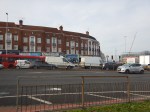

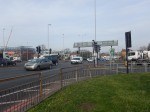

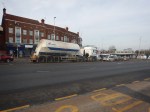


There does seem to be rather a lot of private cars and small commercial vehicles, with only a few HGVs and buses.
I would love to see an analysis of where these journeys start and finish.
Converting the road to a multi-lane dual carriageway wouldn’t be possible, as much of it is lined with private houses and even if it could be built it would just attract more traffic and would need to be widened even more.
There are circular routes further out of London like the M25 and the A412, but this road is an intractable problem.
Perhaps, it needs to be in a Congestion Charge Zone?
But is a solution at hand?
Crossrail
Crossrail, if and when it opens, will not be a direct solution, as it goes East-West and not North-South like the A406 through the area.
But it will give better access to Heathrow, which is a large traffic generator in West London.
Crossrail will link the following to the Airport.
- Canary Wharf
- The City of London
- East London and Essex
- South-East London and Kent
- West End and Paddington
It will do little to help those in North and South London to travel to and from the Airport.
Old Oak Common Station And High Speed Two
The connection of High Speed two and Crossrail could make a difference.
- Passengers using High Speed Two travelling to and from Heathrow, would have an easy route.
- North and North-East Londoners will be able to use the North London Line with a change at Old Oak Common.
- South Londoners will be able to use the West London Line with changes at Old Oak Common and Clapham Junction stations.
But Old Oak Common station won’t open under 2026 at the earliest.
It is needed now.
It also does nothing for those travellers in wide swathes of North-West London.
The West London Orbital Railway
If there is a trusty knight on an immaculate white charger, coming to the rescue, it could be the West London Orbital Railway, although as it would be stitched together from parts of existing and underused infrastructure, it has more of the Dirty Dozen about it.
There would be two routes.
- West Hampstead Thameslink and Hounslow via Cricklewood, Gldstone Park, Neasden, Harlesden, Old Oak Common, Acton Central, South Acton, Brentford, Syon Lane and Isleworth.
- Hendon and Kew Bridge via Brent Cross West, Gldstone Park, Neasden, Harlesden, Old Oak Common, Acton Central and South Acton.
The project has various advantages.
- No substantial amount of new track will be needed.
- It could be run using battery-powered trains.
- Costs would be well under half a billion pounds.
- It would connect to Thameslink and Bakerloo, Jubilee and North London Lines.
When Old Oak Common and High Speed Two open, it would have a direct connection.
I wrote about this railway in detail in New Railway Line For West London Proposed.
North Acton Station
As stated under Development in the Wikipedia entry for North Acton station, there may be reasons to rebuild the station to create a connection between the North London and Central Lines.
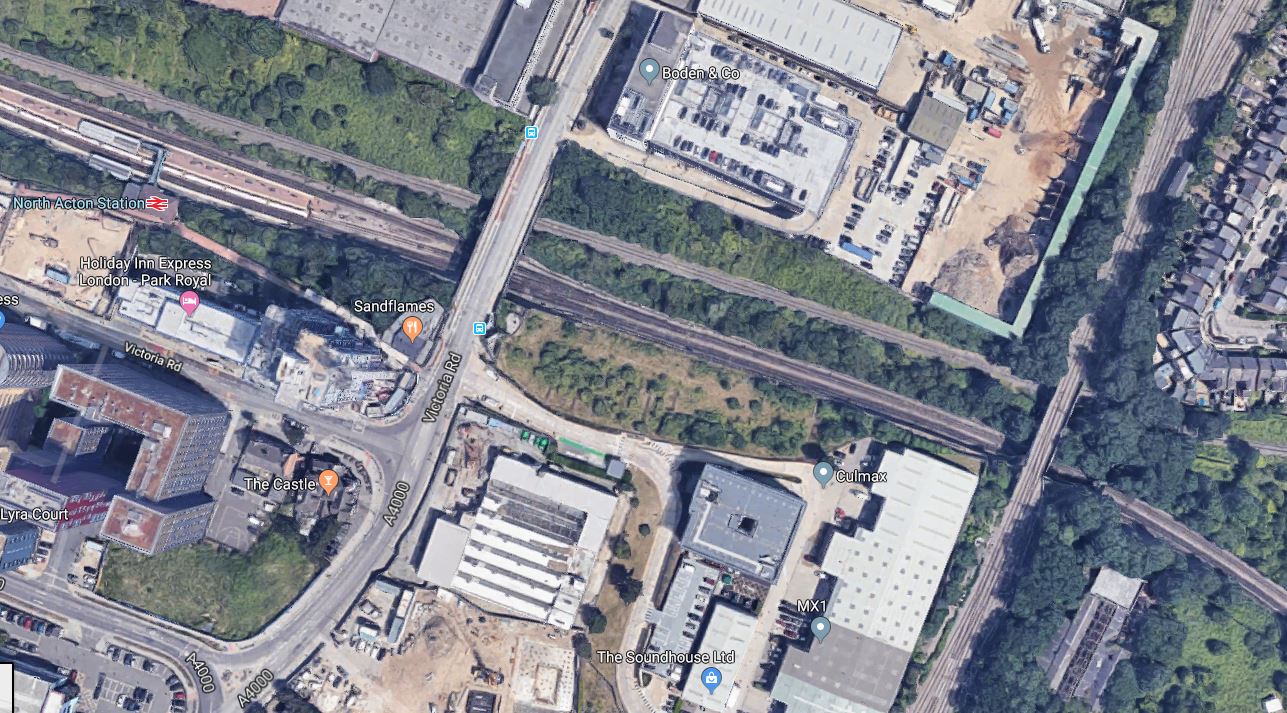
This Google Map shows the area around North Acton station.
Note.
- North Acton station in the North-West corner of the map.
- The North London Line running North-South to the right of the map.
- The Dudding Hill Line branches off the North London Line at the top of the map.
- The Central Line running East-West through North Acton station and under the North London Line.
- Threading its way through North of the Central Line is the Acton-Northolt Line.
- The Acton-Northolt Line could be developed by Chiltern Railways to give access to a second London terminal at Old Oak Common.
To develop a successful station at North Acton, that tied everything together would be a hard ask.
- The bridge carrying the North London Line is very high.
- The height would make step-free access expensive.
- The frequency of trains on both the North London and Central Lines could be twelve trains per hour (tph).
- At least, there does appear to be plenty of space from the map.
On the other hand, an architect with vision might be able to create a station that was affordable and provided high benefits for passengers.
Conclusion
There’s certainly potential in West London to improve the rail routes, although I’m not sure whether rebuilding North Acton station would be viable.
But, we should start building the West London Orbital Railway immediately.
Extra Intermediate Stations On Crossrail
Various groups and councils regularly ask if there could be an extra station on Crossrail, that would be convenient for their needs.
Can Extra Stations Be Accommodated In The Timetable?
There is not much point in building an extra station, if it means that a realistic timetable can’t be achieved.
Every station stop will introduce a delay intro the timetable. The train may only be stationary for thirty seconds or so, but there is extra time in the braking and acceleration either side of the stop.
But the Class 345 trains have been designed so that the times to execute a station stop are minimised.
Rapid Acceleration And Deceleration
The trains have been designed with eight motored cars out of a total of nine.
- This high-proportion of powered axles gives the trains acceleration and deceleration, which is fast, but well within the levels for passenger safety and comfort.
- The trains also have regenerative braking, which is powerful and smooth.
- At times on the current service between Liverpool Street and Shenfield, I have noticed the trains waiting at stations for a couple of minutes, to allow the timetable to catch up.
These trains have the performance to execute a station stop in the smallest time possible.
Wide Doors And Spacious Lobbies
The trains have been designed with wide double doors and spacious lobbies.
This enables fast unloading and loading of passengers at each station.
Level Access Between Train And Platform
Trains and platforms could be arranged, so that all passengers can embark and disembark as fast as possible.
Precision Driving And Automatic Train Control
As much of the route uses modern digital signalling and the trains have a comprehensive driver assistance system, the trains should be driven to a high degree of precision.
Conclusion
All of these factors will make it possible to execute station stops very quickly.
Thus, if it is desired to add a new station stop, the stop might only add a few minutes to the timetable.
You wouldn’t want to add half a dozen stops between Stratford and Shenfield, but the odd stop here and there shouldn’t be a problem!
Could Extra Stations Be Added In The Tunnels?
I would hope that Crossrail’s design process wouldn’t have left out an important station in the Underground sections of the line.
In my lifetime only one station has been added to a line after it opened, except on an extension. That station was Pimlico on the Victoria Line, but that was a late addition to the project and opened within fourteen months of the opening of the rest of the line.
I think, that I can safely say that from the history of London’s extensive network of underground railways, that it would be extremely unlikely to add a new underground station to Crossrail.
But I think though the following could happen.
New Entrances To Existing Stations
Even these will be extremely unlikely, if Crossrail have done their planning thoroughly.
But then there are massive property developments, sprouting up all over Central London.
One of London’s latest signature office developments, the Norman Foster-designed Bloomberg London will incorporate an entrance to Bank Underground station.
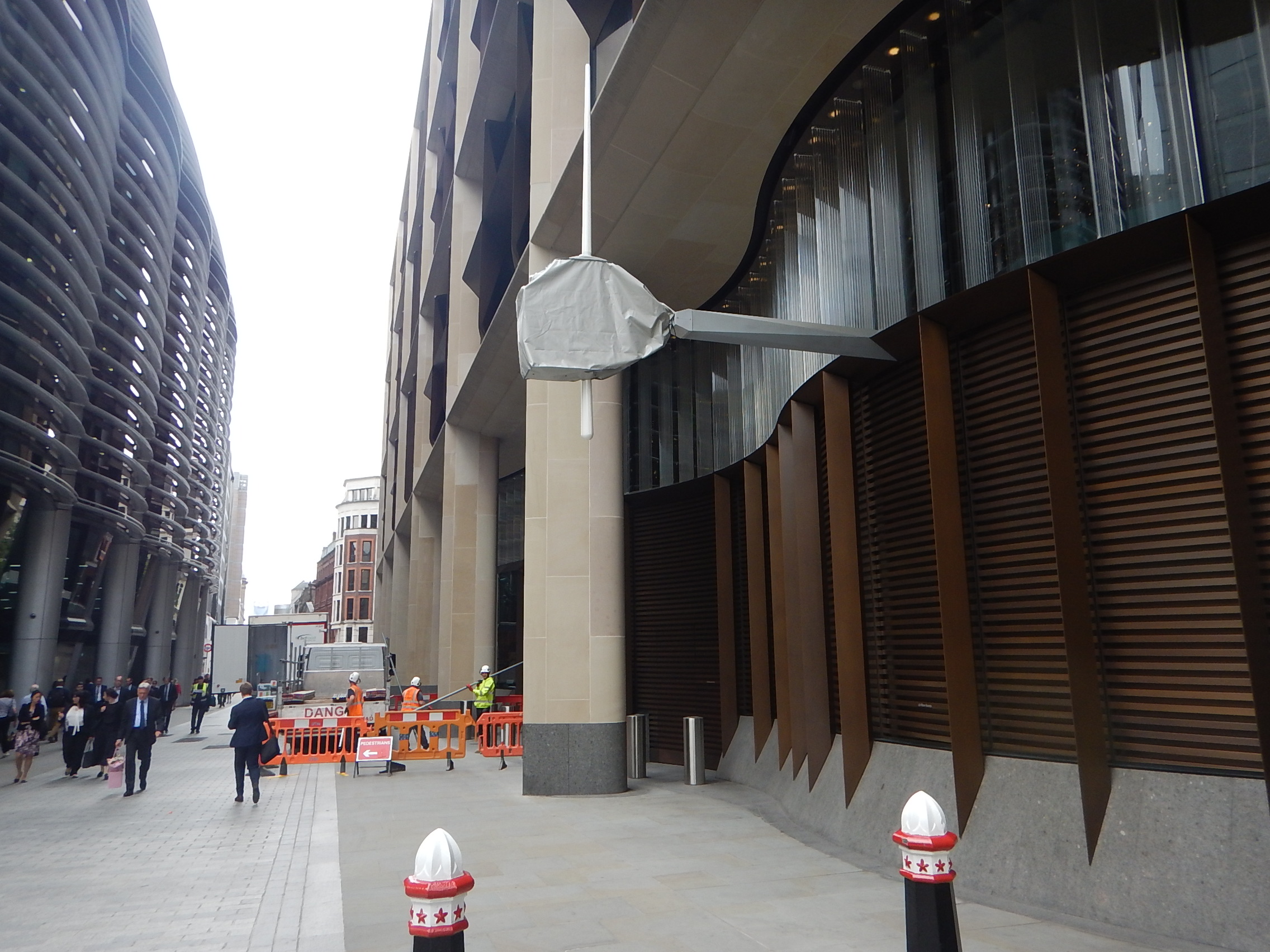
Hopefully, the entrance will open soon.
Bank station’s new step-free entrance will also incorporate a massive office development on the top.
If a property developer is spending around a billion pounds on a development, and it can be connected to a station, they will seriously look at doing it.
I can’t believe that no new developments will want to have an entrance to a Crossrail station.
The New Museum Of London
The current site of the Museum of London is too small and difficult to find. The Museum is planning to move to Smithfield and will be very close to Farringdon station.
There is a massive over-site development on top of the station, that I wrote about in TfL Gives Go Ahead To Build Above Farringdon Station.
This Google Map shows the relationship between the station and the new site of the museum.
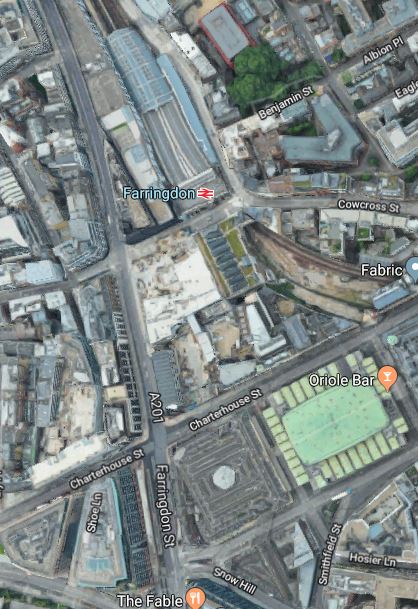
Note.
- The building with the light-green roof is the Poultry Market.
- Thameslink runs under the Poultry Market.
The basement of this Poultry Market together with the site to its West and the triangular site to the South, will be transformed into the new Museum of London.
Much of the space between the Poultry Market and Farringdon station is a Crossrail work-site and whole area is ripe for development, which must surely incorporate some form of connection between the Museum and Farringdon station.
Farringdon, which for many years was just a meat market surrounded by a lot of low grade buildings, should evolve into a visitor attraction in its own right.
For a better look at the current state of the area, visit A Detailed Look At The Space Between Farringdon Station And The New Museum Of London Site.
As a Friend of the Museum of London, I am looking forward to what will happen!
The Liverpool Street-Moorgate Mega -Station
I don’t think many, who use Liverpool Street and Moorgate stations understand what will happen when Crossrail opens.
This visualisation shows the below-ground elements of the Crossrail station, that will connect the two current stations.
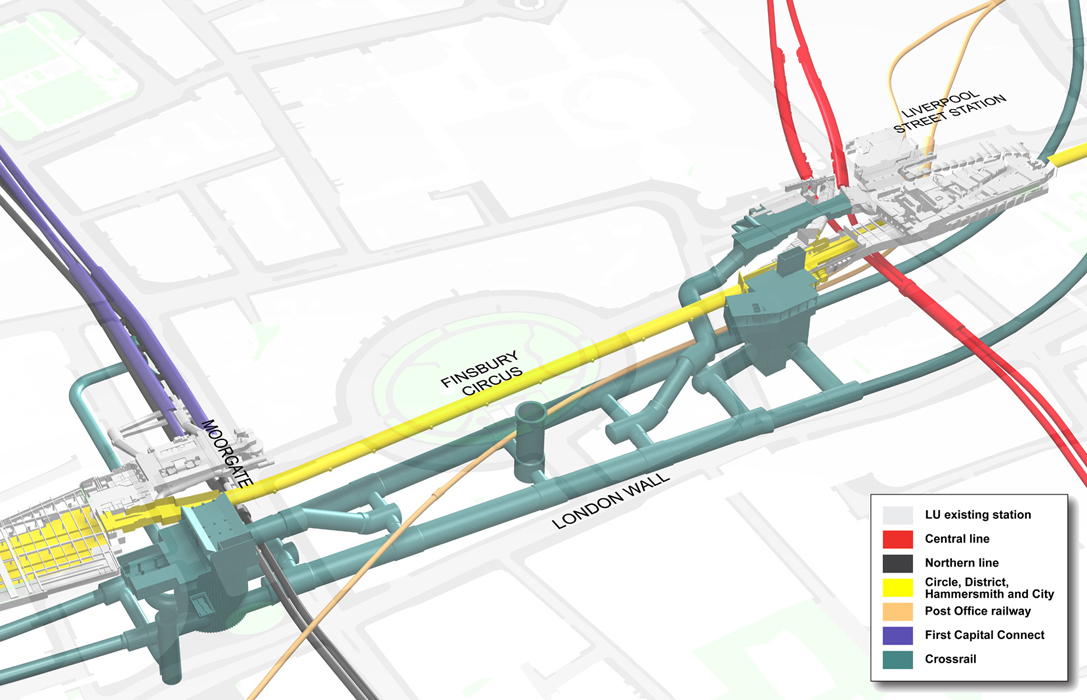
Note.
- On the right is the Central Line, which is shown in red and continues South to Bank station under Bishopsgate.
- On the left is the Northern Line, which is shown in black and continues South to Bank station.
- The Circle, Hammersmith and City and Metropolitan Lines, which are shown in yellow.
- Crossrail is in blue.
- The ventilation and evacuation shaft for Crossrail in Finsbury Circus.
This Google Map shows the area of the stations.
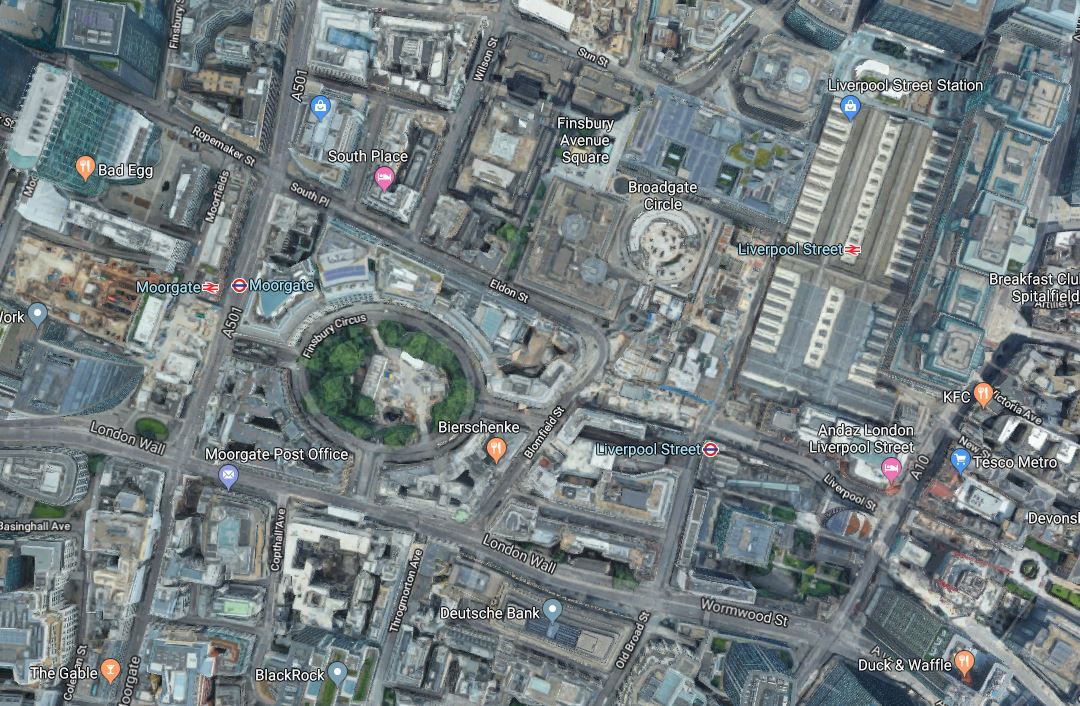
Note Finsbury Circus in the middle.
I would not be surprised if some redevelopment has access into this mega-station complex, that stretches either side of Finsbury Circus.
This access needn’t be below ground, as I strongly believe that the City of London will become virtually traffic-free in the next ten years.
Missing Interchanges
One of the omissions in the design of Crossrail, is the lack of a link to both the Piccadilly and Victoria Lines.
Consider.
By 2024, these two lines will be running at least thirty-six trains per hour (tph) in both directions.
The capacity of Crossrail in each direction could be thirty tph each carrying 1500 passengers or 45,000.
Dear Old Vicky’s current trains hold 876 passengers, so if she achieves the magic forty tph, which I believe she will, then this equates to just over 35,000.
Siemens will surely ensure, that the capacity of the Piccadilly Line will at least be as high, as that of the Victoria Line.
It is just amazing to think what might be squeezed out of twentieth-century infrastructure, some of which is over a hundred years old.
Oxford Circus Station And The Hanover Square Entrance To Bond Street Crossrail Station
This is the easy interchange between Crossrail and the Victoria Line.
- Oxford Circus station is full-to-bursting and will be rebuilt in the next few years, with wider platforms, more escalators and full step-free access.
- I also think, that provision of an easy walking route to the Hanover Square entrance of Bond Street station will be provided, either by pedestrianising much of the area or perhaps building a pedestrian tunnel with travelators.
- It is probably less than two hundred metres to walk on the surface.
Coupled with some property development along the route, there must be possibilities for an innovative scheme, that would ease passengers on routes between Paddington and Heathrow and North and East London.
I took these pictures, as I walked between Oxford Circus Tube station and Hanover Square.




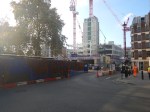
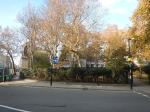
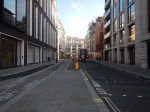
This Google Map shows the route from Oxford Circus station to Hanover Square.
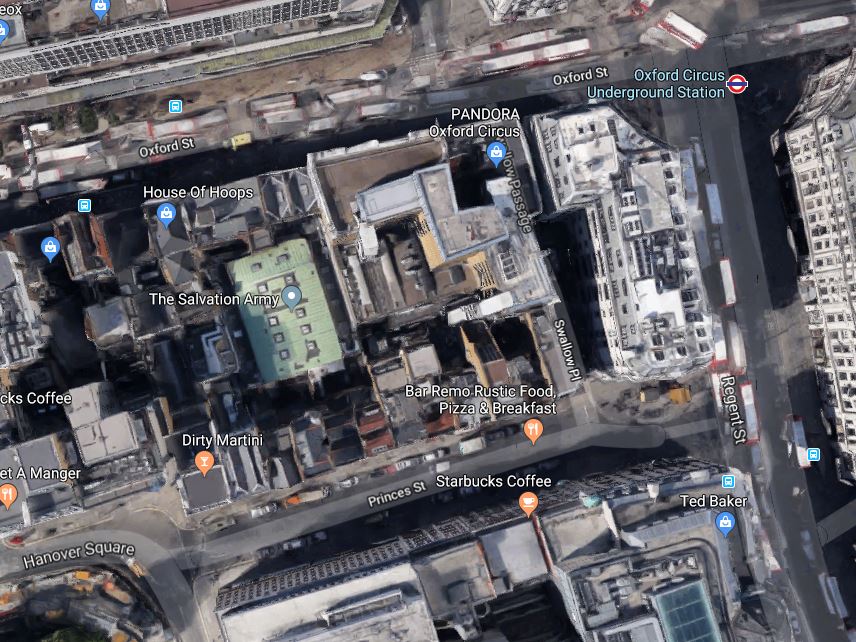
In the simplest scheme, part-pedestrianisation of Hanover Square and Princes Street might just do it!
- A new entrance to Oxford Circus station could also be constructed in the middle of a large pedestrian area, at the shut off junction of Princes Street and Regent Street.
- A short tunnel would connect the new entrance, to the rebuilt.Oxford Circus station.
- Walking wouldn’t be long, with the possibility of a wait in the gardens in the centre of Hanover Square.
- Appropriate retail outlets could be placed along Princes Street.
- Crossings with lights would enable pedestrians to cross into and out of the gardens.
Was this always Transport for London’s plan to link Crossrail to the Victoria Line?
It’s certainly feasible and works with little or no construction.
The Importance Of Finsbury Park Station
Finsbury Park station has two direct routes to Crossrail; Thameslink to Farringdon and the Northern City Line to Moorgate and could have a third if the Victoria Line has a better connection at Oxford Circus/Bond Street.
Passengers needing to use Crossrail from the Northern reaches of the Piccadilly Line could walk across the platform to the Victoria Line and then use the Oxford Circus/Bond Street connection.
It is not a perfect route, but if Finsbury Park were to be upgraded to a passenger-friendly interchange, it would be a lot better.
So it looks like, it will be Vicky to the rescue again.
Never in the field of urban transport was so much owed by so many to a single railway built on the cheap.
Interchange Between Crossrail And The Piccadilly Line At Holborn Station
Consider.
- Holborn station is due to be rebuilt with a second entrance in the next few years.
- Crossrail passes under Holborn station.
- After rebuilding, Holborn station will probably offer the best interchange to an East-West route from the Piccadilly Line.
- To add extra platforms on Crossrail, would probably mean long closures on the line.
It is one of those projects, that can be done, but not without immense disruption.
But at some point in the future, it is a link that could be added, so I wouldn’t be surprised to see the expanded Holborn station will have provision for a link to Crossrail.
New Surface Stations On Crossrail
Usually, when you look at old maps of railway lines there are a number of places, where stations used to be.
However, between Reading and Shenfield stations, there is no station that has been closed. There is a site for Crowlands station that was planned near Romford, in the early twentieth century, but was never built. No-one is suggesting it should be opened now.
So where are stations planned or proposed?
Old Oak Common Station
In fifteen years or so, Old Oak Common station could be one of the most important non-terminal on Crossrail.
Current plans say that the following lines will call at the station.
- Crossrail
- Great Western Railway
- High Speed Two
In addition the following lines may call.
- London Overground
- West London Orbital Railway
- Chiltern Main Line
It could become a very comprehensive interchange station.
This Google Map shows the vast Old Oak Common site.
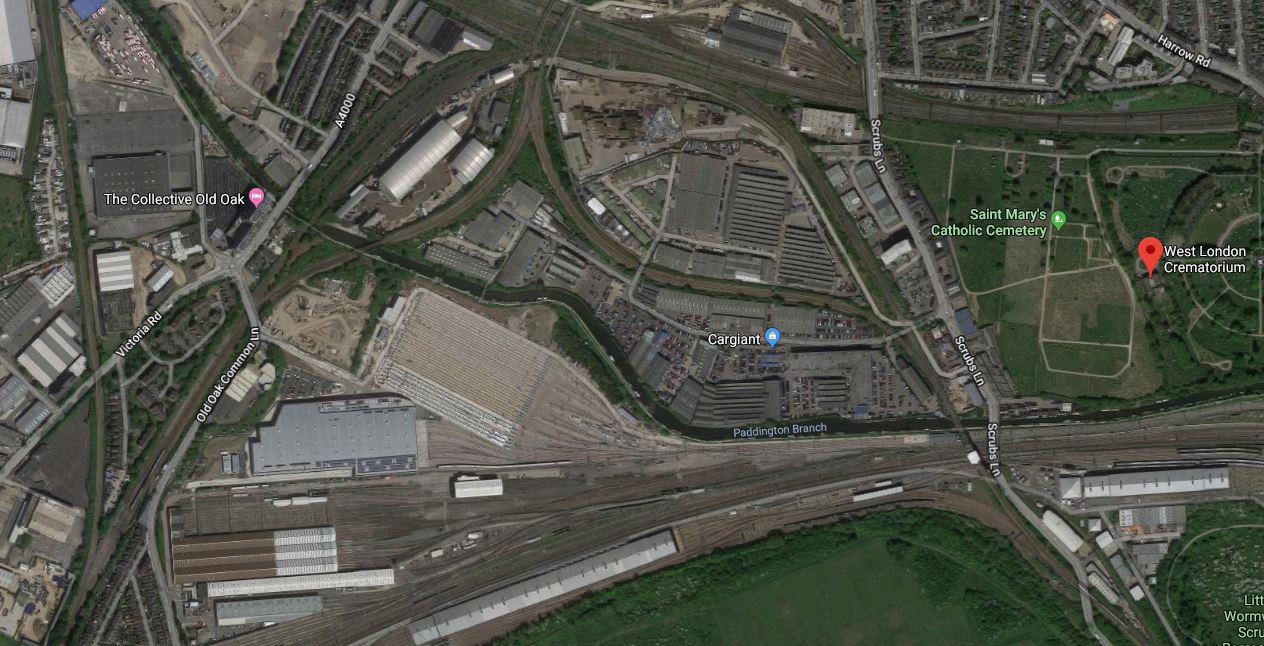
Note.
- The Grand Union bisecting the site in an East-West direction.
- The inverted-Y of the Overground, with North London Line to Richond going South-West and the West London Line to Shepherds Bush going South-East.
- The Great Western Main Line going East-West across the bottom of the map.
- The West Coast Main Line going East-West across the top of the map.
- The Dudding Hill Line going North-South at the Western side of the map.
Between the Grand Union Canal and the Great Western Main Line, there are currently four rail depots. From South to North, they are.
- Hitachi’s North Pole depot, where they service the Class 800 trains for Great Western Railway.
- The Heathrow Express depot.
- The Great Western Railway depot.
- Crossrail’s main depot.
The Heathrow Express depot is due to be demolished to make way for the new Old Oak Common station.
Wikipedia says this about the station.
The High Speed 2 line will be below ground level at the Old Oak Common site, with the parallel Great Western Main Line and Crossrail tracks on the surface to the south.
This map from Wikipedia, shows how the lines connect.
A few points.
- Considering that the High Speed Two tracks are below the surface and the Crossrail and Great Western tracks will be on the surface, I am fairly sure that a simple clean interchange will be created.
- The different levels will also mean that if say there were to be a Crossrail branch to Watford or High Wycombe, then the High Speed Two tracks are well out of the way.
- The High Speed Two platforms will be almost four hundred metres long, with the Crossrail and Great Western platforms probably about half as long. This should give lots of scope to create good connections to the other lines through the station.
- The new Old Oak Common Lane station will be on the North London Line between Stratford and Richmond stations, will be the way I access High Speed Two from Dalston and it will be 350 metres West of the main station.
- The West London Orbital Railway could have a station on the Dudding Hill Line, which runs to the West of, but close to Old Oak Common Lane station.
- The new Hythe Road station will be on the West London Line between Stratford and Clapham Junction stations and will be 1100 metres from the main station.
- Hythe Road station will incorporate a turnback platform for services from Clapham Junction. It would be ideal for a service between Gatwick Airport and High Speed Two.
- It should not be forgotten that there is going to be a large number of houses built around Old Oak Common.
It looks to me that if I took the wrong train from Dalston Kingsland station to get a High Speed Two train to Birmingham or the North, I might end up at the wrong end of my double-length High Speed Two train, with a walk of up to 1100+400+350 = 1850 metres to get to the required place on my train.
I would hope that the High Speed Two station would have some form of high-tech people mover, that stretched across the station site. It could be like a cable car without the cable.
Hopefully, the designers of Old Oak Common station will create what needs to be one of the best stations in the world.
London City Airport Station
Wikipedia says this about adding a station for London City Airport.
Although the Crossrail route passes very close to London City Airport, there will not be a station serving the airport directly. London City Airport has proposed the re-opening of Silvertown railway station, in order to create an interchange between the rail line and the airport. The self-funded £50m station plan is supported ‘in principle’ by the London Borough of Newham. Provisions for re-opening of the station were made in 2012 by Crossrail. However, it is alleged by the airport that Transport for London is hostile to the idea of a station on the site, a claim disputed by TfL.
In 2018, the airport’s chief development officer described the lack of a Crossrail station as a “missed opportunity”, but did not rule out a future station for the airport. The CEO stated in an interview that a station is not essential to the airport’s success
This Google Map shows the Western end of the terminal at London City Airport and the Docklands Light Railway running to the station at the Airport.
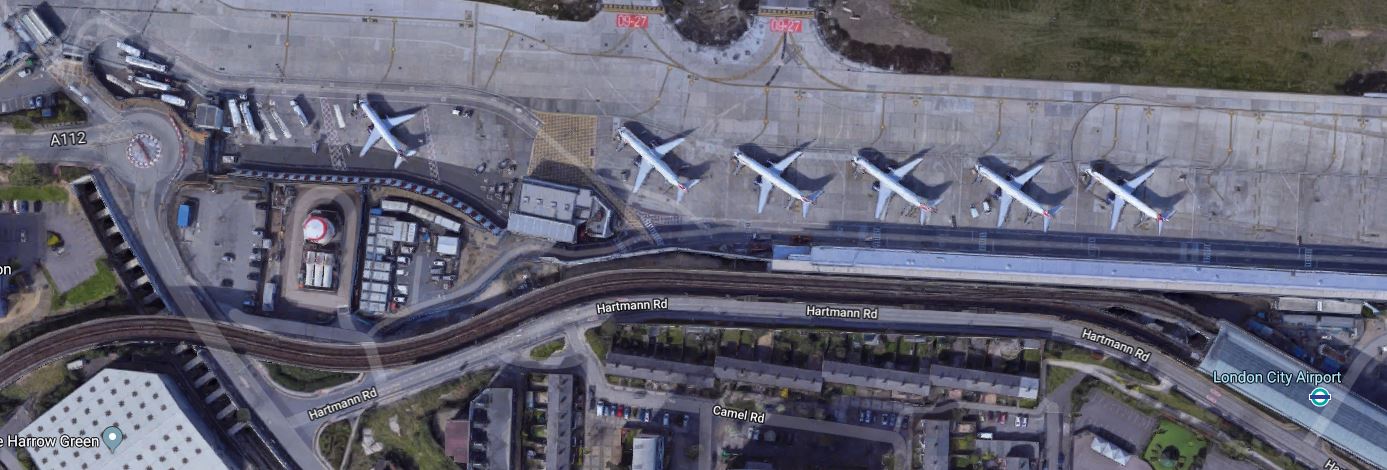
The Southern portal of Crossrail’s Connaught Tunnel can be seen under the DLR at the left end of this map, due to the concrete buttresses across the cutting rebuilt for Crossrail.
Surely, it would not be the most difficult of designs to build a station, somewhere in this area, where the former Silvertown station once stood.
I said more about this station in August 2017 in Action Stations On Crossrail Howler.
I will be very surprised if this station isn’t built.
Ladbroke Grove Station
If Ladbroke Grove station is built, it will because of property development. Wikipedia says this about current plans.
At a site just to the east of the Old Oak Common site, Kensington and Chelsea Council has been pushing for a station at North Kensington / Kensal off Ladbroke Grove and Canal Way, as a turn-back facility will have to be built in the area anyway. Siting it at Kensal Rise, rather than next to Paddington itself, would provide a new station to regenerate the area. Amongst the general public there is a huge amount of support for the project and then-mayor of London Boris Johnson stated that a station would be added if it did not increase Crossrail’s overall cost; in response, Kensington and Chelsea Council agreed to underwrite the projected £33 million cost of a Crossrail station, which was received very well by the residents of the Borough. Transport for London (TfL) is conducting a feasibility study on the station and the project is backed by National Grid, retailers Sainsbury’s and Cath Kidston, and Jenny Jones (Green Party member of the London Assembly).
This Google Map shows the wider area.
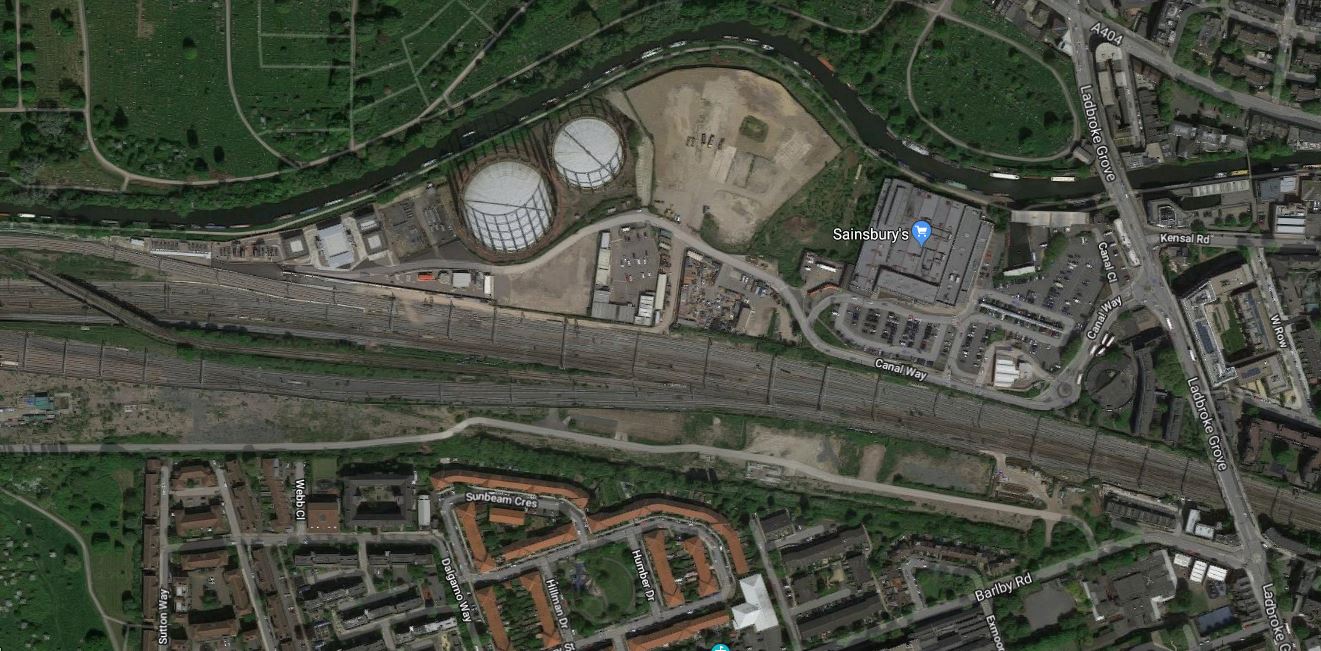
Note.
- Ladbroke Grove is the road running North-South at the right side of the map.
- Canal Way is the twisting road running North of the railway.
- Sainsbury’s supermarket is North of Canal Way.
- The cleared site of the old Kensal gasworks is earmarked for housing.
The Crossrail tracks are on the North side of the railway, so access from a station to the housing could be very easy.
Conclusion
Crossrail is not even open yet and it looks like when it does, it will start a large number of projects to expand its scope.
Some will be about extending the system, some about better transport links and other about property development.
Crossrail will be an unlimited opportunity for London and the South East.
HS2 Need To Get Their Act Together
Crossrail has been good in keeping Londoners and others informed about designs and what is happening, with constant updates to the News page on their web site.
Last month, HS2 started the contractual process to find a builder for the HS2 station at Old Oak Common.
But there is nothing about it on their News page, which is just a load of press releases.
I have found this picture of the proposed station in several places on the Internet.
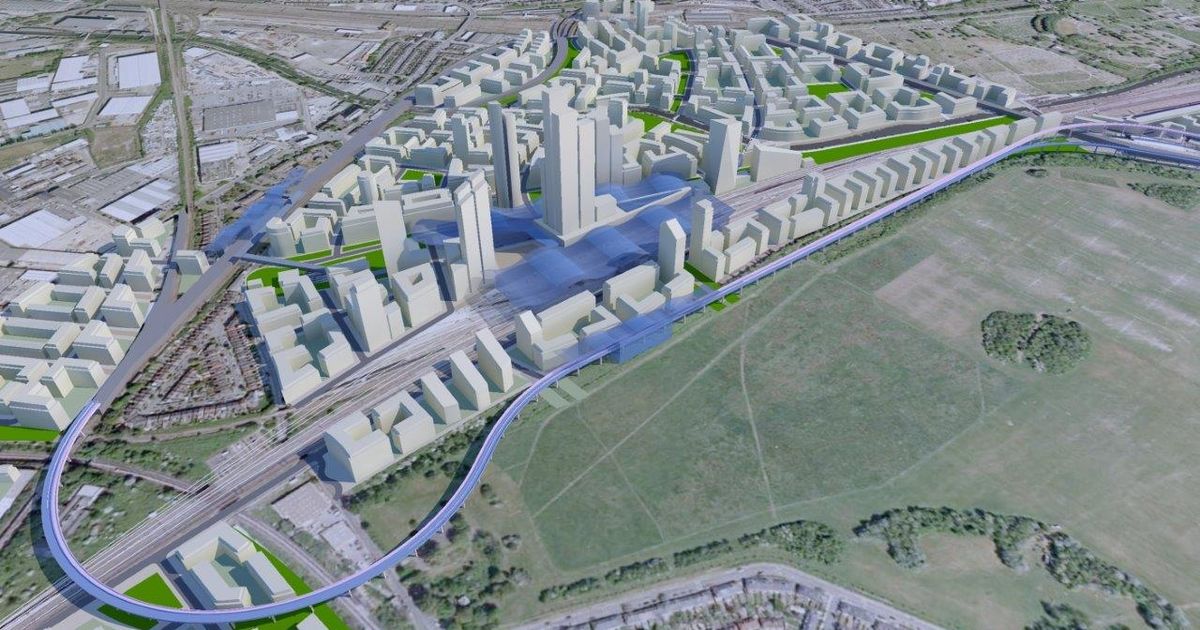
But where is the detailed information page, which explains it all?
I found this map of the rail lines in Wikipedia Commons.
Note.
- It would appear that the rail line going along the North side of the common in the visualisation is the Great Western Main Line, which will also be used by Crossrail.
- It appears that the rail loop in the foreground of the visualisation, which is not shown on the map, is to allow Crossrail trains to access the North London Line.
- There must be another proposed loop or viaduct to allow trains to connect to the Northbound West Coast Main Line. This would allow Crossrail to be extended to Watford and Milton Keynes.
Where is the definitive map and information from HS2?
Old Oak Common station will affect travel plans for millions of travellers to and from most parts of London and a lot of places in the wider South East.
No wonder, there are people who don’t want HS2 to be built, if they have no information!
So why aren’t HS2 following the same news and information route, that has been successful for Crossrail?
Are Transport for London Planning For The Future In The West?
Over a dozen Underground stations in West London have been earmarked for upgrading to step-free access.
I listed them in West London Stations To Be Made Step-Free.
There are various common properties.
- Boston Manor and Osterley stations are on the Heathrow branch of the Piccadilly Line, which when updated would make the branch seventy percent step-free.
- Hanger Lane and Northolt stations are on the West Ruislip branch of the Central Line, which when updated would make the branch seventy-one percent step-free.
- Ickenham, Ruislip, Sudbury Hill and Park Royal are on the Uxbridge branch of the Piccadilly Line, which when updated would make the branch sixty percent step-free.
- Hanger Lane and Park Royal stations are a valid out-of-station interchange.
- Sudbury Hill and Sudbury Hill Harrow are a valid out-of-station interchange.
- Ickenham and West Ruislip are a valid out-of-station interchange.
- Ealing Broadway and Old Oak Common are developing into major interchanges.
With Crossrail going through West London and due to be fully-open in a couple of years, transport in West London is certainly going to get better for all.
But other things will or possibly could happen.
New Trains On The Piccadilly Line
The Piccadilly Line is in some ways an odd one out of London Underground lines.
- Only 28 % of the line’s stations have an interchange with other lines or National Rail compared with 94 % for the Victoria Line.
- Only two of the major London terminals; Kings Cross and St. Pancras International, are served by the Piccadilly Line and very badly in truth!
- The line has no interchange with Crossrail.
- The line has a terminus at Heathrow.
- The line runs extensively in West London on old District Line tracks, so there are a lot of stations in the area, where platform-to-train access is bad.
The trains are also some of the oldest on the London Underground.
Under Future Upgrades in the Wikipedia entry for the line, this is said.
The intention is for the new trains to eventually operate on the Bakerloo, Central, Piccadilly and Waterloo & City lines. On current plans, resignalling work on the Piccadilly line will begin in 2019 and new trains should be in service by 2022.
Wikipedia also says this about the trains.
- The trains will be lightweight, low-energy and semi-articulated.
- The trains will have a battery capability to take them to the next station in case of power failure.
- The trains will have a low-floor. Will this be lower than current trains? Probably yes, as it would increase headroom.
- The trains will have an 11 % higher capacity than the existing trains.
- The trains could have air-conditioning.
I would add the following comments and pedictions.
- The trains will be designed for quicker exit and entry to the trains.
- The trains will shorten journey times.
- The trains will be wheelchair and buggy friendly.
- The batteries on the train will be used to handle regenerative braking.
- The trains will have air-conditioning, as passengers will demand it.
- A solution will be found, so that there is level platform-to-train access at all stations.
Point six will be difficult, but in my view this must be done to enable trains to spend as little time as possible, whilst calling at a station.
Perhaps trains will adjust their ride height as they approach a station, by adding and releasing air from the suspension.
If this level access can be achieved by a clever train design, the expense and disruption of rebuilding station platforms substantially, could be reduced.
Unfortunately, some Piccadilly Line platforms are also used by the larger S Stock trains, so any technological advantages must be made on the new Piccadilly Line trains.
Piccadilly Line To Ealing Broadway
Ealing Broadway station is being upgraded for Crossrail.
In the November 2017 Edition of Modern Railways, there is a Capital Connection supplement, which discusses London’s railways.
On Page 7 in a section about the sub-surface lines, this is said.
One possibility being discussed is that the Piccadilly should take over the District’s Ealing Broadway service. This would free up space on the South side of the inner-London circle for more City trains off the Wimbledon branch, one of the sub-surface network’s most-crowded routes.
On Page 15 in a section about the Mayor’s plans, this is said.
It is suggested Piccadilly Line services run to Ealing Broadway instead of the District Line, enabling increased frequencies on the latter’s Richmond and Wimbledon branches.
As the plan is mentioned twice, certainly the proposal is being thought about.
I discussed this in some detail in Is There Going To Be More Change At Ealing Broadway Station?
Distilling my thoughts from last year and what I’ve seen recently, I have the following thoughts, if the Piccadilly Line had a branch to Ealing Nroadway station.
- The Piccadilly Line would have a two-platform step-free terminus, capable of handling twelve trains per hour (tph)
- Increasing Piccadilly Line frequencies through the core, probably needs another high capacity terminal in the West.
- The Piccadilly Line would have an interchange with Crossrail and Great Western Railway for Heathrow, Oxford and Reading.
- In the later 2020s, when the Piccadilly and Central Lines are running the same new deep-level trains, Ealing Broadway would only handle one type of Underground train.
- As Ealing Broadway, Ealing Common and Acton Town stations would only handle the new deep-level Underground trains, platform-to-train access problems could be solved by lowering the platforms.
The current Piccadilly Line service in the West is as follows.
- Twelve tph to Heathrow
- Six tph to Rayner Lane station, with three tph continuing to Uxbridge.
- Three tph to Northfields
The new trains and signalling, must surely increase the core frequency from the current 21 tph to something approaching the 36 tph of the Victoria Line.
I suspect that twelve tph to Ealing Broadway would fit well, with both the needs of the Piccadilly Line and Crossrail’s frequency of twelve tph.
There are other problems to sort out, but Piccadilly Line trains to Ealing Broadway station could be an excellent plan.
Piccadilly Line To Heathrow
The Heathrow branch of the Piccadilly Line will be seventy percent step-free, after Boston Manor and Osterley stations are upgraded.
I think the time will come in the next few years to bite the bullet and do the following on the branch.
- Make all street-to-platform fully step-free.
- Lower the platforms to give level platform-to-train access to the new deep-level trains.
As this branch is Piccadilly Line-only, there should be few related problems.
Piccadilly Line To Rayners Lane and Uxbridge
The Uvbridge branch of the Piccadilly Line will be sixty percent step-free, after Ickenham, Ruislip, Sudbury Hill and Park Royal stations are upgraded.
As with the Heathrow branch, I think that the following should be done.
- Make all street-to-platform fully step-free.
- Lower the platforms to give level platform-to-train access tothe new deep-level trains.
The problem is between Rayners Lane and Uxbridge stations, where the branch is shared with the Metropolitan Line.
The following could be done.
- Put in extra tracks and platforms.
- Live with the current platforms and step down into a Piccadilly Line train.
- All Piccadilly Line trains could terminate at Rayners Lane and from Rayners Lane to Uxbridge is served by Metropolitan Line only
- As the platforms are long and all trains are walk-through, clever platform design with Harrington Humps could be a solution.
Only option 4 would be an affordable solution, that might be acceptable to all stakeholders.
Central Line To Uxbridge
In the Wikipedia entry for the Central Line, this is said.
The Central crosses over the Metropolitan and Piccadilly lines’ shared Uxbridge branch near West Ruislip depot, and a single track linking the two routes was laid in 1973. The London Borough of Hillingdon has lobbied TfL to divert some or all Central trains along this to Uxbridge, as West Ruislip station is located in a quiet suburb and Uxbridge is a much more densely populated regional centre. TfL has stated that the link will be impossible until the Metropolitan line’s signalling is upgraded in 2017.
This map from carto.metro.free.fr shows the lines around Ruislip Depot.
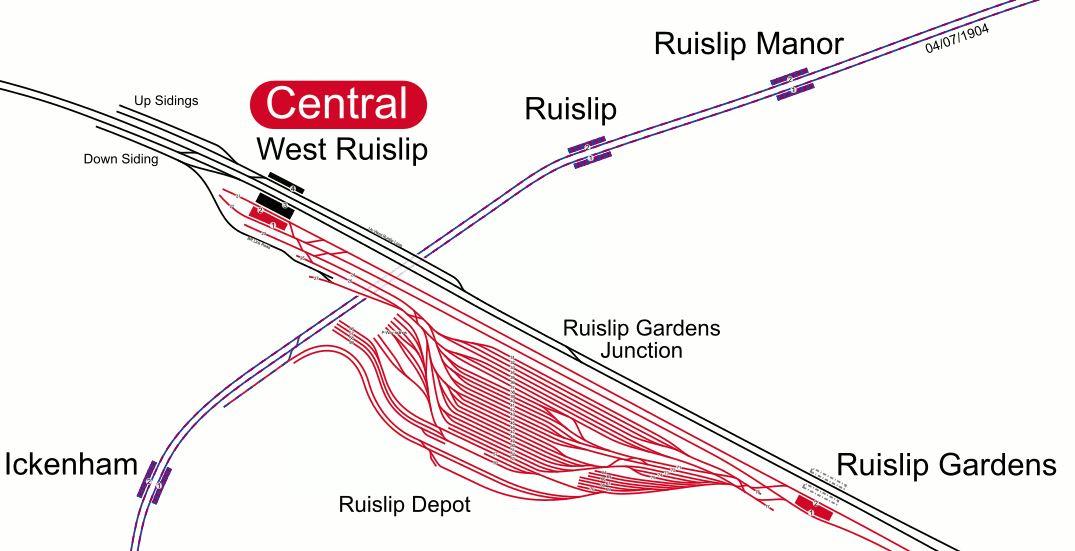
Note.
- The Central Line is shown in red.
- The track used by the Piccadilly and Metropolitan Lines is the bluey colour.
- The Chiltern Main Line is shown in black.
- Ickenham and Ruislip stations will soon have some measure of step-free access.
- Ickenham and West Ruislip stations are a valid out-of-station interchange, with a walk of 1.1 miles.
Would running Central Line trains to Uxbridge be feasible?
Uxbridge station has four platforms and currently has the following Off Peak services.
- Metropolitan – 8 tph to Aldgate
- Piccadilly – 3 tph to Cockfosters
With these frequencies in the morning Peak.
- Metropolitan – 6 tph to Aldgate
- Metropolitan – 4 tph to Baker Street
- Piccadilly – 6 tph to Cockfosters
West Ruislip has a 3 tph Off Peak service.
Uxbridge with four platforms can probably handle up to twenty-four tph with modern signalling, so there should be scope once the the new signalling is installed on the Metropolitan Line for changes to be made.
It may need new trains on both the Central and the Piccadilly Line, that can use the new signalling, before full advantage could be taken of running Central Line trains to Uxbridge.
But at some time in the future, it looks like the following would be possible on the West Ruislip branch of the Central Line.
- 4 tph to West Ruislip
- 4 tph to Uxbridge
That would be a very worthwhile service.
The Greenford Branch
The Greenford Branch is one of those lines in London and the South East, that have a low priority for the train operating companies.
Others include.
- Abbey Line
- Brentford Branch Line
- Bromley North Line
- Romford-Upminster Line
- Slough-Windsor & Eton Line
Twenty years ago, you would have included the North London and the Gospel Oak to Barking Lines. But look at those two now!
The Greenford Branch is typical of this sort of line.
- Single platform at each end.
- Two tph run by a single train.
- Elderly trains.
- No electrification
- No Sunday service
- More information.
- Virtually no marketing.
- Poor interchange at West Ealing station, although interchange at Greenford is excellent.
All of these lines could benefit from a common philosophy.
- Four tph where possible, to encourage Turn-Up-And-Go.
- A viable train use philosophy.
- Modern electric trains that attract passengers.
- Good interchange at the principal station or stations.
A plan for the Greenford Branch has yet to emerge.
However Crossrail will change everything.
- Up to twelve tph could stop at West Ealing station.
- West Ealing station will have full step-free access between the Greenford Branch, Crossrail and GWR services.
- Passengers might use the line with heavy bags to get to and from Heathrow.
- Management of West Ealing station may pass to Transport for London.
On a cold, wet day, passengers changing to the Greenford Branch will not want to wait half an hour for the next train to Greenford and the intermediate stations.
Increased passenger numbers and pressure for good service will require a four tph frequency on the Greenford branch.
- This will require two trains.
- Better customer service will be needed.
|As the two end stations could both be under Transport for London control, would it be sensible to pass management of the line to that organisation and run the line under the Overground banner?
But what trains could be used?
- As the line is not electrified and platforms can only handle two- or possibly three-car trains, London Overground’s standard four-car Class 710 trains would not be suitable.
- Class 172 trains could be used, but these are going to West Midlands Trains.
- Passengers might accept a modernised British Rail era diesel like a Class 150 train.
- There is also the Class 230 train, which West Midlands Trains will be using on the Marston Vale Line.
- Could Bombardier create a three-car Aventra with on board energy storage, that would be charged at either or both ends?
My money would be on one of the last two options.
- A standard electric train would require electrification of the branch.
- There would be servicing problems with a small diesel fleet.
- Class 230 trains have been designed for remote servicing, so three trains would work.
- The diesel trains and the Class 230 train would require little if no infrastructure changes.
- The branch is under three miles long, so a return trip is probably well within range of a battery train.
- A three-car Aventra with on board energy storage would have many applications in the UK.
- The Aventra with on board energy storage would require little if no infrastructure changes, except for some extra overhead wires to create a charging point at West Ealing.
London Overground will probably go for a surprising, but cost-effective solution.
Onward From Greenford
This map from carto.metro.free.fr shows the lines at Greenford station.
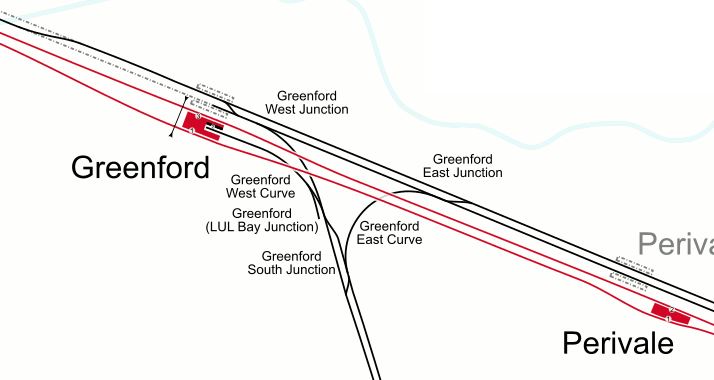
There must surely be possibilities to extend the current passenger service to the West.
- It would create a West Ealing to West Ruislip feeder service for Crossrail.
- Greenford station would need extra platforms on the Acton-Northolt Line.
- Train length would be less of a problem and four-car trains could probably be used.
It would fit well with restoring passenger services on the Acton-Northolt Line.
Old Oak Common To West Ruislip On The Acton-Northolt Line
Network Rail have plans to reinstate passenger services on the Acton-Northolt Line, so that Chiltern Railways can have an extra London terminal with a connection to Crossrail, High Speed 2 and the London Overground. Under Chiltern Main Line Connection, in the Wikipedia entry for Old Oak Common station, this is said.
Network Rail has proposed that the Chiltern Main Line should have a second terminal at Old Oak Common to increase capacity on the route as there is no room to expand the station at Marylebone. To do so, services would use the Acton–Northolt line (formerly the “New North Main Line”) and perhaps see Chiltern trains terminating here rather than Marylebone.
A summary report by Network Rail, which was released in 2017, forecast that a new London terminal will be needed by 2043 and proposed Old Oak Common for this role, with upgrading of the Acton-Northolt Line.
I doubt that I’ll see it, as I’ll be 96!
But it does seem a credible idea with questions to ask!
- Will the route be double- or single-track?
- Will there be express and/or Metro services?
- How many interchanges will there be with the Central Line?
- Will the route be used by Crossrail?
- Will the route be electrified?
I do think that there will be some very serious thinking going on.
A few thoughts on what could define what might ensue.
High Wycombe Station
High Wycombe station is a three platform station, with a lot of space between the tracks, as this Google Map shows.
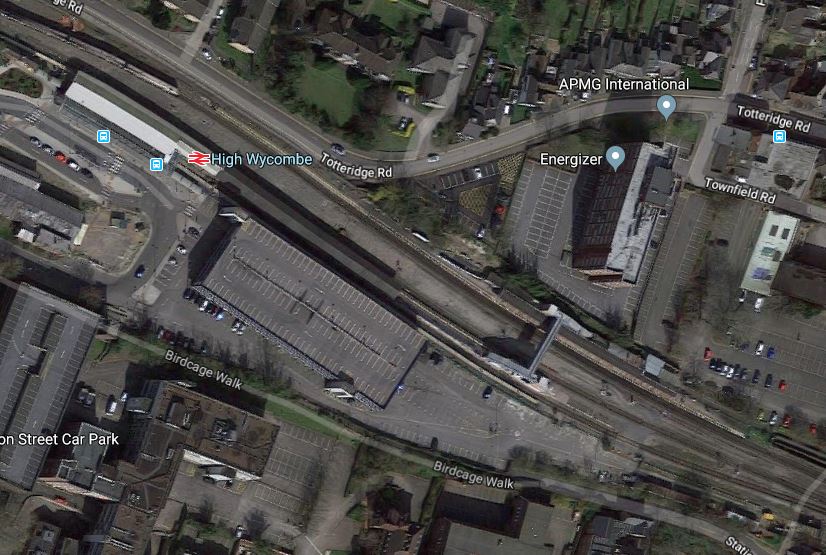
It would appear there is space for the station to be developed, as a terminus for more services from London.
The Chiltern Metro
According to Wikipedia, Chiltern Railways have ambition to create a Chiltern Metro. Wikipedia says this.
New Chiltern Metro Service that would operate 4+tph for Wembley Stadium, Sudbury & Harrow Road, Sudbury Hill Harrow, Northolt Park, South Ruislip and West Ruislip. This would require a reversing facility at West Ruislip, passing loops at Sudbury Hill Harrow, and a passing loop at Wembley Stadium (part of the old down fast line is in use as a central reversing siding, for stock movements and additionally for 8-car football shuttles to convey passengers to the stadium for events). This ‘Chiltern Metro’ service was not programmed into the last round of franchising agreements.
This sounds to be a good idea but it would need a dedicated platform at Marylebone and is there sufficient capacity on the Chiltern Main Line to accommodate the number of extra trains required to West Ruislip.
Crossrail
How Crossrail will affect London is totally unpredictable.
- Currently, the system is planned to run 24 tph between Heathrow, Paddington and Reading in the West and Abbey Wood and Shenfield in the East.
- Various sources show that Crossrail has been built for 30 tph.
- I wouldn’t be surprised to see the route move to a Thameslink or East London Line model, where two or four tph run to other destinations outside the core.
Ebbsfleet, Gravesend and Milton Keynes have been mentioned for expansion, but what about Basingstoke, Beaulieu, High Wycombe, Oxford and Southend?
Electrification
Three factors will be the main drivers if the Acton-Northolt Line is electrified for Network Rail’s proposed passenger services to Old Oak Common.
- Extension of Crossrail to High Wycombe would surely need the Acton-Northolt Line to be electrified and possibly double-tracked.
- The next generation of multi-mode trains will operate on a mixture of electric, diesel, hydrogen and battery power.
- The ambition of Chiltern Railways.
I think on balance, if the Acton-Northolt Line is reopened to passenger services, it will be electrified.
Space could be limited as this picture from Hangar Lane station shows.

But most problems should be possible to solve, by lowering track and rebuilding some bridges.
North Acton Station
North Action station could be updated in the following ways.
- Extra platforms for the Acton-Northolt Line.
- A connection to the North London Line.
- Over-site development.
- More spacious station buildings.
Note also that North Acton station could be a calling point on the West London Orbital Railway.
On the other hand, Old Oak Common station might handle a lot of these connections, so I suspect that if North Acton station has a connection, it will be led by the needs of property developers.
Park Royal Station
Park Royal station could be rebuilt with Hanger Lane station as an interchange between the Central and Piccadilly Lines, with extra platforms for the Acton-Northolt Line.
Again, property development will decide what happens.
Hanger Lane Station
This Google Map shows the location of Hanger Lane station in the middle of the Hanger Lane Gyratory.
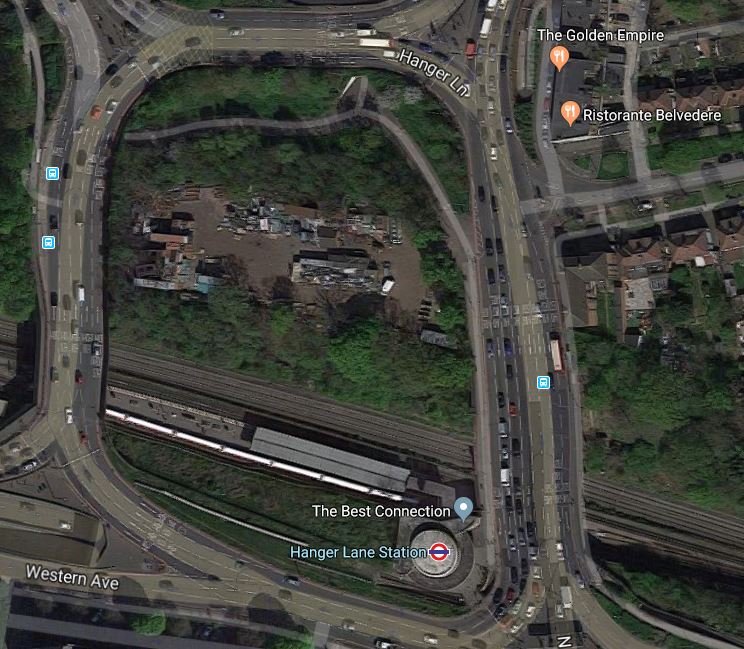
Note the following.
- The Central Line train in the Westbound platform.
- The double-track of the Acton-Northolt Line to the North of the Central Line station.
- Inside the ring of roads, there would appear to be a large site, that could be suitable for redevelopment, as perhaps offices or housing.
These pictures show the site in the middle of the roads.




Note.
- To call the site a junk-yard would be a compliment.
- Hanger Lane station is going to be made step-free.
- A tunnel for HS2 will pass underneath., following the route of the Acton-Northolt Line.
- There are HS2 notices about. Are HS2 going to use the dump for a ventilation shaft for a tunnel underneath?
It would not be the most difficult design project in the world to make provision for platforms on the Acton-Northolt Line, to future-proof the station for Crossrail or any Chiltern service to Old Oak Common.
This is the sort of development that I like!
Imagine the following.
- A cluster of perhaps four very high residential and office towers, reaching above the pollution and noise of the traffic.
- A ring of trees could also shield the development from the traffic.
- The tracks of the Acton-Northolt Line could be slewed to take advantage of an island platform.
- Trains running at least four tph to Old Oak Common.
- Crossrail could continue across Central London.
- Trains could run to West Ruislip or High Wycombe in the West.
- London Underground running up to ten tph on the Central Line.
- Developers will integrate the station, the development and the required local services.
The possibilities are dramatic.
In the next decade or so, as vehicles get less polluting, developments like this will become more common.
Perivale Station
Perivale station is Grade II Listed with some of the worst steps I’ve seen on the London Underground.



Extra platforms on the Acton-Northolt Line and a step-free station would be very difficult.
I doubt, there are many stations worse for step-free access in London!
Greenford Station
Greenford station is already step-free, but extra platforms on the Acton-Northolt Line, could be very difficult, due to the different track levels.
But Action-Northolt Line platforms with a step-free connection would give easy access to the Greenford Branch.
Northolt Station
Northolt station is being made step-free and could be extended with extra platforms on the Acton-Northolt Line.
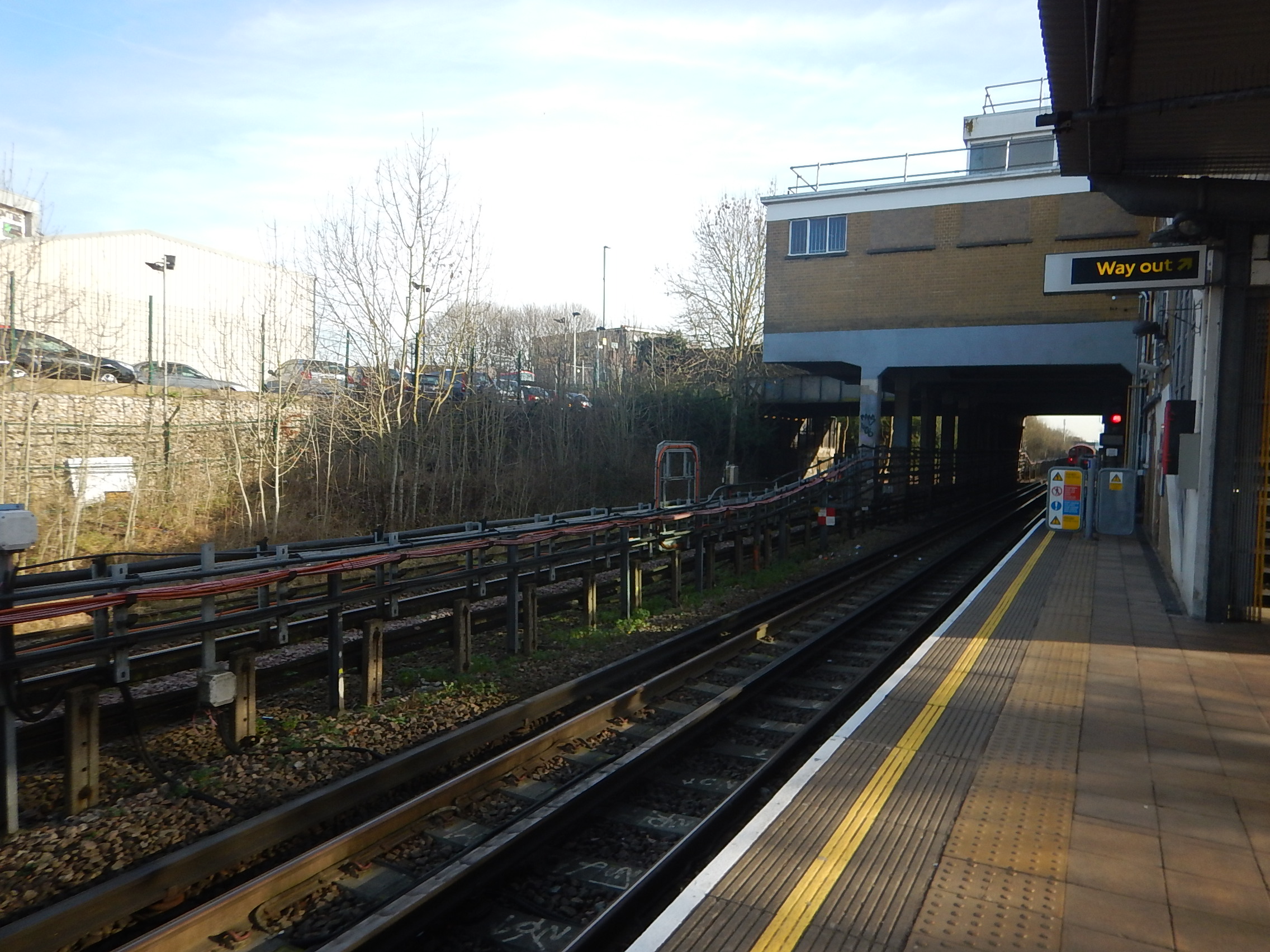
The picture was taken from the Central Line platform and shows the station building, which almost looks as if it was built to be extended to a platform on the Acton-Northolt Line, which is to the left of the electrified Central Line track.
South Ruislip Station
South Ruislip station already has platforms on both lines.
Ruislip Gardens Station
Ruislip Gardens station probably wouldn’t need a connection to the Chiltern Line.
West Ruislip Station
West Ruislip station already has platforms on both lines.
A Possible Heavy Rail Service Between Old Oak Common and West Ruislip
Consider.
- Central Line trains take seventeen minutes between North Acton and West Ruislip with six intermediate stops.
- So I think it likely that a modern train could travel from Old Oak Common to West Ruislip in about fifteen minutes, with perhaps stops at three or four stations like North Acton, Hanger Lane, Greenford, Northolt and South Ruislip.
- The Acton-Northolt Line is a mixture of single and double track. with some space for a second track.
- All stations except Old Oak Common could have step-free interchanges with the bCentral Line.
It could either be a service linked to Chiltern or Crossrail.
I can’t help feeling that eventually, this service will be part of Crossrail.
Conclusion
The railway changes that are happening will certainly allow a lot more development in West London.
Crossrail 2 Review Prompts Fresh Delays
Note that this document was written in January 2018 and I gave it a serious rewrite in November 2022, to reflect the scrapping of all further work on Crossrail 2, which I wrote about in Crossrail 2 Falls Victim To £1.8bn TfL Bailout.
This title of this post is the same as this article on Construction News.
This is the opening paragraph.
Crossrail 2 is set for further delays after London’s transport boss admitted a fresh funding review would push back consultations on the scheme until the end of 2018.
It would now look increasingly unlikely that the hybrid bill to enable Crossrail 2, will get through Parliament before the next General Election in 2022.
These dates should be noted for Crossrail.
- Approved – 2007
- Construction started – 2009
- Services started – 2015
- Partial opening – 2018 – Now delayed until 2021
- Full opening – 2019 – Now delayed until 2022
So, if Crossrail 2 is approved in 2022, we could be looking at an opening date of 2034 to 2037.
If it is needed earlier for political reasons, then we must do some serious thinking.
Crossrail 2 As A Series Of Related Projects
I’ve always believed that Crossrail 2, should be considered to be a series of related projects. followed by the boring of the Central Tunnel.
- Increasing Capacity On The Waterloo Suburban Lines to four trains per hour (tph)
- Station Improvements On The Waterloo Suburban Lines
- Increasing Capacity in Tooting And Wimbledon
- Providing better access to Clapham Junction station
- Making it easier for passengers transferring between trains and Underground at Waterloo.
- Improving public transport access to Chelsea.
- Creating better access to Euston, St. Pancras and Kings Cross stations.
- Improving transport in Dalston and Hackney.
- Four-tracking the West Anglia Main Line between Coppermill Junction and Broxbourne.
- Allowing An Increased Number Of West Anglia Services to Terminate At Stratford
- Creating a high-capacity commuter route up the Lea Valley.
- Creating a high-capacity commuter route to Wood Green and New Southgate.
- Taking Pressure Off the Victoria Line
These projects would incorporate all the holes, through which to thread the Central Tunnel, that will run between Wimbledon and Tottenham Hale.
So would it be better to build Crossrail 2 as a series of smaller projects?
Increasing Capacity On The Waterloo Suburban Lines To 4 Tph
In An Analysis Of Waterloo Suburban Services Proposed To Move To Crossrail 2, I showed that it would be possible to run a service with Crossrail 2’s characteristics terminating in Waterloo station.
I said the following would be needed.
- More platform capacity in Waterloo station.
- Modern high-performance 100 mph trains like Class 707 trains or Aventras.
- Wimbledon station would only need minor modifications.
- Some improvements to track and signalling between Waterloo and Wimbledon stations.
- A measure of ATO between Waterloo and Wimbledon stations.
Much of the infrastructure works have been completed in Summer 2017, as I reported in It’s All Over Now, Waterloo!.
All it needs to introduce a much improved Waterloo Suburban service, is for Bombardier to build the new 100 mph Class 701 trains for South Western Railway.
Note that, these improvements will be needed, whether Crossrail 2 is built or not!
Station Improvements On The Waterloo Suburban Lines
Many of the stations on the Waterloo Suburban Lines need substantial improvement.
- Some station buildings need sympathetic improvement.
- Some stations need step-free access.
- Some stations could be redeveloped to create much-needed housing on top of a new station.
- Some stations might need extra platforms and/or capacity improvements.
- There are level crossings that need to be closed.
Note.
- These improvements will be needed, whether Crossrail 2 is built or not!
- As Crossrail 2 and South Western Railway will both be using Aventra trains, improvements will be the same if Crossrail 2 is built or not!
There could be quite a large number of small projects.
Increasing Capacity In Tooting And Wimbledon
Crossrail 2 will increase the capacity at Wimbledon and Tooting Bradway stations, with up to thirty tph passing through.
Wimbledon will benefit from the following, whether or not Crossrail 2 is built.
- More trains on the Suburban Lines to Waterloo or Central London via Crossrail 2..
- Increased frequency on the District Line, where the new signalling is being installed under the Four Lines Modernisation program.
- Increased frequency and capacity on the Northern Line.
- Increased frequency and capacity on Tramlink.
- A new Tramlink route to Sutton.
- After all the work at London Bridge, would it be possible to increase the frequency of trains on the Sutton Loop Line, which currently handles a measly two tph for most of the day?
The area will probably benefit from the splitting of the Northern Line into two separate lines.
Transport for London (TfL) have talked about creating a major interchange, by increasing capacity at Streatham Common station.
Services going through the station and the major junction a short distance to the North include.
- Thameslink services on the Sutton Loop Line, between Sutton and St. Albans via Wimbledon, Elephant & Castle and St. Pancras.
- Brighton Main Line services between Victoria and East Croydon.
- The Milton Keynes to East Croydon service calls.
- London Bridge to West Croydon services.
- There is a six tph service to and from Balham station.
It has also been suggested that the station could be a terminus for London Overground’s East London Line services and a Tramlink extension.
I can certainly understand why TfL are thinking of an improved interchange at Streatham Common station.
The original plan for Crossrail 2 showed a preference for the route to go through Balham station rather than Tooting Broadway station.
Surely, if Balham is not to be on Crossrail 2, that station may well be upgraded.
- The disused platforms could be reinstated.
- Full step-free access could be added.
- A better connection between National Rail and the improved Northern Line could be created.
It could become a true Gateway To The South!
Providing Better Access To Clapham Junction Station
Provision has been made in the design of the Northern Line Extension, so that it could be extended from Battersea Power Station station to Clapham Junction station.
If the connection at Clapham Junction is designed to the high-standard of Crossrail, then the Northern Line Extension could provide an important route for commuters.
The trains on the Northern Line Extension will connect to the Morden branch at Kennington station.
The Wikipedia entry for Kennington station says this.
TfL has assessed that the Battersea extension will not have a significant impact on the number of passengers entering and exiting the station, but, to accommodate additional interchanges between the branches, additional cross-platform passageways will be constructed between each pair of plaforms. When the extension opens, all services from the Charing Cross branch will run to Battersea Power Station. Trains to and from Morden will run via the Bank branch.
So it looks like Clapham Junction station will gain a free-flowing connection to both branches of the Northern Line.
Note that, if the Northern Line Extension is extended to Clapham Junction, it will probably be built to allow easy connection to a future Crossrail 2.
Making It Easier For Passengers Transferring Between Trains And Underground At Waterloo
The on-going upgrade to Waterloo station will improve the transfer and also provide better walking routes.
In addition, the recent upgrade across the South Bank between Waterloo East and London Bridge stations, could be useful to a proportion of passengers.
But more needs to be done!
These other projects might help.
- To increase capacity on Southeastern services out of Charing Cross station, it has been proposed to rebuild the station, so it reaches across the Thames.
- Waterloo East station could be a prime site for redevelopment.
- The Bakerloo Line is going to be upgraded with new trains and more capacity.
- The Bakerloo Line will have a good connection to Crossrail at Paddington station.
- The Waterloo and City Line will be getting new trains, which could increase capacity by twenty-five percent.
- The |Waterloo and City Line could get improved access at Waterloo to match the improved access currently being created at Bank station.
Surely done in the right order, these projects could increase capacity for passengers at Waterloo, who are connecting to other parts of London.
Improving Public Transport Access To Chelsea
Kings Road, Chelsea station was cancelled in March 2017.
Perhaps, the posh people of Chelsea don’t want the plebs visiting? How will their maids and dogsbodies get to work?
Creating Better Access To Euston, St. Pancras and Kings Cross Stations
One of the main objectives for Crossrail 2, is to provide better access to the three major stations of Euston, St. Pancras and Kings Cross.
The chosen solution is to build a ‘mega-station’ called Euston St. Pancras station. The connections of the station are described like this in Wikipedia.
The station will be firmly integrated into Euston and St. Pancras mainline stations, as well as Euston Underground station. Access to King’s Cross station, and King’s Cross St Pancras Underground station will be via a short walk through St. Pancras station. There may also be a link to Euston Square station on the Underground, created as part of Euston station’s reconstruction for High Speed 2.
In order to illustrate, the lines in the area and the relationship of Euston St. Pancras station to the current stations, look at this map from carto.metro.free.fr.
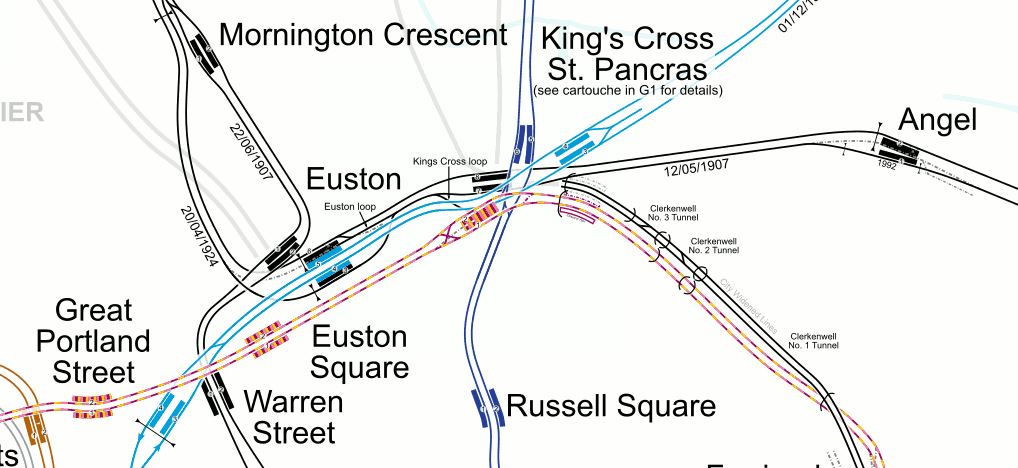
Crossrail 2 will pass through Angel station, before roughly following the line of the Northern Line through Kings Cross St. Pancras station to Euston station, where it will turn South towards the next station, which is Tottenham Court Road station, where it will have an interchange with Crossrail.
Like, its earlier sister, Crossrail 2 will have to go deep to avoid the tunnels of the Underground and London’s sewers.
However, London’s famous clay, that was instrumental to the creation of London’s deep-level Tube lines, will probably enable a successful tunnel to be created.
High Speed 2 is scheduled to open in 2026 and it appears to me, that there is no way, that given the slippage of the project, that Crossrail 2 can open before High Speed 2.
So how will the extra passengers using High Speed 2 be handled at Euston station?
The only alternative plan, that I can see is to fall back on the existing lines.
Affecting all the connections between High Speed 2 and the Underground, would hopefully be a complete rebuilding of Euston station incorporating the following.
- A connection to the sub-surface lines.
- Full step-free access to all Underground lines.
The Circle, Hammersmith & City and Metropolitan Lines, are undergoing an Upgrade Program, which is known as the Four Lines Modernisation by TfL and is described like this in Wikipedia.
Together with the introduction of S Stock trains, the track, electrical supply and signalling systems are being upgraded in a programme planned to increase peak-hour capacity on the Circle and Hammersmith & City lines by 65 per cent by the end of 2018. A single control room for the sub-surface railway is to be established in Hammersmith and an automatic train control (ATC) system will replace signalling equipment installed from the 1940s. The cross-London Crossrail line, planned to open in 2018, is expected to reduce crowding between Paddington and Whitechapel.
Note the reference to Crossrail, with its connections to the sub-surface lines at Paddington, Farringdon, Liverpool Street and Whitechapel stations. Passengers will Duck-and-Dive around the busy sections, using Crossrail and its five helper lines, that loop along it to the North and South.
- Central Line
- Circle Line
- District Line
- Hammersmith & City Line
- Jubilee Line
- Metropolitan Line
Predicting how the capacity will split between the various lines across London, will be a statistical nightmare.
But there will be a substantial increase in capacity on the sub-surface lines through Kings Cross St. Pancras and Euston.
The Northern Line could be a totally different line, when High Speed 2 opens in 2026.
- Bank station will open in 2021 with 40% more capacity.
- Camden Town station will be rebuilt by 2024/25.
- The Northern Line Extension to Battersea Power Station station is scheduled to open in 2020.
All this work, may well allow a Northern Line Split, which would bring increased train frequencies and more capacity.
The Victoria Line is probably at maximum capacity at the present time, but history has shown that she never knows when to stop calling for more!
- Capacity at Highbury & Islington, Oxford Circus and Walthamstow Central stations is probably a limiting factor.
- Access at Euston and Kings Cross St. Pancras stations could certainly be improved.
The Piccadilly Line could be a big contributor to extra capacity through the area.
Can the line be upgraded with new trains in time to make a meaningful contribution?
Lastly, we mustn’t forget the new station complex at Old Oak Common, which connects High Speed 2, Crossrail and the North London Line.
Note that, these improvements will be implemented, whether Crossrail 2 is built or not!
Improving Transport In Dalston And Hackney
As a resident of Dalston since 2010, I can honestly say, that public transport has improved a lot in recent years.
- The North London Line has two frequent five-car train services from Stratford in the East to Clapham Junction and Richmond in the West.
- The East London Line has four frequent train services from Highbury and Islington and Dalston Junction in the North to Clapham Junction, New Cross, New Cross Gate and West Croydon in the South.
- The Victoria Line has thirty-six tph between Brixton and Walthamstow Central.
- Lea Bridge station has reopened.
- Liverpool Street to Cheshunt, Chingford and Enfield are now Overground routes.
- There are numerous bus routes with new buses going hither and thither.
The icing on the cake, is that extra services and new trains will be provided in the next couple of years.
- Dalston Junction and Whitechapel for Crossrail will have at least 20 tph.
- Hackney Wick and Highbury & Islington will have at least 10 tph.
- New trains will appear on Liverpool Street to Cheshunt, Chingford and Enfield and Gospel Oak to Barking Line services.
Crossrail 2 would be an improvement for Dalstonistas and Hackneysians, as we could get to Central London faster.
But from December 2019, Crossrail with perhaps a single change will give us numerous ways to get to all the stations on the proposed line, quicker than you could do the trip in a Hackney cab, driven by the likes of Lewis Hamilton.
Hackney has survived on the crumbs of London’s transport system since the trams and trolley buses were scrapped.
Like all those with Cockney in their genes, nurture or environment, we’ll keep smiling through!
Note that, the improvement in Hackney will be implemented, whether Crossrail 2 is built or not!
Four-Tracking The West Anglia Main Line Between Coppermill Junction And Broxbourne
This needs to be done to create extra capacity on the West Anglia Main Line for the following services.
- Express services to Stansted Airport, Cambridge and possibly Norwich.
- Extra express services terminating at Stratford for Crossrail.
- Local services from Liverpool Street and Stratford to Broxbourne, Hertford East and Bishops Stortford.
- 100 mph running for Express services on the fast lines.
Four-tracking would certainly be necessary to accommodate the proposed 10-15 tph service for Crossrail 2.
Note that, this four-tracking will be needed, whether Crossrail 2 is built or not!
Allowing An Increased Number Of West Anglia Services to Terminate At Stratford
Greater Anglia have said, that they will run extra Stansted Airport services into Stratford station from 2019.
- Previously, these Stratford-Stansted Airport services used the High Meads Loop under the Eastfield Shopping Centre, in much the same way as Merseyrail’s Wirral Line trains run under Liverpool.
- Services would all call at either Platform 11 or 12 at Stratford, depending on the way the loop is travelled.
- The loop is double-track, which opens the possibility of local services using one platform and Stansted services using the other.
- If local services used Platform 12, North London Line services would be perhaps fifty metres away.
- It would be a walk of about a hundred metres to Crossrail and the Central Line and not much further to the Jubilee Line and the Docklands Light Railway.
- Using a loop is a technique that saves time, as the train goes straight on, without the driver changing ends and Merseyrail handle something like twelve tph on the Wirral Line.
- With a measure of Automatic Train Control (ATC), I suspect that a frequency of fifteen or even twenty tph could be possible through the High Meads Loop.
Could paths be found to incorporate perhaps two tph between Stratford and Chingford via a reinstated Hall Farm Curve?
It seems to me that Network Rail’s track design at Stratford station incorporated a lot of future-proofing!
Creating A High-Capacity Commuter Route up the Lea Valley
Crossrail 2 intends to implement a 10-15 tph service between Tottenham Hale and Broxbourne stations.
After the four-tracking of the West Anglia Main Line, the only other works needed to create a high-capacity commuter route up the Lea Valley will be.
- Remodelling of Coppermill Junction, so trains can access Crossrail 2’s Central Tunnel.
- Rebuilding of Tottenham Hale station to accommodate the extra services, to and from the Crossrail 2 tunnel, Liverpool Street and Stratford.
- Rebuilding stations to serve the new tracks.
The rebuilding of Tottenham Hale station is already underway.
There is the interesting possibility pf running at least a ten tph service up the Lea Valley from Stratford to Broxbourne and Hertford East.
If the High Meads Loop, were to be fully developed at Stratford, as the terminus of both Stansted Express and local Lea Valley services, using Crossrail from Stratford to cross London would probably be an acceptable alternative route until the Crossrail 2 tunnel is built.
It would have other advantages.
- Capacity would be released at Liverpool Street station.
- Capacity would be released through Clapton and Hackney Downs stations on the direct route to Liverpool Street.
- Services could be connected to Stratford International station with the addition of another platform.
- Heathrow to Stansted Airport would be a single change at Stratford with just a short walk.
The major undertaking of the Crossrail 2 central tunnel could also be delayed to smooth cash-flow.
Creating A High-Capacity Commuter Route To Wood Green And New Southgate
This section will be nearly all in tunnel and will call at the following stations.
New Southgate – For Great Northern and Thameslink
- Alexandra Palace – For Great Northern and Thameslink
- Turnpike Lane for Piccadilly Line
- Wood Green for Piccadilly Line
- Seven Sisters for Victoria Line, London Overground and Gospel Oak To Barking Line.
The area is one I know well and it probably needs improved services.
But some are already planned.
- Thameslink will add at least two tph to Alexandra Palace and New Southgate.
- New trains will add capacity and frequency to the Piccadilly Line.
- New trains will add capacity and frequency to Great Northern services into Moorgate on the Northern City Line.
- New trains will add capacity and frequency to the Gospel Oak to Barking Line.
Hopefully, enough capacity can be incorporated to serve North London.
Taking Pressure Off The Victoria Line
Dear Old Vicky can’t give much more and what really would relieve it is Crossrail 2.
The two lines connect at the following stations.
- Tottenham Hale
- Seven Sisters
- Euston St. Pancras
- Victoria
But the following will help.
- The rebuilding of Walthamstow Central, Highbury & Islington and Oxford Circus stations.
- The upgraded Piccadilly Line with connections at Finsbury Park, Kings Cross St. Pancras and Green Park
- The upgraded Northern Line with connections at Kings Cross St. Pancras, Euston, Warren Street and Stockwell.
- The cross-platform interchange with the Northern City Line at Highbury & Islington connects to Crossrail.
- The upgraded Overground routes into Liverpool Street from Cheshunt, Chingford and Enfield Town.
- A reinstated Hall Farm Curve would give Walthamstow and Chingford easier access to Crossrail at Stratford.
Other new connections and stations might take off extra pressure.
The Central Tunnel
The Central Tunnel, that will run between Wimbledon and Tottenham Hale stations, will be a major undertaking.
- It is about twice as long as Crossrail’s Central Tunnel from Stratford to Paddington.
- There will also be the branch tunnel to Wood Green.
- There will be some large and complicated stations, like Dalston and Euston St. Pancras.
- Some of the tunnelling South of the Thames could be challenging.
Remember that, boring the tunnels on Crossrail took around five years, with another two years to lay the track.
On the other hand, the following will apply on Crossrail 2.
- The contractors will have all the knowledge and experience gained on Crossrail.
- The tunnel portal sites at Tottenham Hale and Wimbledon look to have plenty of space.
- Some of the stations, will be ready to accept the tunnel boring machines.
Overall, it will be a very doable project, but I suspect it could take ten years or more.
Other Projects Will Help
In my review of the smaller projects that should be done before the Central Tunnel of Crossrail is bored, Other projects get multiple mentions.
Digital Signalling And ETCS
Crossrail, Thameslink, Crossrail 2 and several Underground Lines will all be lines that have the most modern of signalling, which will also allow a degree of Automatic Train Control.
New passenger trains will be able to take advantage of this technology, but what about lines, where freight trains also run.
Ths article on Global Railway Review is entitled The Digital Railway Begins With Landmark Siemens ETCS Contract.
This is the opening two paragraphs.
Network Rail has awarded Siemens Rail Automation the contract to supply, install and support its European Train Control System (ETCS) on freight locomotives across Great Britain.
Network Rail’s multi-million pound contract grants Siemens to supply, install and support ETCS in-cab signalling equipment on the 745-strong fleet of freight locomotives which operates across Great Britain. ETCS is expected to make Britain’s freight locomotives safer and greener whilst unlocking capacity.
The installation of ETCS will surely be invaluable on lines around London, where freight trains and passenger services mix.
- Crossrail branch to Shenfield
- Crossrail branch to Reading
- Sections of Thameslink
- North London Line
- West London Line.
- The Gospel Oak to Barking Line
Some of these lines and their passenger services are not ready for digital signalling, but the two Crossrail branches and Thameslink will probably be already equipped or will be in the near future.
Digital signalling should unlock more capacity everywhere it is installed.
The Creation Of More Transport Hubs
London has had major transport hubs, where rail lines and other transport modes connect, as long as it has had trains, trams and horse buses.
More transport hubs have been added in recent years and others will be created in the next few years.
- Brent Cross
- Dalston
- Finsbury Park
- Hackney
- New Cross/New Cross Gate
- Shenfield
- Stratford
- Streatham Common
- Tottenham Hale
- Walthamstow Central
- West Hampstead
Have all been discussed or planned and some have been started.
But these are small projects compared to the massive transport hub planned at Old Oak Common.
- It will serve the developments at Park Royal and Old Oak Common.
- High Speed 2 services will stop between Euston and Birmingham.
- ,Crossrail, Great Western,West Coast Main Line, North London Line and West London Line services will call.
- The Central Line may call.
- Plans exist for a West London Orbital Railway linking North-West and South-West London to Old Oak Common.
It would be a transport mega-hub.
Could others be developed?
Crossrail
Crossrail will inject a massive amount of East-West capacity into London’s transport system.
Some journeys that would be easy on Crossrail 2, will be possible using Crossrail and another line.
Take, where I live in Dalston.
When I moved to the area in 2010, for residents of a large area of Islington and Hackney, the only way to get to the City, Canary Wharf, the West End or major stations was to get a bus to Highbury & Islington, Liverpool Street or Moorgate stations and use the Underground.
Then along came Big Orange in the shape of the London Overground.
After Crossrail opens, for many journeys, I will hop on the Overground to Whitechapel station, from where I’ll take Crossrail to my destination.
The capacity, speed and novelty of Crossrail wil help make up for a delayed Crossrail 2.
Thameslink
Used properly by the rail companies, I believe Thameslink could create a lot more North-South capacity across London.
Some of this could help provide capacity at stations, that will be served by Crossrail 2..
Especially as, Crossrail 2 and Thameslink will share stations at Alexandra Palace, St. Pancras and Wimbledon.
The long-talked about improved stations at Peckham Rye and Loughborough Junction and a possible new one at Camberwell, would help create better connectivity across South London.
What Thameslink needs is a good connection to Clapham Junction, but this would appear to be difficult.
But don’t underestimate London’s troubled North-South Link!
For a start it should be on the Tube Map!
High Speed 2
High Speed 2 will affect Crossrail 2 in two opposite ways, when it opens in 2026.
- The planned rebuilding of Euston station for the line will incorporate better connections to the Underground and any sane rebuilding would surely bring Euston Square station into the complex.
- The new line will have a station at Old Oak Common, where there will be an interchange with Crossrail and the London Overground.
The first will increase passenger numbers at Euston, whilst the second should reduce them.
Four Lines Modernisation
Transport for London describe the Four Lines Modernisation with this paragraph.
We are transforming the Circle, District, Hammersmith & City and Metropolitan lines. When the work is completed in 2023, increased capacity and boosted reliability will make journeys faster and more comfortable.
TfL say these will be the benefits of the modernisation.
- A new fleet of air-conditioned trains, with brighter more spacious interiors, low floors and dedicated spaces for wheelchair users, CCTV and other improved features
- Space for more customers
- Faster journeys and reduced waiting times
- Fewer delays as safe but obsolete equipment – dating back to the 1920s in some places – is replaced with modern, computerised signalling and control systems
- Better live customer information on platforms and to smart devices.
Note.
- The trains have arrived and no-one seems to have complained.
- TfL’s documents claim the new signalling can handle up to thirty tph.
- The new trains and signalling could do for the four sub-surface lines, what they did for the Victoria Line and increase frequencies by a substantial amount.
- It is highly likely that the rebuilt Euston station will have easy access to Euston Square station.
- Paddington, Euston, Kings Cross St. Pancras and Liverpool Street will see a high-frequency service across the capital, that connects at both ends to Crossrail.
- Crossrail will be faster between Whitechapel and Paddington.
The benefits of the Four Lines Modernisation and the rebuilding of Euston station would effectively create two new high capacity lines across Central London, with up to thirty tph carrying around nine hundred people each.
- A loop North of Crossrail, between Whitechapel and Paddington, serving Euston, St. Pancras, Kings Cross and Liverpool Street
- A loop South of Crossrail, between Whitechapel and Paddington, serving Victoria, Charing Cross, Blackfriars, Cannon Street and Fenchurch Street.
The Four Lines Modernisation will give Crossrail a very serious competitor, that was originally opened by the Victorians in the 1860s.
- Crossrail can handle 24 tph , which each contain 1500 passengers. 36,000 passengers per hour
- The North and South loops of the sub-surface lines could be able to handle 30 tph, which each contain 900 passengers. 27,000 passengers per hour
- Crossrail 2’s Central Tunnel is being designed to handle 30 tph, which might each contain 1500 passengers. 45,000 passengers per hour
These are truly massive numbers.
But perhaps more importantly, the Four Lines Modernisation should be able to go a long way to solving the problems of handling the large numbers of extra passengers using Euston for High Speed 2, when the first phase opens in 2026.
With all this extra capacity through Euston and Kings Cross coming on stream around 2023, I think that sensible planning would say that the Central Tunnel of Crossrail 2 through the area can be delayed by several years.
Upgrading The Piccadilly Line
I used the Piccadilly Line between Oakwood and Southgate stations between 1958 and 1965 to get to school. The current 1973 Stock trains on the line date from 1974 or only nine years after I left.
Wikipedia says this about new trains for the Piccadilly Line.
London Underground has invited Alstom, Bombardier and Siemens to develop a new concept of lightweight, low-energy, semi-articulated train for the deep-level lines, provisionally called “Evo” (for ‘evolution’). So far only Siemens has publicised an outline design, which would feature air-conditioning and would also have battery power enabling the train to run on to the next station if third and fourth rail power were lost. It would have a lower floor and 11% higher passenger capacity than the present tube stock. There would be a weight saving of 30 tonnes, and the trains would be 17% more energy-efficient with air-conditioning included, or 30% more energy-efficient without it.
Given the new trains seen in recent years, coupled with new signalling, I believe that there could be an increase in frequency from the current twenty-four tph to a Victoria Line frequency of over thirty tph.
- Current capacity of the line is 24 tph, each of which can carry 684 passengers. This is 16416 passengers per hour.
- Future capacity of the line could be 33 tph, each of which can carry 760 passengers. This is 25080 passengers per hour.
Like the Victoria Line, I think the capacity of the Piccadilly Line will be more limited by platform and station design, than the trains and the signalling.
But that won’t stop the Piccadilly Line from helping to hold the fort until the Central tunnel for Crossrail 2 is built.
London Underground’s New Deep Level Trains
After the Piccadilly Line trains have been delivered, it s highly likely that more trains will be built for the following lines.
- Forty for the Bakerloo Line giving a 25% capacity increase.
- Hundred for the Central Line giving a 25% capacity increase.
- Ten for the Waterloo and City Line giving a 25% capacity increase.
These figures come from an article entitled Deep Tube Upgrade in the November 2017 Edition of Modern Railways.
Bakerloo Line Upgrade And Extension To Lewisham
It could be argued that South East London needs extra capacity just as much as South West London.
The Deep Tube Upgrade article in Modern Railways says that this about an extended Bakerloo Line.
The 1972 stock trains are now the oldest on the system and are set to reach nearly 60 years in service before they are replaced. The Bskerloo fleet also is undergoing refurbishment, wgich is both addressing structural issues and improving the passenger environment.
Associated with this is the plan to extend the Bakerloo Line beyond Elephant & Castle to Lewisham via the Old Kent Road. Transport for London is undertaking a series of consultations into this plan, which have exhibited consistent support for the proposals, and the aim is for the extension to open around 2030, concurrent with the line’s modernisation.
Current Bakerloo Line stations, where work could happen or already has happened include.
- Elephant & Castle will be upgraded.
- Lambeth North has recently had a facelift.
- Waterloo is being updated to give better connection to National Rail services.
- Oxford Circus is going to be upgraded to add more capacity to the Victoria Line platforms.
- Baker Street has been planned to have step-free access, but due to budgetary restraints, this has not happened.
- Paddington is being updated to provide direct access to |Crossrail.
- Queen’s Park is planned to become step-free in 2019.
Most of the stations need improvement and a large proportion need step-free access.
Oxford Circus Station
Oxford Circus station was rebuilt in the 1960s for the Victoria Line.
- That rebuild was sized to handle around twenty tph on the Bakerloo, Central and Victoria Lines.
- The Central and Victoria Lines are now handling well over thirty tph.
- The Bakerloo and Central Line will be getting new Deep Level trains, which will further increase passengers.
- I would never bet against engineers squeezing another four tph out of Dear Old Vicky to run a forty tph frequency.
Oxford Circus station won’t be able to take the extra passengers and it will need a rebuild.
Judging by the solutions at Bank, Bond Street, Camden Town, Holborn, Kings Cross St. Pancras and Knightsbridge, I suspect it could take the form of a new entrance, which connected to the ends of platforms.
This map from carto.metro.free.fr shows the lines through the station.
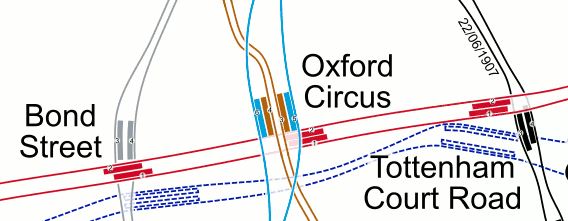
The lines are as follows.
- Red – Central
- Silver – Jubilee
- Brown – Bakerloo
- Turquoise – Victoria
- Purple – Crossrail
Consider.
- The Central Line runs at a not very deep level under Oxford Street.
- Oxford Street is going to be pedestrianised.
- The cross-platform interchange between the Bakerloo and Victoria Lines.
Could a simple new entrance be built at the Eastern end of the Central Line platforms?
These pictures were taken between Marks & Spencer at the Pantheon and Oxford Circus station.


I could imagine an island entrance to the |Central Line in the middle of a fully pedestrianised Oxford Street.
- Escalators could lead to a spacious mezzanine floor, a few metres under Oxford Street.
- The mezzanine could contain ticket machines and perhaps kiosks and even toilets.
- From the mezzanine a gate-line would control access to escalators leading to the Eastern end of the Central Line platforms.
- Lifts could be added as required.
On the surface the entrance could be covered with a fosterito or some other similar structure.
I believe that the opening of Crossrail and the pedestrianisation of Oxford Street could allow this entrance to be constructed without stopping the Central Line trains running through Oxford Circus station, although passengers would not be able or allowed to use the Central Line at the station.
It wouldn’t be a first for the UK.
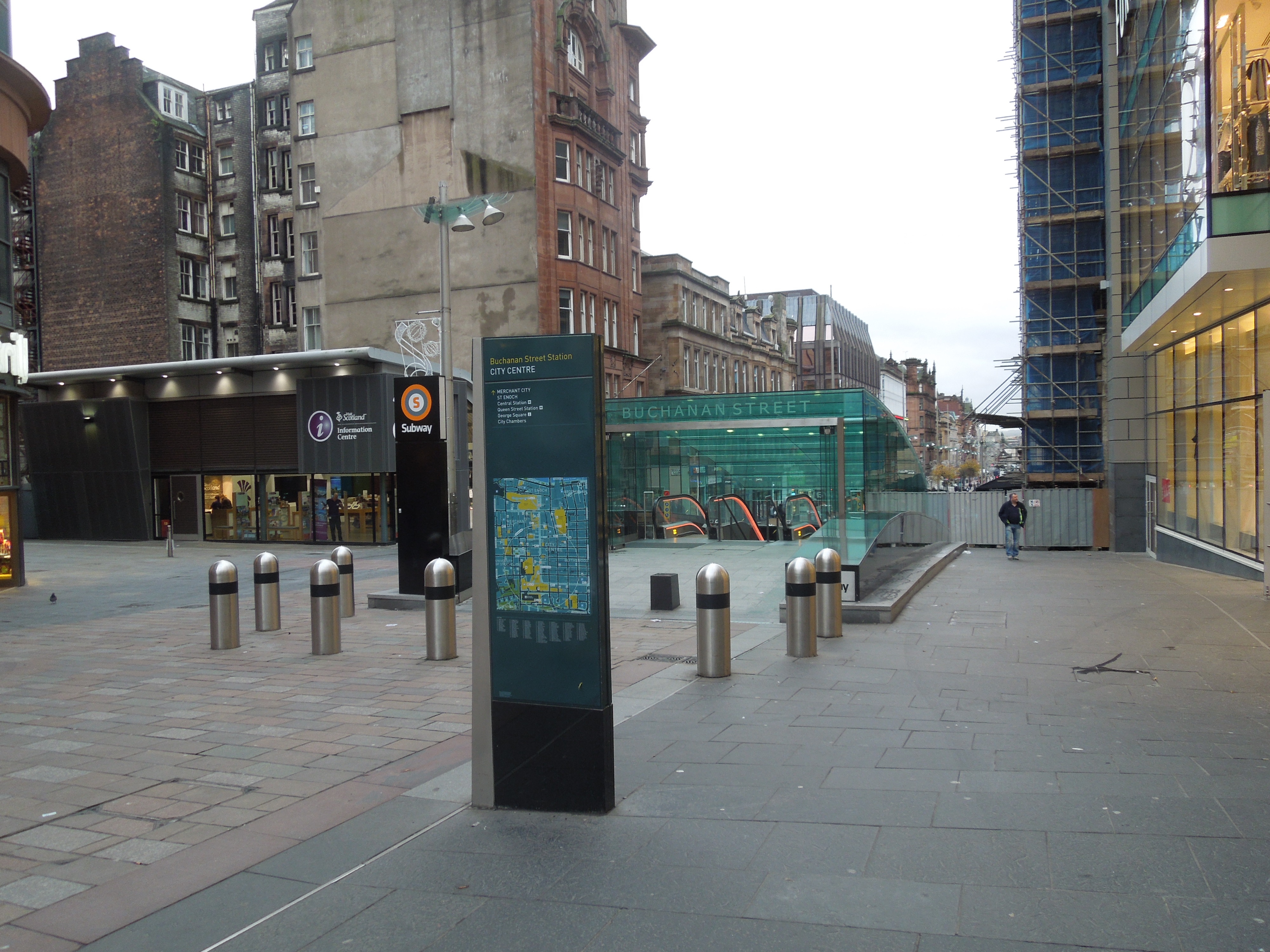
The picture shows Buchanan Street station on the Glasgow subway. Wikipedia says this about the canopies.
Other than St Enoch it is the only station with an underground ticket hall, and surface buildings are restricted to new mid-street entrance canopy which was rebuilt in 1999 as part of the repaving of Buchanan Street. This canopy is constructed entirely of structural glass: all beams and columns, the walls and roof are glass.
Note that Buchanan Street could be considered to be Glasgow’s Oxford Street.
Oxford Circus station could be redeveloped into an even more important interchange.
Many have said, that it needs a good connection to Crossrail.
Consider.
- Crossrail’s platforms at Bond Street station are long and stretch to Hanover Square, where there is an entrance to the station.
- The Hanover Square entrance to Bond Street station is approximately half-way between the Oxford Street entrances of Bond Street and Oxford Circus stations.
- The Crossrail platforms are deeper than the other lines. One picture shows them twenty-six metes below ground level.
I can’t see why, if it was decided to connect the two stations, that a pedestrian tunnel connection couldn’t be squeezed in.
This visualisation from Crossrail shows the Hanover Square entrance to Bond Street station.
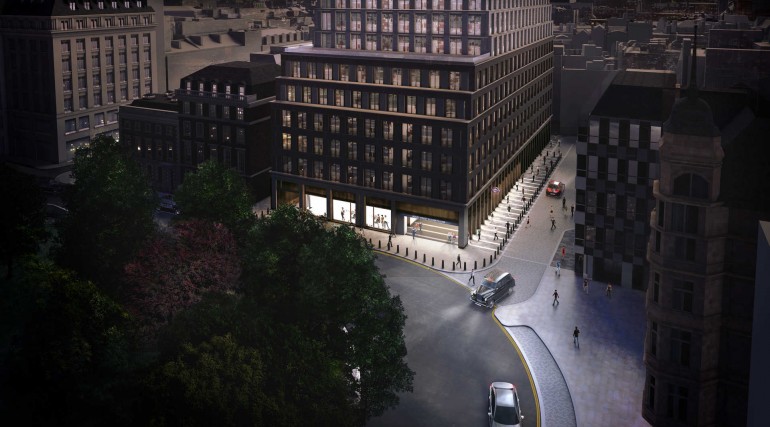
It looks to me that the design expects transferring passengers will walk on the surface.
Consider.
Let’s hope that Hanover Square gets fully pedestrianised and traffic-free.
A tunnel would have a great advantage over a surface route in that it would only be used by people transferring between the two stations.
Perhaps an entrance to the rebuilt Oxford Circus station, should be in the North-Eastern corner of Hanover Square.
Or could there be a fosterito or a new entrance in a traffic-free Princes Street?
These pictures show Princes Street.



There are possibilities, which all depend on whether it is possible to dig a pedestrian tunnel from Oxford Circus.
There are more difficult stations, where the building of other entrances will be much more difficult.
An Improved Central Line
Crossrail and the Central Line have connections at Stratford, ,Liverpool Street, Tottenham Court Road, Bond Street and Ealing Broadway stations.
These connections will make it easier for stations and parts of the Central Line to be closed for major works, as passengers have a ready alternative.
I believe that this could cut time and costs when updating the line for the new Deep Level Trains and improving stations.
As the new trains will bring a twenty-five percent increase in capacity, it will all help take pressure from other lines.
An Improved Waterloo & City Line
New trains and perhaps an improved station at Waterloo will improve this route.
But the big improvement will happen early this year, when the new entrance at Bank station opens.
Underground And Overground Station Upgrades
This page on the TfL website gives details of station improvement. The page starts with this.
We’re modernising some of our busiest stations to increase capacity, make journeys faster and add step-free access. We’re also integrating them with other modes of transport, like buses, National Rail and cycling.
At present plans are underway or are being developed for the following key stations, which will be on or near the route of Crossrail 2.
- Alexandra Palace
- Bank and Monument
- Camden Town
- Elephant & Castle
- Finsbury Park
- Hackney Central
- Holborn
- Knightsbridge
- Oxford Circus
- Palmers Green
- Peckham Rye
- Seven Sisters
- Tottenham Hale
- Victoria
- Walthamstow Central
- Waterloo
- White Hart Lane
Others will probably join this list.
Splitting The Northern Line
Once the improvements at Camden Town and Bank stations have been completed and the Northern Line Extension to Battersea has been completed, TfL have ambitions to split the Northern Line.
- A Charing Cross Line would run from between Edgware and Battersea Power Station via Charing Cross
- A Bank Branch would run between High Barnet and Morden via Bank.
The two lines would have interchanges at Camden Town, Euston and Kennington.
Wikipedia has a section on the splitting of the Northern Line, which says this.
Running trains between all combinations of branches and the two central sections, as at present, means only 30 trains an hour can run through each of the central sections at peak times, because merging trains have to wait for each other at the junctions at Camden Town and Kennington. Completely segregating the routes could allow 36 trains an hour on all parts of the line.
Plans also exist for the following.
- Further extension of the from Battersea Power station to Clapham Junction station.
- New high-capacity modern trains, similar to those being specified for the Piccadilly Line.
I estimate, that the high-capacity trains for the Piccadilly Line will be able to carry 720 passengers in air-conditioned comfort. Currently, the 1995 Stock trains on the line can accommodate 662 passengers.
This gives the following current and future capacities of the two lines.
- Current capacity of the line is 30 tph, each of which can carry 662 passengers. This is 19860 passengers per hour.
- Future capacity of the line is 36 tph, each of which can carry 720 passengers. This is 25920 passengers per hour.
This gives around a thirty percent increase in capacity.
As with the Four Lines Modernisation, the application of high quality engineering from the Twenty-First Century to Victorian and Edwardian tracks and tunnels can give a surprisingly-high increase in capacity.
London Overground’s New Class 710 Trains
London Overground serves North and East London and will have interchanges with Crossrail 2 at Cheshunt, Dalston, Euston and Seven Sisters stations.
Their Lea Valley services to Cheshunt, Chingford andEnfield Town are getting new Class 710 trains.
Information on these new trains is scant, but I suspect that their performance would be superior to the current Class 315 and Class 317 trains, which have maximum speeds of 75 and 100 mph respectively.
Most Aventras seem to be 100 mph trains, with the exception of Crossrail’s Class 345 trains, which are 90 mph trains.
Your guess is as good ass mine, as to what the operating speed of the Class 710 trains will be. Unless of course, you have a data sheet!
Because of their modern design, I think we can assume that the new trains will also save a minute or two at each stop, when compared to the existing trains.
They will also have a larger passenger capacity, which I estimate at somewhere near 700 for a four-car train.
The East London Line
Never underestimate the contribution, that London’s newest cross-River line can make.
The East London Line (ELL) shows what you can do, when you take an old well-built tunnel and apply the following.
- New trains.
- Well-designed stations.
- Modern signalling.
- A passenger-friendly timetable.
I always wonder what Marc and Isambard Brunel, would think of the way the Thames Tunnel has morphed into a sixteen tph electric railway from their tunnel for foot passengers and horse-drawn vehicles.
But Transport for London haven’t finished their development of the East London Line.
Projects in the pipeline include.
- The ELL will connect to Crossrail at Whitechapel in December 2018.
- The trains have been ordered for two extra tph to both Crystal Palace and Clapham Junction stations.
- An interchange at Brockley station with the line between Nunhead and Lewisham stations.
- An interchange at Penge with the Chatham Main Line.
- An interchange at Loughborough Junction station with Thameslink.
- A full step-free interchange could be built at Brixton.
- Peckham Rye station could be an important interchange.
- Increasing the maximum frequency along the line to 24 tph.
- A possible new destination at a rebuilt Streatham Common station.
- New Cross and New Cross Gate stations could be rebuilt to interchange with the Bakerloo Line Extension.
Because of the planned mega-station at Dalston on Crossrail 2, the East London Line will play an important role as a feeder line for Crossrail 2.
Just as the Waterloo Suburban and the West Anglia Main Lines, will serve South-West and North-East London respectively, development of the ELL could bring benefits to some very neglected parts of South East and South London.
I believe that updating the stations could be the key.
- Brockley will have ten tph on the ELL and two tph between Victoria and Lewisham.
- Lounghborough Junction will have six tph on the ELL and eight tph on Thameslink.
- Peckham Rye station will have six typh on the ELL, two tph on Thameslink , 4 tph to London Bridge and several other services.
- Penge station will have ten tph on the ELL and four tph between Victoria and Orpington.
The density of services across South London would be seriously increased.
The North London Line
The North London Line may not have the same number of destinations as the East London Line, as it only offers two services.
- Four tph run between Stratford and Richmond
- Four tph run between Stratford and Clapham Junction
Both services run seven days a week.
As with the East London Line, Transport for London have plans for the North London Line.
In Musical Trains On The Overground, I quote from an article on London Reconnections, which says that Transport for London would like to increase the frequency of these two services to six tph, which would give twelve tph between Willesden Junction and Stratford.
But that is not all!
- Two new stations at Hythe Road and Old Oak Common Lane will be built to serve the new developments at Park Royal and Old Oak Common.
- These new stations will also interchange with Crossrail, High Speed 2, West Coast Main Line, Great Western and Chiltern services.
- West Hampstead station is being rebuilt.
- Highbury & Islington station will probably be rebuilt to improve interchange between the London Overground, Victoria Line and the Northern City Line.
- Transport for London have suggested that Camden Road station could have a quality step-free interchange with the Northern Line at Camden Town station.
- ETCS will probably be applied to the North London Line, to increase the capacity of freight and passenger services.
The North London Line would also benefit, if improved West Anglia Main Line services ran to Stratford, as the simple step-free interchange is ready and waiting.
The West London Line
The West London Line is London’s most underutilised rail route.
Consider.
- If its cousin in the East can handle twenty tph, surely a redesigned West London Line could operate at least sixteen tph.
- It connects to the new super-hub station of Old Oak Common in the North for HS2, West Coast Main Line and Crossrail.
- It connects to the Victorian super-hub station of Clapham Junction in the South.
- The London Overground already connects North-East London to South-West London using the West London Line, with a frequency of four tph.
- Southern’s Milton Keynes to East Croydon service needs a higher frequency and could be another valuable North-South route across London.
Transport for London should take control of this line and give it the service that West London needs.
- An increase to six tph for the Stratford to Clapham Junction service is already planned.
- TfL should take over the Milton Keynes to East Croydon service as recommended by Chris Gibb.
- A new station is being built at Hythe Road.
I also feel that a new station should have been built to serve the new housing development at Earl’s Court.
The Gospel Oak To Barking Line
The Gospel Oak To Barking Line is the joker in the pack.
- It is currently going through a shambolic electrification.
- New four-car electric Class 710 trains are rumoured to be arriving in Spring 2018, which will double capacity.
- It will provide a second electrified freight route across North London.
- The line is being extended to a new station at Barking Riverside.
- ETCS will probably be applied to the Gospel Oak to Barking Line, to increase the capacity of freight and passenger services.
The current frequency of four tph will probably be retained for some time with the new trains.
Currently, it appears that the Class 172 trains take ninety minutes to do the round trip along the line, with ten intermediate stops. This means that six trains are needed for a four tph service.
If the new trains can do the round trip in an hour, because of their better performance, this would reduce the number of trains required to four for a four tph service.
Whether two trains less are needed will depend on the performance of the trains, which has not been disclosed.
But I do feel that the line will suffer a severe case of London Overground Syndrome and actual passenger traffic will exceed forecasts by a large margin.
Without the freight trains on the line, I suspect that with enough trains, the frequency on this line could be increased to six tph.
But I wouldn’t rule it out happening some time in the future, when the following has been done.
- The Barking Riverside Extension has been completed.
- The xtra trains for Barking Riverside have been delivered.
- All trains using the line work under ETCS.
I think it should be noted that after completion of the Barking Riverside Extension, Platform 1 at Barking station will probably be available for turning trains, at times of service disruption.
From what I’ve seen of station works on the Gospel Oak to Barking Line, it might already be possible to add one or two coaches to the trains, if they are needed.
So there could be scope to massively increase the capacity of the line.
An Improved Chingford Branch Line
The London Overground service on the Chingford Branch Line has a frequency of four tph between Liverpool Street and Chingford, with trains taking twenty-seven minutes for the trip with seven stops.
Improvements proposed for the line include.
- An increased frequency of trains.
- Better connection between Chingford/Walthamstow and Stratford, via a reinstated Hall Farm Curve.
- New stations at Forest Road and Chingford Hatch.
The problem is the restriction caused by the level crossing at Highams Park station, which probably limits the line to its current frequency.
However, the higher performance Class 710 trains, digital signalling and some innovative timetabling could see an improved service that satisfies all stakeholders.
An Improved Service To Enfield Town
Enfield Town station has a service to Liverpool Street with the following characteristics.
- A two tph service in the Off Peak
- , A four tph service in the Peak
- Trains take thirty-four minuses with twelve or thirteen intermediate stops.
- Some intermediate stations are step-free like Edmonton Green, but others need a lot of improvement.
There is also the massive new development of Tottenham Hotspur’s new stadium at White Hart Lane station, which will be built fully-step-free.
It looks like London Overground have prepared for the stadium development, in that two extra tph are planned for the route from 2019 along with new Class 710 trains.
The question also has to be asked if, the new |Class 710 trains can do the trip fast enough to bring the round trip time to under an hour.
If they can, it appears, that the same number of trains will be able to add two tph to the timetable.
An Improved Service To Cheshunt
Cheshunt station has a service to Liverpool Street withe the following characteristics.
- A two tph London Overground service in the Off Peak taking astound 39 minutes with fifteen stops.
- A four tph Greater Anglia service in the Off Peak taking astound 23-29 minutes with 1-5 stops.
It looks to me, that the higher performance of the new trains will improve the service to Cheshunt.
White Hart Lane
White Hart Lane station is being rebuilt with full step-free access to cope with sixty-thousand crowds at Tottenham Hotspur’s new stadium.
The Off Peak London Overground services will be at least as follows, after 2019.
- Four tph to Enfield Town
- Two tph to Cheshunt
- Six tph to Liverpool Street
- There will also be extra trains on match-days.
Wikipedia says this about Tottenham Hotspur matches.
On days that see football matches at Tottenham Hotspur’s ground nearby the station sees increased usage. A special timetable operates on match days, with trains arriving and departing every few minutes before and after the game. There is an increase in the number of trains to and from the line’s termini at Cheshunt and Enfield Town, as well as starting and terminating White Hart Lane trains and services to and from Edmonton Green and Liverpool Street. Abellio Greater Anglia occasionally serve the station on match days only, similarly to Northumberland Park Station.
Historically, additional match-day services also connected to the Gospel Oak to Barking Line and to Stratford from Cheshunt.
The historical route from Stratford to Cheshunt via White Hart Lane is still intact and it’s fully electrified.
Dalston Interchange
Crossrail 2 envisages a mega-station at Dalston.
- It will connect to the current two stations of Dalston Junction and Dalston Kingsland.
- It will make it easier for passengers to connect between the North and East London Lines.
- The connection to the East London Line will connect Crossrail 2 to a large number of stations in East and South-East London.
- The connection to the North London Line will connect Crossrail 2 to a large number of stations in North London.
- The station could become a major bus interchange.
A mega-station will surely help in the development of much needed housing in the area.
The current lack of direct connectivity between the North and East London Lines at Dalston is a big weakness. Walking between the two stations is an obstacle course on crowded narrow pavements, alongside the busy Kingsland High Street.
The problems are worse, as Dalston Kingsland station, is a busy station without step-free access.
The Crossrail 2 mega-station at Dalston will hopefully solve this connectivity problem, as there could be a step-free tunnel underneath Kingsland High Street.
But Dalston needs a solution now!
A chance was lost, with three new developments along Kingsland High Street between the two stations, which were built without improving the quality of pedestrian routes.
This Google Map shows the two stations.
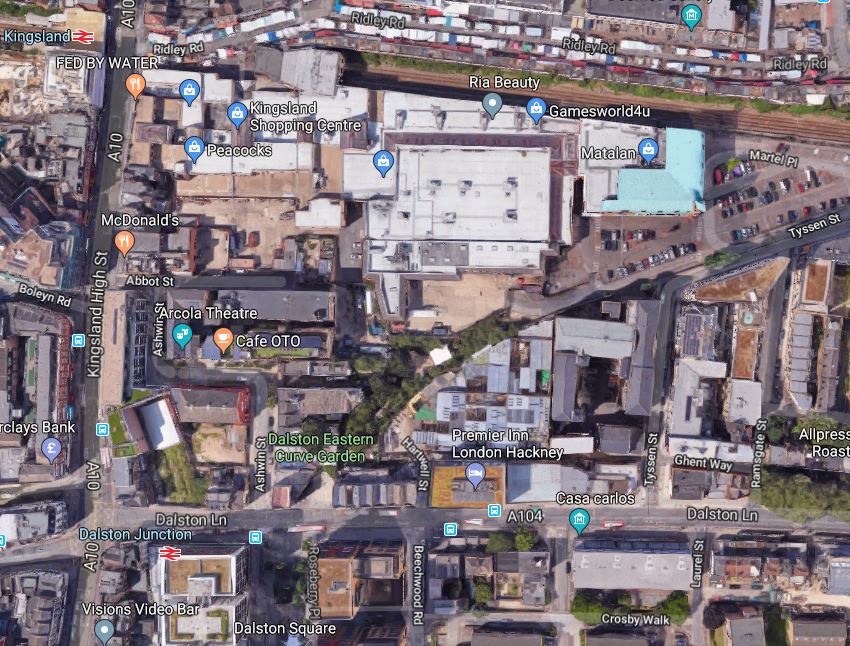
Note the Kingsland Shopping Centre, which is single storey with a lot of surface-level parking.
The owners have submitted plans for redevelopment, but nothing seems to have happened.
I’m sure, that an imaginative developer could create something worthwhile.
- Some quality shops for Dalston’s residents.
- New land could be created over the top of the North London Line.
- More efficient parking.
- Some green space.
- Housing on top of the shopping centre.
- A pleasant walking route with perhaps cafes and small shops between the two stations.
There could be a new step-free entrance to Dalston Kingsland station on the East side of Kingsland High Street, to serve the Shopping Centre and Ridley Road Market.
It seems to me that a good plan for Dalston could be developed, that would work with or without the building of Crossrail 2.
There is a precedent for building on the surface first, in that Moor House was built on the site of the future Crossrail station and incorporated the ventilation shaft for the railway line.
Perhaps, Foster and Partners should do their best for Dalston!
Hackney Interchange
Hackney Central and Hackney Downs stations are now linked by a walkway and will increasingly become an important interchange between the North London and Lea Valley Lines.
Proposals are being developed to improve both stations.
The combined station might even get another Eastern branch of Crossrail 2.
STAR
STAR is a new service being added to the rail network in East London.
- STAR stands for Stratford-Tottenham-Angel Road.
- Meridian Water is a new station that will serve a massive £3.5 billion development and replace Angel Road station.
- A third track is being added between Lea Bridge and Meridian Water stations.
- The service will have a frequency of at least four tph.
This page on the Network Rail web site, which is entitled Lee Valley Rail Programme, gives more details.
- 5,500 metres of new track will be installed.
- ,This would appear to be about the distance of a single track from Meridian Water to just short of Lea Bridge station.
- Tottenham Hale station is being made Crossrail 2-ready and developed into a major step-free transport hub, linking West Anglia Main Line, Victoria Line and numerous bus routes.
- Northumberland Park station is being replaced with a new step-free station.
- The new track and the extra platforms at Tottenham Hale and Northumberland Park could be bidirectional.
The engineering seems to be progressing, but I have questions about the passenger service.
I think the extra track could be used in one in three ways.
- The new line would be used by all trains going South from the West Anglia Main Line to Stratford.
- Trains between Stratford and North of Meridian Water, that needed to call at all stations, would use the line as a loop.
- A dedicated service would run between Stratford and Meridian Water.
Currently trains between Angel Road and Lea Bridge take twelve minutes. If four tph were to run between Lea Bridge and Meridian Water in both directions, that would take eighty-four minutes.
I suspect even with Greater Anglia’s new Class 720 trains, that are modern 100 mph trains designed for fast stops at stations, that running four tph in both directions along the new third track is difficult, if not impossible.
So it would appear that using the third track for Southbound services to Stratford is the only viable option.
- Greater Anglia also want to run direct services between Stratford and Stansted, which would perhaps add two tph to the route.
- The track layout would be very simple with no flat junctions.
- At Meridian Water, Northumberland Park and Tottenham Hale, island platforms would mean passenger-friendly separate platform faces for Liverpool Street and Stratford services.
- Northbound services from Liverpool Street and Stratford would merge between Coppermill Junction and Tottenham Hale.
Note.
- Digital signalling could be needed, to ensure safe and efficient operation of the trains.
- If the third tack was designed for fast running, there could be time savings on Stansted Express running to and from Stratford for Crossrail and all the other connections.
- The third track could probable handle at least ten tph
At the Stratford end, four tph could be accommodated in Platform 11 as the two tph West Anglia service are ow!
But the extra trains for Stansted Express would probably need another method.
Could we see all services using the High Meads Loop and calling in Platform 12?
- Stansted Expresses used to do this, some years ago.
- Loops like this have a capacity of upwards of ten tph.
- Platform 12 at Stratford is not used at present.
- Crossing of other tracks on flat junctions in the Stratford area could be minimised.
- Time would be saved on turning trains, as the driver would not have to change ends.
- Platform 11 at Stratford could still be used as a bay platform for trains from the West Anglia Main Line.
There are a lot of possibilities, but the following will happen.
- There will be at least a four tph stopping service between Stratford and Meridian Water.
- This stopping service could continue to Hertford East or Bishops Stortford, as the current Stratford services do now!
- Stansted Expresses will run to Stratford.
- There will be excellent stations at Meridian Water, Northumberland Park and Tottenham Hale.
- Further capacity will be created.
It could also be the first instalment of a clever plan to four-track the West Anglia Main Line, as far as Broxbourne.
I could envisage the extra tracks being squeezed in a section at a time, whilst the current services continue on the West Anglia Main Line.
The Northern City Line
The Northern City Line is North London’s forgotten commuter railway, that runs from Moorgate to North London and into Hertfordshire.
- The Class 313 trains are some of the oldest scrapyard specials on the UK network.
- Most stations need refurbishment and the addition of step-free access.
- Many of the stations need a good cleaning and a lick of paint.
- Some of the operating procedures haven’t changed since the Victorian era.
- Six tph work in the Off-Peak, with up to fifteen tph in the Peak.
- Weekend service is patchy.
- The line has cross-platform interchange with the Victoria Line at Highbury and Islington station.
The good news is coming thick and fast for this line.
- Crossrail will have a step-free connection to the Northern City Line at Moorgate station in December 2018.
- Highbury and Islington station is planned to be redeveloped with a second entrance and step-free access.
- Finsbury Park station is being redeveloped with more capacity and step-free access.
- Alexandra Palace station will get step-free access.
- Extra track capacity has been installed between Finsbury Park and Alexandra Palace.
- Work will be done to improve Gordon Hill and Stevenage stations.
The big change will be the new Class 717 trains, which could increase train frequency to twelve tph.
When the stations have been updated and the new trains are running, this line will become a much more valuable part of London’s rail infrastructure.
- It connects to Crossrail at the Southern end.
- It connects to Thameslink and the East Coast Main Line at the Northern end.
- It connects to the Victoria and North London Lines at Highbury and Islington station.
- The new trains will offer increased capacity, comfort and frequency and reduced journey times.
- In the future it will connect with Crossrail 2 at New Southgate, Alexandra Park and Moorgate
Before Crossrail 2 is opened, the Northern City Line can be developed into a very valuable alternative route in East London.
The Docklands Light Railway Extensions To Euston, St. Pancras and Victoria
If there’s a capacity problem anywhere to the East of Bank station, you can always expect Cinderella to keep people moving. If they gave medals for transport at Olympic Games, then the 2012 Gold would have gone to the Docklands Light Railway.
Despite being built down to a cost, it seems to have been designed to a quality, that
- Provides a reliable service in Docklands and to and from Canary Wharf
- Inspires affection in its passengers.
- Encourages residents and visitors to use the system.
- Allows easy extension of the system.
Now that the line will be getting new trains, which will probably offer.
- Increased capacity.
- More comfort.
- Better passenger facilities.
- Increased frequencies.
Perhaps it is time to give travellers between Bank station and the East, a new route to Central London.
This map shows the proposed extension of the Docklands Light Railway to the West.
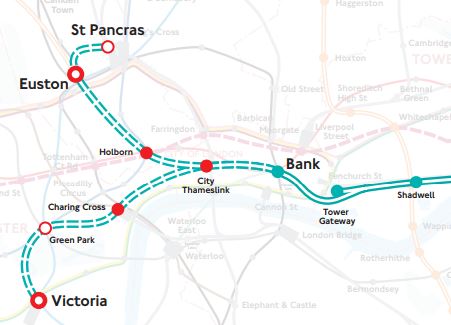
Note that this is a well-connected extension.
- Charing Cross, Euston, St. Pancras and Victoria are major rail interchanges.
- There are several interchanges with the Northern, Piccadilly and Victoria Lines.
- Euston, St. Pancras and Victoria will be on Crossrail 2.
- City Thameslink and St. Pancras are interchanges with Thameslink.
In addition, Bank, Charing Cross, Euston and Holborn are or will be upgraded.
The only thing missing is an easy interchange with Crossrail to the West of Bank.
Conclusion
I’m certain that someone must have added up the capacity, that all of the smaller projects will bring across London.
I haven’t but some of the current in-progress projects in the pipeline will add a lot of capacity to the South-West to North-East corridor across London.
- The new trains and signalling for the Piccadilly Line.
- The new Class 710 trains for the London Overground in North-East London.
- Extra capacity across North London on the North London and Gospel Oak to Barking Lines.
- Extra capacity between North and South London on Thameslink, the East London Line and a split Northern Line.
- Extra capacity between East and West London on Crossrail and the Circle, District and Metropolitan Lines.
- Develop the West London Line to its full potential.
- The capacity upgrade at Waterloo station.
- Four-tracking of the West Anglia Main Line has started with the addition of a third track for STAR.
Could everything in London be organised, so that the only thing needed to complete Crossrail 2, is to build the Central Tunnel?
I believe this could be so!
So perhaps in 2035 or even later, the Central Tunnel would be built to link everything together.


