Did Plans For Crossrail Ever Include A Station At Holborn?
I have only one North-South bus route, where I live.
The 141 bus connects Palmers Green and London Bridge station.
- The 141 bus was the replacement for the 641 trolley bus, which was the main link between Wood Green, Turnpike Lane and Harringay, and the City of London, when I was a child.
- The vehicles are up to ten years old Wrightbus diesel hybrids.
- The route suffers badly from overcrowding as it connects, Bank and Moorgate stations in the City of London, with the outer reaches of the Piccadilly Line.
The overcrowding on the 141 bus route has got worse in the last couple of years because of the following.
- The rebuilding of London Bridge station brought more passengers to the 141 bus route.
- The opening of the new London Bridge bus station at London Bridge station has improved access to the buses at London Bridge station.
- The improvement of the connection of the buses to the Docklands Light Railway, Central Line and Northern Line at Bank station.
- The opening of the Battersea branch of the Northern Line, which brings more passengers to Bank station.
- The opening of the new Cannon Street entrance to Bank Underground station.
- The opening of the Elizabeth Line through Moorgate station.
- Recently, a new walking route between Moorgate and Liverpool Street was opened, which will bring more passengers to the buses on Moorgate.
- The rebuilding of Old Street station brought more passengers to the 141 bus route.
So what was the response of the Mayor and Transport for London, to all this increase of passenger numbers?
The 21 bus, which shadowed the 141 route, and doubled the number of buses through where I live, was moved to serve Holloway.
It was a big crime against mathematics and the wishes of our long-serving Labour MP; Meg Hillier.
So to handle many more passengers between London Bridge station and Newington Green through the City of London, the number of buses was halved.
I believe that the overcrowding will get worse because of the improvements, that Transport for London have planned.
- The Piccadilly Line will be getting new air-conditioned trains within a couple of years and these will inevitably attract more passengers to the line.
- On the other hand the air-conditioning may persuade passengers to use the Piccadilly Line more than they do now. Instead of changing to the 141 bus at Manor House station, passengers could change at Finsbury Park, King’s Cross St. Pancras or Holborn stations for other routes to the City of London.
- The third line to receive the new air-conditioned trains will probably be the Central Line, which would create another East-West air-conditioned line and bring more passengers to Bank station.
- The Central Line could give some relief for the buses through Bank, if an extra station was built on the Central Line to interchange with Shoreditch High Street station on the East London Line of the London Overground.
- The fourth line to receive the new air-conditioned trains will probably be the Waterloo and City Line, which would create another air-conditioned line and bring more passengers to Bank station.
- It is likely, that more services will be added to the Elizabeth Line, which will bring more passengers to Moorgate station.
- It is likely, that more services will be added to the Northern City Line, which will bring more passengers to Moorgate station.
- The Mayor is also planning to pedestrianise Oxford Street, which may fill up the Central Line with extra passengers.
It looks to me, that there will be a need for a large increase of bus capacity through the City of London on a North-South axis.
On the other hand, the City of London have stated that they will pedestrianise many of their streets.
So what can be done to avoid gridlock in the City of London?
Develop The Northern City Line At Moorgate
I use this route regularly to and from Moorgate station.
- It already has new Class 717 air-conditioned trains.
- The route is already digitally signalled in conjunction with the East Coast Digital Programme.
- It has two platforms at Moorgate station.
- Highbury & Islington station has interchanges with the Victoria Line and the North and East London Lines of the London Overground.
- Finsbury Park station has interchanges with the Victoria Line and National Rail services.
- Bowes Park station has an out of station interchange with Bounds Green station on the Piccadilly Line.
- Step-free access needs improving.
- The Victorians had plans to extend the line to Lothbury near Bank station.
If the Northern City Line could handle more passengers, would passengers get to all parts of the City of London by changing at Finsbury Park and walking from Moorgate or Old Street stations?
I regularly go between my house and Moorgate, by taking a bus to Essex Road station and using the Northern City Line.
I believe that with improvements on the Northern City Line, the line could be turned into a very valuable part of London’s rail infrastructure.
Connect The Central Line And The East London Line At Shoreditch High Street Station
I wrote about this proposal in Will Shoreditch High Street Be Connected To The Central Line?
The Elizabeth Line needed to be completed before this could be started.
Build The Western Extension Of The Docklands Light Railway
I wrote about this proposal in The Bank Station Upgrade And The Western Extension Of The DLR.
Rebuild Holborn Station
The interchange between Piccadilly and Central Line at Holborn station is difficult to say the least.
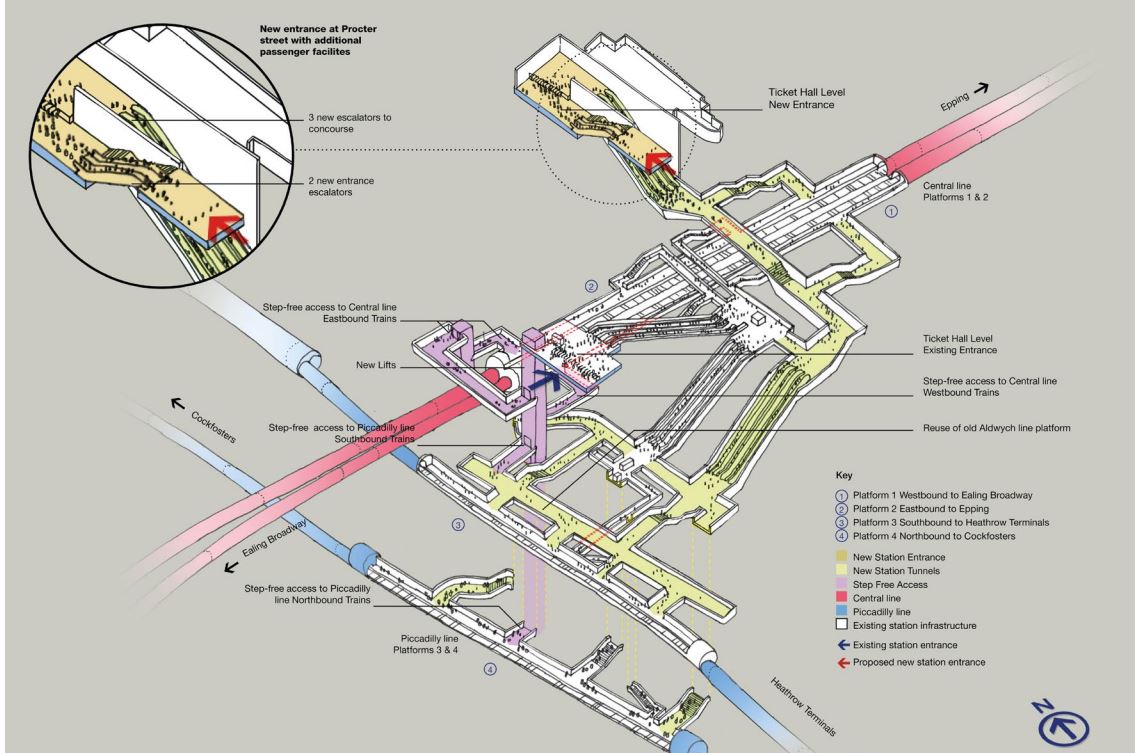
Holborn station is being extended with a new entrance. As with Euston, I suspect it has been designed with a feasible place for DLR platforms to be added.
This document on the TfL web site, gives more details of what is proposed at Holborn station.
I extracted this visualisation of the proposed station.
This map from carto.metro.free.fr shows the lines in the through and around the station.
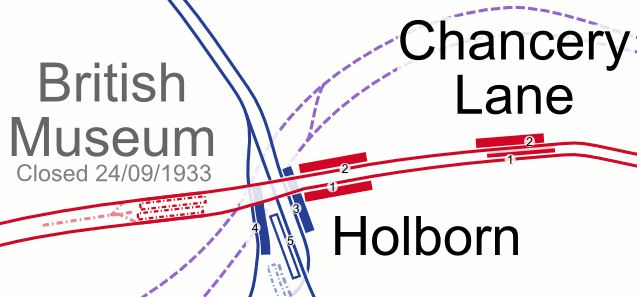
.Note, the Elizabeth Line, which is shown by dotted lines passes to the North of the station.
Conclusion
Not all these improvements need to be done, but each would improve transport in the City of London.
Farringdon Station – 13th February 2022
The two main entrances to Farringdon station have now been finished and the road that runs between them has now been pedestrianised.


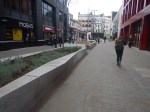


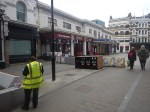
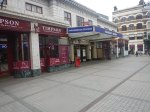
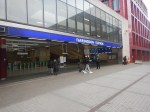

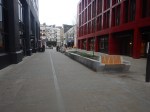
Is Farringdon station the only London station with separate entrances for National Rail and the Underground that are on opposite sides of a pedestrianised plaza?
Does it need to have some outdoor cafes in the Summer months?
Pedestrians Get More Space In Dalston
I took these pictures in the Kingsland Road in Dalston this morning.


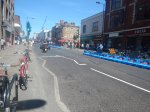
It will be interesting to see how this narrowing works out.
Not just for pedestrians! But for politicians as well!
There has been a certain amount of drivers against the narrowed roads. Who will they vote for in the next election for London Mayor?
A Tale Of Two Cities
This article in the Evening Standard is entitled Traffic Will Be Banned From Three Roads Leading To Bank Junction Following Cyclists’s Death.
- Priority will be given to pedestrians and cyclists at Bank Junction in the City of London.
- The works will be completed before the works at Bank station are completed in 2022.
- There may be a street market in front of the Bank of England.
- The taxi drivers don’t like it.
Compare this to the attitude of London’s other city;Westminster, which has recently, gone against the pedestrianisation of part of Oxford Street and the extension of a Cycle Superhighway.
Plans To Pedestrianise Bank Junction In The City Of London
The title of this post is the same as this article on IanVisits.
Bank Junction is the heart of the City and to pedestrianise it and just allow cyclists and buses could create a central focus for the City, where people will meet just as they do at other important squares like Trafalgar and others all over the world.
In a couple of years time, Bank Underground station will be an extremely well-connected step-free station, with even more entrances.
Taken with the pedestrianisation of the junction, the two projects will transform access to the City of London.
Further pedestrianisation in the area is also on the cards, which will make things even better.
Where The City Of London Leads The Rest Will Follow!
The City of London is a unique Local Authotity, in that very few people live in its area.
C and I used to live in the Barbican with our three boys. It was a very different experience to living anywhere else I’ve lived.
It still functions today as housing and many have lived in the Estate for longer than forty years.
It was one of the first high-quality Local Authority housing schemes in London and it showed if you built quality it worked.
From what I’ve seen elsewhere, other Local Authorities and Housing Associations are building high quality homes for rent.
The City is now tacking another problem in a radical way.
This article on the BBC is entitled The Politics Of Pedestrianisation.
Read the article, of which this is an extract.
Next week, the local authority will take another step towards a bold, radical plan to change the streets in the Square Mile over the next 25 years.
Some streets could be closed to motor vehicles during rush hour and there could be zero emission zones.
There will also be a 15mph speed limit across the district.
The local authority wants to cut the number of vehicles by a quarter by 2030.
The City has consulted workers and residents.
The article says this about the survey.
It found 98% of people travel to the area by walking, cycling or public transport, while 84% think pavements are too crowded.
Four in five people think traffic levels in the City are too high, with 67% saying it contributes to poor air quality, while 59% said it creates an unpleasant street environment.
The authority said it listened to workers and businesses and has to deliver what they want to remain competitive – especially in a post-Brexit world.
It also said it must improve the area to appeal to business and wants to change the priority completely, giving more space to pedestrians and cyclists.
But black cab drivers don’t like it. Surprise! Surprise!
Steve McNamara of the Licensed Taxi Drivers’ Association (LTDA) says pedestrianisation is being dreamt up by middle-class blokes who don’t realise how the milk for their caramel lattes is delivered.
“They are strangling the best city in the planet and they don’t realise people need to have goods and services delivered,” he said.
He thinks the march to pedestrianisation will kill The City.
But I do like it! Look at these pictures I took in the City at about two in the afternoon.
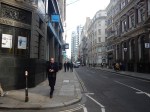
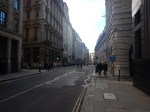
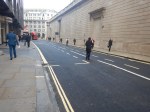
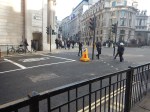
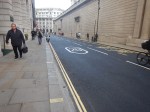
The banning of all vehicles except cyclists and buses has cleared the area around Bank, where it is now a pleasure to walk.
I was actually walking to and from Bank to Leadenhall Market, where I go sometimes for a pleasant lunch in Leon
A year ago, walking would have required a lot of traffic-dodging!
It looks to me, that in a few years time, the City of London will be a square mile of tower blocks and historic alleys and buildings.
- It will be criss-crossed by cycle and pedestrians routes.
- Two or three major routes, will survive for buses and taxis.
- Around the City will be the ring of stations; Aldgate, Bank, Barbican, Blackfriars, Cannon Street, City Thameslink, Fenchurch Street, Liverpool Street, Monument, Moorgate, St. Pauls and Tower Hill.
- The massive Bank and Moorgate/Liverpool Street stations in the heart of the action, will be two of the largest Metro stations in the World.
The City of London will become the Gold Standard for historic cities.
Other UK cities and parts of London like Oxford Street will surely follow.
I do find it strange that the other two big cities in the UK, where walking is pleasant in the centre are Glasgow and Liverpool. Like the City of London, they have underground railways and a river
London Has A New Underground Line
On Friday, I went between Brighton and Cambridge stations on one of the first Thameslink services on the route.
I wrote about it in Observations On Thameslink Between Brighton And Cambridge.
That journey took me on London’s new Underground Line between London Bridge and Finsbury Park stations.
The following trains are going North from London Bridge to Finsbury Park.
- 11:29 – Horsham to Peterborough – Arrives at Finsbury Park at 11:52
- 12:49 – Brighton to Cambridge – Arrives at Finsbury Park at 13:13
- 15:04 – Horsham to Peterborough – Arrives at Finsbury Park at 15:27
- 15:34 – Brighton to Cambridge – Arrives at Finsbury Park at 15:57
And the following trains are going South from Finsbury Park to London Bridge.
- 10:59 – Peterborough to Horsham – Arrives at London Bridge at 11:24
- 12:09 -Cambridge to Brighton – Arrives at London Bridge at 12:37
- 14:29 – Peterborough to Horsham – Arrives at London Bridge at 14:55
- 15:11 – Cambridge to Brighton – Arrives at London Bridge at 15:37
All journeys take around 23-25 minutes, with stops at Blackfriars, City Thameslink, Farringdon and St. Pancras International stations.
It may officially be part of Thameslink, but it will function like a convewntional Underground Line, but with bigger trains.
The Underground Alternative
If you look at Transport for London’s Journey Planner, this give a time of twenty minutes for a journey between London Bridge and Finsbury Park, using the Northern and Victoria lines with a change at Euston.
That is also not a step-free or wheel-chair friendly route.
Obviously, at the moment, most passengers have no choice, as there is only four trains per day in each direction on the new Thameslink route.
But when a Full Service is running, with a train every ten minutes, things will be very different.
My Access To Thameslink
Timings to Thameslink stations from my house are as follows.
- Finsbury Park – 15 mins by 141 Bus and Piccadilly Line
- London Bridge – 25 mins by 21 or 141 Bus
- London Bridge – 31 mins using Transport for London’s Journey Planner’s recommended route via Dalston Junction and Canada Water.
The latter probably explains why Londoners are generally Grade 1 Duckers-And-Divers!
I suspect, when I go to Gatwick Airport, I’ll go via Finsbury Park, using the mini-cab from around the corner or a black cab, as both will be quicker.
I suspected right. Returning from Finsbury Park station to home this evening, took ten minutes and cost a tenner.
A Preview Service
Thameslink are only running a preview service between London Bridge and Finsbury Park at the current time.
On my Friday trip, it was particularly noticeable, that passengers were thin on the ground between the two stations.
- But then passengers probably didn’t know about the service and may have been confused seeing a train going to Cambridge.
- It’s also not shown on the Tube Map.
- I didn’t notice any advertising for the new route.
So how do you use something that you don’t know about?
The Full Service
This route will have the following characteristics, when Thameslink open it fully.
The Route Will Serve The City of London Well
These factors will help this section of Thameslink serve the City of London.
- Step-free stations at Farringdon, City Thameslink and London Bridge ring the South and West of the City of London.
- Crossrail with an interchange with Thameslink at Farringdon also gives a quick route to the East of the City of London and Canary Wharf.
- The City of London is also planning a lot of pedestrianisation.
Other developments like Crossrail and the expansion of Bank station and the Docklands Light Railway, will make London’s financial district, one of the best connected by public transport in the World.
The Route Will Have Tourist Attractions
The route could have been designed for tourists.
- London Bridge station has London and Tower Bridges, Southwark Cathedral, Borough Market, HMS Belfast and the Shard.
- But the most spectacular modern architecture at London Bridge, is the station itself, with its lifts, escalators, fifteen platforms and a shopping centre.
- Blackfriars is a unique station, as it spans the Thames with entrances on both banks, and it is the world’s largest solar-powered bridge.
- Blackfriars station is a short walk along the river from the Tate Modern and the Millennium Bridge.
- Many good walks along the river start from Blackfriars.
- City Thameslink station dates from 1990 and it shows, but it is close to St. Paul’s Cathedral, the Old Bailey, so it attracts visitors at both ends of the moral spectrum.
- Farringdon station will be a major interchange, where Crossrail and Thameslink connect, so don’t let unsuitable organisations build all the hotels this area will attract.
- Farringdon is close to two of London’s iconic markets; Smithfield meat market and the attached wife market.
- Saint Pancras International station is a fur coat and no knickers station, as although it looks good, it’s practicality is suspect.
- If they’d given the job to the architect, who updated Kings Cross station next door, they would have got a a more practical station.
- Finsbury Park station is a place, where you go and explore the local area, which is vibrant and full of history.
- You may even get as far as Alexandra Palace or Manor House, where I saw John Mayall and the Bluesbreakers with a very drunk Eric Clapton in the 1960s.
It is a line to explore London.
Six Trains Per Hour
There will be six trains per hour (tph), which will run All Day.
- Two tph – Peterborough to Horsham – twelve-car
- Two tph – Cambridge to Brighton – twelve-car
- Two tph – Cambridge to Maidstone East – eight-car
This gives a six tph service between Finsbury Park and London Bridge and also a four tph service to East Croydon and Gatwick Airport.
Two Additional Trains Per Hour In The Peak
In the Peak, there will be two tph, that run from Welwyn Garden City to Sevenoaks.
But they will go via Elephant and Castle rather than London Bridge.
Thameslink must have their reasoning behind this service, but I have some questions.
- Would commuters in the Peak prefer to go to London Bridge?
- Would passengers from Sevenoaks and Welwyn Garden City like an All Day service?
These questions and others will be answered in the next few years, as hameslink develops.
Full Step-Free Access At London Bridge Station
London Bridge station has full step-free access for all the following services.
- Thameslink
- Services to and from Cannon Street station
- Services to and from Waterloo East and Charing Cross stations.
- Jubilee and Northern Lines of the Underground
- Terminating services at London Bridge
- Several bus routes, including my bus home!
Note.
- Passengers will use the escalators to get to the right destination.
- Thameslink passengers will use the island platform to reverse direction.
- It took me just two minutes to change from Platforms 2/3 to Platforms 8/9.
- Going from Platform 6/7 to the bus station was under three minutes and a 141 Bus was just getting ready to leave.
- Passengers can walk across London Bridge to the City of London.
There are few stations better than London Bridge anywhere in the world!
Full Step-Free Access at Finsbury Park Station
Finsbury Park station is being updated to have full step-free access for the following services.
- Thameslink
- Great Northern Services to Cambridge, Kings Lynn and Peterborough
- Northern City Line services to and from Moorgate station
- Piccadilly and Victoria Lines. of the Underground.
There will also be same-platform interchange between Thameslink and Northern City Line services.
The Improved Northern City Line At Finsbury Park Station
The Northern City Line will be substantially improved.
- New Class 717 trains have been ordered.
- This could mean an increased All Day service of perhaps 10-12 tph.
- Moorgate station will be on Crossrail.
- There will be a same-platform interchange with Thameslink at Finsbury Park station.
- Hopefully, the terrible stations on the route will be improved.
This line will change from being a crowded, outdated backwater of the UK rail system to an important modern link to the City of London and Crossrail from large parts of North and North-East London.
The Link To Crossrail
The link between Thameslink and Crossrail at Farringdon station will probably be heavily used, if it is well-designed and fully-step free. Which I suspect it will be, until proven otherwise!
Don’t forget too, the link to the Metropolitan and Circle Lines at this key station, which is much better than the link at St. Pancras
Step-Free Access At All The Intermediate Stations Between London Bridge and Finsbury Park
Access at Blackfriars, City Thameslink, Farringdon and St. Pancras stations are all fully step-free.
The Fastest Way To Gatwick Airport And Brighton From North London
My friend lives in Walthamstow and always goes to Gatwick Airport by using the Victoria Line and Gatwick Express.
- This takes twenty-three minutes for the Victoria Line and thirty minutes for the train.
- The Thameslink route via Finsbury Park, takes nine minutes for the Victoria Line and an hour for the train.
Note.
- Both trains will run every fifteen minutes, when the full Thameslink service is running.
- The Thameslink timing is only the time of the Preview Service. Will the Full Service be faster?
- Finsbury Park and Victoria will both be fully step-free within a year or so.
- The trains on Gatwick Express will be more comfortable.
- The walk at Finsbury Park is shorter than at Victoria.
- The Thameslink route will be more affordable.
Everybody will have their own preference.
The biggest winners will be.
- Those living on the Northern reaches of the Piccadilly Line, who will have a full step-free interchange to Thameslink at Finsbury Park
- Those living on the Northern City Line, who will have a same-platform interchange to Thameslink at Finsbury Park.
- Those who walk, cycle or take a bus or cab to Finsbury Park.
Gatwick Airport could be a big winner, as a whole area of North London and Hertfordshire now has a new excellent direct connection to the Airport.
What Still Needs To Be Done?
It is a well-thought out route, but some things still need to be done.
Is Six Tph Enough Trains Between London Bridge And Finsbury Park?
I ask this question, with my scheduling hat on!
At the moment of the 24 tph through the Snow Hill Tunnel, two-thirds of the trains go up the Midland Main Line, with just a third on the East Coast Main Line.
I think that, when Thameslink increase the frequency through the central core, that they will increase the frequency through Finsbury Park.
Could Two Tph From The Sutton Loop Go To Welwyn Garden City?
Curremtly, four tph start at St. Albans City station, go through London, then round the Sutton Loop, before returning to St. Albans City.
Would it be desirable to start two of these services from Welwyn Garden City station?
It will all depend on operational issues and the routes passengers take.
City Thameslink And St. Paul’s Stations Need A Connection
I believe this is possible and I wrote about it in A Pedestrian Connection Between City Thameslink Station And St. Paul’s Tube Station.
Should The Docklands Light Railway Be Extended To City Thameslink, Euston And St. Pancras?
I wrote about this extension in detail in A Connection Between City Thameslink Station And The Docklands Light Railway.
Could Thameslink Connect To The Waterloo And City Line?
I wrote about this connection in Could The Waterloo And City Line Have An Intermediate Station At Blackfriars?
Development of new trains for the Underground, will make this link possible.
Should Thameslink Be On The Tube Map
I wrote about this in Thameslink Should Be On The Tube Map.
All Of Thameslink Should Be In The Oystercard Area
Gatwick Airport is already in the Oystercard area, but it is silly that Oyster cards and contsctless cards can’t be used on all Thameslink services.
Conclusion
The possibilities for Thameslink and the effects it will have will be enormous.
Bank Junction Goes Buses And Cyclists Only
On Monday, the 22nd of June 2017, the City of London brought in an order making the busy Bank Junction buses and cyclists only between seven in the morning and seven in the evening from Monday to Friday.
I took these pictures soon after ten in the morning.
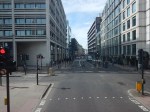


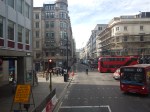

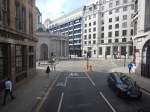

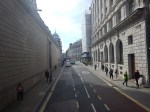


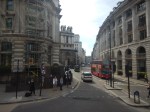
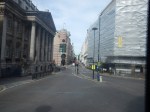
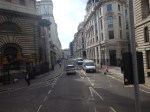


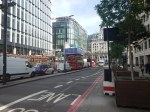

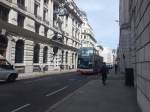
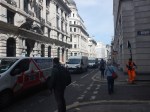
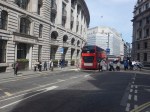
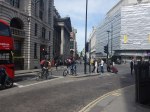


The first few pictures were taken from the top of a Routemaster bus on Route 21, as it travelled from where I live across the city to London Bridge station.
Note.
- Most drivers seemed to be avoiding the area.
- The City of London Police were telling drivers, but didn’t appear to be ticketing anybody.
- Much of the congestion seemed to be caused by half-empty polluting Tour Buses.
- One pedestrian was moaning that he couldn’t use his car to get around the City.
Overall, it appeared to be a calm start.
The Upgrade Of Bank Station
I have only shown the area on the surface, but under the ground around Bank Junction, a massive construction project is starting in the City of London’s twin goals of more and better office accomodation and transport links.
Bank station is getting a major upgrade, which will include.
- In The New Tunnel Under Bank Station, I wrote about an upgraded pedestrian tunnel that crosses the area.
- In Between Bank And Cannon Street Station, I wrote about how Bloomberg are helping develop a new step-free entrance to the Waterloo and City Line and Bank station, which will open by early 2018.
- A new Northern Line tunnel to create more space on the platforms and increase frequency on the line.
- The station weill receive a forty percent increase in capacity.
- Full step-free access with thirteen new escalators and three new lifts.
- A new entrance to Bank station opposite Cannon Street station.
- Two North-South moving walkways.
- Some of the £600million project cost will be funded by oversite office development.
- Hopefully, much of the work will be finished by 2021.
There’s more in this article in the Guardian, which is entitled Bank station upgrades point to London’s bigger, busier future.
Bank Station And Crossrail
You may wonder, why if Bank station is so important, that Crossrail doesn’t call and Crossrail 2 won’t either.
It may not, but the Central Line will have good connections to Crossrail at Stratford, Liverpool Street, Tottenham Court Road and Bond Street stations.
So passengers for Bethnal Green, Bank, St. Paul’s, Chancery Lane and Holborn will change from Crossrail to the Cwntral Line at a convenient station.
In addition, Crossrail will feed passengers into loops in the District, Hammersmith and City and Jubilee Lines.
Travellers will pay their money and take their choice.
Other Developments At Bank
I wouldn’t be surprised to see more pedestrian routes linking the City stations of Bank, Cannon Street, Fenchurch Street, Liverpool Street and Moorgate; both on the surface and possibly underground.
I would also make sure that all buses in the centre of London are low-emission vehicles. That certainly doesn’t apply to those polluting and jam-creating Tour Buses and tourist coaches.
 The Anonymous Widower