UK Government Sets 8-Hour Minimum For LDES Cap-And-Floor Sheme
The title of this post, is the sa,e as that of this article on Energy Storage News.
This is the sub-heading.
The UK government has published a Technical Decision Document confirming crucial aspects of its long duration electricity storage (LDES) cap-and-floor scheme, which includes increasing the minimum duration required from six hours to eight
These paragraphs give full details.
The document, released by regulator Ofgem on 11 March, details the final overarching rules and requirements for the scheme as well as how it will be implemented, though significant detail still remains to be worked out.
The scheme will provide a cap-and-floor revenue protection for 20-25 years that will allow all capital costs to be recoverable, and is effectively a subsidy for LDES projects that may not be commercially viable without it. Most energy storage projects being deployed in the UK today are lithium-ion battery energy storage systems (BESS) of somewhere between 1-hour and 3-hour in duration (very occasionally higher).
One of the most significant new details of the scheme is that, following industry feedback, the minimum duration for projects to qualify has been increased from six hours to eight hours of continuous rated power.
The ‘continuous rated power’ aspect prevents shorter duration projects from bidding in a smaller section of their MW capacity in order to act like an 8-hour system.
Another interesting detail pointed out by several commentators is that the cap is a ‘soft’ one, meaning it will allow extra revenue to be shared between developers and consumers. Exact details on the ratio are yet to be determined.
As a Graduate Control Engineer from Liverpool University in the 1960s, I hope that the move from a six to eight hours minimum duration is feasible.
I wasn’t dealing with power systems, but with multi-vessel chemical plants.
These are my thoughts.
The biggest project, I was dealing with a few years later in the 1970s, was the modeling of all the the reservoirs and pipelines by the Water Resoures Board.
As the supply side of the water industry hasn’t had too many issues with the volume of water supplied, I feel that the main modelers must have done a reasonable job.
Six To Eight Hours Of Continuous Operation
The article says this about uprating from six to eight hours of continuous operations.
All the systems that have been proposed for cap-and-floor operation, seem to have some form of physical storage.
- Energy Dome appears to have tents of carbon dioxide.
- Energy Vault uses stacks of heavy weights.
- Form Energy has tanks of rust.
- Gravitricity has huge weights in disued mine shafts.
- Highview Power has large tanks of liquid air.
- Pumped storage hydro has two lakes, that hold water.
- Rheenergise has two large tanks, of a water-based slurry.
So to go from six to eight hours will hopefully just need some more storage.
Highview Power appears to use similar gas tanks to those used to store natural gas or hydrogen.
This image clipped from Highview’s web site, shows large tanks for liquified gas storage.
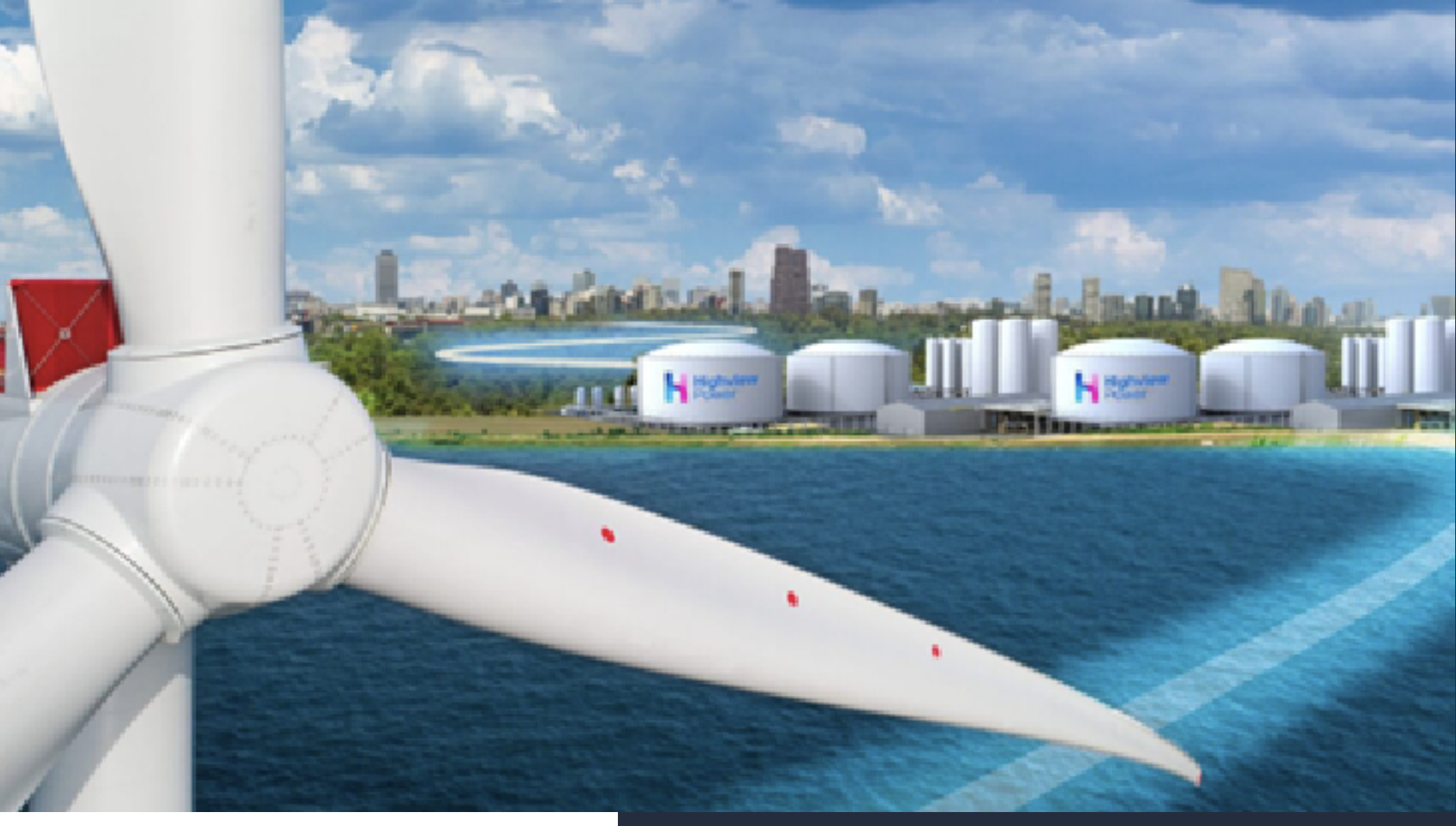
With tanks like these, which can hold GW-equivalents of liquid air, Highview could be building batteries with storage to rival the smaller pumped storage hydroelectric power stations. They are already talking of 200 MW/2.5 GWh systems, which would have a 12.5 hour continuous rating and would probably need two to three tanks.
Coire Glas Pumped Storage
I’ll use Coire Glas pumped storage hydro electric power station as an example.
As currently planned SSE’s Cioire Glas pumped storage hydroelectric power station is 1.5 GW/30 GWh, so it has a a 20 hour continuous rating.
In The UK’s Pumped Storage Hydroelectricity, I gave a rough estimate of the pumped storage hydroelectricity systems in operation or planed as nearly 11 GW/224GWh.
The Soft Cap
The article says this about a soft cap.
Another interesting detail pointed out by several commentators is that the cap is a ‘soft’ one, meaning it will allow extra revenue to be shared between developers and consumers. Exact details on the ratio are yet to be determined.
I seem to remember that when I was modeling a larger multi-vessel chemical plant at ICI, I was using sharing between vessels, to get the system to operate on a PACE-231R analog computer.
So I suspect a soft cap is possible.
Mercia Power Response & RheEnergise Working Together To Build Long Duration Energy Storage Projects In The UK
The title of this post, is the same as that as this news item from Mercia PR.
As it is from the 16th of August last year, I wonder why my Google Alert didn’t pick it up.
This is the sub-heading.
Mercia Power Response, a key provider of flexible power response services to the UK grid, has signed an agreement with RheEnergise to explore the potential deployment of RheEnergise’s new and innovative form of long-duration hydro-energy storage, known as High-Density Hydro® (HD Hydro).
These are the first three paragraphs.
Mercia Power Response, a key provider of flexible power response services to the UK grid, has signed an agreement with RheEnergise to explore the potential deployment of RheEnergise’s new and innovative form of long-duration hydro-energy storage, known as High-Density Hydro® (HD Hydro). Mercia Power Response (“Mercia PR”) and RheEnergise will work together to identify suitable sites for additional HD Hydro storage projects. The two companies’ initial focus will be the feasibility of getting 100MW of HD Hydro in commercial operation by 2030 by utilising Mercia PR’s existing grid connections.
With 40 sites having a combined capacity of 263MW and a number of sites under development and construction over the next 5-10 years, Mercia PR believes that RheEnergise’s HD Hydro storage technology would be a complementary, low carbon solution to its operating portfolio.
Additionally, Mercia PR’s industry partners bring market expertise in energy trading and forecasting, helping RheEnergise to optimise grid-connected energy storage projects.
Note.
- The average size of Mercia PR’s batteries would appear to be 6.5 MW.
- Working on the often-used two-hour duration, that would be a storage capacity of 13 MWh.
- I suspect some of Mercia PR’s sites will be more suitable for lithium-ion batteries and some will be more suitable for RheEnergise’s HD Hydro systems.
- I have witnessed local Nimbys objecting to lithium-ion systems on grounds of the fire risk.
- I am fairly sure, that the National Grid will be able to cope with both lithium-ion batteries and RheEnergise’s HD Hydro systems.
- I suspect Mercia PR’s industry partners, with their market expertise in energy trading and forecasting, could turn a small wind or solar farm into a nice little earner.
This looks to be a good fit between two innovative companies.
RheEnergise To Build First-Of-A-Kind Hydro Storage System
The title of this post, is the same as that of this article on Power Technology.
This is the sub-heading.
A demonstrator of the company’s long-duration hydro-energy storage system will be constructed at Sibelco’s Devon mine.
These are the first two paragraphs.
UK hydro-energy storage company RheEnergise is to build a first-of-a-kind demonstrator of its long-duration hydro-energy storage system at Sibelco’s mining operations at Cornwood, near Plymouth, Devon. The construction of the demonstrator will start soon, with commissioning scheduled in September.
The power generated by RheEnergise’s HD Hydro demonstrator, which has a peak power production of 500kW, will support Sibelco’s mining operations at times of high energy demand and help the company decarbonise its operations. The Cornwood site produces kaolin, mainly for sanitary ware, ceramics, tiles and industrial applications.
I have some thoughts.
A Short Construction Time
If RheEnergise’s timescale is correct and it is the same in RheEnergise’s original press release, then I can draw the following conclusions.
- Five months is a short construction time.
- I would suspect that the system can be built from readily available components.
- RheEnergise’s HD Hydro system, which uses a fluid with a specific gravity of 2.5 can work with standard pipes and turbines.
I wouldn’t be surprised, that the only difference between RheEnergise’s system and a standard water-based hydro system is the fluid and a few settings on the control system.
It might even be possible to check that the system works by using water as the storage fluid.
But that would of course shorten the testing time.
Could An Existing Pumped Storage System Be Uprated With RheEnergise’s Fluid?
Consider
- There are only a few small pumped hydro systems.
- The RheEnergise system needs to be sealed.
- The storage capacity would be raised by 2.5 times.
It is an interesting idea, but could be possible in some cases.
What Will Be The Storage Capacity Of The Sibelco System?
This is not stated, but typically a battery system has a duration of two hours.
So that would give a capacity of 1 MWh.
Could RheEnergise’s HD Hydro System Back Up A Wind Or Solar Farm?
Consider.
- Batteries are always a good addition to a wind or solar farm, as they stabilise the output.
- A lot would depend on the possible size of the RheEnergise system battery.
- The location of the wind farm is probably important.
An onshore wind farm on top of a hill might be an ideal candidate.
Conclusion
RheEnergise could be installed in a lot of sites.
Vertical Farming Consortium Secures UK Government Funding To Advance Low-Emission Food Production Using Energy Storage
The title of this post, is the same as that of this article on Renewable Energy Magazine.
This is the sub-heading.
A consortium of four British companies, comprising UK Urban AgriTech (UKUAT), Intelligent Growth Solutions Ltd, RheEnergise and James Hutton Institute has received a grant from the UK Government to advance the development of low-carbon and low-cost food production by co-locating renewable energy with vertical farms.
These paragraphs outline the project.
The V-FAST consortium’s £488,000 project will explore how co-locating RheEnergise’s HD Hydro Energy Storage system with vertical farms can support a low-emission route to growing protein-rich crops in a controlled environment.
Last year, V-FAST – Vertical Farming And Storage Technologies – started investigating sites in Scotland’s Central Belt for the location of Scotland’s next generation of hectare+ scale vertical farms, powered by 100 percent renewables and using RheEnergise’s High-Density Hydro energy storage system. These farms would provide locally produced fresh foods (salads and fruits) to over 60 percent of the Scottish population and help meet the Scottish Government’s ambitions to produce more homegrown fruit and vegetables. These site investigations in Scotland continue.
Now, with the Innovate UK and BBSRC funding as part of the Novel Low Emission Food Production Systems competition, V-FAST will broaden the area for its site feasibility studies to across the UK, using GIS to identify and rate suitable locations for vertical farms that are co-located with renewables and High-Density Hydro energy storage. As part of the project, V-FAST will also undertake crop trials to establish optimal climate recipes in terms of their energy efficiency relative to produce metrics (e.g. protein per kWh or kg of CO2e).
It certainly sounds unusual to pair vertical farming with energy storage, but if it works, why knock it?
RheEnergise’s HD Hydro Energy Storage system is effectively pumped storage hydroelectricity using a fluid with a specific gravity of 2.5.
So instead of needing mountains to store energy, it can use medium-sized hills.
The Wikipedia entry for vertical farming, introduces the concept like this.
Vertical farming is the practice of growing crops in vertically stacked layers. It often incorporates controlled-environment agriculture, which aims to optimize plant growth, and soilless farming techniques such as hydroponics, aquaponics, and aeroponics. Some common choices of structures to house vertical farming systems include buildings, shipping containers, tunnels, and abandoned mine shafts.
As both HD Hydro Energy Storage system and vertical farming seem to need some form of vertical space, can colocation be advantageous in terms of cost?
Wikipedia also says that vertical farms also face large energy demands due to the use of supplementary light like LEDs.
So could V-FAST be an unusal marriage made in heaven of plant science and energy storage?
RheEnergise And Colbún Sign MoU For Long Duration Energy Storage Projects In Chile
The title of this post is the same as that of this article on Water Power and Dam Construction.
These are the first two paragraphs.
Colbún, Chile’s third-largest power generation company and a prominent hydropower operator, has entered into a partnership with RheEnergise, a UK-based clean technology firm, to investigate the viability of deploying RheEnergise’s innovative long-duration hydro-energy storage solution, High-Density Hydro® (HD Hydro), in Chile. The agreement marks RheEnergise’s first entry into South America’s energy market.
Colbún and RheEnergise will jointly assess the feasibility of constructing a 10MW, 10-hour HD Hydro system in Chile. This initiative is seen as a valuable addition to Colbún’s diverse portfolio of hydro, wind, and solar projects, offering a novel technology to address the intermittency challenges associated with renewable energy sources. RheEnergise will conduct thorough investigations and technical studies to identify potential sites for its HD Hydro system, while Colbún will contribute local market expertise, guidance on planning and permitting, and insights into utility.
Note.
- Colbún has a Wikipedia entry and seems to be a fairly large company.
- The proposed system appears to be a 10 MW/100 MWh system, which could be ideal to back up a small wind or solar farm of about 50 MW capacity.
- Colbún seem to have the expertise to be a good partner for RheEnergise.
This last paragraph gives a snapshot of the Chilean market.
“Chile is a very attractive market for RheEnergise’s HD Hydro,” added Sophie Orme, Commercial Director at RheEnergise. “The Chilean Government is leading the way in Latin America, having dedicated US$2 billion for energy storage auctions from 2024, and set a renewables target of 70% by 2030 and carbon neutral by 2050. We are delighted to partner with Colbún, drawing on their first-hand experience of the market, in particular hydro and solar and to help them achieve their plan to add 4GW of renewable assets by 2030.”
I certainly wish both companies a successful future with this MoU.
Mercia Power Response And RheEnergise Target 100MW Of High-Density Hydro Energy Storage
The title of this post, is the same as that of this article on the Institution of Mechanical Engineers.
This is the sub-heading.
Two new partners will explore installation of high-density hydro energy storage with 100MW capacity by 2030.
These two paragraphs outline the deal.
Mercia Power Response, a provider of flexible power response services to the UK grid, signed an agreement with RheEnergise to explore the potential deployment of its new form of long-duration hydro energy storage, known as High-Density Hydro (HD Hydro).
The companies will work together to identify suitable sites for HD Hydro storage projects, using Mercia PR’s existing grid connections.
Note.
I am certainly pleased that this simple idea for energy storage appears to be on its way.
Gresham House Energy Storage Sets GBP80 Million Fundraise
Gresham House Energy Storage Fund must be doing something right, as similar headlines are used in half-a-dozen places on the Internet and they regularly seem to be raising more money.
But then, as a Graduate Control Engineer and a previous owner of half a finance company, I’ve always thought raising money to build batteries was a good idea.
My only niggle with Gresham House, is that I would have thought by now, they would have put some money into building one of the excellent new technology batteries that are coming through.
The storage fund or some of its employees, may of course have contributed to some of the crowdfunding for these new technologies, all of which I feel have a good chance of being a success.
Note.
- Energy Dome is Italian and all the others are at least fifty percent British.
- Most of the British batteries have had backing from the UK government.
- All these batteries are environmentally-friendly.
- None of these batteries use large quantities of rare and expensive materials.
- Energy Dome even uses carbon dioxide as the energy storage medium.
In addition, in Scotland, there is traditional pumped storage hydro-electricity.
Project Iliad
This article on renews.biz has a slightly different headline of Gresham House To Raise £80m For US Battery Buildout.
This is the first two paragraphs.
Gresham House Energy Storage Fund is seeking to raise £80m through a share placing.
The new equity raised will primarily be used to finance 160MW of solar with co-located four-hour battery projects in California, US, known as Project Iliad.
The article then gives a lot of financial details of Project Iliad and Gresham House.
Will Gresham House be backing co-located solar/battery projects in the UK?
- In Cleve Hill Solar Park, I write about a co-located solar/battery project in Kent.
- This press release from National Grid is entitled UK’s First Transmission-Connected Solar Farm Goes Live, which also describes a co-located solar/battery project, being built near Bristol.
These two projects are certainly serious and could be pathfinders for a whole host of co-located solar/battery projects.
WillGresham House back some of this new generation?
Hydro-Storage Options To Be Studied For Grängesberg
The title of this post, is the same as that of this news item from Anglesey Mining.
These are the highlights of the news item.
- Anglesey Mining plc, together with its 49.75% owned subsidiary Grängesberg Iron AB (“GIAB”) have entered into an MoU with Mine Storage to investigate the potential for the Grängesberg Mine to be converted into a Pumped Hydro-Storage project at the end of the mine’s producing life.
- Pumped-Hydro Storage is a green-energy storage solution that utilises water and gravity to store electrical energy. An underground mine can provide a closed-loop solution using proven, pumped hydro-power technology. Essentially, the system involves water being gravity fed through pipes down a shaft into the turbines, which produce electricity for supply to the grid and also pump the water back to surface. The mine storage system has a high round-trip efficiency of 75-85% and proven durability.
- The MoU with Mine Storage could lead to numerous future benefits.
I like this project.
Too often, when mines, quarries or other large operations come to the end of their economic lives, they are just abandoned in the hope that something worthwhile will happen.
But here we have a company planning the end of an iron ore mine in a way that will turn it into a source of future revenue.
I have a few thoughts.
Mine Storage
Mine Storage are a Swedish company with an informative web site.
The web site answered most of my questions.
Mines Are Moving From a Liability To A Resource
Consider.
- Gravitricity are using mines to store energy using cables and weights.
- Charlotte Adams and her team at Durham University are developing the use of the heat in abandoned coal mines.
- The Global Centre of Rail Excellence is being developed in a disused opencast mine in Wales.
- RheEnergise are developing their first High Density Hydro system in the Hemerdon Tungsten Mine in Devon.
And now we have this co-operation between Anglesey Mining and Mine Storage working together on pumped storage hydroelectricity.
Where is Grängesberg
This Google Map shows the location of Grängesberg.
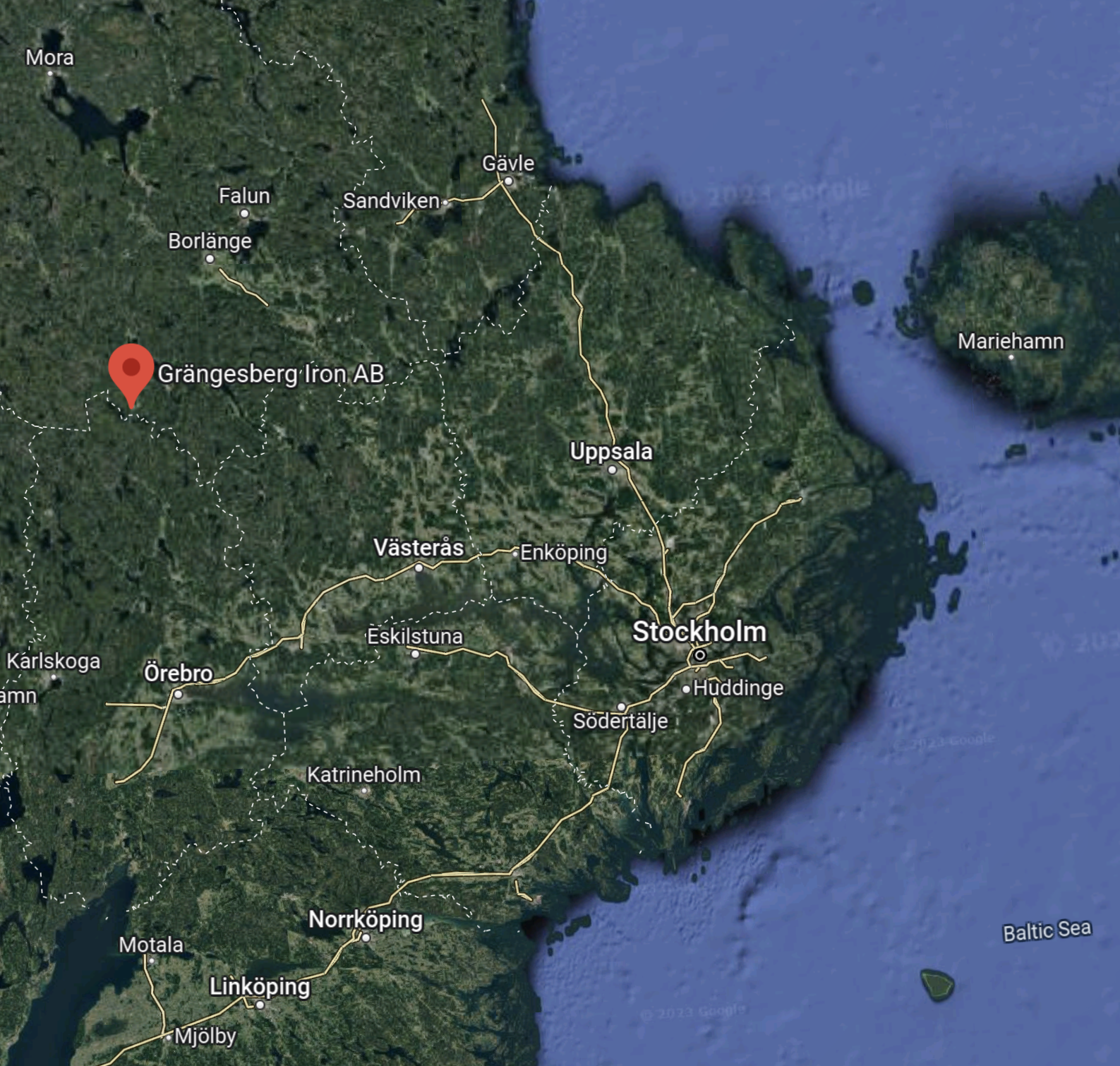
It is convenient for storing energy for Stockholm.
Diversifying A US$200 billion Market: The Alternatives To Li-ion Batteries For Grid-Scale Energy Storage
The title of this post, is the same as that of this article on Energy Storage News.
This is the introductory paragraph.
The global need for grid-scale energy storage will rise rapidly in the coming years as the transition away from fossil fuels accelerates. Energy storage can help meet the need for reliability and resilience on the grid, but lithium-ion is not the only option, writes Oliver Warren of climate and ESG-focused investment bank and advisory group DAI Magister.
Oliver starts by saying we need to ramp up capacity.
According to the International Energy Agency (IEA), to decarbonise electricity globally the world’s energy storage capacity must increase by a factor of 40x+ by 2030, reaching a total of 700 GW, or around 25% of global electricity usage (23,000TWh per annum). For comparison, this would be like swelling the size of the UK’s land to that of the USA.
Similar to how “nobody ever gets fired for buying IBM”, lithium-ion holds a similar place in grid scale electrical storage today.
And just as IBM did in the last decades of the last century, the builders of lithium-ion will fight back.
He then lists the problems of grid-scale lithium-ion batteries.
- Shortage of cobalt.
- Toxic and polluting extraction of some much needed metals and rare earths from unstable countries.
- Lack of capacity to load follow.
- Limited lifespan.
He does suggest vehicle-to-grid can provide 7TWh of storage by 2030, but it has similar problems to lithium-ion grid scale batteries.
Finally, he covers these what he considers several viable methods of energy storage in detail.
He introduces them with this paragraph.
No single killer application or technology exists to get the job done. Diversification is key with success dependent on the wide-scale adoption of multiple grid-scale energy storage solutions.
- Energy Dome – Italy – Stylish Use of CO2
- Augwind Energy – Israel – Stores Energy As Compressed Air Underground
- Cheesecake Energy – UK – Stores Energy As Heat And Compressed Air
- Highview Power – UK – Stores Energy As Liquefied Air
- Ocean Grazer – Netherlands – Ocean Battery
- RheEnergise – UK – High Density Hydro
- Lumenion – Germany/Japan – Stores Energy As Heat
- Energy Vault – Switzerland – Raising And Lowering Of Weights
Note.
- All systems are environmentally-friendly and use readily-available materials like air, water, sea-water, steel and concrete for their systems.
- The most exotic materials used are probably in the control computers.
- Some systems use readily-available proven turbo-machinery.
- Most systems appear to be scalable.
- All systems would appear to have a working life measured in decades.
- I would expect that most well-educated teenagers could understand how these systems worked.
Only Augwind Energy and Lumenion are new to me.
He finally sums up the economics and the market potential.
Our ability to expand energy storage capacity is one of the most pressing issues that will determine whether this defining ‘transitional’ decade is a success. But we’ll need to invest wisely into the right technologies that get the greatest bang for the buck (in terms of GWh capacity and return on capital) given the limited lifespan of Li-Ion and the decarbonisation of the grid.
At a current capital cost of US$2,000 per kW quoted by the US National Renewable Energy Laboratory (NREL) for 6-hour Li-ion battery storage, the 700GW of capacity needed by 2030 equates to around a US$1.5 trillion market over the coming decade, making it worth nearly US$200 billion a year.
The Energy Storage News article is a comprehensive must read for anyone, who is considering purchasing or investing in energy storage.
I have some further thoughts.
From My Experience Would I Add Any Other Systems?
I would add the following.
- Form Energy, because its iron-air battery is well-backed financially.
- Gravitricity, because it can use disused mine shafts to store energy and the world has lots of those.
- STORE Consortium, because its 3D-printed concrete hemispheres, that store energy using pressurised sea-water can be placed within a wind farm.
I also suspect that someone will come up with an energy storage system based on tidal range.
Finance
When we started Metier Management Systems, finance to breakout from the first initial sales was a problem. We solved the problem with good financial planning and an innovative bank manager who believed us all the way.
David, was a rogue, but he was a rogue on the side of the angels. Long after Metier, he even came to my fiftieth birthday party.
David would have found a way to fund any of these systems, as they tick all the boxes of demonstrated, environmentally-friendly, safe and understandable. They are also likely to be bought by companies, governments and organisations with a high net value, a very respectable reputation and/or large amounts of money.
I also think, that just as we did with the original Artemis project management system, some of these systems can be leased to the operators.
Second-Use Of Systems
Several of these systems could be moved on to a new location, if say they were supporting an industry that failed.
That would surely help the financing of systems.
Rheenergise & University Partners Secure £1M Grant From UK Government
The title of this post, is the same as that of this press release from Reenergise.
This is the sub-heading.
The Department for Energy Security & Net Zero funded research project will identify and test minerals and discarded wastes for use in RheEnergise’s grid scale hydro energy storage system.
And these are the first three paragraphs.
In partnership with the University of Greenwich and the University of Exeter, RheEnergise, the UK company that is developing a new and advanced form of pumped hydro-energy storage, has secured a grant of £1 million funded through the Net Zero Innovation Portfolio (NZIP) as part of the UK Government’s Energy Entrepreneurs Fund. The government grant will fund work to identify and test waste materials that could be used in the high-density fluid (HDF) that is integral to RheEnergise’s grid-scale High-Density Hydro® energy storage system. The HDF is an environmentally benign alternative to water.
RheEnergise’s long duration storage system is low-cost and energy efficient. The fluid used in the system is 2½ times denser than water (similar in viscosity to cream) and is therefore able to provide 2½ times the power and 2½ times the energy when compared to conventional low-density hydro-power systems that rely on water and operate in the Scottish Highlands, Wales and across Europe. It means that RheEnergise can deploy its long duration energy storage system beneath the surface of hills rather than mountains, so opening up massive commercial opportunities in the UK, Europe and further afield.
The research project, funded by the Department for Energy Security & Net Zero’s Energy Entrepreneurs Fund, wants to identify suitable minerals and waste streams which can be recycled into the high-density fluid which can be locally sourced and are lower-cost, rather than having to rely on minerals imported from overseas.
I feel the concept of High-Density Hydro is excellent and will work.
If this research leads to lower costs, that can only help the development and deployment of High-Density Hydro.
 The Anonymous Widower