It’s All Happening In Jamshedpur!
When I read this article on Hydrogen Fuel News, which is entitled Cummins And Tata Motors Ignite Change With H2 Internal Combustion Engines, I couldn’t resist using the jokey headline, which was inspired by the sub-heading.
The manufacturing has started in Jamshedpur, India at a new state-of-the-art facility
These two paragraphs give some more details.
The hydrogen internal combustion engines continuing to be produced at the facility are being integrated into Tata Motors trucks. This technology is being viewed as a promising zero- or low-carbon alternative to diesel power because of its powerful performance and substantial operating range.
Cummins’ B6.7H engines have notable similarities to current natural gas and diesel engines, particularly in terms of the components they contain. Moreover, they can fit in standard engine vehicles and require similar refueling times.
I first wrote about the Cummins B 6.7H engines in Cummins Shows Hydrogen Internal Combustion-Engined Concept Truck At IAA Transportation Exhibition, which I posted in September 2022.
I have these further thoughts.
Cummins B Series Engine
The Wikipedia entry for the Cummins B Series Engine, starts with these two paragraphs.
The Cummins B Series is a family of diesel engines produced by American manufacturer Cummins. In production since 1984, the B series engine family is intended for multiple applications on and off-highway, light-duty, and medium-duty. In the automotive industry, it is best known for its use in school buses, public service buses (most commonly the Dennis Dart and the Alexander Dennis Enviro400) in the United Kingdom, and Dodge/Ram pickup trucks.
Since its introduction, three generations of the B series engine have been produced, offered in both inline-four and inline-six configurations in multiple displacements.
Note.
- Cummins B Series is used in a wide variety of vehicles.
- It is available in both four and six cylinder versions.
But what Wikipedia doesn’t say, is that any Cummins’ customer will get the engine he wants for his application, even if it means creating a special version of the engine. Thirty years ago, I did a small data analysis job for Cummins in Darlington and on a tour of the works, I was given full details on how they treated customers. Cummins are not your average US company.
London’s Routemaster Buses
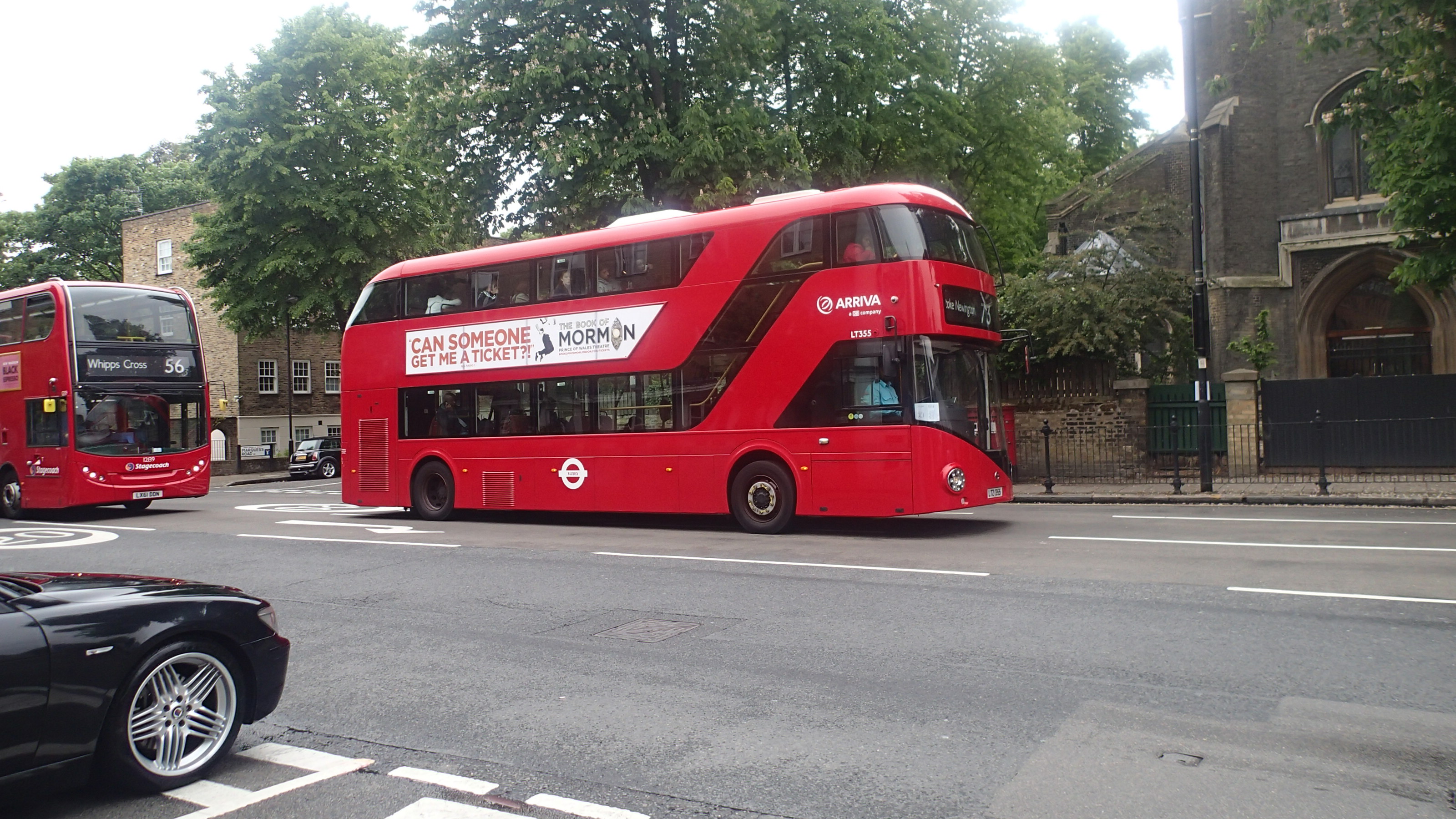
These buses are powered by a small four-cylinder version of the B-series engine, called a 4.5L ISB, which is described like this in Wikipedia.
The 4.5L ISB is essentially a four-cylinder, two-thirds version of the 6.7L ISB rated at 185 hp (138 kW), used in the New Routemaster, a series hybrid diesel-electric double-decker bus in London.
Note.
- Some diesel Range-Rovers, have more power, than these buses, but then they’re not hybrids.
- The engine also needs to be smaller, as it’s mounted under the back stairs.
Did Cummins’ special engine. allow the unique design of London’s Routemaster Buses?
Could London’s Routemaster Buses Be Converted To Hydrogen?
As an engineer and with my knowledge of Cummins’ design and manufacturing methods, I am fairly certain, if Cummins can manufacture six-cylinder versions of the B-Series engines, then four-cylinder hydrogen-powered engines are not far behind.
If London were to convert the thousand New Routemaster buses to hydrogen, there would be winners all round.
- Cummins would love the publicity and would probably benefit from increased sales of their hydrogen engines in vehicles like refuse trucks and small buses.
- It would surely give a route to convert older vehicles to hydrogen.
- The air in cities will improve.
But London has a problem, It is one of the few large cities in the world without readily-available hydrogen.
As this post illustrates and my Google searches show, India has a more advanced and scientifically-correct view on the usefulness of hydrogen.
Will Jaguar Land Rover Switch To Cummins’ Hydrogen Engines?
If Tata Motors make a success of hydrogen in India, it must make them think about adding hydrogen engines to Jaguar Land Rover products, specially as other manufacturers are getting serious about hydrogen.
Conclusion
Cummins will change the world for the better.
Trucks On Moorgate
I took these pictures of trucks on Moorgate this morning in one twenty minute period.















Note.
- All of the large trucks were diesel-powered.
- Some smaller vans might have been electric.
- Six of the trucks were concrete mixer trucks.
- One of the concrete mixer trucks was advertising ECOPact The Green Concrete.
Surely, if large heavy good vehicles, like these were hydrogen-powered, it would cut carbon footprints and reduce pollution.
I doubt we’ll see many hydrogen trucks in London, until we have a Mayor, who has a hydrogen policy that isn’t to ignore hydrogen and hope it goes away.
Should Hydrogen-Powered Trucks Pay A Lower Charge In The Silvertown And Blackwall Tunnels?
London has a lot of heavy diesel trucks, which include.
Cement mixer trucks.
Large eight-wheeler trucks transporting aggregate, building materials and construction spoil to and from construction sites.
Council refuse trucks.
Skip trucks.
Supermarket delivery trucks.
They are large polluters and the only way they will be made zero-carbon, will be to use hydrogen.
In Cummins Agrees To Integrate Its Hydrogen ICE Technology Into Terex® Advance Trucks, I write about how Cummins and Terex are going to be building hydrogen-powered cement mixers.
This picture shows the baby of the range, which could be ideal for a smaller country like the UK.
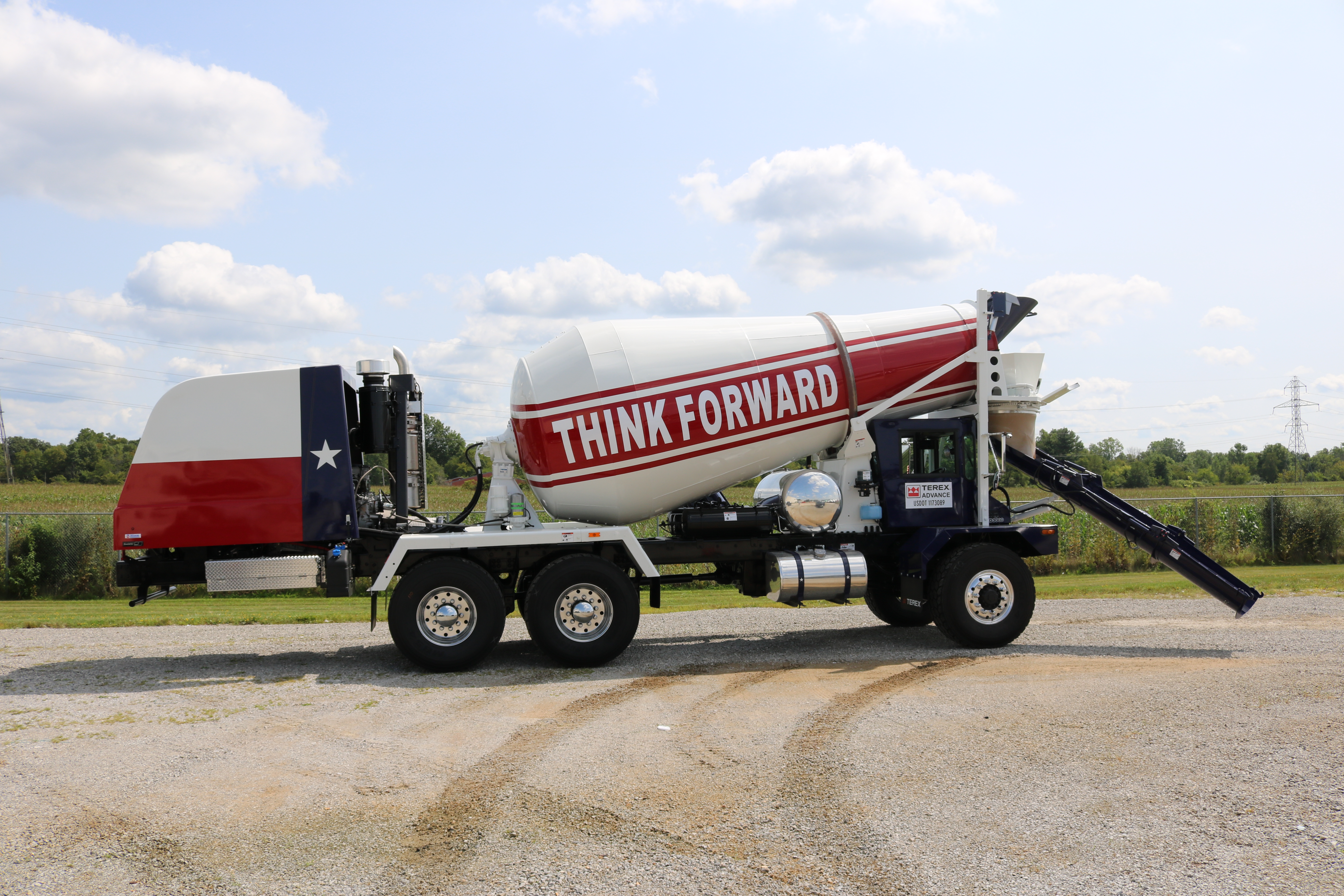
Note how it is the other way round to traditional cement mixer trucks.
As companies are now selling low-carbon concrete in the UK, I suspect, it won’t be long before they will be delivering it in a hydrogen-powered zero-carbon truck.
If hydrogen-powered trucks could be given an economic boost, by lowering their charges for the Silvertown And Blackwall Tunnels, this might increase their uptake by owners of large trucks, which would in turn reduce pollution.
But this would need the election of a London Mayor, who had a hydrogen policy other than ignore it and hope it goes away.
Silvertown Tunnel: Cracks In Mayoral Policies
The title of this post, is the same as that, as this article on the BBC.
This is the sub-heading.
It is an infrastructure project that is well-underway with the boring almost completed — but it has a very low profile.
These three paragraphs possibly explain why.
Every step of the Crossrail tunnelling, the media were invited along. Not so with this project.
This is Silvertown Tunnel. It is more than 1km long and will be London’s first road tunnel in over 30 years.
Perhaps one of the reasons it isn’t being pushed publicity-wise, is it is very controversial.
Reading the rest of the article it certainly is controversial in many people’s minds.
These are my thoughts.
Avoiding The Dartford Crossing
When I drove back to Suffolk from Gatwick, Kent or Sussex, in the last century, because of congestion at the Dartford Crossing, I would sometimes cut through London and use the Blackwall Tunnel, when I thought it would be quicker.
When the Silvertown Tunnel opens, this could be a viable alternative for vehicles.
My experience of modelling flows, tells me, that water finds its own level. With driving, Satellite Navigation will be able to tell drivers, which will be the fastest route.
It is my view, that the Silvertown Tunnel will become the biggest rat-run in London.
Except some of these rats will be super-rats in 45-tonne HGVs.
Cutting Pollution In London
If super-rat-running is going to happen, then this will raise pollution in Central London, with all those heavy trucks going through.
The only way to cut pollution would be to have differential pricing for vehicles in the tunnels.
Perhaps hydrogen and electric vehicles should be at a discount.
But then Sadiq Khan doesn’t have a hydrogen policy, except to ignore it and hope it goes away.
The Elizabeth Line Effect
Talking to Elizabeth Line staff at Whitechapel station, they feel that there is an increasing number of passengers, who do journeys in East London on an up-one-branch-down-t’other basis between places like Ilford and Woolwich.
I believe, that other cross-river railways and the Bank station improvements, will also take passengers out of their cars, which will free up the Silvertown Tunnel for more HGVs.
A City Airport Station On The Elizabeth Line
I wrote about this in Thoughts On London City Airport And The Elizabeth Line.
How many cars would this remove from the tunnels under the Thaames?
Exploring London Bus Route 132
London Bus Route 132, is run by battery-electric buses and it the first in London to use opportunity charging.
These pictures show the route from North Greenwich to Bexleyheath Shopping Centre.









































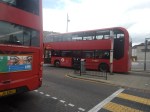

Note.
- These pictures were shot in two sections on the 3rd and the 6th of July 2023.
- The break was at Eltham station.
- Some sections of the route had a lot of cars.
- Some side roads were full of parked cars.
- There were large numbers of cars parked in front of houses.
There are my thoughts.
More will appear here over the next couple of days.
The Buses
The buses used on the route are Alexander Dennis Enviro400EV, which are built on a BYD Auto chassis.
They have a range of 160 miles.
The Route
The route has several inclines both ways and I estimate it is just under ten miles.
At North Woolwich, the bus didn’t appear to have a charge, but I can’t be sure.
But it disappear at Bexleyheath Shopping Centre and I was certain it went for a charge.
So is the operational philosophy to fill, the bus up overnight and then top the battery up every time, that it needs it at Bexleyheath.
A Comparison With A Similar Route In Birmingham That Has Hydrogen-Powered Buses
As the bus ran between North Woolwich and Bexleyheath Shopping Centre, I was comparing it, with the trip, I made across Birmingham, in hydrogen-powered buses, that I wrote about in Riding Birmingham’s New Hydrogen-Powered Buses.
Both were quality buses, but I felt the hydrogen bus had more power.
Opportunity Charging At Bexleyheath
If, buses need to be charged at the Bexleyheath Shopping Centre end of the route, where will they go?
This Google Map shows Bexleyheath Bus Garage in relation to the Shopping Centre.
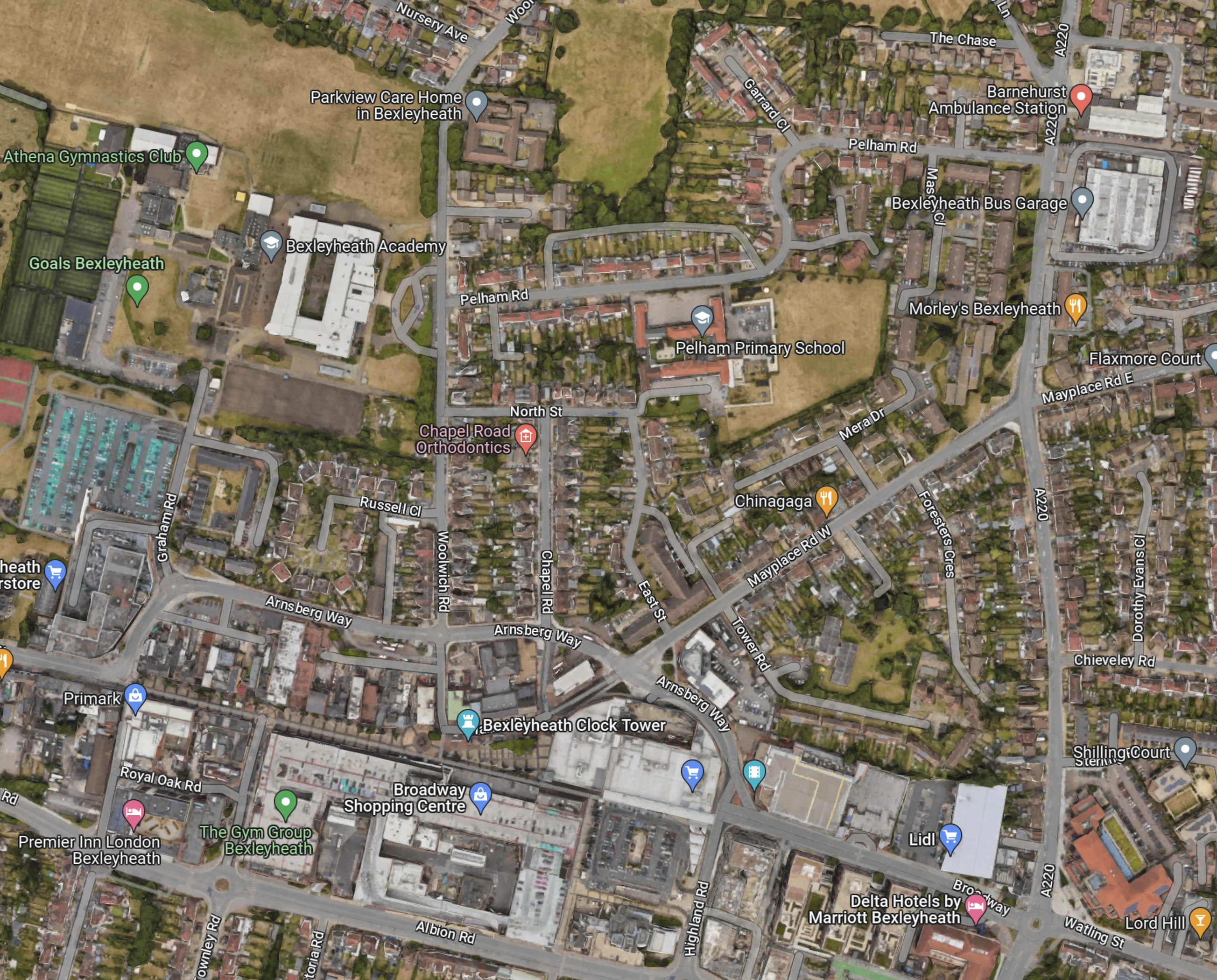
Note.
- Bexleyheath Bus Garage is in the North-East corner of the map.
- It looks like it shares a site with Bexley Fire Station and Barnehurst Ambulance station.
- So the garage is well located for any future lithium-ion battery fires.
- In the middle of the map at the bottom, is Bexleyheath Clock Tower, in the middle of the town centre.
- I estimate it’s less than two kilometres between Bexleyheath Bus Garage and the Shopping Centre.
This Google Map shows a close-up of the Western side of the Bexleyheath Bus Garage.
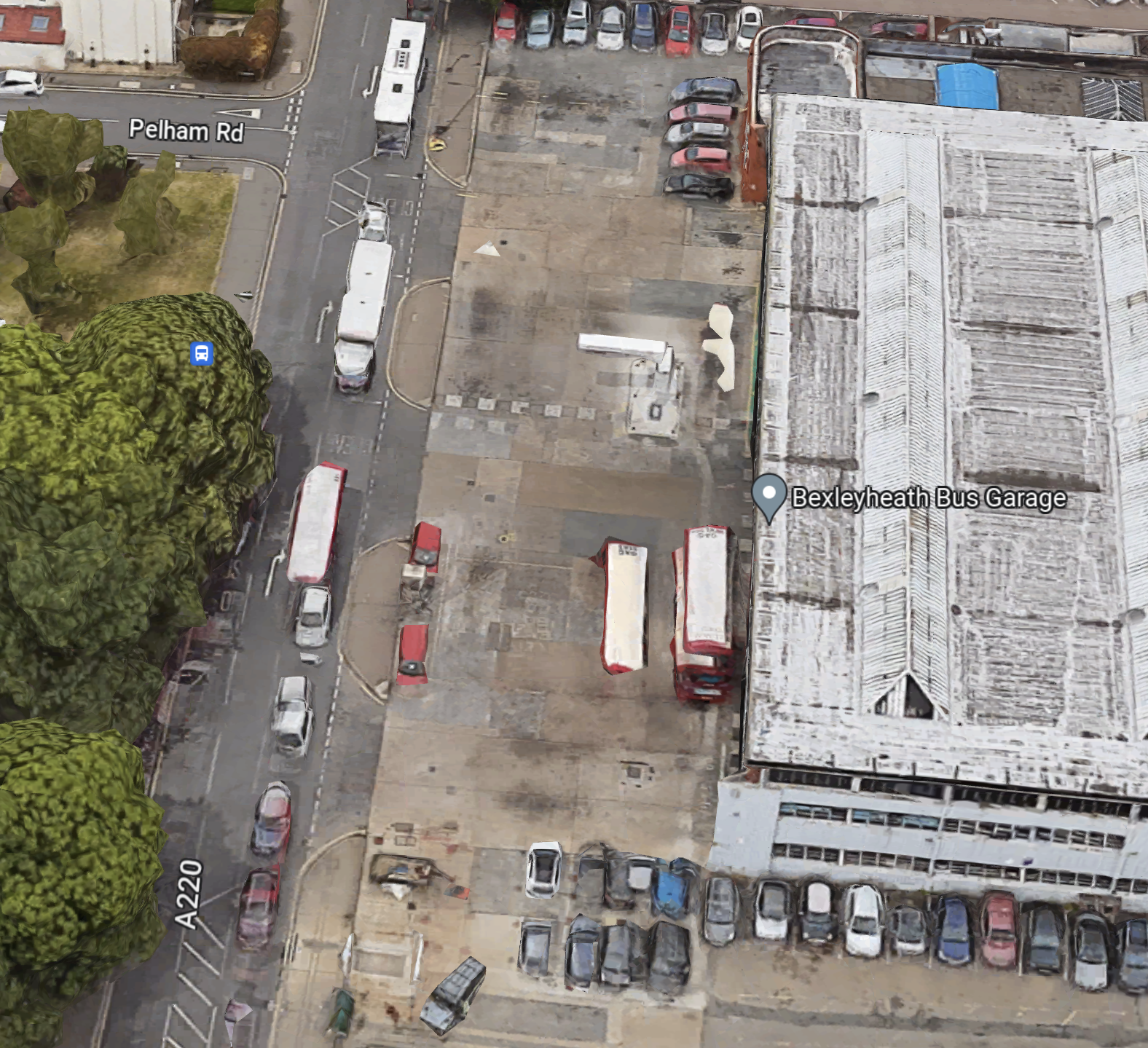
Note.
- The two buses parked by the side of the garage.
- Behind them a white arm reaches over towards the road.
- This is the charger and buses connect using a pantograph on the roof.
It could be an All-In-One Fast Charging Station AIO from Furrer+Frey.
The Electrical Connection At Bexleyheath Bus Garage
Consider.
- The bus garage shares a site with a fire station and an ambulance station, which surely must need a reliable power source.
- This is London’s first application of opportunity charging.
- There are improvements constantly happening to London’s struggling power network.
- It is a large site and I suspect there is space for a battery to boost power.
I would assume that Transport for London wouldn’t have chosen a bus garage with a dodgy power supply.
Could The Charger Be Solar-Powered?
This Google Map shows the roof of Bexleyheath Bus Garage.
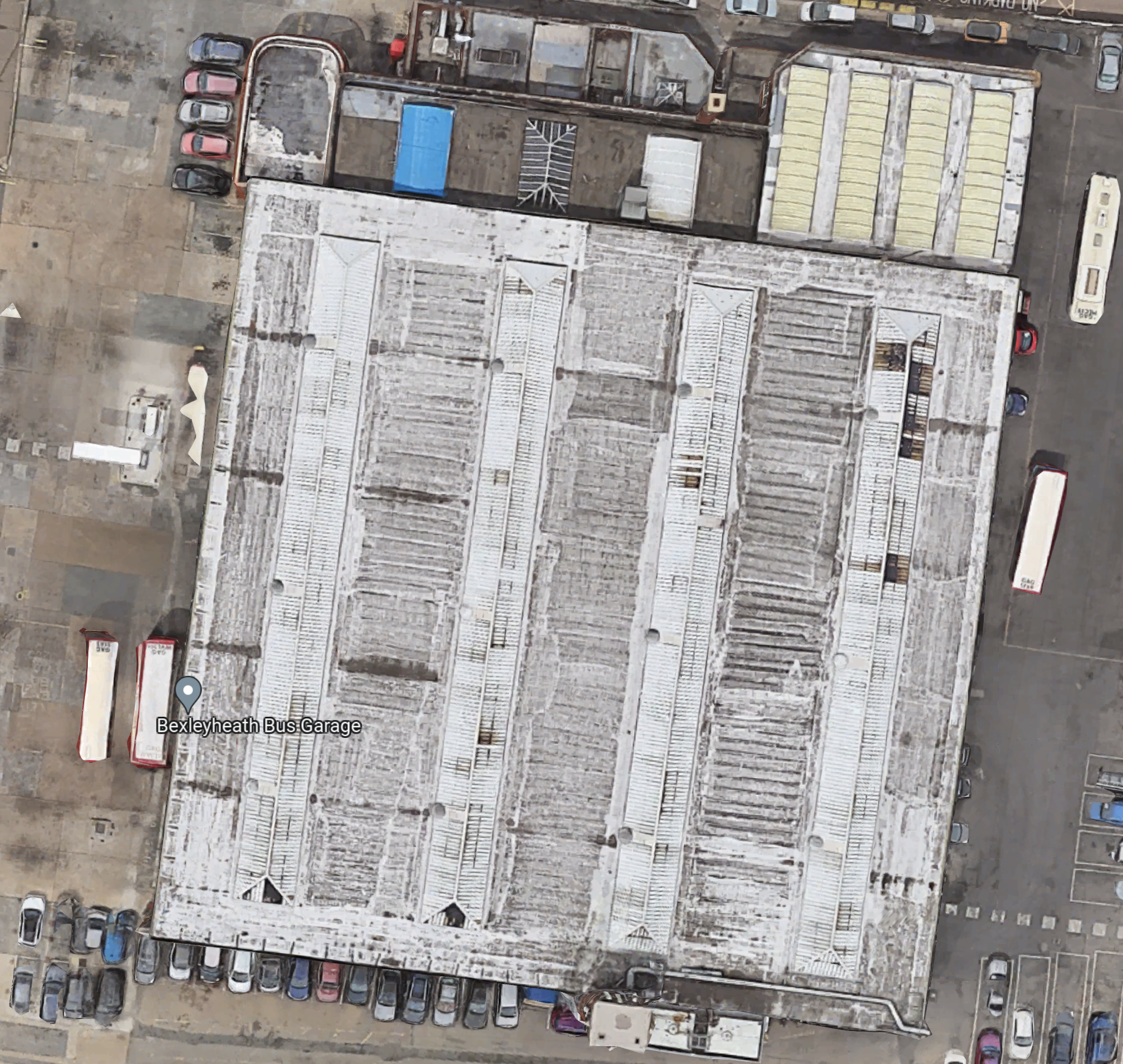
Note.
- It appears to be a square with a length of about six buses.
- It looks rather dirty.
I suspect that the roof could be replaced with a modern solar roof.
Hydrogen Or Electric
This article on RouteOne is entitled Enviro400FCEV Hydrogen Bus Fleet For Liverpool Debuts.
This paragraph describes the performance.
Alexander Dennis has chosen the heavy-duty variant of VEDS. It is designed to deliver up to 410kW of power, but the vehicle OEM says that in the Enviro400FCEV, output is limited to 350kW. Such an approach will maximise fuel economy while still enabling a high road speed and good hill climbing ability. Expected range is up to 300 miles.
So the range on hydrogen is nearly doubled.
Wrightbus’s outwardly similar electric and hydrogen buses have ranges of 200 and 280 miles, but filling times of 2.5 hours and 8 minutes.
The problem with hydrogen in London, is that the Mayor and Transport for London, don’t appear to have a hydrogen policy.
But I think, that hydrogen will win out in cities and areas, where hydrogen can be supplied.
I also believe that hydrogen has other advantages.
- There is likely to be significant progress in improving hydrogen-powered heavy vehicles.
- Hydrogen internal combustion engines are coming and could promise more affordable hydrogen buses.
- Better and more affordable methods to create green hydrogen are being developed.
- Some existing diesel buses will be able to be converted to buses powered by hydrogen internal combustion engines.
- Lithium-ion batteries have a high environmental footprint.
Hydrogen is also likely to be the fuel of choice for heavy trucks.
SSE Becomes First Utility To Trial First Hydrogen Fuel Cell EV Van
hydrThe title of this post, is the same as that of this article on Hydrogen Central.
This is the first two paragraphs.
The low-carbon energy infrastructure company will be the first utility to trial the hydrogen-powered vehicle – and the first to put it to the test in real-life fleet operations by deploying the vehicle with SSE engineers.
The project will enable First Hydrogen’s team to gather data on fuel consumption, usage, and efficiency. The trials are being used to inform development of First Hydrogen’s Generation II series, currently in development, and will help enhance Total Cost of Ownership (TCO) data.
The deployment will take place in Aberdeen, as the city has some of the UK’s best hydrogen infrastructure.
The Mayor of London please note how being a hydrogen denier causes London to have more pollution.
Why Should I Pay For The ULEZ Scrappage Scheme?
The Mayor’s pet anti-pollution project the ULEZ scheme is controversial to say the least.
This article on the BBC is entitled ULEZ: Labour MPs In London Call For ULEZ Scrappage Scheme Review.
So even MPs in his own party don’t agree with the current policy!
Consider.
- I am a non-driver after a stroke ruined my eyesight.
- The only possible benefit, that I might get, is slightly less pollution around where I live.
- But the jury is out on that and the current evidence is dubious, as the Mayor has paid for it to be collected.
- In 2021, the population of London had the chance to remove Sadiq Khan, but decided to re-elect him, despite his ULEZ policy.
- So I have no sympathy for those, who have to rely on a non-compliant car or van to go about their daily business.
- They knew they had to either get a compliant vehicle, pay the £12.50 per day or move to somewhere with a friendlier transport policy.
- If the Mayor wanted to cut pollution in London, he could at least have a hydrogen policy, which allowed large trucks based in London to use this clean fuel.
We have another Mayoral election in 2024!
I shall not be voting for any candidate, who proposes to use London taxpayers’ hard-earned money for a scrappage scheme or who doesn’t have a feasible hydrogen policy.
ULEZ: Impact Of Mayor’s Expansion Questioned
The title of this post, is the same as that of this article on the BBC.
This is the sub-heading.
One in six cars registered in outer London did not meet Ultra Low Emission Zone (ULEZ) standards last year, according to figures from the Society of Motor Manufacturers and Traders
These paragraphs outline the analysis.
The data was released following a Freedom of Information request by the BBC to Transport for London (TfL).
It comes amid a dispute over whether existing data used by City Hall and TfL is accurate.
However, London Mayor Sadiq Khan said the newly released data was unreliable.
From the end of August, all those driving vehicles within Greater London that do not meet ULEZ pollutant limits will face a £12.50 daily charge or a £180 fine.
I’m sure that any Professor of Statistics from London’s universities or an expert from the Royal Statistical Society, could give a definitive answer on the statistics.
But then Khan is a lawyer and will hide behind the law in this case, by claiming he is both judge and jury.
If Khan really cared about London’s air, he would have a hydrogen policy, which would enable London’s local cement, construction and refuse trucks to be replaced or converted to hydrogen, so that the city’s air improved.
It would also make it easier to introduce more hydrogen-powered buses.
Companies like Tesco and Marks & Spencer, who regularly run trucks into London, should be encouraged to convert their delivery trucks to zero-carbon, by adjustment of the ULEZ charges.
The ULEZ has been badly thought out and needs to be realigned with what is practical and reduces the pollution.
 The Anonymous Widower