Travelling Between Heathrow Airport And Staines Station
Staines Station and Heathrow Airport are not far apart, as this OpenRailwayMap shows.
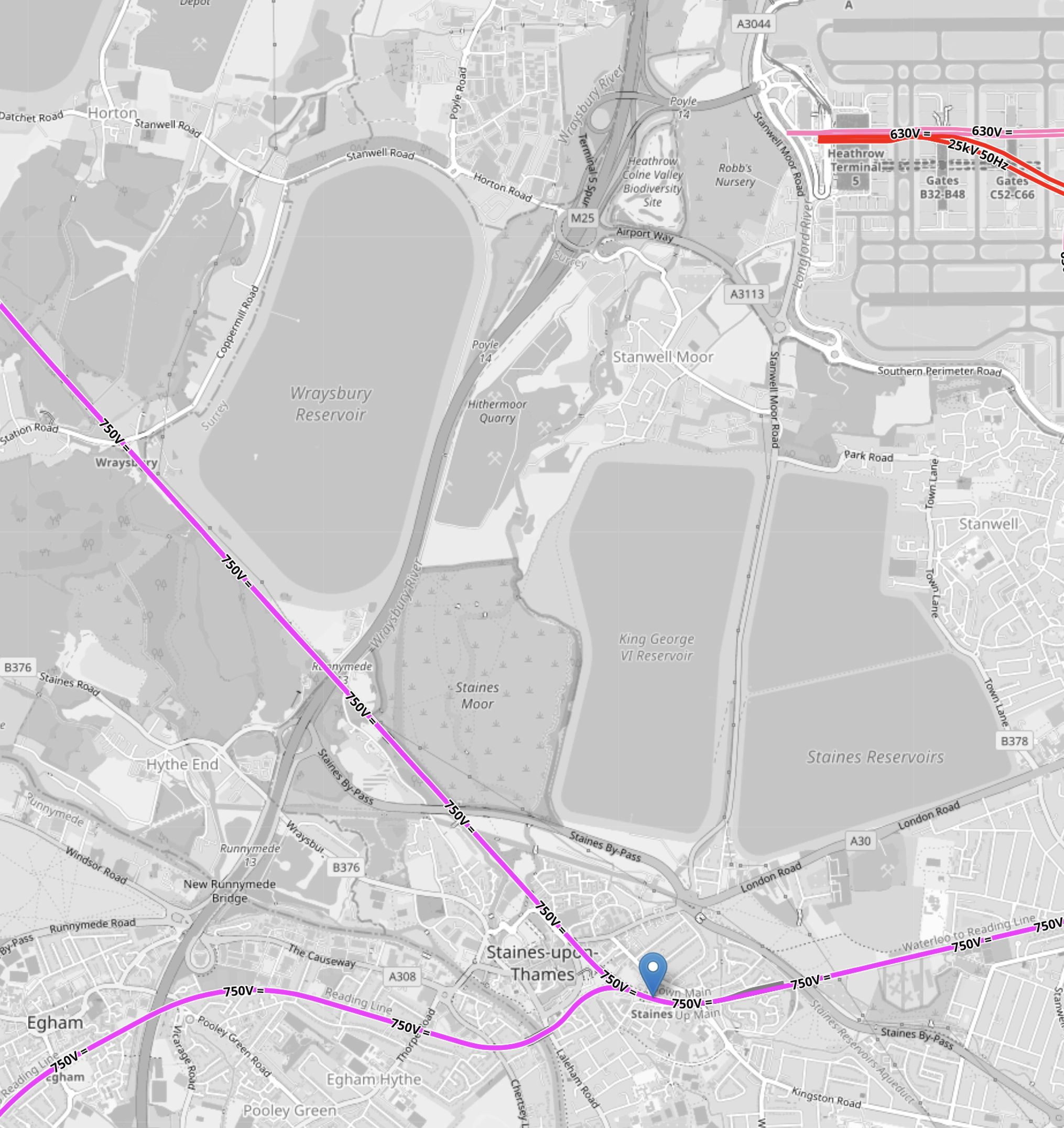
Note.
- The mauve lines in the bottom half of the map are South West Trains services out of Waterloo.
- Waterloo via Feltham, Twickenham and Richmond to name but three stations , is to the East.
- Reading is to the South-West
- Windsor is to the North-West.
- The blue arrow indicates Staines station.
- Heathrow Terminal 5 is in the North-East corner of the map.
- The pink tracks are the Piccadilly Lines
- The red tracks are for the Elizabeth Line and Heathrow Express.
- This OpenRailwayMap shows Terminal 5 to a larger scale.

Note.
- The pink tracks are the Piccadilly Line.
- The red tracks are for the Elizabeth Line and Heathrow Express.
- In front of the red tracks is what looks like a circular walkway or emergency exit, with a rectangular block to its West.
- The rectangular block is the lift tower to get from the railway station to the Departures and Arrivals floors of Terminal 5.
I asked Google AI if it would it be possible in the future to extend the Elizabeth Line to the West out of the Western end of Terminal 5 and received this reply.
Extending the Elizabeth line west from Terminal 5 is technically possible and has been proposed, notably as part of a potential westward rail link to Staines or to support airport expansion, but it is not currently funded. Terminal 5 was designed with future expansion in mind, potentially allowing a connection to Staines to create a “southern rail link” for better connections.
Perhaps there are two tunnels under the lift shafts?
How many trains per hour (tph) terminate in those two platforms?
- 4 tph – Heathrow Express
- 2 tph – Elizabeth Line to Shenfield.
Note.
- Only six trains in two platforms is easily managed.
- Because, Heathrow Express services appear to use both platforms, when I visited yesterday, the system seems to confuse passengers.
- The services surely need to be evened up, so that there are four tph of each service, with each service having a dedicated platform.
- But terminating eight trains in two platforms could be troublesome.
- Platforms are numbered 1 to 6 from the South.
- Platforms 1 and 2 have not been built yet.
Although four tph for Heathrow Express in one platform, should be easy with digital signalling, as you see it every day in London, it may be difficult on two platforms, at the same time.
In Is More Capacity Between Heathrow Airport And Central London, Needed On The Elizabeth Line?, I said this.
Currently, the Elizabeth line provides up to 12 trains per hour (including Elizabeth line and Heathrow Express) on the relief lines, making it nearly at capacity.
Note.
- When I use the Elizabeth Line, I deliberately avoid trains going to and from Heathrow, unless I’m going that way, as they are too crowded with passengers and their oversized cases.
- High Speed Two, the West London Orbital Railway and the North London Line will bring passengers for Heathrow Airport to Old Oak Common station.
- Surely, as Heathrow Airport gets bigger and increases its passenger numbers. the Elizabeth Line will need to be increased in capacity.
I believe Elizabeth Line capacity needs to be increased soon.
The only feasible plan I’ve seen is Heathrow Southern Railways plan, which included.
- Construction of a bay platform 0 at Staines alongside the Staines to Windsor line.
- A step-free bridge across the tracks.
- Construction of a single-track railway with 25 KVAC overhead electrification and a passing looop, between the new platform 0 at Staines and Platform 3 at Heathrow Terminal 5 station.
- Run four trains per hour in both directions between Heathrow Terminal 5 and Staines stations.
- This plan would would add two trains per hour through the Central Tunnel.
Various Journeys Would Be As Follows
This OpenRailwayMap shows Staines junction and the positions of the three platforms.
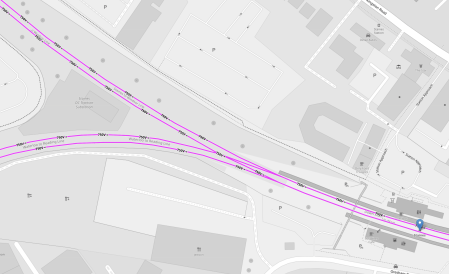
Note.
- The Windsor Line goes North-West.
- The Reading Line goes West.
- The Waterloo Line Goes East.
- Platform 1 is on the North side of the tracks.
- Platform 2 is on the South side of the tracks.
- The bay platform, which I’ve numbered 0, will be on the North side of the tracks towards Windsor.
- I suspect the step-free bridge will be over the tracks and replace the current rickety structure.
- The bridge would be a short walk from all three platforms.
Interchanges would be as follows.
- Windsor to Heathrow – Walk between Platforms 1 and 0.
- Reading to Heathrow – Walk between Platforms 1 and 0.
- Heathrow to Windsor – Cross the bridge between Platforms 0 and 2.
- Heathrow to Reading – Cross the bridge between Platforms 0 and 2.
- Waterloo to Heathrow – Cross the bridge between Platforms 2 and 0.
- Heathrow to Waterloo – Walk between Platforms 0 and 1.
Note.
- All trains to or from Heathrow use Platform 0.
- All trains to Waterloo use Platform 1.
- All trains going away from Waterloo use Platform 2.
- Reading and Heathrow gain a step-free route at 2 tph.
- All interchanges at Staines station would be step-free.
- A train like London Crosslink, which used to go between Feltham and Woking, would use Platform 1 going towards Feltham and Platform 2 going towards Woking.
Staines station would gain step-free access to all Heathrow terminals, all Elizabeth Line and High Speed Two stations.
Could Anglia Railways’ London Crosslink Be Recreated As Part Of The London Overground?
I like the idea of the London Crosslink service, that ran for a few years between East Anglia and Hampshire via the North London Line and Staines.
My arguments for its restoration are described in Could Anglia Railways’ London Crosslink Be Recreated As Part Of The London Overground?
At various times in my life, it would have been very useful.
Today, as I live about fifteen minutes from Highbury and Islington station, I could use London Crosslink for the following reasons.
- Visiting friends and family in Hampshire.
- Going to Heathrow Airport, especially Terminal 5.
- Visiting friends in East Anglia.
- Going to football at Ipswich.
- Exploring new parts of England.
- I would wait at home and time my departure to catch a booked train at a fully step-free station.
Conclusions
Extending the Elizabeth Line to Staines gives these advantages.
- Staff at Heathrow, who live in the Staines area get easy access to the airport.
- Buses and coaches between Heathrow and the local area may be reviewed.
- Less cars will be used to get to and from the airport.
- Reading and Heathrow gain a step-free route at 2 tph.
- A lot of stations would gain a step-free route to all terminals at Heathrow, and all Elizabeth Line and High Speed Two stations.
There may well be other advantages.
That Was Close!
I took this picture in Liverpool Street station on the Elizabeth Line.
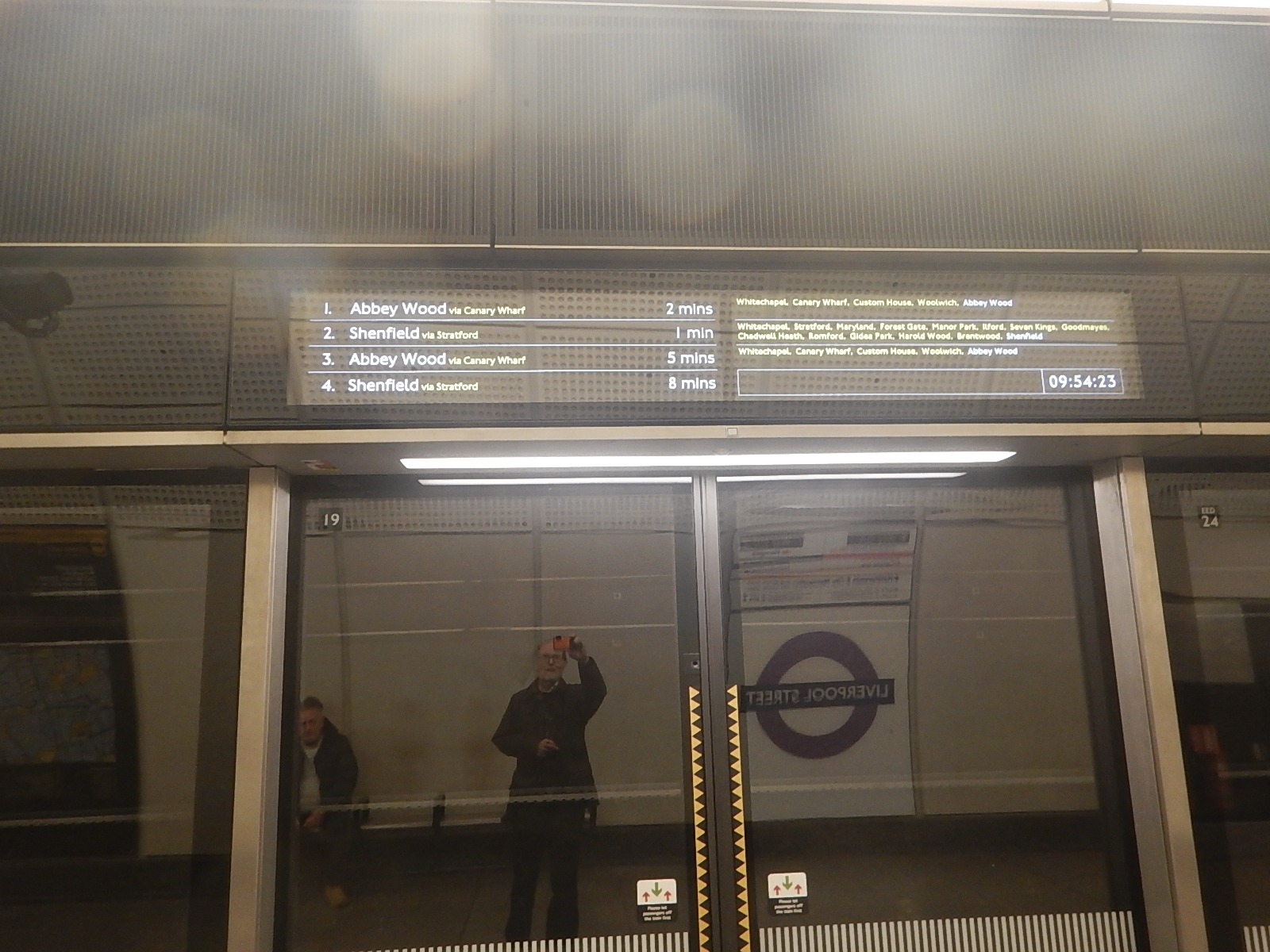
Note.
- The timings of the first two trains.
- The Shenfield train did arrive before the one for Abbey Wood.
How did it manage that? It looks like a another Fujitsu moment in the display to me!
Shenfield To Heathrow – 21st May 2023
Today, is the first day, when Elizabeth Line trains are running direct between Shenfield station and Heathrow.
I took the 10:41 train from Shenfield and it arrived at Heathrow Terminals 2 & 3 station at 12:02.
I took these pictures on the route.
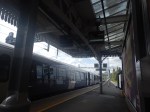
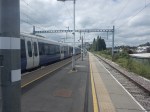
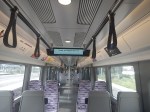
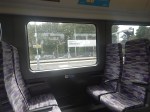
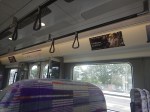
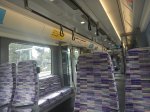
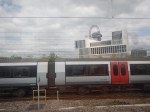
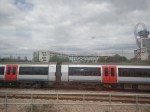
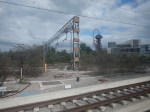
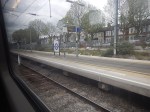
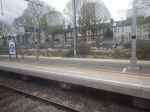

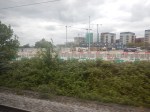
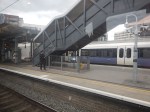

Note.
- The busiest section of the journey was between Ilford and Liverpool Street, when all seats were taken.
- It was also reasonably busy after Ealing Broadway.
- Are passengers going to Heathrow Airport with a change at Ealing Broadway?
Given the crowds of passengers, that I keep seeing on the Elizabeth Line, I keep thinking that the sixteen trains per hour (tph) Off Peak frequency needs to be increased.
The First Elizabeth Line Train From Shenfield To Heathrow Leaves At 07:26 Tomorrow
The National Rail timetable is showing that tomorrow, Elizabeth Line trains will leave Shenfield at four minutes to the half-hour.
They take ninety minutes to get to the airport.
The Ultimate Bi-Mode
This picture shows, what could be an experiment by Freightliner at Shenfield.
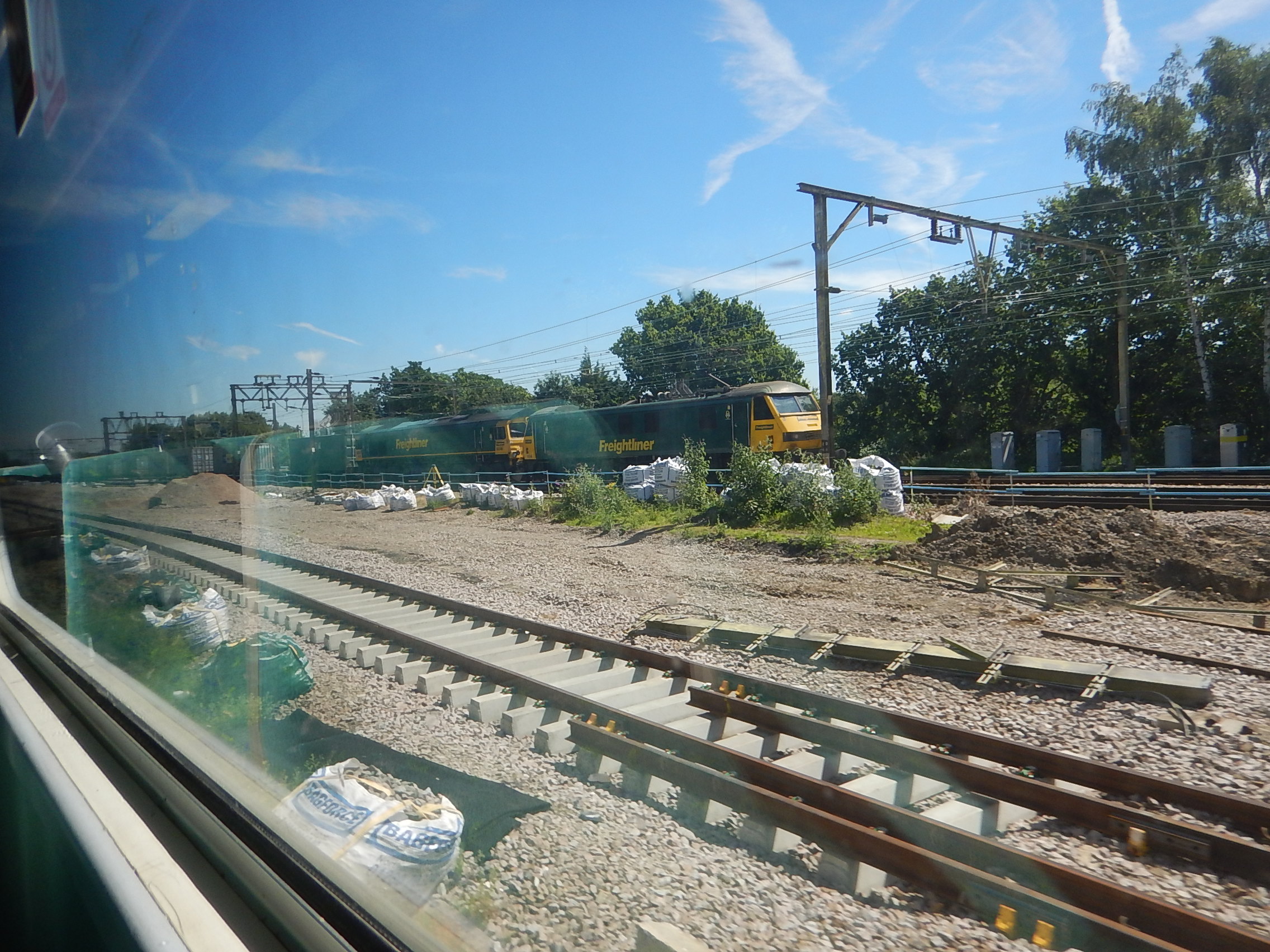
Unfortunately, I didn’t have a chance to ask the driver, if the Class 66 locomotive was running dead-in-train or helping the Class 90 locomotive with a very heavy load.
The picture shows, that the electric and diesel locomotives can work together, at the front of a train.
Note.
- The Class 66 locomotive has a power of 1,850 kW and the Class 90 locomotive has 3,730 kW.
- Did the Class 66 locomotive pull the train out of Felixstowe?
Since I took this picture, I’ve never seen a similar pairing again.
Was Baldrick An Essex Man?
I have been looking at Network Rail’s page for Beaulieu Park station.
This is the heading.
Network Rail and Essex County Council are working together to develop proposals for the first railway station to be built on the Great Eastern main line for over 100 years.
These two paragraphs outline the project and where the finance is being obtained.
The new station is part of a wider regeneration of the Beaulieu Park estate in Chelmsford with new road infrastructure and up to 14,000 homes.
Essex County Council, in partnership with Chelmsford City Council, successfully secured £218m of funding from the Government’s Housing and Infrastructure (HIF) fund together with £34m contributions from the South East Local Enterprise Partnership and the developers of Beaulieu, Countryside and L&Q.
These features of Beaulieu Park station are listed on the page.
- Three platforms with a central loop line and new tracks to enable stopping services to call at the station while allowing fast trains to pass through unimpeded
- Step free access to all platforms via 2 lifts
- Accessible toilets, baby change facilities, waiting area and space for retail/catering
- Ticketing facilities, with ticket vending machines and a gate line
- Pedestrian and cycle access routes to the station
- 500 spaces for cycle parking and storage
- A bus interchange including bus stands for local services
- Pick up and drop off area with dedicated taxi bays
- Parking for over 700 cars, 5% of which to be designated Blue Badge bays, and motorcycle spaces, as well as dedicated parking for station staff, emergency services, and a dedicated space for service access.
Note.
- How many other parkway stations, other than Ebbsfleet International station have 700 parking spaces?
- The parking at Whittlesford Parkway can only hold 377 vehicles.
- How many other parkway stations have an overtaking loop for faster trains?
Beaulieu Park is not your average parkway station!
I have a few thoughts.
Which Of The Current Services Will Call?
The Network Rail page says this about services.
It will provide additional access to the railway with regular connections to the capital (only 40 minutes from London Liverpool Street station) and other destinations in the east of England. New tracks will enable stopping services to call at the station while allowing fast trains to pass through unimpeded.
Note.
- Trains between London and Hatfield Peverel station typically take under forty minutes.
- Two fast trains per hour (tph) between Liverpool Street and Norwich via Colchester, Ipswich and Stowmarket pass through.
- Only one of the fast trains stops at Chelmsford.
- Four stopping tph, one to each of Braintree, Clacton-on-Sea, Colchester Town and Ipswich pass through.
If all the stopping trains stopped, Beaulieu Park would have the following services.
- Braintree – 1 tph
- Chelmsford – 4 tph
- Clacton-on-Sea – 1 tph
- Colchester – 3 tph
- Colchester Town – 1 tph
- Hatfield Peverel – 1 tph
- Ingatestone – 2 tph
- Ipswich – 1 tph
- Kelvedon – 2 tph
- London Liverpool Street – 4 tph
- Marks Tey – 2 tph
- Romford – 1 tph
- Shenfield – 3 tph
- Stratford – 4 tph
- Witham – 4 tph
All trains are new Class 720 electric trains.
I also feel, that Network Rail could be being cunning.
Suppose, the Liverpool Street and Norwich express, that doesn’t stop at Chelmsford, stopped instead at Beaulieu Park.
- This would give an hourly express service between Beaulieu Park and Norwich, which stopped at Colchester, Manningtree, Ipswich, Stowmarket and Diss.
- It would also enable two tph between Beaulieu Park and Ipswich.
The 700 parking spaces at Beaulieu Park now start to make sense.
- Both Ipswich and Norwich stations are within walking distance of the town centres and the football grounds.
- Ipswich station has a shuttle bus service to the town centre and the hospital.
- Both stations have several local train services.
Beaulieu Park station appears to have been designed as a Park-and-Ride station for the Great Eastern Main Line and all its branches.
Services To And From Lowestoft
In Making Sense Of The New East Anglia Franchise, I looked in detail at Greater Anglia’s promises.
In a section, which is entitled London – Lowestoft – Yarmouth Services, I said this.
There are going to be four direct services between London and Lowestoft each day. This probably initially means two trains to London in the morning peak and two trains back in the evening one.
When, I first moved back to Suffolk in the 1970s, I regularly caught a diesel-hauled train from Wickham Market to London for the day.
This is all motherhood and apple pie for those in Lowestoft wanting to go to London, but I suspect it isn’t the easiest service for a train operator to schedule efficiently and make money.
Would a train operator really want to start a full train at Lowestoft at say six in the morning and then have it wait around all day in London before returning in the evening?
The service hasn’t started.
Services To And From Cambridge Or Peterborough
At some time in the last decade, one of the predecessors of Greater Anglia, used to run a service to Peterborough via Colchester and Ipswich, so that travellers in Essex could catch trains to the North.
Given too that Cambridge has an employment problem, if a service was run, it might attract passengers.
The Class 755 trains Could Serve Bury St. Edmunds, Cambridge, Lowestoft, Newmarket, Peterborough And Yarmouth
Consider.
- A pair of Class 755 trains would leave Liverpool Street.
- They would use electric power to run to Ipswich.
- The trains would run in one of the paths of the current hourly Ipswich service.
- Like their all electric siblings; the Class 745 trains, they would probably run most of the journey at near 100 mph.
- At Ipswich the trains would split.
- One train would go to on to Lowestoft and Yarmouth and the other would go to Cambridge and Peterborough.
If passenger numbers felt it was a good idea, I’m certain, it could be timetabled.
The Chelmsford Avoiding Line
In Will The Chelmsford Avoiding Line Be Rebuilt?, I described the avoiding line, that used to be between the two tracks at Chelmsford station.
It probably saved a few minutes, by allowing fast expresses to pass stopping trains.
Effectively, a new avoiding line is being built at Beaulieu Park, a few miles from the original position at Chelmsford.
So will the fast expresses save a few minutes?
Could The Elizabeth Line Run To Beaulieu Park?
Consider
- The end sections of the Elizabeth Line seem to be busy, as I wrote in Very Busy Lizzie.
- The City of Chelmsford is between Shenfield and Beaulieu Park.
- Paddington and Reading is 35.9 miles.
- Liverpool Street and Hatfield Peverel is 35.9 miles.
So Beaulieu Park is actually closer to London than Reading.
Perhaps, at some time in a few years, passenger traffic between Beaulieu Park and Shenfield will be such, that the Elizabeth Line will be extended to Beaulieu Park.
The ideal service from Beaulieu Park would surely be two tph to Heathrow, as getting to Heathrow from East Anglia by train needs a change at Liverpool Street.
The only drawback is that to work effectively on the Great Eastern Main Line, a sub-variant of the Class 345 trains will be needed with a 100 mph operating speed. I wrote about these trains in Extending The Elizabeth Line – High Speed Trains On The Elizabeth Line.
But they may have the advantage of being able to take the fast lines between Shenfield and Stratford.
Conclusion
Beaulieu Park may just look like any other station to serve a housing development.
But it’s a lot more than that!
- It’s a Park-and-Ride for the whole Great Eastern Main Line and London.
- It should speed up expresses between London and Colchester, Ipswich or Norwich.
- It should improve local connectivity.
- It could take a lot of traffic off the nearby A12.
- It could give the City of Chelmsford its own local metro.
- It could give Heathrow a direct link to much of Essex.
- How much carbon will be saved by passengers?
We need many more well thought out Park-and-Ride stations.
Very Busy Lizzie
Yesterday, I took the Elizabeth Line, back from Reading to Moorgate.
- When, I got on at Reading, there were perhaps fifty empty seats and I was able to have three seats to myself.
- But by Slough, It was standing room only!
- It cleared a bit at Paddington, but by Moorgate there were only a few seats left.
Currently, there are two trains per hour (tph) between Abbey Wood and Reading stations.
As other passengers said it’s always busy, I suspect that Transport for London need to tweak the signalling, so that four tph run to Reading.
This section called Planned Service in the Wikipedia entry for the Elizabeth Line says this.
In May 2023, it is planned to allow trains to run from both eastern branches to west of Paddington. This will allow both more flexible, and higher frequency, services: 24 tph peak, 20 tph off-peak, and direct services between Shenfield and Heathrow. In the longer term, when Old Oak Common opens, all trains will serve Old Oak Common, with those not serving the Reading or Heathrow branches reversing there.
The service changes for May 2023 were confirmed in February 2023. The peak timetable will increase to 24 trains per hour. Off-peak service level will remain at 16 trains per hour, with two Shenfield–Paddington trains extended to Heathrow Airport Terminal 5 and two Abbey Wood–Terminal 5 trains switching to Terminal 4.
This will give an Off Peak schedule as follows.
- Reading and Abbey Wood – 2 tph
- Maidenhead and Abbey Wood – 2 tph
- Heathrow Terminal 4 and Abbey Wood – 4 tph
- Heathrow Terminal 5 and Abbey Wood – 0 tph
- Heathrow Terminal 5 and Shenfield – 2 tph
- Paddington and Shenfield – 6 tph
I don’t believe it is good enough.
- There is no direct Heathrow Terminal 5 and Abbey Wood service.
- Reading needs four tph to Central London.
- See Elizabeth Line: Commuters Say Service ‘Not What Was Promised’
- See So Many Cases On A Train!
I suspect passenger congestion and reaction will force a rethink by the Mayor and Transport for London.
Extending The Elizabeth Line – Rebuilding Shenfield Station
I have a feeling that Shenfield station will become a bottleneck on the Great Eastern Main Line.
- I feel that both passenger and freight traffic will increase through the station in the next ten years.
- I also feel that there is a possibility that the Elizabeth Line will be extended to Southend/Airport/Victoria and/or Beaulieu.
- Yesterday, I changed between a Southend and a Lizzie Line service, which meant down in one lift and up in another.
- With more and more housing likely to be built in the area, I wouldn’t be surprised to see a lot more parking.
I wouldn’t be surprised to see the station needing to be rebuilt and expanded in the next few years.
Crossrail’s New Opening Plan
This article on the excellent and well-informed IanVisits is entitled Crossrail Changes Its Staged Opening Plans.
Ian states that Crossrail will be split into two routes.
- Shenfield and Paddington
- Abbey Wood and Heathrow/Reading
Frequencies will be reduced, but Ian states there could be two positive benefits.
- Abbey Wood and Paddington could open earlier in 2022.
- The full integrated service could be brought forward six months.
Why is this possible?
These are my thoughts.
The Covid-19 Pandemic
The current TfL Rail service between Shenfield and Liverpool Street stations coped well before the pandemic and now with reduced passenger numbers it is able to handle current passenger loads without a problem.
I have used Crossrail from Paddington to Heathrow and Reading during the pandemic and Crossrail’s nine-car trains are handling passenger numbers with ease.
It would appear to me, that by using two platforms at Liverpool Street and Paddington stations, the benefits of Crossrail have been delivered to the East and West of the massive Greater London conurbation.
Stratford Station
Stratford station is more or less complete with respect to Crossrail.
- It can handle ten-car trains, if they run in the future.
- The two dedicated platforms for Crossrail, can probably handle the maximum frequency of trains, the line will ever carry.
But Stratford’s biggest advantage is the connections to the Central and Jubilee Lines, and the North London Line of the London Overground, which between them give access to most of Central and North London.
Ealing Broadway Station
A few weeks ago, a fully step-free Ealing Broadway station opened, as I wrote about in Ealing Broadway Station – 31st May 2021.
As with Stratford station, Ealing Broadway station is ready for any future Crossrail service.
It also has connections to the Central and District Lines to give access to most of Central London.
Can The Underground Cope In Central London?
All Lines except the Northern and Piccadilly Lines have seen improvement to signalling and/or trains in recent years and in my meandering around London, they seem to be coping well with the current passenger levels.
Liverpool Street Station
I use Liverpool Street station regularly and changes are happening at the station.
- Platforms have been lengthened so that ten-car Crossrail trains can be handled.
- The main entrance to the Underground was updated a few years ago and has a very wide gateline.
- A wider gateline is being installed for Crossrail and other suburban services on the East side of Liverpool Street station.
- A new entrance to Crossrail has been completed in front of Broadgate and appears ready to open, as I observed in Crossrail’s First Inclined Lift Is Now Available To View!.
A second high capacity step-free entrance has opened on Moorgate. When Crossrail opens through Liverpool Street station opens it will enable the following.
Passengers will be able to walk underground between Liverpool Street and Moorgate, with a substantial section of the route up and down escalators. I described the route in detail in London’s First Underground Roller Coaster.
The Crossrail entrance inside the Underground station at Liverpool Street station is now visible.

Note.
- Crossrail is behind the two pairs of massive stainless-steel doors.
- Peeping through the window, construction appeared to be almost at completion.
- If you turn right here, you take the escalator down to the Central Line.
Eventually, Liverpool Street and Moorgate stations could even be considered a single station with a massive escalator connection between the two original stations.
Liverpool Street And Stratford Stations Together Give Crossrail A Comprehensive Under/Overground Connection
These Under/Overground lines connect to either or both stations.
- Central Line – Connects to both stations, but at Stratford it’s a cross-platform interchange with Crossrail. Ideal for Oxford Street, the City of London and St. Paul’s.
- Circle Line – Connects to Liverpool Street. Ideal for Euston, Kings Cross, Paddington, St. Pancras, Victoria and large parts of South Central and West London.
- Hammersmith And City Line – Connects to Liverpool Street. Ideal for Euston, Kings Cross, Paddington, St. Pancras and large parts of West London.
- Jubilee Line – Connects to Stratford. Ideal for Bond Street, Canary Wharf, London Bridge, Waterloo and Westminster.
- Lea Valley Lines – These Overground Lines connect to Liverpool Street. Ideal for Enfield, Hackney, Haringey, Waltham Forest and North East London and South East Hertfordshire.
- Metropolitan Line – Connects to Liverpool Street. Ideal for Euston, Kings Cross, Paddington and St. Pancras, Wembley Stadium and North-West London.
- North London Line – This Overground Line connects to Stratford. Ideal for Acton, Brent, Dalston, Hackney, Hampstead and a large proportion of North and West London.
Liverpool Street and Stratford certainly have comprehensive connections to the Underground and Overground.
Liverpool Street And Shenfield Is Signalled With TPWS
TPWS is the only signalling system used on the section of Crossrail between Liverpool Street And Shenfield stations.
It offers these benefits, as opposed to the ETCS used in Crossrail’s core tunnel.
- It eased the replacement of the original Class 315 trains with new Class 345 trains.
- It allows Crossrail’s trains to share tracks with other trains not fitted with ETCS.
- Drivers only have to handle one signalling system on the route.
The single signalling system must make commissioning and operating the service between Liverpool Street And Shenfield stations easier.
Liverpool Street Station Gives Crossrail Flexibility In The East
The distance between the two current Crossrail platforms at Liverpool Street station and the steel doors will probably be no more than a couple of minutes walk with just a couple of steps down into the Underground station, which can be by-passed by a lift.
Currently, the service between Liverpool Street and Shenfield station has a frequency of eight trains per hour (tph)
- These trains are currently nine-cars long.
- The two Crossrail platforms at Liverpool Street have been lengthened to handle ten-car trains.
- The gateline for the Crossrail platforms is being improved to handle a higher volume of passengers.
If overcrowding should become a problem between Liverpool Street and Shenfield, then there is a quick fix of adding a tenth car to the trains, which would increase capacity by eleven percent.
The extra cars would be borrowed from Crossrail trains sitting in sidings, that are not needed because of the reduced train frequencies.
When Crossrail opens between Abbey Wood and Paddington stations, passengers needing to go between say Ilford and Paddington will be able to take the short walk between both pairs of Crossrail platforms at Liverpool Street station.
But the big advantage comes, when Crossrail starts running between Shenfield and Paddington.
Trains can be gradually swapped between Liverpool Street and Paddington as a terminus.
If there is a problem in Crossrail’s central tunnel, then services can be swapped back to Crossrail’s two current platforms in the National Rail station.
It looks to be a well-designed system.
Could The Pedestrian Route Between Liverpool Street And Moorgate Stations Be Opened Early?
This article on IanVisits is entitled Northern Line Bank Branch To Close For 4 Months Next Year.
The Northern Line will be closed between Moorgate and Kennington stations from the 15th January to mid-May.
Extra buses will obviously be run between Moorgate and Kennington to help during the closure.
- Finsbury Square is already used to turn buses and could be used as a Northern terminal.
- London Bridge has a bus station and could be used to turn buses.
- In his article Ian talks of buses between Oval and the City.
- The 21 and 141 bus routes run between Moorgate and London Bridge.
Would opening the pedestrian link help a lot of people by providing an easier route between Bank and Moorgate stations, by using the Central Line to Liverpool Street and then the tunnel?
- It would be fully step-free.
- Passengers from say St. Paul’s or Chancery Lane stations on the Central Line needing to get to say Angel station might find it an easier route.
- The weather isn’t always good enough for a walk.
It would be an escalator connection par excellence.
I suspect that this pedestrian route could open before January 15th.
- It will obviously need to be open when Crossrail opens between Abbey Wood and Paddington.
- As a pedestrian route, it will improve connectivity at both Liverpool Street and Moorgate stations.
- The Crossrail station at Liverpool Street, has been handed over to Transport for London.
- It could allow the opening up of the step-free tunnel from the Northern and Northern City Lines to the new entrance at Moorgate station.
Could the last point be the most significant, as it would make the Northern Line platforms at Moorgate station fully step-free in time for the blockade between Moorgate and Kennington stations?
As Transport for London have accepted Liverpool Street station, opening of the pedestrian route is surely their sole decision.
Could The Pedestrian Route Between The Bakerloo Line And Crossrail Be Opened Early?
Access to the Bakerloo Line at Paddington is being transformed by two projects.
- The addition of a step-free pedestrian tunnel, which will be around eighty metres long, that will link the Bakerloo Line and Crossrail.
- A new step-free entrance and booking hall for the Bakerloo Line,that will replace the current Praed Street entrance.
This page on the Transport for London web site, which is entitled Paddington Bakerloo Ticket Hall, gives more details of the new entrance.
Transport for London indicate that the second project will be completed by mid-2022.
But I do wonder, if after Paddington station is handed over to Transport for London, if this tunnel could be opened to give interim step-free access to the Bakerloo Line, until either Crossrail or the new entrance opens.
When Crossrail and these two projects are completed, will this mean that the Bakerloo Line will see a lot more passengers?
Abbey Wood And Paddington
Crossrail between Abbey Wood And Paddington has the following characteristics.
- It is a new twin-track railway, that it doesn’t share with other trains.
- Most of the route is in tunnel, with just three sections on the surface.
- The route is signalled with ETCS.
- All new underground stations will have platform-edge doors.
It is very much a railway designed to the highest modern standards.
The Surface Section At Abbey Wood
The surface section at Abbey Wood has these purposes.
- To provide an interchange station with the North Kent Line.
- To turn back trains towards the West.
- To provide stabling for trains and service trains to enable a smooth operation of the Abbey Wood and Paddington section of Crossrail.
This map from cartometro shows the track layout to the East of Plumstead station.
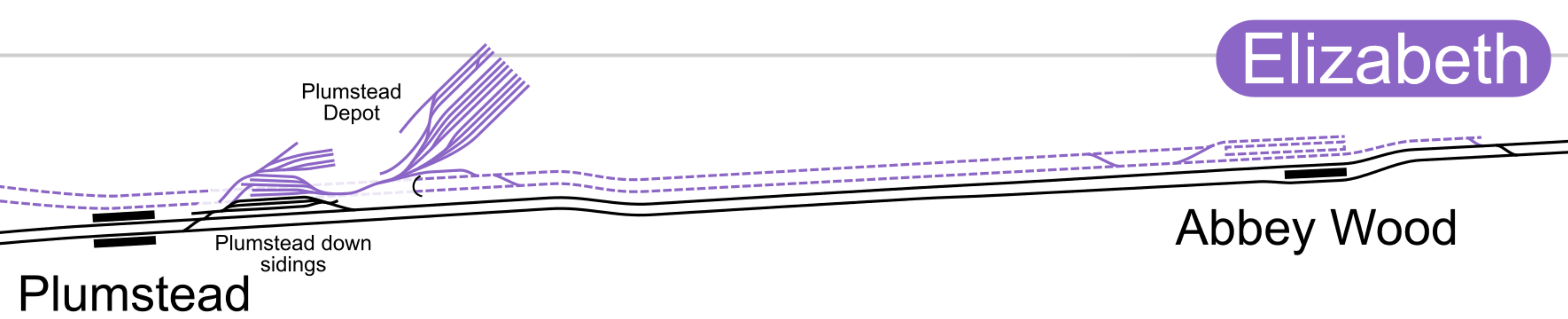
Note.
- Crossrail is shown in purple.
- Abbey Wood station has two platforms for Crossrail and two for the North Kent Line.
- The platforms appear to be numbered one to four from the South.
- There appears to be a turnback for Crossrail trains in Platform 3, which also appears to have crossovers to connect to the North Kent Line.
- Crossovers to the West of Abbey Wood station allow trains to use either Crossrail platform.
- These crossovers also allow access to the sidings at Plumstead.
- The Plumstead tunnel portal can be seen below Plumstead Depot.
If Abbey Wood station follows the two National Rail platforms at Liverpool Street in handling a total of 8 tph, then initially Abbey Wood could handle this frequency of trains.
Ian says this in the first article about the frequencies of Crossrail during testing.
Before the blockade, Crossrail was testing the line with an 8 trains per hour (8tph) service, but this week they are going to be ramping that up to 12tph, which will mirror the timetabled service that the line will offer when it opens early next year.
Note that 12 tph will require Abbey Wood station to handle 6 tph on each platform.
Transport for London also intend to simulate 24 tph through the central section, which will be the Peak frequency when the line fully opens.
The Surface Section At Custom House
This map from cartometro shows the track layout around Custom House station.
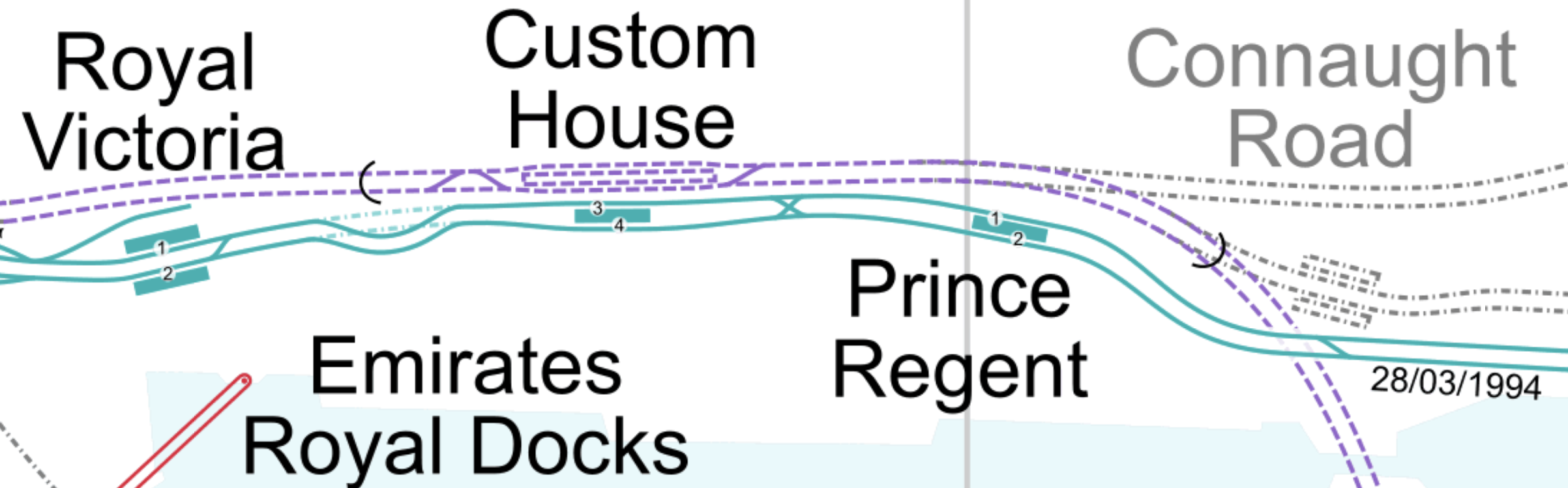
Note.
- Crossrail is shown in purple.
- The DLR is shown in light green.
- The tunnel portal for the central Crossrail tunnel is to the West of Custom House station.
- The tunnel portal for the Connaught tunnel is in the area of the former Connaught Road station.
- Between the other end of the Connaught tunnel and Woolwich station, some of the route is in a cutting.
- There are crossovers either side of Custom House station.
I suspect a lot of the complications are because an old route was reused.
The Surface Section At Paddington
This map from cartometro shows the track layout around Paddington station.
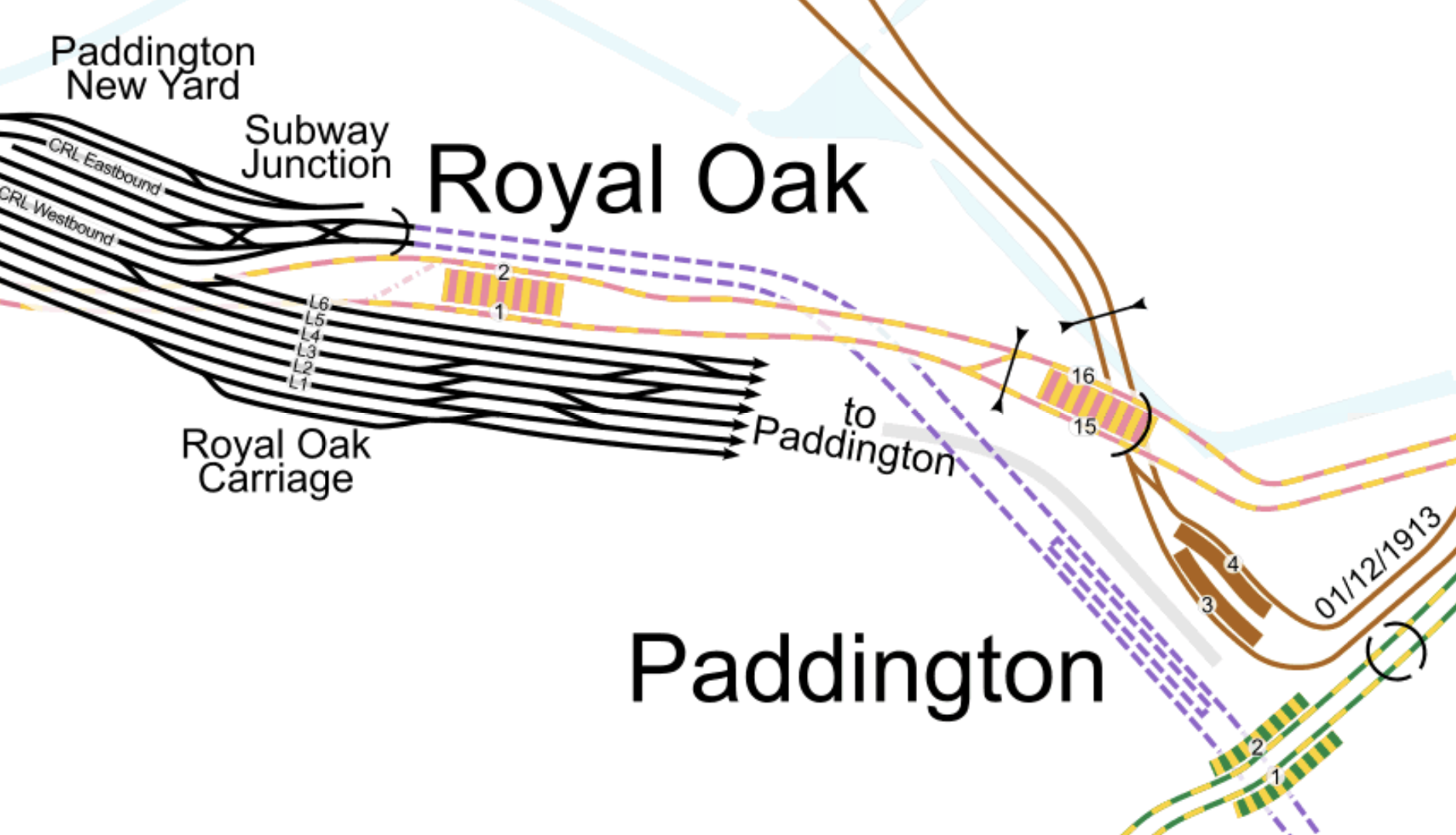
Note.
- The Crossrail station at Paddington is a straight-through two platform station.
- The Royal Oak portal, where Crossrail comes to the surface is just to the West of Royal Oak Underground station.
- Two lines are labelled CRL Eastbound and CRL Westbound are connected to the Crossrail lines.
- Between and around these lines is Paddington New Yard
- There are two full crossovers between Paddington New Yard and the Royal Oak portal.
To reverse at Paddington, trains proceed to Paddington New Yard, where the driver changes ends and then returns to Paddington, when needed.
Trains for Reading and Heathrow use the CRL Eastbound and CRL Westbound lines to connect to Crossrail’s Western surface tracks and the Central core tunnel.
It all looks well-designed to my untrained eye.
Platform Edge Doors
This page on the Crossrail web describes the platform edge doors.
This is the first paragraph.
Crossrail has installed floor-to-ceiling platforms screen doors at each of the eight new underground stations on the Elizabeth line – that’s roughly 4 kilometers of platform edge screens in total.
The new stations between Abbey Wood and Paddington are,
- Paddington
- Bond Street
- Tottenham Court Road
- Farringdon
- Liverpool Street
- Whitechapel
- Canary Wharf
- Custom House
- Woolwich
This is eight underground stations and one surface station; Custom House.
So does it mean that Custom House station doesn’t have platform edge doors?
I took these pictures of Custom House station today.

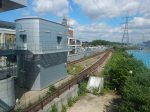
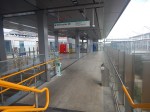
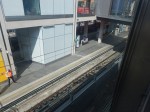


Note.
- The Crossrail trains were running at a frequency of 8 tph.
- , The pictures don’t show any platform edge doors or structures capable of supporting platform edge doors.
Could the regulations allow a surface station like Custom House to be built without doors, or were they left out to save money?
Safety is assured by being able to shut off all entrances to the platforms.
But it does appear that between Custom House and Paddington stations, passengers and trains are separated by platform edge doors.
- Platform edge doors are controlled by the signalling, so with the correct interlocking a lot of things are possible.
- Suppose, a station is not ready for passengers, then by locking the doors closed, trains can still pass through.
- Does this mean that at stations like Liverpool Street, where passengers might need to walk between the Moorgate and Liverpool Street ends of the station to change trains, that these pedestrian routes could be opened? I think it does?
It does appear to me, that platform edge doors are the key to opening a partially-completed railway.
When Could Abbey Wood And Paddington Open?
It strikes me that the following conditions must be met.
- Paddington station must be handed over to Transport for London.
- Platform edge doors at all stations must work reliably.
- The trains must work reliably with the signalling.
It looks like Bond Street, Paddington and Whitechapel stations, are the only stations that have not been handed over to Transport for London.
- I suspect, as Paddington is a terminal station, it must be handed over.
- Crossrail have said they could live with Bond Street opening later.
- Whitechapel appears to have been a difficult station to build, so perhaps it could open later.
Could Crossrail open partially, earlier than anyone thinks?
Perhaps this post called Your First Crossrail Service May Arrive In Time For Christmas, was based on fact and not rumour in the Sunday Times.
Crossrail Tests Its Trains In Southend
The title of this post is the same as that of this article in the Southend Echo.
This is the first paragraph.
Crossrail trains are being tested from Southend to London – raising hopes that in future they could run to and from the town on a regular basis.
As the title of the article indicates, it could be that Bombardier and Crossrail are seeing how a Class 345 train performs on the route, prior to the delivery of Greater Anglia’s similar Class 720 trains, which are another train in Bombardier’s Aventra family.
Southend Victoria Station
Southend Victoria station could be a destination for Crossrail in the future, but consider these facts.
- Southend Victoria station is 41.5 miles from London Liverpool Street station and the fastest services take about an hour.
- Southend Victoria has a frequency of three trains per hour (tph) to London Liverpool Street.
- Southend Victoria station has four terminal platforms and is a short walk to the Town Centre.
- Reading station is 36 miles from London Paddington station and the fastest services take just over half-an-hour.
- Fast-growing Southend Airport with its station is on the Shenfield to Southend Line and the Airport would surely welcome a direct link to Central London and Heathrow.
- The three tph on the Shenfield to Southend Line doesn’t have a good interchange with the one train every forty minute service on the Crouch Valley Line.
If there is a major problem, it is that Greater Anglia is losing passengers to c2c with its station at Southend Central.
Between 2013/14 and 2015/16 Southend Victoria has lost 2.79 million passengers, whereas in the same period Southend Central has gained 1.14 million.
From what I have seen Greater Anglia intend to speed up the Liverpool Street to Norwich services to ninety minutes and run at a frequency of 3 tph. They are also going to add a fourth train that goes to Ipswich. So again, the three tph service to Southend, isn’t the best fit to services on the Great Eastern Main Line for passengers travelling between say Southend and the County Town of Chelmsford.
There are probably not too many reasons for Crossrail to be extended to Southend for its own sake, but if Greater Anglia and Crossrail decide that an integrated service is to be provided between Shenfield and Southend, then everything is up for discussion.
Fast Trains Between London And Southend Victoria
The current Southend to London trains stop seven times to the East of Shenfield.
They would probably need to stop at Southend Airport and perhaps two of the busiest stations, but cutting out five stations would probably bring the journey time down to fifty minutes, which would attract passengers and make it easier for Greater Anglia to run the service, as trains could do the round trip in comfortably under two hours.
Running three tph, as now, would need just six trains and running a desirable four tph would need eight trains.
I’d be very interested to see what time a one of the new Stadler Class 745 trains, could achieve on the route, with just four stops at Stratford, Shenfield, Billericay and Southend Airport.
Slow Crossrail Trains Between Shenfield And Southend Victoria
Paired with the fast trains could be a number of extended Crossrail services.
Based on Crossrail’s projected timings between Liverpool Street and Shenfield of 41 minutes and the current 35 minutes between Shenfield and Southend, a timing of 76 minutes is estimated.
- Crossrail’s trains could save as much as two minutes at each of the seven stops, East of Shenfield.
- The Shenfield to Southend Line has an 80 mph speed limit, which I suspect could be improved.
So could we see Slow Crossrail trains achieving the times that Fast Greater Anglia trains do now?
I think the answer is yes and it shows how trains have improved in the last few decades.
How Many Trains Could Use The Shenfield To Southend Line?
The capacity must be quite high, as the only complication is the totally independent Crouch Valley Line.
Southend Victoria station has four platforms, so the station could probably handle sixteen tph, which is more than enough.
I feel that it would be possible to run four Fast expresses and four Slow Crossrail trains in an hour.
Whether that would be an acceptable timetable is another matter.
Interchange With The Crouch Valley Line
The Crouch Valley Line’s one train every forty minutes must be a nightmare for Greater Anglia and passengers alike, and I suspect that Greater Anglia have a cunning plan to run a two tph service on the line.
It appears that the track layout can achieve this, with the two trains passing at North Fambridge station. But as they don’t run two tph on this branch there must be other limitations.
Foremost of these could be the three tph service on the Shenfield to Southend Line.
So sorting out the Shenfield to Southend Line might improve the service on the Crouch Valley Line.
Conclusion
I have come to these conclusions about services between Liverpool Street and Southend Victoria stations..
- A Fast Greater Anglia express service could probably achieve a sub-fifty minute time.
- A Slow Crossrail service, could probably do the trip in an hour.
- Better interchange with Crouch Valley Line and Great Easstern Main Line services would be achieved.
- Four Fast and four Slow services in each hour is possible.
My choice for the Liverpool Street to Southend Victoria service would be as follows.
- Four tph – Crossrail Class 345 trains – Stopping at all stations.
- Four tph – Greater Anglia Class 745 trains – Stopping at Southend Airport, Billericay, Shenfield and Stratford.
Or the simple option of just running the four Crossrail trains.
Crossrail to Southend, isn’t a ridiculous aspiration.
 The Anonymous Widower