Port Talbot To Become Offshore Wind Hub For Celtic Sea
The title of this post, is the same as that of this article on the BBC.
This is the sub-heading.
Port Talbot will become the first dedicated hub for floating offshore wind in the Celtic Sea.
These four introductory paragraphs add some detail.
Associated British Ports (ABP) will begin detailed design and engineering work on new port infrastructure after securing grant funding of up to £64m from the UK government.
The project will support the assembly and deployment of floating turbines that will operate in deeper waters off the Welsh coast. ABP said the development could support thousands of jobs and attract hundreds of millions of pounds in further investment.
The UK government said the new port would help deliver clean, homegrown electricity, protect households from volatile fossil fuel markets and create up to 5,000 new jobs.
Redeveloping the port to handle the assembly of wind turbines could position Port Talbot at the centre of a fast-growing clean energy sector.
I have some thoughts.
How Much Wind Power Is Planned For The Western Approaches?
In Ocean Winds Enters Lease Agreement With Crown Estate For 1.5 GW Celtic Sea Floating Wind Project, I published this Google AI estimate of the wind power, that could be developed in the Western Approaches.
How Much Wind Power Is Planned For The Western Approaches?
I asked Google AI, the title of this section and received this answer.
The UK has a target of 50 GW of offshore wind by 2030, with significant projects planned for the Celtic Sea (part of the Western Approaches), which is a key area for 5 GW of floating wind. Total UK offshore wind pipeline capacity exceeds 93 GW, with major developments in this region focusing on floating technology.
Key details regarding wind power in the Western Approaches (specifically the Celtic Sea) include:
Celtic Sea Developments: The area is a primary focus for floating wind projects, designed to capitalize on deep-water potential, with 5 GW of floating wind expected to be deployed across the UK by 2030.
Pipeline and Capacity: The total UK pipeline for offshore wind, which includes the Western Approaches, is 93 GW, and the government is aiming for 43-50 GW of installed offshore capacity by 2030.
Project Status: The region is expected to benefit from the Crown Estate’s leasing rounds aimed at accelerating floating wind, with 15.4 GW of new projects submitted across the UK in 2024.
Wales/South West England Context: Wales has 1.4 GW of projects in the pre-application stage, with some potential for developments off the South West coast.
For more detailed information on specific projects and their development status, you can visit the RenewableUK website and RenewableUK website.
It looks like about 20 GW of offshore wind could be installed in the Western Approaches.
I would expect, a lot of work will be generated in the Port Talbot area.
A Lot Of Steel Will Be Needed
Earlier in the weeek, the UK Government backed the steel industry in Port Talbot, with a press release entitled UK Steel Industry Backed By Major New Trade Measure And Strategy.
Port Talbot Is A Comprehensive, Well-Connected Site
This Google Map shows the site.
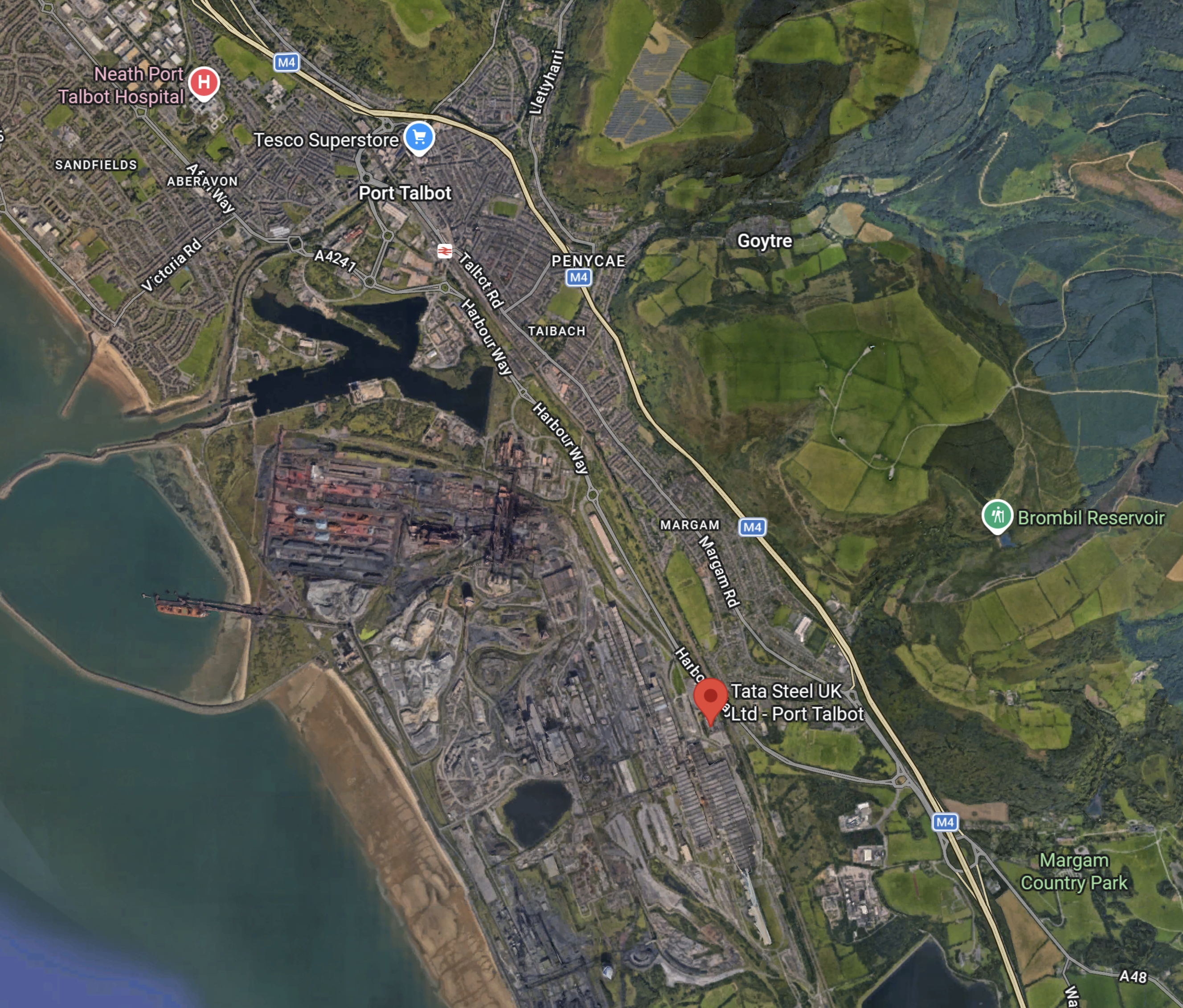
Note.
- The M4 running along the site.
- The South Wales Main Line running along the site, with Port Talbot Parkway serving the site.
- The harbour by the station.
- The Tata steelworks marked by the red arrow.
I hope the up to £64 million grant from the government is sufficient for Associated British Ports (ABP) to turn the harbour into a world-class floating wind facility and that the Treasury haven’t been too mean.
BW Ideol, ABP To Explore Serial Production Of Floating Wind Foundations At Port Talbot
I wrote a post with this name in December 2023, before the leases for the Celtic Sea windfarms had been awarded. As one has been awarded to EDf Renewables, BW Ideol seem to have made a good move.
BW Ideol have a web page, which describes their concrete floating wind foundations manufacturing line.
I hope South Wales has got enough concrete?
Welsh Government Backs Marine Power Systems’ Floating Wind Tech With GBP 8 Million
The title of this post, is the same as that of this article on offshoreWIND.biz.
This is the sub-heading.
The Welsh government has invested GBP 8 million (approximately EUR 9.4 million) in Marine Power Systems (MPS) to support the commercialisation of its floating offshore wind technology.
These three paragraphs add more detail to the story.
According to the company, the funding will accelerate the deployment of its PelaFlex platform, a floating wind solution designed for deep-water sites where conventional fixed-bottom foundations are not viable.
Marine Power Systems said the investment will help move the technology from advanced development towards commercial-scale deployment and manufacturing. The company also plans to expand its industrial and assembly capabilities in the UK.
The PelaFlex platform has been designed to simplify fabrication, installation and long-term operations while enabling wind farms to be located further offshore where wind speeds are typically stronger and more consistent, MPS says.
The offshore wind industry in Wales seems to be gearing up for a big expansion.
Gwynt Glas is the collective name for the three 1.5 GW floating wind farms in the Western Approaches and in Gwynt Glas And South Wales Ports Combine Strength In Preparation For Multi-Billion Floating Wind Industry, I describe the initial agreement that started the Gwynt Glas project.
To my mind, Associated British Ports and the wind farm developers are making sure they can carpet the Western Approaches, with offshore wind farms.
In Ocean Winds Enters Lease Agreement With Crown Estate For 1.5 GW Celtic Sea Floating Wind Project, I talk in general about the progress of the first three 1.5 GW floating wind farms in Gwynt Glas and in particular about leasing of the third wind farm.
These two posts, indicate that the Port of Port Talbot is preparing itself to produce the floaters for floating wind turbines.
- BW Ideol, ABP To Explore Serial Production Of Floating Wind Foundations At Port Talbot
- Two Ports Advance To Next Stage Of UK Gov Funding For Floating Wind
It certainly appears, that South Wales will be able to build the heavyweight gubbins for floating offshore wind.
According to Was South Wales Once The World’s Largest Coal Exporter? it was, and in 1913, the region produced 57 million tons of coal, with more than half exported.
It does look like South Wales is going to repeat the economic success with offshore energy.
I’ve heard tales from elderly Welshmen talking of the coal ships in the docks of South Wales and will we be seeing gas tankers in the docks of South Wales?
Was South Wales Once The World’s Largest Coal Exporter?
I asked Google AI, the title of this post and received this answer.
Yes, South Wales was once the world’s largest coal-exporting region and home to the busiest coal-exporting ports in the world. During its peak in 1913, the South Wales coalfield supplied almost one-third of total global coal exports, with Cardiff and Barry leading the world as the top coal ports.
Key details regarding the coal boom in South Wales:
Peak Production: In 1913, the region produced 57 million tons of coal, with more than half exported.
Top Export Ports: In 1913, Barry was recognized as the world’s largest coal-exporting port, closely followed by Cardiff.
The “Coal Metropolis”: Cardiff became the world’s leading coal and shipping metropolis, with the Cardiff Coal Exchange setting the global price for steam coal.
Economic Impact: The boom drove massive population growth in the South Wales Valleys and created tremendous wealth for cities like Cardiff, Barry, and Newport.
Global Demand: Welsh coal was highly sought after for its high quality, fueling steamships, railways, and industries across the world, from Russia to South America.
By 1920, the industry employed over 270,000 miners, but it saw a steep decline thereafter due to economic depression, international competition, and the exhaustion of accessible reserves.
Ocean Winds Secures Third Celtic Sea Floating Wind Site
The title of this post, is the same as that of this article on offshoreWIND.biz.
This is the sub-heading.
Ocean Winds has secured the third floating offshore wind site in the Celtic Sea, offered through the Crown Estate’s Round 5 auction earlier this year. The developer is joining Equinor and the Gwynt Glas joint venture, which were awarded rights for two of the three sites offered in Round 5 in June.
This paragraph outlines Ocean Winds’s deal.
On 19 November, the Crown Estate said that Ocean Winds was set to be awarded the rights for a third floating offshore wind site in the Celtic Sea.
There would now appear to be three Celtic Winds deals for wind farms.
- Gwynt Glas – 1.5 GW
- Ocean Winds – 1.5 GW
- Equinor – 1.5 GW
Note.
- 4.5 GW will be able to power a good proportion of South Wales and the South-West peninsular.
- In Gwynt Glas And South Wales Ports Combine Strength In Preparation For Multi-Billion Floating Wind Industry, I talk about partnerships between the wind farms and the ports.
- If you sign up for a large wind farm from the Crown Estate, do you get to have afternoon tea with Charles and Camilla in the garden at Highgrove or even Buckingham Palace?
This map of the wind farms is available from download from this page on the Crown Estate web site.
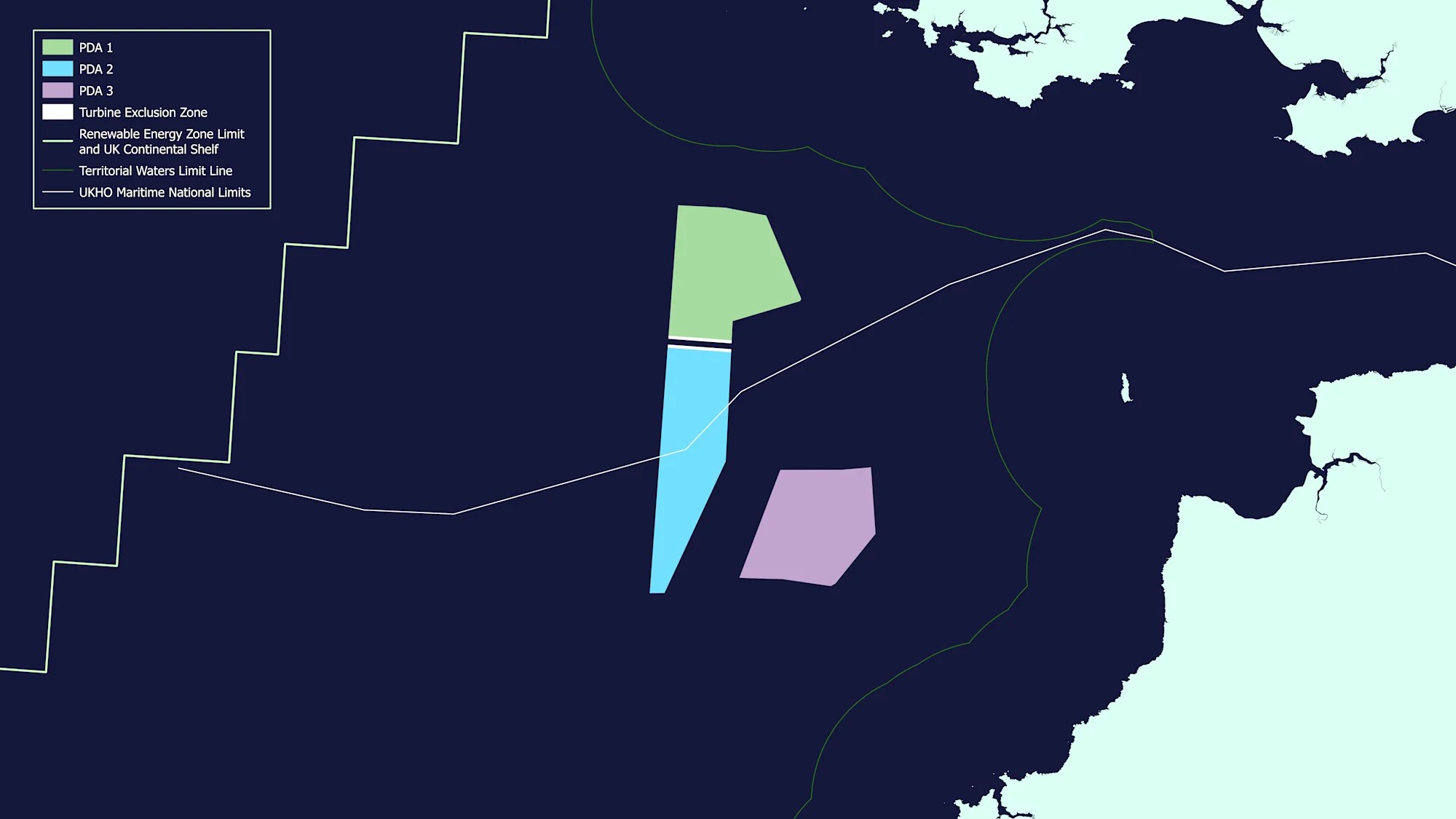
Note.
- Gwynt Glas is in green.
- Ocean Winds is in blue.
- Equinor is in mauve.
- The white dot to the East of the wind farms is Lundy Island.
This triple wind farm is certainly well-placed to supply power to Cornwall, Devon and South Wales.
Heads Of The Valleys Road Upgrade Officially Opens
The title of this post, is the same as that of this article on BusinessNewsWales.
This is the sub-heading.
The final phase of the £2 billion Heads of the Valleys Road upgrade programme has officially opened.
These first two paragraphs add detail to the project.
The Welsh Government said it marked the completion of “one of the UK’s largest and most technically challenging road projects”.
The £1.4 billion Section 5&6 Dowlais to Hirwaun final phase links the Valleys, South and West Wales to the English Midlands and beyond, together with ports serving Irish and other European destinations. As well as improving the resilience of the South Wales trunk road network, the road provides a vital link across the top of the South Wales valleys for the Metro project improving links to the Cardiff and Swansea Bay City Regions, the Welsh Government said.
From the statistics of work done and the money involved, it would appear that a comprehensive upgrade has fixed a big gap in the UK’s motorway network in South Wales.
This Google Map shows the locations of Dowlais and Hirwaun.
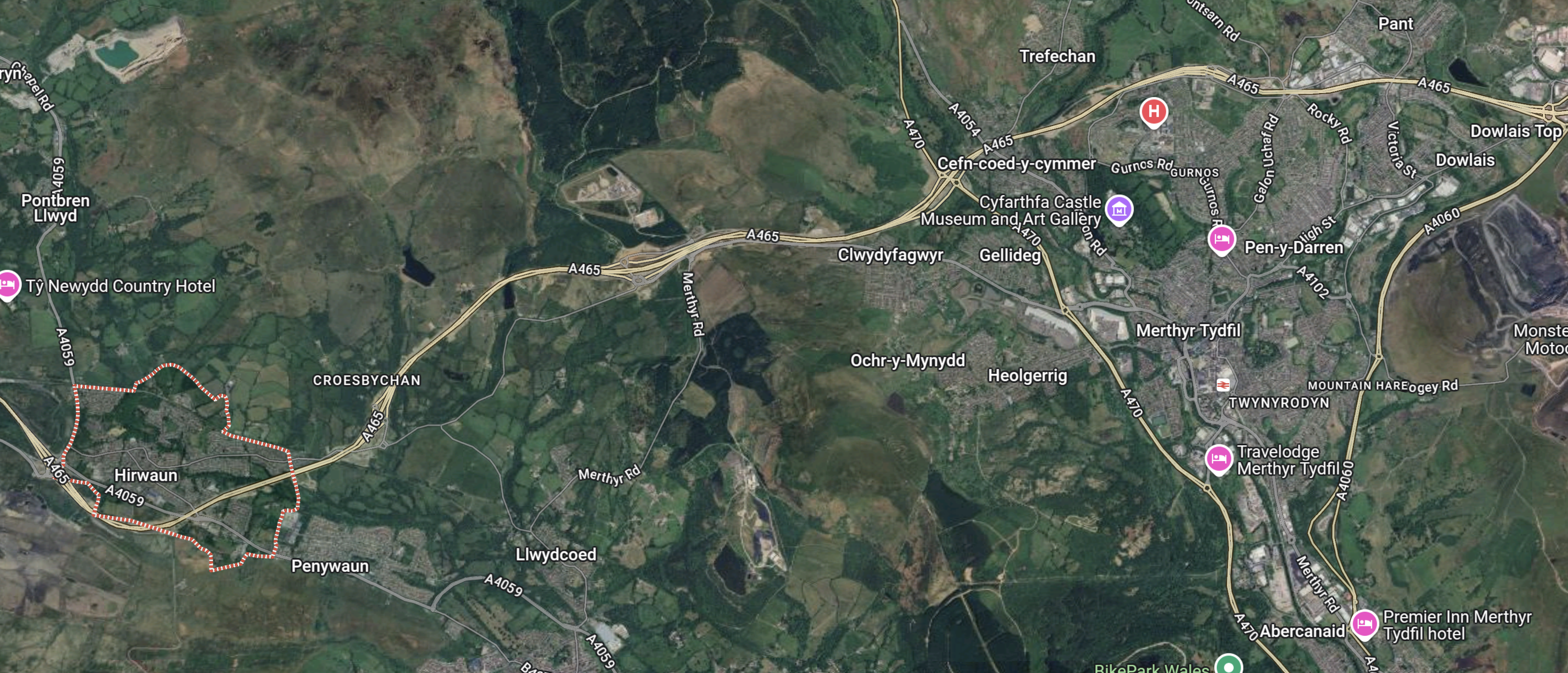
Note.
- Dowlais is in the North-East corner of the map.
- Hirwaun is in the South-West corner of the map and is outlined in red.
- The Heads of the Valleys Road links Dowlais and Hirwaun.
- Going East from Dowlais leads to Abergavenny, Monmouth, Raglan and the English Midlands.
- Abergavenny has a station, but Monmouth and Raglan don’t!
- Abergavenny station has comprehensive services to stations as far apart as Cardiff, Crewe, Holyhead, Manchester Piccadilly, Swansea and Wrexham General.
Abergavenny station could eventually turn out to be a parkway station for the South Wales Valleys.
I can certainly understand, why Lumo wants to run a service to Hereford.
I also feel that the Welsh government and Transport for Wales would be in favour of the service.
- Three towns in Wales; Cwmbran, Pontypool and Abergavenny get a direct service to Bristol Parkway and London Paddington stations.
- Hereford already has an hourly connection to Birmingham New Street via Worcester and University.
- If a coach were to be provided between Bristol Parkway and Bristol Airport, this could make getting to Bristol Airport easier.
I can see further improvements to services, that terminate at Abergavenny.
UK’s First Offshore Hydrogen Production Trials Kick Off in South Wales
The title of this post, is the same as that of this article on offshoreWIND.biz.
This is the sub-heading.
After six years of development, sustainability consultancy ERM has launched offshore trials to test its Dolphyn Hydrogen process which combines electrolysis, desalination, and hydrogen production on a floating wind platform, marking the first time hydrogen has been produced from seawater in a marine environment in the UK.
These are the first three paragraphs.
The trials conducted in Pembroke Port, South Wales, through July 2024 are said to represent an important step forward in enabling the UK to produce low-carbon hydrogen safely, reliably, and at scale.
In ERM’s Dolphyn Hydrogen process, hydrogen is transported to shore via a pipeline and it can be used directly for power generation, transport, industrial purposes, and heating.
The development of the Dolphyn Hydrogen process has been supported by the UK Government’s Department for Energy Security and Net Zero, through the Low Carbon Hydrogen Supply 2 Competition in the GBP 1 billion (approximately USD 1.2 billion) Net Zero Innovation Portfolio (NZIP). It has been awarded funding of over GBP 8 million (about USD 10.13 million) to date and has also been championed by devolved Governments in Wales and Scotland.
There’s more about Dolphyn Hydrogen on their web site.
Conclusion
This self-contained floating hydrogen factory could be very useful operating either singly or as a small fleet.
It would help if Dolphyn Hydrogen disclosed some hydrogen production capacities.
This is said in a press release.
The pilot project at Vattenfall’s Offshore Wind Farm in Aberdeen Bay will have an output of 8.8MW and will be able to produce enough hydrogen every day to power a hydrogen bus to travel 24,000km.
That looks about right.
I shall be following Dolphyn Hydrogen.
UK Unveils GBP 50 Million Fund To Boost Offshore Wind Supply Chain
The title of this post, is the same as that of this article on offshoreWIND.biz.
This is the sub-heading.
The Crown Estate has initiated a Supply Chain Accelerator to stimulate early-stage investment in the UK offshore wind supply chain.
These are the first three paragraphs.
The accelerator is a new GBP 50 million (approximately EUR 58.7 million) fund created to accelerate and de-risk the early-stage development of projects linked to offshore wind.
An initial GBP 10 million round of funding is now open for Expressions of Interest for businesses looking to establish UK projects that could support the development of a new UK supply chain capability for floating offshore wind in the Celtic Sea.
The application process opens formally in mid-June and closes at the end of July. The final announcement will be made in October 2024.
This sounds like a very good idea.
This is the next paragraph.
Earlier this year, the Crown Estate published research, the Celtic Sea Blueprint, which predicted that 5,300 jobs and a GBP 4.1 billion economic boost could be generated through deploying the first floating offshore wind capacity, that will result from the current leasing Round 5 process, under which leases for up to 4.5 GW of generation capacity will be awarded in the waters off South Wales and South-West England.
It looks to me, that the £100 million could help prime the pumps to do the following for South Wales and South-West England.
- Create 5,300 jobs
- Create a £ 4.1 billion economic boost.
- Develop up to 4.5 GW of generation capacity.
If we assume the following.
- 4.5 GW of generation capacity.
- Capacity factor of 50 %.
- Strike price of £ 35/MWh.
- A year has 8,760 hours.
We can say the following.
- Average hourly generation is 2,250 MWh
- Average yearly generation is 19,710 GWh or 19,710,000 MWh
This would be a yearly income of £ 689, 850 million.
Ørsted Secures Exclusive Access To Lower-Emission Steel From Dillinger
The title of this post, is the same as that of this article on offshoreWIND.biz.
This is the sub-heading.
Ørsted will be offered the first production of lower-emission steel from German-based Dillinger, subject to availability and commercial terms and conditions. The steel plates are intended to be used for offshore wind monopile foundations in future projects.
These three paragraphs outline the deal.
Under a large-scale supply agreement entered into in 2022, Ørsted will procure significant volumes of regular heavy plate steel from 2024, giving the company access at scale to and visibility of the most crucial raw material in offshore wind while supporting Dillinger to accelerate investments in new lower-emission steel production, according to Ørsted.
The Danish renewable energy giant expects to be able to procure lower-emission steel produced at Dillinger’s facility in Dillingen, Germany, from 2027-2028.
Taking the current technology outlook into account, the reduction of the process-related carbon emissions from production is expected to be around 55-60 per cent compared to conventional heavy plate steel production, Ørsted said.
Increasingly, we’ll see lower emission steel and concrete used for wind turbine foundations.
This press release on the Dillinger web site is entitled Historic Investment For Greater Climate Protection: Supervisory Boards Approve Investment Of EUR 3.5 billion For Green Steel From Saarland.
These are two paragraphs from the press release.
Over the next few years leading up to 2027, in addition to the established blast furnace route, the new production line with an electric arc furnace (EAF) will be built at the Völklingen site and an EAF and direct reduced iron (DRI) plant for the production of sponge iron will be built at the Dillinger plant site. Transformation branding has also been developed to visually represent the transformation: “Pure Steel+”. The message of “Pure Steel+” is that Saarland’s steel industry will retain its long-established global product quality, ability to innovate, and culture, even in the transformation. The “+” refers to the carbon-neutrality of the products.
The availability of green hydrogen at competitive prices is a basic precondition for this ambitious project to succeed, along with prompt funding commitments from Berlin and Brussels. Local production of hydrogen will therefore be established as a first step together with the local energy suppliers, before connecting to the European hydrogen network to enable use of hydrogen to be increased to approx. 80 percent. The Saarland steel industry is thus laying the foundation for a new hydrogen-based value chain in the Saarland, in addition to decarbonizing its own production. In this way, SHS – Stahl-Holding-Saar is supporting Saarland on its path to becoming a model region for transformation.
It sounds to me, that Tata Steel could be doing something similar at Port Talbot.
- Tata want to build an electric arc furnace to replace the blast furnaces.
- There will be plenty of green electricity from the Celtic Sea.
- RWE are planning a very large hydrogen electrolyser in Pembroke.
- Celtic Sea offshore wind developments would probably like a supply of lower emission steel on their door-step.
I would suspect, that Welsh steel produced by an electric arc furnace will match the quality of the German steel, that is made the same way.
More Trains To Carmarthen
The last time, I looked at the number of GWR trains to Carmarthen its Wikipedia entry, it was just a couple.
Today, one train per hour (tph) is shown between London Paddington and Swansea, with this supplementary information.
- 7 trains per day continue to Carmarthen, calling at Gowerton (limited), Llanelli, Pembrey & Burry Port, Kidwelly (limited) and Ferryside (limited)
- On Summer Saturdays, 2 trains per day run to Pembroke Dock, calling at all stations between Carmarthen and Pembroke Dock
In Regulator Approves New Grand Union Train Service From Carmarthen To London Paddington, I talked about the plans of Grand Union Trains to run five trains per day (tpd) between London Paddington and Carmarthen.
This would appear to give a total of twelve tpd between London Paddington and Carmarthen.
This page on the Crown Estate web site is entitled Celtic Sea Floating Offshore Wind, where this is said.
The Government has set an ambition to deliver up to 5GW of floating wind by 2030, with rapid expansion anticipated thereafter.
At The Crown Estate, we are committed to helping the UK achieve its net zero ambitions. To support this, we are excited to deliver a new leasing opportunity in the Celtic Sea for the first generation of commercial-scale floating offshore windfarms – unlocking up to 4GW of new clean energy capacity by 2035, kick-starting industry in the region, and providing power to almost four million homes.
We will be inviting full commercial scale projects up to 1GW, which may be developed in a phased or ‘stepping stone’ approach. Recognising the need to develop the UK supply chain and supporting infrastructure for this nascent technology, this approach is deliberately intended to provide opportunities for growth and investment. This will also facilitate the co-ordination of the necessary infrastructure, such as ports and grid connections, all of which are key to the sustainable development of the UK floating wind sector over the long term.
This leasing opportunity will provide the foundation for greater capacity in the future and help establish an exciting new industrial sector for the UK, creating opportunities for significant new investment in jobs, skills and infrastructure for the communities onshore.
It appears to me, that Great Western Railway and Grand Union Trains both believe that there will be large increase in demand for rail travel between London Paddington and Carmarthen and also along the South Wales Coast.
Grand Union Trains are also proposing the building of a new parkway station at Parc Felindre North of Swansea.
But then this area of South Wales and the Celtic Sea, has the four things needed for the development of up to 5 GW of offshore wind; a lot of wind, a large area of empty sea, steel and deep water ports to assemble all the floating wind turbines.
A Zero-Carbon High Speed Railway Between London Paddington And Carmarthen
Consider.
- The Great Western Railway between London Paddington and Carmarthen is 222.5 miles and trains take around three hours and fifty minutes, which is an average speed of 58 mph.
- Between Bristol Parkway and Reading stations, the operating speed is 125 mph.
- In South Wales, the operating speed is generally between 70 and 100 mph.
- Only the 77.4 miles between Cardiff Central and Carmarthen via Swansea is not electrified.
There is probably scope to increase the operating speed using digital signalling and by improving the track.
I would suspect that a time between London Paddington and Carmarthen of under three-and-a-half hours is possible.
The Range Of Battery-Electric Trains
Hitachi have not been specific about the zero-carbon range of their Intercity Tri-Mode Battery Train, which is described in this Hitachi infographic.

In Stadler FLIRT Akku Battery Train Demonstrates 185km Range, I talk about Stadler’s record-braking Battery-electric; Akku, which covered 185 km or 115 miles.
I suspect that Hitachi’s engineers and those at their battery suppliers; Turntide Technology will be ultra-competitive, so I wouldn’t be surprised that the zero-carbon range of the Hitachi train is very competitive to the Stadler FLIRT Akku.
A hundred mile range would allow electric services to be run on these routes.
- Cardiff and Carmarthen – 77.4 miles
- Chippenham and Bristol Temple Meads and return – 48.8 miles
- Chippenham and Bristol Western-super-Mare and return – 86.9 miles
- Swindon and Cheltenham Spa and return – 86.5 miles
- East Coast Main Line and Hull and return – 72.2 miles
- Plymouth and Penzance – 79.5 miles
- Taunton and Newbury – 89.6 miles
- York and Scarborough and return – 84.1 miles
I am fairly sure that Hitachi will aim for at least a hundred mile battery range for their Intercity Tri-Mode Battery Train.
- This would be competitive with other train manufacturers like Stadler and Siemens.
- They would handle a lot of important routes.
- With development they could probably handle Edinburgh and Inverness.
I can’t wait to have a ride.
So Many Floating Wind Designs, So Few Test Sites – Norwegian METCentre Sold Out
The title of this post, is the same as that of this article on offshoreWIND.biz.
This is the sub-heading.
There are currently more than 80 floating wind technology concepts and designs worldwide, and testing even a certain number of these could prove to be an endeavour since there are not many test sites dedicated to floating wind technology in Europe.
It strikes me that we need more test centres.
As UK waters will in the next couple of decades be home to a lot more GW of wind farms, perhaps we should develop a test centre.
I wonder, if South Wales would be the place for a test centre.
- There is a lot of sea, which isn’t cluttered with oil and gas rigs, and wind farms.
- There are a lot of wind farms planned in the area.
- There are at least two good technology universities.
- There are some deep water ports.
- Electricity connections and power generation are good.
- There is good train connections to the rest of England and Wales.
- A train testing centre is being built at Nant Helen. Some tests needed to be done could be the same.
Some innovative designs for wind turbines are also being developed in South Wales.
 The Anonymous Widower