Swiss Federal Railways Targets London As It Seeks More Cross-Border High Speed Trains
The title of this post is the same as that of this article on the Railway Gazette.
This is the introductory paragraph.
Swiss Federal Railways is looking at ordering up to 40 high speed trainsets for use on international services to Italy and France, and ’potentially for other destinations such as Barcelona and London’.
There also three paragraphs, which talk about Switzerland and London services.
SBB has also examined the possibility of launching a direct service between Switzerland and London, concluding that this would be technically feasible but challenging.
The need to provide security and border controls at all the stations served has long been a barrier to new services through the Channel Tunnel. However, SBB believes this may be possible at Zürich HB, Basel SBB and Genève Cornavin.
SBB would like to offer such a service and is to further develop its plans, but implementation is not seen as possible until the 2030s at the earliest.
These are my thoughts.
The Channel Tunnel Is Being Opened Up For Other Operators
The Channel Tunnel is at last looking to put on other services.
Switzerland could be easy technically, but there is the security and border controls, as the article points out.
But I see sorting security and border controls as an opportunity, not a problem.
Surely, a workable solution would have export potential all round the world.
London And Geneva Is Only Six Hours On The Train
Six hours in comfort on a train, would not bother me!
Switzerland And London Are Both Suitable Destinations For Year-Round, Short-Break Trips
C and myself were always popping off for short breaks, as it suited our work patterns.
She would sometimes say, that a case had come out and we would nip off somewhere for a couple of days.
I think, that more people will work flexibly and will have more gaps, where two days in Geneva or Zurich would fit. Provided, they could just turn up and go.
I also have done several business and leisure trips to Switzerland.
Fast Direct Trains To Switzerland Would Make Italy More Accessible
I have taken trains to Italy and it is a long way.
But breaking the journey in Switzerland could make the journey easier and you could use one city going South and another going North.
When I stayed in Geneva to go to CERN, I got a free day ticket for the buses and trams thrown in, which was very useful.
Will The Swiss Offer A Rail Pass For All Their High Speed Trains?
I wonder, if the Swiss have this in mind, as they already offer passes that include all Swiss public transport including all the cable cars.
A Swiss High Speed Rail Pass might allow me to go London and Florence, Naples or Rome and return all on one ticket.
Americans wanting to get away from Trump could fly to Switzerland and then explore Europe in Swiss trains, with no worries.
Conclusion
The Swiss should take their fingers out and go for it!
FART Train On Show At InnoTrans
The title of this post, is the same as that of this article on Railway Gazette.
This is the first paragraph.
Stadler has unveiled a custom-designed electric multiple-unit for the narrow gauge Centovalli railway which runs for 52 km between Locarno in Switzerland and Domodossola in Italy.
This appears to be one of Stadler’s special trains for a very unique railway in the Southern Alps.
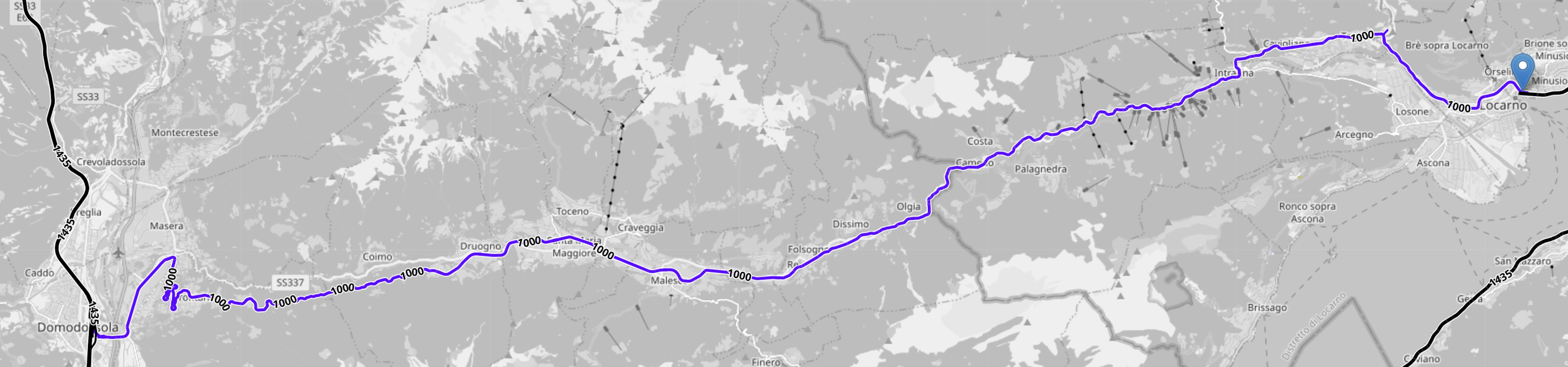
This Google Map shows the route between Domodossola and Locarno.
Note.
- The Centovalli Railway runs East-West and is shown in purple.
- Locarno is in the East and is marked by a blue arrow.
- Domodossola is in the West, where the Centovalli Railway meets the Domodossola–Milan railway, which is shown in black and runs North to Brig via the Simplon Tunnel.
In From Milan To Geneva, I must have taken a train through Domodossola, as this picture is in the post.
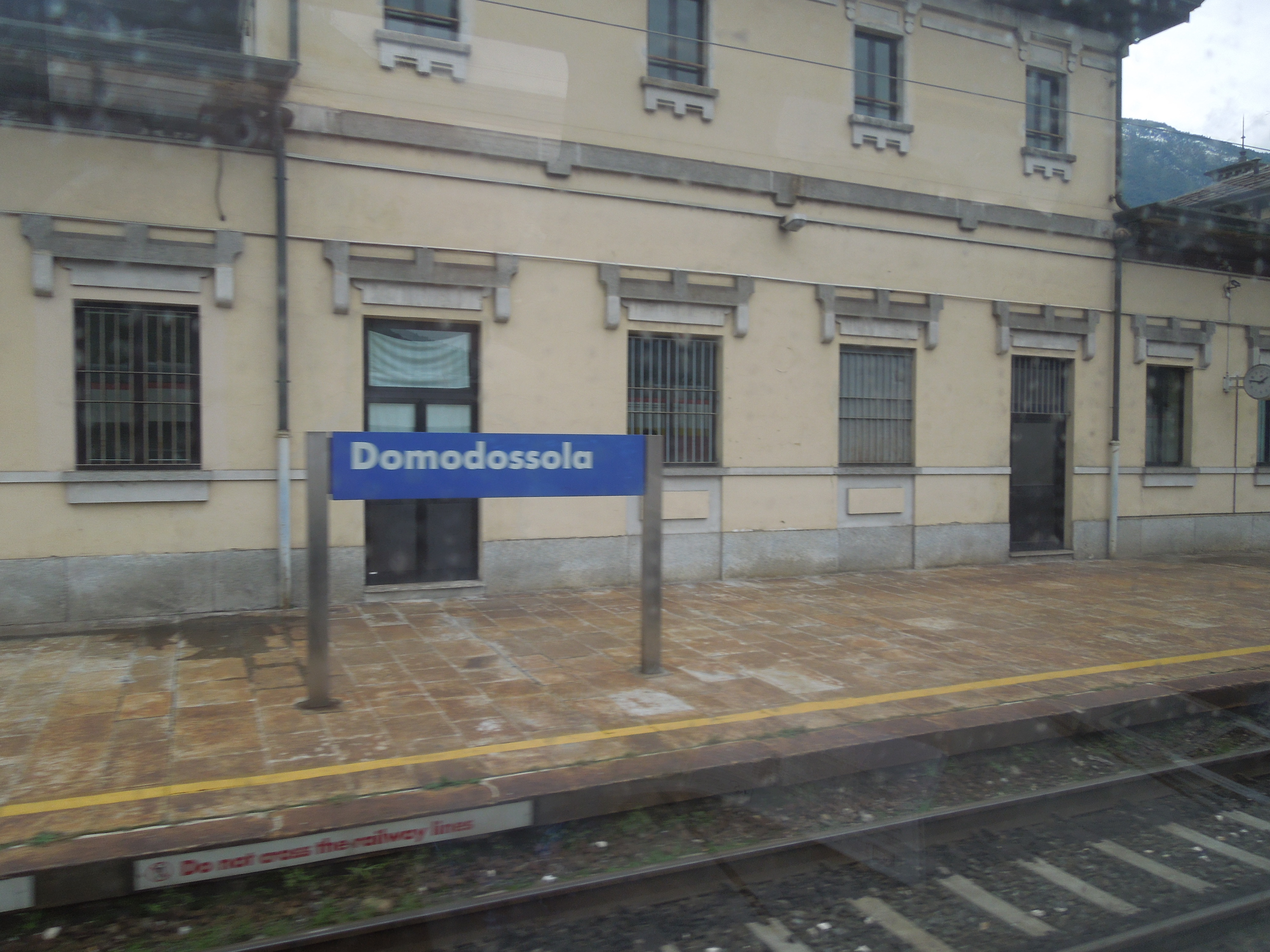
Domodossola station looks a lot grander in its Wikipedia entry.
Rail-Replacement Helicopter Service Takes Off
The title of this post, is the same as that of this article on Railway Gazette International.
These paragraphs give the story.
A rail-replacement helicopter service is being offered while the Braunwaldbahn funicular is closed for maintenance.
Services are suspended from November 6 to 17 on the 1 367 m long metre gauge funicular, which climbs 580 m to connect Linthal with the car-free village of Braunwald.
There are four seats available on each 2 min helicopter flight, with local residents, workers and students having priority over tourists.
The story has appeared in the Daily Express and there is this excellent and entertaining YouTube video.
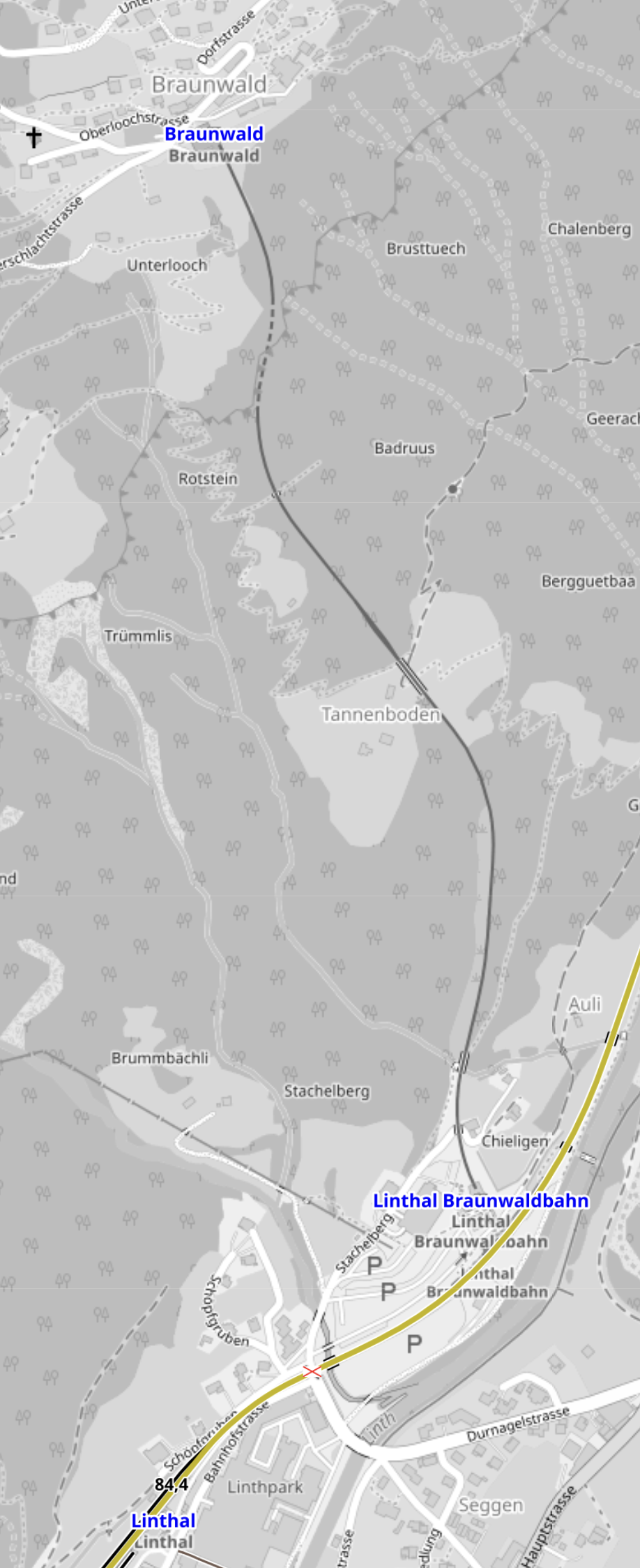
This OpenRailwayMap shows the Braunwaldbahn funicular and its connection to the railway at Linthal.
It sounds like fun!
MOB To Launch Gauge-Changing Montreux – Interlaken GoldenPass Express
The title of this post, is the same as that of this article on Railway Gazette.
Countdown To Swiss Record Attempt: Assembling A 1.91-kilometre Train
The title of this post, is the same as that of this article on RailTech.com.
The article explains all the things that they do to achieve this ultra-long train, but they do leave out the why!
I can only assume, that they want to test the train software in the most extreme of circumstances and they feel that this is the best they can do!
Cargo Sous Terrain
This is a Swiss idea to move small parcels around the country.
This is the project’s web site.
There will be a network of tunnels under Switzerland serving all the major centres.
This article on LeNews is entitled Switzerland’s Underground Tunnel Project Gets Green Light From Upper House, describes the project.
This is the first paragraph.
On 1 June 2021, a project to build an underground freight tunnel network stretching from Geneva to St Gallen, gained almost unanimous support in the Council of States, Switzerland upper house.
These are a few points from the article.
- It appears to be privately funded.
- There will be a three-lane tunnel network across the country.
- It will use driverless electric vehicles.
- Speed will be 30 kph.
- It will run twenty-four hours per day.
- There will be a track in the roof of the tunnel for smaller parcels.
- There will be a total of 500 km of tunnels.
- Completion date is set for 2045.
- It will cost around £24 billion.
It’s as though all of Switzerland were to be turned into a giant Amazon or Ocado warehouse.
Will It Work?
I don’t see why not, although it would be an immense project!
This paragraph indicates they will start small.
The first 70 km section of the tunnel network, which will connect a hub in Härkingen-Niederbipp with Zurich, is scheduled for completion in 2031.
But even that will cost around £2.5 billion!
It certainly, is a bold idea, that has possibilities.
Hyundai Delivers World’s First Hydrogen-Powered Trucks
The title of this post, is the same as this article on Car Advice.
The trucks llok impressive and they are going to Switzerland.
Hydrogen For Hydrogen-Powered Trains And Other Vehicles
I have received e-mails worrying about how hydrogen-powered trains and other vehicles, like buses and trucks, will get the fuel they need.
Production Of Hydrogen
There are two major methods of producing large quantities of hydrogen.
Steam Reforming Of Natural Gas
Steam reforming is used to convert natural gas into hydrogen by using high temperature and pressure steam in the presence of a nickel catalyst.
This section in Wikipedia is entitled Industrial Reforming, says this.
Steam reforming of natural gas is the most common method of producing commercial bulk hydrogen at about 95% of the world production of 500 billion m3 in 1998. Hydrogen is used in the industrial synthesis of ammonia and other chemicals. At high temperatures (700 – 1100 °C) and in the presence of a metal-based catalyst (nickel), steam reacts with methane to yield carbon monoxide and hydrogen.
It gives this chemical equation for the reaction.
CH4 + H2O ⇌ CO + 3 H2
I have two questions about steam reforming.
- How much fossil fuel energy is needed to create the high temperatures and pressures to make the process work?
- What happens to the carbon monoxide (CO)? Is it burnt to provide heat, thus producing more carbon dioxide (CO2)?
I therefor question the use of steam reforming to produce hydrogen for vehicles, especially, as a system might be required to be installed in a train, bus or freight depot.
The only time, where steam reforming could be used, is where an existing refinery producing large quantities of hydrogen by the process is close TO the point of use.
Electrolysis Of Water Or Brine
It is fifty years, since I worked in the chlorine-cell rooms of ICI’s Castner-Kellner chemical complex at Runcorn.
The process used was the Castner-Kellner Process and this is the first paragraph of the Wikipedia entry.
The Castner–Kellner process is a method of electrolysis on an aqueous alkali chloride solution (usually sodium chloride solution) to produce the corresponding alkali hydroxide, invented by American Hamilton Castner and Austrian Karl Kellner in the 1890s.
Brine from Cheshire’s extensive salt deposits is electrolysed using a graphite anode and a mercury cathode to produce chlorine, hydrogen, sodium hydroxide and sodium metal.
Large amounts of electricity are needed, but the biggest problem is the poisonous mercury used in the process.
My work incidentally concerned measuring the mercury in the air of the plant.
Since the 1960s, the technology has moved on, and ICI’s successor INEOS, still produces large quantities of chlorine at Runcorn using electrolysis.
More environmentally-friendly processes such as membrane cell electrolysis are now available, which produce chlorine, hydrogen and sodium hydroxide.
In the 1960s, the production of chlorine and hydrogen was a 24/7 process and I would suspect that INEOS have a good deal to use electricity from wind and other sources in the middle of the night.
The Future Of Hydrogen
Hydrogen is a clean fuel, that when it burns to produce heat or is used in a fuel cell to produce electricity, only produces steam or water.
There is also a lot of research going into hydrogen fuel-cells, hydrogen storage and batteries, and some of this will lead to innovative use of hydrogen as a fuel.
As an example, there is a growing market for fuel-cell forklifts. The first one was built in 1960, so fifty years from idea to fulfilment seems about right.
How many other applications of hydrogen will be commonplace in ten years?
- City buses
- Local delivery vans for companies like Royal Mail and UPS.
- Taxis
- Refuse trucks
I also think, some surprising applications will emerge driven by the need to clean up the air in polluted cities.
Ideally, these applications will need a hydrogen filling station at the depot.
Modern electrolysis technologies should lead to the development of simple cells, for the electrolysis of water to produce hydrogen and oxygen.
Powered by renewable energy sources or nuclear, this technology could be used to create zero-carbon hydrogen at the point of use.
Diesel Or Hydrogen?
The diesel engine in a New Routemaster bus is a Cummins diesel with these characteristics.
- 4.5 litre
- 138 kW
- 400 Kg
So how much would a 150 kW fuel-cell weigh?
A Ballard FCveloCity-HD, which is capable of producing 100 kW, weighs around 300 Kg.
I feel that as hydrogen and battery technology improves, that more and more city vehicles will be hydrogen-powered.
Hyundai Launch A Hydrogen-Powered Truck
This page on the Hyundai web site is entitled Hyundai Motor Presents First Look At Truck With Fuel Cell Powertrain.
It will be launched this year and looks impressive. Other articles say they have tied up with a Swiss fuel-cell manufacturer called H2 Power and aim to sell a thousand hydrogen-powered trucks in Switzerland.
Swiss Pass And Swiss Pocket Timetables
I used a Swiss Pass on my three day trip to Switzerland.
Wikipedia describes it like this.
The Swiss Travel Pass allows unlimited travel on the Swiss public transport network (trains, buses, ships and tramways) for a certain number of days (3, 4, 8 or 15 consecutive days), as well as free or discounted entry to most Swiss museums. Discounts apply to mountain transport (lifts, funiculars, cogwheel trains). Some mountain transport is free of charge.
The Swiss Travel Pass Flex works exactly like the Swiss Travel Pass, but can be used to travel on 3, 4, 8 or 15 consecutive or non-consecutive days within one .
Research the pass you need before you go.
I bought mine from athe SBB ticket office in Zurich Airport.
It also came with a map, where it could be used.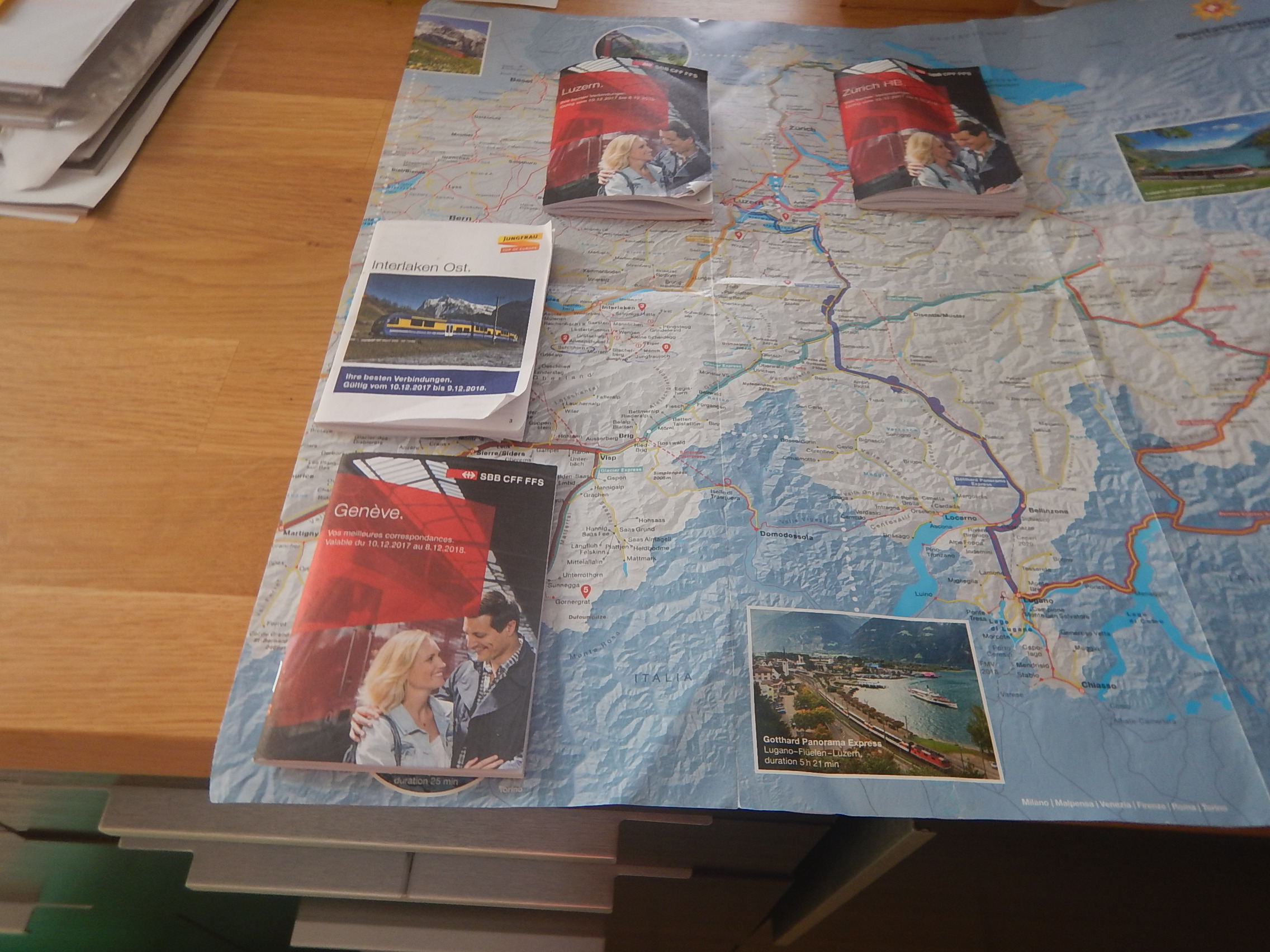
In the picture, there are four of the mini-timetables that seem to be available at most major stations.
These timetables give the times of trains from the station to other major cities. They also give the return trains, so are ideal for planning a day out.
The train companies in the UK, should copy this.
One thing that I found out about a Swiss Pass after I bought it, is that you can buy extension tickets for a journey from the Swiss border to say somewhere like Innsbruck, which is a few kilometres further on. It’s a bit like the ticket, I’ll buy in a few minutes to extend my Freedom Pass to Rayleigh.
The Swiss Pass may be pricey, but it’s worth it and is probably a lot cheaper than hiring a car.
 The Anonymous Widower