Centrica And European Energy Sign Agreement On Måde Green Hydrogen Facility
The title of this post, is the same as that of this press release from Centrica.
This is the sub-heading.
Centrica Energy and European Energy have signed a balancing and optimisation agreement for the Måde green hydrogen facility located at Port Esbjerg. Under the agreement, Centrica Energy will manage power production from co-located wind turbines, designating excess power production to green hydrogen production.
These two introductory paragraphs give more details.
Powering the 12MW green hydrogen facility are two wind turbines, part of the Måde Wind Turbine Test Center, developed by European Energy with a total installed capacity of 16MW. The turbines will provide renewable electricity, which is used to produce green hydrogen through electrolysis with demineralised water.
Expected to produce approximately 1,500 tonnes of green hydrogen every year, European Energy has secured an agreement with Port Esbjerg and a world-class industrial gases company for the offtake from the facility. As the production of hydrogen is a heat-intensive process, the excess heat from production will be fed into the local district heating network, demonstrating sector coupling across the electricity, fuel, and heating domains.
These are my thoughts,
Hydrogen Production
The hydrogen production uses a standard electrolysis method, but excess heat will be fed into the local district heating network.
AquaVentus And Denmark
I introduced AquaVentus in this post called AquaVentus.
This video shows the structure of AquaVentus.
I clipped this map from the video.

Note.
- The thick white line running North-West/South-East is the spine of AquaVentus, that delivers hydrogen to Germany.
- There is a link to Esbjerg in Denmark.
- There appears to be an undeveloped link to Norway.
- There appears to be an undeveloped link to Peterhead in Scotland.
- There appears to be a link to just North of the Humber in England.
- Just North of the Humber are the two massive gas storage sites of Aldbrough owned by SSE and Brough owned by Centrica.
- There appear to be small ships sailing up and down the East Coast of the UK. Are these small coastal tankers, that are distributing the hydrogen to where it is needed?
In the last century, the oil industry, built a substantial oil and gas network in the North Sea.
It appears now the Germans are leading the building of a substantial hydrogen network in the North Sea, that will bring the hydrogen they need to their country.
I also suspect that any spare hydrogen produced in Esbjerg can be added to the AquaVentus network.
- Hydrogen could be sent to Brough and Aldbrough in the UK for storage.
- Hydrogen could be sent to any country in the network that needs it.
Countries will pay for the hydrogen they use.
Optimising AquaVentus
AquaVentus is a complex network.
- Hydrogen could be produced offshore in British, Danish, Dutch, English, German, Norwegian, Orcadian, Scottish and Shetland waters.
- Hydrogen could be sent to Brough and Aldbrough in the UK for storage.
- Hydrogen can be sent to Belgium, Denmark, Germany, Norway, The Netherlands and the UK.
A company like Centrica has the expertise and the software to control the various hydrogen flows to the best advantage of hydrogen producers and users.
‘World’s First’ O&M Campaign Using Heavy-Lift Cargo Drones Underway At Dutch Offshore Wind Farm
The title of this post, is the same as that of this article on offshoreWIND.biz.
This is the sub-heading.
Ørsted has deployed heavy-lift cargo drones (HLCDs) for maintenance work at the Borssele 1&2 offshore wind farm in the Netherlands. This is the first time heavy-lift cargo drones are being used in an operational campaign, according to the company which tested the concept in 2023 at its Hornsea One offshore wind farm in the UK.
These are the first two paragraphs.
At the 752 MW Dutch offshore wind farm that has been in operation since 2020, the 70-kilogram drones will transport cargo of up to 100 kilograms from a vessel to all 94 wind turbines. The campaign now underway at Borssele 1&2 is being performed to update some critical evacuation and safety equipment in each of the turbines.
A drone can complete a task that typically takes several hours in minutes, according to Ørsted.
Note.
- The article claims, a lot of time is saved.
- I suspect we’ll be seeing the use of drones for multiple deliveries, a lot more in the future.
I like the concept, where deliveries to a number of sites are made by drone, rather than in a traditional way perhaps by a ship or truck with a crane.
H2ercules
H2ercules is a project that will create the German hydrogen network.
The H2ercules web site, introduces the project with these two paragraphs.
A faster ramp-up of the hydrogen economy in Germany is more important than ever in order to drive forward the decarbonisation programme, put the German energy system on a more robust footing, and thus contribute towards a green security of supply. What this needs is a geographical realignment of the infrastructure for energy in gas form: Instead of flowing from the east of Germany to the west and south of the country, the gas – natural gas now, hydrogen in the future – will have to make its way in future from generation locations in the north-west to centres of consumption located mainly in the west and south. That also means that new sources will have to be connected, and gaps in existing pipeline networks will have to be closed. To speed up this vital process, OGE and RWE have developed the national infrastructure project “H2ercules”, which is intended to supply consumers in Germany’s south and west with domestically produced green hydrogen from the north of the country, in addition to imported sources. This will involve connecting up the electrolyser capacities that are currently being planned and developing more besides. RWE wants to create up to 1 GW of additional electrolyser capacity as part of the H2ercules project. For the connection component, OGE is planning to put 1,500 km of pipelines in place. For the most part, this will mean converting pipelines from the existing natural gas network to hydrogen, supplemented by newly constructed facilities. Converting natural gas pipelines is not only the more cost-efficient solution, but it also allows for a faster schedule. The system is expected to be supplemented by the planned hydrogen storages of RWE.
The current plan is to complete the project in three stages between 2026 and 2030, in order to connect industries to the hydrogen supply as soon as possible. The aim of this collaboration across multiple value levels is to resolve the chicken-and-egg problem on a super-sized scale and also smooth the way forward for other projects.
Note.
There will be a lot of conversion of the existing natural gas network to hydrogen.
RWE wants to create up to 1 GW of additional electrolyser capacity as part of the H2ercules project.
The second paragraph indicates to me, that they want to move fast.
This map from the H2ercules web site, indicate the proposed size of the network in 2030.

These three paragraphs describe how H2ercules will be developed.
OGE and RWE are both strong companies that aim to combine forces as part of the H2ercules project in order to overcome this Herculean task. While the task for OGE will be to convert the required gas pipelines to hydrogen and construct new pipelines, RWE will expand its electrolyser capacity and import green hydrogen in addition. Gas-fired power stations with a capacity of at least 2 GW will be converted to hydrogen, and new H2 -storages as well as H2-storages repurposed from gas storages on the Dutch border will be connected to the hydrogen supply system.
H2ercules also opens up new opportunities to connect Germany’s future centres of hydrogen consumption to key import routes, first via pipelines from Belgium and the Netherlands, and later via Norway and also from southern and eastern Europe, with the added prospects of import terminals for green molecules in Germany’s north. The project is thus contributing significantly to the creation of a European hydrogen market.
The first additional companies and organisations have already indicated their interest in this project, and it is expected that in the future smaller businesses will benefit in addition to large-scale customers, as the entire industry is guided towards a decarbonised future.
These are my thoughts.
Why Is It Called H2ercules?
I suspect, it’s nothing more, than the Germans wanted a recognisable and catchy name.
- Name selection is not helped by the German for hydrogen, which is wasserstoff.
- Hercules is Herkules in German, which doesn’t really help.
- Projekt Wasserstoff isn’t as memorable as H2ercules, which at least isn’t English.
It looks to me, that the Germans have come up with a good acceptable compromise.
The Wilhemshaven Hydrogen Import Terminal
German energy company; Uniper is building a hydrogen import terminal at Wilhemshaven to feed H2ercules and German industry with hydrogen from places like Australia, Namibia and the Middle East. I wrote about this hydrogen import terminal in Uniper To Make Wilhelmshaven German Hub For Green Hydrogen; Green Ammonia Import Terminal.
Wilhelmshaven and Great Yarmouth are 272 miles or 438 kilometres apart, so a pipeline or a tanker link would be feasible to export hydrogen from Notfolk to Germany.
I suspect RWE will build a giant offshore electrolyser close to the Norfolk wind farms and the hydrogen will be exported by tanker or pipeline to Germany or to anybody else who pays the right price.
RWE’s Norfolk Wind Farms
What is interesting me, is what Germany company; RWE is up to. Note they are one of the largest UK electricity producers.
In December 2023, they probably paid a low price, for the rights for 3 x 1.4 GW wind farms about 50 km off North-East Norfolk from in-trouble Swedish company; Vattenfall and have signed contracts to build them fairly fast.
In March 2024, I wrote about the purchase in RWE And Vattenfall Complete Multi-Gigawatt Offshore Wind Transaction In UK.
This map from RWE shows the three wind farms, with respect to the Norfolk coast.
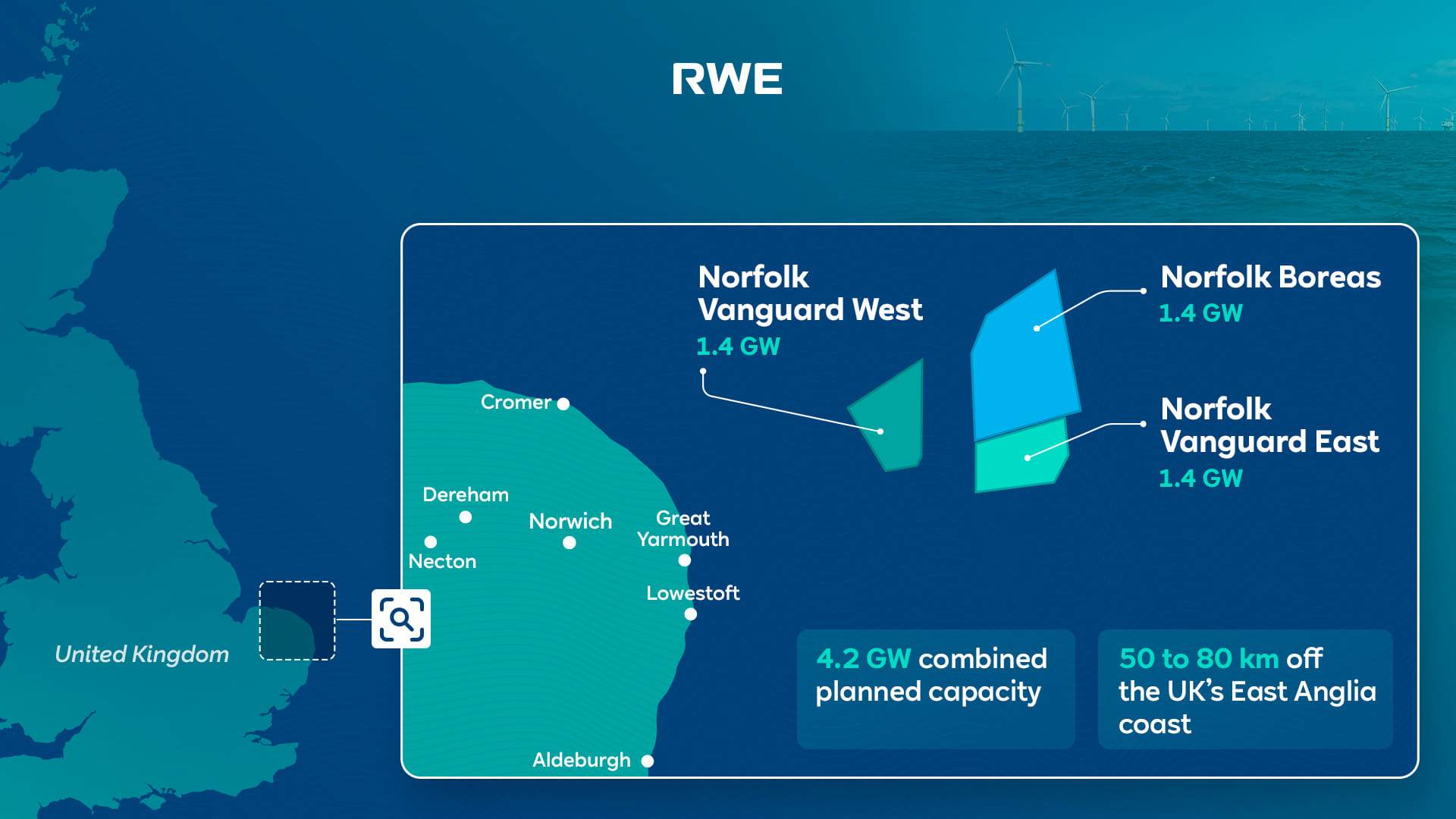
Could it be, that RWE intend to build a giant offshore electrolyser to the East of Great Yarmouth?
- The planning permission for an electrolyser, which is eighty kilometres offshore, would be far easier, than for one onshore.
- The hydrogen pipeline between Norfolk and Germany would be less than 400 kilometres.
- Hydrogen could also be brought ashore in Norfolk, if the price was right.
- The Bacton gas terminal is only a few miles North of Great Yarmouth.
But the big advantage, is that the only onshore construction could be restricted to the Bacton gas terminal.
Adding More Wind Farms To The Electrolyser
Looking at the RWE map, the following should be noted.
South of Norfolk Vanguard East, there is the East Anglian Array wind farm, which by the end of 2026, will consist of these wind farms.
- East Anglia One – 714 MW – 2020
- East Anglia One North – 800 MW – 2026
- East Anglia Two – 900 MW – 2026
- East Anglia Three – 1372 MW – 2026
Note.
- The date is the commissioning date.
- There is a total capacity of 3786 MW
- All wind farms are owned by Iberdrola.
- There may be space to add other sections to the East Anglian Array.
I doubt, it would be difficult for some of Iberdrola’s megawatts to be used to generate hydrogen for Germany.
To the East of Norfolk Boreas and Norfolk Vanguard East, it’s Dutch waters, so I doubt the Norfolk cluster can expand to the East.
But looking at this map of wind farms, I suspect that around 4-5 GW of new wind farms could be squeezed in to the North-West of the the Norfolk Cluster and South of the Hornsea wind farms.
The 1.5 GW Outer Dowsing wind farm, which is being planned, will be in this area.
I can certainly see 8-10 GW of green electricity capacity being available to electrolysers to the North-East of Great Yarmouth.
Conclusion
UK offshore electricity could be the power behind H2ercules.
- The hydrogen could be sent to Germany by pipeline or tanker ship, as the distance is under 400 kilometers to the Wilhelmshaven hydrogen hub.
- Extra electrolysers and wind farms could be added as needed.
- The hydrogen won’t need to be shipped halfway round the world.
The cash flow won’t hurt the UK.
.
RWE And the Norfolk Wind Farms
In March 2024, I wrote RWE And Vattenfall Complete Multi-Gigawatt Offshore Wind Transaction In UK, which described how Vattenfall had sold 4.2 GW of offshore wind farms, situated off North-East Norfolk to RWE.
This map from RWE shows the wind farms.
Note.
- The Norfolk Zone consists of three wind farms; Norfolk Vanguard West, Norfolk Boreas and Norfolk Vanguard East.
- The three wind farms are 1.4 GW fixed-foundation wind farms.
- In Vattenfall Selects Norfolk Offshore Wind Zone O&M Base, I describe how the Port of Great Yarmouth had been selected as the O & M base.
- Great Yarmouth and nearby Lowestoft are both ports, with a long history of supporting shipbuilding and offshore engineering.
The wind farms and the operational port are all close together, which probably makes things convenient.
So why did Vattenfall sell the development rights of the three wind farms to RWE?
Too Much Wind?
East Anglia is fringed with wind farms all the way between the Wash and the Thames Estuary.
- Lincs – 270 MW
- Lynn and Inner Dowsing – 194 MW
- Race Bank – 580 MW
- Triton Knoll – 857 MW
- Sheringham Shoal – 317 MW
- Dudgeon – 402 MW
- Hornsea 3 – 2852 MW *
- Scroby Sands – 60 MW
- East Anglia One North – 800 MW *
- East Anglia Two – 900 MW *
- East Anglia Three – 1372 MW *
- Greater Gabbard – 504 MW
- Galloper – 353 MW
- Five Estuaries – 353 MW *
- North Falls – 504 MW *
- Gunfleet Sands – 172 MW
- London Array – 630 MW
Note.
- Wind farms marked with an * are under development or under construction.
- There is 4339 MW of operational wind farms between the Wash and the Thames Estuary.
- An extra 6781 MW is also under development.
If all goes well, East Anglia will have over 11 GW of operational wind farms or over 15 GW, if the three Norfolk wind farms are built.
East Anglia is noted more for its agriculture and not for its heavy industries consuming large amounts of electricity, so did Vattenfall decide, that there would be difficulties selling the electricity?
East Anglia’s Nimbies
East Anglia’s Nimbies seem to have started a campaign against new overground cables and all these new wind farms will need a large capacity increase between the main substations of the National Grid and the coast.
So did the extra costs of burying the cable make Vattenfall think twice about developing these wind farms?
East Anglia and Kent’s Interconnectors
East Anglia and Kent already has several interconnectors to Europe
- Viking Link – Bicker Fen and Jutland – 1.4 GW
- LionLink – Suffolk and the Netherlands – 1.8 GW – In Planning
- Nautilus – Suffolk or Isle of Grain and Belgium – 1.4 GW – In Planning
- BritNed – Isle of Grain and Maasvlakte – 1.0 GW
- NeuConnect – Isle of Grain and Wilhelmshaven – 1.4 GW – Under Construction
- GridLink Interconnector – Kingsnorth and Warande – 1.4 GW – Proposed
- HVDC Cross-Channel – Sellinge and Bonningues-lès-Calais – 2.0 GW
- ElecLink – Folkestone and Peuplingues – 1.0 GW
- Nemo Link – Richborough and Zeebrugge – 1.0 GW
Note.
- Five interconnectors with a capacity of 6.4 GW.
- A further four interconnectors with a capacity of 6 GW are on their way.
At 12.4 GW, the future capacity of the interconnectors between South-East England and Europe, is nor far short of South-East English wind power.
There are also two gas pipelines from the Bacton gas terminal between Cromer and Great Yarmouth to Europe.
The Wikipedia entry for the Bacton gas terminal gives these descriptions of the two gas pipelines.
Interconnector UK – This can import gas from, or export gas to, Zeebrugge, Belgium via a 235 km pipeline operating at up to 147 bar. There is a 30-inch direct access line from the SEAL pipeline. The Interconnector was commissioned in 1998.
BBL (Bacton–Balgzand line) – This receives gas from the compressor station in Anna Paulowna in the Netherlands. The BBL Pipeline is 235 km long and was commissioned in December 2006.
It would appear that East Anglia and Kent are well connected to the Benelux countries, with both electricity and gas links, but with the exception of the Viking Link, there is no connection to the Scandinavian countries.
Did this lack of connection to Sweden make convincing the Swedish government, reluctant to support Vattenfall in their plans?
Bringing The Energy From The Norfolk Wind Farms To Market
It looks to me, that distributing up to 4.2 GW from the Norfolk wind farms will not be a simple exercise.
- Other wind farms like the 2852 MW Hornsea 3 wind farm, may need a grid connection on the North Norfolk coast.
- The Nimbies will not like a South-Western route to the National Grid at the West of Norwich.
- An interconnector to Denmark or Germany from North Norfolk would probably help.
But at least there are two gas pipelines to Belgium and the Netherlands.
RWE, who now own the rights to the Norfolk wind farms, have a large amount of interests in the UK.
- RWE are the largest power producer in the UK.
- They supply 15 % of UK electricity.
- They have interest in twelve offshore wind farms in the UK. When fully-developed, they will have a capacity of almost 12 GW.
- RWE are developing the Pembroke Net Zero Centre, which includes a hydrogen electrolyser.
RWE expects to invest up to £15 billion in the UK by 2030 in new and existing green technologies and infrastructure as part of this.
Could this be RWE’s plan?
As the Norfolk wind farms are badly placed to provide electricity to the UK grid could RWE have decided to use the three Norfolk wind farms to produce hydrogen instead.
- The electrolyser could be placed onshore or offshore.
- If placed onshore, it could be placed near to the Bacton gas terminal.
- There are even depleted gas fields, where hydrogen could be stored.
How will the hydrogen be distributed and/or used?
It could be delivered by tanker ship or tanker truck to anyone who needs it.
In Developing A Rural Hydrogen Network, I describe how a rural hydrogen network could be developed, that decarbonises the countryside.
There are three major gas pipelines leading away from the Bacton gas terminal.
- The connection to the UK gas network.
- Interconnector UK to Belgium.
- BBL to The Netherlands.
These pipelines could be used to distribute hydrogen as a hydrogen blend with natural gas.
In UK – Hydrogen To Be Added To Britain’s Gas Supply By 2025, I describe the effects of adding hydrogen to the UK’s natural gas network.
Feadship Ushers In The Fuel-Cell Era With The Launch Of118.80-metre Project 821
The title of this post, is the same as this press release from Feadship.
This picture from Feadship shows project 821.
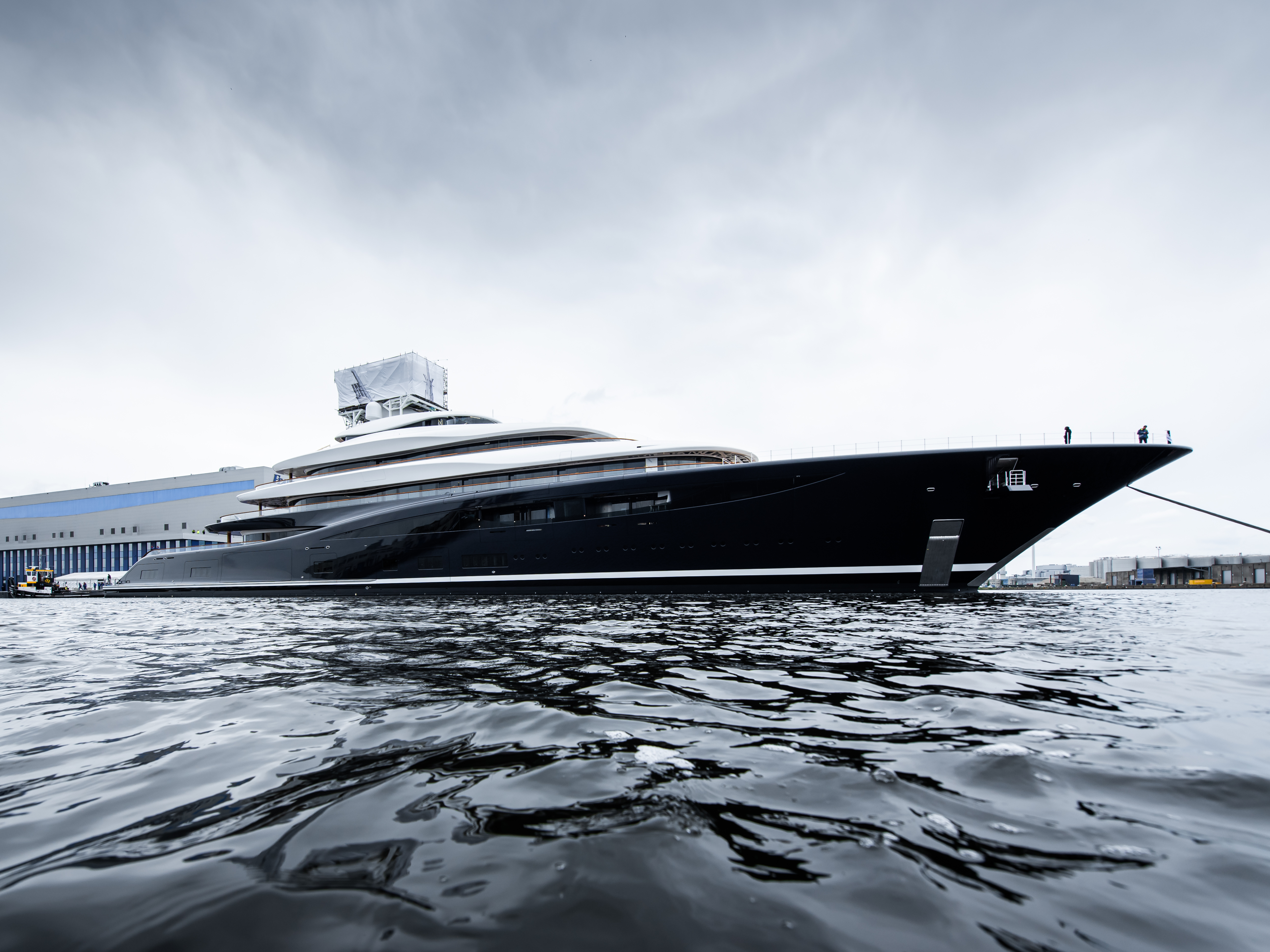
These are the first two paragraphs of the press release.
When the drydock doors slid open on 4 May at Feadship’s Amsterdam shipyard, the yachting
world was forever changed. Say hello to Project 821, the world’s first hydrogen fuel-cell
superyacht. Five years in the making, innovation-packed Feadship Project 821 is the answer to
a fundamental question: “How far can we push green technology on superyachts?”Designed by RWD and with owners representation by Edmiston, Feadship’s bold response was
a multi-faceted, zero-diesel approach designed to cruise between harbours or anchorages and
to operate the yacht’s hotel load and amenities with emission-free power from green hydrogen.
“The aim has been to develop a new, clean technology not just for this project, but for the
world,” said Jan-Bart Verkuyl, Feadship Director / CEO Royal Van Lent Shipyard. The size of
the proposed yacht – 100-metres-plus – made it a good candidate to explore pure green
hydrogen as the fuel-cell source. For those captivated by cutting-edge innovations, this yacht
presents an opportunity for potential acquisition as it showcases the pinnacle of modern
technological advancements.
As the superyacht is 118.8 metres long, I can see a lot of ships of this size being powered by hydrogen.
Denmark Launches Massive Offshore Wind Auction
The title of this post, is the same as that of this article on offshoreWIND.biz.
This is the sub-heading.
Denmark has opened a new offshore wind tender, the country’s largest ever, offering a minimum of 6 GW of new capacity spread over six wind farms, with the overplanting option allowing for 10 GW or more of new capacity to be added.
These are two paragraphs from the article.
The offshore wind farms must deliver at least 6 GW, and as a new element, there will be freedom to establish as much offshore wind as possible on the tendered areas, with the exemption of Hesselø with a maximum capacity of 1.2 GW.
If the market utilizes this freedom to optimize the usage of the areas, it could result in the construction of 10 GW offshore wind or more, the agency said.
Recently, some wind farms in the UK have been increased in size after the auction.
In Crown Estate Mulls Adding 4 GW Of Capacity From Existing Offshore Wind Projects, I note how 4 GW of overplanting could be employed to raise the total capacity from 4.6 GW to 8.6 GW.
So have the Danes decided to build expansion into the tender?
One of the wind farms in the auction is called Nordsøen I.
- It will be about 50 km. from the West Coast of Denmark.
- It appears it will have a capacity of at least 1 GW.
- It could connect to the shore, not far from where the Viking Link between Lincolnshire and Denmark connects to the Danish grid.
- There is a 700 MW interconnector between the area and Eemshaven in The Netherlands.
- There is 1.5 GW of overland transmission lines to Germany.
All these connections, increase energy security for Denmark, Germany, the Netherlands and the UK.
Could the Danes be building the Nordsøen I, so it could work with the all the connections in Southern Jutland and improve energy security?
UK ESO Unveils GBP 58 Billion Grid Investment Plan To Reach 86 GW of Offshore Wind By 2035
The title of this post, is the same as that of this article on offshoreWIND.biz.
This is the sub-heading.
Great Britain’s electricity system operator (ESO) has proposed a GBP 58 billion (approximately EUR 68 billion) investment in the electricity grid. The proposal outlines a vision for incorporating an additional 21 GW of offshore wind into the grid by 2035, which would bring the country’s total offshore wind capacity to a potential 86 GW.
These three paragraphs add more details to what the investment in the grid means for offshore wind.
The ESO released on 19 March the first Beyond 2030 report. The plan sets up the necessary infrastructure to transfer power to and from future industries, as electricity demand is expected to rise by 64 per cent by 2035, according to the ESO.
The grid operator said that the plan connects a further 21 GW of offshore wind in development off the coast of Scotland to the grid in an efficient and coordinated way which would bring the country’s total offshore wind capacity to a potential 86 GW.
The proposals could assist the UK government in meeting the sixth Carbon Budget and allow for the connection of Crown Estate Scotland’s ScotWind leasing round.
These are my thoughts.
How Much Offshore Wind Is In The Pipeline?
This Wikipedia entry is a List Of Offshore Wind Farms In The United Kingdom.
It gives these figures for wind farms in various operational an development states.
- Operational – 14,703 MW
- Under Construction – 5,202 MW
- Pre-Construction – 6,522 MW
- Contracts for Difference – Round 3 – 12 MW
- Contracts for Difference – Round 4 – 1,428 MW
- Early Planning – England – 18,423 MW
- Early Planning – Wales – 700 MW
- Early Planning – Scotland – 30,326 MW
Note.
- These add up to a total of 77,316 MW.
- If all the wind farms in the Wikipedia entry are commissioned, the UK will be short of the 86,000 MW total by 8,664 MW.
- Some wind farms like Ossian could be increased in size by a few GW, as I reported in Ossian Floating Wind Farm Could Have Capacity Of 3.6 GW.
It looks like only another 7,164 MW of offshore wind needs to be proposed to meet the required total.
This article on offshoreWIND.biz is entitled The Crown Estate Opens 4.5 GW Celtic Sea Floating Wind Seabed Leasing Round, will add another 4,500 MW to the total, which will raise the total to 81,816 MW.
The article also finishes with this paragraph.
Round 5 is expected to be the first phase of development in the Celtic Sea. In November 2023, the UK Government confirmed its intention to unlock space for up to a further 12 GW of capacity in the Celtic Sea.
A further 12 GW of capacity will take the total to 93,816 MW.
In Three Shetland ScotWind Projects Announced, I talked about three extra Scotwind wind farms, that were to be developed to the East of Shetland.
These will add 2.8 GW, bringing the total to 96,616 MW.
I don’t think the UK has a problem with installing 86 GW of offshore wind by 2035, so we must create the electricity network to support it.
The Electricity Network In 2024
I clipped this map from this article in The Telegraph, which is entitled Britain’s Energy System Will Not Hit Net Zero Until 2035, National Grid Tells Labour.
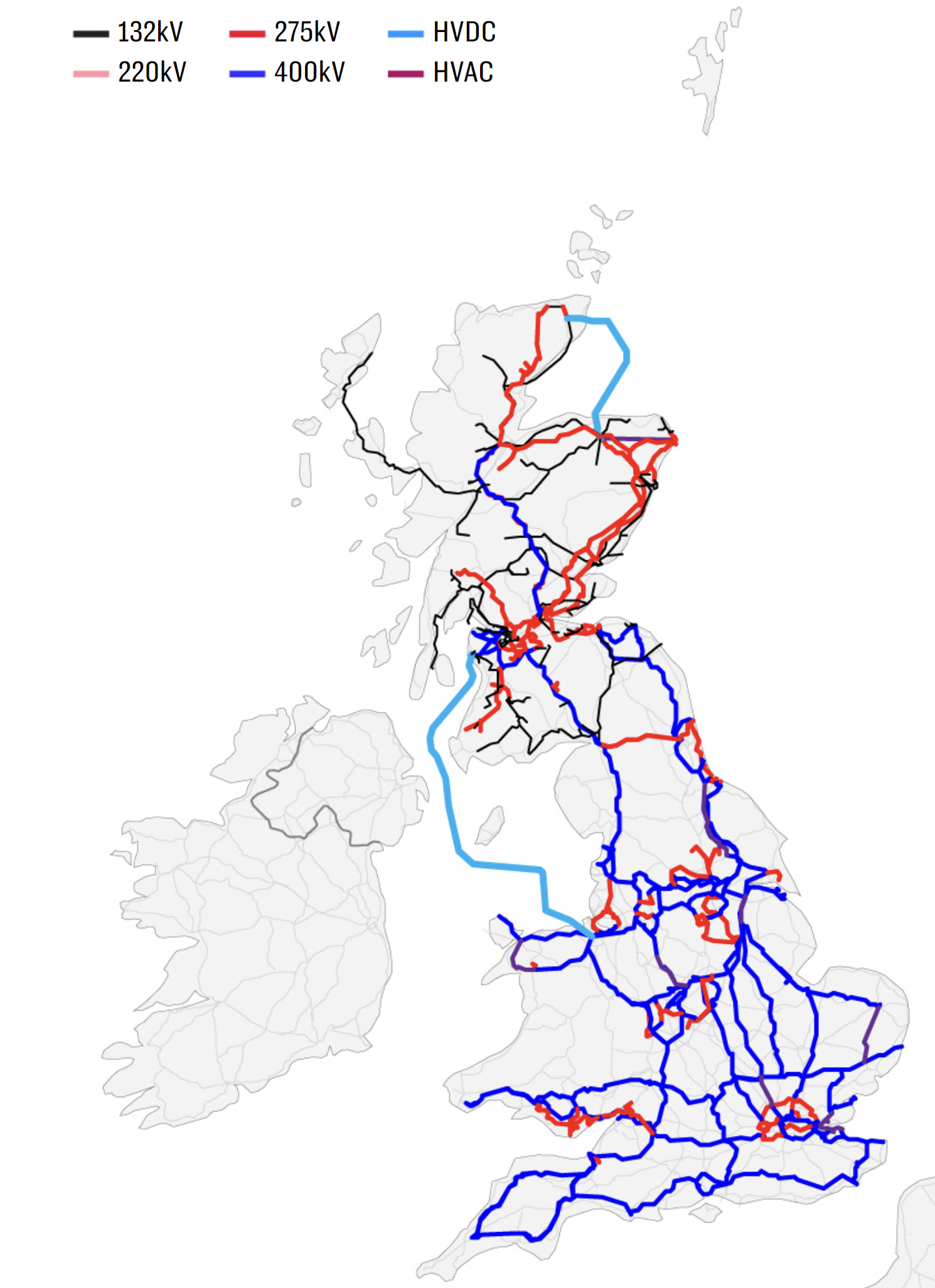
The dark blue lines are the 400 kV transmission lines.
- The one furthest East in East Anglia serves the Sizewell site, which hosts the Sizewell B nuclear power station and will be the home of Sizewell C nuclear power station, unless the Green or LibDem Parties are a member of a coalition government.
- Kent and Sussex seem to be encircled by 400 kV lines, with small spurs to the interconnectors to Europe.
- Two 400 kV lines appear to serve the South-West peninsular, with one going along the South Coast and the other further North. I suspect these two motorways for electricity explain, why the Morocco-UK Power Project terminates in Devon.
- London seems to have its own M25 for electricity.
- There also appears to be an East-West link to the North of London linking Sizewell in the East and Pembroke in the West. Both ends have large power stations.
- There also appear to be two 400 kV lines from Keadby by the Humber Estuary to North Wales with the pumped storage hydro power station at Dinorwig.
- Two more 400 kV lines link Yorkshire to the South of Scotland.
- A lonely Northern cable connects Edinburgh and the North of Scotland.
The red lines, like the one encircling central London are the 275 kV transmission lines.
- Think of these as the A roads of the electricity network.
- They encircle London often deep underground or under canal towpaths.
- They reinforce the electricity network in South Wales.
- Liverpool appears to have its own local network.
- They also seem to provide most of the capacity North of and between Edinburgh and Glasgow.
Newer cables are starting to appear on this map.
There are two light blue cables and these are HVDC cables that run underwater.
- The 1.2 GW Caithness – Moray Link does what it says in the name and it connects the far North of Scotland direct towards Aberdeen.
- The much larger 2.25 GW Western HVDC Link connects Hunterston near Glasgow to Flintshire Bridge near Liverpool. Note how it passes to the West of the Isle of Man.
Not shown on the map are the smaller 500 MW Moyle Interconnector and the recently-opened 600 MW Shetland HVDC Connection.
The Electricity Network In 2050
This second map shows how the network will look in 2050.

Note.
- The colours are the same, as the previous map.
- Although, I do think there are some errors in which have been used.
- There are a lot more cables.
There are several more light blue cables and these are HVDC cables that run underwater.
- Shetland is now linked to the North of Scotland by the Shetland HVDC Connection.
- There appears to be a cluster of HVDC interconnectors at Caithness HVDC switching station, near Wick, including a new one to Orkney, to go with the others to Moray and Shetland.
- The 2 GW Scotland England Green Link 1 will run from Torness in Southeast Scotland to Hawthorn Pit substation in Northeast England.
- The 2 GW Eastern Green Link 2 will run from Sandford Bay, at Peterhead in Scotland, to the Drax Power Station in Yorkshire, England.
- There also appear to be two or possibly three other offshore cables linking the East Coast of Scotland with the East Coast of England.
- If the Eastern cables are all 2 GW, that means there is a trunk route for at least 8 GW between Scotland’s wind farms in the North-East and Eastern England, which has the high capacity wind farms of Dogger Bank, Hornsea and around the Lincolnshire and East Angliam coasts.
- Turning to the Western side of Scotland, there appears to be a HVDC connection between the Scottish mainland and the Outer Hebrides.
- South-West of Glasgow, the Western HVDC Link appears to have been duplicated, with a second branch connecting Anglesey and North-West Wales to Scotland.
- The Moyle Interconnector must be in there somewhere.
- Finally, in the South a link is shown between Sizewell and Kent. It’s shown as 400 kV link but surely it would be a HVDC underwater cable.
There are also seven stubs reaching out into the sea, which are probably the power cables to the wind farms.
- The red one leading from South Wales could connect the wind farms of the Celtic Sea.
- The blue link North of Northern Ireland could link the MachairWind wind farm to the grid.
- The other two red links on the West Coast of Scotland could link to other ScotWind wind farms.
- The red link to the North of East Anglia could link RWE’s Norfolk wind farms to the grid.
- The other stubs in the East could either connect wind farms to the grid or be multi-purpose interconnectors linking to Germany and the Netherlands.
It looks to me, that National Grid ESO will be taking tight control of the grid and the connected wind farms, as an integrated entity.
As a Graduate Control Engineer, I can’t disagree with that philosophy.
Hydrogen Production
In How Germany Is Dominating Hydrogen Market, I talked about how Germany’s plans to use a lot of hydrogen, will create a large world-wide demand, that the UK because of geography and large amounts of renewable energy is in an ideal place to fulfil.
I can see several large electrolysers being built around the UK coastline and I would expect that National Grid ESO have made provision to ensure that the electrolysers have enough electricity.
Would I Do Anything Different?
Consider.
- If it is built the Morocco-UK Power Project will terminates in Devon.
- There could be more wind farms in the Celtic Sea.
- It is likely, that the wind farms in the Celtic Sea will connect to both Pembroke and Devon.
- Kent has interconnectors to the Continent.
Would a Southern HVDC link along the South Coast between Devon and Kent be a good idea?
Conclusion
Looking at the proposed list of wind farms, a total in excess of 96 GW could be possible, which is ten GW more than needed.
The network not only serves the UK in a comprehensive manner, but also tees up electricity for export to Europe.
UK Energy Grid Needs £60bn Upgrade To Hit Green Target, Plan Says
The title of this post, is the same as that of this article on the BBC.
This is the sub-heading.
The UK’s electricity network needs almost a further £60bn of upgrades to hit government decarbonisation targets by 2035, according to a new plan.
These five paragraphs explain the plan.
About 4,000 miles of undersea cables and 1,000 miles of onshore power lines are needed, said the National Grid’s Electricity Systems Operator (ESO).
The investment would add between £20 to £30 a year to customer bills, it said.
The government said the ESO’s plans were preliminary and yet to pass a “robust planning process”.
The plans were written up by the ESO, the organisation which runs the electricity network and would run the updated system it is calling for too. It is currently owned by National Grid but will transfer into government ownership later this year.
Its latest £58bn estimate is for work needed between 2030 and 2035 and comes on top of a previous £54bn estimate for work taking place between now and 2030.
These are my thoughts.
The Amount Of Undersea Cable
Edinburgh and London are roughly 400 miles apart as the train runs, so it looks like there could be the equivalent of ten underwater cables between the North of Scotland and England.
In Contracts Signed For Eastern Green Link 2 Cable And Converter Stations, I talked about the proposed 2 GW link between Peterhead in Scotland and Drax in England, which will be a double cable. So there’s the first two of these long cables.
It looks to me, that National Grid are proposing to use underwater cables wherever they can, so they avoid large expensive planning rows stirred up by Nimbies.
Monitoring The Undersea Cables
Last week Ofgem gave National Grid a £400,000 grant to develop new innovative technologies, which I wrote about in £400k For National Grid Innovation Projects As Part Of Ofgem Fund To Help Shape Britain’s Net Zero Transition.
One of the project is called HIRE – Hybrid-Network Improvement & Reliability Enhancement and will be used to check all these cables are performing as they should.
My electrical engineering experience tells me, that there must be some cunning way, that will detect that something is happening to the cable. The involvement of a technology company called Monitra in the project is a bit of a giveaway.
How Much Will It Cost Me?
Currently, UK consumers pay about £30 per year to have electricity delivered, so this will rise to between £50 and £60 per year.
That is just over a pound a week. I would pay about the same for a resident’s parking permit outside my house for an electric car and probably three times more for a petrol or diesel car.
Do We Have Enough Cable?
Two undersea cable factories are under development in Scotland and I suspect the 4,000 miles of undersea cables will be delivered on schedule and covered in saltires.
What About T-Pylons?
The latest onshore electricity transmission line between Hinckley Point C and Bristol, doesn’t use traditional pylons.
It uses T-pylons like these to connect the 3.26 GW nuclear power station.
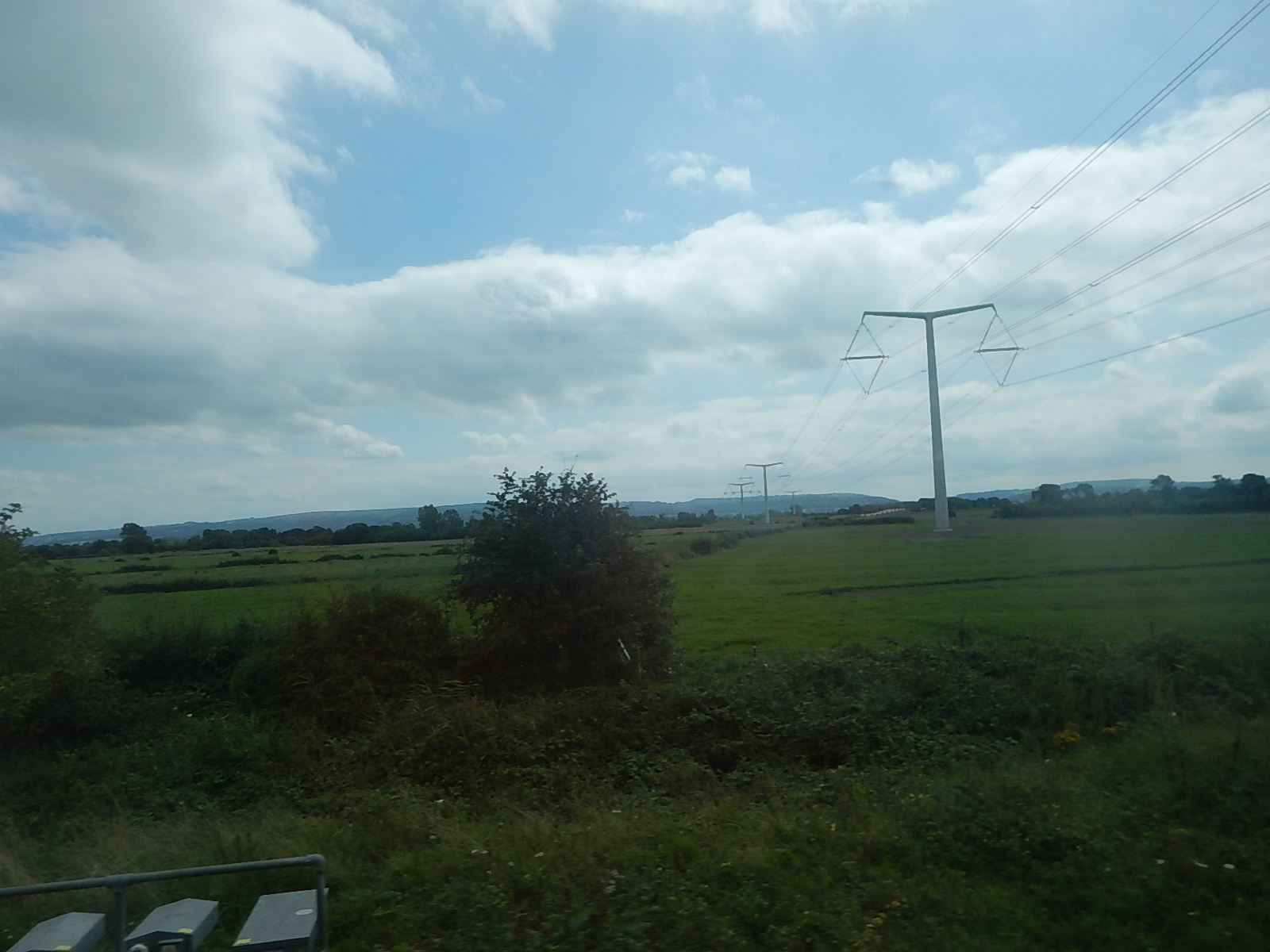
Note that they are shorter, designed to be less intrusive, have a smaller footprint and are made from only ten parts.
I suspect they will cost less to install and maintain.
There is more on T-pylons in National Grid Energise World’s First T-Pylons.
I wouldn’t be surprised that some of the oldest traditional pylons will be replaced by T-pylons.
I am surprised that T-pylons are not mentioned in the BBC article.
I like T-pylons. How do you feel about them?
Eastern Green Link 2
This press release from National Grid, describes Eastern Green Link 2 like this.
Eastern Green Link 2 (EGL2) is a 525kV, 2GW high voltage direct current (HVDC) subsea transmission cable from Peterhead in Scotland to Drax in England delivered as a joint venture by National Grid and SSEN Transmission.
This map from National Grid, shows the route of the Eastern Green Link 2.

The Northern landfall is at Sandford Bay and the Southern landfall is at Wilsthorpe Beach.
This Google Map shows Sandford Bay and Peterhead power station.
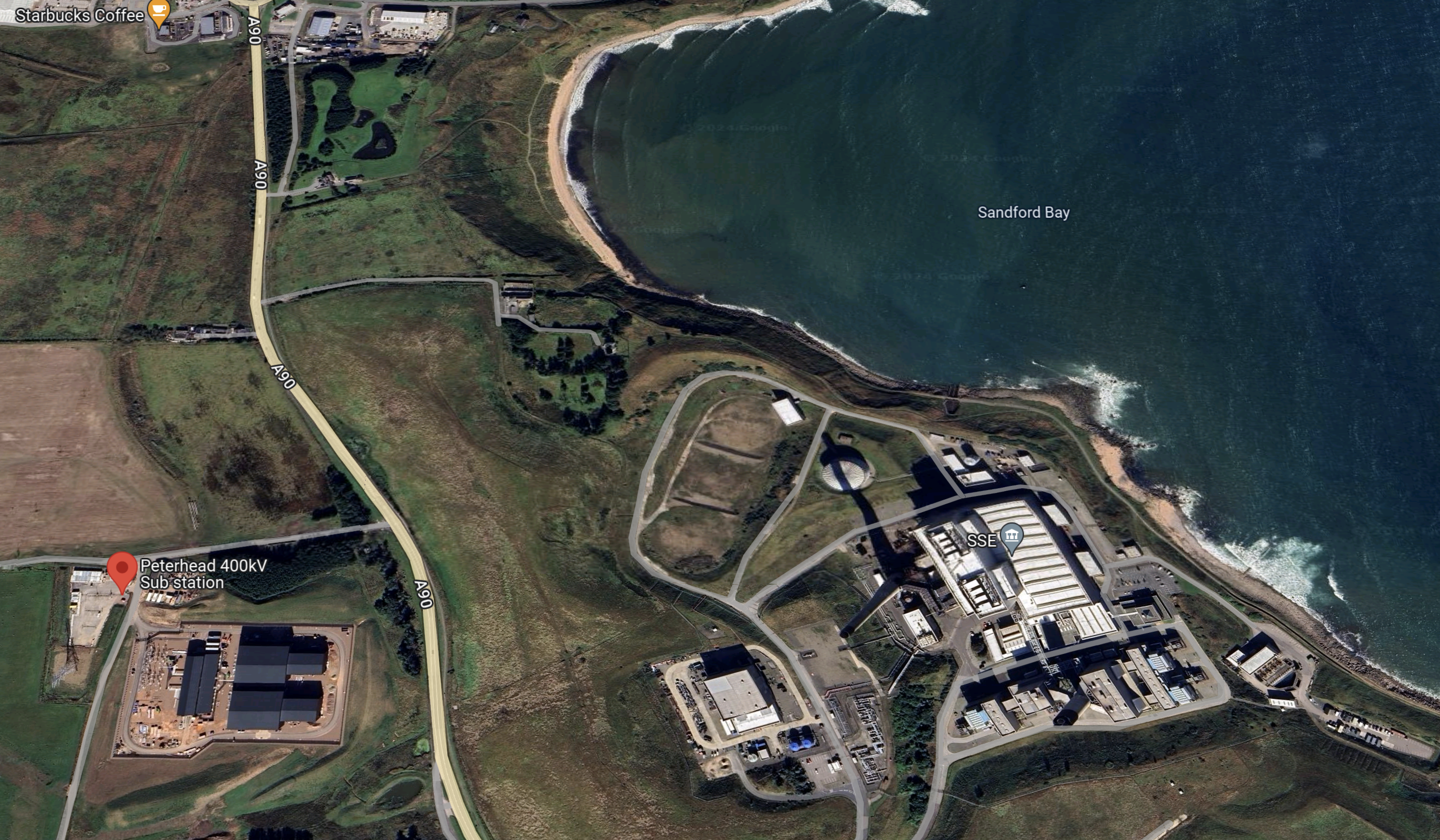
Note.
- Sandford Bay occupies the North-East corner of the map.
- The red arrow indicates the main 400kV sub-station at Peterhead.
- The 2177 MW gas-fired Peterhead power station is to the East of the sub-station marked as SSE.
This second Google Map shows the onshore route of the cable from Wilsthorpe to Drax.

Note.
- Flamborough Head is in the North-East corner of the map.
- Wilsthorpe Beach is at Bridlington a couple of miles South of Flamborough Head.
- The red arrow indicates Drax Power station.
- An onshore underground cable will be installed from landfall in Wilsthorpe to a new onshore converter station built in Drax.
The EGL2 HVDC cable connection from Scotland to England consists of 436km of submarine cable and 69km of onshore cable.
Both converter stations will be on existing power station sites and the major onshore works will be the underground cable between Wilsthorpe and Drax.
Where Does Drax Go From Here?
Currently, Drax power station is a 2595 MW biomass-fired power station.
There are now other large power sources that could replace some or all of the output of Drax power station.
- 2GW of Scottish wind power coming to Drax on Eastern Green Link 2.
- 6 GW of offshore wind is being developed at the Hornsea wind farms.
- 8 GW of offshore wind is being developed at the Dogger Bank wind farms.
- 2.5 GW from the three gas-fired power stations at Keadby, two of which are likely to be fitted with carbon capture.
- 1.8 GW from the proposed hydrogen-fired Keadby Hydrogen power station.
Given the bad feelings many have about Drax burning biomass, with 20.3 GW of electricity, you might think that shutting down Drax would be a simple solution.
But, according to Drax’s Wikipedia entry, it has a unique property.
Despite this intent for baseload operation, it was designed with a reasonable ability for load-following, being able to ramp up or down by 5% of full power per minute within the range of 50–100% of full power.
So Drax could be very useful in balancing the grid, by ramping up and down to fill the gap between production and need.
In addition, there is good biomass. This is from the Wikipedia entry.
A 100,000 tonne pa capacity straw pelletization facility was constructed at Capitol Park, Goole in 2008.
Drax are also promoting BECCS or Bioenergy carbon-capture and storage.
There is a Wikipedia entry for Bioenergy With Carbon Capture And Storage, of which this is the first couple of sentences.
Bioenergy with carbon capture and storage (BECCS) is the process of extracting bioenergy from biomass and capturing and storing the carbon, thereby removing it from the atmosphere. BECCS can theoretically be a “negative emissions technology” (NET).
I do feel that carbon capture and storage is a bit like sweeping the dust under the carpet, when you sweep the floor around it.
But carbon capture and use could be another matter.
This Google Map shows the Drax site.

Note how it is surrounded by agricultural land.
Could the power station be the source of pure carbon dioxide to be fed in greenhouses to flowers, herbs, salad vegetables, tomatoes and other plants?
I suspect there’s productive life left in Drax power station yet!
LionLink
LionLink, that is being developed by National Grid is a new type of interconnector, called a multi-purpose interconnector, that will connect Suffolk and The Netherlands via any convenient wind farms on the way. This means that the electricity generated can go where it is needed most.
I wrote about LionLink in World’s Largest-Of-Its-Kind Power Line To Deliver Clean Power To 1.8m UK Homes And Boost Energy Security.
Other Multi-Purpose Interconnectors
I can see other multi-purpose interconnectors like LionLink being built around the UK.
- There could be one across the Dogger Bank to link out 8 GW of Dogger Bank wind farms with those of the Dutch, Danes and Germans on their section of the bank.
- NorthConnect could be built between Scotland and Norway via some of the wind farms being developed to the North-East of Scotland.
- Could wind farms to the North of Ireland use a multi-purpose interconnector between Scotland and Northern Ireland.
- I can also see one or possibly two, being built across the Celtic Sea to link Devon, South Wales and Southern Ireland via the wind farms being developed in the area.
- Will we also see a Channel multi-purpose interconnector to transfer electricity along the South Coast of England?
Some of these multi-purpose interconnectors could be key to creating a revenue stream, by exporting electricity, to countries in Europe, that have a pressing need for it.
Conclusion
National Grid’s excellent plan will lead to the end of the practice of shutting down wind turbines. The spare electricity will be exported to Europe, which will surely create a good cash-flow for the UK. This in turn will encourage developers to create more wind farms in the seas around the UK’s coasts.
LionLink: Proposed Windfarm Cabling Sites In Suffolk Are Revealed
The title of this post, is the same as that of this article on the BBC.
This is the sub-heading.
National Grid has revealed where it wants to build energy infrastructure for cabling between the UK and the Netherlands.
These four paragraphs describe the project.
The power line, called LionLink, would connect offshore wind farms in the North Sea.
The energy company wants the cables to reach land at either Walberswick or Southwold, both in Suffolk.
A converter station would be built on the outskirts of nearby Saxmundham and could cover a six-hectare area.
That would then connect to a substation being built at the village of Friston, also in Suffolk, as part of the offshore wind plans.
But the plans have brought the Nimbies out in force.
This Google Map shows the Suffolk Coast, to the South of Southwold.
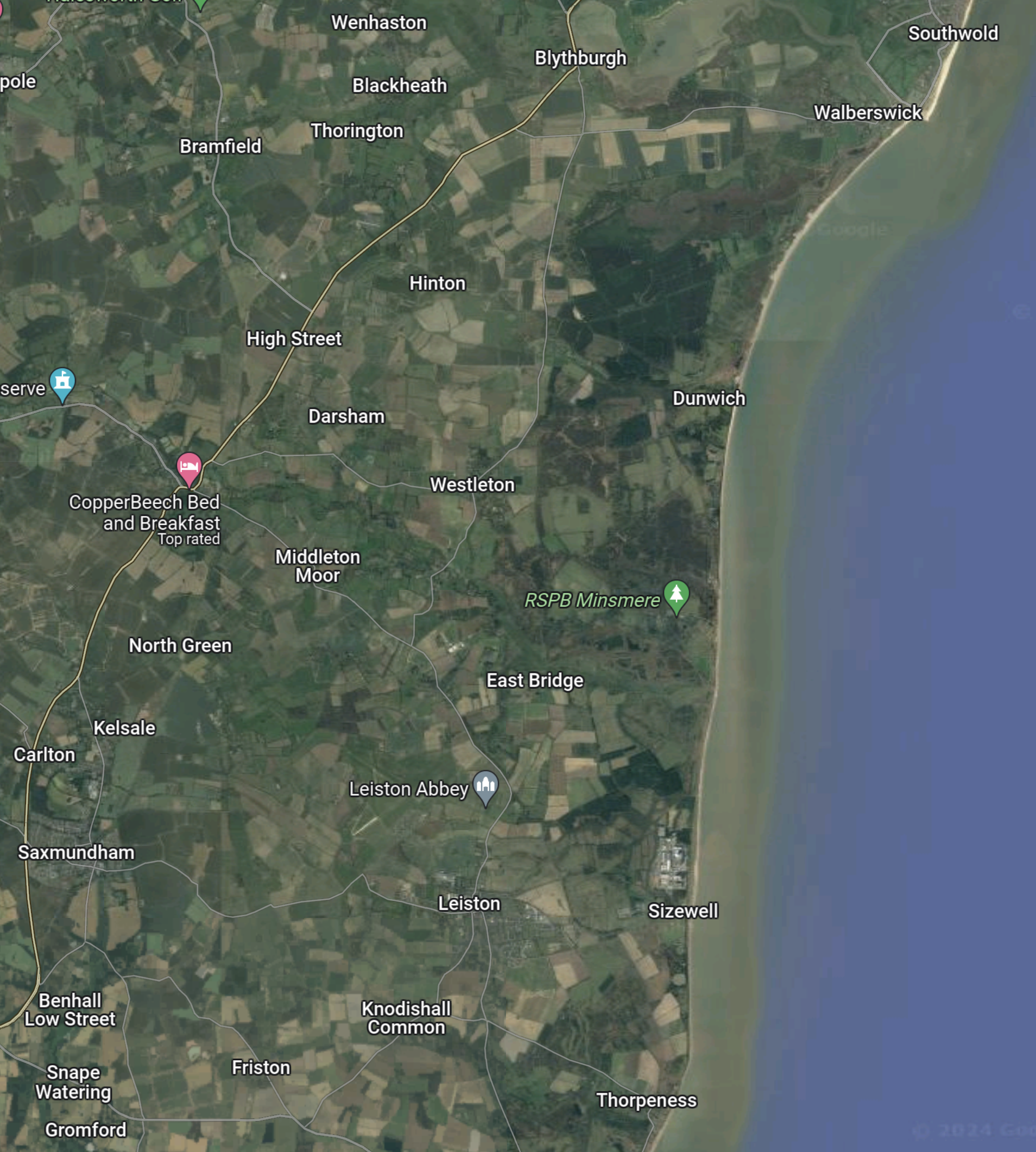
Note.
- Southwold and Walberswick in the North-East corner of the map.
- Saxmundham is just up from the South-West corner of the map, with Friston to its East.
- Sizewell with the 1.2 GW Sizewell B nuclear power station is on the coast directly East of Saxmundham.
- Sizewell B is planned to be joined by the 3.2 GW Sizewell C nuclear power station.
- LionLink is likely to have a capacity of 2 GW.
- I also believe that at least another GW of offshore wind power will be squeezed in along this section of coast.
The Sizewell site is connected to the National Grid at Bullen Lane substation to the West of Ipswich.
These pictures show the pylons that were built in the 1960s to connect Sizewell A to the National Grid.
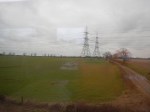





I doubt, they would be allowed to be erected today.
One alternative would be to use T-pylons, like these built to connect Hinckley Point C to the National Grid.

There is more on T-pylons in this press release from National Grid, which is entitled National Grid Energise World’s First T-Pylons.
This Google Map shows the area between Ipswich and the coast.
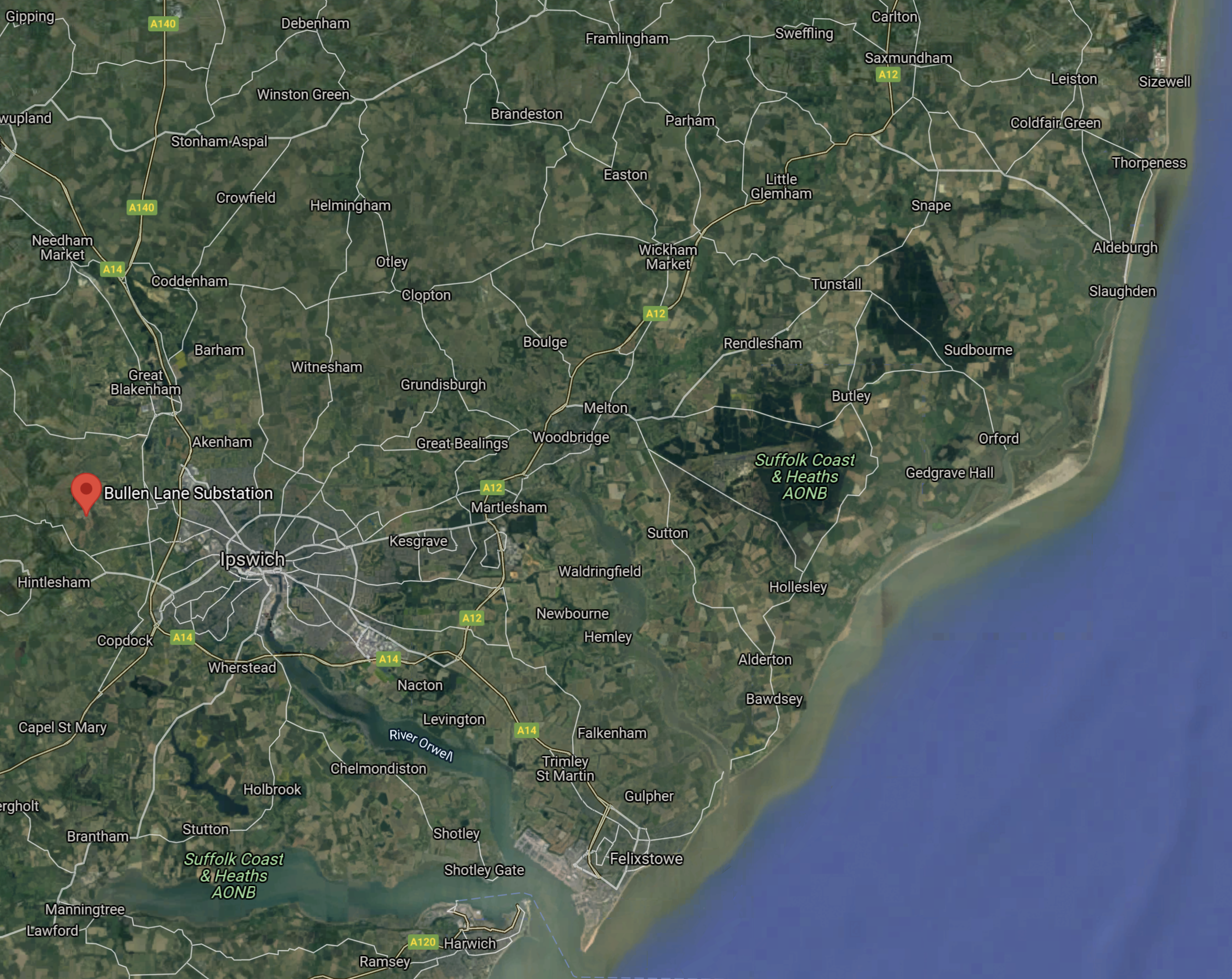
Note.
- Sizewell is in the North-East corner of the map.
- Felixstowe, Harwich and Freeport East are at the mouth of the rivers Orwell and Stour.
- The Bullen Lane substation is to the West of Ipswich and shown by the red arrow.
Looking at maximum power flows in Suffolk and Somerset, we get.
- North-East Suffolk to the National Grid at Bullen Lane – 7.4 GW.
- Hinckley Point C to the National Grid – 3.26 GW.
I am led to the conclusion, that there need to be a doubling of the pylons between North-East Suffolk and Bullens Lane.
I can understand why the Nimbies have been aroused.
I believe that National Grid will have to take the undersea route along the coast of Essex and Suffolk, to get the electricity to its markets.
 The Anonymous Widower