Ørsted In Talks To Sell Half Of Huge UK Wind Farm To Apollo
The title of this post, is the same as that as this article in The Times.
This is the sub-heading.
The US investment giant is eyeing a 50 per cent stake in the Danish energy company’s £8.5 billion Hornsea 3 project off the Yorkshire coast
These are the first three paragraphs, which add more detail.
An American investment giant is negotiating a deal to buy half of what will be the world’s largest off-shore wind farm off the coast of Yorkshire from the troubled Danish energy company Ørsted.
New York-based Apollo, which oversees assets of about $840 billion, is in talks with Ørsted about acquiring a 50 per cent stake in Hornsea 3, an £8.5 billion project that started construction in 2023 and will be capable of powering more than three million UK homes.
A transaction would be a boost for Orsted, which has come under pressure in recent months from rising costs and a backlash against renewables in the United States by President Trump. Orsted started the process of selling a stake in Hornsea 3 in 2024 and said last month that it had an unnamed preferred bidder for the asset, which the Financial Times first reported was Apollo.
I have written several times about Ørstedregularly building a large wind farm and then selling it, so they must be doing something right.
In World’s Largest Wind Farm Attracts Huge Backing From Insurance Giant, I wrote about how Aviva bought Hornsea 1 from Ørsted.
One of the guys at Aviva explained that these sort of investments gave the right sort of cash flow to fund insurance risks and pensions.
Now that Trump has attempted to give his kiss of death to wind power in the United States, will US funds be looking for quality investments like Hornsea 3 in the UK and other large wind farms in France, Germany, Norway, Japan and Korea?
Already, Blackrock are investing billions to build a massive data centre at Blyth, where there are Gigawatts of offshore wind power and an interconnector to Norway, so that UK and Norwegian wind can be backed up by UK nuclear and Norwegian hydropower.
Highview Power And Ørsted
I wrote Highview Power, Ørsted Find Value In Integrating Offshore Wind With Liquid Air Energy Storage in November 2023.
I would have thought, that by now a battery would have been announced in one of Ørsted’s many projects.
I asked Google AI if Highview Power and Ørsted were still talking about liquid air energy storage and received this reply.
Yes, Highview Power and Ørsted are still actively involved in Liquid Air Energy Storage (LAES), having completed a joint study in late 2023 on combining LAES with offshore wind to benefit the UK grid, and the findings were presented to the government for its long-duration energy storage (LDES) consultation. They believe LAES can reduce wind curtailment, increase energy productivity, and support grid resilience, with potential projects aligned with offshore wind farm timelines.
Perhap’s Ørsted are getting their finances aorted first?
Conclusion
The Times They Are A-Changing!
Offshore Construction Work Resumes On Revolution Wind After US Judge’s Ruling
The title of this post, is the same as that of this article on offshoreWIND.biz.
This is the sub-heading.
A US judge in Washington has cleared the way for work to resume on the 704 MW Revolution Wind offshore wind farm after granting a temporary injunction that lifted the federal stop-work order imposed in August.
These two paragraphs add details to the post.
On 22 August, the US Department of the Interior’s (DOI) Bureau of Ocean Energy Management (BOEM) issued a stop-work order halting all offshore construction activities on the 704 MW project, which is already 80 per cent completed, according to its developers, Ørsted and Skyborn Renewables.
A few days later, the joint venture challenged the stop-work order in the US District Court for the District of Columbia, while Connecticut and Rhode Island filed their own lawsuits against the decision on the same day.
I’ve written about this project before in ‘This Has Nothing To Do With National Security’ | Revolution Wind Halt Leaves Connecticut Leaders Demanding Answers
Nuclear Plan For Decommissioned Coal Power Station
The title of this post, is the same as that of this article on the BBC.
This is the sub-heading.
Nuclear power could be generated on the site of a former coal power station in Nottinghamshire.
These first four paragraphs add details.
Cottam Power Station was decommissioned in 2019, and in August its eight 114m (375ft) cooling towers were demolished.
Three businesses – American energy firm Holtec International, EDF UK, and real estate manager Tritax – have now signed an agreement to set up a small modular reactor (SMR) to power “advanced” data centres at the 900-acre site.
Holtec said the project could create “thousands of high-skilled manufacturing and construction jobs”, as well as “long-term roles”.
The SMR at Cottam would be the second of its kind, following the creation of a plant at Palisades in Michigan, in the US.
Note.
- Cottam was a 2,000 MW power station, that could run on coal, oil and biomass.
- If a nuclear power station is built at Cottam, it will be one of the first nuclear stations not close to the coast.
I asked Google AI for details of the plant at Palisades in Michigan and received this reply.
The Palisades SMR project at the Palisades Nuclear Plant in Michigan will feature two Holtec SMR-300 units, each producing at least 300 megawatts of power, for a combined total of at least 600-640 megawatts of net power. This project aims to have the first US dual-unit SMR 300 system operational by 2030, and the SMRs are designed to produce electricity and provide steam for other industrial purposes.
It does appear that the new generation of reactors from Holtec, Rolls-Royce and X-energy are smaller than many nuclear reactors built in the last twenty years.
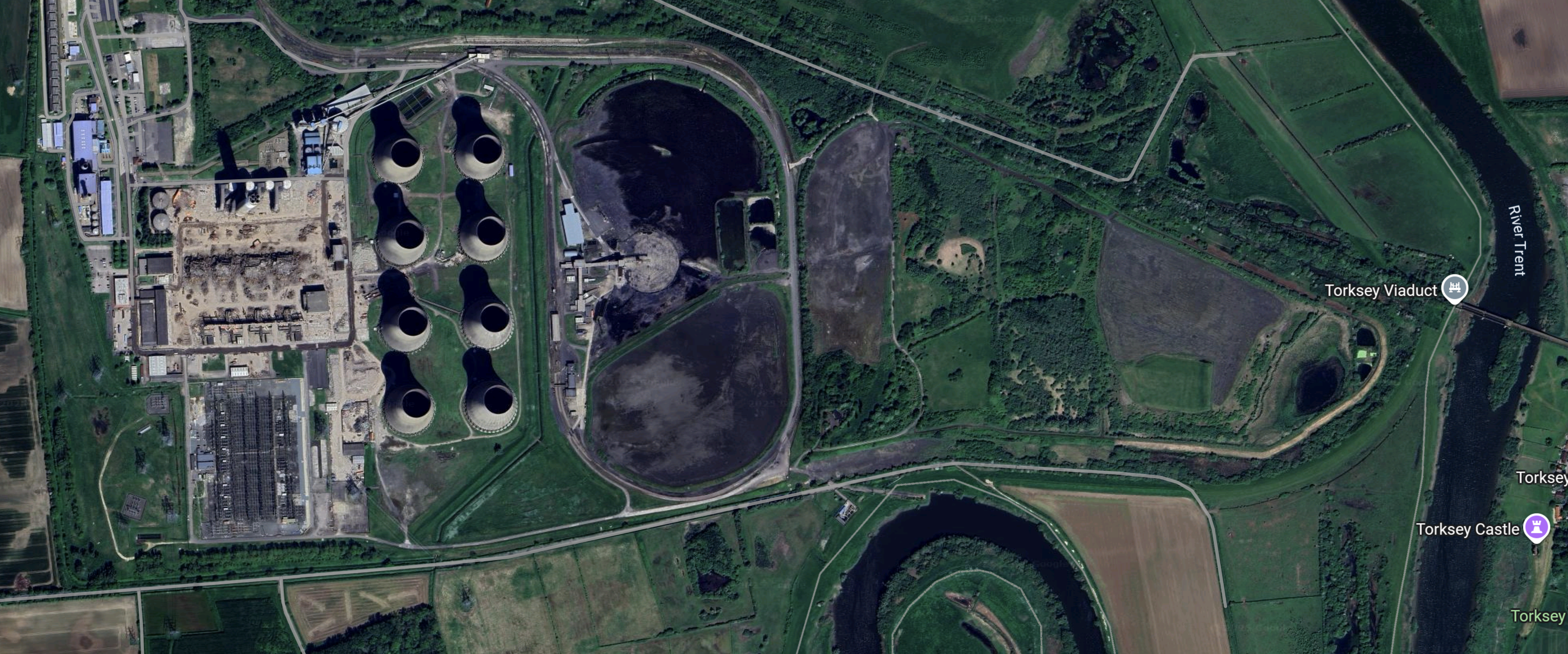
This Google Map shows the Cottam site.
Note.
- The River Trent surrounds the site.
- Could the Trent be used for cooling water?
- The cooling towers are still in place, so the image must have been taken before August.
- The sub-station is in the South-West corner of the site.
- The railway over Torksey viaduct is disused.
It would appear that there is generous space for the SMRs and a few data centres.
The Cottam Solar Project
In DCO Decision On 480MW West Burton Solar NSIP Delayed Until 2025, I wrote about three large solar projects in Eastern England.
The Cottam Solar Project was one of the projects and wants to use the Cottam site.
- The Cottam Solar Project has a web site.
- It will have a capacity of 600 MW, with a battery, with a battery with a 600 MW output and a 600 MWh capacity.
- The solar farm will use the grid connection of the former coal-powered Cottam power station.
- The project is massive and will cover 1270 hectares.
Will this solar project lease space for the SMR, so they can co-exist?
Conclusion
It does appear that there are more than one use for old coal-fired power station sites.
US Interior Secretary: ‘No Future For Offshore Wind Under This Administration’
The title of this post, is the same as that of this article on offshoreWIND.biz.
This is the sub-heading.
US Interior Secretary Doug Burgum said at a press conference on 10 September that offshore wind has no future in the US under the Trump administration and that the government was reviewing five offshore wind projects that are now under construction.
There is also this quote from Burgum.
Offshore wind was too expensive and not reliable enough.
Many of those projects weren’t really about electricity, they were about tax subsidies
I think the fact that the subsidies have been either cut back or limited means that it is likely that there will not be future offshore wind built in America.
He also added that there were concerns that wind turbines interfered with whales and radar systems.
I asked Google AI a few questions.
Is Offshore Wind Extremely Expensive?
Google AI replied.
No, offshore wind is not considered extremely expensive when compared to other energy sources, particularly gas-fired power stations, and its costs are projected to fall further. While initially more expensive to construct than onshore wind due to the marine environment, the higher and more consistent wind speeds offshore generate more power, leading to a competitive or lower overall levelised cost of energy (LCOE) in many regions. Recent economic challenges like inflation and supply chain disruptions have increased costs temporarily, but the sector’s financial position is recovering, and cost reductions are expected to continue.
That looks pretty fair to me.
Is Offshore Wind Reliable?
Google AI replied.
Yes, offshore wind is a reliable energy source because it generates power more consistently than onshore wind due to higher, more dependable wind speeds at sea, and can be integrated with other renewables and energy storage to provide continuous power. Offshore wind turbines operate almost all the time, and the power can be backed up by grid-level storage to ensure a steady electricity supply, even when the wind isn’t blowing.
That looks pretty fair to me.
Are Subsididies And Tax Breaks Important For Offshore Wind?
Google AI replied.
Yes, subsidies and tax breaks are important for the offshore wind industry, which faces high upfront costs and inflationary pressures, to make it more cost-competitive with fossil fuels and secure financing for projects. These incentives help reduce costs for developers, de-risk investments, and ensure the technology can meet climate targets by fostering investment and ensuring long-term viability.
That looks pretty fair to me, but if you were in the oil and gas industry you might think differently.
On the other hand some countries like Norway and the UK, are encouraging the linking of offshore wind farms to offshore oil and gas production to decarbonise offshore operations.
Does Offshore Wind Kill Whales?
This article on the BBC is entitled Fact-Checking Donald Trump’s Claim That Wind Turbines Kill Whales.
It goes into detail about Trump’s claims about wind turbines and marine life.
These are four paragraphs.
“We know what the main threats are to humpback whales: it’s very much the impact from things like fishing and ship strikes,” says Rob Deaville from the Zoological Society of London’s Cetacean Strandings Investigation Programme.
“To talk about wind farms being a problem takes away discussion around the very real threats that are a problem for those species.”
Many other areas with high numbers of wind farms have not seen an increase in whale mortality.
For example, the UK is home to the world’s four largest wind farms, but no humpback whale strandings there have been conclusively linked to the impact of those farms.
That looks pretty fair to me.
But because of our massive portfolio of offshore wind farms and top universities, who research the marine environment, the UK is in a unique position to expose fake science, that was made up on the back of a used envelope.
Does Offshore Interfere With Radar?
Google AI replied.
Yes, offshore wind farms can interfere with radar by reflecting radar signals, causing “radar clutter” or false echoes that can obscure real targets, like aircraft or ships, or create phantom images on a radar display. This interference, also known as a “blade flash,” can negatively impact air defense, air traffic control, and maritime navigation, leading to reduced accuracy and potential safety risks.
That looks pretty fair to me.
Have Wind Turbines Caused Any Air Accidents?
Google AI replied.
Yes, wind farms have caused air accidents, though they are rare. These incidents primarily involve light aircraft colliding with wind turbines or experiencing loss of control due to turbulence from turbine wakes. Examples include a pilot crashing near a wind farm due to turbulence and another fatal crash involving an aircraft hitting a turbine blade.
That looks pretty fair to me.
I learned to fly light aircraft in the 1970s and I remember being told about wake turbulence from airliners, which has been strong enough in some cases to flip an aircraft like a Cessna 150 upside down or into a spin.
What Are The CAA’s Rules For Flying Near Wind Turbines?
Google AI replied.
The primary CAA rule for flying near wind turbines is related to their visibility and safety, focusing on lighting requirements and potential hazards like turbulence. Structures 150 meters or higher require medium-intensity red lights. Pilots must avoid dazzling lights with their own, and wind turbine developers must assess and mitigate risks such as turbulence, radar interference, and impact on Instrument Flight Procedures (IFPs).
That looks like what I would have expected.
Conclusion
I have tried not to be selective with my evidence, but if you are there are reasons that could be used to ban wind turbines.
I am also happy to add any other questions.
‘Targeted Attack’ | US DOI Plans To Revoke More Permits; White House Seeking To Engage Health And Human Services Department?
The title of this post, is the same as that of this article on offshoreWIND.biz.
This is the sub-heading.
In a matter of months, the US offshore wind industry went from a growing investor and employer to an industry that is now undergoing what Oceantic Network called a “targeted attack” after reports emerged that the US Department of the Interior (DOI) plans to revoke federal permits for two more projects. The Trump administration has reportedly also asked multiple agencies, some of which are typically not involved in offshore energy permitting, to get involved in reviewing the impacts of offshore wind.
The whole article is very much a must-read.
The last two paragraphs are a quote from Sam Salustro, who is SVP Policy & Market Strategy at Oceantic Network.
“The Trump administration is singling out an American energy industry, undermining a 40-state, $25 billion domestic supply chain while holding American business investments hostage. This is from a political playbook that should make every industry worry whether they will be targeted by this administration or the next”
“We call on federal leaders to halt this targeted attack and restore certainty and predictability to our energy industry and the thousands ready to get back to work.”
Trump has no right to destroy an industry along with thousands of jobs, just because he doesn’t like it, when there is no commercial or environmental reason.
I will certainly not welcome Trump and his fellow travellers to the UK for his State Visit.
US Transportation Dept Cancels Funding For 12 Offshore Wind Port Projects To ‘Invest In Real Infrastructure’
The title of this post, is the same as that of this article on offshoreWIND.biz.
This is the sub-heading.
The US Department of Transportation (USDOT) has withdrawn or terminated funding for twelve offshore wind-related port projects, totalling USD 679 million (approximately EUR 580 million). These funds will be used, where possible, “to invest in real infrastructure, restoring American maritime dominance,” according to a press release issued by USDOT on 29 August.
The rest of the article is in two sections.
- US Wind-Backed Sparrows Point Steel Marshalling Port on the List
- ‘Prioritizing Real Infrastructure Improvements Over Fantasy Wind Projects’
Both sections are worth a detailed read.
They sound even more stupid decisions, if read in a voice reminiscent of Baldrick with an American accent.
Centrica Enters Into Long Term Natural Gas Sale & Purchase Agreement
The title of this post, is the same as this press release from Centrica.
This is the sub-heading,
Centrica plc today confirmed that its trading arm, Centrica Energy, has entered into a natural gas sale and purchase agreement with US-based Devon Energy Corporation.
This first paragraph adds a few more details.
Under the agreement, Devon Energy will supply 50,000 (MMBtu) per day of natural gas over a 10‑year term starting in 2028. This is equivalent to five LNG cargoes per year. The volumes will be indexed to European gas hub price (TTF). This sale and purchase agreement supports Centrica’s objective of managing market price risk in its LNG portfolio by aligning feed gas pricing with European gas prices whilst providing Devon Energy with international price exposure.
At a first look, it looks a lot of gas.
In Investment In Grain LNG, I talk about Centrica’s purchase of the Grain LNG Terminal from National Grid. But the Grain LNG Terminal comes with several things that Centrica might need for gas from Devon.
- A large amount of gas storage.
- The ability to convert liquid natural gas (LNG) into gas suitable for consumers.
- Space to build more storage if required.
- The ability to store LNG for other companies.
- Two jetties for delivering the LNG to the Grain LNG Terminal.
- The ability to load tankers with LNG, so that it can be sold on to third parties like say the Germans or the Poles.
Centrica also say this about their use of the Grain LNG Terminal in this press release, that describes the purchase of the terminal.
Aligned with Centrica’s strategy of investing in regulated and contracted assets supporting the energy transition, delivering predictable long-term, inflation-linked cash flows, with 100% of capacity contracted until 2029, >70% until 2038 and >50% until 2045.
Centrica have obviously modelled their gas supply and delivery and I believe they have come up with a simple strategy, that will work.
How Will Centrica Use The Gas From The Grain LNG Terminal?
The Wikipedia entry for the Grain LNG Terminal says this about the terminal delivering gas into the gas grid.
The terminal can handle up to 15 million tonnes per annum of LNG, has a storage capacity for one million cubic metres of LNG, and is able to regasify up to 645 GWh per day (58 million cubic metres per day) for delivery into the high pressure gas National Transmission System (NTS).
Note.
- This will be one of the major uses of the gas.
- I wouldn’t be surprised if these capacities will be increased significantly, so that more gas can be stored and processed.
In Investment in Grain LNG, I outlined how I believe that hydrogen and ammonia will be produced for the bunkering of ships on one of busiest sea lanes in Europe, if not the world.
Some LNG will be used to create these zero-carbon fuels.
Some modern ships, also run on natural gas, so I asked Google AI about their operation and received this answer.
Ships can run on natural gas, specifically liquefied natural gas (LNG), by using it as a fuel source in specially designed engines. LNG is natural gas that has been cooled to a liquid state at -162°C, making it easier to store and transport. This liquid form is then used to power the ship’s engines, either directly or by burning the boil-off gas (BOG) that naturally occurs when LNG warms up.
This means that some LNG could be used to directly fuel these ships.
What Is The Gas Capacity Of The Grain LNG Terminal?
I asked Google AI this question and received this answer.
The Grain LNG Terminal, the largest LNG import terminal in Europe, has a storage capacity of 1,000,000 cubic meters (m³) and an annual throughput capacity of 15 million tonnes of LNG. This is equivalent to about 20% of the UK’s total gas demand. The terminal also has the capacity to deliver 25% of the UK’s daily gas demand.
As the space is there, I wouldn’t be surprised to see Centrica increase the capacity of the terminal, as in cold weather, emergency gas for Germany can be delivered quicker from Kent than the United States.
Could The Grain LNG Terminal Accept Gas Deliveries From The United States?
I’m certain that it already does.
Could The Grain LNG Terminal Accept Gas Deliveries From The UK?
If we start extracting gas again from under the seas around the UK, could the Grain LNG Terminal be used to store it?
Yes, but it would have to be liquified first.
It would be more energy efficient to process the extracted gas, so it could be used directly and gasify enough gas at Grain LNG Terminal from storage to make up any shortfall.
Conclusion
Centrica have done some very deep joined up thinking, by doing a long term gas deal and the Grain LNG Terminal purchase so that they have the gas to supply and somewhere to keep it, until it is needed.
US Floating Wind Platform Developer Issues RFI To Fabricators Worldwide
The title of this post, is the same as that of this article on offshoreWIND.biz.
This is the sub-heading.
Aikido Technologies, which recently secured a spot at a Norwegian offshore demo site, has released an RFI for its 15 MW ‘AO60’ floating wind platform to offshore wind fabricators.
These are the first four paragraphs which add more details.
The California-based floating wind foundation developer said on social media that it had issued the RFI to more than ten “top-tier offshore wind fabricators from around the world”.
The RFI has been released in three separate packages, each tailored to a specific type of facility: one for standard offshore steel shops, one for tubular/jacket yards, and one for monopile/tower facilities.
“This is how we can build 1, 50 or 100 of these units with existing fabrication capabilities, with components that can be easily transported around the world for final assembly at a local port. No need for custom yards, custom vessels or custom ports”, Aikido Technologies said.
In May 2025, the company was allocated a slot for its AO60 platform at the Marine Energy Test Centre (METCentre) in Norway, where Aikido will deploy what it says is a first-of-its-kind 15 MW demonstration project.
As someone, who wrote project management computer systems for thirty years, I like Aikido’s plans and feel they would be well suited to the UK, where we have quite a few local ports, that would appear suitable for final assembly of the A060 platforms.
In Yarmouth Harbour To Be ‘Completed’ In £60m Project, I describe the expansion of the Port of Great Yarmouth.
These two paragraphs describe the work to be done.
Peel Ports said it would invest between £50m and £60m in Great Yarmouth’s Outer Harbour by developing the southern terminal, creating a roll-on roll-off (RORO) lift ramp and a large storage area.
Port director Richard Goffin said the construction work, which is set to begin in 2026, would “complete” the port as laid out in a business case in the early 2000s.
This image from Peel Ports Group shows how the Port of Great Yarmouth will look after the the proposed development.
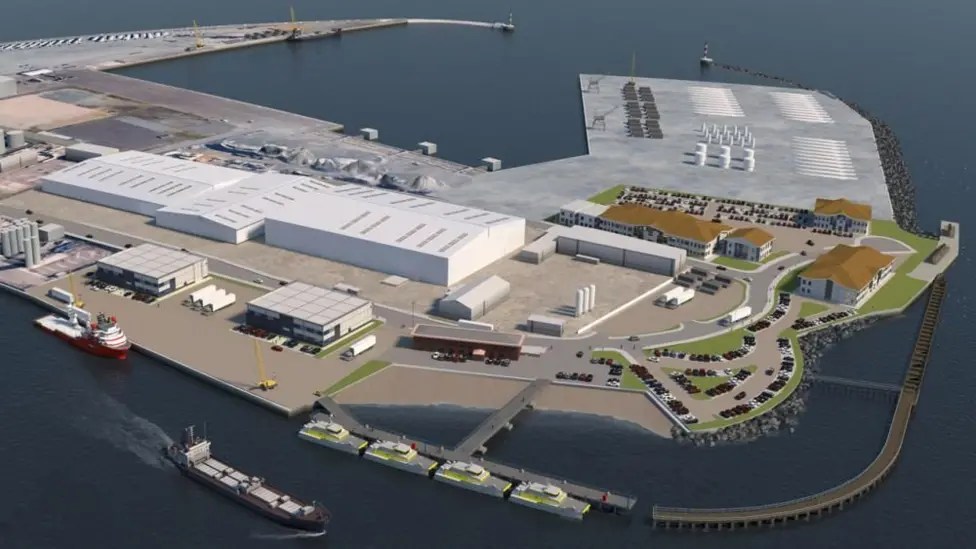
As the Port of Great Yarmouth has a depth of ten metres it could be an ideal base for the assembly and maintenance of floating wind turbines.
Trump Wants National Guard To Dump Homeless ‘Far From Washington’
The title of this post is the same as that of this article on The Times.
On reading that title, I asked Google, what Adolf Hitler did with the homeless.
Wikipedia gave this answer.
In 1933, the Nazi Party passed a Law “against Habitual and Dangerous Criminals”, which allowed for the relocation of beggars, homeless, and the unemployed to concentration camps.
I know Trump has German ancestry, but!
US Gov’t Withdraws All Offshore Wind Energy Areas
The title of this post, is the same as that of this article on offshoreWIND.biz.
This is the sub-heading.
The US Bureau of Ocean Energy Management (BOEM) has rescinded and de-designated all Wind Energy Areas (WEAs) on the US Outer Continental Shelf (OCS). The WEAs are areas in the US federal waters that BOEM previously identified as suitable for wind energy development and, following a multi-stage process, designated Wind Energy Areas for which a lease sale may be proposed.
This first paragraph adds more details.
“By rescinding WEAs, BOEM is ending the federal practice of designating large areas of the OCS for speculative wind development, and is de-designating over 3.5 million acres of unleased federal waters previously targeted for offshore wind development across the Gulf of America, Gulf of Maine, the New York Bight, California, Oregon, and the Central Atlantic”, the US agency said on 30 July.
Trump may not be able to do anything about windmills in Scotland, but he has certainly killed them off in the seas around the United States.
The last paragraph of the article contains the words of Stephanie Francoeur, SVP of Communications & External Affairs at Oceantic Network, who are a US offshore renewable energy industry organisation.
“This will result in even higher energy costs, increased blackouts, job loss, and billions of dollars in stranded investments, further delaying shovel-ready projects supported by a domestic heavy manufacturing supply chain renaissance that spans 40 states. Crippling affordable and reliable wind energy makes no economic sense and undermines the administration’s “all-of-the-above” energy strategy. We urge the Department to adopt policies which put all sources of American energy on an even playing field.”
Donald! The lady has warned you! And she seems angry!
Could This Decision Be Beneficial To Other Wind Projects Around The World?
I wouldn’t be surprised, as there will now be a lot of quality resources and assets in the United States, that will be looking for work.
 The Anonymous Widower