£100m Train Test Complex Plans For Neath Valley Backed
The title of this post is the same as that of this article on the BBC.
This much-needed project, which some wag has called Project Hornby, seems to be moving on..
This brief description is from the article.
The complex would allow trains to be tested on special tracks – laid out on 4.5 mile (7.3km) and two mile (3.1km) ovals – at speeds of up to 100mph (160kph).
It will certainly test their ability to go round corners.
Hopefully, the test track will shorten the time, it takes new and updated trains into service.
Global Centre Of Rail Excellence Takes A Step Forward With Formal Partnership Arrangements
The title of this post is the same as that of this article on Wales Online.
This is the first two paragraphs.
The planned £100m Global Centre of Rail Excellence on the border of Neath Port Talbot and Powys will take a step closer to reality when councillors meet to formalise partnership arrangements next week.
Plans for the centre which were announced by the Welsh Government last summer involve a new facility to test trains in the UK.
In my view this centre is much needed, so that trains manufactured and modified in the UK, can be adequately tested in as short a time as possible.
Sending trains to be tested half-way across Europe, as currently sometimes happens, is not an efficient method of getting trains into service.
Severn Toll Change
The title of this post is the same as that of a short article in the February 2019 Edition of Modern Railways.
This is the first paragraph.
There are concerns that the removal of toll charges on the M4 Severn Crossings on 17 December could result in a loss of rail freight traffic to road. The toll, for westbund vehicles only, was £16.70 per Heavy Goods Vehicle last year. It had been reduced from £20 in January 2018, when VAT ceased to be levied because the motorway bridges had passed from private to public ownership.
It now appears that it is now cheaper to get wine from Felixstowe to a warehouse in Avonmouth, by using a train to Cardiff and then using trucks, than by using a train to Bristol and a shorter truck journey.
Surely, the longer journeys by both diesel truck and probably diesel train, creates more carbon dioxide.
Obviously, the UK and Welsh Governments didn’t assess the carbon emission consequences of abolishing the tolls on the Severn Bridges.
I also wonder, if more people will now drive between South Wales and England, because of the incentive of a toll-free crossing, which will further increase carbon-dioxide emissions.
Cost Of Widening The Last Section Of The A465 Will Be More Than The Entire South Wales Metro
The title of this post, is the same as that of this article on Wales Online.
The article is a good example of comparing costs between road and rail and is well worth a read.
£18.75m Halton Curve Project Delayed A Further Six Months
The title of this post is the same as that of this article on Rail Technology News.
I could just blame politicians for the latest project to be delayed, but it is not wholly their fault.
Train companies all over the UK, Europe and the Rest of the World have been ordering new trains at an unprecedented rate for the following reasons.
- The replacement of clapped-out trains like Pacers.
- Extra trains to provide extra services.
- Faster trains to provide faster services.
- Bigger or longer trains to provide more capacity.
- New electric trains for newly electrified routes.
- New trains often cost less to service and maintain.
- Affordable finance for quality new trains is available in billions of pounds, euros and dollars of all kinds.
In addition a lot of trains are being updated with new technology like signalling, automatic systems and high-technology interiors.
All of these factors mean that there is a high level of train testing that needs to be done.
These test tracks are in Europe and listed in Wikipedia.
- Czech Replublic – Velim railway test circuit – Two circuits of 4 and 13 km.
- France – Centre d’essais ferroviaires – Near Alstom Valenciennes factory site in Raismes, includes 2.75 km for testing at 100 km/h, a 1.85 km loop for endurance testing at 80 km/h, and a loop for testing driverless trains.
- Germany – Test and validation centre, Wegberg-Wildenrath – Near Wildenrath in North Rhine-Westphalia, Germany. Several loops of standard gauge and metre gauge track with various electrification systems.
- Poland – Test Track Centre near Żmigród – Operated by Warsaw Railway Institute. 7.7 km standard gauge loop, 160 km/h maximum allowed speed.
- Romania – Railway Testing Center Faurei – Total length of lines: 20,2 km, maximum speed 200 km/h.
- United Kingdom – Old Dalby Test Track
- United Kingdom – High Marnham Test Track
Note that Italy and Soain, who build substantial numbers of trains, don’t have a specialist testing centre.
I have read somewhere that each individual train has to be run for so many hours before it can be certified for service.
Consider
- Bombardier is building 412 Aventras with lengths between three and ten cars.
- CAF is building trains for Calodonian Sleeper, Keolis Amey Wales, Northern, TranPennine Express and West Midlands Trains.
- Hitachi is building 182 Class 800/801/802 trains with length of five or nine cars.
- Hitachi is building 80 Class 385 trains with lengths of 3/4 cars.
- Siemens are building trains for Govia Thameslink Railway.
- Stadler is building trains for Greater Anglia, Keolis Amay Wales and MerseyRail.
I haven’t done a detailed calculation must it must be at least 700 trains.
In addition there are various rebuilt and existing trains that will need to be tested.
- ScotRail’s shorterned InterCity 125s
- Porterbrook’s Class 769 trains.
- Vivarail’s Class 230 trains.
- Alstom’s Class 321 Hydrogen trains.
- Crossrail Class 345 trains need further testing.
And there will be new orders for the following franchises and lines.
- East Midlands.
- London Underground Piccadilly Line.
- South Eastern
- West Coast Alliance
I haven’t done a detailed calculation but we must be talking of nearly a thousand new trains of which probably six hundred will be delivered in the next five years.
I’m no expert, but I feel that two short test tracks and short lengths of improvised test tracks in factories, isn’t enough to test all these trains and certify them for service.
I should also blow my own trumpet and I know that when I wrote project management software, I was probably the best programmer in the World, at automatically scheduling resources.
So I tend to know, an impossible scheduling problem, when I see one!
Conclusion
We do send trains to Europe to specialist centres like the one at Velim in the Czech Republic. But these centres are also used by other European manufacturers.
I am led to the inevitable conclusion, that we need more train testing facilities, in both the UK and mainland Europe.
The Welsh Government has come to the same conclusion and are planning a test track at Neath, which I wrote about in £100m Rail Test Complex Plans For Neath Valley.
What would help, would be if Chris Grayling oiled a few wheels with some money. It might even result in some Continental trains coming to Wales for specialist testing like curing them of dracophobia.
I would also have felt that CAF would be happy with a test track fifty miles away from their new factory in Newport.
Come on, Wales! Fire up the dragons and get started!
First D-Train With Transport for Wales In March 2019
The title of this post, is the same as that of this article on Rail Magazine.
This is the first paragraph.
The first Class 230 D-Train for Transport for Wales should be ready by March 2019, with all five in traffic from May 2019.
There are also other details.
The Train Formation
More details are given about the formation of the Class 230 trains.
- The trains will be three cars.
- The driving cars will have batteries.
- The centre car will have four generators.
When the trains were D78 Stock on the London Underground, they ran as a six-car train formed of two half-trains containing.
- DM – Driving Motor
- T – Trailer
- UNDM – Uncoupling Non-Driving Motor
The two UNDM cars were coupled together, to form the six-car train.
So is the formation of a Class 230 train as follows?
- DM – Driving Motor with battery
- T – Trailer with four generators
- DM – Driving Motor with battery
I would suspect that the DM cars are identical.
Regenerative Braking
The trains will have regenerative braking, where the energy recovered will be stored in the batteries.
In the D78 Stock, the Trailer car wasn’t motored, so unless motors are fitted in this application, the two Driving Motor cars can almost be considered two identical battery locomotives with regenerative braking, that are solely responsible for moving the train.
The Trailer Car With Power
The Trailer Car in the middle of the train contains the four generators.
The Wikipedia entry for the Ford Duratorq engine, has a section for a 3.2 litre diesel engine, where this is said.
The 3.2 is an I5 engine used in the Ford Transit, the Ford Ranger, Ford Everest, Mazda BT-50 and the Vivarail D-Train.
The standard engine has a rating of 200 hp or 150 kW.
The Class 230 train would appear to have an installed power of 600 kW.
Interiors
The article says that everything the passenger will see inside the train is new!
Performance
This is a quote from Tristan Guyard of Transport for Wales.
On the Conwy Valley and Wrexham – Bidston routes, ‘230s’ will be quicker than most other new trains built in the UK at the moment. This is because of the high proportion of motored wheels and the use of batteries to provide additional power. When these trains come into service, we will be able to improve journey times and have a more flexible timetable as soon as 2019.
The Conwy Valley Line seems a stiff route, which might get a better service with a more powerful train.
The Wrexham-Bidston route currently takes 56 minutes to go South and 58 minutes to go North, which probably makes timetabling a half-hourly service a difficult job.
Will the Class 230 trains offer enough extra performance for these services?
Perhaps this is why they have four diesel power packs.
We will find out next year, what is the toughness of these remanufactured London Underground trains!
Thoughts On The Traction System
How Does The Power Compare To Other Trains?
How powerful is the 600 kW in the Class 230 train?
By comparison. a two-car Class 156 train, has 860 kW of diesel power.
On the other hand the three-car Class 230 train has regenerative braking using batteries.
Is The Class 230 Train A Serial Hybrid?
In a serial hybrid vehicle, a power source like a diesel engine charges the battery and the battery drives the vehicle and powers internal systems.
The classic serial hybrid vehicle is a New Routemaster bus, which is powered by a 138 kW diesel engine.
In this bus., the engine starts and stops to keep the energy in the battery within a particular range.
It is a very simple control system and is regularly used in many applications, where water or temperature levels are to be kept within range.
The layout of the Class 230 train with a central power car could easily provide power to the batteries in the two Driving cars.
The train’s control system would switch the engines on and off automatically as required.
If two diesel generators supplied the battery in each Driving Car, the train could even be considered a double serial hybrid.
So this should make the train reliable, as most components of the drive-train are duplicated.
Conclusion
I sometimes feel that the Class 230 train could end up as a heroic design failure.
But then the oldest trains in service on the UK’s rail network are the London Underground 1938 Stock on the Island Line.
London Underground rolling stock seems to have a longevity, that other trains seem to have been built without!
Or is it that as the elderly fleets of the Glasgow Subway, Merseyrail and the Northern City Line seem to keep soldiering on, that spending a large proportion of your working life underground, is good for trains?
£100m Rail Test Complex Plans For Neath Valley
The title of this post, is the same as that of this article on the BBC.
This is the first three paragraphs.
Plans for a £100m rail testing complex to work on next generation train technology have been revealed in south Wales.
It is at an early stage but it could be built on the site of a mothballed opencast mine in Neath Port Talbot.
The preferred option would be to site it at the mothballed opencast mine at Nant Helen near the border with Powys and at the coal washery site next door at Onllwyn, which is still operational.
This Google Map shows the massive open-cast mine near the village of Onllwyn.
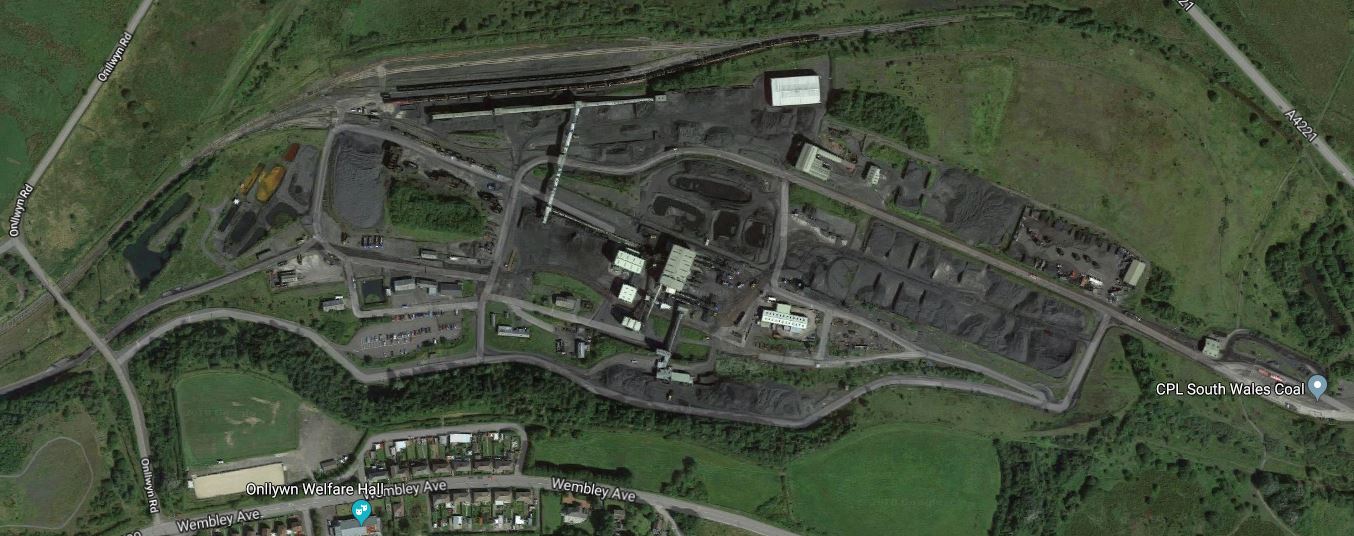
Note the rail connection at the Northern side of the mine.
Onllwyn has a Wikipedia entry, which says this.
With over 200 years of coal mining behind it, the parish was once home to five pits that employed hundreds of men. Now all that remains is a coal washery and coal processing plant. On the route of the former Neath and Brecon Railway, a freight only routes exists to the coal washery from the South Wales Main Line at Neath.
So at least it’s swapping an old industry, with one that could have a very sparking future.
As I said in Talgo Explores Options For Building UK Test Track.
So perhaps we do need another convenient test track!
The site would be even more convenient, if the South Wales Main Line were to be electrified, through Neath to Swansea.
What Is It With The Welsh And Batteries?
If ordering two fleets of rail vehicles with batteries, that I wrote about in The Greening Of The Valleys, KeolisAmey Wales have now gone and ordered a third fleet for North Wales.
This article in the Railway Gazette is entitled Vivarail D-Trains For Wales & Borders.
This is the first paragraph.
Incoming Wales & Borders franchisee KeolisAmey is to take delivery of five three-car Class 230 D-Train diesel-battery multiple-units from Vivarail, which is to produce them using the bogies and aluminium bodyshells of withdrawn London Underground D78 metro trains.
Note that they are described as diesel-battery trains.
The article says the Class 230 trains will be used on these lines.
- The Borderlands Line between Wrexham and Bidston.
- The Conwy Valley Line.
- Between Chester and Crewe stations.
Five trains have been ordered, but I suspect it will eventually be more.
I believe that this picture shows a property of the Class 230 train, that would be ideal for Welsh routes or any other scenic lines.
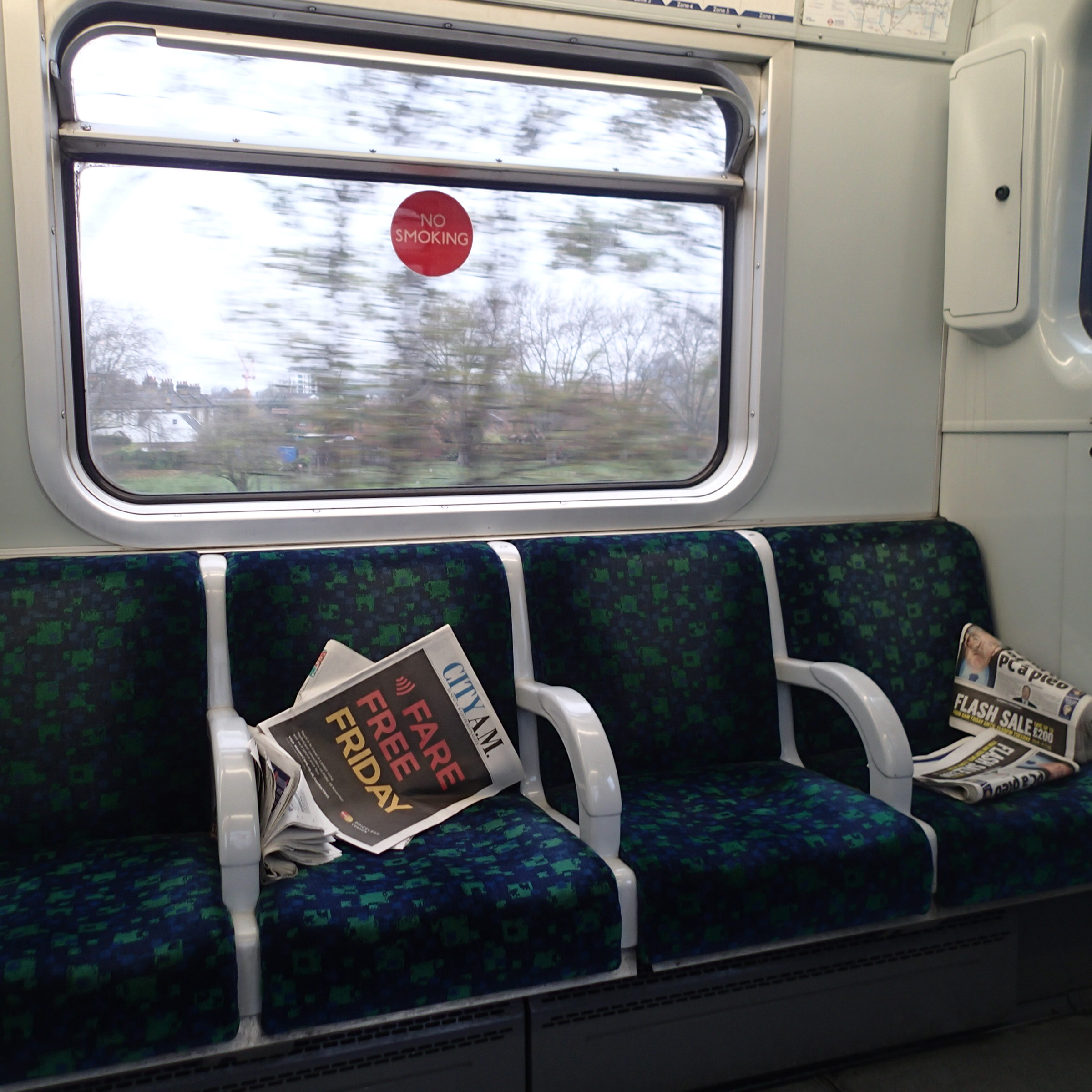
They have large windows and get the interior design right and they could become an iconic way to fill a difficult niche market.
- A reliable hourly or half-hourly service on a remote line.
- A quality interior with everything customers expect like a fully-accessible toilet, wi-fi and power sockets.
- Space for bikes, buggies, babies and wheel-chairs.
- Step-free entry between train and platform was possible at some stations on the District Line and I suspect that many stations could be made, so that wheelchairs and buggies could just roll across.
- The ability to be serviced remotely.
Note that the train is fitted with toilets from Cwmbran in South Wales.
Did Transport for Wales say, that if you fitted Welsh toilets, we’ll buy a few trains?
I suspect though, that they are much better toilets, than those I saw as a child in castles like Caernarfon, Conway and Harlech, where the inhabitants in the Middle Ages must have been quick on the job to avoid the getting shot with arrows, where it would hurt!
I suspect constipation was rare in those days!
Seriously though, here’s a video of the Class 230 trains for Wales.
This video comes from this article in this article on Wrexham.com.
How Do The Trains Work?
I obviously don’t know exactly, but I suspect the method of operation is very similar to that of some of the advanced hybrid buses, like a new Routemaster.
Each of the diesel engines have a generator, which produces electricity. This can either be fed directly to the traction motors to power the train or stored in the onboard battery.
The train’s control system manages the power and chooses, whether traction power comes from the diesel engine or the battery.
This means that the diesel engines don’t have to work all the time.
Every Pair Of Pictures Tell A Story
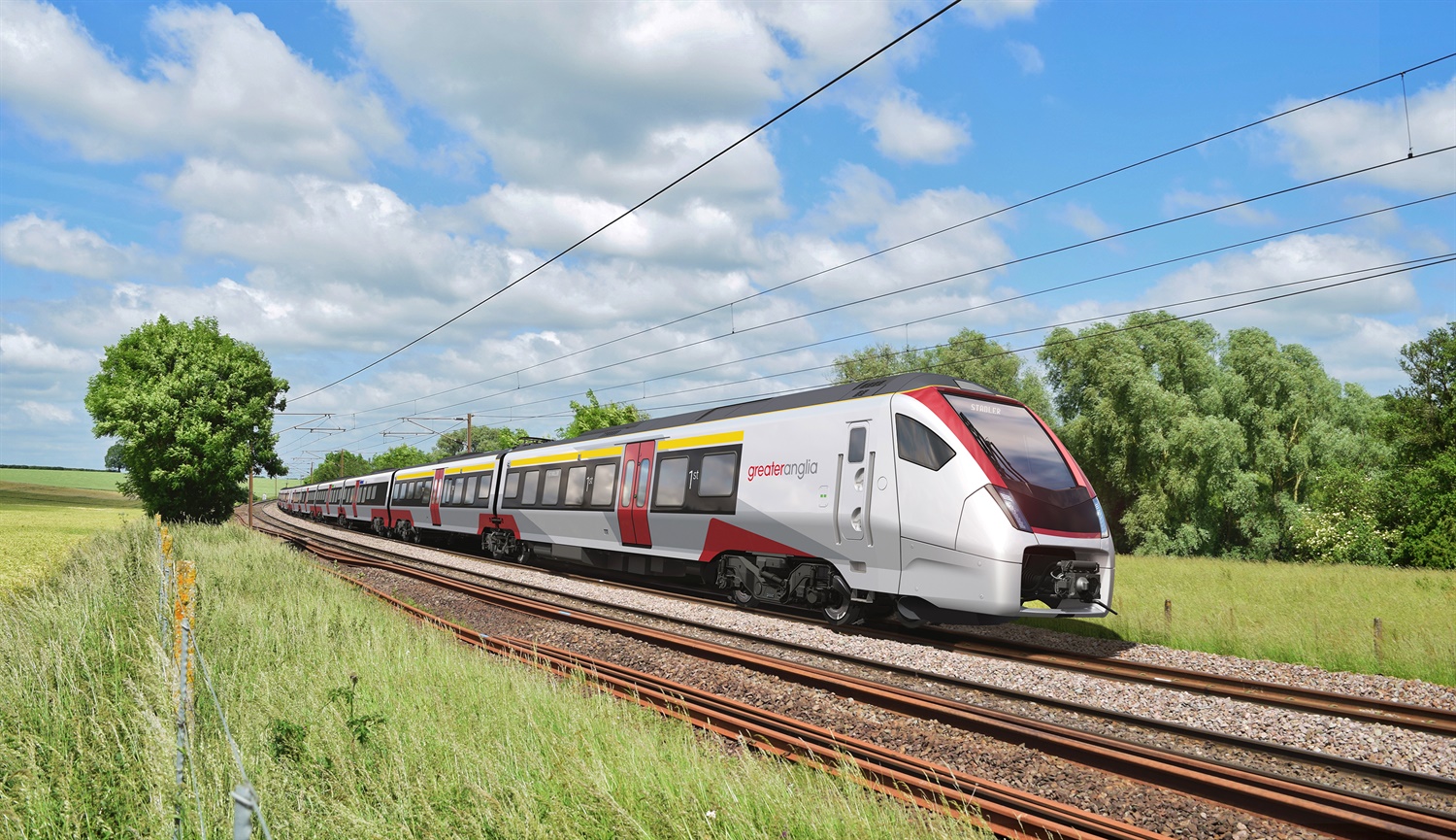
This picture on the Rail Technology Magazine website shows a Greater Anglia Class 755 train.
And this picture on the Global Rail News website shows one of the new trains for Transport for Wales.
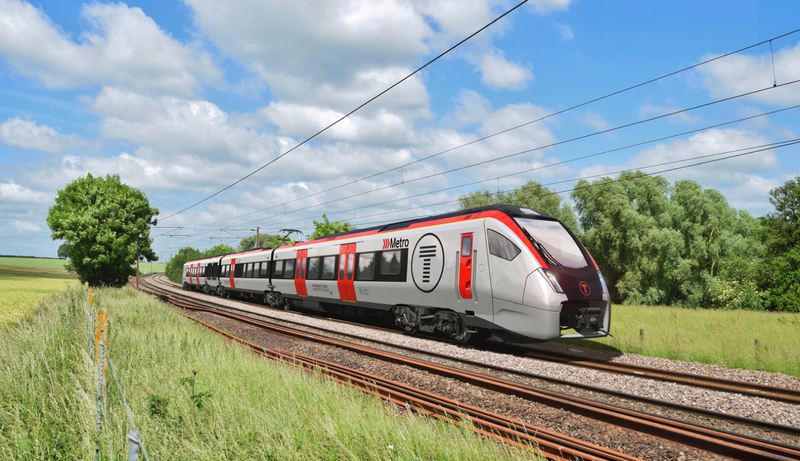
It is captioned “A Tri-mode unit on the Rhymney Line”.
On another report it is captioned “How a KeolisAmey tram-train will look”.
All trains look very similar and I’m pretty certain that Wales will be getting some Class 755 trains.
Class 755 Trains
Class 755 trains will have the following characteristics.
- 100 mph operating speed.
- Able to work on 25 KVAC overhead electrification
- Able to work using an onboard diesel power-pack.
- Three or more passenger cars.
- Ability to be lengthened by adding extra cars as required.
- Lots of power.
They would be ideal replacements for the current Class 175 trains, as the performance would appear to be similar.
They would also be ideal for services on the following routes.
When running around Birmingham, Cardiff, Crewe, Liverpool and Manchester, they would be able to use the electrification.
So are Keolis/Amey going for a predominantly uniform fleet of perhaps three-car and four-car Class 755 trains outside of the Cardiff Valley Lines, just as Greater Anglia used these trains on their routes without electrification North of Cambridge and Ipswich?
The Borderlands Line
The interesting route is the Borderlands Line between Wrexham Central and Bidston stations.
Currently, to get to and from Liverpool, there is a need to change trains at Bidston.
Merseyrail‘s new Class 777 trains are being built by Stadler.
- They will link Bidston station to Liverpool, where they will call at several stations in a single-track loop tunnel.
- The trains have been designed to work under battery power.
- Both classes of train are likely to be very similar under the skin.
So to eliminate the time-wasting change of train at Bidston station, I wonder if Stadler have designed the Class 755 and Class 777 trains, so that they can both run in the loop tunnel.
The additions needed to the Welsh Class 755 trains, over the Greater Anglian versions would be.
- Ability to use Merseyrail’s third rail electrification.
- Clearance to run in the tunnel with diesel onboard.
- Ability to evacuate passengers in the tunnel, in an emergency.
As Merseyrail have recently rebuilt the tunnel for the new Class 777 trains, I suspect that Stadler can design a Class 755 train, that would be able to avoid the change of train at Bidston.
I’ll Wait For More Information
It would seem prudent to wait for more information.
Discontinuous Electrification For Valley Lines?
The title of this post, is the same as that of an article in the May 2018 Edition of Modern Railways.
The Valley Lines in question are the Cardiff Valley Lines, that fan out from Cardiff Central and Cardiff Queen Street stations in various directions.
- Some of the lines into the valleys are quite steep.
- The lines in the Cardiff area seem to be typical coastal lines and fairly flat.
- The lines are a mixture of single and double track.
- There are various plans to extend some of the branches.
According to the article, it would appear that the current diesel system would be replaced with a system, with these characteristics.
- Light rail vehicles
- Discontinuous electrification
- Use of stored energy.
- Street running is expected to be in the specification for the vehicles to be used, to allow extension in the Cardiff Bay area and perhaps other places.
The proposal would save costs against full electrification and heavy rail.
My observations follow.
Batteries
Batteries will be an integral part of the design of the new rail vehicles.
Powering The Trains
The article states that battery power will be used to power the trains on sections that are difficult to electrify, like the mile-long Caerphilly Tunnel.
Battery power could also be used on level and downhill sections of track up to a few miles, but I suspect on steep uphill sections, electrification will be needed.
Handling Regenerative Braking
I believe that regenerative braking will be employed on the rail vehicles and the energy generated will be stored in the batteries.
The main advantage of this is that it simplifies the power supply to the electrification, as it only has to handle power going to the train.
This less complex electrical system, saves construction costs.
Recovering The Train’s Potential Energy
A train travelling from Cardiff to one of the terminal stations at the heads of the valleys, will need to acquire an amount of potential energy, based on the train’s mass and the height involved. This will be provided by the train’s traction system powered by the electrification and the energy in the batteries.
Coming down the hill, the regenerative braking will control the speed of the train and store any energy generated in the batteries.
This will save on the cost of energy to operate the system.
Charging The Batteries
The batteries will be charged from both the overhead electrification and the regenerative braking.
Extensive simulations of the route on computers would be able to calculate the following, for a wide range of scenarios.
- The size of the batteries.
- The power of the traction motors.
- Where the electrification needs to be installed.
- The maximum power output of the electrification system.
These calculations could also lead to an energy-saving operating philosophy, that could be programmed into the train’s computer system.
I suspect the worst case scenario, would be a train full of the heaviest Welshmen after an important rugby match at the Millennium Stadium.
Electrification
My thoughts on how various sections of track would be electrified follow.
Tracks With A Significant Uphill Gradient
These would need to be electrified, as I doubt battery power on the steepest gradients, would be enough to take a fully-loaded train to the top of the hill.
Electrification would be lighter-weight 750 VDC overhead wires.
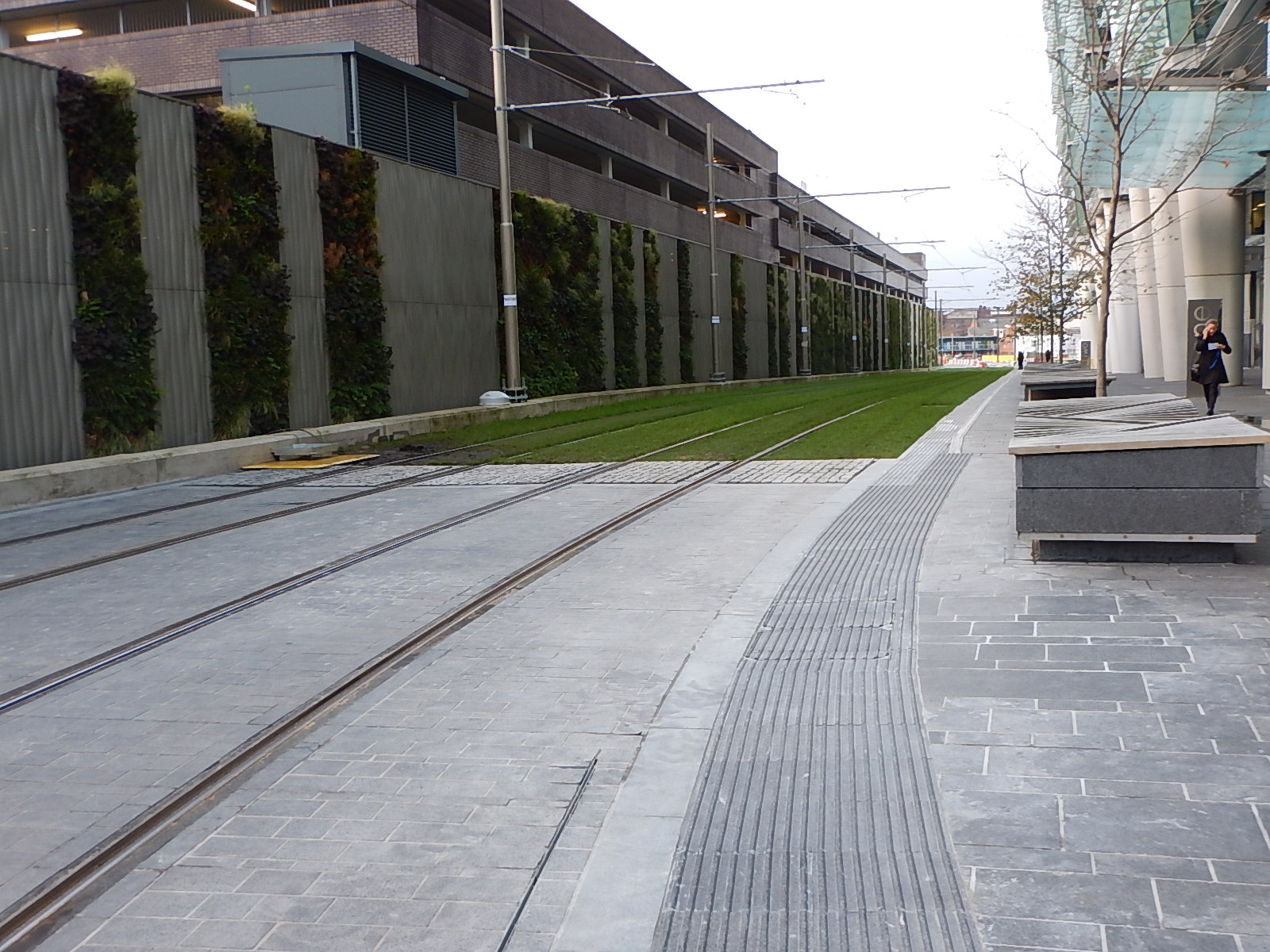
The picture shows some of the overhead wires in Birmingham, that are used by the Midland Metro’s Urbos 3 trams.
Tracks With A Downhill Gradient
These would not need to be electrified, as Newton’s friend gravity would do most of the work.
However, as batteries will be fitted, these can have three important functions on downhill stretches of track.
- Give the tram a nudge if needed.
- Restart the train after a stop at a station.
- Store any energy created by regenerative braking.
Note that we could have the unusual situation on a double-track section of line, where the uphill track was electrified and the downhill track was left without electrification.
Level Tracks
These would not need to be electrified, as battery power would be used to propel the train.
Selected Stations
Some stations could need to be electrified to ensure that the service was reliable. These might include terminal stations or those with tricky gradients on either side.
Tracks With 25 KVAC Electrification
Some of the tracks used by the trains on the Cardiff Valley Lines should be electrified with 25 KVAC, by the end of December 2018.
Class 399 tram-trains, that are used in Sheffield can use either 750 VDC and 25 KVAC overhead electrification.
it would probably be a good idea, if the new vehicles on the Cardiff Valley Lines could also use both voltages.
Automatic Pantographs
The pantographs on the vehicles would be raised and lowered automatically to access the electrification. This could even be GPS-controlled and able to be carried out at line speed.
Tram-Trains?
I very much feel, that tram-trains could be used to advantage.
- Some of the Valley Lines are also used by freight trains, so couldn’t be converted to trams-only.
- Tram-trains like the Class 399 tram-train, under test in Sheffield can work on both 750 VDC and 25 KVAC overhead wires.
- Tram-trains can use conventional railway signalling.
- Tram-trains could work on the South Wales Main Line to Newport.
- Modern tram-trains like the Class 399 tram-train have performance, that is about the same as a Class 142 train, which is a Pacer, that works the Cardiff Valley Lines, in large numbers.
- Tram-trains could run on the streets as trams, as they do in Sheffield.
Several manufacturers make tram-trains, which I believe could be suitablefor the Cardiff Valley Lines.
Stadler’s Class 399 Tram-Trains
Nothing is said about the vehicles, that would be used, but I think they need the following characteristics.
- Ability to climb the steepest section of the routes using 750 VDC overhead electrification.
- Ability to store energy.
- Regenerative braking to charge the batteries coming down the hills into Cardiff.
- A similar capacity to a Class 150 train, which is around 150 seats.
- It would be a bonus if they could use 25 KVAC overhead electrification, which will be available on part of some of the routes.
- Ability to raise and lower the pantograph quickly and automatically.
- Ability to run on the National Rail network.
- Ability to run on the street.
This specification is virtually the same as a Class 399 tram-train with the following additions.
- More seats and possibly an extra car.
- Batteries.
Class 399 tram-trains are a UK version of the Stadler Citylink tram-train. The German version is used in Karlsruhe to climb into the hills surrounding the city, on routes that are as challenging as the Cardiff Valley Lines.
So I have no worries about a version of the Class 399 train handling the Cardiff Valley Lines.
I certainly believe after my experience in Karlsruhe, and looking at other Citylink variants, that Stadler can come up with a tram-train for Cardiff based on the Class 399 tram-train.
And Then There’s CAF!
CAF have provided the Urbos 3 trams for Edinburgh Trams and the Midland Metro.
These are modern trams, that will be doing the following in a few years in the Midlands.
- Running on stored energy in the centre of Birmingham and to Wolverhampton station.
- Sharing the South Staffordshire Line with heavy freight on a new route to Merry Hill Shopping Centre.
This sounds like a tram-train with stored energy.
Wikipedia also lists a version of the Urbos family, called an Urbos TT, which is described like this.
The Urbos TT series is built with tram-train technology, connecting existing heavy rail infrastructure directly to urban tramway systems.
This document on the CAF web site, gives more details of Urbos variants, including the Urbos TT.
Looking at the modular nature of the design, you could have a custom-built tram-train tailored to the rail network.
But surely, the major factor with CAF, is that they have recently opened a factory at Newport.
If CAF get the order for the Cardiff Valley Lines, they could do a substantial part of the train building in a factory connected directly to the lines.
Converting The Valley Lines
I think that there are advantages and cost savings to be had, by good design in this area.
Could The Rail Vehicles Be Designed To Fit The Existing Platforms?
The first thing to do would be to design, build and fully test the rail vehicles.
Could the tram-trains be built, so that they fitted all the existing platforms?
- Class 150 trains are 2.82 metres wide.
- Urbos 3 trams on the Midland Metro are 2.65 wide.
If the tram-trains could run without platform modifications, this would be a big cost saving and still allow diesel units to use the lines, at the same time.
Testing The Trains
If the tram-trains were being given a 25 KVAC capability, they could even be tested on the quadruple-track the South Wales Main Line after the line is electrified through Newport.
Electrifying The Lines
It could be that the only sections of the valley lines that will need electrification, are the steep lines into the hills, as all other sections could use stored power or the 25 KVAC, where it exists.
- It would probably be possible to put up the simpler 750 VDC overhead lines during weekend and perhaps longer possessions.
- The electrification could be designed so that it doesn’t interfere with existing services.
- The lines would be converted one at a time.
- ,Note that tram-trains could share track and platform with the current diesel trains working the lines.
If CAF were to get the order surely the Ebbw Valley Line, which could be connected easily to the factory would be the first to be converted.
Conclusion
Obviously, the devil will be in the detail, but it does look like a viable plan will emerge.
I think that if CAF get the order, that they could be big winners.
The Cardiff Valley Lines could demonstrate the following.
- Running on main lines with 25 KVAC electrification.
- Running on 750 VDC electrification.
- Running on batteries.
- Running on lines with steep hills.
- Street running.
- Sharing tracks with freight trains and other passenger services.
- The tram-trains could also connect to Cardiff Airport.
It is a world-class demonstration and test track for innovative tram-trains, designed to cope with challenging rail networks.
With a factory close by at Newport, the selling of the tram-trains to other operators would be a salesman’s dream.
I think there’s more to CAF coming to Newport, than was apparent, when the deal for the factory was signed.
 The Anonymous Widower