The Liverpool Manchester Hydrogen Clusters Project
The project is described briefly on this page on the Cadent web site.
This is the introduction.
The use of hydrogen in place of natural gas could offer a route to widespread decarbonisation of gas distribution networks.
The Liverpool-Manchester Hydrogen Cluster project is a conceptual study to develop a practical and economic framework to introduce hydrogen into the gas network in the Liverpool-Manchester area.
It proposes converting natural gas into clean-burning hydrogen gas, using a process called steam methane reforming. The process also removes CO2 from the gas, which can then be captured using existing carbon and capture storage technology and stored in depleted offshore gas reservoirs.
The hydrogen gas would then be supplied to a core set of major industrial gas users in Liverpool-Manchester and fed into the local gas distribution network as a blend with natural gas.
Note.
- At Runcorn, Ineos make hydrogen and chlorine by the electrolysis of brine.
- When I worked in Castner-Kellner works at Runcorn, it was generally taken away be truck.
- The Burbo Bank wind farm in Liverpool Bay, can produce 348 MW of electricity using some of the biggest wind turbines in the World, according to this article in The Guardian.
- Using excess electricity generated by win turbines at night, is used by the Germans to create hydrogen.
It doesn’t look like the project will suffer from a shortage of hydrogen.
Alsthom And Hydrogen Powered Trains
Alsthom have a site at Widnes, where they modify and paint trains. They have also indicated, that they might build new trains in the UK.
They have also developed a hydrogen-powered train called the Alsthom Coradia iLint, which starts test running with passengers in a couple of months.
This promotionalvideo shows how Alsthom’s hydrogen-powered Coradia iLint works.
The North Wales Coast Line would be an ideal test track.
- It’s around eighty miles long.
- It is nearly all double-track.
- It has a 90 mph operating speed.
- It’s probably pretty flat, as it runs along the coast.
I don’t think too many people would bother about a few extra quieter trains, just emitting steam and water vapour.
North Wales could be getting a new environmentally-friendly tourist attraction.
Swansea Bay Metro
Looking for possible privately-funded rail projects, I have come across the Swansea Bay Metro on Wikipedia.
Wikipedia outlines the project like this.
- A new line from Baglan to Swansea station diverting the mainline from the current route via Neath, reducing journey times to Cardiff to 30 Minutes
- The new Main Line would have stations at Swansea Bay Campus and SA1
- Reopening of the current freight only Neath Valley Line to passengers with new stations at Jersey Marine, Neath Abbey, Neath (shown as Neath 2) and Aberdulais
- A new line from Neath to Llansamlet Interchange via a new station at Llandarcy
- New stations on the existing Swansea to Baglan at Llansamlet Interchange, Phoenix and Morfa
- New stations at M4 J45, Morriston, M4 J46 and Pontlliw
- A new station on Station Road.
It is a comprehensive project that would probably cost over a £1 billion.
This could just be the sort of project that Chris Grayling felt could be developed.
This study document from Professor Mark Barry gives more details of a possible proposal.
This map is included.
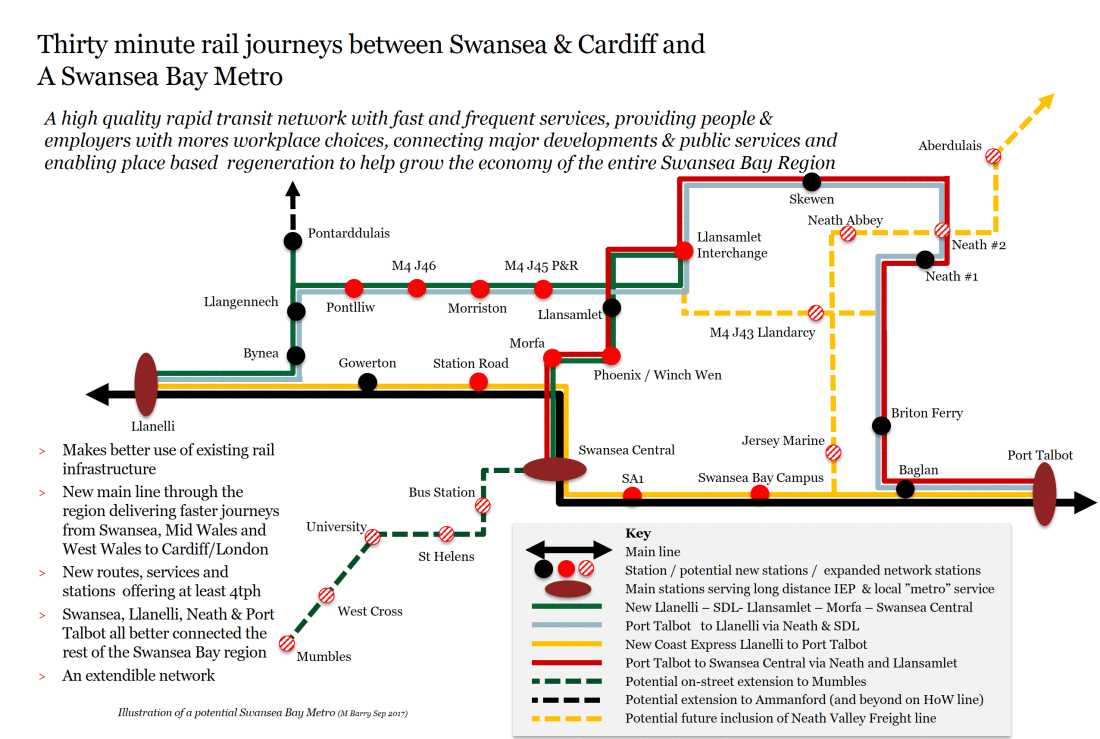
It certainly is a comprehensive project.
Hitachi Battery Trains On The Great Western Railway
The slow pace of the electrification on the Great Western Main Line has become a big stick with which to beat Network Rail.
But are rolling stock engineers going to pull Network Rail out of their hole?
On page 79 of the January 2018 Edition of Modern Railways, Nick Hughes, who is the Sales Director of Hitachi Rail Europe outlines how the manufacturer is embracing the development of battery technology.
He is remarkably open.
I discuss what he says in detail in Hitachi’s Thoughts On Battery Trains.
But here’s an extract.
Nick Hughes follows his description of the DENCHA; a Japanese battery train, with this prediction.
I can picture a future when these sorts of trains are carrying out similar types of journeys in the UK, perhaps by installing battery technology in our Class 395s to connect to Hastings via the non-electrified Marshlink Line from Ashford for example.
This would massively slice the journey time and heklp overcome the issue of electrification and infrastructure cases not stacking up. There are a large number of similar routes like this all across the country.
It is a prediction, with which I could agree.
I conclude the post with this conclusion.
It is the most positive article about battery trains, that I have read so far!
As it comes direct from one of the train manufacturers in a respected journal, I would rate it high on quality reporting.
Hitachi Battery Train Technology And Their UK-Built Trains
The section without electrification on the Marshlink Line between Ashford International and Ore stations has the following characteristics.
- It is under twenty-five miles long.
- It is a mixture of double and single-track railway.
- It has nine stations.
- It has a sixty mph operating speed.
As the line is across the flat terrain of Romney Marsh, I don’t think that the power requirements would be excessive.
In the Modern Railway article, Nick Hughes suggests that battery technology could be installed in Class 395 trains.
The Class 395 train is part of a family of trains, Hitachi calls A-trains. The family includes.
- Class 800 trains as ordered by GWR and Virgin Trains East Coast.
- Class 801 trains as ordered by GWR and Virgin Trains East Coast
- Class 802 trains as ordered by GWR, Hull Trains and TransPennine Express
- Class 385 trains as ordered by ScotRail.
In Japan, another member of the family is the BEC819, which is the DENCHA, that is mentioned in the Modern Railways article.
As a time-expired electrical engineer, I would think, that if Hitachi’s engineers have done their jobs to a reasonable standard, that it would not be impossible to fit batteries to all of the A-train family of trains, which would include all train types, built at Newton Aycliffe for the UK.
In Japan the DENCHAs run on the Chikuhō Main Line, which has three sections.
- Wakamatsu Line – Wakamatsu–Orio, 10.8 km
- Fukuhoku Yutaka Line – Orio–Keisen, 34.5 km
- Haruda Line – Keisen–Haruda, 20.8 km
Only the middle section is electrified.
It looks to me, that the Japanese have chosen a very simple route, where they can run on electrification for a lot of the way and just use batteries at each end.
Bombardier used a similar low-risk test in their BEMU Trial with a Class 379 train in 2015.
So How Will Battery Trains Be used On the Great Western?
On the Great Western Main Line, all long distance trains and some shorter-distance ones will be Class 80x trains.
The size of battery in the DENCHA can be estimated using a rule, given by Ian Walmsley.
In an article in the October 2017 Edition of Modern Railways, which is entitled Celling England By The Pound, Ian Walmsley says this in relation to trains running on the Uckfield Branch.
A modern EMU needs between 3 and 5 kWh per vehicle mile for this sort of service.
So the energy needed to power the DENCHA, which is a two-car battery train on the just under twenty miles without electrification of the Chikuhō Main Line in a one way trip would be between 112 and 187 kWh.
A Battery-Powered Class 801 Train
The Class 801 train is Hitachi’s all-electric train, of which Great Western Railway have ordered thirty-six of the closely-related five-car Class 800 train and twenty-one of the nine-car units.
The difference between the two classes of train, is only the number of generator units fitted.
- Trains can be converted from Class 800 to Class 801 by removing generator units.
- Bi-mode Class 800 trains have a generator unit for each powered car.
- The all-electric Class 801 train has a single generator unit, in case of electrical power failure.
- When trains couple and uncouple, the train’s computer system determines the formation of the new train and drives and manages the train accordingly.
If I was designing the train, I would design a battery module, that replaced a generator unit
This leads me to think, that a five-car Class 801 train, could have one generator unit and up to four battery modules.
- The computer would decide what it’s got and control the train accordingly.
- The generator unit and battery power could be used together to accelerate the train or at other times where high power is needed.
- If the batteries failed, the generator unit would limp the train to a safe place.
- The number of battery units would depend on the needs of the route.
It would be a true tri-mode train; electric, diesel and battery.
I will now look at some routes, that could see possible applications of a battery version of Class 80x trains.
Cardiff To Swansea
I’ll start with the most controversial and political of the cutbacks in electrification.
At present plans exist to take the electrification on the Great Western as far as Cardiff Central station, by the end of 2018.
The distance between Cardiff Central and Swansea stations is forty-six miles, so applying the Ian Walmsley formula and assuming the train is five-cars, we have an energy usage for a one-way trip between the two cities of between 690 and 1150 kWh.
As the Class 80x trains are a modern efficient design, I suspect that a figure towards the lower end of the range will apply.
But various techniques can be used to stretch the range of the train on battery power.
- From London to Cardiff, the line will be fully-electrified, so on arrival in the Welsh capital, the batteries could be fully charged.
- The electrification can be continued for a few miles past Cardiff Central station, so that acceleration to line speed can be achieved using overhead wires.
- Electrification could also be installed on the short stretch of track between Swansea station and the South Wales Main Line.
- There are three stops between Cardiff and Swansea and regenerative braking can be used to charge the batteries.
- The single generator unit could be used to help accelerate the train if necessary.
- There are only two tph on the route, so efficient driving and signalling could probably smooth the path and save energy.
- Less necessary equipment can be switched off, when running on batteries.
Note. that the power/weight and power/size ratios of batteries will also increase, as engineers find better ways to build batteries.
The trains would need to be charged at Swansea, but Hitachi are building a depot in the city, which is shown in these pictures.


It looks like they are electrifying the depot.
Surely, enough electrification can be put up at Swansea to charge the trains and help them back to the South Wales Main Line..
The mathematics show what is possible.
Suppose the following.
- Hitachi can reduce the train’s average energy consumption to 2 kWh per carriage-mile, when running on battery power.
- Electrification at Cardiff and Swansea reduces the length of battery use to forty miles.
This would reduce the battery size needed to 400 kWh, which could mean that on a five-car train with four battery modules, each battery module would be just 100 kWh. This compares well with the 75 kWh battery in a New Routemaster bus.
Will it happen?
We are probably not talking about any serious risk to passengers, as the worst that can happen to any train, is that it breaks down or runs out of power in the middle of nowhere. But then using the single generator unit, the train will limp to the nearest station.
But think of all the wonderful publicity for Hitachi and everybody involved, if the world’s first battery high speed train, runs twice an hour between Paddington and Swansea.
Surely, that is an example of the Can-Do attitude of Isambard Kingdom Brunel?
Paddington To Oxford
The route between Paddington and Oxford stations is electrified as far as Didcot Parkway station.
The distance between Didcot Parkway and Oxford stations is about ten miles, so applying the Ian Walmsley formula and assuming the train is five-cars, we have an energy usage for the return trip to Oxford from Didcot of between 300 and 500 kWh.
If the five-car train has one generator unit,four battery modules and has an energy usage to the low end, then each battery module would need to handle under 100 kWh.
There are plans to develop a South-facing bay platform at Oxford station and to save wasting energy reversing the train by running up and down to sidings North of the station, I suspect that this platform must be built before battery trains can be introduced to Oxford.
If it’s not, the train could use the diesel generator to change platforms.
The platform could also be fitted with a system to charge the battery during turnround.
Paddington To Bedwyn
The route between Paddington and Bedwyn is electrified as far as Reading station, but there are plans to electrify as far as Newbury station.
The distance between Newbury and Bedwyn stations is about thirteen miles, so applying the Ian Walmsley formula and assuming the train is five-cars, we have an energy usage for the return trip to Bedwyn from Newbury of between 390 and 520 kWh.
As with Paddington to Oxford, the required battery size wouldn’t be excessive.
Paddington To Henley-on-Thames
The route between Paddington and Henley-on-Thames station is probably one of those routes, where electric trains must be run for political reasons.
The Henley Branch Line is only four miles long.
It would probably only require one battery module and would be a superb test route for the new train.
Paddington To Weston-super-Mare
Some Paddington to Bristol trains extend to Weston-super-Mare station.
Weston-super-Mare to the soon-to-be-electrified Bristol Temple Meads station is less than twenty miles, so if Swansea can be reached on battery power, then I’m certain that Weston can be reached in a similar way.
Other Routes
Most of the other routes don’t have enough electrification to benefit from trains with a battery capability.
One possibility though is Paddington to Cheltenham and Gloucester along the Golden Valley Line. The length of the section without electrification is forty-two miles, but unless a means to charge the train quickly at Cheltenham station is found, it is probably not feasible.
It could be possible though to create a real tri-mode train with a mix of diesel generator units and battery modules.
This train might have the following characteristics.
- Five cars.
- A mix of generator units and battery modules.
- Enough generator units to power the train on the stiffest lines without electrification.
- Ability to collect power from 25 KVAC overhead electrification
- Ability to collect power from 750 VDC third-rail electrification.
Note.
- The battery modules would be used for regenerative braking in all power modes.
- The ability to use third rail electrification would be useful when running to Brighton, Exeter, Portsmouth and Weymouth.
The train could also have a sophisticated computer system, that would choose power source according to route,timetable, train loading, traffic conditions and battery energy level.
The objective would be to run routes like Paddington to Cheltenham, Gloucester to Weymouth and Cardiff to Portsmouth Harbour, as efficiently as possible.
Collateral Advantages
Several of the routes out of Paddington could easily be worked using bi-mode Class 800 trains.
- But using battery trains to places like Bedwyn, Henley, Oxford and Weston-super-Mare is obviously better for the environment and probably for ticket sales too!
- If places like Bedwyn, Henley and Oxford are served by Class 801 trains with a battery option, it could mean that they could just join the throng of 125 mph trains going in and out of London.
- Battery trains would save money on electrification.
I also suspect, that the running costs of a battery train are less than those of using a bi-mode or diesel trains.
Conclusion
Hitachi seem to have the technology, whereby their A-train family can be fitted with batteries, as they have done it in Japan and their Sales Director in the UK, has said it can be done on a Class 395 train to use the Marshlink Line.
We may not see Hitachi trains using batteries for a couple of years, but it certainly isn’t fantasy.
Great Western Railway certainly need them!
Grayling Sets An Excellent Precedent
This article on the BBC is entitled St Mellons Private Rail Station Welcomed By Chris Grayling.
This is said.
A proposal to create Wales’ first privately-owned railway station has been welcomed by UK Transport Secretary Chris Grayling.
He told MPs he was very happy to see plans for St Mellons Parkway in east Cardiff go ahead.
Cardiff South and Penarth MP Stephen Doughty said south Wales needed new stations to make the most out of rail electrification.
The new station has been provisionally named Cardiff Parkway.
Mr Doughty said the proposals to build the station in east Cardiff were “backed by the private sector, backed cross party, backed by the Welsh Government, backed by Cardiff council”
Chris Grayling said he was happy to see it go ahead and that as it was privately-funded, it didn’t need the same form of public funding.
At the present time, there is only one privately-funded station; Southend Airport.
There is also this article on Wales Online, which is entitled There could be 12 new railway stations built in Wales.
Builders are going to be busy!
UK Ditches Electrification Plans In Wales, The Midlands And The North
The title of this post is the same as that of an article in Global Rail News. This is the first two paragraphs.
The UK government has abandoned plans to electrify the railway between Cardiff and Swansea, the Midland Main Line north of Kettering and the line between Windermere and Oxenholme in favour of bi-mode, or ‘alternative-fuel’, trains.
An announcement from the Department for Transport (DfT) this morning said electrification of the lines was no longer needed and that cancelling the work would result in less disruption for passengers.
So do I agree with the Government’s decision?
Before I answer that question, I will put a few facts into this post!
All Trains Should Be Powered By Electricity
Most trains in the UK are actually powered by electricity.

If you take the noisy and smelly Class 66 locomotive, the wheels are actually turned by electricity, although that electricity is generated by a 2,460 kW diesel engine and an alternator, which is then fed to the traction motors.
The great advantage of electricity is that when you need to deliver precise power to move the train, it is very easy to control.
As an example of precise electric control, think of a variable-speed drill or food mixer.
What makes some trains more efficient than others, is the way they handle the electricity and get it to the traction motors.
Electrification; Overhead Or Third Rail
Ptobably the most efficient way to get electrical power to a train is from an electrification system, which in the UK can be 25 KVAC overhead wire or 750 VDC third rail.
25 KVAC overhead electrification has the following problems.
- Bridges and tunnels must be raised or enlarged to give sufficient clearance for the wires.
- Stations must be designed so that passengers can’t get near the wires.
- Overhead wires are liable to damage.
- Overhead gantries can be unsightly and subject to objection by local interest groups.
- Erecting overhead gantries on an existing railway seems subject to various problems.
I could add that in the UK, we seem to be particularly bad at overhead electrification, but then most other countries electrified their lines decades ago.
750 VDC third rail electrification has one main problem, which is one of Health and Safety.
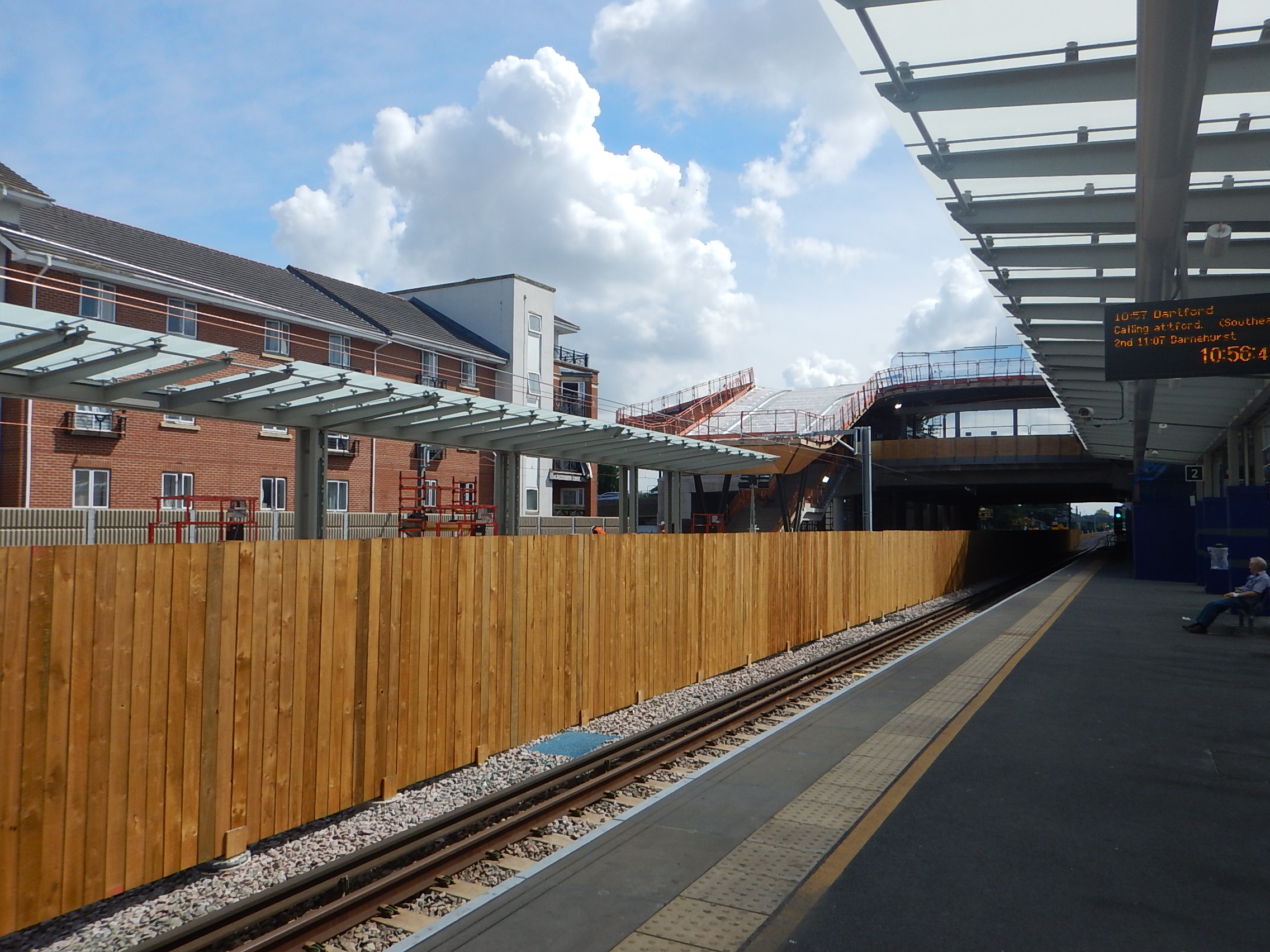
What is the purpose of this palisade fence at Abbey Wood station?
It certainly doesn’t protect passengers on the North Kent Line platform from where I took the photo from the 750 VDC third rail electrification in front of the fence.
The Crossrail tracks behind the fence are electrified with 25 KVAC, which is several metres in the air.
So is the fence to protect passengers on the platform behind the fence from running across the electrified track?
I think it probably is!
Electrification of both types has problems in certain track layouts.
- Switches and crossings sometimes need very complicated layout of the power system.
- Level crossings can present difficult Health and Safety problems.
- Depots can be dangerous places, even without live rails and overhead wires.
Engineers are constantly coming up with ideas to make electrification safer and more efficient.
Diesel Power
Putting an appropriate diesel engine on a train coupled to an alternator is a common way to generate electricity to power the train.
But.
- There is the noise and the smell.
- Diesel engines are very heavy.
- Diesel fuel has to be carried.
- Diesel trains have to be regularly refuelled.
To cap it all, diesel trains are not very green.
Gas Turbine Power
One version of he Advanced Passenger Train of the 1970s was intended to be powered by gas turbines and this shows how engineers tried all sorts of power for trains.
Gas turbine power, although very successful in aircraft is probably not suitable for trains.
Hydrogen Power
The Alstom Coradio iLint is a train powered by a hydrogen fuel cell. This is said in the Wikipedia entry.
Announced at InnoTrans 2016, the new model will be the world’s first production hydrogen-powered trainset. The Coradia iLint will be able to reach 140 kilometres per hour (87 mph) and travel 600–800 kilometres (370–500 mi) on a full tank of hydrogen. The first Coradia iLint is expected to enter service in December 2017 on the Buxtehude-Bremervörde-Bremerhaven-Cuxhaven line in Lower Saxony, Germany. It will be assembled at Alstom’s Salzgitter plant. It began rolling tests at 80km/h in March 2017.
As we have successful hydrogen-powered buses in London, I suspect we might see trains powered by hydrogen fuel cells.
Battery Power
Powering a heavy train for more than a couple of miles, by means of batteries seems very much of a fantasy.
I was sceptical until I rode inn Bombardier’s Class 379 train, that took part in the BEMU trial.

I believe strongly, that the place for a battery in a train is not normally as a primary power source, but as an intermediate electricity store in much the way the battery is used in a hybrid bus or car.
The battery would be charged, when running on electrified track or by using an onboard diesel engine or hydrogen fuel cell.
It could then power the train on a length of track without electrification.
Regenerative Braking
Regenerative braking can save as much of twenty percent of the electricity use of a train.
Every time the train brakes, the traction motors turn into generators and transform the train’s kinetic energy into electricity.
On some systems like the London Underground, the electricity is returned to the network and used to power nearby trains.
But on some trains, it is passed through resistors on the train roof and just turned into heat.
Hybrid vehicles have shown how it is possible to use batteries to store and reuse the energy and I believe that this technique is now starting to be used on trains.
In Thoughts On Batteries, I said this.
A typical four-car electric multiple unit like a new Class 710 train, weighs about 130 tonnes or 138 tonnes with passengers. Going at a line speed of 100 kph, it has a kinetic energy of 15 KwH. So this amount of kinetic energy would be well within the scope of a 75 KwH battery from a Routemaster bus.
I think that the typical four-car electric multiple unit can easily be fitted with a battery to handle the braking for the train.
The physics of steel-wheel-on-steel-rail are also very efficient, as Robert Stephenson, if not his father, would have known.
So it would appear that combining regenerative braking with batteries of a practical size can improve the efficiency of a train.
One of the great advantages of handling the regenerative braking on the train with batteries, is that expensive transformers to handle the return currents are not needed at trackside.
Putting It All Together
I very much feel that the ultimate train should have the following characteristics.
- The ability to work on 25 KVAC overhead and/or 750 VDC third rail electrification.
- A suitable independent power source, which today would probably be diesel.
- Regenerative braking.
- A battery of sufficient size.
- The ability to switch modes automatically.
As a Control Engineer, I feel sure that some form of Automatic Power Management would be welcomed by the driver.
The Class 800 Train
The Class 800 trains, have the following maximum speeds.
- 125 mph on 25 KVAC overhead wires
- 140 mph on 25 KVAC overhead wires with ETCS in-cab signalling.
- 100 mph on diesel.
I think it is true to say, that on 125 mph lines, they may be capable of going faster.
But whatever they can do is probably well known now as Hitachi have over two years of experience of running the trains on British tracks.
In Do Class 800/801/802 Trains Use Batteries For Regenerative Braking?, I analyse the posed question.
After spending several hours searching the Internet, I found this very helpful document on the Hitachi web site.
Reading every word several times, I came to the conclusion, that it is more likely than not, that all variants of Class 80x trains have batteries, that are used for the following.
- Handling regenerative braking
- Providing hotel power for the train in case of complete power failure.
- Providing emergency train recovery in case of complete power failure.
I also discovered the following.
- The all-electric Class 801 train, has at least one onboard diesel engine for emergency situations.
- All Class 80x trains could be modified to use third rail electrification.
- All Class 80x trains can couple and uncouple in under two minutes.
- Class 80x trains can rescue another.
- Class 80x trains can be locomotive-hauled.
Hitachi have worked hard to produce a seriously comprehensive train.
This specification will lead to some interesting operational strategies.
More Destinations
Great Western Railway currently has services between London Paddington and the following destinations in South Wales
- Bridgend
- Carmarthen
- Cardiff
- Llanelli
- Neath
- Newport
- Pembroke Dock
- Port Talbot
- Swansea
But how many other stations in South Wales could benefit from a direct service?
The intriguing thing is that a Class 800 train is narrower at 2.7 metres, than the following trains.
A five-car Class 800 train is also considerably shorter and a lot quieter than an InterCity 125.
So it raises the possibility of direct services between London and the following stations.
- Smaller stations in West Wales like Fishguard Harbour and Milford Haven
- Important stations in the Cardiff Valley Lines.
Could a five-car Class 800 train reach Aberdare, Ebbw Vale and Merthyr Tydfil, with some platform and track modifications?
Or if not a five-car, what about a four- or three-car train, which due to the flexible nature of the trains, I feel is very much possible!
Joining And Splitting Of Trains
In Wales, smaller separate trains could join into a train of up to twelve-cars at say Cardiff or Newport stations and then run to London as a single train.
Similar processes could apply in West Wales, with trains joining at perhaps Port Talbot Parkway station.
Returning from London, the trains would split at an appropriate station.
The big advantage of this approach, is that two or even three services share one path and driver between the join/split station and London, which means an increased number of separate services and total seats between Wales and London.
Similar processes will be possible on the following sets of routes, which will or could be run by Class 80x trains.
- London Paddington to Cheltenham, Gloucester, Hereford, Oxford and Worcester.
- London Paddington to Devon and Cornwall.
- Midland Main Line services.
- East Coast Main Line services.
How many stations on these lines will receive a new direct service to and from London?
Network Rail’s Secret Weapon
I have been suspicious for some time, that Network Rail have a very sophisticated simulation of the UK rail network. In fact, I’d be very surprised if they didn’t have one.
But that’s because I’ve done extensive dynamic simulation and scheduling in my working life and know the power and capabilities of such a system.
It’s just that some of the new franchises have developed some quite radical train patterns.
So I would suspect, a lot of the thinking behind the dropping of electrification has been thoroughly tested on the computer.
So how will the three lines quoted in the article be handled?
Oxenholme To Windermere
The Windermere Branch Line is just ten miles long with four stations.
This article in the Railway Gazette, says this.
‘We have listened to concerns about electrification gantries spoiling protected landscapes’, Grayling said when confirming the cancellation of plans to electrify the Windermere branch in the Lake District, adding that Northern would begin work to trial an ‘alternative-fuelled’ train on the route by 2021. Grayling mentioned the ongoing development of battery and hydrogen power in his statement, but Northern said it had only just begun to explore possible options following the cancellation of the electrification, and so any decision on the technology to be used was still some way off.
From May 2018 Northern plans to operate services to Windermere using Class 769 Flex electro-diesel units to be formed by fitting diesel powerpacks to Class 319 EMUs. New CAF DMUs would then be introduced to the route from December 2019.
It is both a short-term and a long-term solution, that is probably to the benefit of all stakeholders.
Given that the Class 769 train has been designed to serve Manchester to Buxton, you can’t accuse Porterbrook and Northern of hiding their creation under a bushel.
Cardiff To Swansea
The South Wales Main Line between Cardiff Central and Swansea stations is a forty-five mile double-track with the following operating speeds.
- 90 mph from Cardiff Central to East of Bridgend station
- 75 mph from Bridgend to Swansea Loop North Junction
- 40 mph from Swansea Loop North Junction to Swansea
But there is a short section at 100 mph through Pyle station.
This is said in the article in Global Rail News.
Referring to the Cardiff-Swansea route, the statement said, “Rapid delivery of passenger benefits, minimising disruption and engineering work should always be our priority and as technology changes we must reconsider our approach to modernising the railways.”
The argument is based on the planned introduction of bi-mode Class 800 trains later this year.
I have flown my virtual helicopter along the tracks and it doesn’t seem a badly designed route.
- It appears to be fairly straight with flowing curves.
- There are only eleven stations to pass through.
- Looking at the current timetables, it would appear that the fastest trains take about 51-53 minutes to go between Cardiff and Swansea.
- Wikipedia says this about the South Wales Main Line, “resignalling and line speed improvements in South Wales, most of which would be delivered in 2010–2014”.
So have Network Rail found a way to increase the operating speed nearer to the 100 mph of the Class 800 trains, when running on diesel?
I obviously don’t know for sure, but given the improvements to the South Wales Main Line and the performance of the new trains, I wonder if Network Rail’s simulations have shown that there is very little to be gained by full electrification.
As I indicated earlier, by joining and splitting services, the number of trains and the total number of seats can be increased to West Wales without needing more train paths between London and Cardiff.
Midland Main Line
There has been discussions in Modern Railways recently about the problems of devising a timetable for the Midland Main Line.
The article in the Railway Gazette says this.
Hitachi is supplying bi-mode trainsets for Great Western services under the Department for Transport’s Intercity Express Programme, while the operator of the next East Midlands franchise will be required to introduce bi-mode trainsets from 2022. DfT said the use of electro-diesel trainsets instead of electrification would mean passengers would ‘benefit sooner’, because ‘disruptive’ work to install ‘intrusive wires and masts’ would ‘no longer be needed’.
It looks to me that simulation has shown, as in South Wales, there is little to be gained from full electrification.
But there could be a lot to gain from the following.
- Creative joining and splitting of trains.
- Improved track layouts.
- Improving the electrification South of Bedford.
- Adding new stations.
With these intelligent bi-mode trains, electrification can be added selectively, if it is shown to be worthwhile.Control systems linked to GPS, can raise and lower the pantograph appropruiately.
Conclusion
I think that someone asked the heretical question.
What would happen if instead of electrification, we used bi-mode trains?
Both the South Wales Main Line and the Midland Main Line have similar characteristics.
- Operating speed upwards of 90 mph.
- Sections where the operating speed could be raised.
- Partial electrification at the London end.
- All London suburban trains sharing the routes are 100 mph trains.
- Modern signalling
Couple this with the Class 800 trains and a very good simulation, and I suspect that Network Rail have found ways to improve the service.
I very much feel that similar techniques are being used to increase the capacity of the electrified Great Eastern Main Line to achieve Norwich-in-Ninety.
I can’t of course prove my feelings, but then I started writing computer simulations in the mid-1960s and like to think, I know when I see others have done some good numerical analysis.
Where Else Could Bi-Mode Trains Be Used In This Way?
This is very much speculation on my part.
Basingstoke To Exeter Via Salisbury
Consider.
- There have been ambitions to electrify this route for decades.
- The new operator of the route; South Western Railway and Great Western Railway, who will operate Class 800 trains, are partially in the same ownership.
- Third rail or dual voltage Class 800 trains are possible.
- The trains are 100 mph units on diesel against the current 90 mph Class 158 trains.
- The trains would save four minutes between London Waterloo and Basingstoke.
- The trains could take advantage of speed improvement South of Basingstoke.
- If Basingstoke to Exeter was a 100 mph line, then up to fifteen minutes could be saved.
- The trains could join and split to serve multiple destinations.
But perhaps the biggest advantage would be that all trains between London Waterloo and Basingstoke would be 100 mph trains, which must mean that more trains could use the line.
Cardiff to Brighton via Southampton, Portsmouth Harbour and Bristol
Consider.
- This route has significant overcrowding according to Wikipedia.
- Cardiff to Bristol should eventually be electrified with 25 KVAC overhead wires.
- Brighton to Southampton is electrified with 750 VDC third rail.
- Great Western Railway run this route and have Class 800 trains.
- Dual voltage Class 800 trains are possible.
To run this route efficiently, Great Western Railway would need an appropriate number of five-car dual voltage Class 800 trains.
Norwich To Stansted Airport via Ely and Cambridge
The Breckland Line between Norwich and Cambridge has the following characteristics.
- Double-track throughout its just over fofty miles.
- Sections of electrification at Norwich and South of Ely.
- A variable operating speed of up to 90 mph.
The line has recently been upgraded with improved track, removal of level crossings and modern signalling.
As part of their new franchise proposal, Greater Anglia decided to run services from Norwich to Stansred Airport using new Stadler Class 755 trains, with the following characteristics.
- Three- or four-car
- Bi-mode power.
- 100 mph capability.
- Running on 25 KVAC, where available.
I think this is a good plan and is an example of the sort of use of bi-mode trains that will be seen increasingly.
Consider.
- Norwich gets a much better connection to Cambriodge and Stansted Airport.
- Some services on the route are still run by 90 mph Class 158 trains.
- Speed improvements will come because of the nearly fifty miles of electrification between Ely and Stansted Airoport.
- There may be further track improvements possible.
There is also the big possibility of being able to run a direct service between Norwich and London via Cambridge. I estimate that this could be done in about two and a half hours.
This is obviously not as fast as the route via Ipswich, where the current timing is around one hour fifty minutes and plans are in progress to reduce it by twenty minutes, but as an engineering work diversion, it is faster than a bus replacement service.
Peterborough To Colchester via Bury. St. Edmunds and Ipswich
This is an extension of the current Peterborough to Ipswich service that will be run by a bi-mode Class 755 train, under the new franchise agreement.
Consider.
- The route is not electrified, except for Peterborough to Stowmarket.
- Colchester gets a new hourly direct link to Peterborough, which has many services to the North.
- A two train per hour service across Suffolk between Ipswich and Bury St. Edmunds is created.
- Colchester to Peterborough may be reduced by twenty minutes or more.
- Ipswich to Peterborough may be reduced by a few minutes.
If it was decided to electrify from Stowmarket to Peterborough, timings would benefit substantially.
Ipswich To Cambridge via Bury. St. Edmunds and Newmarket
This is an existing service that will be run by a bi-mode Class 755 train, under the new franchise agreement.
Leeds To Glasgow Via Settle
Why not?
If you look at timings for Leeds to Glasgow, they are typically as follows.
- 3 hours 58 minutes with an 11 minute change at Haymarket.
- 4 hours 12 minutes with a 30 minute change at Carlisle
- 4 hours 4 minutes on a direct train via Edinburgh.
The Settle-Carlisle Line has been stoutly repaired after the 2015-2016 Temporary Closures and is probably in its best state for years, if not ever.
- Leeds to Skipton is electrified.
- Carlisle to Glasgow is electrified.
- Virgin Trains East Coast run to Skipton, using InterCity 225s.
I estimate that a Class 800 train could reduce the journey time to around three-and-a-half hours.
Would that be a successful service considering driving between Leeds and Glasgow probably takes almost four hours?
Wales Orders Some Golden Oldies
This article on Global Rail News is entitled Arriva Trains Wales Invests In Bi-mode Class 319s.
These four paragraphs define the deal and why.
The Welsh Government and Arriva Trains Wales are investing in five Class 319 Flex bi-mode trains.
Due to arrive next year, the four-car trains will be leased from Porterbrook thanks to £1.9 million from the Welsh Government and £1 million from Arriva Trains Wales.
Arriva Trains Wales said the trains would likely be deployed on commuter services into Cardiff.
Introducing the 319s will allow Arriva Trains Wales to carry out work needed on its Class 150 and 158 vehicles to ensure they meet new accessibility standards.
This looks to me to be a sensible way to provide cover and also increase the size of the fleet.
Consider.
- The Class 769 train, to give the Class 319 Flex train it, its new official TOPS name, has been designed around the Manchester to Buxton route.
- Manchester to Buxton is as stiff as any route in the Cardiff Valley Lines.
- The trains can do 100 mph on 25 KVAC overhead electrification, so would be ideal for any partially-electrified routes.
- According to this article on the BBC, electrification reaches Cardiff in December 2018.
- The trains can do around 90 mph on diesel.
- Range is ten Manchester-Buxton round trips on a full tankfull.
- Modern Railways has reported the trains can change between diesel and electric modes on the move.
- Drivers have told me, that the brakes on Class 319 trains are superb. Will that be needed on descents into Cardiff?
In Riding In A Clean Class 319/4 Train, I describe a recent ride in one of the better examples, that could be converted for Wales.
The trains may be thirty-years-old, but they are based on Mark 3 coaches, as are the InterCity 125, so like certain actors and singers, they seem to keep on performing.
How Would The Bi-Mode Trains Be Used?
Arriva Trains Wales has the following trains currently working the Cardiff Valley Lines or that need to be converted to meet the latest regulations..
- 15 – Class 142 Pacer
- 15 – Class 143 Pacer
- 36 – Class 150 Train
- 24 – Class 158 Train
The Pacers can in part be ignored, as I suspect they’ll be going to the scrapyard, when the next franchise starts. But Arriva Trains Wales will need fifteen four-car trains to replace them, if they hit the cut-off date in the regulations.
The Class 158 trains were given a full refurbishment in 2010-2, as described like this in Wikipedia.
A complete refurbishment programme to provide the Class 158s with full ‘as new’ interiors took place between December 2010 and October 2012. Funded by the Welsh Assembly Government at a cost of £7.5m, work completed includes interior and exterior repainting, along with replacement of seating, wall coverings, carpets, lighting, luggage racks and toilet fittings. A passenger information system has been fitted, while selected seats have gained at-seat power sockets for mobile phones and laptops. Until this refurbishment, the fleet had seen only minor attention to its interior since a refit by Wales & West in the late 1990s, as well as having been only partially repainted into Arriva colours externally
So will these Class 158 trains need much more than attention to detail and a very good clean? As most seem to be based away from Cardiff, I don’t think we’ll see many Class 769 trains standing in for Class 158 trains. Unless of course Arriva Trains Wales wanted to see how a Class 769 train performs on a longer route.
The Class 150 trains are a totally different matter. In What Train Is This?, I rode in a superbly refurbished Class 150 train, that if standing in for a Class 172 train wouldn’t bring many complaints.
Much of the time on the Cardiff Valleys Lines, the Pacers and the Class 150 trains seem to be running as pairs to make four-car trains.
So five Class 769 trains mean that ten Class 150 trains can be released for updating.
It is worth comparing a Class 769 train with two Class 150 trains working as a pair.
- A Class 769 train, based on a Class 319/4 has a capacity of 50 First Class and 255 Standard Class seats.
- A Class 150 train has a capacity of 147 seats or 294 for a pair.
- The Class 769 train has a top speed of 100 mph on 25 KVAC overhead electrification.
- The Class 769 train has a top speed of just over 90 mph on diesel.
- The Class 150 train has a top speed of 75 mph.
- The Class 769 train has a higher power/weight ratio than the Class 150 train.
It would appear that a pair of Class 150 trains and a Class 769 train can be considered equivalent and with the right number of trains, the two types of train could work the Cardiff Valley Lines.
But the bi-mode Class 769 train has the advantage that it is faster and can run on 25 KVAC overhead wires.
On some routes the Class 769 train may actually reduce the number of trains needed.
Cardiff Central To Ebbw Vale Town
This route between Cardiff Central and Ebbw Vale Town stations uses the South Wales Main Line and the Ebbw Valley Railway.
If you look at the timetable, the trains take up to a few minutes over the hour, which must be an inconvenient time to use trains efficiently.
But eighteen minutes of the route are between Cardiff Central and Pye Corner stations, has perhaps fifteen minutes or so on the South Wales Main Line, with four tracks and an operating speed of 90 mph.
Given the superior power and speed, I suspect that the Class 769 trains can do a round trip in under two hours, even if they had to run on diesel on the South Wales Main Line.
This would mean only two trains would be needed to work an hourly service. Class 769 trains would be four coaches, as one size fits all!
Penarth To Rhymney
This route between Penarth and Rhymney stations uses the Rhymney Line.
If you look at the timetable, journeys both ways take around an hour and 16-20 minutes.
I think that three trains would be needed to work an hourly service.
Two factors slow the trains.
- There are eighteen stops along the route.
- From Bargoed to Rhymney, the line is only single track.
This extract is from the Wikipedia entry for the Rhymney Line.
In March 2007 the latest in a series of infrastructure improvements on the Valley Lines was announced, included lengthening of platforms between Rhymney and Penarth to allow Class 150 units to operate in multiples of 3 (6 cars). However, this is postponed indefinitely due to the sub-lease by the Department for Transport, to First Great Western, of the units that would have allowed this extra capacity.
Would four-car Class 769 trains be an adequate substitute for the planned three Class 150 trains working in multiple as a six-car?
If they were, this would mean that three trains would certainly work an hourly service with a substantial increase in capacity.
I wonder what times, well-driven Class 769 trains, with their hill-climbing abilities could do for the service on this line.
Bridgend/Barry Island/Cardiff Central To Merthyr Tydfil/Aberdate
These services are run in what appears to be an intricate diagram.
But as the Class 769 trains are faster and more capable than anything else running the routes, they should be able to deputise.
Could This Interim Pattern Emerge?
These routes could be run by Class 769 trains.
- Cardiff Central to Ebbw Vale Town
- Penarth to Rhymney
Conveniently, the two routes would need five trains.
By the end of 2018, it is predicted that the South Wales Main Line will be electrified, which would mean they could use electric power for some of the routes.
There might be small amounts of add-on electrification to ease changeover of mode.
- South Wales Main Line to Pye Corner
- Cardiff Central to Penarth
It might even be sensible to electrify the Vale of Glamorgan Line to give a second electrified route from Cardiff Central to Bridgend and serve Cardiff Airport.
Electrification of the lines in Cardiff would probably be much simpler than on some of the steep valley lines, but it would allow more Class 769 trains or similar to work the Cardiff Valley Lines efficiently.
But I did say this would only be an interim plan until perhaps 2020.
So Where Do CAF Come In?
CAF bring several things to this party.
- By 2020, CAF will have a fully functioning factory a few miles down the line at Llanwern, just to the East of Newport.
- CAF build trams, trains and tram-trains of all sizes and speeds.
- CAF are one of the world leaders in the application of energy storage to rail vehicles.
- CAF are not afraid to experiment or do Research and Development.
- CAF have a modular train concept called Civity, which in their data sheet claim is all things to everybody.
I believe that CAF can come up with a train with the following characteristics.
- Electric or diesel power.
- On-board energy storage.
- Regenerative braking.
- Lots of powered-axles.
- Four-cars
- 100 mph on electric power
- 90 mph on diesel power.
It looks very much like a modern Class 769 train with added battery power.
In fact the Class 769 trains will do all the specification development and route proving for CAF’s engineers.
So Where Do Porterbrook Come In?
Someone will have to finance the new trains for South Wales and they must be in prime position.
Similar systems can also be developed in other UK cities using Class 769 trains.
Conclusion
I have a feeling, that Network Rail have looked at electrifying the Cardiff Valley Lines and decided that it will be very difficult. Various commentators have suggested using trams.
What I have proposed is using bi-mode trains designed specifically for the Cardiff Valley Lines, that use electric power on and around the South Wales Main Line, diesel power to climb the hills and gravity and a bit of storage or diesel to come down.
I think that the purchase of five Class 769 trains will lead to an innovative solution from CAF to creating a world-class rail system in South Wales.
|Aberthaw Resumes Cement Dispatch
This is the title of another article in the January 2017 Edition of Modern Railways.
I wasn’t sure where Aberthaw was, so I looked it up on the Internet and this Google Map shows Aberthaw Cement Works, Cardiff International Airport and the Vale of Glamorgan Railway, that links Cardiff Central station in the East to Bridgend in the West.
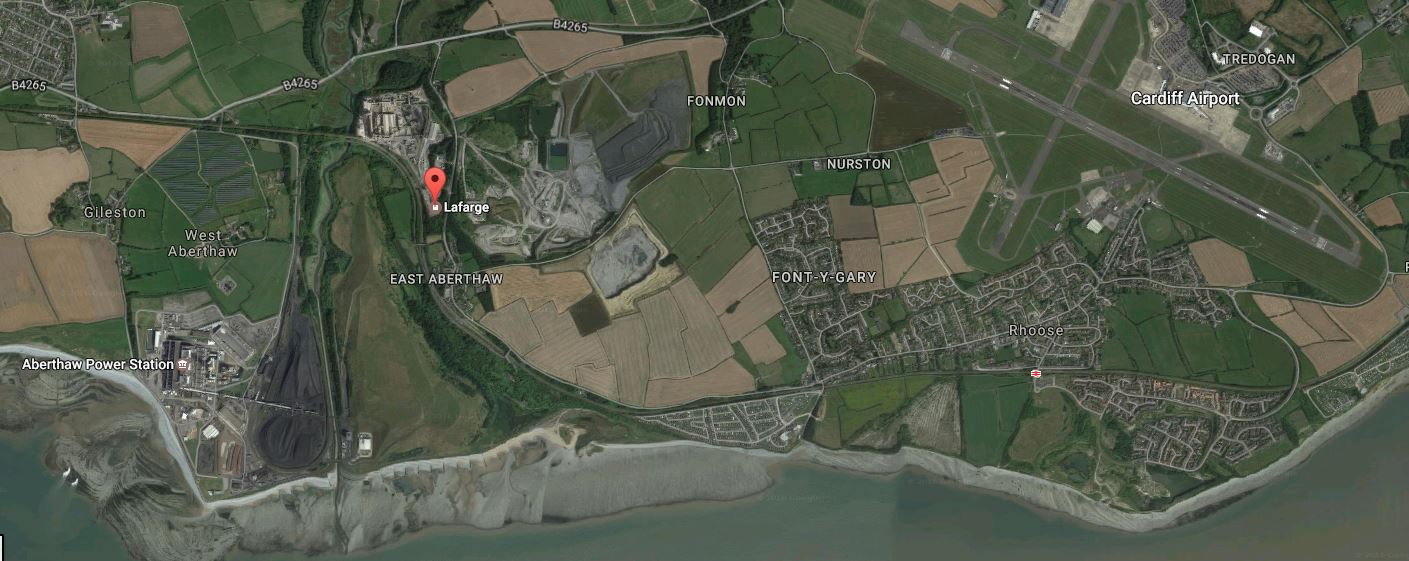
Note.
- The red arrow indicates the cement works.
- The Airport terminal is on the North side of the long runway,.
- Rhoose Cardiff International Airport railway station is on the other side of the runway and connected to the Airport by a sguttle bus.
- The line was closed by Beeching to passenger traffic in 1964, but was reopened in 2005.
Could Cardiff Airport benefit from the same sort of train-train link, that has been proposed for Glasgow that I wrote about in The Glasgow Airport Rail Link Will Be A Tram-Train?
But the map does illustrate the benefit of rail access to the cement works.
- The works is close the Vale of Glamorgan Line.
- Trains from the cement works can go East to places that need the product, including surprisingly, the South West of England.
- The rail link could cut the number of truck movements by 25%.
This would seem to be an ideal use for rail freight.
Are we doing enough to develop similar links, from other large factories all over the UK?
As the line is supposed to be electrified in a few years, could it be that a proper review of the line should be done first, to see whether any other projects should be done at the same time.
The reason I say this, is that the history of the line is much the same as that of the Grand Old Duke of York and his soldiers.
From Carmarthen To Pembroke
From Carmarthen stastion I went on to Pembroke station before returning on a train an hour later, taking these pictures.
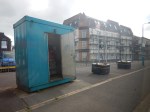


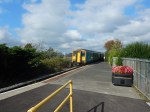


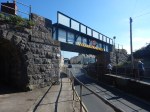
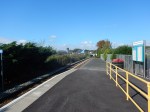
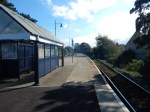


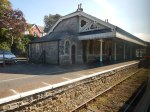

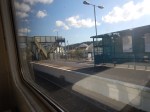



Pembroke and Tenby are certainly worth a visit and you could probably arrange the journeys, so that you did it all using one return ticket breaking the journey at Tenby one way.
The conductor suggested I do it, so if you’re uncertain if it’s possible, ask them.
Changing Trains At Carmarthen Station
Carmarthen station is on a spur from the West Wales Line from a triangular junction.
This Google Map shows the station and the junction.
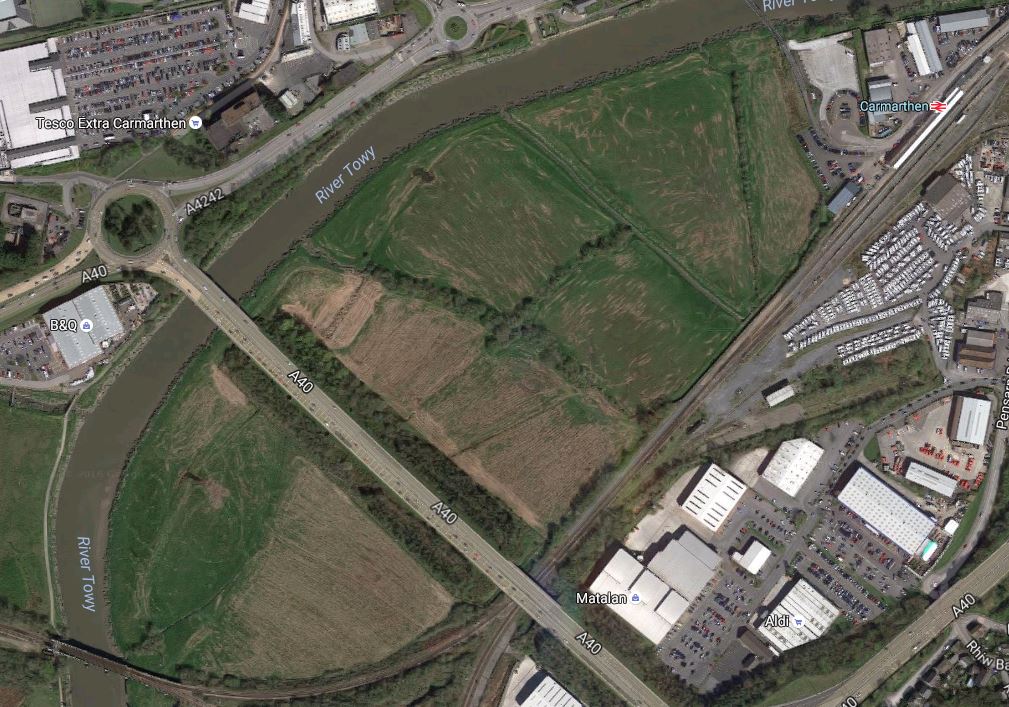
Carmarthen Station
My train from Swansea arrived in the station and I crossed the tracks to the other platform to get my onward train to Pembroke.
These are some pictures of the station.
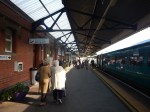
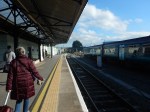
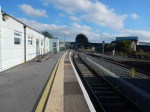

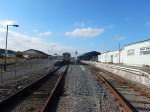
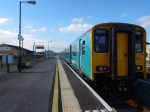
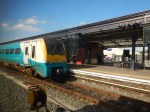

There aren’t many stations, where passengers are allowed to cross the lines.
This Google Map shows the station layout in detail.
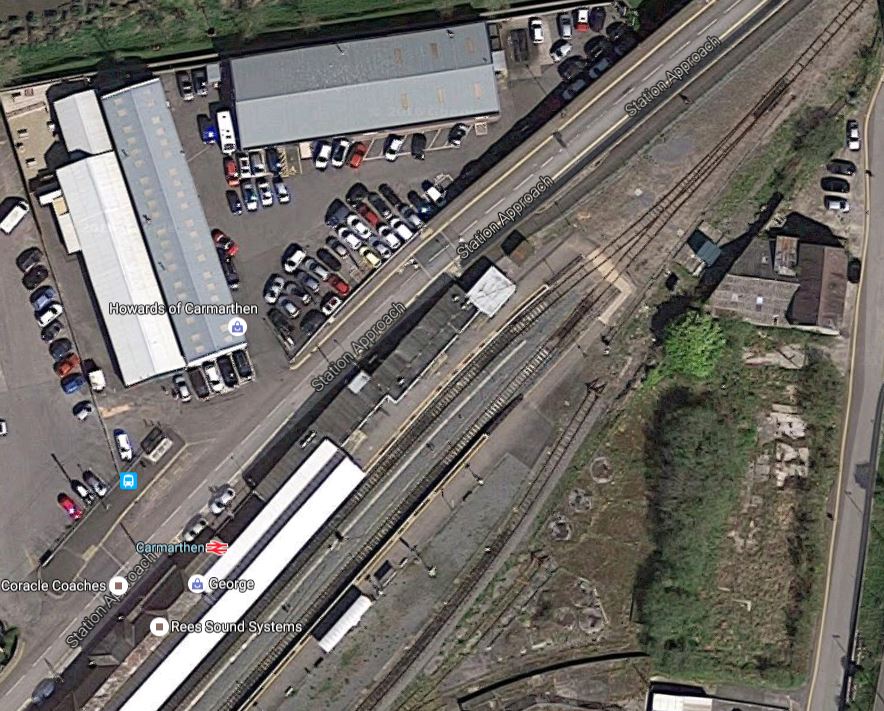
Carmarthen Station Layout
It is a good example of how a reversing siding works.
Note in the larger map, the railway crosses over the River Towy, as it goes to the West.
There is a lifting bridge over the river called Carmarthen Bridge.
This web page on Movable Bridges, describes the bridge and has a picture.
The bridge was built in 1911 and hasn’t worked since about 1956.
Have You Heard about…the New European Transport Strategy?
That is the title of an article in Georgia Today, which gives a solid overview of the strategy. This is the first two paragraphs of the article.
In 2013, the European Commission, in a EUR 250 billion European strategy which gives priority to the creation of an integrated transport network and seeks to level the imbalance between the Member States of the European Union, proposed the creation of international transport corridors, bringing together Western and Central Eastern Europe. In order to overcome traffic imbalance in the EU, nine multimodal corridors will be created, each of which has to combine at least three types of transport and connect three states.
The new infrastructure policy will unite 28 EU states under trans-European transport network (TEN-T). Nine transport corridors will be provided: Baltic – Adriatic Sea, North Sea – Baltic, the Mediterranean Corridor, Middle Eastern Corridor, Scandinavia – the Mediterranean Sea, the Rhine – Alps, the Atlantic Corridor, the North Sea – the Mediterranean Sea, and the Rhine – Danube. They will be grouped into three general areas of “East – West”, “North – South” and “Diagonal” corridors. The project is scheduled for completion in 2030. The transport corridors will receive priority funding to connect the east and west of the European Union. To finance the first phase of the project, EUR 26 billion was allocated.
I suppose that the Brexiters will say, that all it will do is bring more migrants to the UK.
But, think of the news a couple of days ago, when the Swiss opened the Gotthard Base Tunnel as is reported in this article on the BBC. This tunnel will have passenger trains, but one of it’s main purposes, is to get trucks from the roads through Switzerland, by moving a million tonnes of freight a year onto the trains. The tunnel removes a bottleneck on the Rotterdam-Basel-Genoa corridor, which has been named the Blue Banana by a group of French geographers.
This is the introduction to the Wikipedia entry.
The Blue Banana (French: banane bleue, also known as the European Megalopolis or the Manchester–Milan Axis) is a discontinuous corridor of urbanisation in Western Europe, with a population of around 111 million. The concept was developed in 1989 by RECLUS, a group of French geographers managed by Roger Brunet.
It stretches approximately from North West England across Greater London to the Benelux states and along the German Rhineland, Southern Germany and Switzerland to Northern Italy in the south.
Since when have Greater London and Manchester been in mainland Europe?
I also didn’t realise that I lived in a megalopis of 111 million people.
We are doing our bit to create the freight rail corridor from Manchester to Milan, by improving rail routes between the Channel Tunnel and up the spine of the country to Manchester and eventually to Scotland.
This must bring benefits to the UK in terms of freight and trade.
- At the Northern end of the route, Liverpool is creating one of the largest container ports in the world.
- Our car factories can export direct to Europe using massive trains, as I wrote about in What A Lot Of Minis!
- British Steel’s renowned long products from Scunthorpe can’t be exported easily other than by train.
- Mediterranean produce can be delivered fresher to the UK.
- Scottish food and drink will have fast access to the heart of Europe.
And these are just five small examples.
One fifty kilometre tunnel in Switzerland has just made trade for the UK, easier.
Some of the other transport corridors will greatly help Eastern Europe, of which some parts need all the help they can get. The article says this about Rail Baltica.
There is a priority project in the railroad Rail Baltica. The Trans-European railway Rail Baltica, linking Helsinki – Tallinn – Riga – Kaunas – Warsaw and continuing on to Berlin, is to be developed within the territories of the co-operating EU Member States. Rail Baltica will support the wider EU goals of parity of access to services and infrastructure of EU Member States and development of sustainable modes of transportation, improved balance and interoperability between different means of transportation, and the establishment of links with the rest of the EU rail network. Even as far back as the 1990s it was in the works to build an underwater railway tunnel between Tallinn and Helsinki, but the project was delayed due to financial constraints. This corridor also involves the development of river waterways and canals (Belgium, Germany, the Netherlands), as well as ferry traffic (between Finland and Estonia). The project cost is estimated at over EUR 3.6 billion, including 50% from the EU budget (program TEN-T), and 50% from the budget of the project participants. In the Baltic countries there is no such means, and there are discussions about the feasibility of building a high-speed road which will pass by numerous settlements.
I feel very strongly, that good rail and road links through an area, improve its prosperity. If we look at that small project of the Borders Railway, can anybody deny that it has been a success and that it has helped to enhance the place of the Scottish Borders on the UK Tourist Map.
As I write this Radio 5 Live is hosting a discussion on Brexit from Cardiff. Some of the issued raisded include steel and agriculture.
The Welsh may not like it, but an electrified Great Western for freight and passengers, will make South Wales fully part of the Blue Banana, which can only be positive for the Principality.
 The Anonymous Widower