Could Manchester Airport Be Accessed From The West By A Tunnel Under The M56?
This OpenRailwayMap shows the railways of East London between Dalston Junction and Stratford International stations.

Note.
- Dalston Kingsland station is marked with an arrow in the West of the map.
- Stratford International station is marked by the blue lettering in the East of the map.
- The orange line between them is the North London Line.
- There are also two pink lines, which indicate High Speed One, which is dug several metres below the North London Line.
It can’t be much different to dig a high speed railway underneath a motorway. Has anybody done this?
This OpenRailwayMap shows the railways leading to Manchester Airport.
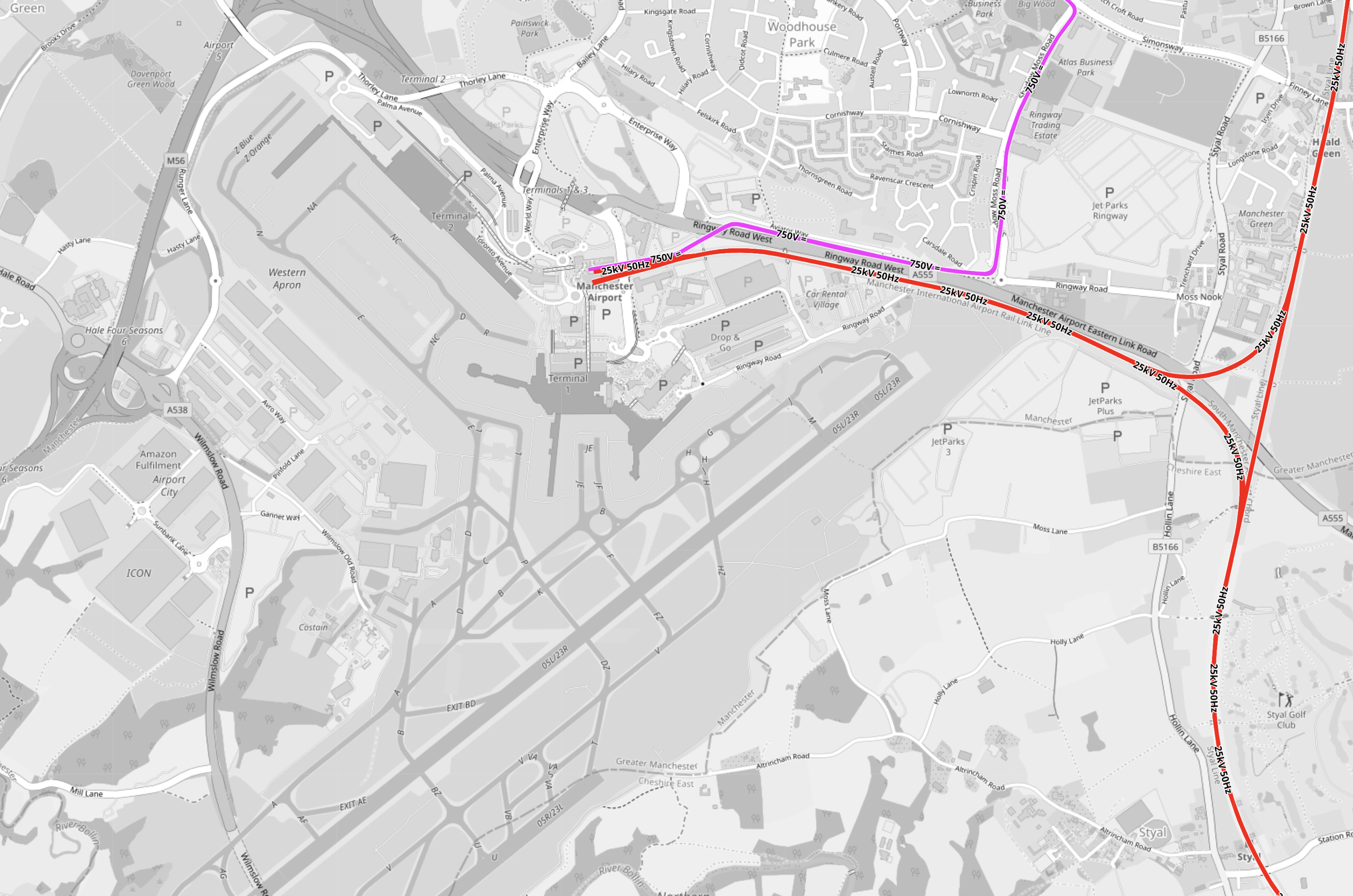
Note.
- Junctions 5 and 6 of the M56 motorway are on the Western edge of the Airport.
- The red tracks are the Styal Line.
- The mauve tracks are the Metrolink.
- It should be noted that railway lines pass under Heathrow Airport’s runways.
Point 4 makes me sure, that Manchester Airport can have a station connected to the West by a railway under the M56.
This OpenRailwayMap shows the railways around Weaver Junction on the West Coast Main Line, where the trains branch off to Liverpool.

Note.
- The West Coast Main Line goes down the Eastern side of the map.
- Warrington Bank Quay is the next station to the North.
- The Liverpool Branch goes off to the West.
- The M56 tuns diagonally across the map from the North-East corner crossing both both branches of the West Coast Main Line.
This Google Map shows where the M56 crosses over the West Coast Main Line to Warrington Bank Quay.
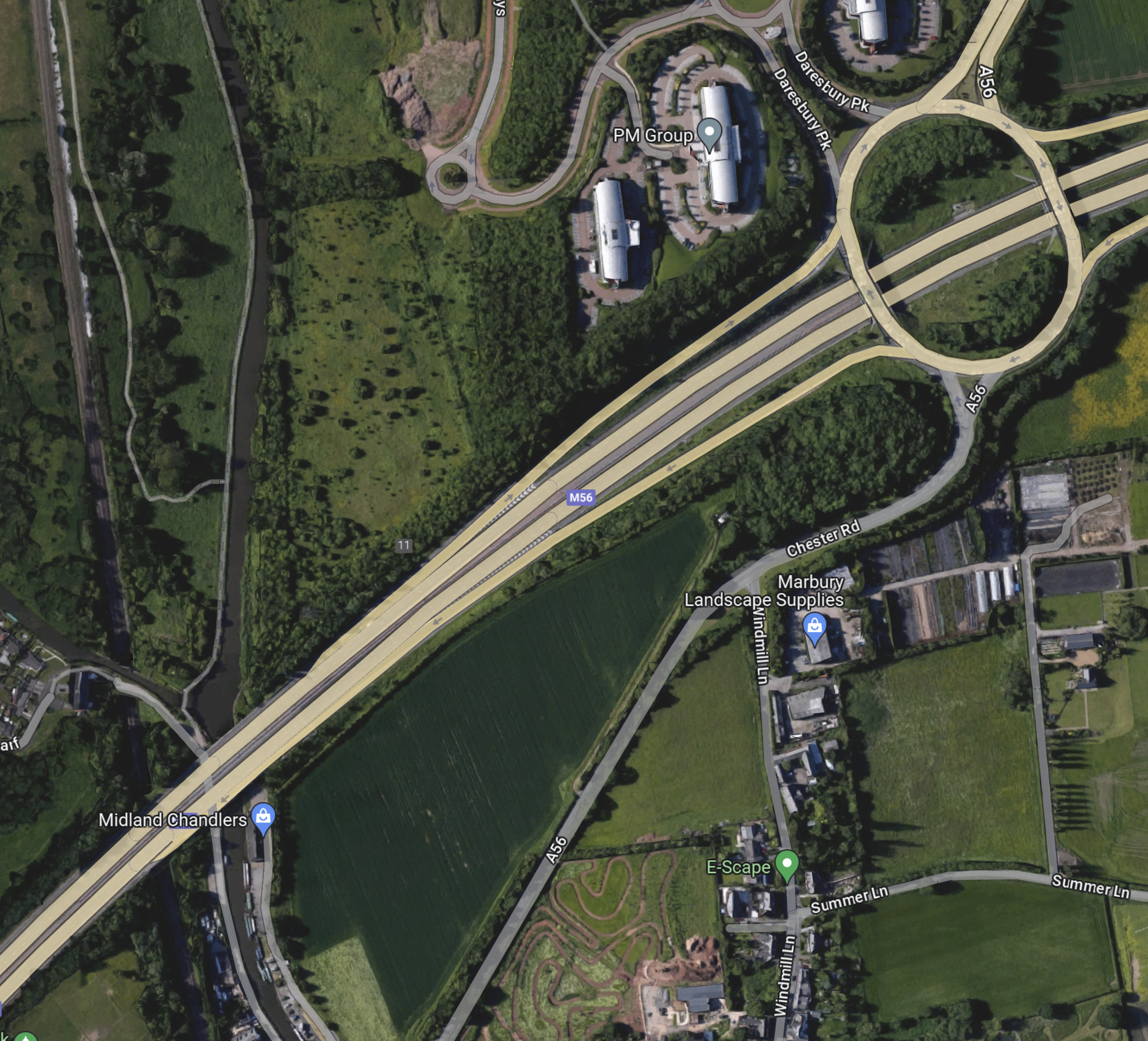
Note.
- The M56 motorway is obvious.
- The Eastbound motorway goes to Manchester Airport and Manchester.
- The junction is numbered 11.
- The railway runs down the Western side of the map.
I believe that it would be possible to connect a railway running East under the motorway to the West Coast Main Line.
This Google Map shows where the M56 crosses over the Liverpool branch of the West Coast Main Line.
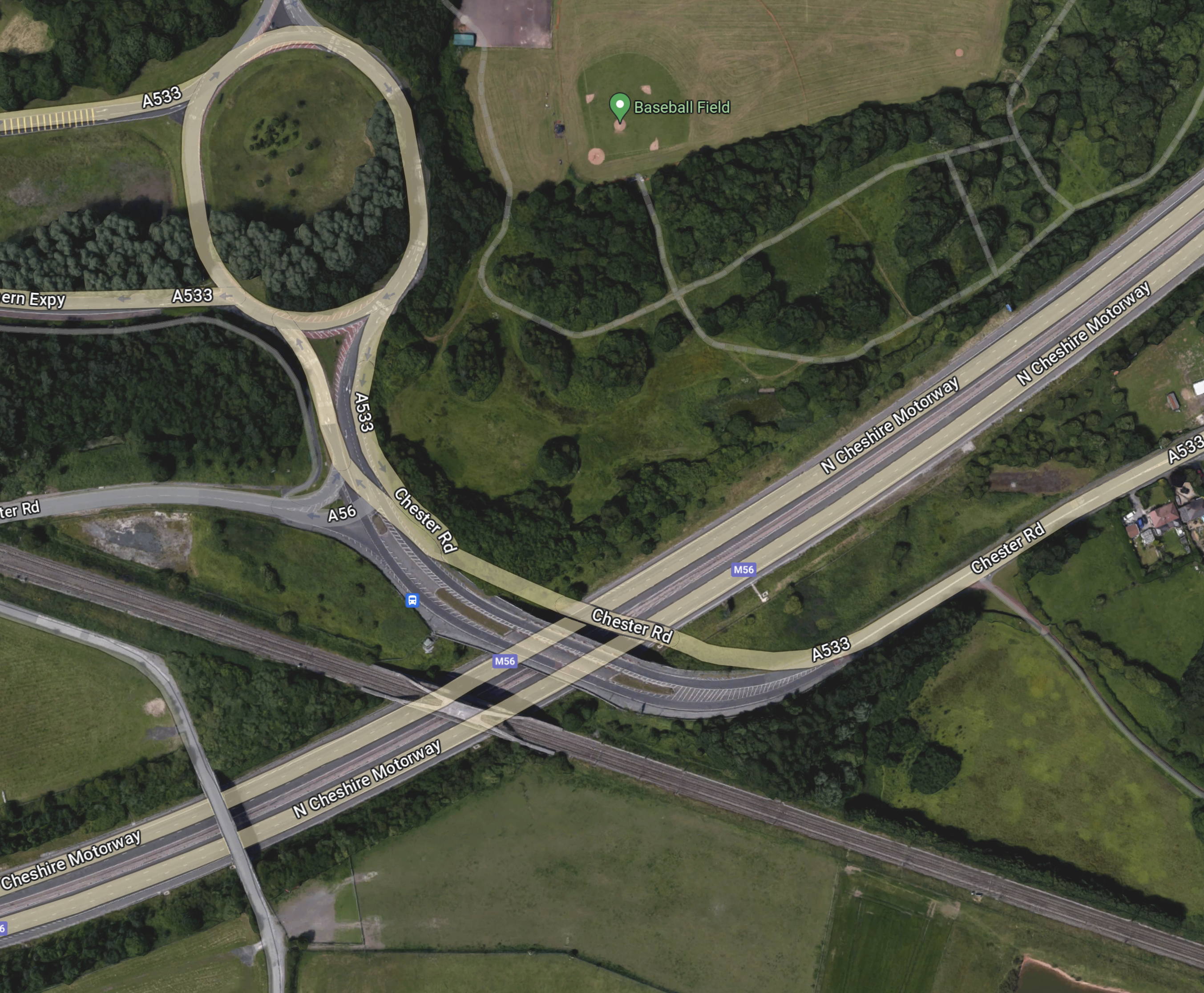
Note.
- There is no motorway junction here.
- The North-East bound motorway goes to Manchester Airport and Manchester.
- The railway runs slightly diagonally across the bottom of the map.
- The Westbound railway goes to Runcorn and Liverpool.
- The Eastbound railway goes to Weaver Junction, Crewe and the South.
There would only need to be a connection between Liverpool and the railway under the motorway going to and from Manchester Airport.
I have some further thoughts and questions.
This Is Just My First Thought
I am happier about the connection to the Liverpool branch than the Northern connection.
But then I feel there are several routes at both junctions, some of which will take a wider route.
How Long Will The Tunnels Be?
Between Junctions 11 and 6 on the M56 is 16 miles.
At What Speed Would The Trains Run?
I suspect that once on the straight section between Junctions 11 and 6, speeds of up to 90 or 100 mph should be possible, but speeds would probably be lower at the junctions to the West Coast Main Line.
How Would It Connect To Manchester Piccadilly?
The tunnel would continue the other side of the Airport and it’s a further 9.4 miles to under Manchester Piccadilly.
In The Rival Plans For Piccadilly Station, That Architects Say Will ‘Save Millions’, I wrote about Weston Williamson’s plan for Manchester Piccadilly station.
This was their visualisation.

Note.
- In the visualisation, you are observing the station from the East.
- The existing railway lines into Piccadilly station are shown in red.
- Stockport and Manchester Airport are to the left, which is to the South.
- Note the dreaded Castlefield Corridor in red going off into the distance to Oxford Road and Deansgate stations.
- The new high speed lines are shown in blue.
- To the left they go to Manchester Airport and then on to London, Birmingham and the South, Warrington and Liverpool and Wigan, Preston, Blackpool, Barrow-in-Furness, the North and Scotland.
- To the right, they go to Huddersfield, Bradford, Leeds, Hull and the North East, and Sheffield, Doncaster and the East.
- Between it looks like a low-level High Speed station with at least four tracks and six platforms.
- The high speed lines could be oriented so they ran East-West, rather than North-South in this visualisation.
- The Manchester Metrolink is shown in yellow.
The potential for over-site development is immense. If the Station Square Tower was residential, the penthouses would be some of the most desirable places to live in the North.
Onward From Manchester Piccadilly
I would hope that a connection could be made to the Huddersfield Line to the East of Manchester Piccadilly station, so that trains could use the TransPennine Upgrade all the way to Leeds.
High Speed Two To Lancaster
There has been a lot of speculation about the Northern end of High Speed Two, so I might as well add sort out a few facts and add a bit of speculation of my own.
The Current Lancaster Service
I shall look at the 07:30 train on the 29th September 2023.
- It was a nine-car Class 390 train or Pendolino, which left on time.
- Euston and Lancaster are 230 miles apart.
- The train passed Crewe at 09:59
- The train arrived at Warrington Bank Quay at 09:14 and left at 09:15.
- The train arrived at Wigan North Western at 09:25 and left at 09:26.
- The train arrived at Preston at 09:39 and left at 09:41.
- The train arrived at Lancaster at 09:55 and left at 09:57.
- The journey took two hours and 25 minutes
- The average speed was 95.2 mph.
- There is at least one train per hour (tph).
Lancaster Will Get Its Own High Speed Two Service
This graphic shows High Speed Two services after Phase 2b is completed.
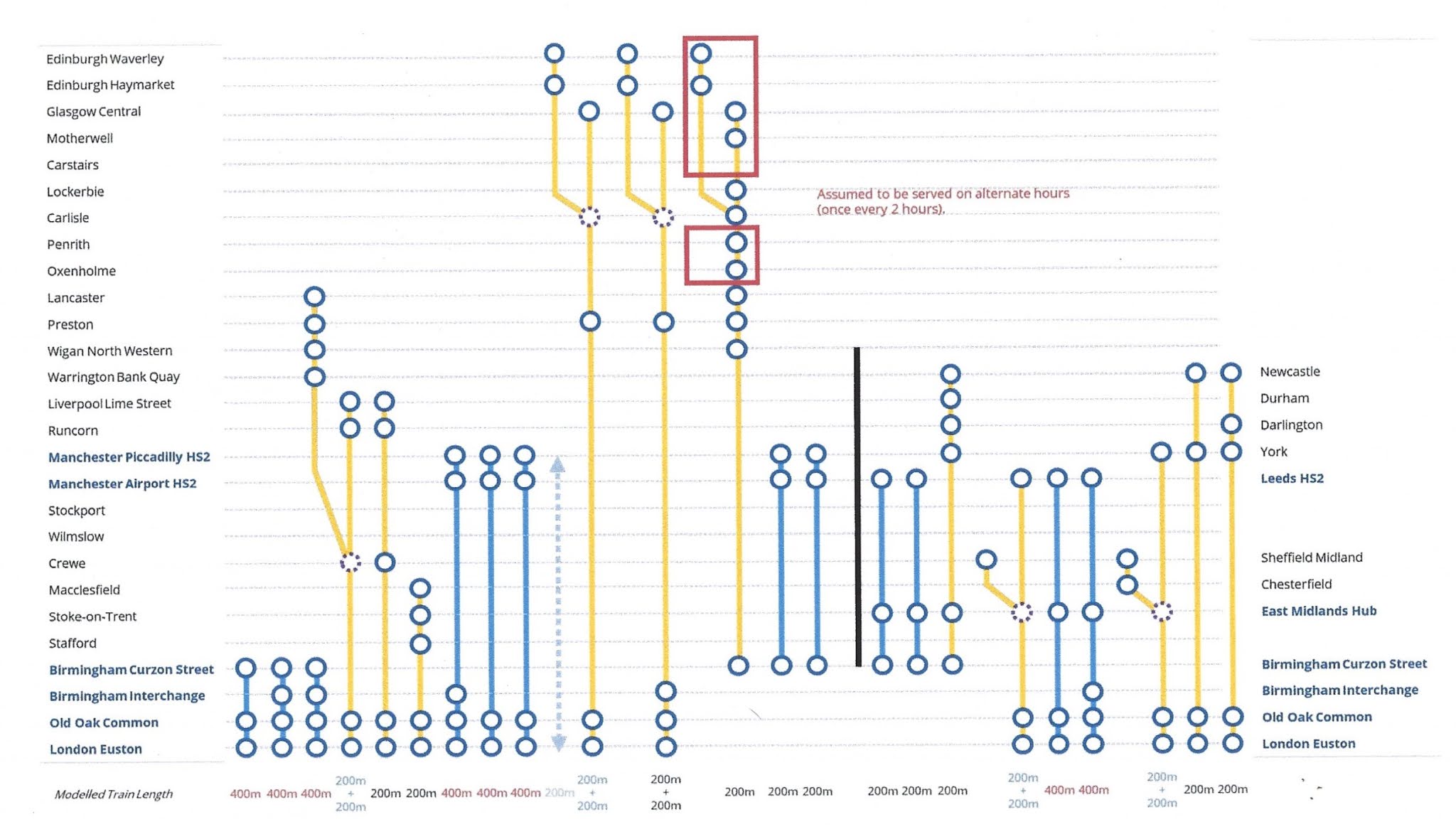
Note.
- Lancaster and Liverpool share a pair of High Speed Two Classic Compatible trains, that will split and join at Crewe.
- The Lancaster service will stop at Warrington Bank Quay, Wigan North Western and Preston, to the North of Crewe.
The Wikipedia entry for High Speed Two gives these times for trains from London after Phase 2a opens to Crewe.
- Crewe – 56 minutes
- Warrington Bank Quay – One hour and 20 minutes
- Wigan North Western – One hour and 34 minutes
- Preston – One hour and 18 minutes
- Lancaster – Two hours and 3 minutes
- Oxenholme – One hour and 56 minutes
- Carlisle – Two hours and 23 minutes
Note.
- The Crewe, Warrington Bank Quay, Wigan North Western and Lancaster times will apply to the direct Lancaster service.
- The Preston and Carlisle times apply to the non-stop Scottish service.
- Oxenholme will be reached with a change from London.
- Currently, Pendolinos travel between Crewe and Lancaster in an hour or a few minutes less.
I feel the Lancaster time is suspect and a better time would be around one hour and 52-56 minutes.
140 Mph Running Between Crewe And Preston
Consider.
- London Euston and Crewe is 56 minutes
- One hour and 18 minutes to Preston infers a time of 22 minutes between Crewe and Preston.
- Crewe and Preston is 51 miles.
This implies an average speed of 139 mph.
As the West Coast Main Line was built for 140 mph, when digital signalling was installed, this would appear to be feasible, once the signalling is upgraded.
It may also mean, that faster times are possible in services to Warrington Bank Quay and Wigan North Western.
Crewe And Warrington Bank Quay
Consider.
- The distance is 24.1 miles
- HS2 will take 24 minutes with one acceleration and one deceleration, which probably take a maximum of 4 minutes in total.
- I explain the four minutes in High Speed Two To Crewe.
This gives an average speed of 72.3 mph.
Warrington Bank Quay And Wigan North Western
Consider.
- The distance is 11.7 miles
- HS2 will take 14 minutes with one acceleration and one deceleration, which probably take a maximum of 4 minutes in total.
This gives an average speed of 70.2 mph.
Wigan North Western And Lancaster
Consider.
- The distance is 36.1 miles
- HS2 will take 29 minutes with two accelerations and two decelerations, which probably take a maximum of 8 minutes in total.
- I will also allow a minute for the dwell time at Preston.
This gives an average speed of 108.3 mph.
Crewe And Lancaster
Consider.
- The distance is 72 miles
- HS2 will take 67 minutes with four accelerations and four decelerations, which probably take a maximum of 16 minutes in total.
- I will also allow a minute for the dwell times at Warrington Bank Quay, Wigan and Preston.
This gives an average speed of 90.6 mph.
I now feel happier about two hours and three minutes between London and Lancaster.
Conclusion
The West Coast Main Line needs upgrading to full in-cab digital signalling as soon as possible.
Once working it would give journey time savings for everybody travelling on the line.
See Also
Could High Speed Two Finish At Lichfield?
High Speed Two To Wigan
There has been a lot of speculation about the Northern end of High Speed Two, so I might as well add sort out a few facts and add a bit of speculation of my own.
The Current Wigan North Western Service
I shall look at the 08:30 train to Glasgow on the 20th September 2023.
- It was an eleven-car Class 390 train or Pendolino, which left on time.
- Euston and Wigan North Western are 193.8 miles apart.
- Trains call at only Warrington Bank Quay
- The train passed Crewe at 09:59
- The train called at Warrington Bank Quay at 10:14 and left at 10:15.
- The train arrived at Wigan North Western at 10:25 on time.
- The journey took one hour and 55 minutes
- The average speed was 101.1 mph.
- The Crewe and Wigan North Western section is 35.8 miles and the train is scheduled to take 26 minutes.
- The average speed between Crewe and Wigan North Western is 82.6 mph.
The train slows past Crewe because of the stop at Warrington Bank Quay.
London Euston And Wigan North Western After Phase 2a Of High Speed Two Opens
According to the Wikipedia entry for High Speed Two, these are the timings.
- London Euston and Crewe – 56 minutes
- London Euston and Warrington Bank Quay – One hour and 20 minutes
- London Euston and Wigan North Western – One hour and 34 minutes
From these figures and the times of the 08:30, I can deduce these journey times.
- Currently, Crewe and Warrington Bank Quay takes 16 minutes and High Speed Two will take 24 minutes
- Currently, Warrington Bank Quay and Wigan North Western takes 10 minutes and High Speed Two will take 14 minutes
- Currently, Crewe and Wigan North Western takes 26 minutes and High Speed Two will take 38 minutes
I am surprised that sectional timings on this short section of the West Coast Main Line are slower than current timings. Digital signalling and the faster acceleration and deceleration of the new trains, are more likely to decrease times, than increase them.
London Euston And Preston After Phase 2a Of High Speed Two Opens
According to the Wikipedia entry for High Speed Two, these are the timings.
- London Euston and Crewe – 56 minutes
- London Euston and Warrington Bank Quay – One hour and 20 minutes
- London Euston and Wigan North Western – One hour and 34 minutes
- London Euston and Preston – One hour and 18 minutes
This graphic shows High Speed Two services.
Note that Preston gets two non-stop services to and from London and another with stops at Warrington Bank Quay and Wigan North Western, and a train split/join at Crewe.
The one hour and 18 minutes surely applies to one or both of the non-stop services.
140 Mph Running Between Crewe And Preston
Consider.
- London Euston and Crewe is 56 minutes
- One hour and 18 minutes to Preston infers a time of 22 minutes between Crewe and Preston.
- Crewe and Preston is 51 miles.
This implies an average speed of 139 mph.
As the West Coast Main Line was built for 140 mph, when digital signalling was installed, this would appear to be feasible, once the signalling is upgraded.
It may also mean, that faster times are possible in services to Warrington Bank Quay and Wigan North Western.
Consider.
- Crewe and Wigan North Western is 35.8 miles
- High Speed Two will take 38 minutes
- The average speed between Crewe and Wigan North Western will be just 56.5 mph.
But if it could run at 140 mph mph between Crewe and Wigan North Western, the base time would be just over 15 minutes.
To this time must be added two full station stops and the time it takes to split or join.
With the superior acceleration and deceleration of the High Speed Two trains and their level of automation, these operations will not take 23 minutes.
I believe that this means that minutes can be saved on services to Lancaster, Liverpool Lime Street, Warrington Bank Quay and Wigan North Western.
London Euston And Wigan North Western After Phase 2b Of High Speed Two Opens
There will be no changes as the full-size High Speed Two trains are not planned to run to the North of Crewe.
See Also
Warrington Bank Quay Could Become Major Rail Interchange
The title of this post, is the same as that of this article on the Warrington Guardian.
This is the first three paragraphs.
Warrington Bank Quay could become a major rail interchange as part of plans to create a new train line through the town.
Transport for the North revealed the final draft of its proposed Northern Powerhouse Rail earlier this week, with one of its key recommendations being the construction of a new link running from Liverpool to Manchester via the town centre.
And the Warrington Guardian understands that this will involve an underground line calling at Bank Quay Station.
I talked about this in Northern Powerhouse Rail – A New Line Between Liverpool And Manchester Via The Centre Of Warrington.
But it does appear to be more ambitious than the original indications.
Northern Powerhouse Rail – A New Line Between Liverpool And Manchester Via The Centre Of Warrington
In this article on Transport for the North, which is entitled Northern Powerhouse Rail Progress As Recommendations Made To Government, one of the recommendations proposed for Northern Powerhouse Rail is a new rail line between Liverpool and Manchester via the centre of Warrington.
I shall look at a few of the possibilities for various sections of the line starting at the Manchester end.
High Speed Two And Northern Powerhouse Rail Between Warrington/Lymm And Manchester Airport
This map clipped from High Speed Two’s interactive map, shows the route of High Speed Two in the area between Lymm and Manchester Airport.

Note.
- High Speed Two is shown in orange
- The blue dot is Manchester Interchange station at Manchester Airport.
- High Speed Two goes North to Wigan North Western station.
- High Speed Two goes South to Crewe station.
- High Speed Two goes East to Manchester and the East.
- The East-West Motorway is the M56 with Junction 7/8 in the middle of the map and Junction 9 with the M6, at the Western edge of the map.
This enlarged map shows High Speed Two between Manchester Airport and Junction 7/8 of the M56.

The colours of High Speed Two indicate the type of construction.
- Black is a bored tunnel. Only in the North East corner, where it continues to Manchester.
- Brown is a track between retaining walls. Used through Manchester Interchange or Airport station.
- Red is a viaduct.
- Yellow is a cutting.
This Google Map shows a similar area.

High Speed Two’s tracks will be on the South side of the Motorway and will be shared with Northern Powerhouse Rail.
- There is likely to be up to twelve trains per hour (tph) in both directions.
- I would think, that with modern signalling that the trains would be running at 140 mph or more.
- Between Manchester Airport and Warrington could be a line as between St. Pancras and Ebbsfleet on High Speed One.
This map clipped from High Speed Two’s interactive map, shows the M56 and High Speed Two around Junction 7/8 of the M56.

The colours are as before.
- The obvious way to build a new rail line between Manchester and Warrington, would surely be to create a rail junction just South of the Motorway junction.
- A line to Warrington could run along the South side of the Motorway.
- I also believe that there should be a connection between the High Speed Two lines to Manchester and Wigan North Western, to allow high speed services between Manchester and Barrow, Blackpool, Preston, Windermere and Scotland.
Building the rail junctions around the Motorway junctions would be a good idea for environmental and visual reasons.
Northern Powerhouse Rail would then continue to Junction 9 of the M56 Motorway.
This Google Map, shows the M56 around Junction 9 with the M6.

Note.
- The M56 running East-West.
- The M6 running North-South.
- Lymm services to the North-West of the junction.
- Lymm is to the North-East and Warrington is to the North-West of the junction.
Would it be possible for to run South of the M56 and then turn North to run along the Western side of the M6 towards Warrington?
I very much feel, that with modern 3D software, an engineer with expertise in extreme knitting could thread a double-track line through to take a North-Western route towards Warrington.
The Bridge Across The Mersey
If you look at maps of the area, there is a big problem of water between Junction 9 of the M56 and Warrington town centre, with its two stations of Warrington Bank Quay and Warrington Central, both of which have services to Liverpool Lime Street station.
The problem is the Manchester Ship Canal.
I then noticed a bridge to the South East of the town centre, which is shown in this Google Map.

It may look like it has got more than a touch of the dreaded iron moths, but it certainly looks like it was once a double track rail line.
The bridge was on the Warrington and Altrincham Junction Railway, which did what you would expect from the name.
This Google Map shows the track of the railway either side of the bridge.

Note the bridge in the centre of the map and the green scar of the former railway running East-West across the map.
To the East the green scar of the railway can be picked out all the way to M6.

Note.
- The bridge is at the West over the Manchester Ship Canal.
- The green scar of the Warrington and Altrincham Junction Railway can be followed all the way to the M6,
- I think the track is now a footpath, as it is marked on the map with a dotted white line.
I would be interested to know, if it could take a modern double track railway.
This Google Map shows an enlarged view of where the green scar of the Warrington and Altrincham Junction Railway goes under the M6.

Note the dotted white line marking the railway, towards the top of the map.
Would it be possible to design a track layout, where Northern Powerhouse Rail came up the Western side of the M6 and was able to connect to Warrington?
I certainly believe it’s a possibility.
Warrington Bank Quay Station
To the West of the bridge over the Manchester Ship Canal, the Warrington and Altrincham Junction Railway ran through low-level platforms at Warrington Bank Quay station.
This Google Map shows Warrington Bank Quay station.

This picture shows a freight train passing under Warrington Bank Quay station.

Note.
- There are four North-South platforms on the West Coast Main Line.
- The Warrington and Altrincham Junction Railway passes East-West under the four main platforms.
- Low levels platforms used to handle passengers on the East-West lines.
- I was looking to the East in the picture.
- The tracks continue to the West on the route of the former St. Helens Railway, which is now a freight route.
- The map shows the tracks curving sharply round one of the meanders of the River Mersey.
Warrington Bank Quay station is on a congested and tight site, but by using some of the spare railway land, I feel it could rebuilt to be an excellent station for Warrington.
Warrington Bank Quay Station As An Interchange
Warrington Bank Quay station could be an excellent and efficient interchange between High Speed Two and Northern Powerhouse Rail.
There are also local services from the station, which could be useful for some travellers.
Between Warrington Bank Quay Station And Widnes
This Google Map shows the Mersey estuary between Warrington Bank Quay station and Widnes.
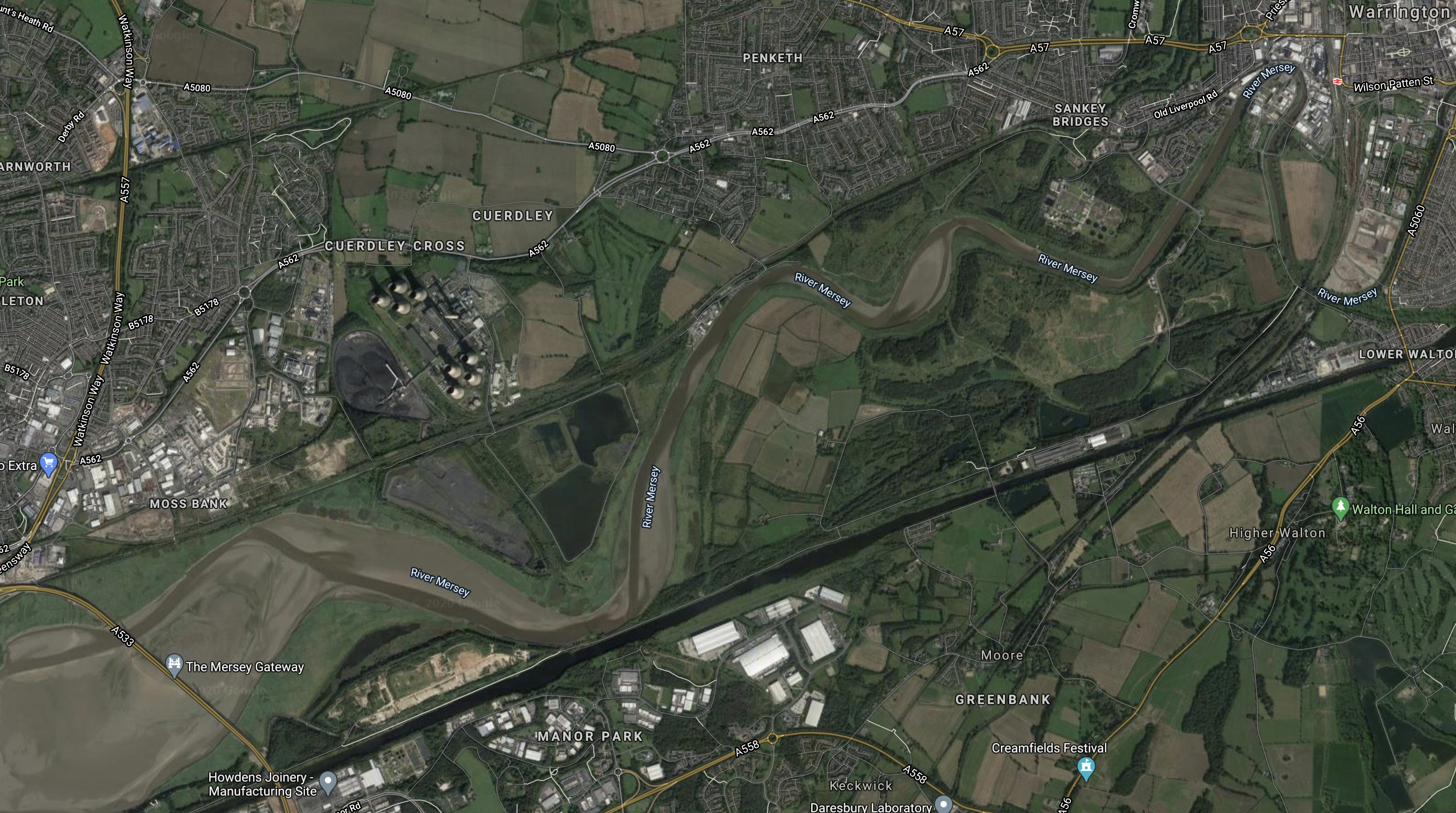
Note.
- Warrington is in the North-East corner of the map, with Warrington Bank Quay station shown by a red station symbol.
- The new Mersey Gateway bridge is in the South-West corner of the map.
- The River Mersey meanders between the bridge and Warrington.
- Fiddlers Ferry power station can be picked out in the nearest meander of the Mersey to the bridge.
- The dark straight line below the river is the Manchester Ship Canal.
- There is currently a freight line on the North bank of the river.
This Google Map shows Fiddlers Ferry power station, with the railway between the now-decommissioned power station and the River Mersey.

Note.
- Fiddlers Ferry will become an employment site.
- It could even be a good place for a depot for Northern Powerhouse Rail.
- I think there’s scope to increase the operating speed of the railway along the Mersey.
Could it even be an electrified high speed line with a 125 mph operating speed?
Between Widnes And Liverpool Lime Street
The trains coming from Warrington could join the Liverpool Branch of the West Coast Main Line at Ditton East Junction.
The route between Ditton East Junction and Liverpool Lime Street has the following characteristics.
- It has four tracks.
- It is 10.6 miles long.
- Avanti West Coast’s expresses typically take twelve minutes for the trip without stopping.
- The stations on the route; Liverpool South Parkway; West Allerton, Mossley Hill and Edge Hill, all have one platform per line.
- It is fully electrified.
- Lime Street station has recently been updated with longer platforms and a higher capacity approach to the station.
- Some local services have already been moved to Merseyrail’s Northern Line.
- Stopping services on the route have their own platforms.
I believe that with the installation of full digital signalling and a degree of automatic train control, as far as Crewe and Warrington Bank Quay stations, that the following services could be handled.
- Six tph – Northern Powerhouse Rail – Liverpool and Manchester Airport and Manchester Piccadilly
- One tph – East Midlands Railway – Liverpool and Nottingham
- Three tph – High Speed Two – Liverpool and London Euston
- One tph – High Speed Two – Liverpool and Birmingham Curzon Street
- Two tph – London North Western – Liverpool and Birmingham and London Euston
Note.
- This is only 13 tph.
- Avanti West Coast services would be replaced by High Speed Two.
- TransPennine Express services would be replaced by Northern Powerhouse Rail
- The Liverpool and Nottingham service may or may not go via Ditton East junction.
If the capacity on this branch could be raised to 15 tph, that would be only be a train every four minutes, or half the frequency, that will eventually be operational on Crossrail and Thameslink. It would also be less than the 18 tph frequency of High Speed Two.
Conclusion
This simple exercise has proven to me, that a high speed line could be built between Manchester Airport and Liverpool Lime Street station.
- Several sections of the route could have an operating speed of 125 mph or more.
- By running the tracks along the M56 and M6, visual and aural intrusion could be minimised.
- The line along the Mersey through Warrington could be a valuable part of the route.
- West of Warrington, much of the infrastructure needed, appears to be in place and it would only need to be upgraded.
There was a large and extremely pleasant surprise at the Liverpool end.
The approach to Liverpool Lime Street is two fast and two slow lines, and I believe, that this section of the route could handle up to say 15 fast trains and six stopping trains per hour, with full digital signalling.
Unlike London and Manchester, I doubt that Liverpool will need a tunnel to access the City Centre.
I also believe that after its refurbishment of the last couple of years, Lime Street could be substantially ready for High Speed Two and Northern Powerhouse Rail.
Project Management Recommendations
This project divides neatly into three.
- Between Manchester Airport and Warrington along the route of the M56 and M6.
- Reconstruction, upgrading and electrification through Warrington and the rebuilding of Warrington Bank Quay station.
- Reconstruction, upgrading and electrification between Warrington and Liverpool.
The first project will be a major one, involving the construction of nearly twenty miles of new electrified railway, with numerous viaducts, bridges and a large junction at High Legh with High Speed Two.
The other two projects would be a lot simpler and would involve turning twenty miles of double-track freight line into a modern electrified railway.
I would construct projects 2 and 3 early in the schedule, as it would give Warrington a new Bank Quay station. A passenger service to Liverpool Lime Street, could also be opened if required.
 The Anonymous Widower