Rail Operations Group Gets Serious About Thunderbirds Etc.
The February 2019 Edition of Modern Railways has an article entitled Class 93 Tri-Oomph!, which has been written by Ian Walmsley.
This is the first paragraph.
Rail Operations Group has become known for the efficient haulage of EMUs around the country using very clever tranlation devices built into Europhenix converted Class 37 kicos. As I described in the March 2016 issue (“Lost in translation”) it looked at tens of millions of pounds worth of EMUs being dragged around unbraked, thought ‘this can’t be right’, and proceeded to make 50-year-old locomotives operate with state-of-the-art computer kit.
Rail Operations Group (ROG) had employed classicdisruptive innovation to create a new market, that was to everybody’s benefit.
As Ian reports, the company has grown a lot in the last few years and now does a lot more than just move new trains around.
- Old trains are also moved.
- Old trains are also stored safely.
- Operations are all planned as a consultancy.
The company is already planning their next operational niche.
A Move Into Logistics
ROG is moving into logistics.
Ian talks about the inefficiency and polluting distribution system using trucks, that add to traffic congestion.
He talks about rail being a better way and then says this.
The difference with ROG is that the company is going to invest in two Class 769 (bi-mode 319s’) converted for parcel use, and while these are not my favourite trains, parcels are a lot less fussy than me about how long they take to get to top speed.
Using 769s’ means that your hubs can be almost anywhere; not necessarily on a 25 KVAC electrified siding, just close to a road system interchange area.
So what happens, if they don’t get a customer? The Class 769 trains will be delivered with seats, so they could be sub-leased for passenger use.
I wrote The Go-Anywhere Express Parcel And Pallet Carrier (HSPT) in May 2017, where I discussed the uses for this type of parcel carrier. This was my conclusion.
There is definitely a market for a HSPT.
If it does come about, it will be yet another tribute to the magnificent Mark 3 design!
As to the secondary use of these trains as passenger trains, there is nothing wrong with that. After all, we’ve all had our fill of the dreaded Rail Replacement Buses.
In Gospel Oak-Barking Fleet Plan Remains Unclear, I talked about the problems caused by late delivery of the new Class 710 trains.
The problem would have been eased, if two Class 769 trains in good condition could have been called up at a couple of days notice.
Surely, there are other applications.
- I suspect that given the number of level-crossing accidents in the UK, they will find a lot of use.
- I don’t think Porterbrook will mind, if ROG effectively offered a try-before-buy service to train operators.
- There must also be a market for pop-up rail services to large sporting and cultural events.
Again, it appears ROG have found a niche and have invested in it.
Before leaving the subject of Class 769 trains, I must mention Brexit.
Could the trains find a use in a no-deal Brexit-world moving high-value freight from ports and airports to inland distribution centres?
Thoughts On The Class 93 Locomotive
These are some thoughts from the article.
Available Power
Ian starts by saying this about the operation of the Class 93 locomotive.
Apart from the obvious electric (4,000kW) and diesel (900kW), the third mode is a Lithium Titanate Oxide (LTO) battery (400kW), which can be used in conjunction with the diesel to give a power boost up to 1,300kW or 1,743hp in old money.
The extra oomph from the battery takes you from a Class 33 to a Class 37 in old locos but with minimal losses, and you don’t need full power for very long on most non-electrified routes.
I suspect there’s a clever control system, that optimises the use of the battery.
The Ultimate Thunderbird
The locomotive appears to have a unique feature of a variable height coupler, which enables it to haul rolling stock with all the five standard heights of coupler, that exist on UK railways.
How did this madness occur?
But as the locomotive can deal with them all, Ian argues that the Class 93 locomotive could be the ultimate Thunderbird or rescue locomotive.
Moving Trains In The Future
Ian argues that ROC’s collection of locomotives used for moving new and replaced trains is getting older and will soon be difficult to service.
The Class 93 locomotives would be ideal for this role.
But Ian sees this very much as a fallback position, if the locomotives do not find innovative new uses.
Ian finishes with this paragraph.
When we first saw Dr. Beeching’s new Freightliners(now ‘intermodal’) in the 1960s, they did 75 mph. They still do, but there are some really smart looking 100 mph flats available. Remember the path-ology. There are plenty of cross-country runs where a Class 37 equivalent is fine for the diesel bits, then pan up and 4,000kW is yours. Come on. Not excited by this? You must be in the wrong job.
As an example some freight trains go between Felixstowe and Birmingham, Liverpool or Manchester using the North London Line.
They are hauled all the way by a Class 66 diesel.
Put the containers on the smart looking 100 mph flats with a Class 93 locomotive on the front and the following happens.
- The locomotive uses diesel between Felixstowe and Ipswich, with possibly some battery boost.
- The locomotive uses electric power for most of the journey.
- The locomotive might use diesel power at the destination for a short distance.
- On the double-track 100 mph Great Eastern Main Line, the operating speed will not be far off the new Class 745 and Class 720 trains.
- On the North London Line, the train will pass through some of the smartest parts of North London with lower levels of noise, vibration and pollution.
- On the West Coast Main Line, the train will be able to mix it with the new Class 730 trains on the slow lines.
Greater Anglia have the trains to run more services between London and Ipswich.
How many more could they squeeze in, if all freight trains had a similar performance to their express services?
Consider now, freight trains taking the cross-country route from Felixstowe to the North and Midlands via Peterborough.
- With track improvements at Haughley and doubling of the line between Kennett and Ely, I suspect that timings on the flat lands of East Anglia using hybrid power would be approaching those of Class 66 locomotive-hauled stock.
- With a faster cruise on the East Coast Main Line, would the trains take the direct route on the slow lines, rather than the diversion through Lincoln?
The Class 93 locomotive could be the ultimate Felixstowe Flyer.
Could it also be the freight locomotive that passenger train operators want reight operators to use, as it keeps freight trains out of the way of passenger ones?
Routes For Bombardier’s 125 Mph Bi-Mode Aventra
This article in Rail Magazine, is entitled Bombardier Bi-Mode Aventra To Feature Battery Power.
A few points from the article.
- Development has already started.
- Battery power could be used for Last-Mile applications.
- The bi-mode would have a maximum speed of 125 mph under both electric and diesel power.
- The trains will be built at Derby.
- Bombardier’s spokesman said that the ambience will be better, than other bi-modes.
- Export of trains is a possibility.
Bombardier’s spokesman also said, that they have offered the train to three new franchises. East Midlands, West Coast Partnership and CrossCountry.
These are my thoughts on these franchises.
Bi-Mode And Pure Electric
I’m pretty certain that if you want to create a 125 mph bi-mode train, you start with a 125 mph electric train, if you want a high degree of commonality between the two trains.
Hitachi have a whole family of Class 800 trains, each of which has a different specification for the diesel power. Even the pure-electric Class 801 trains, has one diesel engine for emergencies.
An electric train with batteries could be very efficient, if the batteries were used to handle regenerative braking and boost the trains, where more power is required.
East Midlands
It is no surprise that Bombardier are talking to the groups, that are bidding to become the new franchise holder for the East Nidlands, when it is awarded in April 2019.
They wouldn’t want to see another company’s product roaring past the factory.
The proposed bi-mode Aventra will probably have been designed very much with the Midland Main Line in mind.
- The Midland Main Line will be electrified from St. Pancras to Kettering and Corby.
- Will the fast lines be electrified to Glendon Junction, where the Corby Branch joins the Midland Main Line?
- The route between St. Pancras and Glendon Junction is being upgraded to four tracks, with as much 125 mph running as possible.
- The non-stop nature of Midland Main Line services South of Kettering could be significant.
- North of Kettering, there is currently no electrification.
- The development of Toton station for HS2 is being accelerated and there could be an island of electrification here, by the mid-2020s.
- If HS2 shares the Midland Main Line corridor between Toton and Sheffield, this section could be electrified by the late-2020s.
Over the next decade, there will be more electrification and a greater proportion of the route, where 125 mph running will be possible.
There has been a bit of controversy, that the number of stops the franchise will make at Bedford and Luton is being reduced after May this year.
The reason given is that it will enable faster services to Derby, Nottingham and Sheffield.
North To Derby, Nottingham and Sheffield
Consider a bi-mode train with batteries going North.
- Between St. Pancras and Kettering, it will be at 125 mph for as long as possible.
- The train will also ensure that at Kettering, it has the batteries brim full, sfter charging from the electrification.
- After a stop at Kettering station, if the electrification reached to Glendon Junction, the acceleration would all be electrically-powered.
- Whether it stopped at Kettering or not, the train would pass Glendon Junction at line speed with full batteries.
It’s almost as if the electrification is being used as a catapult to speed the train North.
South From Derby, Nottingham and Sheffield
Being as electrically efficient coming South would be a lot more difficult.
- I suspect that train batteries will be charged at Derby, Nottingham and Sheffield, so they start their journey South with full batteries.
- Using a full battery and assistance from the onboard generator, trains would be accelerated away from the terminii.
- The trains computer would select automatically, whether to use battery or onboard generator power and would harvest all the power from regenerative braking.
- At each stop on the journey, energy would be lost, as regenerative braking systems do not are only between seventy and ninety percent efficient.
- Once at Glendon Junction, the train would raise the pantograph and switch to getting power from the overhead wires.
It’s all about a well-programmed computer on the train, which knows the route, the timetable and battery state so it can switch power sources appropriately.
Electrification
On the other hand, electrification around Toton could make everything easier and more efficient.
With electrification, every little helps.
- Modern trains can raise and lower pantographs, quickly and automatically.
- Faster journeys.
- Lower carbon emissions.
- Less noise and vibration from diesel generators.
Everyone’s a winner.
Oakham To Kettering
The Oakham-Kettering Line to Corby station is being electrified, double-tracked and I suspect speed limits will be raised.
Speed limits are also being raised and track improvements are being done, South of Glendon Junction.
Currently, services take seventy minutes. With the 125 mph Aventras on the route, they will not need to use the onboard generator, but surely the journey time could be reduced to under an hour, which would attract passengers and need less trains to run a two trains per hour (tph) service.
The Oakham Problem
Oakham station is in the middle of the town, as this Google Map shows.

The Department for transport would like to see more services to the town and the next station of Melton Mowbray.
But the line through the station is busy with freight trains and there is a level crossing in the middle of the town.
125 mph bi-mode trains, won’t help with the problem of Oakham.
Joining And Splitting Of Trains
There is also the possibility of joining and splitting trains.
Hitachi’s Class 800 trains can do this and I’m sure bi-mode Aventras will be able to do this automatically.
There is only four platforms available for trains on the Midland Main Line at St. Pancras and regularly two trains occupy one platform.
The ability to run a pair of bi-mode trains, that joined and split could be a great asset.
Liverpool To Norwich
This long route is an important one for those, who live near its stations. It is usually served by one or two Class 158 trains, which are often very crowded.
The route is partially electrified.
- Liverpool to Hunts Cross
- Manchester Oxford Road to Stockport
- Grantham to Peterborough
- Around Ely
- Around Norwich
So there should be plenty of places to raise the pantograph and charge the batteries.
It is a typical long-distance route for the UK and I’m sure it would benefit from 125 mph bi-mode Aventras.
West Coast Partnership
Bids for the West Coast Partnership, which will run services on the West Coast Main Line and HS2, will be submitted by July 2018. The winning bidder will be announced in May 2019 and take over services two months later.
A modern 125 mph bi-mode would be an ideal replacement for the current twenty Class 221 trains, that work on the West Coast Main Line.
These Class 221 trains are.
- Diesel powered.
- Five-cars long.
- Built in 2001-2002 by Bombardier.
- 125 mph capable.
- Some services are run by splitting and joining trains.
But most importantly, most services are run substantially under wires.
New 125 mph bi-mode trains would certainly improve services.
- Several of the current services operated by Class 221 trains, would become electric ones.
- How much faster would they be able to run a service between London Euston and Holyhead?
- They would also be able to run new services to places like Barrow. Blackburn and Huddersfield.
- Five cars could be a convenient train size for the operator.
But above all, they would offer a better passenger experience, with less noise and vibration from the diesel engines.
The longest section of running using onboard power of a bi-mode Aventra will be along the North Wales Coast Line to Holyhead.
- The line has an 90 mph operating speed.
- The line is 85 miles long.
- The gradients won’t be too challenging, as the line runs along the coast.
- Services stop up to half-a-dozen times on the route.
- From London to Crewe is electrified.
- The section between Crewe and Chester may be electrified.
It looks to be an ideal route for a 125 mph bi-mode Aventra.
As the route appears to not be as challenging as the Midland Main Line, could this route, be the ideal test route for a hydrogen fuel-cell powered Aventra.
West Coast Partnership may well have plans to use 125 mph bi-mode trains as feeder services for HS2’s hubs at Birmingham and Crewe.
I could certainly see West Coast Partnership ordering a mixed fleet of 125 mph Aventras, some of which would be bi-modes and some pure electric.
CrossCountry
CrossCountry has a diverse portfolio of routes, which have every characteristic possible.
- Some are lines with a 125 mph operating speed.
- Some are electrified with 25 KVAC overhead wires.
- Some are electrified with 750 VDC third-rail.
- Some are not electrified.
A bi-mode train with these characteristics would fit well.
- 125 mph capability on both electric and diesel power.
- Battery power for short branch lines.
- Modern passenger facilities.
- Five-cars.
- Ability to work in pairs.
They could actually go for a homogeneous fleet, if they felt so inclined.
That would be a substantial fleet of upwards of fifty five-car trains.
The new CrossCountry franchise will be awarded in August 2019 and start in December 2019.
Other Routes
If the 125 bi-mode Aventra with batteries is built, there could be other routes.
Borders Railway
Why would you run a 125 mph bi-mode Aventra on the 90 mph Borders Railway?
- The Borders Railway will be extended to Carlisle, which will mean, that both ends will be electrified for a few miles.
- This will mean that bi-mode trains with batteries could charge their batteries at both ends of the line.
- If traffic increases, extra cars can be added.
- The trains would be able to use the West Coast Main Line to link the Lake District to Edinburgh.
- They could be given a tourism-friendly interior, to go with the large windows common to all Aventras.
The trains would help to develop tourism in the South of Scotland and the North of England.
East West Rail
The East West Rail between Oxford and Cambridge is going to built without electrification.
- But that doesn’t mean that it should be built with an operating speed in the region of 90 mph!
- The legendary InterCity 125s have been running on lines without electrification at 125 mph since the late 1970s, so it isn’t an unknown practice.
So if the line were to be built for high speed across some of the flattest parts of England, why not unleash the 125 mph bi-mode Aventras?
They could serve Ipswich, Norwich and Yarmouth in the East using their onboard generators.
They could serve Bournemouth, Bristol, Reading and Southampton, if the trains had a dual-voltage capability.
They could use electrification at Bedford, Bletchley, Cambridge and Reading to charge the batteries.
Settle-Carlisle Line
Surely, if the 125 mph bi-mode Aventras are suitable for the Borders Railway, then it should be able to work the Settle-Carlisle Line.
- Both ends of the line are electrified, so batteries could be charged.
- The line needs more and better services.
But the main reason, is that there will be a high-class scenic route between Edinburgh and Leeds.
I estimate that a London to Edinburgh service via Leeds, Settle, Carlisle and the Borders Railway would take six and a half hours, using a 125 mph bi-mode Aventra.
Some tourists love that sort of trip.
Waterloo To Exeter
The West of England Line has the following characteristics.
- It runs between Basingstoke and Exeter.
- It is a hundred and twenty miles long.
- It has a 90 mph operating speed.
- The line is not electrified.
- It is connected to the electrified South Western Main Line to Waterloo.
- The route is electrified between Waterloo and Basingstoke.
- Direct trains take three hours twenty-three minutes between Waterloo and Exeter, with fourteen stops between Basingstoke and Exeter.
- The trains used on the route are twenty-five year-old Class 159 trains.
Would a 125 mph bi-mode Aventra improve the passenger service between Waterloo and Exeter?
- The Aventras are built for fast dwell times at stations, so there could be time saving with all those stops.
- The Aventras could use the third-rail electrification between Waterloo and Basingstoke.
- There may be places, where the operating speed can be increased and the faster Aventras would take advantage.
- The trains could have a passenger-friendly interior and features designed for the route.
The real benefits for South Western Railway and their passengers would come, if the trains could do Waterloo to Exeter in three hours.
Routes For A Pure-Electric Version
There are several routes in the UK, where the following apply.
- Some long-distance trains are run by 125 mph trains.
- The route is fully- or substantially-electrified.
- A proportion of the route allows 125 mph running.
- Sections of the route is only double-track.
Routes satisfying the criteria include.
- The West Coast Main Line
- The East Coast Main Line
- The Great Western Main Line
- The Midland Main Line
On these routes, I believe it would be advantageous, if all passenger trains were capable of operating at 125 mph.
This is cause if all trains were running at 125 mph, they could be more closely spaced, thus increasing capacity.
Digital signalling would probably be needed.
There are several train services,, that use the electrified 125 mph sections of these routes.
Birmingham/Liverpool/Manchester To Edinburgh/Glasgow
TransPennine Express, are replacing their current Siemens 110 mph Class 350 trains on this service, with new CAF 125 mph Class 397 trains.
Euston To The West Midlands, Liverpool And Preston
West Midland Trains are replacing some of their current Siemens 110 mph Class 350 trains with new Aventras.
Information is scarce at the moment, but could some of these new Aventras be 125 mph units for working on the West Coast Main Line?
Leeds/York To Edinbugh
TransPennine Express run trains on this route.
St. Panvras To Corby
The Corby Branch is being upgraded.
- Double-track
- 125 mph running
- Electrification
The section of the Midland Main Line between St. Pancras and Glendon Junction is also being upgraded to allow as much 125 mph running as possible.
If 125 mph bi-mode trains are to be used from St. Pancras to Derby, Nottingham and Sheffield, then surely, it would be logical to use a pure-electric version of the train between St. Pancras and Corby?
Various documents and web pages say, that the St. Pancras to Corby services are going to be worked by 110 mph Class 387 trains. Surely, faster 125 mph trains, which had been designed for the route would be better for passengers and the train operating company.
From my experience of scheduling, the section of the Midland Main Line between St. Pancras and Bedford, must be a nightmare to timetable successfully.
- There are two train operating companies using the route, who go a hundred miles in different directions.
- The Class 700 trains used by Thameslink are only 100 mph trains, so probably can’t use the fast lines too often, as if they do, they’ll delay the expresses..
- Regular passengers object to any change in stopping patterns or journey times.
- Passengers liked to get on express services at Bedford, but they now don’t stop.
- Passengers don’t like the Class 700 trains.
- Luton Airport wants more services.
My experience, says that something radical must be done.
Consider.
- Plans are for two tph between St. Pancras and Corby.
- How many passengers would complain if they ended up in the St. Pancras Thameslink platforms, rather than the high-level ones? They’re both equally badly connected to the Underground, buses and taxis.
- There will be four tph between Bedford and London all day on Thameslink, with an extra four tph in the Peak.
- Some or all of these services will call at both Luton and Gatwick Airports.
- Looking at the two semi-fast services. which both run at tw trph, they seem to stop virtually everywhere.
I think it would be possible for the two tph St. Pancras to Corby services to become express services between Corby, Gatwick Airport and Brighton.
- The services would only stop at Kettering, Bedford, Luton, Luton Airport Parkway, St. Albans, West Hampstead Thameslink, St. Pancras Thameslink, Farringdon, City Thameslink, Blackfriars, London Bridge and East Croydon.
- The services would use the 125 mph fast lines North of St. Pancras, as much as possible.
- Corby services would always call at St. Pancras Thameslink.
- The trains would be designed for both Airport services and long-distance commuting.
- The trains would be maximum length.
Obviously, this is my rough idea, but something like it might satisfy the stakeholders, more than what is proposed.
I think there are also other services, which are fully electrified, which could be upgraded, so that they would be suitable for or need 125 mph electric trains.
Kings Cross To King’s Lynn
I wrote about this route in Call For ETCS On King’s Lynn Route.
Portsmouth Direct Line
Under Topography Of The Line in the Wikipedia enter for the Portsmouth Direct Line, this is said.
The central part of the route, from Guildford to Havant, runs through relatively thinly populated country. The line was designed on the “undulating principle”; that is, successive relatively steep gradients were accepted to reduce construction cost. In the days of steam operation this made the route difficult for enginemen.
But with.
- A second man in the cab, in the shape of the train’s computer, juggling the power.
- Regenerative braking to the batteries saving energy for reuse when needed.
- Bags of grunt from the traction motors.
The pure electric version of the 125 mph Aventra might just have the beating of the topography.
South Western Railway plan to introduce an older train from Litchurch Lane in Derby on this route, in the shape of the last of the Mark 3s, the Class 442 train or the Wessex Electrics, which were built in the 1980s.
It will be interesting to see how a 125 mph pure electric Aventra compares to something made in the same works, thirty years earlier.
Waterloo To Southampton, Bournemouth and Weymouth
The South Western Main Line goes to Southampton Central, Bournemouth and Weymouth.
- It is a 100 mph line
- It is fully-electrified.
Would a 125 mph pure-electric Aventra be able to put the hammer down?
I’m sure Network Rail can improve the line to a maximum safe line-speed.
Conclusion
If Bombardier build a 125 mph bi-mode Aventra with batteries, there is a large market. Especially, if there is a sibling, which is pure electric.
Bombardier Bi-Mode Aventra To Feature Battery Power
The title of this post is the same as this article in Rail Magazine.
A few points from the article.
- Development has already started.
- Battery power could be used for Last-Mile applications.
- The bi-mode would have a maximum speed of 125 mph under both electric and diesel power.
- The trains will be built at Derby.
- Bombardier’s spokesman said that the ambience will be better, than other bi-modes.
- Export of trains is a possibility.
Bombardier’s spokesman also said, that they have offered the train to three new franchises. East Midlands, West Coast Partnership and CrossCountry.
In some ways, I am not surprised about what is said in this article.
Another article on Christian Wolmar’s web site, is entitled Bombardier’s Survival Was The Right Kind Of Politics.
This is said.
Bombardier is not resting on its laurels. Interestingly, the company has been watching the problems over electrification and the fact that more of Hitachi’s new trains will now be bi-mode because the wires have not been put up in time. McKeon has a team looking at whether Bombardier will go into the bi-mode market: ‘The Hitachi bi-mode trains can only go 110 mph when using diesel. Based on Aventra designs, we could build one that went 125 mph. This would help Network Rail as it would not have to electrify everywhere.’ He cites East Midlands, CrossCountry and Wales as potential users of this technology.
The article was published in February 2017 and mentions, 125 mph on diesel and two of the companies in the recent article.
The Design Of The Trains
My thoughts are as follows.
The Starting Point
I’m pretty certain that if you wanmt to create a 125 mph bi-mode train, you start with a 125 mph electric train, if you want a high degree of commonality between the two trains.
Bombardier haven’t yet built any of their Aventras for West Midland Trains, but as they will use the West Coast Main Line extensively, will they be 125 mph trains and not 110 mph trains, as is said in Wikipedia?
Aventras And Battery Power
I will believe until Bombardier say I’m wrong, that Crossrail’s Class 345 trains, which are Aventras, use batteries for the following purposes.
- To handle regenerative braking.
- To limp the train out of the tunnel or to the next station or safe exit point, if there should be a catastrophic power failure.
- To lessen the amount of electricity fed to the trains in the tunnels.
- To allow features like remote wake-up, which need a train to have some form of power at all times.
- To move trains in sidings and depots without having live electrification.
- To run passenger features, when the power fails.
Effectively, the Class 345 trains have electricity as a main power source and batteries for energy storage and a secondary or emergency power source.
I talked to one of their staff, who was training drivers on Crossrail’s Aventras. The conversation went something like this.
- Me: “What happens, when the Russians hack the power supply?”
- Driver-Trainer: “We switch the train to emergency power!”
- Me: “You mean batteries?”
- Driver-Trainer: (Pause, then something like) “Might be!”
Can anybody think of another way to have emergency power on the train?
Electric Traction, Regenerative Braking and Batteries
Bi-mode trains and Alstom’s hydrogen-powered Coradia iLint are electrically powered at all times.
This means that under electric, diesel or hydrogen power, the traction motors can generate electricity to brake the train.
On an electric train, this electricity is returned through the overhead wire or third rail to power other nearby trains. This electricity could also be stored in an onboard battery, just as it is in a hybrid or battery-electric vehicle.
Driving A Bi-Mode Train With Batteries
The bi-mode Aventra could have electricity from one of four power sources.
- 25 KVAC overhead electrification.
- 750 VDC third-rail electrification.
- An onboard electricity generator powered by diesel fuel or hydrogen.
- Batteries
So will the driver need to keep switching power sources?
I am a Control Engineer by training and optimising the best power to use is a typical problem for someone with my training and experience.
The train’s computer would take all the information about the route, timetable, signal settings, battery charge level, train loading, weather and other factors and drive the train automatically, with the driver monitoring everything thoroughly.
Aircraft have been flown in a similar fashion for decades.
I look in detail, at the mathematics of a bi-mode Aventra with batteries in Mathematics Of A Bi-Mode Aventra With Batteries.
I came to the following conclusions.
I am rapidly coming to the conclusion, that a 125 mph bi-mode train is a practical proposition.
- It would need a controllable hydrogen or diesel power-pack, that could deliver up to 200 kW
- Only one power-pack would be needed for a five-car train.
- For a five-car train a battery capacity of 300 kWh would probably be sufficent.
From my past professional experience, I know that a computer model can be built, that would show the best onboard generator and battery sizes, and possibly a better operating strategy, for both individual routes and train operating companies.
Obviously, Bombardier have better data and more sophisticated calculations than I do.
Note, that everything I proposed, is well within the scope of modern engineering, so other companies like CAF and Stadler, who are actively involved in rail application of battery technology, could join the party.
This picture is a visualisation of a Stadler Class 755 train, which they are building for Greater Anglia.
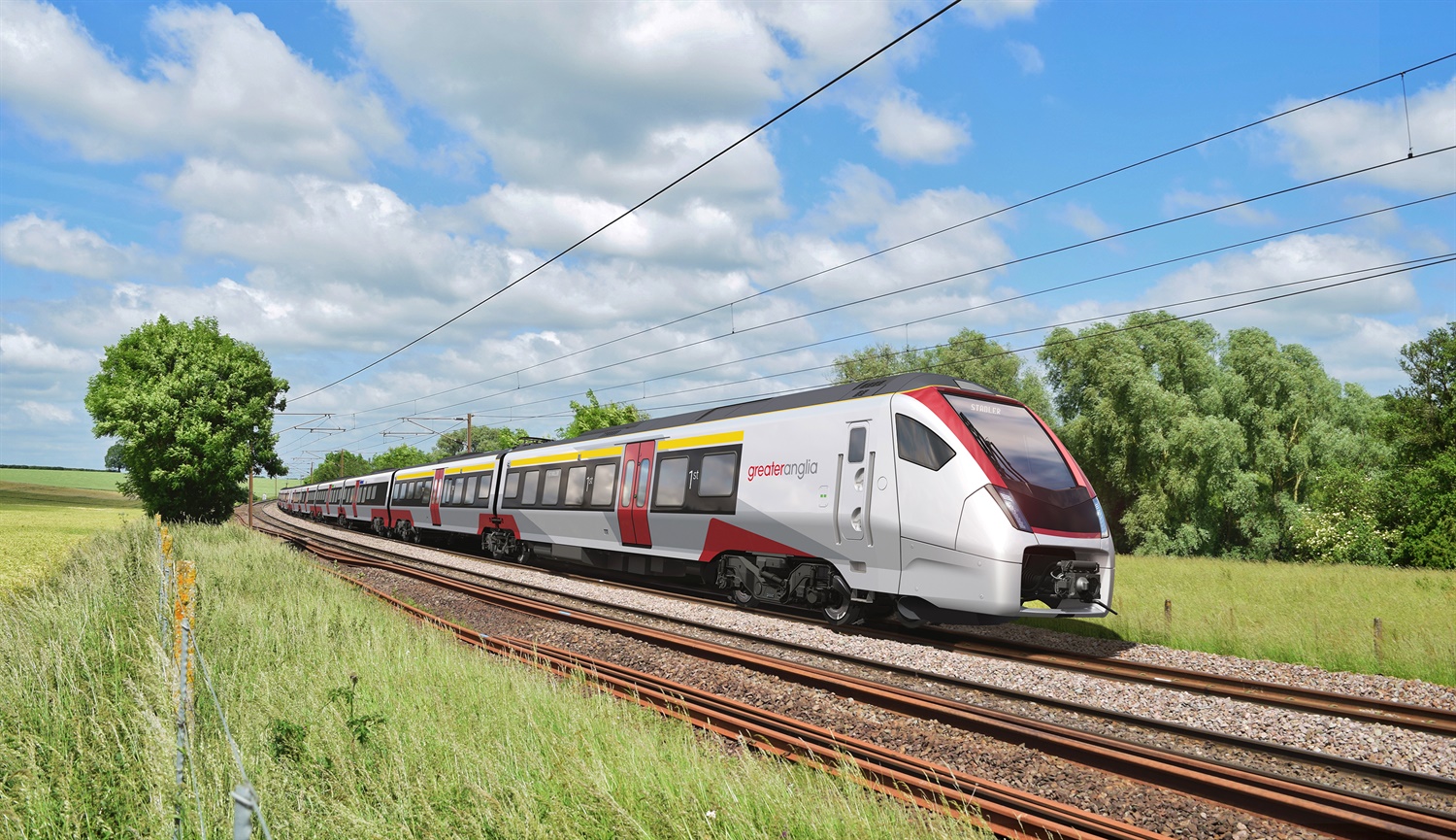
Note the smaller third car, which contains the diesel engine of this hybrid train. Is there room for batteries as well?
I can’t find any information on the web about the power train of the Class 755 train, but this article in the Railway Gazette, describes another Stadler bi-mode Flirt, that Stadler are building for Italy.
This is said.
The units will be rated at 2 600 kW with a maximum speed of 160 km/h when operating from 3 kV DC electrification, and 700 kW with a maximum speed of 140 km/h when powered by the two Stage IIIB compliant Deutz TCD 16.0 V8 diesel engines.
There is provision to add up to two more cars if required to meet an increase in ridership. Two more engines could be added, or the diesel module removed if only electric operation is needed.
Note.
- The Deutz diesel engines are rated at 520 kW.
- As 700 kW is the power of the train, I suspect each engine generator creates 350 kW of power.
- 160 km/h would be ideal for the Great Eastern Main Line
- 140 km/h would be more than adequate for roaming around East Anglia
I suspect that if batteries were used on this train, that the engines would be smaller.
We will see in May 2019, when the trains enter service.
Diesel Or Hydrogen Generator
Electricity generation using a diesel generator and electricity generator from a hydrogen fuel cell, each have their own advantages.
- Diesel fuel has a higher energy density than hydrogen
- Diesel engines create a lot of noise and vibration and emit carbon dioxide, noxious gases and particulates.
- Hydrogen fuel cells can be silent and only emit water and steam.
- Ballard who are a Canadian company and a leading manufacturer of hydrogen fuel-cells, manufacture one for use in rail applications which has an output of 100 kW, that weighs 385 Kg.
- MTU make the diesel engine for a Class 800 train, which has an output of over 600 kW, that weighs 5000 Kg.
- Hydrogen storage is probably heavier and more complicated than diesel storage.
- Both generators can be fitted into convenient rectangular power packs.
I would envisage that in the future, hydrogen electricity generators will get more efficient, lighter in weight and smaller in size for a given power output.
I don’t think it is unreasonable to believe, that within a reasonable number of years, hydrogen generators and their hydrogen storage tank, will be comparable in weight and size to current diesel generators and fuel tanks.
Accelerating A Bi-Mode Train With Batteries
The major use of electricity on a 125 mph train, will be in accelerating the train up to line speed. The energy needed will be.
- Proportional to the mass of the train. This is why your car accelerates better, when it’s just you in the car and you don’t have your overweight mother-in-law in the back.
- Proportional to the square of the velocity.
I have calculated that a five-car bi-mode Aventra, carrying 430 passengers and travelling at 125 mph, will have a kinetic energy of 91.9 kWh.
Obviously, using electricity from electrification is the best way to accelerate a train.
- Electricity from electrification is probably cheaper and more convenient, than that from an onboard electricity generator.
- If diesel is not used to power the train, there is no noise and vibration from an onboard diesel generator.
- A route with a lot of running on onboard fuel, means more fuel has to be carried.
Using electricity stored in batteries on the train, is also a good way to accelerate a train, but the batteries must have enough charge.
The onboard electricity generator will be used, when there is no electrification and the power stored in the batteries is approaching a low level.
|When Bombardier’s spokesman says, that the ambience will be good, control of the train’s power sources has a lot to do with it.
Could he have been hinting at hydrogen, as hydrogen fuel cells do not have high noise and vibration levels?
Cruising A Bi-Mode Train With Batteries
Newton’s First Law states.
Every body continues in its state of rest or uniform motion in a straight line, unless impressed forces act on it.
If you have a train on a railway track moving at a constant speed, the following forces are acting to slow the train.
- Aerodynamic forces, particularly on the front of the train.
- Rolling friction of the steel wheel on a steel rail.
- Bends and gradients in the track.
- Speed limits and signals.
So the driver and his control system will have to feed in power to maintain the vrequired spreed.
I have sat on the platform at Stratford, whilst an Aventra has gone past at speed. I wrote about it in Class 345 Trains Really Are Quiet!
This was my conclusion.
Bombardier have applied world class aviation aerodynamics to these trains. Particularly in the areas of body shape, door design, car-to-car interfaces, bogies and pantographs.
Remember too, that low noise means less wasted energy and greater energy efficiency.
In addition steel wheel on steel rails is a very efficient way of moving heavy weights. Bombardier have a reputation for good running gear.
Once a train has reached its cruising speed, appropriate amounts of power will be fed to the train to maintain speed.
But compared to the power needed to accelerate the train, they could be quite small.
For small amounts of power away from electrification, the control system will use battery power if it is available and can be used.
The onboard electricity generator would only be switched in, when larger amounts of power are needed or the battery power is low.
Slowing A Bi-Mode Train With Batteries
The regenerative braking will always be used, with the energy being stored in the batteries, if there is free capacity.
Imagine the following.
- A bi-mode making a stop at Leicester station on the Midland Main Line.
- It is doing 100 mph before the stop on the main line.
- It will be doing 100 mph after the stop on the main line.
The energy of the train after Leicester will be roughly the same as before, unless the mass of the train has changed, by perhaps a large number of passengers leaving or joining the train.
Let’s assume that the energy at 100 mph in the train is X kWh
- When the train brakes for Leicester this energy will be transferred to the train’s batteries, if there is capacity.
- On accelerating the train, it will need to acquire X kWh. It couldn’t get all of this from the batteries, as for various reasons the overall efficiency of this sort of system is about seventy to ninety percent.
- The onboard electricity generator will have to supply a proportion of the energy to get the train back up to 100 mph.
But in a diesel train it will have to supply all the energy to get back to 100 mph.
Where Would I Put The Batteries?
Aventras seem to have a lot of powered-bogies, so to keep cable runs short to minimise losses and maximise the efficiency of the regenerative braking, I would put a battery in each car of the train.
This would also distribute the weight evenly.
Where Would I Put The Electricity Generators?
Diesel engines always seem to be noisy, when they are installed under the floor of a train. I’ve travelled a lot in Bombardier’s Turbostars and although they are better than the previous generation, they are still not perfect.
I’ve also travelled in the cab of a Class 43 locomotive, with a 2,250 hp diesel engine close behind me. It was very well insulated and not very noisy.
As I said earlier, the most intensive use of the onboard generators will come in accelerating a train to operating speed, where no electrification or battery power is available. There is only so much you can do with insulation!
Stadler, who are building the Class 755 train for Greater Anglia, have opted to put a short diesel generator car in the middle of the train.
This was an earlier train, where Stadler used the technique.
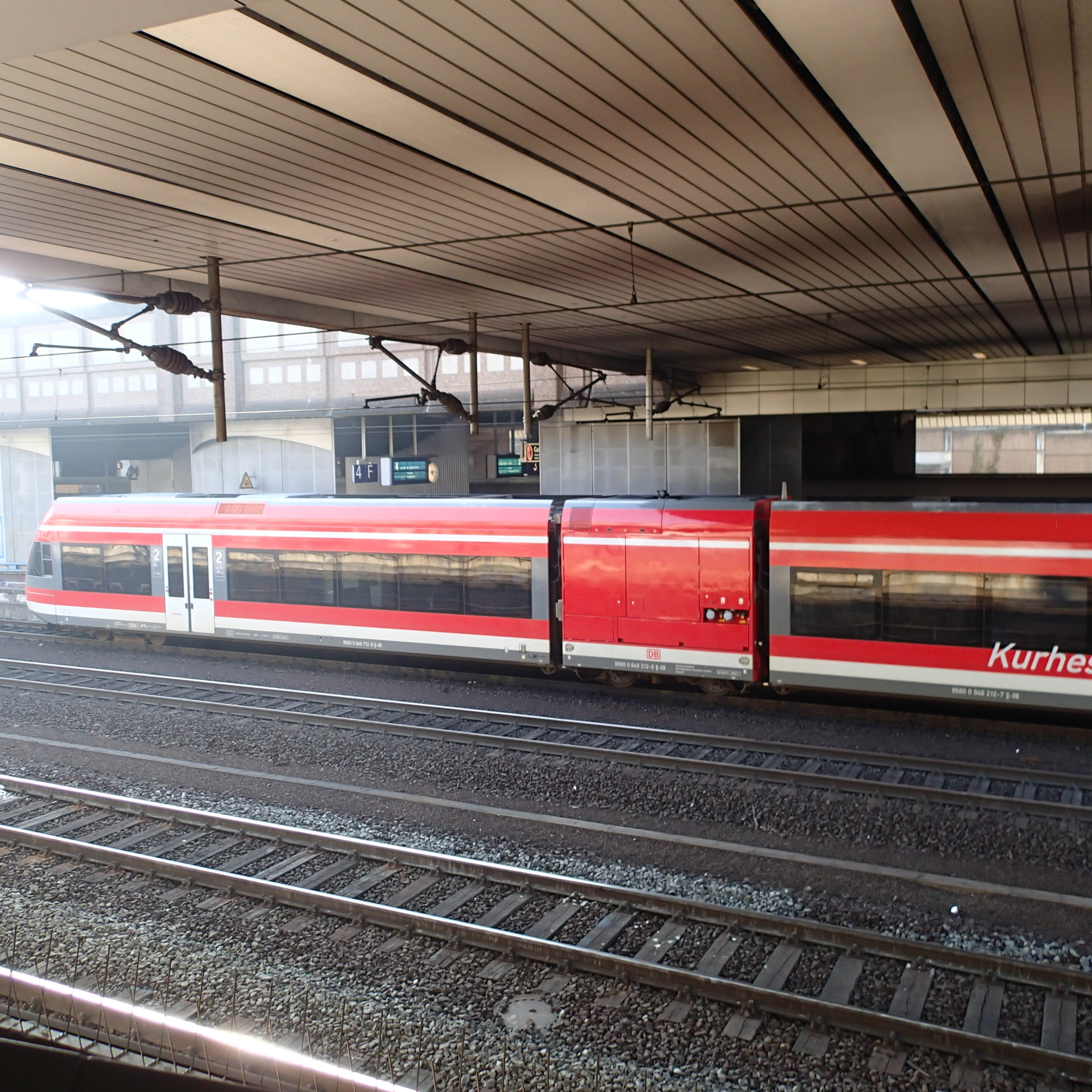
There are reports in Wikipedia, that the ride wasn’t good, but I’m sure Stadler has cracked it for their new 100 mph bi-mode trains.
Creating a bi-mode by adding an extra motor car into the middle of an electric train could be a serious way to go.
- The dynamics are probably better understood now
- A powerful diesel engine could be fitted.
- Batteries could be added.
- Insulating passengers and staff from the noise and vibration would surely be easier.
- There could be a passage through the car, to allow passengers and staff to circulate.
In an ideal world, a four-car electric train could be changed into a five-car bi-mode train, by adding the motor car and updating the train software.
In Mathematics Of A Bi-Mode Aventra With Batteries, I came to the conclusion, that if the batteries are used in conjunction with the power-pack, that a single power-pack of about 200 kW could be sufficient to power the train. This would be smaller and lighter in weight, which would probably mean it could be tucked away under the floor and well-insulated to keep noise and vibration from passengers and staff.
In this article in Global Rail News from 2011, which is entitled Bombardier’s AVENTRA – A new era in train performance, gives some details of the Aventra’s electrical systems. This is said.
AVENTRA can run on both 25kV AC and 750V DC power – the high-efficiency transformers being another area where a heavier component was chosen because, in the long term, it’s cheaper to run. Pairs of cars will run off a common power bus with a converter on one car powering both. The other car can be fitted with power storage devices such as super-capacitors or Lithium-ion batteries if required.
This was published six years ago, so I suspect Bombardier have refined the concept.
So could it be that Bombardier have designed a secondary power car, that can be fitted with a battery and a diesel engine of appropriate size?
- Using a diesel engine with batteries means that a smaller engine can be used.
- The diesel engine could also be replaced with a 200 kW hydrogen fuel cell.
I won’t speculate, but Bombardier have a very serious idea. And it’s all down to the mathematics.
What Would Be The Length Of A 125 Mph Bi-Mode Aventra?
Long distance Aventras, like those for Greater Anglia and West Midlands Trains, seem to be five and ten car trains.
This would fit well with the offerngs from other companies, so I suspect five- and ten-cars will be the standard lengths.
Could There Be A Bi-Mode Aventra for Commuter Routes?
The London Overground has ordered a fleet of four-car Class 710 trains.
The Gospel Oak to Barking Line is being extended to a new Barking Riverside station.
In an article in the October 2017 Edition of Modern Railways, which is entitled Celling England By The Pound, Ian Walmsley says this in relation to trains running on the Uckfield Branch, which probably has a terrain not much different to the lines to London.
A modern EMU needs between 3 and 5 kWh per vehicle mile for this sort of service.
The new extension is about a mile, so this would need 20 kWh each way.
This could easily be done with a battery, but supposing a small diesel engine was also fitted under the floor. Would anybody notice the same 138 kW Cummins ISBe diesel engine that is used in a New Routemaster hybrid bus?
I doubt it.
It is a revealing to calculate the kinetic energy of a fully-loaded Class 710 train. I estimate that it under 50 kWh, if it was travelling at 90 mph, which would rarely be achieved on the Gospel Oak to Barking Line.
Could Bombardier Be Serious About Exporting Bi-Mode Aventras?
In my opinion, the Aventra is a good train an it seems to sell well in its electric form to train operating companies in the UK.
But would it sell well in overseas markets like the United States and Canada, India and Australia?
They obviously know better than I do, so we should take their statements at face value.
The Prospective Customers
The Rail Magazine article mentions three prospective customers.
I deal with them and other possiblilities in Routes For Bombardier’s 125 Mph Bi-Mode Aventra.
This was my conclusion.
If Bombardier build a 125 mph bi-mode Aventra with batteries, there is a large market.
It looks like the company has done a lot of research.
Conclusion
Bombardier are designing a serious train.
MP Calling For Borders Link To High-Speed Rail Network
The title of this post, is the same as that of this article in the Southern Reporter.
My feeling is that I don’t think the MP should worry about this one.
Consider.
- When High Speed 2 opens to Crewe in 2027, London to Glasgow trains will take under four hours.
- The West Coast Main Line will be improved between Carlisle and Glasgow.
- Freight traffic between England and Scotland is increasing.
- A large freight interchange could be built at Longtown.
- Increased services between Liverpool/Manchester and Edinburgh/Glasgow are starting.
- Carlisle station is being refurbished.
All this will lead to more through traffic at Carlisle.
I would think it would be extremely likely, that the West Coast Main Line between Carlisle and Longtown will be improved substantially.
If this happens, then any extension of the Borders Railway will have a fast link to HS2 at Carlisle, from where it will probably join the West Coast Main Line in the Longtown area.
It should also be noted, that High Speed 2 is being designed to give benefits to as many places as possible.
A Borders Railway connected to Carlisle fits this strategy.
Should Crossrail Be Extended From Old Oak Common?
In How Will Chiltern Railways Serve Old Oak Common?, I looked at the possibilities of how Chiltern Main Line services will use the Old Oak Common station complex as an additional London terminus to ease the overcrowding at Marylebone station.
In Will Crossrail Go Up The West Coast Main Line?, I looked at why the extension of Crossrail to Milton Keynes was announced and then cancelled as it was thought to be bad value for money.
But is the general principle of extending Crossrail from Old Oak Common onto a new branch or branches a good idea?
Crossrail Revenue And Profit
If you’re running any railway, you get the highest revenue by running as many trains as you can and making sure that they are full with passengers all the time.
The Central Section of Crossrail between Stratford and Paddington stations will be very heavily used, as it will have to handle the following passenger flows.
- Passengers from the Abbey Wood Branch going to and from Central London
- Passengers from Heathrow going to and from Central London
- Passengers from the Reading Branch going to and from Central London
- Passengers from the Shenfield Branch going to and from Central London
- Passengers from National Rail services at Liverpool Street going to and from Central London
- Passengers from National Rail services at Paddington going to and from Central London
In addition it will also be used as an extra Underground line in Central London
The Central Section will be a cash cow for the Crossrail operator!
The various branches to and from Abbey Wood, Heathrow, Reading and Shenfield, may well be less heavily used, but will probably see a different type of passenger to the Central Section, who might need more space and hopefully a seat.
The Class 345 Trains
The Class 345 trains have been designed for efficiency and flexibility.
- I believe that each car is a separate one-car electric train with its own function.
- Most cars will be motored to distribute traction and braking forces along the train.
- I wouldn’t be surprised to see a battery in each car to handle regenerative braking.
- Cars are joined together to make a train of an appropriate length.
- Initially, the trains are starting at seven cars, but will go to nine cars and possibly ten.
- The interiors have been designed to satisfy both needs of a long distance commuter train and a London Underground train.
The operator will be able to configure the trains as new routes are added and passenger levels change.
Comparing Crossrail And The Victoria Line
It is worthwhile to compare the Central Section of Crossrail with the Victoria Line.
Crossrail’s Central Section has the following characteristics.
- Twenty-four trains per hour (tph) in both directions
- Automatic train operation (ATO)
- Full-size trains of up to ten carriages long
- Platform-edge doors
- Large stations with lots of wide platforms and passages.
- Double-ended stations ay Liverpool Street-Moorgate, Barbican-Farringdon, Tottenham Court Road and Bond Street.
- Step-free access
- Easy access to connecting lines
- Cross-platform reverse at most stations
Whereas the Victoria Line has the following characteristics.
- Thirty-six tph in both directions
- Automatic train operation
- Tube-size trains of six carriages
- Small stations with lots of narrow platforms and passages
- Some step-free access
- Some easy access to connecting lines
- Cross-platform reverse at most stations
The two lines show a difference in design, very much in keeping with their construction dates.
One comparison is surprising.
Crossrail is planned to run twenty-four tph through the Central Section, but if Dear Old Vicky can manage 36 tph on a line built in the 1960s with generally cramped stations, surely Crossrail with the benefit of some of the best modern design can do a bit more.
I’ve read that Crossrail could handle thirty tph, but then we wondered in the 1960s at the Victoria Line’s fast trains and high frequency in the twenties between Seven Sisters and Brixton. And look at the old girl now!
Dear Old Vicky is second in frequency to parts of the Moscow Metro, which run a train every 95 seconds, as opposed to the 100 seconds of the Victoria.
I suspect that grates with the engineers of the London Underground, as no-one likes being second.
A few years ago, the engineers thought 33 tph between Brixton and Seven Sisters was the limit but now there is 36 tph all the way along the line.
So will we see further improvements to the Victoria Line like these?
- A loop at Brixton via Herne Hill station to turn trains at the Southern end of the line.
- Higher capacity stations at Oxford Circus, Euston, Kings Cross St. Pancras, Highbury and Islington, Finsbury Park and Walthamstow Central.
- Air-conditioned, walk-through articulated trains
- Full step-free access at all stations and platforms
- Improved train control software
- Improved methods of working
These and other improvements will push the frequency towards the magic forty tph.
Do I think that forty tph is achievable on a line built in the 1960s?
As a Control Engineer, trained in the 1960s, I can only give one answer. And that must be yes!
I feel that the stations are the key, as at times stations like Oxford Circus and Walthamstow Central are struggling to handle the number of passengers. Victoria was like that a few years ago, but the addition of a new entrance and more and wider passages has made the station seem a lot less crowded.
Surely, Dear Old Vicky has shown what is possible, when you take a well designed railway and try to ramp up the capacity!
Various commentators have said Crossrail will handle thirty tph, but why are they not being more ambitious?
Comparing Crossrail And Thameslink
Crossrail and Thameslink have a lot in common.
- Frequencies of twenty-four tph through their central sections
- High capacity step-free central stations
- High-capacity purpose-built trains
- Automatic Train Control in the central sections.
But there are differences.
- Crossrail’s central section is straight through from Paddington to Stratford, whereas Thameslink has a junction at Blackfriars.
- Crossrail’s central section has seven stations, whereas Thameslink has just five.
- Blackfriars station is also a terminal station on Thameslink’s central section.
- Crossrail’s stations are generally island platforms, which ease reversing direction, whereas Thameslink’s generally aren’t.
- Crossrail is 25 KVAC overhead electrification throughout, whereas Thameslink has a voltage change at St. Pancras.
I think that although both lines will be opened at a frequency of 24 tph, raising the frequency on Crossrail will be easier than Thameslink.
The Importance Of Increasing Frequency On Crossrail and Thasmeslink
The train capacity on the two routes are as follows.
- A nine-car Crossrail Class 345 train can carry 1,500 passengers
- A twelve-car Thameslink Class 700 train can carry 1,754 passengers
- A eight-car Thameslink Class 700 train can carry 1,146 passengers
Compare this with an eight-car Victoria Line 2009 Stock train, which holds just 876 passengers.
So if Crossrail went from 24 to 30 tph through the central section, that would add extra capacity for 9,000 passengers per hour, between Stratford and Paddington.
Building Crossrail and upgrading Thameslink will bring London two high-capacity cross-London Underground Lines.
The more the frequencies on those lines can be increased the higher will be the capacity of the Underground network in Central London.
Crossrail’s Shenfield Branch
The Branch to Shenfield station has the following characteristics.
- It is an almost completely separated double-track railway between Stratford and Shenfield.
- All stations will be step-free.
- Most trains on the route will be Crossrail’s Class 345 trains.
- A few of Greater Anglia’s similar Aventra trains may use the route.
- The route will have modern signalling and ERTMS.
- It is proposed that initially twelve tph will serve the branch
I believe the track, stations and signalling of the Shenfield Branch could handle up to twenty-four tph.
That figure might seem high, but consider the following.
- Shenfield station has three platforms where Crossrail trains can be turned back.
- Walthamstow Central and Brixton stations handle thirty-six trains tph with just two platforms.
- The track layout at Shenfield can accommodate through trains.
Passenger access to the platforms is probably more of a limiting factor, than the track and platforms.
Timings
Currently, Class 315 trains are scheduled to go between Stratford and Shenfield in thirty-six minutes, with faster Longer distance services doing the trip non-stop in fifteen minutes.
- Crossrail is claiming on their web site, that the Class 345 trains will do the trip in thirty-two minutes or four minutes less.
- But there are eleven station between Stratford and Shenfield. So that is a saving of only around twenty-two seconds a station.
I feel Crossrail is playing their timings very safe.
Future Services
I think the following will happen in a few years.
- The current proposal of twelve tph to Shenfield will be increased to something like fifteen or twenty tph.
- Crossrail timings between Stratford and Shenfield will approach the current fastest time of fifteen minutes between the two stations.
- Fast services to and from North of Chelmsford will stop at Shenfield to enable faster and easier journeys.
- Crossrail could be extended to stations like Beaulieu and Southend Victoria.
- Shenfield will become a major rail interchange.
The East of England will see major changes to its rail network.
Crossrail’s Abbey Wood Branch
The Branch to Abbey Wood station has the following characteristics.
- It is a tunnelled double-track railway between Whitechapel and Abbey Wood stations.
- All stations will be step-free.
- All trains on the route will be Crossrail’s Class 345 trains.
- The route will have modern signalling and ERTMS.
- It is proposed that initially twelve tph will serve the branch
I believe the track, stations and signalling of the Abbey Wood Branch could handle up to twenty-four tph.
Future Services
I think the following will happen in a few years.
- The current proposal of twelve tph to Abbey Wood will be increased to something like fifteen or twenty tph.
- Services on the Abbey Wood Branch will continue to match those on the Shenfield Branch, as this makes journeys between the two Eastern branches easier.
- Crossrail could be extended to stations like Ebbsfleet and Gravesend.
- Abbey Wood will become a major rail interchange.
South East London and Kent will see major changes to its rail network.
Summing Up The Two Eastern Branches
The two Eastern Branches can probably provide as many as twenty-four tph for Crossrail.
As the maximum frequency through the Central Section is probably in the thirties, they can allocate services according to where the traffic lies.
It would also appear that as the two services will use the same platforms at Whitechapel station and trains will be every few minutes, that Crossrail is designed to make journeys between say Ilford and Abbey Wood much quicker than by car.
Crossrail’s Reading Branch
The Branch to Reading station has the following characteristics.
- It is a semi-separated double-track railway between Paddington and Reading.
- All stations will be step-free.
- Most trains on the route will be Crossrail’s Class 345 trains.
- Other services may share the tracks.
- The route will have modern signalling and ERTMS.
- It is proposed that initially six tph will serve the branch; four to Reading and two to Maidenhead.
I believe the track, stations and signalling of the Reading Branch could handle up to twenty-four tph,
Future Services
I think the following will happen in a few years.
- The current proposal of six tph to Reading and Maidenhead will be increased increased.
- Crossrail could be extended to stations like Basingstoke and Oxford.
- Reading will become an even more major rail interchange.
West London and Berkshire will see major changes to its rail network.
Crossrail’s Heathrow Branch
The Branch to Heathrow has the following characteristics.
- It is a fully-separated double-track railway between Airport Junction and Heathrow.
- All stations are step-free.
- Most trains on the route will be Crossrail’s Class 345 trains.
- Other services may share the tracks.
- The route will have modern signalling and ERTMS.
- It is proposed that initially six tph will serve the branch.
I believe the track, stations and signalling of the Heathrow Branch could handle in excess of twelve tph.
Future Services
I think the following will happen in a few years.
- The current proposal of six tph to Heathrow is increased.
- Crossrail could be extended to stations beyond Terminal 5.
- Heathrow Express will fade away.
Heathrow will see major changes to its rail network.
Turning Back Crossrail Trains At Paddington
These services will call at Paddington from the East.
- 12 tph from Abbey Wood
- 12 tph from Shenfield
And these from the West
6 tph from Heathrow
2 tph from Maidenhead
4 tph from Reading
This gives an imbalance, so twelve tph will have to be turned back to the East at Paddington.
Crossrail Services
The provisional service pattern is shown in the Wikipedia entry for Crossrail under Services.
It effectively shows the following services, with times are from Crossrail’s provisional journey time calculator.
- 4 tph – Reading to Abbey Wood – 80/78 minutes
- 2 tph – Maidenhead to Abbey Wood – 67/66 minutes
- 4 tph – Heathrow Terminal 4 to Abbey Wood – 60/60 minutes
- 2 tph – Heathrow Terminal 5 to Abbey Wood – 60/60 minutes (assumed same as previous)
- 12 tph – Paddington to Shenfield – 51/51 minutes
It should also be noted that Paddington to Abbey Wood is 29/28 minutes.
Note.
- The first figure is for the West to East journey.
- The second figure is for the East to West journey.
- There isn’t much difference between West to East and East to West journeys.
This leads me to give these numbers for the trains on each route.
- Reading to Abbey Wood – 12 trains
- Maidenhead to Abbey Wood – 5 trains
- Heathrow Terminal 4 to Abbey Wood – 10 trains
- Heathrow Terminal 5 to Abbey Wood – 5 trains
- Paddington to Shenfield – 24 trains
This totals up to 56 trains.
Note.
- My numbers of trains figures, are very rough and are minimum numbers.
- Provisionally, Crossrail will also be running 4 tph between Liverpool Street and Gidea Park in the Peak, which could need four trains.
- Crossrail have ordered 70 trains.
- Some trains will be in maintenance and others will be held in reserve.
Crossrail seem to have ordered a sensible number of trains for the initial services.
Ceossrail Extension To Gravesend
It would appear that a typical Abbey Wood to Gravesend service takes just under half an hour.
This is with slower twenty-five year old Class 465 trains, so extending services to Gravesend would just add an hour to the round trip.
This would make train timetabling easy.
If the Heathrow Terminal 4 service to Abbey Wood was extended to Gravesend, it would require another two trains.
In addition.
- The Class 345 trains have been designed to run on 750 VDC third-rail electrification, with the addition of third-rail shoes.
- I think that the new track layout at Abbey Wood station could cope with four tph running to Gravesend using the North Kent Line.
- A single platform at Gravesend could turn back four tph.
It does look that to choose Gravesend as an extension for Crossrail could be a very good decision.
The New South Eastern Franchise
This will be a key factor in extending Crossrail to Gravesend and I suspect all bidders will give co-operation with Crossrail, a high priority.
I suspect a new franchise will replace a large proportion of the train fleet with new 100 mph traqins and that the Class 465 trains will be retired.
The new franchise is due to start in December 2018.
When Could A Crossrail Service To Gravesend Start?
I believe that the following infrastructure is ready for a four tph Crossrail service to Gravesend.
- The link between Crossrail and the North Kent Line at Abbey Wood station.
- Platform 0 at Gravesend is a twelve-car London-facing bay platform, that could handle the trains.
- Dartford, Gravesend, Greenhithe stations are step-free.
However, certain things must happen before a Crossrail service to Gravesend could start.
- The new Southeastern franchise must be up and running.
- ERTMS must be installed along the North Kent Line.
- All trains running along the North Kent Line must be 100 mph trains, able to take advantage of modern signalling.
- All stations between Abbey Wood and Gravesend must be made step-free.
The new franchise will probably have its new service pattern and modern trains in place by the end of 2023, which would probably make the Crossrail extension easier.
Before a decision is made on the extension, Crossrail needs a couple of years to find out how passengers use the new line and the other services, which will include Thameslink, that call at Abbey Wood station.
Can Crossrail Be Extended From Old Oak Common?
Before answering the question, the related question of whether it is possible should be answered.
Extending Trains From Paddington
Current proposals envisage twelve trains turning back at Paddington.
It would not be difficult if a number of these trains continued to Old Oak Common station.
Can Paddington To Old Oak Common Handle The Extra Trains?
The current proposals envisage just twelve tph using the route between Paddington and Old Oak Common station, with perhaps a few wxtra trains going to and from Old Oak Common Depot.
As the tunnelled section of Crossrail can handle double that frequency, I suspect there will be no problems extending extra trains to Old Oak Common station.
It would appear that there would be no problems extending services to Old Oak Common station.
Where Would The Extra Services Go?
The choices lie between the Chiltern Main Line and the West Coast Main Line.
If we take Crossrail’s well-thought out choice of Gravessend, I think we need a destination, that is ideally just under thirty minutes from Old Oak Common station.
In the next few sub-sections, I’ll look at possibilities.
Extending To High Wycombe On The Chiltern Main Line
A service between High Wycombe and Wembley Stadium stations takes 27 minutes with stops at Beaconsfield, Gerrards Cross and South Ruislip stations. Taking the Acton-Northolt Line and even with stopping at Seer Green and Jordans, Denham Golf Club, Denham, West Ruislip and Greenford, I’m pretty sure, that a train could go from Old Oak Common to High Wycombe and back in comfortably under an hour.
Four tph between High Wycombe and Shenfield would require twelve trains, which is four more than would be needed for the same service between Paddington and Shenfield.
Consider.
- Four tph could easily be turned back in a single platform at High Wycombe station.
- High Wycombe station has plenty of space.
- However, it would need the route between Old Oak Common and High Wycombe to be electrified.
- But, it is a long-term aim of Chiltern Railways to electrify the Chiltern Main Line.
I believe that High Wycombe station could be a viable terminal for Crossrail.
Extending To Milton Keynes Central On The West Coast Main Line
A service between Milton Keynes Central and Wembley Central stations takes 51 minutes with seven stops.
This would mean that a train could go from Shenfield to Milton Keynes Central in comfortably under two hours.
Four tph between Milton Keyns Central and Shenfield would require sixteen trains, which is eight more than would be needed for the same service between Paddington and Shenfield.
Consider.
- Four tph could easily be turned back in a single platform at Milton Keynes Central station.
- Milton Keynes Central station has space for a terminal platform.
- Except for creating the connection at Old Oak Common and updating stations to full step-free access, the infrastructure is pretty good.
- Crossrail would be linked to the East-West Rail Link.
I believe that Milton Keynes Central station could be a viable terminal for Crossrail.
Should Crossrail Be Extended From Old Oak Common?
It is certainly possible to extend to either High Wycombe or Milton Keynes Central.
If a decision were to be made to extend Crossrail, passenger statistics would probably decide, which would be the extra terminal or terminals.
Will Crossrail Go Up The West Coast Main Line?
This report on the BBC from August 2014, is entitled Crossrail Extension To Hertfordshire Being Considered.
This is the opening paragraph.
Proposals to extend Crossrail to Hertfordshire are being considered by the government, Transport Secretary Patrick McLoughlin has announced.
But then in August 2016, the proposal was cancelled as being poor value for money.
The Wikipedia entry for Crossrail has a section called To the West Coast Main Line, under Extensions.
This is said.
Network Rail’s July 2011 London & South East Route Utilisation Strategy (RUS) recommended diverting West Coast Main Line (WCML) services from stations between London and Milton Keynes Central away from Euston, to Crossrail via Old Oak Common, to free up capacity at Euston for High Speed 2. This would provide a direct service from the WCML to the Shenfield, Canary Wharf and Abbey Wood, release London Underground capacity at Euston, make better use of Crossrail’s capacity west of Paddington, and improve access to Heathrow Airport from the north. Under this scheme, all Crossrail trains would continue west of Paddington, instead of some of them terminating there. They would serve Heathrow Airport (10 tph), stations to Maidenhead and Reading (6 tph), and stations to Milton Keynes Central (8 tph)
That sounds all very sensible. So why was the scheme cancelled?
I will look at various factors to see if I can get an idea!
Was It Just Bad Value For Money?
Wikipedia says this.
This proposal was shelved in August 2016 due to “poor overall value for money to the taxpayer”
But it was BC (Before Covid)!
Current Local Services To Milton Keynes
London Midland currently runs five trains per hour (tph) between Euston and Milton Keynes Central stations using Class 350 trains capable of 110 mph.
The new operator; West Midlands Trains will replace these trains with 110 mph Aventras.
Note that both these trains have to be capable of running at 110 mph, as this is necessary for efficient operation of the West Coast Main Line.
Crossrail Local Services To Milton Keynes
Crossrail’s Class 345 trains are only capable of 90 mph running, but then again, West Midlands Trains will have Aventras capable of 110 mph.
So for a start, the current Crossrail trains would be unable to work services to Milton Keynes in an efficient manner.
I would estimate around twenty trains would have to be updated for 110 mph running to provide eight tph.
An Upgrade Of Milton Keynes Central Station
With a fast eight tph running to and from Central London, the nature of the train services at Milton Keynes would change dramatically.
How many of Virgin’s passengers to and from the North would prefer to change to a local train at Milton Keynes, rather than lug heavy baggage on the Underground?
HS2 would have an unexpected competitor.
ERTMS On The West Coast Main Line
Would ERTMS need to be installed on the West Coast Main Line to accommodate al these trains?
This will probably happen soon anyway, but Crossrail to Milton Keynes could bring it forward.
Connecting Crossrail To The West Coast Main Line
Look at this map from carto.map.free.fr, which shows the lines in the Old Oak Common area.
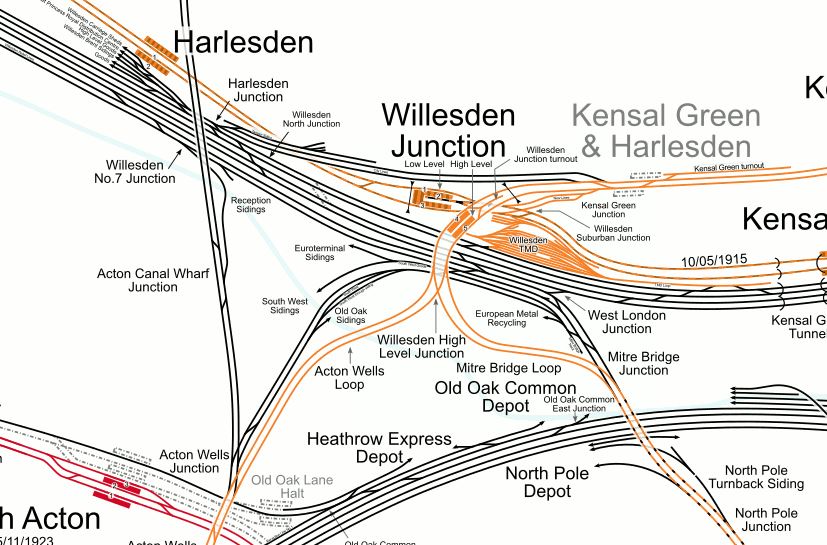
Note.
- The West Coast Main Line is the multi-track railway towards the top of the map.
- The Great Western Main Line is the multi-track railway towards the bottom of the map.
- The Slow Lines on both main lines are on the Northern side of the tracks.
- The Old Oak Common station will be on the Great Western Main Line, just to the West of the North Pole Depot.
This all means that a flyover or a tunnel must be built to connect the two pairs of Slow Lines. It’s not simple!
This Google Map of the area illustrates the problem.
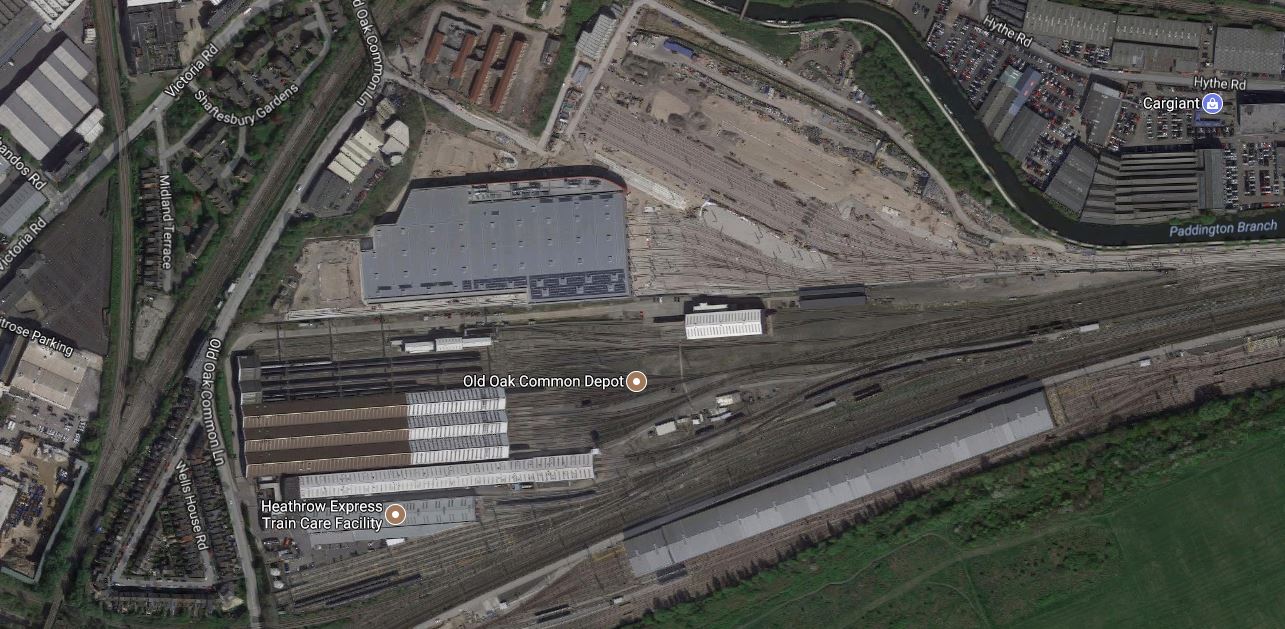
Note.
- The Great Western Main Line going across the bottom of the map.
- The North Pole Depot alongside the Great Western Main Line.
- The Dudding Hill Line and the West London Line at the Western side of the map.
- Crossrail’s newly-built depot is the large grey rectangular building.
- There’s also some housing to the North-West of Crossrail’s Depot
I doubt that a flyover could pass over all that.
But a tunnel starting at the surely soon-to-be-redundant Heathrow Express Depot , that turned North-West would be a possibility.
A tunnel could emerge to the North-West of Harlesden station.
This Google Map shows that area.

Note.
- The silver building in the top-left corner is the Princess Royal Distribution Centre.
- The West Coast Main Line runs diagonally across the map.
- The Dudding Hill Line runs up the Eastern side of the map.
I suspect that space for a tunnel portal can be found.
- Twin tunnels would probably be bored.
- I estimate that they, would need to be just over two kilometres long.
- I suspect too, that they could be built without an additional ventilation shaft in the middle.
Looking at these maps, I’m very much of the opinion, that boring a tunnelled solution, would be possible, but what would be the cost?
The Lee Tunnel in East London is about twice as long and larger in diameter. From the cost of that tunnel, which was opened in 2016, I feel that the two tunnels could be built for just under a billion pounds.
A Tunnel-Free Solution
This Google Map shows Old Oak Common between the Great Western Main Line and the West Coast Main Line.
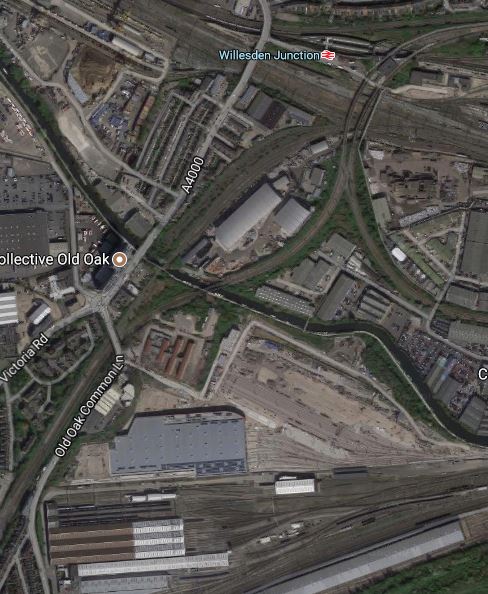
The Crossrail station would be at the bottom just above the North Pole Depot.
I wonder if a line could go through or behind the Heathrow Express site and then follow the North London Line behind the Crossrail Depot to Willesden High Level Junction.
This Google Map shows Willesden High Level Junction and the tracks of the London Overground as they pass over the West Coast Main Line.

I suspect modern three-dimensional design and structural analysis can create a connecting viaduct.
I doubt the track will be much more than a kilometre long and I suspect with the right signalling and a degree of Automatic Train Control, eight tph each way could be handled on a single track.
Conclusion
It looks like updating the Class 345 trains, ERTMS and building a tunnel under Old Oak Common could be a sizeable bill.
Have cost estimates been such, that the project was not deemed to be value for money?
New Railway Line For West London Proposed
The title of this post is the same as this article on Ian Visits.
I’ve also found this article on the Hendon Times, where the railway line is called the West London Orbital Railway.
The West London Orbital Railway now has a section in the Wikipedia entry for the Dudding Hill Line, which is entitled West London Orbital Railway Proposal. This is said.
In September 2017, a proposal for a new West Orbital Railway from Hounslow to Hendon using the disused Dudding Hill Line could go via a new station at Old Oak Common which would be located at Victoria Road and other new stations at Staples Corner, Harlesden and Old Oak Common Victoria Road. 4 trains per hour would run from Hendon to Hounslow and another service from Hendon to Kew Bridge via Old Oak Common.
The proposal seems to be creeping into the media.
The Preamble
I will describe a few of the lines in the area first.
The Dudding Hill Line
The Dudding Hill Line is one of London’s unknown and almost forgotten railway lines.
- It is just four miles long.
- It is double track.
- It runs from the Midland Main Line, North of Cricklewood station to the North London Line at Acton.
- It is not electrified.
- Signalling is not electrified.
- It is part of a freight route, which connects the Gospel Oak to Barking Line with the Great Western Main Line.
- It is connected to the West Coast Main Line and the Chiltern Main Line.
Passenger services ceased in 1902, although even today the occasional charter service uses the line.
This map from carto.metro.free.fr shows the Dudding Hill Line.
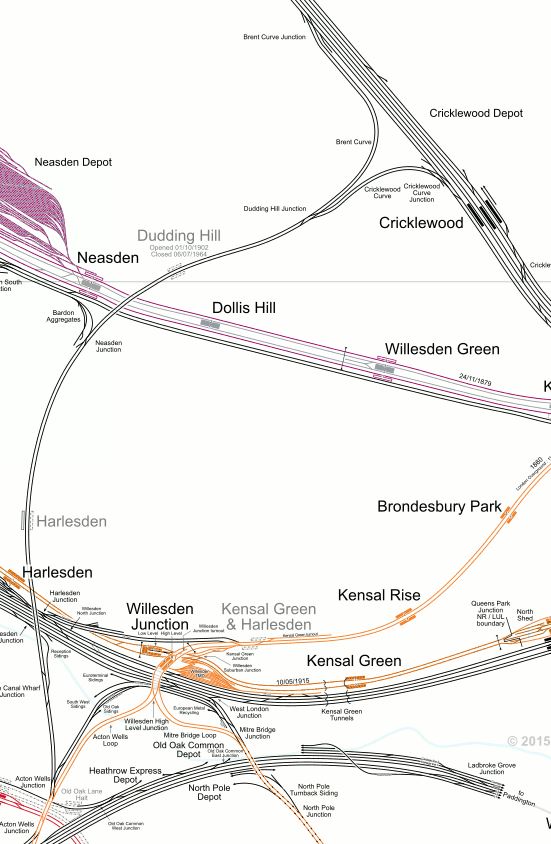
Note.
- How the line joins the Midland Main Line in a triangular junction, which is North of Criklewood station, enabling North and South connections.
- How the line crosses the Chiltern Main Line by Neasden station.
- How the line crosses the electrified West Coast Main Line by Harlesden station.
- How the line joins the North London Line just North of the electrified Great Western Main Line.
This connectivity makes it a very useful freight line.
The Hendon Freight Lines
These two lines run on the Western side of the Midland Main Line between West Hampstead Thameslink and Hendon stations,
North of Hendon they cross the tracks of the Midland Main Line on a flyover and merge with the Slow Lines at Silkstream Junction.
This map from carto.metro.free.fr shows the lines at Hendon.
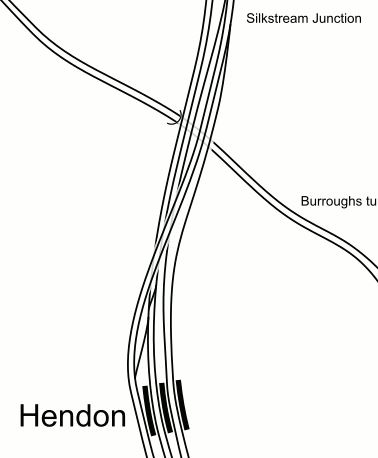
The Hendon Freight Lines have following properties.
- They are only partially electrified.
- They have double-track connections from the North to the Dudding Hill Line, which is named the Brent Curve and Brent Curve Junction.
- They have double-track connections from the South to the Dudding Hill Line, which is named the Cricklewood Curve and Cricklewood Curve Junction.
- As shown at Hendon in the map, the Hendon Up Line passes behind Platform 4 at Hendon, Cricklewood and West Hampstead Thameslink stations.
The innovative use of these lines will be an important part of the proposal for a new passenger service in West London.
The Gospel Oak To Barking Line
The Gospel Oak To Barking Line and the Dudding Hill Line are linked together by the Midland Main Line,
- Between the two lines is fully electrified
- The Gospel Oak to Barking Line will be electrified from May 2018.
- The connecting lines between the Midland Main Line and the Gospel Oak to Barking Line are being electrified around Carlton Road Junction.
This will enable electrified freight trains from East London to the Midlands, using the following route.
- Gospel Oak To Barking Line
- Carlton Road Junction
- Midland Main Line.
Note that there is no flyover between Carlton Road Junction and the Dudding Hill Line, which means they have to cross the Midland Main Line on the flat.
For this reason, electrified freight trains for the West Coast Main Line and the Great Western Main Line must probably take the North London Line from Gospel Oak station.
This probably rules out passenger services between Barking and Acton, using the Dudding Hill Line.
However passenger trains from East London could continue up the Midland Main Line to a suitable terminal.
Class 710 Trains
The Class 710 trains that will be delivered for the Gospel Oak to Barking Line have the following characteristics.
- They are Aventras
- They are dual-voltage and can operate on both 25 KVAC overhead and 750 VDC third-rail electrification.
- They may be fitted with onboard energy storage to operate without electrification for a few miles.
If the last point is true, they will be able to run between West Hamsted Thameslink or Hendon and South Acton stations, with a change of voltage at Acton Central station, using onboard energy storage on the Dudding Hill Line.
The Proposal
The West London Railway has been proposed by a consortium of West London Councils and other interests, that the Dudding Hill Line be reopened to passenger trains.
- ,Services would start in the North at either the proposed Brent Cross Thameslink station or West Hampstead Thameslink station.
- New stations could be built at Gladstone Park and/or Neasden, Harlesden and Old Oak Common,
- The service could be running by the mid-2020s.
The passenger service would open in two phases.
- West Hampstead to Hounslow via Cricklewood, Neasden, Harlesden, OOC, Acton Central, South Acton, Brentford, Syon Lane and Isleworth.
- Hendon to Kew Bridge via Hendon, Brent Cross/Staples Corner, Neasden, Harlesden, OOC, Acton Central and South Acton.
Four trains per hour (tph) would run on both routes.
How Does The Proposal Stack Up?
In the following sub-sections, I’ll discuss the various issues.
Track And Signalling
This is said about the current state of track and signalling in Wikipedia.
In 2009, the track has received considerable maintenance in parts, including complete track and ballast removal and replacement. It was informally thought locally by Network Rail staff that replacement signalling, controlled from Upminster, was planned for Christmas 2010, leading to the closure of the three signal boxes (staffed 24-hours a day, at least during the working week). However, financial constraints within Network Rail have now delayed this timescale.
It looks like the track is in good condition, but the signalling needs replacing.
How Would The Service Be Run?
The Hendon Freight Lines connect to the Dudding Hill Line to give all possible access needed.
It should also be relatively easy to put a single platform on the Up Hendon Line at the following stations.
- West Hampstead – It would act as a terminus.
- Cricklewood
- Brent Cross – When the station is built.
- Hendon – It could act as a terminus.
The new platforms would have the following characteristics.
- They would probably be numbered 5.
- They would probably be able to share platform access and other services with current Platform 4 at each station.
- Little demolition of existing buildings and structures would be required.
A Phase One service coming North from Neasden could do the following.
- Take the Cricklewood Curve from the Dudding Hill Line.
- Join the Up Hendon Line.
- Stop in the new Platform 5 at Cricklewood.
- Continue on the Up Hendon Line to the new Platform 5 at West Hampstead Thameslink.
- Reverse the train at West Hampstead.
- Proceed to and stop in Platform 5 at Cricklewood. Existing cross-overs would allow use of both Hendon Lines.
- Cross over to the Down Hendon Line and take the Cricklewood Curve to rejoin the Dudding Hill Line.
As the service is four tph, provided a train can leave and return to the Dudding Hill Line in fifteen minutes, there should be no problem.
Currently, Cricklewood to West Hampstead takes three minutes, so the Phase One service looks possible.
The Phase Two service to Hendon could do the following.
- Take the Brent Curve from the Dudding Hill Line.
- Join the Up Hendon Line.
- Stop in the new Platform 5 at Hendon.
- Reverse the train at Hendon
- Take the Brent Curve to rejoin the Dudding Hill Line
It looks to be a simple plan, that makes good use of the existing infrastructure.
- Building the extra platforms at Hendon, Cricklewood and West Hampstead shouldn’t be difficult.
- The new routes don’r cross the Midland Main Line.
- The Hendon Lines seem to have plenty of cross-overs and I don’t think any new ones are needed.
- Dual voltage trains would be at home on all existing electrification.
At the Southern end of the route, everything appears fairly simple.
Why Are There Two Phases?
If it’s so simple, why is the service proposed to have two phases?
Look at this map from carto.map.free.fr, which shows the railways around Brent Cross.
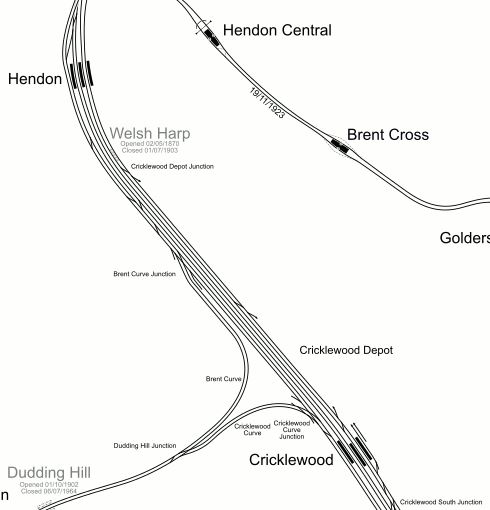
The development of Brent Cross Cricklewood and the building of Brent Cross Thameslink station is going to be a massive undertaking. This describes the development in Wikipedia.
Brent Cross Cricklewood is a planned new town centre development in Hendon and Cricklewood, London, United Kingdom. The development is planned to cost around £4.5 billion to construct and will include 7,500 homes, 4,000,000 sq ft (370,000 m2) of offices, four parks, transport improvements and a 592,000 sq ft (55,000 m2) extension of Brent Cross Shopping Centre. The developers of the scheme are Hammerson and Standard Life. Construction is planned to start in 2018 and be completed in 2021-22
The development will include the building of Brent Cross Thameslink station and the redevelopment of Cricklewood station.
Looking at the Phase One route to West Hampstead Thameslink, the following applies.
- The route doesn’t go past the Brent Cross development.
- The terminal platform at West Hampstead Thameslink would be step-free with a lift.
- The Up Hendon Line is electrified at \West Hampstead Thameslink, but it is not at Hendon.
- Hendon station needs a lot of work to make it step-free.
- West Hampstead Thameslink could be part of a growing West Hampstead Interchange with excellent connections.
- The service could even go straight through Cricklewood station, until it was redeveloped.
It would thus appear that for an easy and affordable construction, the service should serve West Hampstead Thameslink first.
Once Brent Cross Thameslink station is open, Hendon and Kew Bridge stations are updated, Phase Two can open.
Electrification
The electrification of the twelve mile route on the Chase Line between Rugeley and Walsall was budgeted at £78 million.
So hopefully, the four miles of the Dudding Hill Line should be able to be electrified for a reasonable cost.
Consider.
- The track is in reasonable condition and probably well-surveyed.
- There are a few bridges that might need to be raised.
- There are no stations to electrify, just provision to be made.
- Both ends of the route are electrified.
- The route connects to three electrified main lines.
- Electrification of the line would cause little if any disruption to passenger services.
I think that the needs of electrified freight will decide whether this route is electrified.
A Passenger Service Without Electrification
Dudding Hill Line Electrification is not necessary to run s passenger service using Class 710 trains.
- Class 710 trains with onboard energy storage could easily bridge the four-mile electrification gap between the Midland Main Line and the North London Line.
- There would be no problem charging the onboard energy storage at each end of the routes.
- At various places, Aventras will share station platforms with Thameslink’s Class 700 trains and the North London Line’s Class 378 trains, so there should be no station issues.
- From Acton Central to Hounslow and Kew Bridge, the trains would use the third-rail electrification.
Class 710 trains wouldn’t mind if the line is electrified or not.
Stations
The following stations will need to be built or modified.
- Brent Cross Thameslink – New station to be built as part of large development – Might need a platform suitable for use as a terminus.
- Gladstone Park – New station on the site of the old Dudding Hill station – Might be and/or with Neasden.
- Harlesden – New station – Could be linked to the existing station on the Bakerloo Line?
- Hendon – Existing station – Might need a platform suitable for use as a terminus.
- Hounslow – Existing station – Might need a platform suitable for use as a terminus.
- Kew Bridge – Existing station – A new terminus platform would need to be added.
- Neasden – New station – Could be linked to the existing station on the Jubilee Line?
- Old Oak Common – New station to be built as part of large development
- West Hampstead Thameslink – Existing station – Might need a platform suitable for use as a terminus.
The next sections give my thoughts on specific stations.
Brent Cross Thameslink Station
Brent Cross Thameslink station is a planned new station to serve the £4.5 billion Brent Cross Cricklewood development in the area.
I wouldn’t be surprised to see this station built as a close-to-London interchange station, in much the same way as Clapham Junction and Abbey Wood stations work and will work in South London.
At a minimum it will have the following characteristics.
- Two slow platforms for Thameslink services.
- Two fast platforms for long distance services.
- Extra platforms for future services.
- Full step-free access.
The design of the station will be key to extra services using the Midland Main Line.
Cricklewood Station
This Google Map shows the layout of Cricklewood station.
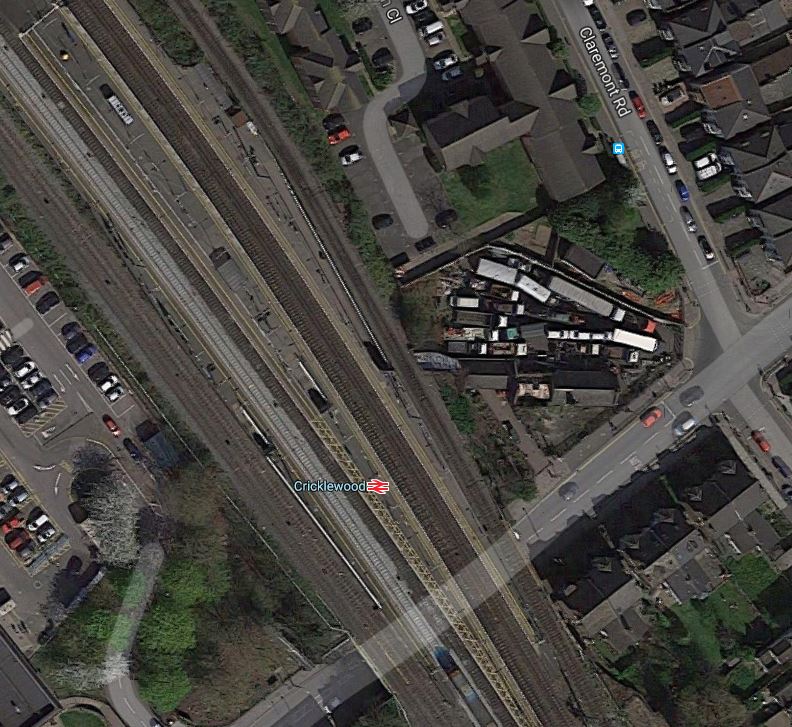
These pictures show the station.


Cricklewood station is one of four stations that need to be modified or built with a Platform 5 on the Up Hendon Line.
The station is also not step-free and this will probably be added in the redevelopment of the station to serve the Brent Cross Cricklewood development..
Harlesden Station
This Google Map shows the layout of Harlesden station.
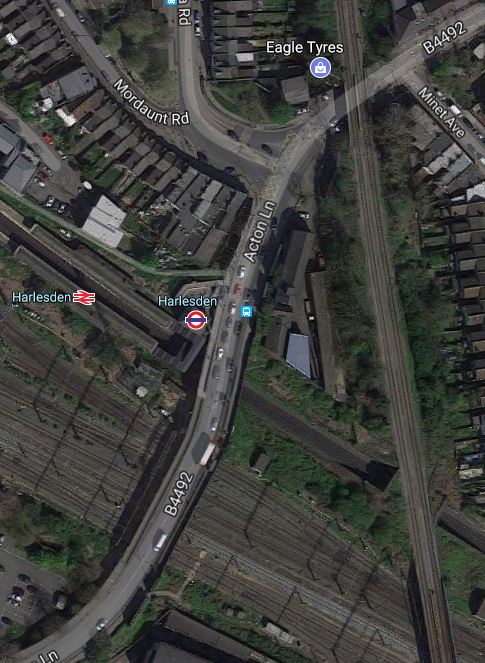
The Dudding Hill Line runs down the map at the right and it crosses the shared tracks of the Watford DC Line and the Bakerloo Line, just to the West of Harlesden station.
These pictures show the station.


I think that, I am being very truthful, if I said that Harlesden station is not one of the London Underground’s finest stations. Ian in his article said this.
The other station, at Harlesden could also see the old station of the same name rebuilt, but again, the freight line runs close to the current Harlesden station, so a combined building would again be likely, this time with just a modest footbridge needed to link the new platforms to the existing station.
I very much feel that a station can be built at Harlesden on the other side of Acton Lane, that has platforms on both the Watford DC/Bakerloo Lines and the Dudding Hill Line. The high level platforms on the would be connected by steps and/or lifts to the low-level ones.
The new station could even be built without closing any of the lines and once completed the old Harlesden station could be demolished.
It would have the following services.
- Three tph between Watford Junction and Euston.
- Nine tph on the Bakerloo Line
- Four tph between West Hampstead Thameslink and Hounslow.
- Four tph between Hendon and Kew Bridge
The last two proposed services would provide an eight tph service to Old Oak Common for Crossrail, HS2, the North London Line and most importantly, a very healthy amount of employment opportunities.
Hendon Station
This Google Map shows the layout of Hendon station.
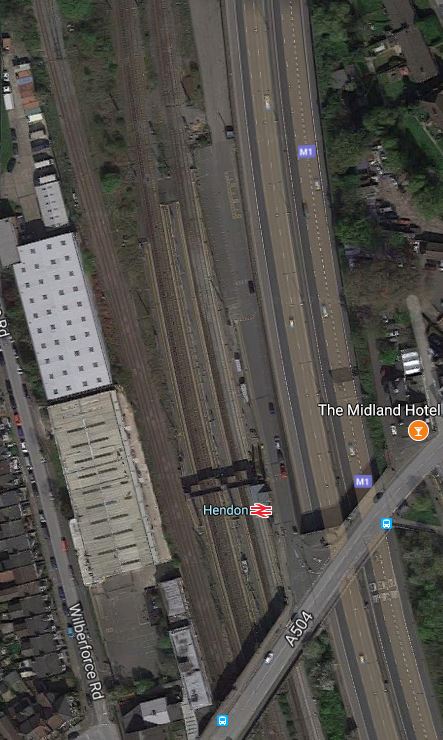
These pictures show the station.

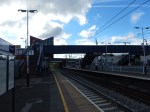

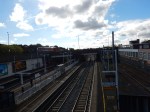
Note.
- The footbridge is not step-free.
- The footbridge is used to support the electrification.
- The electrified fast lines in Platforms 3 and 4.
- The electrified slow lines in Platforms 1 and 2.
- The two freight lines without electrification behind the white metal fence on Platform 4.
In my view, this needs to be done.
- Make the station step-free.
- Build a Platform 5 on the Up Hendon Line, that backs onto Platform 4, so it can share steps and the lift.
- Electrify the line through the platform.
The created Platform 5, will be the terminus of the Phase Two service to Kew Bridge.
Hounslow Station
This Google Map shows the layout of Hounslow station.
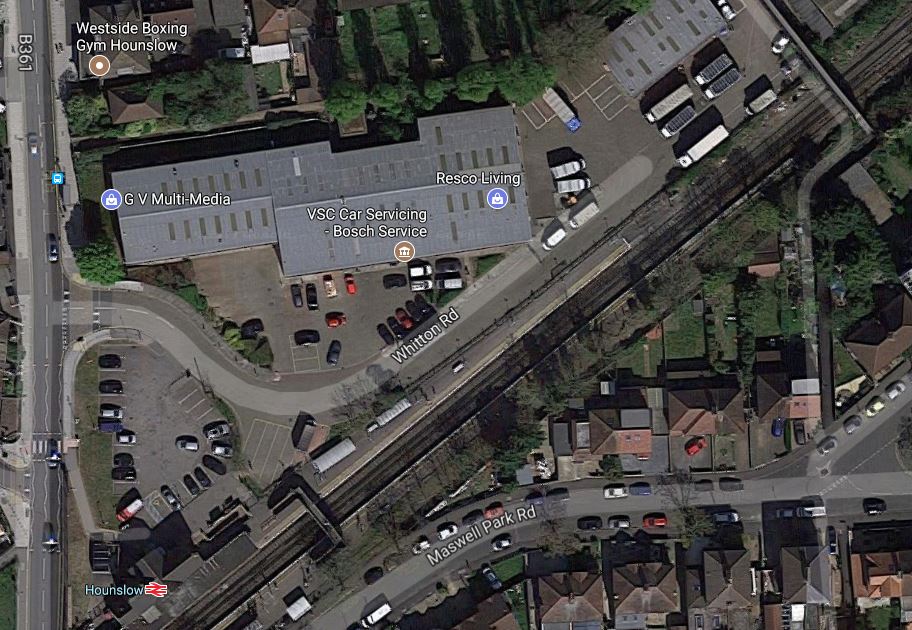
These pictures show the station.
It will be tight to fit a bay platform into the station, but I suspect, it will be placed on the Up (London-bound) side of the station, in what is now an access road and yard to some business premises, where one is labelled Resco Living.
- It will need some changes to the cross-overs at the station to allow trains to access the new platform.
- The station needs a new step-free bridge.
This Google Map shows Hounslow station’s location with respect to Heathrow.
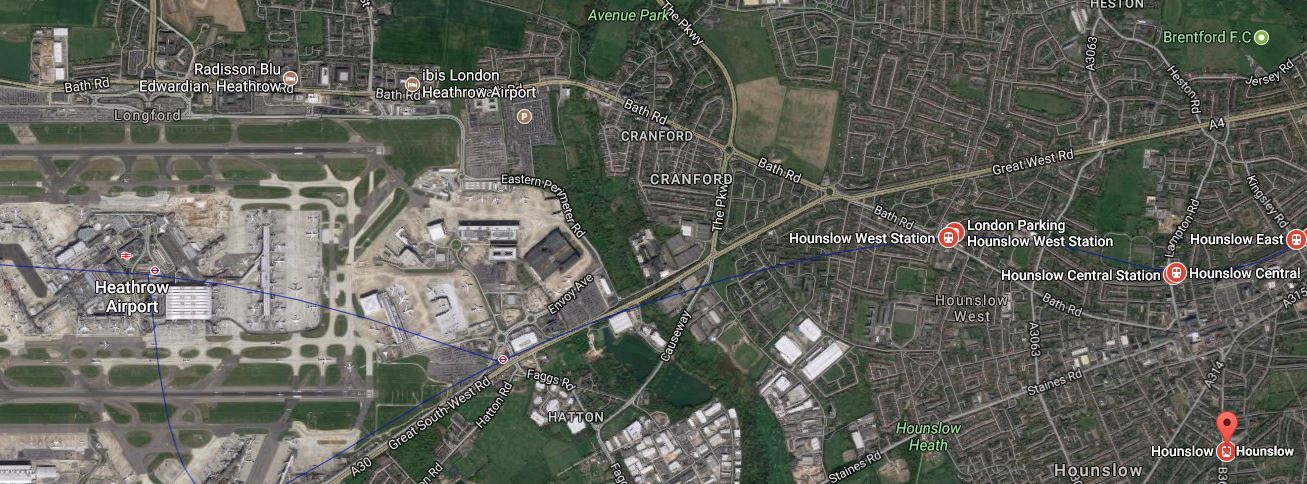
Hounslow station is in the bottom right-hand corer of the map.
I do wonder if Hounslow station, needs a frequent bus to Heathrow Airport. After all the extra four train per hour across London will make it a very busy station.
Kew Bridge Station
This Google Map shows the layout of the lines and the location of Kew Bridge station.
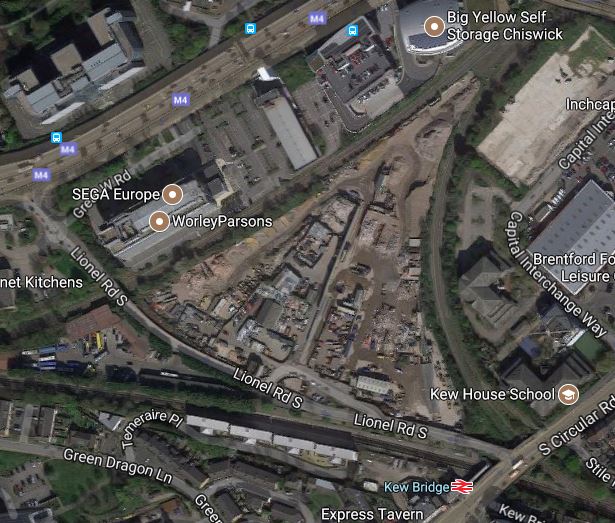
Note.
- The triangal of lines, of which only the bottom side has any trains.
- The top angle leads to South Acton station.
- The proposed Phase One service would use the left side of the triangle.
- The proposed Phase Two service to Kew Bridge would use the right side of the triangle and terminate in a reopened platform at Kew Bridge station.
These pictures show the station.
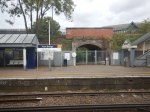


The work needed at Kew Bridge station would appear to be very simple.
- Reinstate the former Platform 3 to handle four tph.
- Replace the footbridge with a better step-free example.
It would also appear that there is a siding to the East of the station, that could be used to reverse trains if necessary.
This map from carto.metro.free.fr shows the lines at Kew.
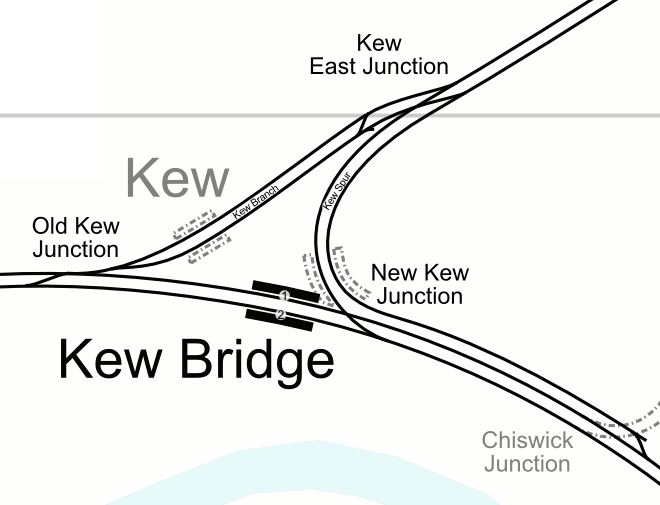
As Brentford’s new stadium and other large developments are being built in the area, I wonder if the proposed Phase One Hounslow service should call at a reopened Kew station.
Neasden Station
This Google Map shows the layout of Neasden station.
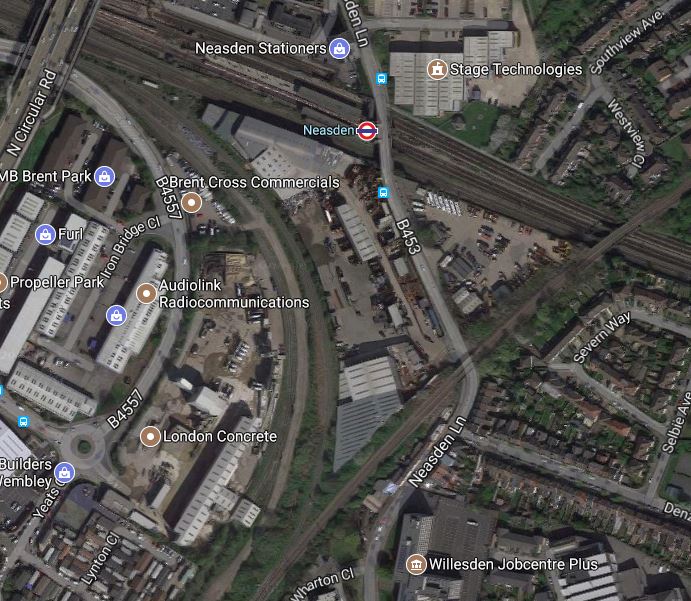
And this map from carto.metro.free.fr shows the lines at the station.

These pictures show the station.
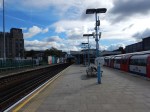


Ian says this about Neasden in his article.
The station at Gladstone Park could see the disused station called Dudding Hill brought back into use, although the likelyhood is that a new station closer to Neasden on the Jubilee line would be favoured for the shorter interchange walk.
There may even be enough space to flip the existing Neasden station southwards and link up with the new Overground line to create a single station linking the two lines.
Whether the funding for that would be available will doubtless depend on getting new housing developers to pick up some of the bill.
There are certainly possibilities.
A combined station would give the following services.
- Upwards of twenty tph on the Jubilee Line
- Four tph between West Hampstead Thameslink and Hounslow.
- Four tph between Hendon and Kew Bridge
The last two proposed services would provide an eight tph service to Old Oak Common for Crossrail, HS2, the North London Line and most importantly, a very healthy amount of employment opportunities.
Old Oak Common Station
Old Oak Common station will be a major interchange between the following lines and services.
- Crossrail
- HS2
- Great Western Main Line
- West Coast Main Line
- Chiltern Tailways
- Bakerloo Line
- Central Line
- North London Line
- West London Line
Whoever sorts this lot out, deserves a Turner Prize.
But after seeing some very complicated stations in both the UK and Europe, I believe that it would be possible to create a station that provided easy step-free interchange between the various lines without walking halfway round the London Borough of Hammersmith and Fulham.
Connecting the West London Orbital Railway to Crossrail would be a very valuable interchange.
West Hampstead Thameslink Station
This Google Map shows the layout of West Hampstead Thameslink station.
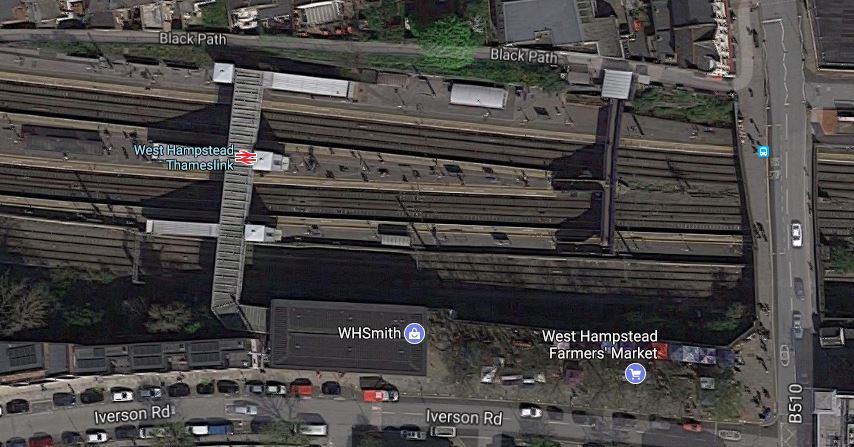
These pictures show the station.

Note.
- In the Google Map, the lines are Slow, Fast and Freight from top to bottom.
- The station is fully step-free.
- The freight lines are electrified.
- The last picture shows how the other West Hampstead stations are being improved.
In my view, all that needs to be done is build Platform 5 for the Phase One service behind Platform 4, so that it can share the steps and the lift.
As other improvements are appearing, West Hampstead will become an important interchange. It’s now got the absolute necessity for a Grade A Interchange; an Marks and Spencer Food Store.
Employment, Housing And Social Benefits
In the seven years since I moved to Dalston, the area has improved considerably.
- New apartment blocks have appeared.
- The shops, restaurants and cafes have got better.
- It also appears to me, that the amount of idle youths hanging around has reduced.
I put a lot of all this, down to considerable investment in both buses and railways. It’s probably not surprising as the London Borough of Hackney doesn’t have an Underground station of its own.
The Overground has been a conspicuous success, offering train services of the following nature.
- Safe, clean stations.
- Visible, well-trained staff.
- New modern trains.
- Train services at a frequency of four tph.
The only problem, is that every time the capacity is expanded it quickly fills.
But then that is only new travellers opting for quality.
On Sunday, I took a ride on top of a bus between Willesden Green and Harlesden stations. These are some pictures I took.







The two most impressive buildings I passed were Courts.
It is my belief that after my experience in Dalston, that improving the transport links in an area of deprivation improves the area considerably, in any number of ways, some of which are rather surprising.
From speaking to people in Dalston, decent reliable transport links seem to have the benefit that those who are unemployed often benefit substantially, by being able to get to nre-found work easily and on time.
So if the proposed line is built with stations at Neasden, Harlesden and Old Oak Common will we see the improvement in North West London, that the Overground has brought to Dalston?
Unfortunately, the only way to test my theory is to build the line.
Building The Line
This is no Crossrail or HS2, where billions need to be spent.
The three largest sub-projects would be.
- Electrification of the Dudding Hill Line, if it is to be done.
- Resignalling of the Dudding Hill Line.
- Necessary track replacement and updating.
In addition, there are around ten station projects.
There will also be a need for up to perhaps sixteen Class 710 trains. This could be around £90-100 million.
Other Possible Rail Services
It might be possible to connect the West London Orbital Railway to other rail services and stations.
Changing At Old Oak Common
All stations on the West London Orbital Railway will have at least a four tph connection to Old Oak Common, with Harlesden and Neasden having an eight tph connection.
Provided that the connection at Old Oak Common is well-designed, I think passengers will be happy to change here for the following services.
- Six tph on Crossrail to Heathrow.
- Twelve tph on Crossrail to Central London.
- West Coast Main Line
- HS2
- Chiltern
- North London Line
- West London Line
I’ve left out the Bakerloo and Central Lines, as it will probably be quicker to take Crossrail and change.
Thameslink And The Midland Main Line
All stations on the West London Orbital Railway will have at least a four tph connection to Thameslink, with Harlesden and Neasden having two separate four tph connections.
Depending on how the new East Midlands franchise arranges services, it might also be possible change onto some services to Derby, Leicester, Nottingham and Sheffield.
Hopefully, the interchange will be step-free. West Hampstead Thameslink already is step-free and I would assume Brent Cross Thameslink will be built that way!
A direct connection from Midland Main Line or Thameslink services to the West London Orbital Railway may be possible, but the current track layout would appear to make it difficult.
Changing At Hounslow And Kew Bridge
The two Southern termini are on the Hounslow Loop Line, which gives valuable connections in South West London, including Clapham Junction.
Affect On Other Services
The West London Orbital Railway affects other passenger services in two places.
The North London Line Through Acton Central And South Acton
Acton Central and South Acton stations on the North London Line are both served by a four tph service between Stratford and Richmond.
- There are also other trains.
- Both stations also have a level crossing.
So would it be possible to fit the eight tph of the West London Orbital Railway through this section of the North London Line?
I suspect the answer is positive, otherwise the impossibility would have killed the proposal.
The Hounslow Loop Line Between Kew Bridge And Hounslow
This section of line has a four tph service in both directions, so it should be able to handle an extra four tph.
Collateral Benefits
There are some benefits to existing services.
Services Through Acton
The two Acton stations; Acton Central and South Acton, receive a big boost to services.
Currently, they have just four tph between Stratford and Richmond.
After Phase Two of the West Ortbital Railway is complete, these servicesc will be added.
- Four tph between West Hampstead Thameslink and Hounslow
- Four tph between Hendon and Kew Bridge
All twelve tph will stop at Old Oak Common.
Major Developments Get New Or Improved Rail Connections
The following developments get new or improved rail connections.
- Brent Cross Cricklewood
- Old Oak Common
- Brentford
How many housing and commercial developments will the passenger serviceencourage?
Conclusion
I believe that the West London Orbital Railway is an elegant proposal.
- No new track or electrification, just signalling and stations.
- Four tph on two routes through areas of London that need much better public transport.
- It links to the major rail hub at Old Oak Common for Crossrail and HS2.
- It can be built without major disruption to existing services.
- It can use the London Overground’s standard Class 710 trains.
- It is very much a self-contained railway, that has little chance to affect existing services.
But above all, it is very much an affordable proposal, with a projected high return.
Slow Trains In The North
I was asked a few hours ago, as to why would TransPennine Express want to get rid of their Class 350/4 trains.
These ten 110 mph trains were only delivered in 2013 -2014, so why should TransPennine Express replace them?
They work Manchester Airport to Glasgow and Edinburgh services, but they have two major problems.
No Wi-Fi
It looks like none of the Class 350 trains have wi-fi, so possibly passing them on now3, will give that problem to the new owner.
They Are Only 110 mph Trains
The trains are being replaced with Class 397 trains from Spanish manufacturer; CAF.
I suspect the Class 397 trains have a few advantages over the Class 350 trains.
- The new trains are probably built with wi-fi.
- The interiors are custom-designed for the Scottish and Manchester Airport markets.
- The trains are five-cars as opposed to four.
- The capavity of the new trains is 286 seats as opposed to 229.
But the major difference is that the Class 397 trains are 125 mph trains, like the Class 390 trains used by Virgin.
Looking at times between Glasgow and Preston on the West Coast Main Line, it would appear that the Class 390 trains are up to twelve minutes faster than the current Class 350 trains, so when both companies are running 125 mph trains will we see an improvement in both?
Similar improvements will probably happen on the East Coast Main Line, where the Class 397 trains will be mixing it with Class 800 trains.
Could The Class 397 Trains Handle 140 mph?
This question has to be asked, as at some point in the next few years, when the signalling allows, there may be possibilities for 140 mph. running on both the West and East Coast Main Lines.
I would hope that the Class 397 trains can be uprated to allow 140 mph running.
Will The Class 397 Trains Get In The Way Of HS2 Trains?
HS2 could reach Crewe as early as 2027 and the trains will take to the West Coast Main Line to go North.
I hope that the Class 397 trains are future-proofed to share a line with these new trains.
Other Trains On The West And East |Coast Main Lines
There are other trains that will use the West and East Coast Main Lines, which will not be able to operate at speeds in excess of 125 mph.
- 100 mph Class 185 trains
- 125 mph Class 220 trains
- 125 mph Class 221 trains
- 100 mph Class 319 trains
- 125 mph InterCity 125 trains
I suspect these trains will have to be kept away from the two main lines to Scotland.
Conclusion
The Class 397 trains will have to be capable of being uprated to 140 mph.
I also suspect that any train not capable of holding 140 mph may not be allowed on the West and East Coast Main Lines.
Enthusiasm For The Borders Railway In Carlisle
This article in the Carlisle Express And Star is entitled New Rail Link To Carlisle Could Be ‘Catalyst’ For Job Creation.
It is discussing the report of the Campaign for a Borders Railway, which recommends rebuilding the line.
This is said in the newspaper.
The summary said: “A new rail link to Edinburgh via the Borders could be a catalyst for the development of new employment uses on the former MOD land at Longtown and in the Kingstown area on the northern fringe of Carlisle.
“Park and ride stations in these areas would provide congestion relief and improve access to the city.
I think that as the only major City on the route, apart from Edinburgh, Carlisle must be a major beneficiary of a reinstated Borders Railway.
Carlisle scores high in the Location, Location, Location stakes, as not only is it just off the M5 between England and Glasgow, but Carlisle Citadel station is a major rail interchange. Incidentally, these romantic Victorian names are dropped far too readily.
This map from Wikipedia, shows the railways around the City.
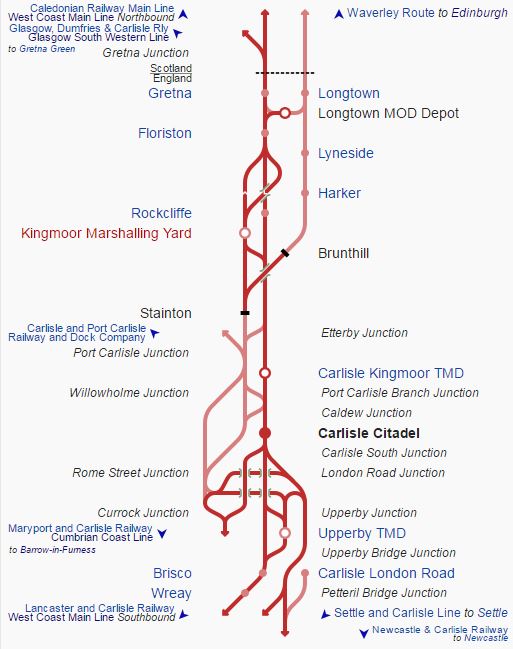
Note Longtown station on the Waverley Route to Edinburgh and the MOD Depot or Defence Munitions Centre Longtown, between the two rail routes, to the North of the map.
This Google Map shows the DMC.
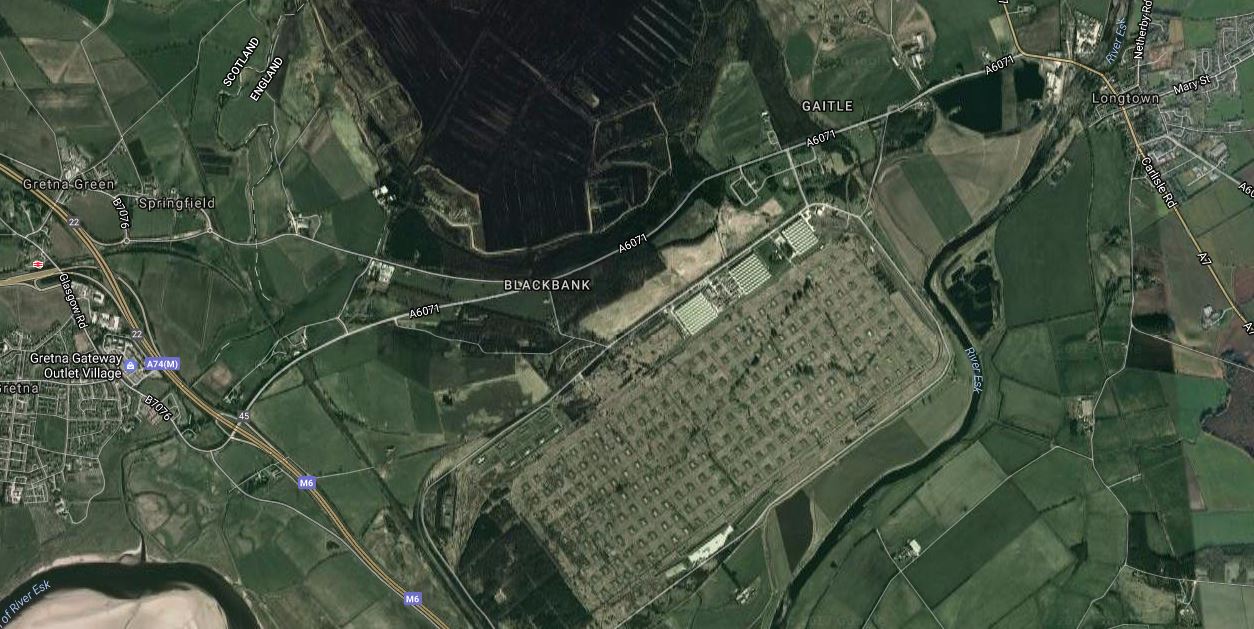
Note the West Coast Main Line with its connection to the Centre and the Glasgow South Western Line branching off to Gretna Green station and all the way to Glasgow.
Longtown is in the North East corner of the map and you can just pick out the track-bed of the Waverley Route, linking the town to Carlisle.
Conclusions
The CBR report, recommends a Park-and-Ride at Longtown and I wonder, if developments there might be the key to rebuilding the Waverley Route on a more economic basis.
A lot would depend on whether the Defence Munitions Centreat Longtown continues to be used, but the following could be built in the area.
- The proposed Park-and-Ride.
- A Strategic Rail Freight Interchange.
- Distribution warehouses.
- Factories that need lots of space and good rail and road access.
A lot would depend on what the locals want and whether Scotland became independent, for which the site must be ideally placed.
If the track-bed of the old Waverley Route is still present and can be used to Carlisle, this route could be developed as a rail route, which might have advantages.
- It has its own route to Carlisle station with a separate bridge over the River Eden.
- The West Coast Main Line bridge over the River Eden appears to be only double-track.
- Would it improves timings to and from Glasgow on the West Coast Main Line?
- Could it be used as a diversion route for freight trains on the West Coast Main Line through Carlisle?
- Extra stations could be opened on the route, that could improve connectivity in the City
- There is probably few paths on the West Coast Main Lines for extra trains from Longtown and/or a reinstated Waverley Route to Edimburgh.
But would the extra cost be justified?
Done properly, as the CBR report says, improving the railways between Carlisle and a new Park-and-Ride at Longtown, would surely improve the Carlisle economy.
Birmingham Airport Mulls Plan For Terminal Inside HS2 Station
This is the title of an article in Construction News.
This Google Map shows Birmingham Airport, the current Birmingham International station, the NEC, with the M42 Motorway going North-South down the Eastern side.
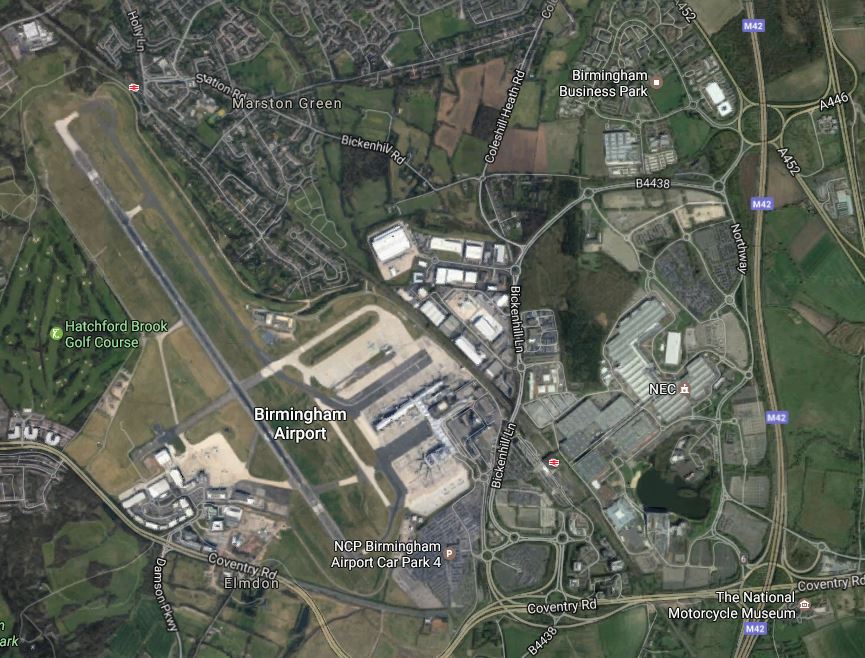
Currently, it is planned that the Birmingham Interchange station for HS2, would be on the other side of the M42 to the NEC.
Surely, the Construction News headline is indicating that something better can be done.
In an ideal world, Birmingham Airport would have one station for HS2, West Coast Main Line and local train and tram services, with a step-free lift/escalator connection between all platforms and both Departures and Arrivals at the Airport.

