FirstGroup Adds Leeds-based J&B Travel To Growing Coach Portfolio
The title of this post, is the same as that of this article on Route One.
These two paragraphs add more detail.
J&B Travel of Leeds is the latest coach business to be acquired by FirstGroup.
The operator, which has been established for more than 40 years, has a fleet of 15 vehicles, with work including home-to-school, private hire and FlixBus contracts.
But in some ways, the most significant thing not mentioned is that FirstGroup have now acquired seven coach firms.
- AndersonTravel in London
- EnsignBus in London
- J & B Travel in Leeds
- Matthews Coaches in County Monaghan, Ireland
- Tetley’s Coaches in Leeds
- York Pullman in Harrogate, Hull, Leeds and York
Note.
- MatthewsCoaches are about halfway between Dublin and Belfast.
- Three of the English acquisitions are in Yorkshire and two are in London.
- Leeds isn’t far off being halfway between London and Central Scotland.
This looks like the first part of a master plan.
- Leeds and County Monaghan could be ideal refuelling points for zero-carbon coaches.
- Ferrybridge, just South of Leeds is getting a hydrogen-fired power station.
- Ferrybridge is a big site with a motorway service station on the M1.
- Wrightbus are building an electrolyser at Ballymena, which is 81 miles from Matthews Coaches.
- Wrightbus have said that Dublin and Cork would be an ideal route for a hydrogen coach.
- Wrightbus have said that Heathrow and Gatwick would be an ideal route for a hydrogen coach.
This plan could be built-on with routes to various cities and attractions.
I have some further sorts and questions.
Could The First Obvious Routes Be Run By Hydrogen Coaches?
From what Wrightbus have indicated, I would rate the obvious routes as.
- Dublin and Belfast – 103 miles or 206 miles round trip
- Dublin and Cork – 107 miles or 340 miles round trip
- Leeds and Glasgow – 224 miles or 448 miles round trip
- Leeds and Edinburgh – 222 miles or 444 miles round trip
- Leeds and London – 197 miles or 396 miles round trip
- Heathrow and Gatwick – 40 miles or 80 miles round trip
Note.
The longest route is 714.5 km.
It would appear that, if the hydrogen-powered coach had a range of 1,000 km. all routes would be possible.
How Far Would A Hydrogen Coach Get On A Tankful From London?
A thousand kilometres is 621.4 miles.
These are the distances from Scottish cities to London.
- Aberdeen – 537 miles
- Dundee – 472 miles
- Dunfermline – 430 miles
- Edinburgh – 410 miles
- Glasgow – 404 miles
- Inverness – 561 miles
- John O ‘Groats – 678 miles
- Perth – 451 miles
- Stirling – 418 miles
I’ve added John O’Groats for completeness, but all cities would be reached.
How Far Would A Hydrogen Coach Get On A Tankful Going West From London?
These are the distances from Western towns and cities to London.
- Aberystwyth – 236 miles
- Fishguard – 255 miles
- Holyhead – 289 miles
- Lands End – 310 miles
- Penzance – 307 miles
I’ve added Lands End for completeness, but all towns and cities would be reached.
John O’Groats And Lands End In A Hydrogen Coach
I asked Google AI how far the journey was and received this answer.
The distance from Land’s End to John o’ Groats varies by transport: about 837-874 miles (1347-1407 km) by road, roughly 600 miles (970 km) as the crow flies, and around 1,200 miles (1900 km) for an off-road walking route, with cyclists typically taking 10-14 days and walkers 2-3 months.
So it looks, like there will be a need for a refuel, but that would give 2,000 kilometres, which is more than the 1,347-1,407 kilometres needed.
Ferrybridge Could Be An Ideal Refuelling Point
I suspect, even in fifty years you could name the places in the UK, where you will be certain of refuelling any hydrogen vehicle on the fingers of one hand.
The list would include.
- Ferrybridge in Yorkshire, where SSE are building a hydrogen-fired power station.
- Felixstowe Docks in Suffolk, where there will be a need to fuel hydrogen trucks.
- Keadby in Lincolnshire, where SSE are building a hydrogen-fired power station.
- Kintore in Aberdeenshire, where an electrolyser is being built.
- Runcorn in Cheshire, where there was an electrolyser in 1968, when I worked there.
This web site lists all the UK hydrogen projects.
This Google Map shows the location of the Ferrybridge hydrogen-powered power station site in relation to Barnsley, Doncaster, Leeds and other towns and cities of Yorkshire.

Note.
- The red arrow indicates the former coal-fired power station site.
- Leeds is in the North-West corner of the map.
- Barnsley and Stocksbridge are in the South-West corner of the map.
- The city of Sheffield is to the South-West of Stocksbridge.
- Doncaster is in the South-East corner of the map.
Last September I wrote Visiting The Consultation For Ferrybridge Next Generation Power Station At Knottingley.
In that post, I wrote about supplying both the power station and the motorway services with hydrogen and felt that it could use one of two methods.
- A pipeline from the hydrogen storage in East Yorkshire.
- Some form of train from a hydrogen production site.
Recently, Network Rail have been conducting tests on the movement of hydrogen by train, which I wrote about in Network Rail’s Test Track Take Centre Stage As Hydrogen Is Delivered By Rail For The First Time.
The Ferrybridge Site Has most things needed.
This map shows the site.
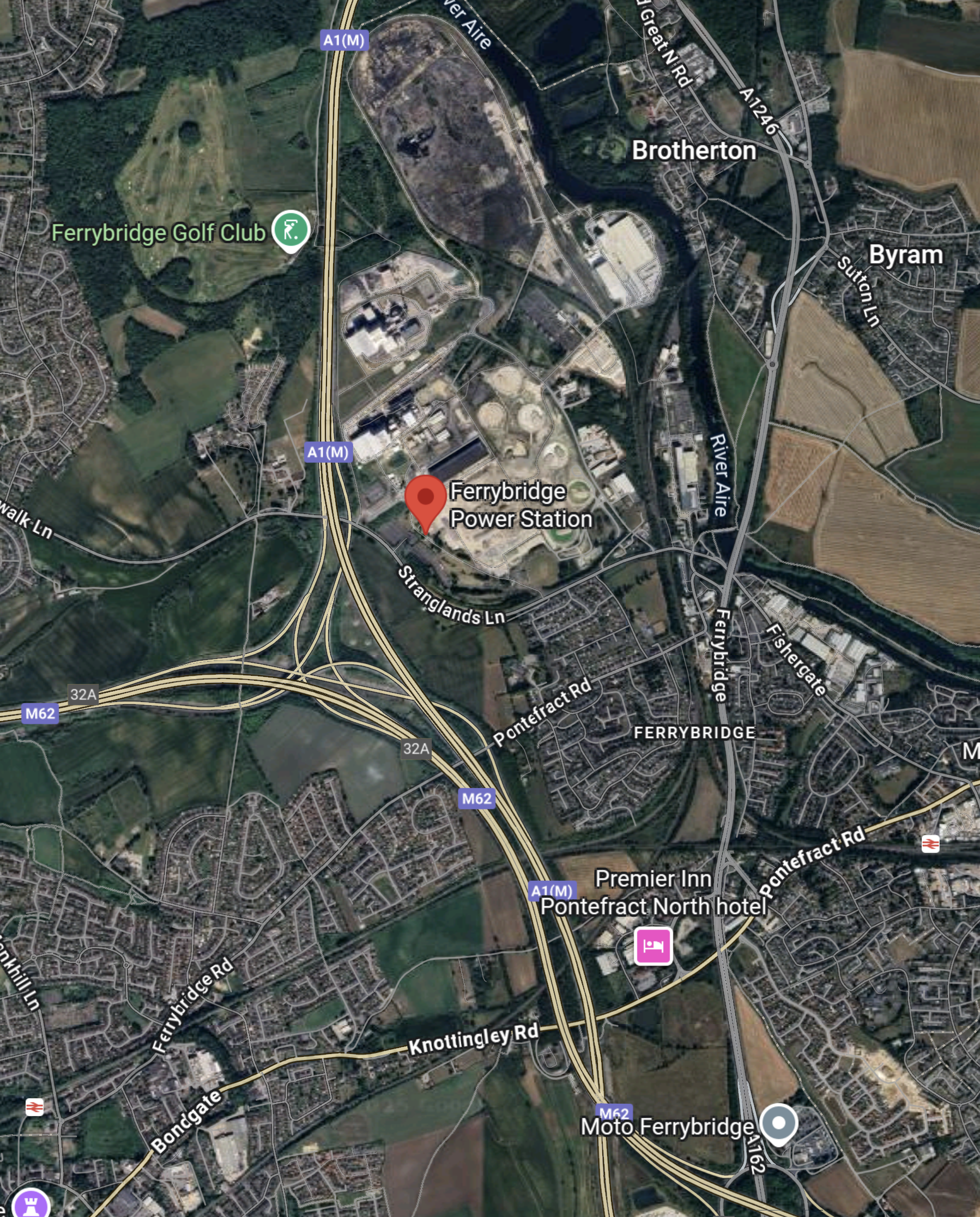
Note.
- The impressive motorway junction, where the North-South M1 crosses the East-West M62.
- Liverpool and Manchester are to the West.
- Leeds, Newcastle and Scotland is to the North.
- Hull is to the East.
- London is to the South.
- There is a Moto Services.
- There is a Premier Inn.
There is even two railway stations on the map.
This reply from Google AI gives the details of the distance between Ferrybridge and the South-West.
The driving distance from Ferrybridge, Yorkshire, to Land’s End is roughly 470 to 500 miles, taking about 8-9 hours, primarily via motorways like the M1, M5, and A30, though exact times and routes vary by real-time traffic and specific starting/ending points.
I am absolutely certain, that if you have a vehicle like a hydrogen coach and you want to go anywhere between A to B on the UK mainland, then if there is hydrogen-refuelling at Ferrybridge, you will be able too do the journey with a refuel at Ferrybridge.
Toyota Announce The Hydrogen Hilux
This article on MSN is entitled Toyota Just Revealed The New Hilux And It’s Changed In Every Way, Except One.
This is a paragraph.
First thing’s first: all of this is subject to change, as Toyota has stated. Toyota has issued several worldwide press releases detailing the specifics of the new Hilux, including a Toyota Australia-designed exterior and interior package, an arrival date for the hydrogen FCEV Hilux set for 2028, and sales scheduled in Europe and the U.K. for mid-2026 with diesel hybrid and all-new BEV variants available.
The 2028 date for the hydrogen FCEV Hilux gives Toyota three years to sort out the hydrogen supply.
Who Could Develop A Network Of Filling Stations For Hydrogen-Powered Vehicles?
By 2028, there could be several groups of hydrogen powered vehicles on the market.
- Toyota’s Hilux FCEV
- Wrightbus will have launched a hydrogen-powered coach.
- I suspect that JCB will have launched a hydrogen-powered digger.
- I also suspect, that at least one hydrogen-powered truck will have been launched in the UK.
- In an article on electrive, the Wrightbus CEO is pracmatic about hydrogen.
Someone will need to develop a network of hydrogen filling stations.
HiiROC claim they have scaleable technology to create an electrolyser, that can generate hydrogen, where it is needed from any hydrocarbon gas.
- The HiiROC electrolyser separates the carbon out as carbon black, so HiiROC can be considered zero-carbon, if the carbon black is used or stored.
- The long range of hydrogen vehicles probably means hydrogen filling stations don’t need to be as numerous as conventional filling stations.
- HiiROC could probably put one of their Thermal Plasma Electrolysers at any location with a natural gas supply.
- HiiROC is also well-backed by Centrica and others.
HiiROC is certainly one possibilities, but there may be others.
What Happened To The Toyota Hydrogen-Powered HiLux?
I wrote about this vehicle in Toyota Unveils Prototype Hydrogen Fuel Cell Hilux, but I’ve not heard any more.
So I asked Google AI, the question in the title of this post and received this reply.
The Toyota hydrogen-powered Hilux is currently in the demonstration and evaluation phase and has not been officially confirmed for mass production. Ten prototypes were built in the UK and are undergoing testing, with some being used for customer and media demonstrations at events like the Paris Olympics. Toyota is using this project to gather data, refine its hydrogen technology, and prepare for a future European market that could see the vehicle go on sale around 2028.
A simple Google search produced this YouTube video and this article in the Toyota UK magazine.
I don’t want to drive one, as that would be illegal, but I have just added riding in one of these beasts to my bucket list.
Toyota Have Gone To The Advanced Propulsion Centre For Their Latest Project
In Toyota Leads Multi-Million-Pound Micromobility Research Project, I write about another project, where Toyota have approached the Advanced Propulsion Centre for funding and technical help. So the Advanced Propulsion Centre must be doing something right, to attract another project from Toyota.
In CoacH2 – The Next Generation Coach, I write about how the Advanced Propulsion Centre are helping to develop the powertrain for Wrightbus’s upcoming hydrogen-powered coach.
It certainly looks like the Advanced Propulsion Centre are in the middle of the net-zero transport revolution.
Hydrogen Coaches? Setra Begins Testing Of A Technology Carrier With Cellcentric Fuel Cell Module
The title of this post, is the same as that of this article on Sustainable Bus.
This paragraph introduces the article.
Daimler Buses has started test drives of its first Setra coach equipped with a hydrogen fuel cell drive, named the technology carrier “H2 Coach.” The 13.9-meter high-decker, model S 517 HD, combines two hydrogen tanks with a total capacity of 46 kilograms and a fuel cell module capable of as many as 300 kW, developed.
Dailmler have also said this about the interim approval for the H2 Coach.
This approval allows test drives both on Daimler Buses’ internal testing grounds and on public roads. The vehicle is intended to offer a zero-emission alternative to diesel-powered coaches, with lower noise, higher range, and shorter refueling times compared with battery-electric vehicles, contributing to improved air quality in cities and holiday regions.
I’ll go along with that.
As Wrightbus and others are developing hydrogen coaches, I believe this could be the first big hydrogen application in road transport.
Which Companies Are Developing Hydrogen-Powered Coaches?
Google AI gave me this answer.
Companies actively developing or deploying hydrogen-powered coaches include Wrightbus (UK), partnering with Symbio, and Temsa and Caetanobus (Turkey). Toyota is converting used coaches with fuel cell modules, while Daimler Buses is road-testing its H2 Coach precursor. Other companies in the broader hydrogen transport space with relevant technology are Hyundai, Volvo, and Tata Motors.
As Symbio’s Wikipedia entry is in French, I am fairly certain, that Symbio is a French company in Grenoble.
This press release from Symbio is entitled Symbio And Wrightbus Unveil TThe Successful Outcome Of Their UK Government-Funded Partnership At CENEX EXPO 2024: A 300 kW Hydrogen-Powered Demonstrator Coach.
This is the sub-heading.
A partnership to develop a 300 kW, zero-emission demonstrator fuel cell coach and future 75 kW city bus applications.
These two introductory paragraphs add more details.
Symbio and Wrightbus signed a partnership to develop and demonstrate a zero-emission, hydrogen fuel cell coach designed for on-road public transportation in the UK. The joint project started in January 2024 with the delivery by Symbio to Wrightbus of four 75 kW StackPack™ fuel cell systems, forming a 300-kW power unit that Wrightbus integrated and tested into one of its single-deckers. The tests enabled the innovation teams on both sides to adjust and define the optimal settings for the vehicle’s powertrain. Having successfully completed this objective, the demonstrator is displayed for the first time at the Cenex Expo, starting Sept. 4, and will be operational and hit the road shortly.
This successful project sets the basis for future development of hydrogen-powered city buses equipped with Symbio 75 kW StackPack™ fuel cell systems, specifically designed for bus applications.
Symbio’s approach is different.
- Many drivers of my generation had a Ford XR3i hatchback.
- This sporty car had an 80 kW engine, a top speed of 115 mph and an acceleration time of 0-60 mph, of under 9 seconds.
- It was also great fun!
I do wonder if one of Symbio’s 75 kW StackPack™ fuel cell systems could be developed and fitted into a small hatchback, to create an afffordable zero-carbon runabout.
Already the press release says that Wrightbus and Symbio are co-operating with each other on 75 kW city bus applications.
Lord Bamford’s company ; JCB found Hyperdrive Innovation to develop batteries for their diggers. These batteries are now used in Hitachi’s Battery Intercity Express Trains.
Now, it looks like his son’s company have found Symbio to develop the fuel-cells needed for their innovative buses and coaches. Would one or two 75kW fuel cells be idea for smaller tractors and diggers?
Wrightbus To Build 1,000 Zero-Emission Buses
The title of this post, is the same as that of this article on The Times.
This is the sub-heading.
Northern Ireland company to ramp up production by 40% and recruit hundreds more employees as it also develops the UK’’s first long-distance hydrogen coach
These are the first two paragraphs, which add more detail.
Wrightbus, the Northern Ireland bus manufacturer, could be supplying as many as 1,000 zero-emission vehicles to depots around the UK as it increases production by 40 per cent over a two-year period and takes on hundreds more workers.
The company, best known for the redesigned 21st century take on the Routemaster ordered by the former mayor of London Boris Johnson, also announced it is to spend £5 million developing the UK’s first long-distance hydrogen coach capable of travelling 1,000km (621 miles) on a single recharging of its fuel cells.
These two paragraphs describe their production and employment plans.
Jean-Marc Gales, the former senior Peugeot director who is Wrightbus’s chief executive, said production at its Northern Ireland plant would go from 1,000 vehicles last year to 1,200 this year and 1,400 in 2026.
Over the same period the company’s workforce will grow from 1,500 to 2,500.
Peter Kyle, the secretary of state for science, innovation and technology, said this.
The level of innovation at Wrightbus and their quality standards have been recognised.
That is surely rare praise for a private company from a Labour Minster.
I first wrote about Wrightbus’s new hydrogen coach in early March, when I wrote Wrightbus Goes Back To The Future As It Relaunches The Contour Coach, which was based on this Wrightbus press release, which has the same title.
I said this in my post.
Wrightbus is entering the coach market for the first time in more than 30 years with the launch of two new vehicles in the next 18 months.
The first vehicle to hit the market is the Contour, a low-emission 55-seater coach that was launched at a customer showcase event today (March 5).
It’s a case of back to the future for Wrightbus, which last produced a Contour coach in 1987 before retiring the vehicle.
The second vehicle, a zero-emission hydrogen coach – which is under development in Ballymena, Northern Ireland – will be added to the Wrightbus coach range within the next 18 months to help drive decarbonisation of the sector.
The low emission Contour has a lead time of just six months from order, which is considerably faster than the current one-to-two-year average wait customers have come to expect from the sector. Featuring a Cummins Euro 6 400BHP X11 engine and a ZF automatic gearbox, the modern-day Contour has been built with comfort in mind, with up to 55 reclining seats – each with its own USB port – alongside other modern safety features. Competitively priced and available with or without PSVAR compliance, there is also the option of the vehicle being ‘pre-prepared’, protecting the vehicle’s ‘second life’ and flexibility.
The coach has a range of bespoke options for customers to choose from and is designed to maximise luggage space and functionality.
The low emission Contour coach was to have been built in China.
But events have moved on fast in the last month, with Trump and China trading insults on tariffs almost daily.
From today’s article in The Times and a press release from the Government, which is entitled Science Secretary Hails Wrightbus As Company Pledges £25 million To Bolster UK’s Green Transport Revolution And Drive Growth, it appears that the Chinese coach has been dropped.
Could the plan now be something like this?
- The low emission Contour coach will either be dropped, built in Ballymena or perhaps even built on JCB’s site in Texas.
- It might possibly be advantageous to build the coach in the United States to balance the tariffs and target the North American market.
- I would feel, that North America could be a lucrative market for the larger thousand kilometre coach.
- With the low emission Contour coach, Cummins get a chance to show the United States their excellent hydrogen technology.
- Trump can claim, that he’s brought jobs back to the United States.
- If Wrightbus and/or JCB build the low emission Contour coach, they could probably create a better product and get it to market earlier.
I suspect we’ll learn more of Wrightbus’s plans in the next few weeks.
A Busy Saturday Lunchtime At Victoria Coach Station
I went to Victoria Coach station at lunchtime today and took these pictures.




















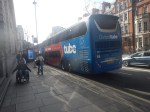




These are my thoughts.
Where Are The British Coaches?
The nearest I saw were the smart coaches of the Oxford Tube, which were built by Plaxtons on a Volvo chassis.
The National Express coaches were made by Caetano in Spain.
I can certainly understand, why Wrightbus’s first product of a new era of British coach-building is an affordable Chinese-built coach, that is fitted with a Cummins engine, that possibly can be converted to hydrogen, as is the case, with some Cummins diesel engines.
As the coach will have a delivery time of six months, I think we’ll see them on the road fairly soon.
There Were Several Three Axle Coaches
In fact, I didn’t know they were very common.
- I suspect that three axles is better for the weight.
- But then you don’t see too many coaches in Central London unless you go to Victoria.
Wrightbus are saying that their hydrogen coach will have three axles.
The Wrightbus Effect
This article on Route One, says of the new Wrightbus Contour coach.
- It will be released this year.
- It will be an affordable product and Chinese-built.
- It will be a 55-seat diesel coach.
- It will have a Cummins engine.
In Wrightbus StreetDeck Ultroliner Next-Gen To Get Cummins Power, I describe how Wrightbus’s new Cummins-powered double-deck bus will be able to be converted to hydrogen-power. I suspect the same option will be available with the Contour diesel coaches.
The article on Route One, says this about the availability of the new coaches.
The Contour’s “competitive price” and lead time of six months promises an edge over some current industry norms, the business says.
That fits with what my finance company found forty years ago, when it was leasing coaches. If there were more coaches, you could lease more.
It looks to me, that the Cummins-powered, Chinese-built Wrightbus Contour coach will be affordable, available and convertible to zero-carbon hydrogen power.
If the quality and reliability of the coaches are high, then these coaches should sell and more coach operators will be wanting to run services from Victoria coach station, with their new affordable Wrightbus Contour coaches.
After what I saw on Saturday, will Victoria coach station have the space to accommodate them?
Coaches To Attractions
I saw coaches to Harry Potter, Legoland and other attractions.
Will this be an area that develops, if there were to be a greater availability of coaches, which Wrightbus, appears to be offering?
FLiXBUS
This is the first paragraph of the Wikipedia entry for FLiXBUS.
FlixBus (styled FLiXBUS) is a German brand that offers low-cost intercity coach services in Europe, North America, South America, and Asia. It is owned by Flix SE , which also operates FlixTrain, FlixCar, Kâmil Koç, and Greyhound Lines. FlixBus operates buses or, in many cases, just handles marketing, pricing, and customer service for a commission, on behalf of bus operators. In 2023, FlixBus had revenues of €2 billion and carried 81 million passengers of which 55 million were in Europe, 14 million were in Turkey, and 12 million were in North America.
They certainly seem to be an ambitious low-cost company, who serve a lot of places in the UK.
As they are a German company and Wrightbus have sold scores of zero-carbon buses to Germany could Wrightbus and FLiXBUS have been talking about affordable, quality coaches?
Could Wrightbus’s New Hydrogen Coach Do A London Scotland Round Trip On A Full Load Of Hydrogen?
Victoria Coach Station And Edinburgh
I have just looked up on the National Express web site and found that I can leave Victoria Coach Station at 22:00 and arrive in Edinburgh at 07:40 the following morning for a ticket price of £29.90.
The road distance would appear to be 638.1 km, which would be a 1276 km round trip. So I would expect that, there would need to be refueling in the round trip.
Victoria Coach Station And Glasgow
I have just looked up on the National Express web site and found that I can leave Victoria Coach Station at 23:00 and arrive in Glasgow at 07:40 the following morning for a ticket price of £23.90.
The road distance would appear to be 652.1 km, which would be a 1300 km round trip. So as with Edinburgh, I would expect that, there would need to be refueling in the round trip.
A Refuelling Strategy
Consider.
- I would expect that a refuelling strategy would minimise, the carrying of large amounts of hydrogen, through the centre of London or any other conurbation.
- The Southern Uplands of Scotland already host a lot of wind farms, including the UK’s largest onshore wind farm at Whitelee, which has a capacity of 539 MW.
- An electrolyser to produce hydrogen is being developed at Whitelee, which is 32.8 km South of Glasgow.
- Newport Pagnell services is 86.5 km. from the Southern end of the M1.
- Toddington services is 62 km. from the Southern end of the M1.
I wonder if two refuelling points, say 50-100 km. from each end of the route, would be a safe an efficient way to fuel the coaches?
Some Services Between London And Scotland
They are in South to North order.
Toddington Services
Toddington Services is 62 km. from the Southern end of the M1.
This map shows the services.
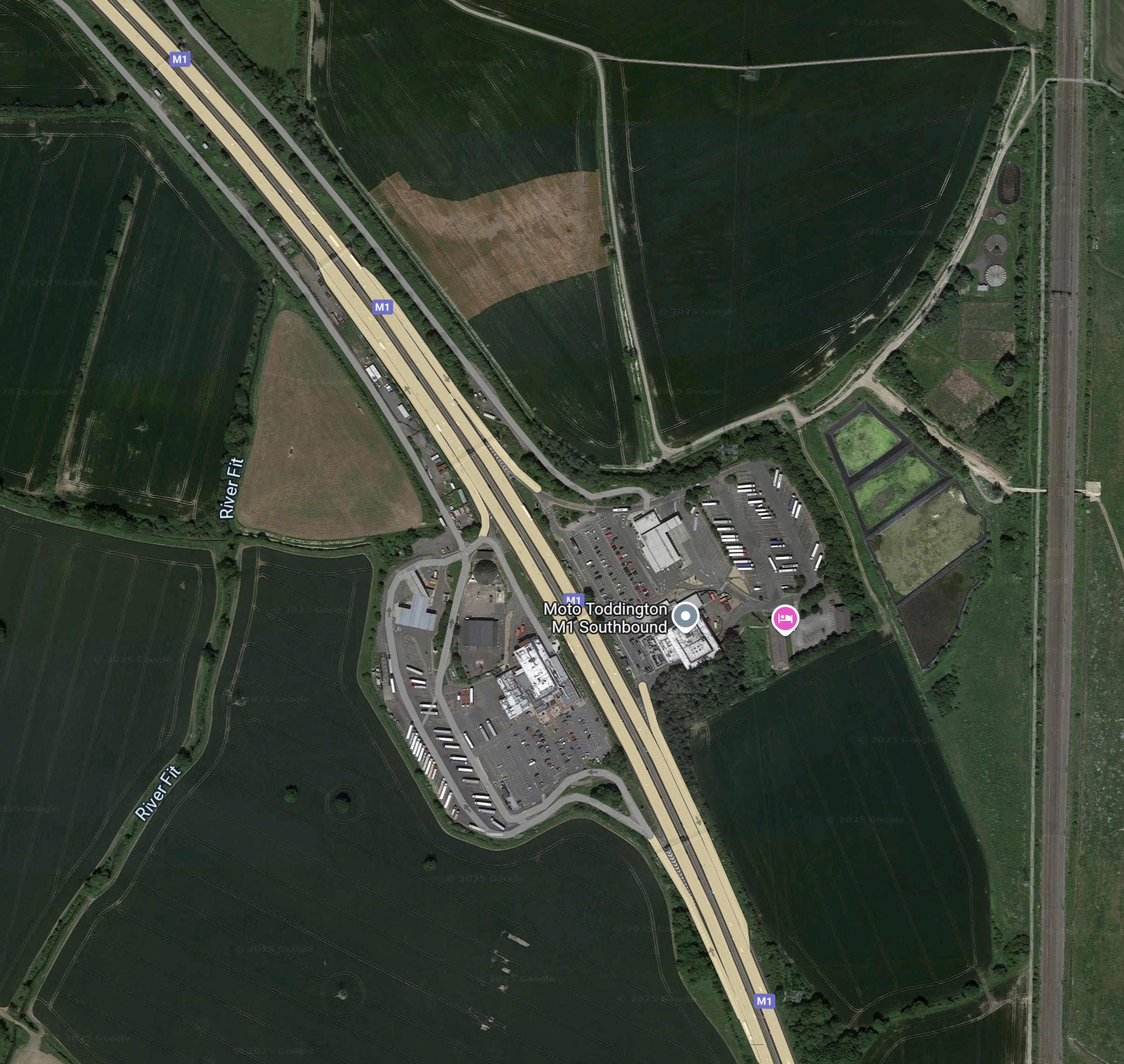
Note.
- There is land around the services that could be used to create more parking for hydrogen coaches.
- There doesn’t appear to be much space for a large wind farm to provide electricity to generate hydrogen.
- The Midland Main Line runs up the Eastern side of the map.
I wonder, if hydrogen could be brought to a refuelling site at Toddington services by the use of rail wagons.
Newport Pagnell Services
Newport PagnellServices is 86.5 km. from the Southern end of the M1.
This map shows the services.
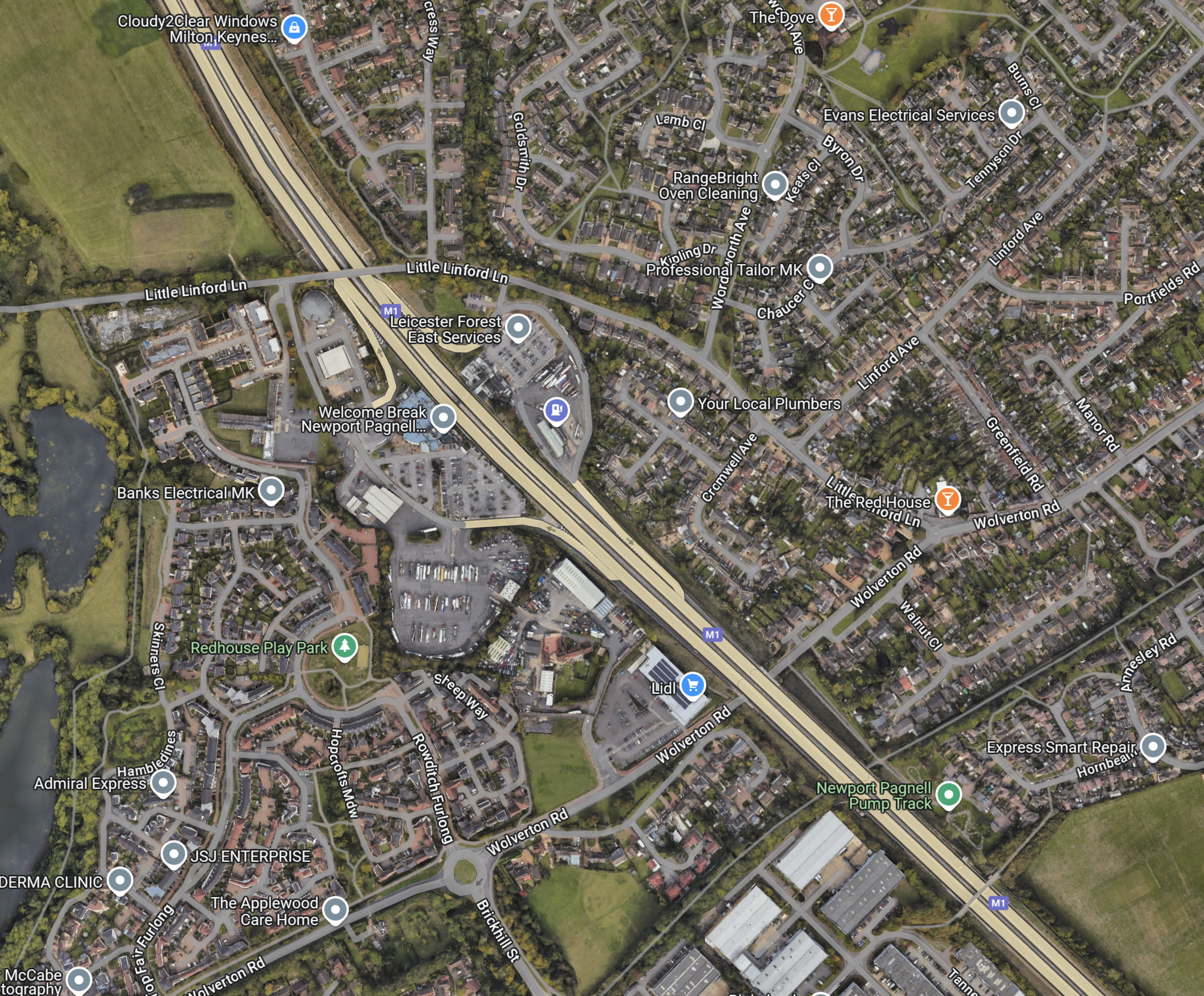
Note.
- The services are labelled as Leicester Forest East.
- The services are tightly surrounded by houses.
I’m not sure the residents would like to have a hydrogen refuelling station in their midst.
Northampton Services
Northampton Services is 104.5 km. from the Southern end of the M1.
This map shows the services.
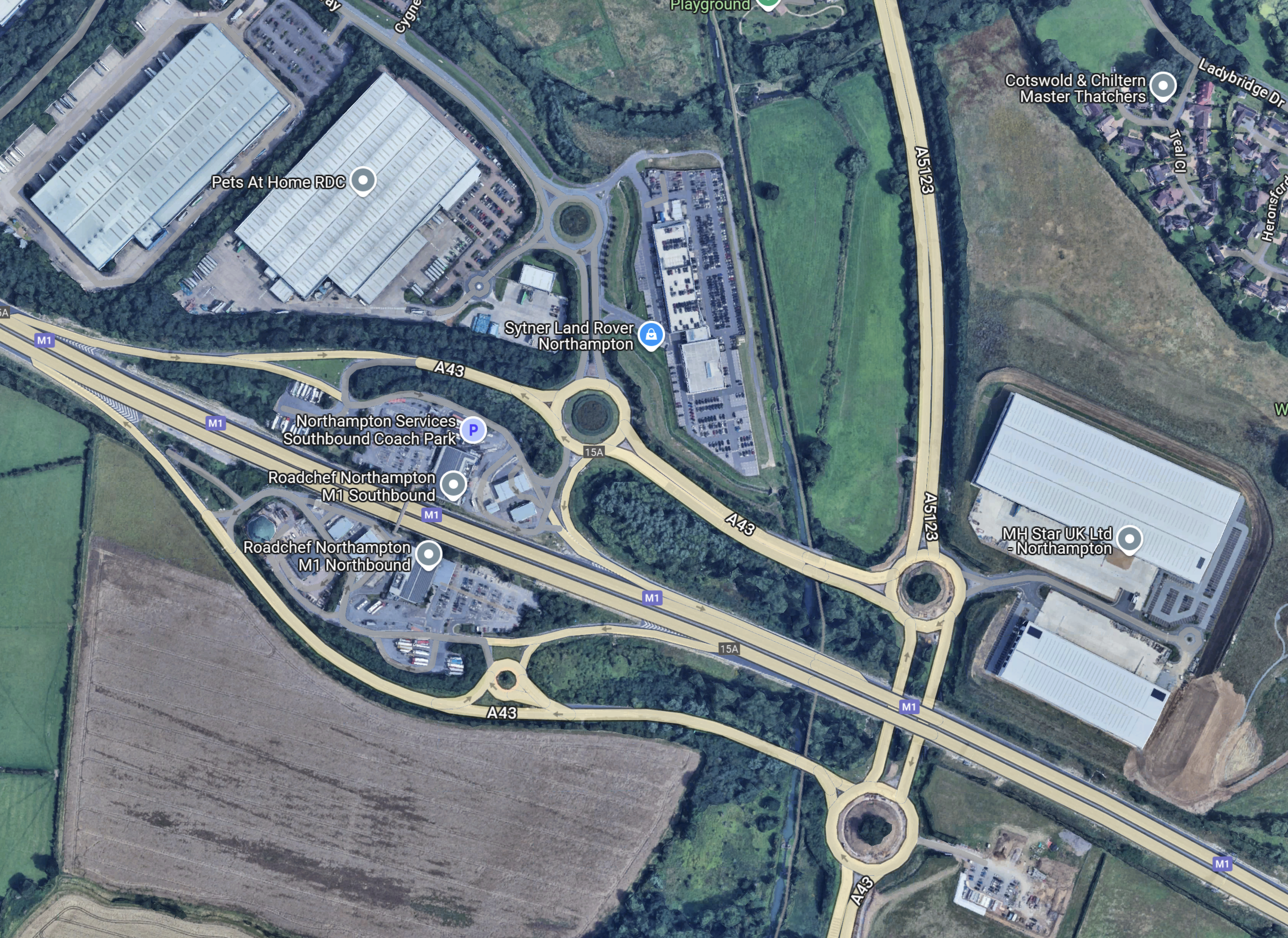
Note.
- It looks a rather complicated services.
- It might be too far from London.
- Provision of hydrogen might be difficult.
I think that this is another services that we can discount.
Watford Gap Services
Watford Gap Services is 120.8 km. from the Southern end of the M1.
This map shows the services.
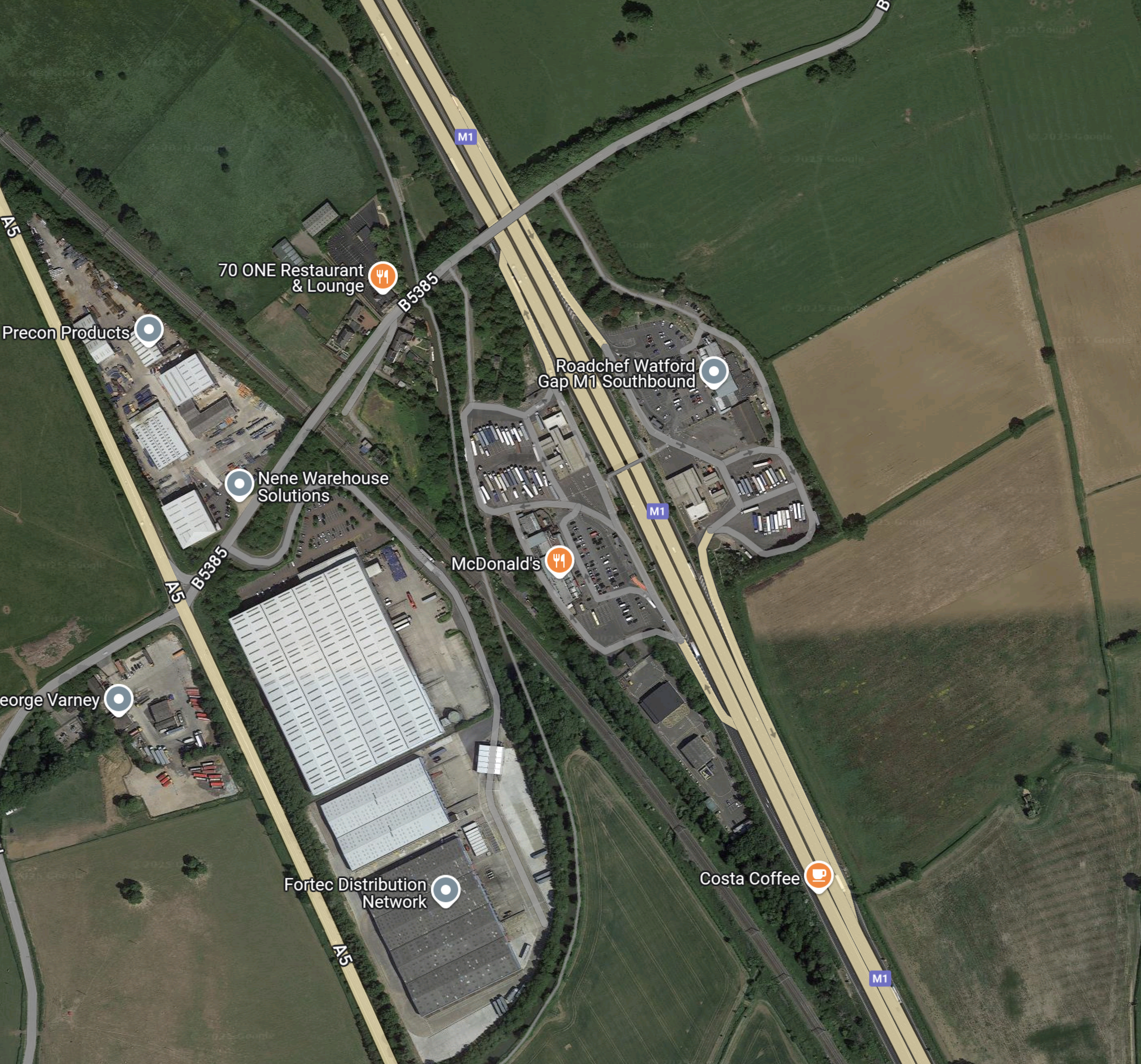
Note.
- There is land around the services that could be used to create more parking for hydrogen coaches.
- There doesn’t appear to be much space for a large wind farm to provide electricity to generate hydrogen.
- The West Coast Main Line runs through the centre of the services.
I wonder, if hydrogen could be brought to a refuelling site at Watford Gap services by the use of rail wagons.
Rugby Services
Rugby Services is 137.8 km. from the Southern end of the M1.
This map shows the services.
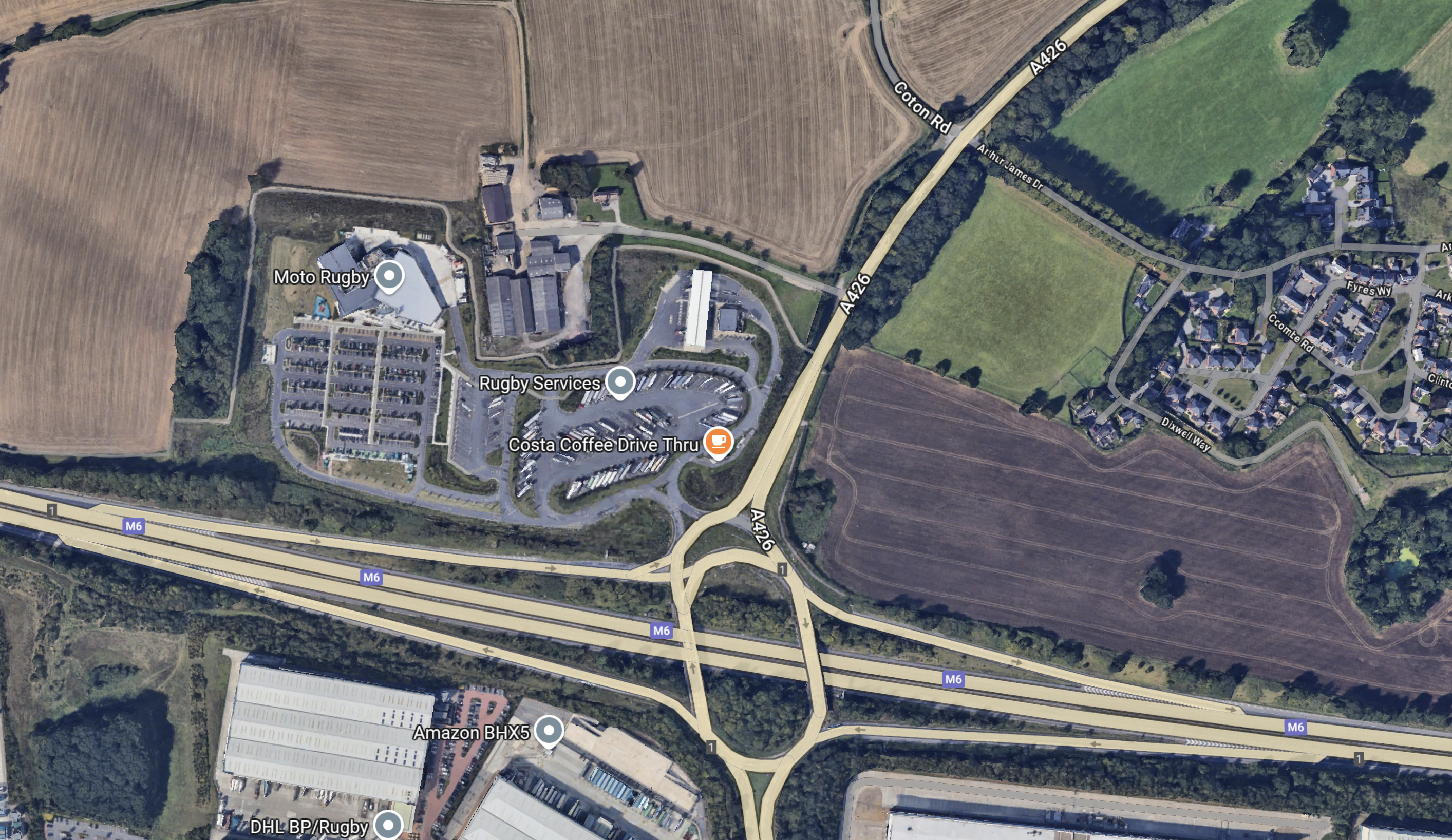
Note.
- There is land around the services that could be used to create more parking for hydrogen coaches.
- It is at Junction 1 of the M6.
There is also a gas compressor station nearby, so I wonder, if a HiiROC system could be located here to extract hydrogen from the natural gas.
This map shows the location of the Churchover compressor station, with relation to Rugby services.
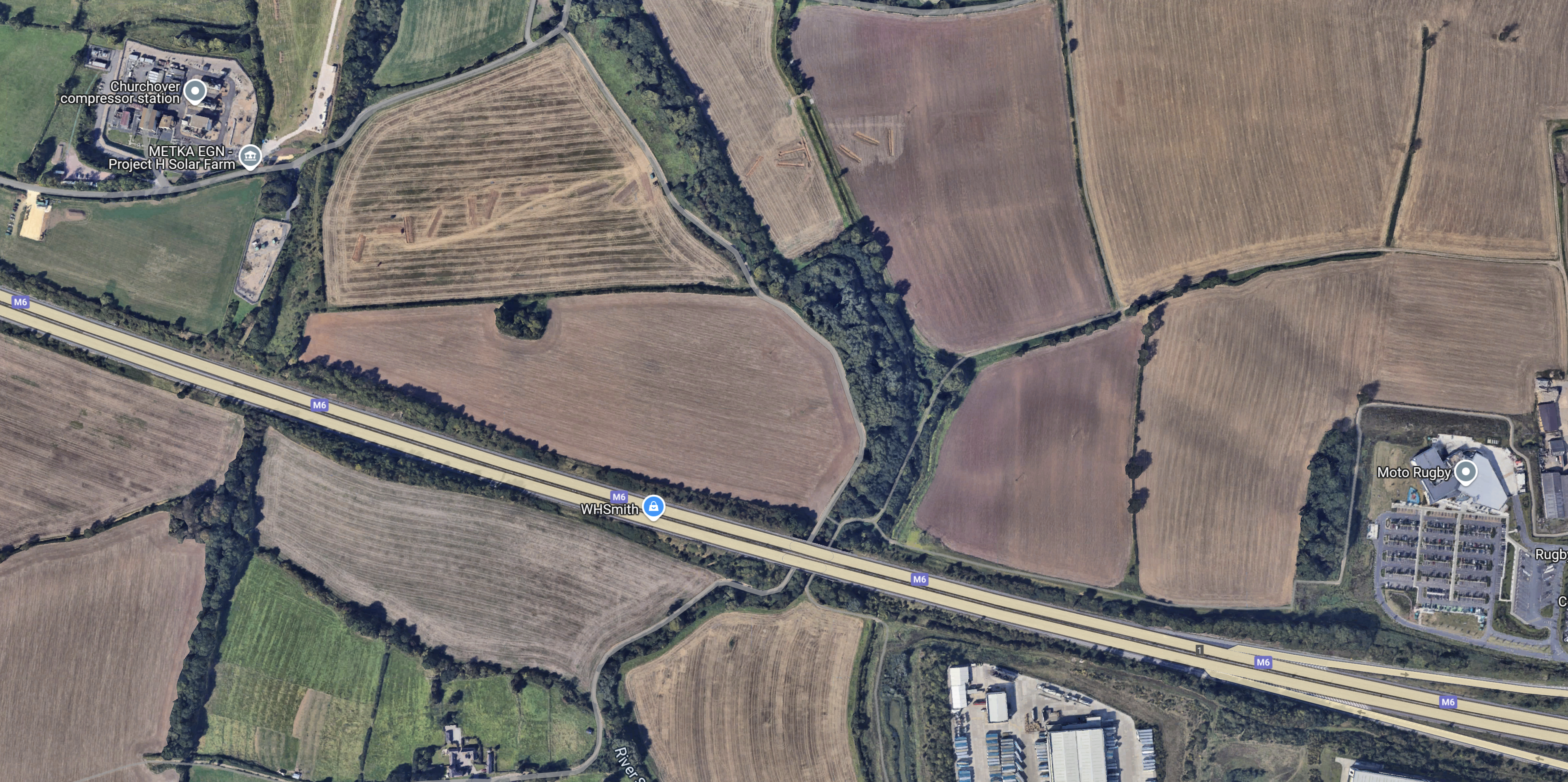
Note.
- The compressor station is in the North-West corner of the map.
- Rugby services are in the South-East corner of the map.
- From labels on the map it appears, a solar farm might be planned by the compressor station.
With a system like HiiROC creating turquoise hydrogen from natural gas, this could be a major filling station for hydrogen-powered trucks, coaches and cars.
Conclusion
It looks to me, that Toddington services would be best, but there would need to be a large increase in capacity, if a large number of hydrogen coaches, were going to fill up at Toddington for their trip into London.
The alternative would be to give the coach a large enough hydrogen tank for a complete round trip.
Heathrow Rail Link Project Could Be ‘Reopened’
The title of this post, is the same as that of this article on the BBC.
This is the sub-heading.
Network Rail has said plans for a rail link between the Great Western mainline and Heathrow Airport could still move forward if funding is found in the future.
These three paragraphs give the current status of the scheme.
The Local Democracy Reporting Service recently reported that the project had been put on hold.
It began in 2012 and involved proposals for a 4 mile (6.5km) rail link to allow train services from Reading and Slough in Berkshire to reach Heathrow using a tunnel.
The £900m scheme would allow people living to the west of Heathrow to travel direct to the airport, instead of having to go into London.
These are some other facts and my thoughts.
The All-Party Parliamentary Group (APPG) For The Western Rail Link To Heathrow
According to the BBC article, this has now been established and this is said.
Labour MP for Slough, Tanmanjeet Singh Dhesi, held a debate in parliament on the western rail link in April and established the All-Party Parliamentary Group (APPG) for the Western Rail Link to Heathrow, to make sure it “remains on the government’s agenda”.
He said the project had been “beset by delays and funding challenges” but still had “wide cross-party and local support”.
Parliamentary backing is surely a good thing.
The Current Scheme
The BBC article shows this map with a rail link connecting the Great Western Main Line to Terminal 5 railway station.
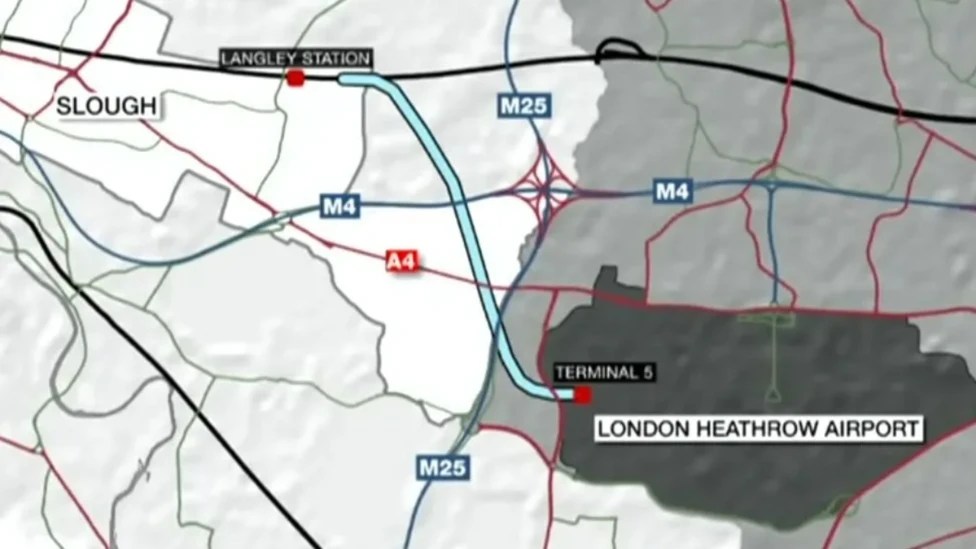
Note.
- The rail link starts from East of Langley station.
- Terminal 5 station can take full-length Elizabeth Line trains.
- Main line trains from Bristol, Cardiff and Wales and the West should be able to access Heathrow.
But I suspect, that there would be extensive changes to Heathrow’s railways to access the other terminals. This would explain the near billion pound cost of the link.
I also suspect that it would take about eight to ten years to build and from what I havc heard, the rail link is urgently needed.
RailAir
RailAir is the current way of travelling between Reading station and Heathrow Airport.
This is the first paragraph of RailAir’s Wikipedia entry.
RailAir describes a number of airport bus and coach services designed to connect the National Rail network to airports in the United Kingdom. Services are currently concentrated on Heathrow Airport, with one other from Luton Airport. RailAir services are operated as public transport services by or on behalf of train operators, where the whole journey is paid for as a through-ticket which combines the railway and bus journey, although journeys can be made using the bus only. As such, many are operated where the train and bus operator are owned by the same company.
Could RailAir be updated to be a more frequent and integrated service?
CoacH2
This page on the Advanced Propulsion Centre UK web site is entitled CoacH2 – Next Generation Hydrogen Fuel-Cell Coach Powertrain Demonstrator.
This is the sub-heading.
Accelerating the development of zero-emission hydrogen fuel-cell electric coaches, with a full on-vehicle technology demonstrator.
These are the first two paragraphs.
Coaches are an integral part of the public transport network, with over 30,000 diesel coaches operating across the UK and Ireland. Due to the specific demands of coach operation (motorway driving, long-range, high passenger and luggage loading capacity) decarbonisation options for this sector are extremely limited with hydrogen fuel-cell technology considered the most viable choice. This project will tackle this difficult to decarbonise sector by developing, testing and validating an innovative hydrogen fuel-cell powertrain suitable for coach applications.
Delivered by a Northern Irish consortium spanning OEM, coach operator and academia, CoacH2 will accelerate the development of zero-emission, fuel-cell electric coaches, with a full on-vehicle technology demonstrator to be manufactured and showcased at Cenex Expo 2024.
As I indicated in British Buses For British Bottoms, Wrightbus build a good well-built, smooth-riding and comfortable bus, so now they can add hydrogen-powered coaches to the product range.
This press release on the Wrightbus web site is entitled Wrightbus Coach Demonstrator Unveiled At Cenex Expo, gives more information on CoacH2.
- The demonstrator has a power of 300 Kw.
- It has a range of 1,000 km. on one refueling.
- An internet search reveals a launch date of 2026 for the hydrogen-powered coach.
I wonder, if RailAir changed their coaches to these new Wrightbus hydrogen-powered coaches, they would transform travel to airports all over the UK.
If the hydrogen-powered coaches are of the same quality of their hydrogen-powered siblings, they will be a quality product with good road-holding, sufficient performance and superb passenger comfort.
RailAir could be the ideal, initial application.
Conclusion
A proper rail link to Heathrow from Reading is needed, but it will take at least ten years to build and cost a billion pounds.
However the RailAir links to Heathrow from Reading and Woking can be improved by using high-performance Wrightbus hydrogen-powered coaches.
 The Anonymous Widower