How Do You Get Round This One, Donald?
This article from Global Rail News is entitled Request for California high-speed train parts to be exempt from domestic content rules.
This is said.
The California High-Speed Rail Authority (CHSRA) has requested several key components of its trains be exempt from the USA’s strict local content requirements because there is nowhere in the country that can currently manufacture them.
So what parts are involved?
It appears to be body shells, braking systems and bogies.
Aren’t they fairly crucial?
It’s Time To Look On The Bright Side Of Trump
This was the title of a comment by Matt Ridley in The Times yesterday.
He may not be everyone’s cup of tea, but I have read a couple of his books; Genome and Nature via Nurture and found they added to my knowledge.
This is a precis of his comment.
He starts like this.
So here, after a few days of talking to people in America’s two biggest economies, California and Texas, are ten reasons why I think a Trump residency may not be as awful as many think, even if, like me, you heard of the news of his victory with a sinking feeling.
The article has ten main sections.
- Just as after Brexit, the markets went up, not down. Despite the predictions of analysts.
- He is already watering down his more outlandish threats.
- The Presidency is nothing like as powerful a job as it seems.
- The Democratic Party will soon be back and hounding Mr. Trump, if only in the Courts.
- Mr. Trump is already surrounding himself with reasonably sensible people.
- Some of his policies are not so bad.
- His adviser on climate and energy, Myron Ebell, is right that climate change policy has become a gravy train for the rich that hurts the poor.
- The promised “swamp draining” – in the unlikely event Mr. Trump pulls it off – will be cathartic.
- His reprehensible attitude to women, minorities and the disabled, though setting a terrible example, is fortunately unlikely to result in actual persecution by the government.
- The idea that this is the end of democracy or the start of fascism, as some hyperventilating luvvies are saying, is nonsense.
Ridley finishes with.
If he really does kill the North American Free Trade Agreement, as well as the transpacific and transatlantic trade treaties, he will assuredly cause a recession that hurts blue-collar workers in the rust belt more than free trade ever did. And he might craqsh the world economy.
I can see few silver linings there.
Here are some quotes from the article I can agree with.
- Mr. Pence is a creationist and religious conservative, which is not my cup of tea.
- The House Speaker, Paul Ryan, is a formidable figure who will effectively decide how much of Trump’s programme will happen.
- Steven Mnuchin, the likely Treasury Secretary, is from Goldman Sachs, for goodness sake.
- If Mr. Trump unleashes more gas production, that will cut emissions and drive out coal faster than renewable energy ever could.
- Compared with many Republicans, Mr. Trump is positively liberal on matters such as abortion and religion.
- If Mr. Trump makes a mess of things, he will be gone in four years – or sooner.
If you get a chance to read the whole article, you should.
Mobile Signals
When I was on the excursion on Gran Canaria, that I wrote about in A Tour Of Gran Canaria, I was getting an excellent mobile signal all the way, despite at times being amongst mountains that were nearly two thousand metres high.
Yesterday, I was in Victoria station and I was trying to use the Internet to find out, where my train left. The Internet signal was like one of Donald Trump’s speeches – utter tripe!
I think for reasons of safety, that all train stations and bus stops, should have a top-rated mobile signal.
Some years ago, the office at my stud in Newmarket had a dreadful signal. So I pointed a parabolic aerial at the nearest mast and rebroadcast it in the office.
Problem solved!
If I was an MP, who won the right to put a Private Members Bill through Parliament, I would make it the law, that all bus stops and train stations had a mobile signal, of the same quality, I was receiving high up in the mountains of Gran Canaria.
Or are the Elite waiting until a fourteen-year-old girl is raped and murdered because she couldn’t phone her parents for a lift, after getting lost on her bicycle?
Seamless Interchangeability
At several places on the UK rail network, two trains running as a pair will split, with one train going to one destination and another going to another.
I wrote about trains splitting and joining in Trains Uncoupling and Coupling at Cambridge.
In the past, UK railways used to use the concept of slip coaches, so that coaches could be dropped from an express without stopping. But the last time it was used in the UK was in September 1960 at Bicester North station.
I have just read this article on the Rail Engineer web site, which is entitled Seamless Interchangeability.
The article talks about a concept of dynamic coupling, where trains are automatically coupled and uncoupled at line speed.
It also talks about the issues this would raise.
As a Control Engineer, I’m fairly certain, that it would be very easy to create a system, where say an eight-car Kings Lynn train could split just before Cambridge station, with the front four-car train going to Kings Lynn and the other four-car train stopping in Cambridge station.
It could either be done using two drivers or by driver-less trains. Although the unions would have a lot to say about the latter.
I also believe that if the trains could uncouple, then coupling at line speed would also be possible.
So what is the point?
An Example From The Brighton Main Line
To make full use of the capacity available, Southern serve Littlehampton and Ore, with a train that divides at Haywards Heath. It is a well-proven technique that has been used for decades.
Automatically splitting the two trains at line-speed, can give journey time advantages.
Take the 19:47 from Victoria, which arrives at Haywards Heath at 20:30 as an example.
The following is taken from the timetable.
- The front portion to Ore leaves at 20:34.
- The rear portion to Littlehampton leaves at 20:36.
- Stops at East Croydon and Gatwick Airport take about a minute.
This leads to the following, if the two trains split immediately after stopping at Haywards Heath and before the trains take different directions after Keymer Junction where the East Coastway Line divides from the Brighton Main Line, a few miles South.
- The Ore train performs a one-minute stop instead of one of four minutes, thus saving three minutes.
- The Littlehampton train performs a one-minute stop instead of one of six minutes, thus saving five minutes.
- The platform at Haywards Heath is only occupied for a minute, as opposed to six.
- The Littlehampton and Ore portions must be capable of providing enough capacity for their route.
For those worried about driver-less trains, the driver of the second train for Littlehampton, would probably step up at the previous stop at Gatwick Airport or at Haywards Heath.
But the outcome would be a small increase in capacity on the line, due to the platform at Haywards Heath being occupied for five minutes less.
Coming North, take the 09:47 from Littlehampton as an example.
The following is taken from the timetable.
- The first train arrives at Haywards Heath at 10:35 and leaves at 10:45.
- The second train arrives at Haywards Heath at 10:41.
The pattern of the trains would be different.
- Whatever was the front portion of the train would go through Keymer Junction first
- The train forming the rear portion would be the next train through the junction.
- The rear portion could catch the front portion and the two trains would be automatically coupled together before Haywards Heath.
- The joined train would stop at Haywards Heath for a minute.
- The driver of the second train could step-down at Gatwick Airport or Haywards Heath.
In some ways the mathematics involved in the coupling, are not unlike those for a fighter jet connecting with a tanker aircraft. Except that speeds are a lot lower and there is no need to control direction only closing speed.
Haywards Heath station would be occupied for up to nine minutes less, thus creating capacity.
This simplistic analysis, shows how automatically coupling and uncoupling trains at line speed can create capacity and decrease journey times.
- Journey time from Victoria to Ore would be reduced by three minutes.
- Journey time from Victoria to Littlehampton would be reduced by five minutes.
- In the Down direction the platform at Haywards Heath station would be occupied for just one minute instead of six.
- Journey time from Littlehampton to Victoria would be reduced by nine minutes.
- Journey time from Ore to Victoria would be reduced by three minutes.
- In the Up direction the platform at Haywards Heath station would be occupied for just one minute instead of ten.
Obviously strategies would have to be developed for various eventualities including.
- Unsuccessful coupling or uncoupling.
- Late trains.
- Signalling and train failures.
- Leaves on the line.
- Extreme weather.
But as during all coupling and uncoupling operations, both trains would have a driver in the cab, keeping an expert eye over the procedure and each train could be driven independently, I think all safety issues could be overcome, to the satisfaction of all parties.
If you read the full article, you’ll see that there are some much more exciting possibilities, than the simple ones I have outlined here.
But I do believe that line speed uncoupling and coupling of trains with a driver in the cab of both trains involved, can be a very powerful tool in creating capacity on the UK’s railways.
The Great Eastern Main Line
I know the Great Eastern Main Line well and several trains are coupled and uncoupled regularly on this line.
As Greater Anglia has ordered new five-car Aventra trains and nearly all platforms can take 12 -car trains, running these trains in pairs and coupling and uncoupling appropriately, is probably in their plans for the line.
As on the Brighton Main Line, could coupling and uncoupling at line speed, unlock capacity on the line?
A few weeks ago, I caught a train from Chelmsford to Manningtree, that divided at Colchester, with the front four-car train going to Clacton and the rear four-car train going to Harwich.
The 16:44 from Liverpool street is a train that divides at Colchester, when it arrives at 17:40. These timinings are from the timetable.
- The Clacton portion of the train leaves at 16:44.
- The Harwich portion of the train leaves at 16:47.
As the Sunshine Coast Line for Clacton leaves the Great Eastern Main Line immediately after Colchester station, it would appear that the two trains must uncouple during the stop at Colchester.
Surely, an improved and well-designed automatic uncoupling system could separate the trains faster, saving minutes on both services.
Towards London, two trains leave Harwich and Clacton at 07:16. The timetable shows.
- The Harwich train arrives at Colchester at 07:47 and leaves at 07:54.
- The Clacton train arrives at Colchester at 07:50 and leaves at 07:54.
Surely, an improved coupling system, could join the trains faster, saving minutes on both services.
The time savings will not be as great as those at Haywards Heath, but automatic coupling and uncoupling must be a worthwhile feature of the new trains.
|As Bombardier are adding automation to the Aventra, could they be adding the ability to automatically couple and uncouple trains, both in the station and at line speed?
The West Coast Main Line
I have seen Class 221 Trains, join at Crewe, but I don’t think this is done any more.
However, with the need for direct services from London to places like Blackpool, Burnley and Huddersfield, the ability to be to couple and uncouple trains quickly must be something that would be useful to make optimal use of the valuable train paths on the line.
The East Coast Main Line, Midland Main Line, Great Western Main Line And South West Main Line
If the West Coast Main Line could benefit, then surely these lines could as well.
Class 800/801 Trains
The Class 395 train is very much related to the Class 800 and Class 801 trains, that are being built by Hitachi for the East Coast Main Line, Great Western Railway and other routes.
In The Impressive Coupling And Uncoupling Of Class 395 Trains, I talked about the design of the coupling system for the Class 395 trains.
I would be very surprised if this feature was not incorporated in the Class 800 and Class 801 trains.
So will we be seeing two five-car Class 800/801 trains dividing and joining at a convenient station and then running as a ten-car train to and from London?
Class 385 Trains
What about the Class 385 trains for Scotland?
- These are another version of Hitachi’s A-Train, like 395s, 800s and 801s.
- These will come in two lengths; three-car and four-car.
- Edinburgh-Glasgow services will need at least two units to be coupled together.
- The trains are being introduced from Autumn next year.
It seems to me, that Scotrail are acquiring a very flexible fleet that can run in various lengths.
Will they have the ability of the 395s to couple and uncouple in under a minute?
And if they do, will Scotrail use this ability to adjust train formation to the traffic?
Aventras
There are three definite orders for Bombardier’s new Aventra train at the present time.
- Class 345 trains for Crossrail.
- Class 710 trains for London Overground.
- Five and ten car units for Greater Anglia.
All trains are fixed formations in a mixture of lengths.
Will Aventras have similar coupling and uncoupling performance to Hitachi’s Class 395 trains?
I suspect normally, the Crossrail trains will never be coupled together, as where are platforms for a four-hundred metre long train?
But suppose a train fails in the central tunnel, will the quickest way to remove it, be to attach it to another train and drag it out?
The routes where the London Overground trains will run, are currently served by a mixture of four-car and eight-car trains. So will London Overground, adjust train length to the known traffic patterns?
Greater Anglia do couple and uncouple trains at present to serve Harwich. So I suspect, we’ll see use of an automatic and fast coupling and uncoupling feature to create a more efficient timetable.
Cross City Lines
There are several cross-city lines in the UK.
- Cross-City Line – Birmingham
- Crossrail
- North Berwick Line – Edinburgh
- Northern Line – Merseyrail
- Snow Hill Lines – Birmingham
- Thameslink
One of the characteristics of cross-city lines, is they are busiest in the centre of the city, where passengers tend to use the trains for short hops , as well as longer distances. Then in the suburbs, outside of Peak hours the trains could run almost empty.
Crossrail’s trains are designed so that hopefully they could cope with the variable traffic, but would it be possible to have half trains, which join and split at outer stations.
Thameslink
I think that Thameslink could be the line that might benefit most, as it would probably want to serve more places.
In All Change On Thameslink, I detailed the current proposed schedule of trains.
- 4 trains per hour (tph) – Sutton to St. Albans (2 tph via Wimbledon, 2tph via Mitcham)
- 2tph – Brighton to Bedford
- 2 tph – Three Bridges/Gatwick Airport to Bedford
- 2 tph – Brighton to Cambridge North
- 2 tph – Horsham to Peterborough
- 2 tph – Maidstone East to Cambridge
- 2 tph – Sevenoaks to Blackfriars
- 2 tph -Orpington to Kentish Town/West Hampstead
- 2 tph – Rainham to Luton (via Dartford and Greenwich)
- 2 tph – East Grinstead to Bedford
- 2 tph – Littlehampton to Bedford
This makes a total of twenty-four tph, which is the design limit for the central tunnel.
In this schedule 4 tph go to Cambridge and 2 tph go to Peterborough. Suppose, it was decided that Peterborough needed 4 tph.
The path limit of 24 tph through the central tunnel makes this impossible, but if Peterborough and Cambridge services joined and split at perhaps Stevenage, then both Cambridge and Peterborough would get 6 tph through the core tunnel.
It would need new six-car trains, that could couple and uncouple quickly.
Conclusion
I believe that improving the coupling and uncoupling of all modern trains to the standard of that of the Class 395 trains could be very beneficial, to train operators, staff and customers.
If coupling and uncoupling could be done at line speed, this might bring extra benefits.
Battersea Power Station Station – 14th November 2016
I was on a train between London Victoria and Brixton stations, when I took these pictures.




They show the spoil conveyor and the site of the new Battersea Power Station station.
Rail Lines In The Battersea Area
This map from carto.metro.free.fr shows the various lines in the area.

Rail Lines In The Battersea Area
Note.
- The lines from Victoria splitting into two groups.
- The Western group, managed by Southern, goes to Battersea Park and Clapham Junction stations
- The second group, managed by Southestern, goes via Brixton to the South East.
- The lines going across are manged by South West Trains and go between Waterloo and Clspham Junction.
Complicated would be a good description
The Connection To Battersea Park Station
According to Wikipedia, there will be an out-of-station interchange between Battersea Power Station and Battersea Park stations.
I hope that when they reburbish the Grade II Listed Battersea Park station, they do it properly to create an interchange between the 10 trains per hour (tph) through the National Rail station and the upwards of 15 tph through the Northern Line station.
It is interesting to note, that plans for the Northern Line Extension could take it to Clapham Junction station, which is the first station for all the 10 tph, that start from Victoria and call at Battersea Park station.
So has the design of the extended Northern Line, achieved the objective of having a simple connection to Clapham Junction?
A New Station For Battersea
In A New Station For Battersea, I wrote about a proposal to create another Battersea station on the Southeastern lines.
I like this idea.
- It effectively gives Victoria station, a connection to a terminus of the Northern Line.
- It could be considered to make Victoria station, London’s second cross-river station.
- It could have more than just the odd parliamentary train to Dalston.
It would be even better, if Battersea Park station was rebuilt with escalators and lifts to make it step-free.
Where Will Madame Tussards Put Their Donald Trump?
The BBC in London are reporting, that Madame Tussards are creating a new waxwork of Donald Trump.
I was wondering, where they would put it!
Vote Early! Vote Often!
Do We Sometimes Misjudge The Consequence Of New Railways And Roads?
I ask this question after reading this article in the Hawick News, which is entitled Calls for extension of Borders Railway to Hawick building up fresh head of steam.
It was this phrase that worried me.
“Hawick businesses are feeling the impact of a one-way ticket that is seeing local shoppers travel from Tweedbank to all points north without any reciprocal arrangements.
It looks like building the Borders Railway has hurt businesses in Hawick. And what about other places in the area like Selkirk?
I think we’ve seen this before in other places.
Where I live near Dalston Junction station, has seen a massive uplift, since the creation of the East London Line. It was in some ways predictable, but I don’t think Transport for London expected the uplift that happened.
Our predictions, were never good in the past, but they don’t seem to be improving.
I wonder how far out predictions will be for Crossrail/Thameslink?
Consider.
- Crossrail and Thameslink working together will make a lot more journeys single change.
- Crossrail has good connections with the East London Line.
- Crossrail gives much improved access to the Bakerloo and Northern City Lines.
- Crossrail/Thameslink gives much improved access to Canary Wharf, the City of London, Gatwick Airport, Heathrow Airport, Luton Airport and Oxford Street in the centre of the cap[ital.
One consequence I see, is that those with Freedom Passes like me, will use the new free railways to advantage.
Roll on 2018 and 2019!
I’m Voting For Balham
There is a controversy as to whether Crossrail 2 should call at Balham or Tooting Broadway stations on the Northern Line. There is even a website called Crossrail 2: Balham Or Tooting? This is said.
Our local station had been planned at Tooting Broadway, but Transport for London (TfL) has discovered difficult ground conditions under Tooting and is thinking of moving the station to Balham.
Tooting was originally chosen as it is more in need of the economic boost and better rail connectivity that Crossrail 2 will bring. However, by moving the station to Balham the cost of Crossrail 2 will be less and surface disruption during construction will be reduced.
I went to Balham station today, as I needed to get a train to Victoria after my walk in Kennington. That may seem strange, but the Victoria Line wasn’t running.

Balham Station
So why am I voting for Balham?
- I have talked to one of TfL’s engineers and he convinced me about the ground conditions at Tooting.
- Tooting would give good connections South on the Northern Line, which I already have from Angel.
- Balham could be developed into a larger four-platform station with multiple connections.
In my mind though, Balham will always be the Gateway to the South.
But we all know that the objections to Balham, are because it would shut the Waitrose.
Don’t Get A Mask To Rob A Bank – Just Buy The App
This is the title of an article in The Sunday Times.
It talks about an App called Blackshades, that can be bought for three hundred pounds, that enables a thief to seize control of a victim’s computer and steal their passwords.
Hopefully, I’m protected but it’s a frightening concept. My passwords aren’t stored on the computer, but in my Mark 1, 1947-vintage core store, which is the safest place for them.
It also says that infiltrating a smart-phone or tablet can be easier than targetting desktops, saying that many criminals set up malicious hotspots in public places.
For that reason, I only use wi-fi in trusted locations and usually have it switched off on my smart phone. I never use wi-fi that wants my e-mail address as giving it usually ensures, I’ll get marketing e-mails, which I class as spam.
I also check my bank account and credit cards every day or so, so that if I’m robbed, I know it first.
From what I can ascertain, I think that contactless payments are pretty safe, especially in London, where there are billions of transactions because of public transport.
So I use contctless wherever I can locally!
A Walk Between Kennington And Oval Tube Stations
I walked this morning between Kennington and Oval tube stations.





Note.
- The aim was to see if I could find any sign of the construction of the Northern Line Extension.
- I walked along Kennington Park Road and then cut into Kennington Park.
The work site at Kenngton Park, was not difficult to spot on the Kennington Park Place side of Kennington Park.
- Many of the sites for Crossrail are very cramped, but at least this one seems to surrounded by grass, that can be very easily restored.
- All the noise-generating equipment is encased in a large acoustic enclosure, as twenty-four hour working is envisaged.
The park also contains the Prince Consort Lodge, which looks to be an interesting Victorian architectural experiment.
This Google Map shows the two stations and Kennington Park.
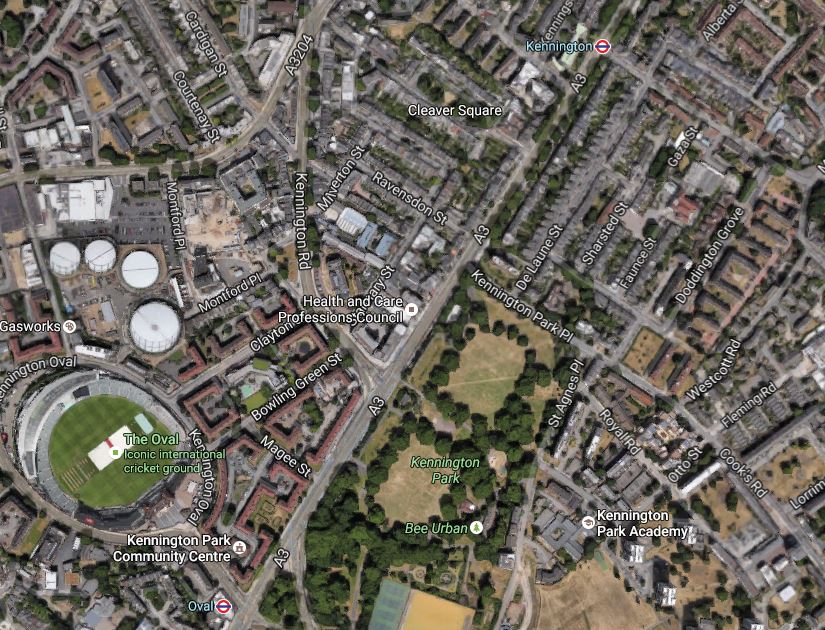
Kennington And Oval Tube Stations And Kennington Park
This Google Map is an enlarged one showing both the work sites at Kennington Park and Kennington Green.
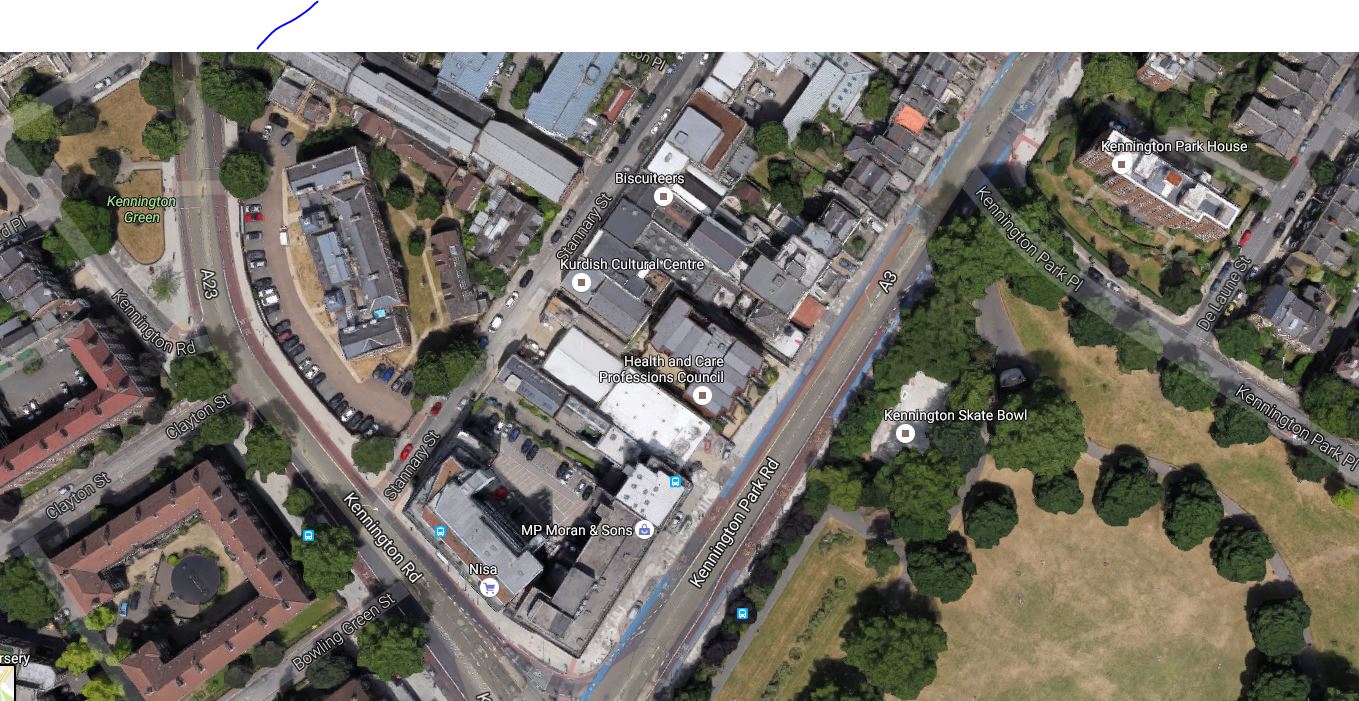
Kennington Green And Kennington Park Work Sites
This map from carto.metro.free.fr, shows the Northern Line through the area.

Lines Through Kennington And Oval Tube Stations
Note.
- The Northern Line was probably dug under Kennington Park Road, which is labelled as the A3.
- Kennington Park is on the Eastern side of Kennington Park Road.
- It looks like the Kennington Loop crosses Kennington Park Road very close to Kennington Park Place.
- Extrapolating being the two maps and reality, should give you the position of the shaft, with respect yo Kennington station.
- There’s more on what is happening here on this web page on the TfL web site.
Reading the documents on the TfL web site, it is now clear how the tunnels will be dug.
- Tunneling will start from Battersea and the tunnel boring machines will be lifted out at the two work sites; Kennington Green and Kennington Park.
- The running tunnel between the Kennington Green shaft will be 211 m. long and should be complete in December 2016.
- The running tunnel between the Kennington Park shaft will be 75 m. long and should be complete in October 2016.
- Both these short tunnels will be dug by traditional methods and lined with sprayed concrete.
At least Google doesn’t seem to be able to find any recent complaints.
Pictures Of The Kennington Green Site
A couple of days later, I went to the Kennington Green site and took these pictures.


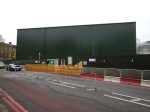

It’s just an anonymous and very professional large green acoustic screen.
 The Anonymous Widower