Could London Introduce Lifts With Inbuilt Ticketing?
Use the Underground or the trains in London and you have to have to touch in and out with your contactless ticket, Oyster card, smart phone or Freedom Pass.
Suppose you want to put lifts into a station, where putting the lift inside the ticket barriers would be difficult, but perhaps putting it outside on the street would be easy.
This technique has been used at Bank station to provide step-free access to the Docklands Light Railway.


When I called the lift to enter the station, the lift was sent by an operator in the Control Room.
So why not combine an outside lift with the ticketing?
Perhaps to call the lift, you need to touch in or out?
Authorities Plan Joint Tram-Train Procurement
The title of this post is the same as that of this article in Global Rail News.
This is the first paragraph.
Several European transport authorities are planning to work in partnership to procure new tram-trains in order to bring down the cost enough to make the transport mode more commercially viable.
This later paragraph gives the members.
The new association includes Karlsruhe’s transport authorities, Albtal-Verkehrs-Gesellschaft (AVG) and Verkehrsbetriebe Karlsruhe (VBK), Saarland tram-train operator Saarbahn Netz, Kassel operator Kasseler Verkehrs-Gesellschaft, Upper Austria’s Schiene Oberösterreich, Erms-Neckar-Bahn and Regionaltangente West in Germany’s Rhine-Main area.
I hope Network Rail keeping a watching brief!
After all, the Class 399 tram-train being trialled in Sheffield is a 25 KVAC version of the tram-trains used in Karlruhe, where the main line voltage is 15 KVAC.
This picture shows a Class 399 tram-train in Sheffield.

This is one of Karlsruhe’s similar tram-trains.

There are some cosmetic differences and the German tram-trains have a coupler for multiple working.
Surely, any initiative for a standard European tram-train, that could work all over the Continent would bring benefits.
- Prices would probably be more reasonable.
- Solutions and problems could be shared.
- \setting up a new tram-train line should become easier and more affordable.
Having travelled extensively on Karlsruhe’s tram-train network, it would appear that they are using not only the tram-trains, but several other ideas in Sheffield.
Different Voltages
Overhead line voltages vary across Europe.
- 15 KVAC is used in Germany
- 1,500 VDC is used in The Netherlands and for some local networks.
- 25 KVAC has become an international standard and is generally used for high speed lines.
Surprisingly, all our overhead electrification used on railways is 25 KVAC. All other systems have been either replaced or closed.
All these different voltages can be handled by a good electrical system on the tram.
This will handle the problem ehere a route runs between two areas or countries with different voltages.
Changing From Tram To Train Mode And Vice-Versa
In Karlsruhe this is performed by connecting the two systems together with a cermaic rod in the catenary to separate the voltages.
Tram-trains just drive across, with perhaps some battery assistance.
I suspect Sheffield are using a similar method to Karlsruhe.
Platform Height
If the tram-trains are to have level access, as most low floor trams do these days, then platform height can be a problem.
Trams generally have low platforms as this picture from Tramlink shows.
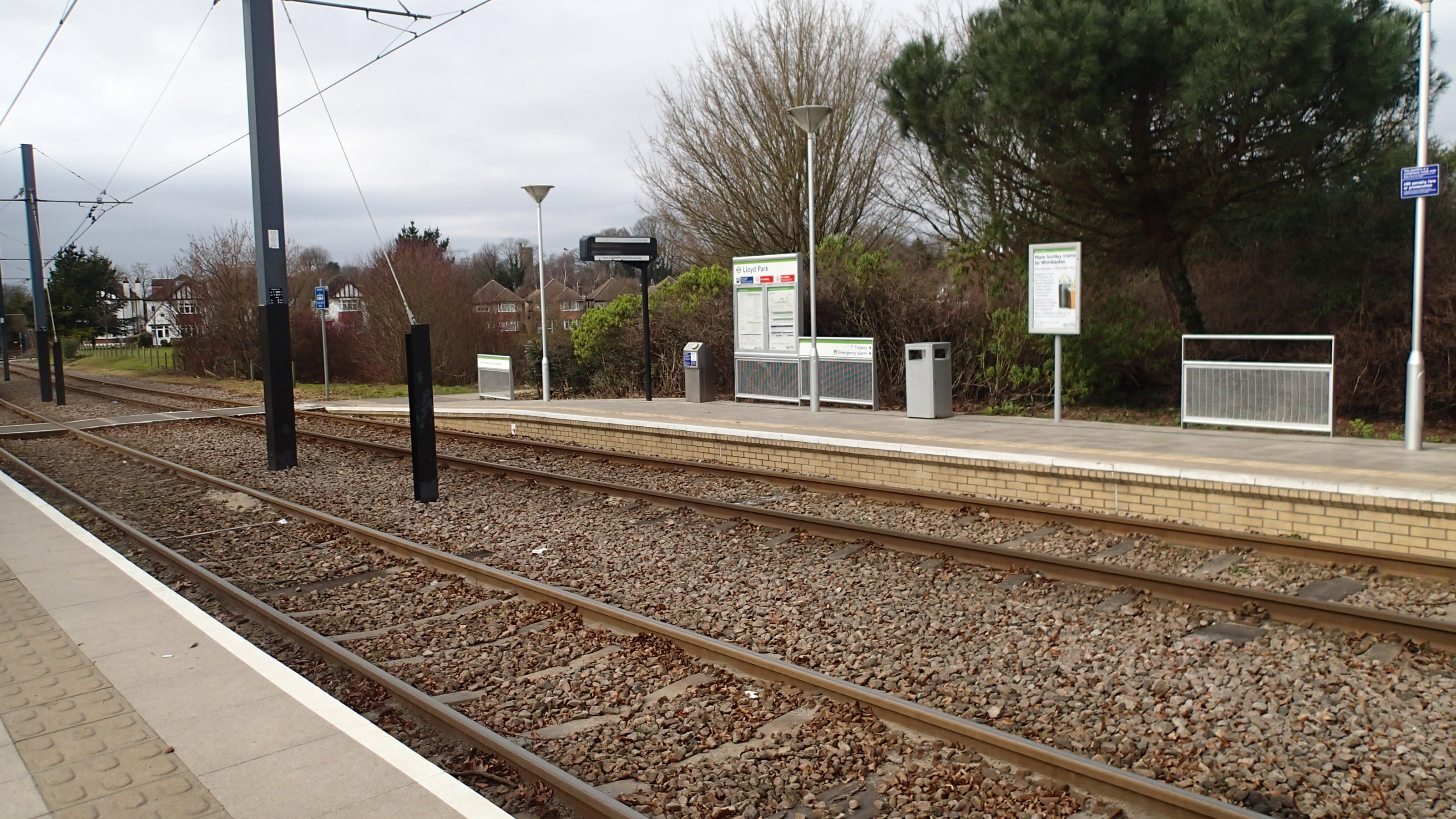
On the Continent, the main line platform heights are often simiar, so level access can be easy.
But in the UK, platform heights are generally higher. The problem appears to be being solved at Rotherham Central station by means of dual height platforms. This technique is used in Karlsruhe.
The article says this about platform height.
VDV has said the tram-trains will be available as two or four-door vehicles and will be able to meet different platform heights and maximum axle loads.
So hopefully, it will be one size fits all!
Karlruhe
This is a paragraph from the article.
AVG and VBK would receive more than half of the new vehicles under the arrangement. AVG said it had already been approached by other transport companies interested in adopting the so-called Karlsruhe model tram-train system.
Karlsruhe certainly seem to be leading this project, in more ways than one.
The Sheffield tram-train trial could be said to use the Karlsruhe model.
Conclusion
I believe that nothing I have seen on the various tram-train systems, I have visited, would stop a common tram-train that worked being developed.
This must lead to the development of a lot more tram-train systems.
Talgo Explores Options For Building UK Test Track
The title of this post is the same as that of this article in Rail Magazine.
This is the first paragraph.
A new UK test track, available to all companies, is being proposed by Spanish manufacturer Talgo as it looks to develop its standing in this country.
It is interesting that the ttrack will be available to all companies, but probably a sensible decision.
- Hitachi have been testing some of their new Class 385 trains in Germany.
- Porterbrook have been testing the new Class 769 train on the Grand Central, which is a herotage line.
So perhaps we do need another convenient test track!
As Talgo are bidding to make trains for HS2, the test track will probably need to be a bit longer than the thirteen miles of the cuirrent Old Dalby Test Track.
The First Hydrogen Trains Have Been Ordered
This article on Global Rail News is entitled Alstom Confirms Orders For Its Hydrogen-Powered Coradia iLint.
There is also this Press Release on the Alstom web site, which gives a lot more details.
Given that this is a real order worth millions of euros, I think we can assume that another practical motive power source for trains has arrived.
One interesting point is that the deal involves the Linde Group, who are the world’s largest industrial gas company.
Tunnelling Complete On Northern Line Extension
The title of this post is the same as that of this article on Global Rail News.
This is said in the Wikipedia entry for the Northern Line Extension To Battersea.
The main tunnelling started in April 2017.
So as it’s now November 2017, the tunnellers have performed like a Jack Russell after a rabbit.
I do think that this excellent performance might give Transport for London ideas for some new passenger or train tunnels under London.
Riding On A Battery-Electric Double-Deck Bus
This morning I rode on a battery-electric double-deck bus.
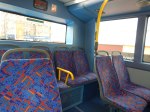


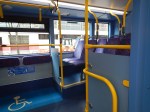

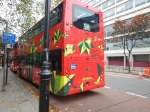

Some of these buses are russing on route 98 between Holborn and Willesden Garage, which includes a run down Oxford Street.
There’s more on the buses in this page on the Metroline web site.
I went upstairs and the experience was little different to that of a normal hybrid bus.
My Thoughts
My thoughts in various areas.
Design
It is a well-designed bus, that is easy to use for this seventy-year-old.
Passenger Experience
Travelling along Oxford Street, the passenger experience was equal to that of a New Routemaster, without the occasional low noise of the engine.
Performance Of The Bus
As we proceeded along Oxford Street, the performance of the bus, was very much in line with current hybrid buses.
The bus wasn’t full on the upper deck, but I suspect that the total weight of the passengers is very much lower than the weight of the battery, so this might mean that a full bus performs well compared with an empty bus.
Limited Space On The Lower Deck
There is one obvious problem and that is that the size of the battery reduces the number of seats downstairs.
As I said earlier, I doubt the weight of the passengers is a problem, but the available space, where they sit and stand could be.
Economics Of The Bus
The bus will obviously be expensive to purchase and to run, as batteries are expensive and need to be replaced every few years.
Coupled with the fact that capacity is smaller than current hybrid buses, which probably means more buses are needed to perform the required service, the economics of the buses may not be suitable for many routes.
I also wonder, if a battery-electric double-deck bus has better economics than a single-deck bus, as the extra weight of the top deck and the extra passengers is small compared to the weight of the battery.
But the economics will get better with improved battery technology.
The Marketing Advantages
BYD and Metroline could be big winners here, as corporate videos and marketing material showing buses in Central London, can’t be a bad thing!
The Competition From Diesel Hybrid Buses
I believe that one competitor to the battery-electric bus will be the next generation of diesel hybrid buses.
Take the current modern hybrid buses like a New Routemaster or any other hybrid bus built in the last couple of years. These have a battery that can power the bus for perhaps a couple of miles.
As the battery is smaller, it can be squeezed into an unlikely space. On a New Routemaster, the diesel engine is under the back stairs and the battery is under the front stairs.
A technique called geo-fencing can be retro-fitted, which forbids the use of the buses diesel engine in sensitive areas, based on GPS technology.
So a route like London’s route 98 could work through the ULEZ on battery power and charge the battery between Edware Road station and Willesden Garage.
The Competition From Hydrogen Hybrid Buses
This will surely be similar to that from diesel hybrid buses.
- Battery size will probably be as for a diesel hybrid bus.
- As hydrogen doesn’t give out noxious emissions, this will be an advantage and you won’t need the geo-fencing.
- But you will need to store the hydrogen.
As hydrogen technology improves, I feel that the hydrogen hybrid bus could become a formidable competitor.
The Competition From Converting Old Diesel Buses To Diesel Hybrid Buses
I talked about this in Arriva London Engineering Assists In Trial To Turn Older Diesel Engine Powered Buses Green.
Never underestimate good engineers with a good idea, that has a good financial payback.
Conclusion
There is going to be a lot of competition between the various technologies and the passengers, bus operators, London and London’s air will be big winners.
As all of this technology can be applied anywhere, other parts of the UK will benefit.
Government Delays Silvertown Tunnel By Six Months
This article on City AM is entitled Government Delays Silvertown Tunnel Decision By Another Six Months Over Air Quality Concerns.
The decision on the Silverton Tunnel will now be made in May 2018.
But surely this is too early.
- The Elizabeth Line will open between Abbey Wood and Paddington stations in December 2018.
- The Elizabeth Line will open between Shenfield and Paddington stations in May 2019.
- Thameslink will open between Kent and Central London via London Bridge in May 2018.
- The ULEZ becomes operational in April 2019.
I would have thought that the decision should be made after the effects of these changes have settled down.
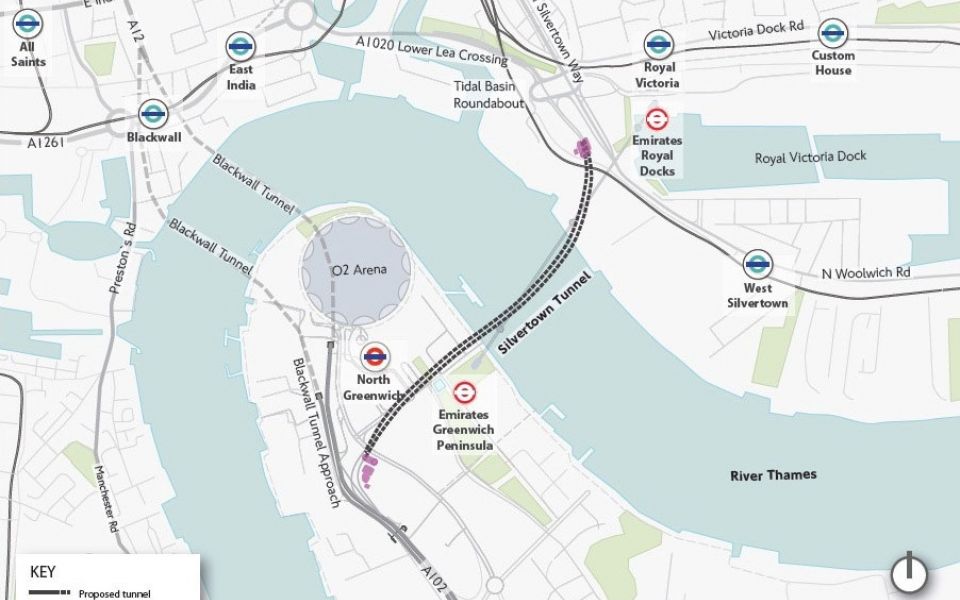
This map shows the route of the tunnel.
Will any other public transport developments reduce the urgency for the tunnel?
London City Airport Crossrail Station
Under New Stations, the Wikipedia entry for Crossrail says this about a station at Silvertown close to the London City Airport.
London City Airport has proposed the re-opening of Silvertown railway station, in order to create an interchange between the rail line and the airport. The self-funded £50m station plan is supported ‘in principle’ by the London Borough of Newham. Provisions for re-opening of the station were made in 2012 by Crossrail. However, it is alleged by the airport that Transport for London is hostile to the idea of a station on the site, a claim disputed by TfL
This must surely cut down the traffic needing to cross the Thames in this area.
Gallions Reach Crossing And Thamesmead Extension Of The Docklands Light Railway
Wikipedia has a section, which says this about the extension.
The proposed Gallions Reach Crossing has been suggested by TfL as allowing a branch to leave the existing DLR network at Gallions Reach, and cross the river on the proposed tunnel/bridge and into Thamesmead. The new branch could then pass through Thamesmead and towards Abbey Wood, Woolwich, or northwards towards Barking. On 4 October 2016 the London Assembly approved the extension to Thamesmead.
Will this extension be a game-changer?
Extending The Gospel Oak To Barking Line From Barking Riverside To Thamesmead
This is definitely another rail extension that will be looked at.
The New Southeastern Franchise
The successor for the current Southeastern franchise will be announced in August 2018 and they will take over the franchise in December 2018.
If this award follows the pattern of others in recent time, there will be a lot of new services and trains promised.
Updating The Woolwich Ferry
Wikipedia has a Future section for the Woolwich Ferry, which says that two new diesel-electric hybrid vessels are on order.
Conclusion
We should wait until all related issues and projects are decided before making the decision on the Silvertown Tunnel.
Where Are The Small Cooking Spoons?
My mother had a very small wooden cooking spoon about twelve or so centimetres long. It was ideal for warming baked beans or making scrambled eggs in a non-stick milk saucepan.
Her’s had suffered an accident and I can remember that one side was slightly burned, but it was still usable. And absolutely the eight size!
I’ve been looking for over fifty years since I left home and not found one yet!
This is the best I can do!

But it’s still too big! Note I have drilled a hole through the handle and fixed a cable-clip in it, so I can hang it up above my cooker.
Is it a Health and Safety requirement that spoons must be big enough, so we don’t get our fingers burned?
I’d actually like one in a high-tech plastic, as it would be easier to clean!
Baked Beans
On the subject of baked beans, I usually buy my small tins in Waitrose.
I should say, that I have a tendency to not eat enough soluble fibre and this was raising my cholesterol. A dietitian recommended that I eat one small tin of baked beans a week and use Benecol instead of margarine. It worked and meant, I avoided going on special drugs.
Last week, I fancied some baked beans with a poached egg for lunch and I was out of stock.
So I went to the corner store close to my house and bought a couple of tins of Heinz baked beans.
Obviously, no problem with cooking, eating or taste, but I found washing up of the saucepan and the spoon much easier!
Which is surely a bonus for the thirty pence extra cost of the beans.
Auckland Rows Back On Battery Train Plan
The title of this post is the same as this article on the International ailway Journal.
This is said.
Following approval by Auckland Council, the proposal went to the New Zealand Transport Agency (NZTA) for final sign-off. However, in the run-up to New Zealand’s general election on September 23, a political consensus emerged in favour of bringing forward electrification of the Papakura – Pukekohe line, prompting the NZTA to reject the case for battery trains.
Can we assume the reason for the change of order is political?
Certainly, CAF, who are building the trains seem to have the required battery technology. This is also said.
CAF says the contract will include an option to equip the trains with battery packs at a later date if required.
I just wonder if battery trains are just too risky for politicians, who tend to be rather conservative and badly-informed about anything technological.
World’s First Hydrogen-Powered Tram Runs In China
The title of this post is the same as this article on Global Rail News.
This is the first two paragraphs.
Rolling stock manufacturer CRRC has announced that the world’s first hydrogen-powered tram has been put into passenger operation in China.
The three-carriage hybrid electric tram enter service in the city of Tangshan, Hebei, on October 26.
It seems to have the following characteristics.
- Three cars
- 66 seats
- 70 kph.
- 40 km range.
It all sounds very tram-like.
It does seem there’s a lot of train and tram manufacturers thinking about hydrogen power.
 The Anonymous Widower