A North London Line With Digital Signalling
In Digital Signalling Implications For North London, I indicated that there may be benefits in equipping the North London Line with digital signalling.
- It would ease co-ordination of services between Gunnersbury and Richmond stations, where track, stations and signalling are shared with the District Line.
- All freight trains are being fitted with digital signalling capabilities.
Obviously, the other benefits of digital signalling like closer running of trains would apply.
Current Service Levels
The Service Levels section of the Wikipedia entry for the North London Line, gives the following details..
Services run seven days a week and since the December 2018 timetable change are the same all day.
- Four trains per hour (tph) – Richmond and Stratford
- Four tph – Clapham Junction and Stratford
Which gives eight tph between Willesden Junction and Stratford
Compared to the service I remember from the 1980s, it is a great improvement.
Possible Future Service Levels
London Reconnections is a web site, that usually gets things right.
In this article, which is entitled More Trains for London Overground: A Bargain Never to be Repeated, this is said.
London Overground have a long-held desire to increase the frequency on the WLL from 4tph to 6tph. They also aspire to another 2tph (at least) from Clapham Junction continuing to Stratford, to further increase the frequency on the North London Line (NLL). This would enable 10tph on eastern end of the North London line. This is due to be implemented with the main order of the new Class 710 stock.
What, it is suspected, London Overground would really like is to have 6tph from Richmond to Stratford and 6tph from Clapham Junction all the way to Stratford. Unfortunately, the additional trains to Stratford would appear to rely on freight, travelling between East London and the West Coast Main Line, using the route via Gospel Oak instead of via the NLL. Until that actually happens, sometime after the electrification of the GOBLIN, such an intensive service on the NLL can only be a dream.
Would this mean this service?
- Six tph – Richmond and Stratford
- Six tph – Clapham Junction and Stratford
Which gives twelve tph between Willesden Junction and Stratford
I can’t say I’d complain living equidistant from Dalston Kingsland and Canonbury stations.
Richmond Station
The current service between Richmond and Gunnersbury station is as follows.
- Four tph – London Overground to Stratford
- Six tph – District Line to Upminster
Digital signalling on the District Line is likely to add 33% capacity to Peak Hour services, so this would mean another two trains to Upminster.
So a future service could be as follows.
- Six tph – London Overground to Stratford
- Eight tph – District Line to Upminster
This level of service could be easily handled by conventional signalling and good driving or by digital signalling.
Piccadilly Line To Ealing Broadway Station
This article on Chiswick W4, is entitled Major Reorganisation Of Local Tube Services Planned.
This is said.
The decision appears to have been made by Transport for London (TfL) to press ahead with a major restructuring of local underground services. This would see the District line service to Ealing Broadway ended and services switched to the Piccadilly line. The rolling stock would transfer to the Richmond and Wimbledon branches of the District line allowing an increase in regularity for these services.
Currently, Ealing Broadway station has a six tph service to Upminster on the District Line.
This map from carto.metro.free.fr shows the lines at Ealing Broadway station.
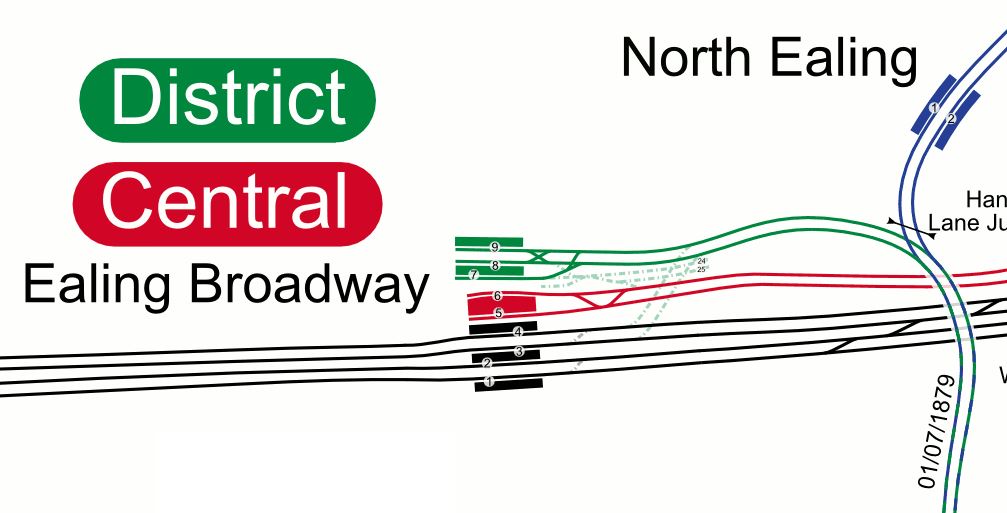
Note that after the changeover, the following would apply.
- The Piccadilly Line would have three platforms.
- In a few years time, the Central and Piccadilly Lines will have similar trains.
- Passengers for Turnham Green, Stamford Brook and Ravensbrook Park, would use the Piccadilly Line, which would probably have a higher frequency.
- Passengers for Victoria and other stations in the East on the District Line, would probably have a step-free cross-platform interchange at a number of stations.
But I think, that probably the main reason for the change, is that it will make the proposed frequency of well upwards of twenty tph of the Piccadilly Line easier to operate.
Consider.
- The platforms would help with service recovery,
- I suspect that TfL would like to see a Victoria Line frequency of thirty-six tph.
- Currently, twenty-four tph run between Arnos Grove and Acton Town in the Peak.
- Twenty-one tph run in the Off Peak.
If thirty-six tph is the intended frequency, then two terminal platforms in a rebuilt step-free Ealing Broadway station, could turn a lot of trains.
A Side Effect Of Changing The District Line Terminus
If the District Line service of six tph to Ealing Broadway, were to be reallocated between Richmond and Wimbledon, this would add three tph to the section between Gunnersbury and Richmond.
So now we could be looking at seventeen tph between Gunnersbury and Richmond stations.
Will that mean that North London Line trains to Richmond will need digital signalling and automatic train control?
The West London Orbital Railway
The proposed West London Orbital Railway will use the Dudding Hill Line to create the following services.
- West Hampstead to Hounslow
- Hendon to Kew Bridge
If both routes run at four tph, then it will add eight tph to the North London Line between Acton Wells and South Acton junctions.
Added to the six tph between Richmond and Stratford, this would be fourteen tph through Acton Central and South Acton stations.
Digital signalling on the North London Line and the West London Orbital Railway would probably ease the merging of trains for the joint section.
Freight
It appears that there are up to four freight trains per hour in both directions on the line.
The Level Crossing At Acton Central Station
I doubt the users of the level crossing at Acton Central would like the levels of traffic, that digital signalling would enable.
A Summary Of Passenger Services
I can summarise the passenger train frequencies as follows.
- Stratford to Willesden Junction – 12 tph
- Willesden Junction to Acton Wells Junction – 6 tph
- Acton Wells Junction to South Acton Junction – 14 tph
- South Acton Junction to Gunnersbury – 6 tph
- Gunnersbury to Richmond – 16 tph
I have assumed all developments mentioned earlier take place.
The Effect Of High Speed Two And Crossrail
When High Speed Two and Crossrail open at Old Oak Common station, this must surely increase the number of passengers using the North London Line, by a significant amount.
There will be two new stations.
- Old Oak Common Lane station will be between Willesden Junction and North Acton stations.
- Hythe Road station will be on the West London Line between Willesden Junction and Shepherds Bush stations.
Will the proposed six tph, each of five cars have sufficient capacity?
Conclusion
It looks to me, that they’ll come a time, when digital signalling will be needed to squeeze the required number of trains along the North London Line.
As I said in the previous section, traffic will continue to grow on the North and West London Lines because of High Speed 2 and Crossrail, as it has done since the route’s reopening with new trains in 2010.
I feel there will come a time, when trains will have to be lengthened from their current length of five cars.
Can all the stations on the route be extended if necessary?
Digital Signalling Implications For North London
As I write this post, two big digital signalling projects are ongoing.
Four Lines Modernisation
This project is described in this document on the TfL web site.
This video is from that document.
The TfL web site says this about the new signalling system.
Work to install a new signalling and control system began in summer 2016. This will eventually allow the trains to be driven automatically, with a train operator in the cab to open and close the doors. The train operator will be responsible for managing customer information and safety.
Similar technology introduced in recent years on the Jubilee and Northern lines improved performance. The new signalling system allows trains to be run closer together, meaning a more frequent service and shorter waiting times, allowing more people to be carried. This new technology will enable us to reduce delays and improve reliability.
The programme will allow us to operate 32 trains per hour, a 33% increase in peak-hour capacity. Installation work will require some line closures.
So it looks that by around 2023, there will be a lot more trains running on the Circle, District, Hammersmith & City and Metropolitan Lines.
The Four Lines Modernisation will have implications for other services.
North London Line
Between Gunnersbury and Richmond stations, the District Line and the North London Line share track, stations and signalling.
This map from carto.metro.free.fr shows the complexity of the tracks around Gunnersbury station.

Obviously, whatever signalling is installed, it must be capable of handling both District and North London Line trains at Gunnersbury Junction and to and from Richmond.
Metropolitan Line To Amersham
Between Harrow-on-the-Hill and Amersham stations, the Metropolitan Line and the London-Aylesbury Line, share track, stations and signalling.
This map from carto.metro.free.fr shows the lines at Harrow-on-the-Hill station.
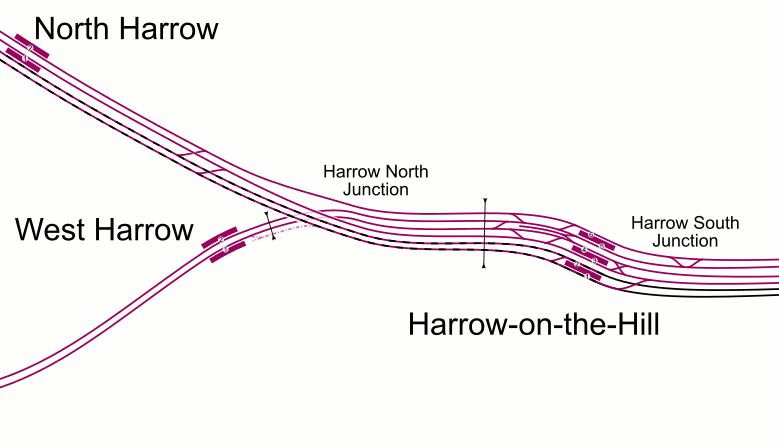
and this one shows the layout at Amersham station.
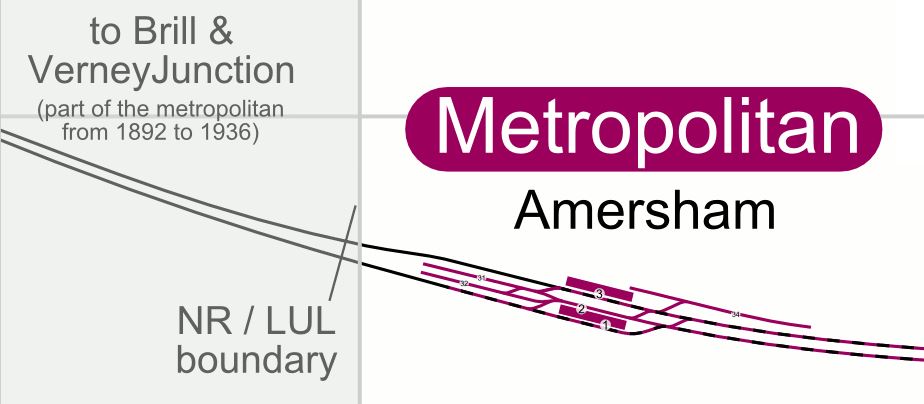
The solution for this section of track is detailed in the Wikipedia entry for the Metropolitan Line, where this is said.
Trackside signals with automatic train protection (ATP) will remain on the line north of Harrow-on-the-Hill, shared with Chiltern Railways DMUs
It is a solution, but will it last for ever?
And what about the Croxley Rail Link, if that is ever built?
Freight Trains Are Going Digital
This page on the Network Rail web site is entitled Freight Trains In Britain To Be Upgraded With Delay-Busting Digital Technology In Multi-Million Pound Deal.
The article says that all 750 freight locomotives will be upgraded.
This project must have implications for the freight services that run across North London on the Gospel Oak to Barking Line and North London Line, especially if these lines were in the future to be digitally signalled.
A Digitally-Signalled Bakerloo Line
At some tie in the next few years a decision will be made about what to do with the Bakerloo Line.
- It will be extended to Lewisham.
- It will receive new trains.
- It will be left as it is.
Options one and two would probably involve new digital signalling.
Addition of digital signalling to the Bakerloo Line would mean implications for the Watford DC Line, with which the Bakerloo Line shares the track between Queens Park and Harrow & Wealdstone stations.
Conclusion
I am drawn to the conclusion, that digital signalling in North London could bring capacity benefits.
Zopa Supports Citizens Advice ‘Super-Complaint’
The title of this post is the same as that of this article on Peer2Peer Finance News.
This is the first paragraph.
Zopa is supporting a ‘super-complaint’ against the Competition and Markets Authority (CMA) which aims to stop loyal bank customers from being overcharged.
This may seem a bit cynical on Zopa’s part, but I’ve been with them for eleven years and have always got a better return after tax and any losses, than I would have got from say a cash ISA or one of the Big Banks’ Savings Accounts.
Read the article and see what you think!
Intriguingly, I’ve never heard a licenced Financial Adviser recommend Zopa.
Will There Be Hydrogen-Powered Class 230 Trains?
In the October 2018 Edition of Modern Railways, there is an article which is entitled Vivaral Delivers First Class 230.
In addition to discussing the deployment on the Marston Vale Line, the article has various sub-sections describing future plans for the Class 230 trains.
One such sub-section is entitled Isle of Hydrogen Hybrid?.
This is the first paragraph.
Vivarail is still waiting to hear whether it will receive a European Union grant to develop a hydrogen fuel cell version of the Class 230, although Mr. Shooter was hopeful confirmation of this would be received in September. The application has been made with a range of other organisations including Canadian fuel cell company Ballard.
Other points from the sub-section include.
- The train will be a hydrogen-battery hybrid.
- The design would be similar to the diesel-battery hybrid for the Borderlands Line.
- The hydrogen fuel cells would be in the centre vehicle.
It is also said that hydrogen storage can’t be on the roof, due to the UK’s restrictive loading gauge.
Conclusion
At the moment, it’s just adding another prototype train to a long list of trains with a better environmental footprint.
If this train is successful, it will be a three-car independently-powered train, with no emissions and low noise, which will be ideal for a lot of routes in the UK and possibly other countries, which share out passenger loading gaue and requirements.
Will Class 230 Trains Run On The Island Line?
In the October 2018 Edition of Modern Railways, there is an article which is entitled Vivaral Delivers First Class 230.
In addition to discussing the deployment on the Marston Vale Line, the article has various sub-sections describing future plans for the Class 230 trains.
One such sub-section is entitled Isle of White Next?.
This is the first paragraph.
Introduction of Class 230s on the Island Line between Ryde and Shanklin is South Western Railway operator FirstGroup’s preferred solution for the line.
Other points from the sub-section include.
- South Western Railway is required to produce a proposal for the Island Line as part of the franchise.
- The current Class 483 trains are the oldest on the UK network.
- A decision is expected before the end of the year.
Vivarail are also reported to have found a way to fit their larger trains in the Ryde Tunnel.
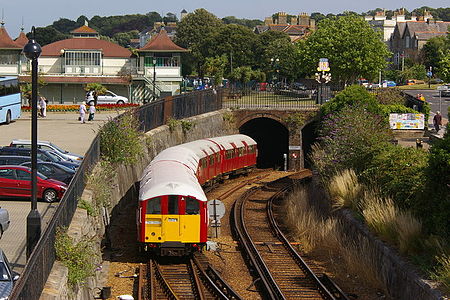
The picture from Wikipedia, shows a Class 483 train approaching Ryde Tunnel.
The height and width of the two trains in London Underground service are as follows.
- Class 483 – Width 2.60 metres – Height 2.88 metres
- Class 230 – Width 2.85 metres – Height 3.62 metres
According to the article 45 mm. of packing will be removed.
But it still could be a very tight fit.
Will The Class 230 Trains Feature Battery Operation?
A year ago in Diesel And Battery Trains Could Be The Solution For Island Line, I reported on a report in the Island Echo.
I discussed battery operation extensively and there are several benefits.
- Energy saving through regenerative braking.
- Health and safety
- Lower maintenance cost.
- Emergency train recovery.
- The addition of a passing loop at Brading station to improve the timetable.
The line could also be extended to Ventnor station as a single-track without electrification.
Conclusion
It looks to me, that Class 230 trains offer more than just a newer train with wi-fi and power sockets.
One thing puzzles me!
If Vivarail can modify London Underground D78 Stock to work on the Island Line, why wasn’t this option considered before?
Bi-Mode Good, Tri-Mode Better
The title of this post, is the same as that of this article on Rail Engineer.
It is an informative article about the creation of the Class 769 trains.
These are some points.
Class 150 Performance
Class 769 performance on diesel is likely to be as good as that of a Class 150 train, if not better.
When running on electric power, they will still be capable of 100 mph.
Extensive Route And Performance Modelling
Extensive computer modelling has been carried out to make sure the train performs.
Access To The Original Designers
It appears that they were able to call in some of the original designers and that at least some of the iriginal drawings were available.
An Extensive Project
The article quotes these figures on the resources used to design the conversion.
- 60 engineers
- 45,000 engineering hours
- 2,500 drawings
- 3,500 detailed components
I suspect that this could account for the late running of the project.
Approvals
There is a large section on approvals, which is well worth a read. It looks to me, that they are making sure, that these trains fit all regulations and not those that apply to upgrades and improvements.
Noise
They are also going for better noise than a Class 15x train, which must be a good thing.
Raiding The Class 150 Parts Bin
They obviously needed exhausts for the two diesel engines, so in true Colin Chapman fashion, they looked round for something that was readily available and would do the job.
As Class 319 and 150 trains share a lot of components like bogies, the exhausts for the converted trains are from a Class 150 train.
Maintenance Costs
The new trains will obviously cost more to maintain than a Class 319 train, but will probably be cheaper to run than a Class 150 train.
The Ultimate Class 769 train.
The article indicates what could be possible.
- Air cooling
- CCTV – both saloon and forward facing
- At seat USB and power sockets
- Ethernet backbone to support engine control and Wi-Fi
- Interior and exterior rebranding
- Guard’s door control panels.
Not a bad specification for a thirty-year-old train.
Orders
There may be more orders in the pipeline.
Conclusion
I think that these trains will do what they are intended to do in a reliable and quality manner.
Tailpiece – Class 455 Flex
The article finishes with a disclosure about what might happen to the Class 455 trains.
These have been extensively refurbished and have been retrofitted with three-phase AC traction systems incorporating regenerative braking. There would be space on the intermediate trailer coach for batteries that could be charged by the regenerated energy and by the diesel engines. Such a feature could have several benefits such as being able to stop the diesel engines in terminal stations and to supplement diesel engine power when accelerating.
Could this be a four-car efficient runabout for branch lines, as they are only 75 mph trains?
Should The Elizabeth Line Be Extended To Ascot?
The idea for this post came from an article in the October 2018 Edition of Modern Railways, that was entitled Windsor Link Railway Gains Momentum.
The article talks about the benefits of the Windsor Link Railway.
Property Development And Landscaping
Ever since I read about the Windsor Link Railway, I thought it would create or free-up sites in Windsor for property development.
I even wrote about this in Is This One Of The Most Valuable Sites For New Development In The UK?.
The article details or suggests the following.
- Around twenty-one acres, which would include the two existing station sites could be developed.
- The Windsor and Eton Riverside station, which Grade II Listed, could be developeed into a boutigue hotel on the river.
- The gardens in the centre of Windsor could be extended.
The article also suggests that the property development could pay for the whole scheme.
Reducing Traffic In Windsor
Windsor is full of tourist coaches and other traffic.
The proposed railway would have.
- A single sub-surface station in the middle of the town.
- Twelve trains per hour (tph) through Windsor, in a single-track tunnel.
- Areinstated Royal Curve at Slough to create a route between Reading and Windsor.
- A Park-and-Ride by the M4 at Chalvey.
- A journey between Waterloo and Windsor of around fifty minutes, with four tph.
- Slough would be the Northern terminal, either in the current station or West of the town in the Trading Estate.
- It should be noted that six-car Aventras similar to Crossrail’s Class 345 trains, would probably hold a thousand passengers.
If a railway like that didn’t cut traffic going into Windsor, then nothing will.
Western Access To Heathrow
The Windsor Link Railway could also serve Heathrow Terminal 5.
The article states that this would probably need a double-track tunnel, so provision should be made in the initial scheme.
Crossrail trains could also use the link to extend Crossrail to Reading via Windsor.
- The Royal Curve at Slough would be rebuilt.
- The new Windsor station would need to be able to handle two hundred metre long trains.
- Trains would serve both Heathrow Central and Terminal 5.
- Trains wouldn’t need a terminal platform at Heathrow Terminal 5 station.
But the biggest benefit (or even curse!) would be to connect Windsor to Central London.
Wider Connectivity
George Bathurst; the scheme’s proposer envisages trains from Windsor to the following places.
- Heathrow
- High Wycombe via Bourne End.
- Reading
- Waterloo
- Woking
In one throwaway remake this is said.
The WLR connection to Heathrow could also be used (with dual-voltage stock) for extending the Elizabeth Line westwards, to Ascot for example.
This would need a chord at Staines, which I wrote about in Heathrow Southern Railway’s Proposed Chord At Staines.
Hence the title of this post!
The Heathrow Southern Railway And The Windsor Link Railway
I wrote about the interaction of the two proposals to access Heathrow from the West and South in Heathrow Southern Railway And The Windsor Link Railway.
This was my original conclusion.
Co-operation could be beneficial to both projects.
I have not changed my conclusion, although I have updated the related post.
Heathrow’s Destinations In The West And South
Taken together the two proposals; Heathrow Southern Railway and Windsor Link Railway, will or could offer the following destinations.
- Basingstoke – Heathrow Southern Railway – Extension to Heathrow Express
- Guildford – Heathrow Southern Railway – Extension to Heathrow Express
- High Wycombe – Windsor Link Railway – Possible via Bourne End!
- Reading – Windsor Link Railway – Possible Extension to Crossrail!
- Slough – Windsor Link Railway – Possible Extension to Crossrail!
- Staines – Heathrow Southern Railway – Extension to Crossrail
- Weybridge – Heathrow Southern Railway – Local Service
- Windsor – Windsor Link Railway – Possible Extension to Crossrail!
- Woking – Heathrow Southern Railway – Extension to Heathrow Express
I can see two high-capacity stations at Terminal 5 and Windsor capable of handling upwards of ten tph in both directions, feeding services all over the area, bringing passengers, workers and freight to Heathrow.
A Crossrail Extension To Ascot
I’ll now look at this in detail.
The Route
As I said earlier this would need the reinstatement of the chord at Staines station.
This map from carto.metro.free.fr shows former route of the chord as a dotted line.
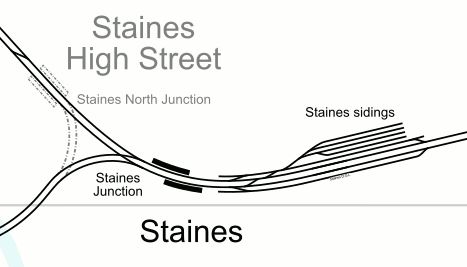
Would it be possible to get one of Crossrail’s two hundred metre long trains around a rebuilt chord?
From Staines, it would be an easy run up the Waterloo-Reading Line, with calls at the following stations.
- Egham
- Virginia Water
- Longcross
- Sunningdale
All appear to be stations capable of taking long trains.
Current Service
Currently, there are two services on this route.
2 tph – Waterloo and Reading
2 tph – Waterloo and Weybridge, which branches off at Virginia Water.
Benefits Of Extending To Ascot
At present Heathrow Terminal 5 is planned to get just two tph from Crossrail. But as Terminal 5 is the busiest terminal at Heathrow by a large margin, surely it needs more services than this.
I also think, that the ideal number of services between Staines and Ascot should be at least four tph.
If two tph ran through Heathrow Terminal 5 to Ascot, this would mean the following.
- There would be at least four tph on services between Staines and Ascot.
- Travellers would have a wider choice of London terminals.
- Travellers would be have direct access to all terminals and HS2 at Old Oak Common.
There would also probably be less road traffic into Heathrow.
Why Stop At Ascot?
Although, George Bathurst suggested Ascot as a terminus, why not continue all the way to Reading station?
Stations on the route are.
- Martins Heron
- Bracknell
- Wokingham
- Wnnersh
- Winnersh Triangle
- Earley
Note that Reading station has three third-rail electrified platforms to handle trains from Ascot, Guidford, Staines and Waterloo.
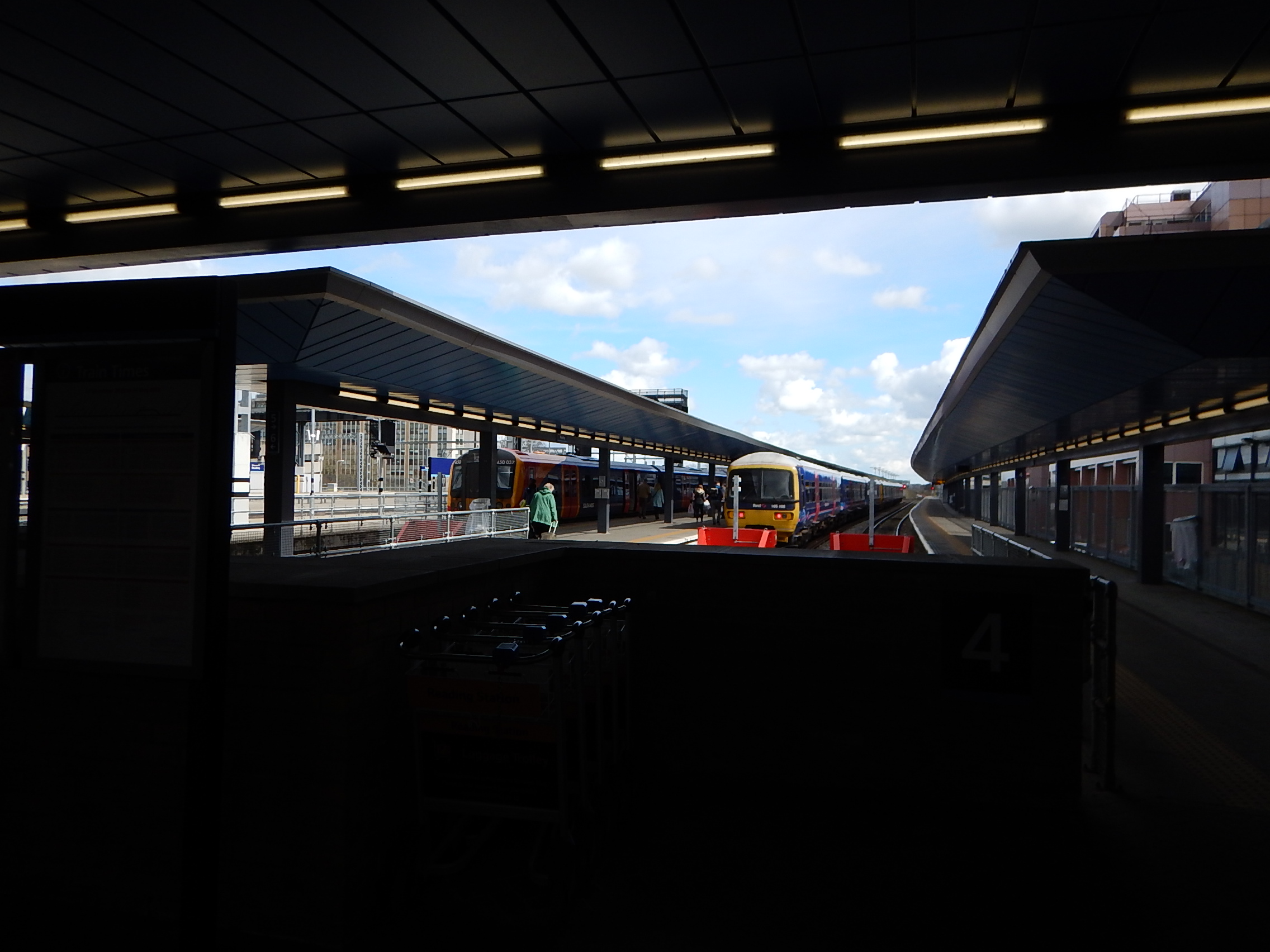
Note the train in the platform is a Great Western Railway train to Gatwick, which in a couple of years will be run by tri-mode Class 769 trains.
As the platforms only handle four tph, there is plenty of capacity to turn extra trains.
I can’t see any reason, why if Crossrail is extended to Ascot, it shouldn’t be extended to Reading.
Especially, as all the benefits I talked about earlier to Ascot would also apply to terminating at Reading.
Conclusion
I believe that an extension of Crossrail to Ascot would be worthwhile, but that it should continue to Reading.
Piccadilly Capacity Study Commissioned
The title of this post is the same as that of an article in the October 2018 Edition of Modern Railways.
This is the first paragraph.
New NR Chief Executive Andrew Haines has commissioned work to understand options for capacity through platforms 13 and 14 at Manchester Piccadilly.
It was originally planned to build two extra tracks, with additional platforms between Manchester Piccadilly and Deansgate stations, to improve the capacity over the Ordsall Chord.
But various engineers and politicians have suggested that Digital Signalling may be an alternative solution.
Speaking to the House of Commons Transport Committee, Mr. Haines said.
We might be better off replacing some of those fleets of trains with trains which have more doors.
Boarding is slow all across the North and I suspect Mr. Haines has studied the problem.
He also added.
He had commissioned work to understand if 15 trains per hour could be delivered through platforms 13 and 14 without major infrastructure works.
I don’t think that Network Rail would waste money on a study, if they didn’t think that 15 trains per hour (tph) were not possible.
Consider.
- Thameslink and Crossrail will soon be running 24 tph through Central London in four directions.
- The East London Line currently runs 16 tph in a tunnel that was opened only thirteen years after the Liverpool and Manchester Railway.
- Trains designed for short dwell times and easy boarding and unloading, as suggested by Mr. Haines would obviously help.
Platforms and the related access at Manchester Piccadilly, Manchester Oxford Road and Deansgate stations would need to be improved.
But that would be a smaller number of affordable projects.
Conclusion
I do think Andrew Haines has a mind that doesn’t believe in boxes, so his ideas won’t go down well with those with big-spending conservative ideas like most rail union leaders, some rail company bosses and the Mayor of Manchester.
Prototype Overhead Line Structure Revealed
The title of this post is the same as that of this article on Global Rail News.
This is the first paragraph.
A prototype overhead line structure (OLS) designed to be quick to install, easy to maintain and more attractive to look at has been unveiled by its creators, Mott MacDonald and Moxon Architects.
Searching the Internet, I found this press release about the structure, which is entitled Moxon and Mott MacDonald unveil prototype for innovative Integrated Overhead Line Structure.
This picture is from the press release.
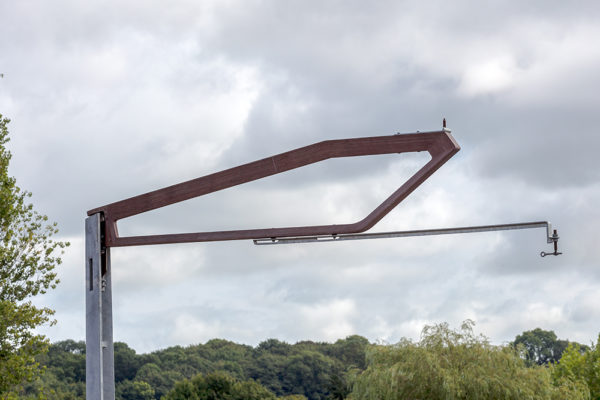
Various advantages are claimed.
- Reduced visual impact.
- Complete interoperability with existing overhead systems.
- Reduced number of components.
- Ease of installation.
- No additional engineer training.
- Reduced maintenance costs.
I like the concept, but is it too radical for Network Rail to give its blessing?
Perhaps the most radical feature is the use of laminated wood in the structure.
Conclusion
This is a very good design, but I doubt we’ll see it installed on UK railways.
£18.75m Halton Curve Project Delayed A Further Six Months
The title of this post is the same as that of this article on Rail Technology News.
I could just blame politicians for the latest project to be delayed, but it is not wholly their fault.
Train companies all over the UK, Europe and the Rest of the World have been ordering new trains at an unprecedented rate for the following reasons.
- The replacement of clapped-out trains like Pacers.
- Extra trains to provide extra services.
- Faster trains to provide faster services.
- Bigger or longer trains to provide more capacity.
- New electric trains for newly electrified routes.
- New trains often cost less to service and maintain.
- Affordable finance for quality new trains is available in billions of pounds, euros and dollars of all kinds.
In addition a lot of trains are being updated with new technology like signalling, automatic systems and high-technology interiors.
All of these factors mean that there is a high level of train testing that needs to be done.
These test tracks are in Europe and listed in Wikipedia.
- Czech Replublic – Velim railway test circuit – Two circuits of 4 and 13 km.
- France – Centre d’essais ferroviaires – Near Alstom Valenciennes factory site in Raismes, includes 2.75 km for testing at 100 km/h, a 1.85 km loop for endurance testing at 80 km/h, and a loop for testing driverless trains.
- Germany – Test and validation centre, Wegberg-Wildenrath – Near Wildenrath in North Rhine-Westphalia, Germany. Several loops of standard gauge and metre gauge track with various electrification systems.
- Poland – Test Track Centre near Żmigród – Operated by Warsaw Railway Institute. 7.7 km standard gauge loop, 160 km/h maximum allowed speed.
- Romania – Railway Testing Center Faurei – Total length of lines: 20,2 km, maximum speed 200 km/h.
- United Kingdom – Old Dalby Test Track
- United Kingdom – High Marnham Test Track
Note that Italy and Soain, who build substantial numbers of trains, don’t have a specialist testing centre.
I have read somewhere that each individual train has to be run for so many hours before it can be certified for service.
Consider
- Bombardier is building 412 Aventras with lengths between three and ten cars.
- CAF is building trains for Calodonian Sleeper, Keolis Amey Wales, Northern, TranPennine Express and West Midlands Trains.
- Hitachi is building 182 Class 800/801/802 trains with length of five or nine cars.
- Hitachi is building 80 Class 385 trains with lengths of 3/4 cars.
- Siemens are building trains for Govia Thameslink Railway.
- Stadler is building trains for Greater Anglia, Keolis Amay Wales and MerseyRail.
I haven’t done a detailed calculation must it must be at least 700 trains.
In addition there are various rebuilt and existing trains that will need to be tested.
- ScotRail’s shorterned InterCity 125s
- Porterbrook’s Class 769 trains.
- Vivarail’s Class 230 trains.
- Alstom’s Class 321 Hydrogen trains.
- Crossrail Class 345 trains need further testing.
And there will be new orders for the following franchises and lines.
- East Midlands.
- London Underground Piccadilly Line.
- South Eastern
- West Coast Alliance
I haven’t done a detailed calculation but we must be talking of nearly a thousand new trains of which probably six hundred will be delivered in the next five years.
I’m no expert, but I feel that two short test tracks and short lengths of improvised test tracks in factories, isn’t enough to test all these trains and certify them for service.
I should also blow my own trumpet and I know that when I wrote project management software, I was probably the best programmer in the World, at automatically scheduling resources.
So I tend to know, an impossible scheduling problem, when I see one!
Conclusion
We do send trains to Europe to specialist centres like the one at Velim in the Czech Republic. But these centres are also used by other European manufacturers.
I am led to the inevitable conclusion, that we need more train testing facilities, in both the UK and mainland Europe.
The Welsh Government has come to the same conclusion and are planning a test track at Neath, which I wrote about in £100m Rail Test Complex Plans For Neath Valley.
What would help, would be if Chris Grayling oiled a few wheels with some money. It might even result in some Continental trains coming to Wales for specialist testing like curing them of dracophobia.
I would also have felt that CAF would be happy with a test track fifty miles away from their new factory in Newport.
Come on, Wales! Fire up the dragons and get started!
 The Anonymous Widower