Do LNER Have Plans For Lincolnshire?
I ask the question in the title of this post, for two reasons.
- In Azuma Test Train Takes To The Tracks As LNER Trials Possible New Route, I talked about how LNER had run a test train to Cleethorpes.
- In First Tri-Mode Long Distance Trains For The East Coast Main Line, I talked about LNER’s order for tri-mode long distance trains.
Note.
- London King’s Cross and Cleethorpes via Newark and Lincoln is just over 200 miles.
- Around eighty miles between London King’s Cross and Cleethorpes is not electrified.
- The Cleethorpes/Grimsby area is doing well because of all the offshore wind and the power stations at Keadby.
- I am fairly sure, that Lincolnshire will attract more energy-related businesses or ones that need a lot of energy.
- Lincoln is a city that is becoming more important for business and education.
- Lincoln probably needs a train service to the capital of at least one train per hour (tph).
For a train to do the round-trip between London King’s Cross and Cleethorpes, without refueling or charging the batteries at Cleethorpes, needs a train with a range without electrification of over 150 miles.
It seems to me, that LNER’s new CAF tri-mode long distance trains would be ideal to run a one train per two hours (tp2h), between London King’s Cross and Cleethorpes.
- The service could call at Stevenage, Peterborough, Grantham, Newark Northgate, Lincoln, Market Rasen, Barnetby and Grimsby Town.
- I estimate that the trip would take about 0ne hour and 55 minutes to Lincoln and two hours and 55 minutes to Cleethorpes.
- The CAF tri-mode long distance trains could probably easily handle the 160 miles without wires.
- Cleethorpes can handle a ten-car train.
The current London King’s Cross and Lincoln service and the future London King’s Cross and Cleethorpes would be timed to give Lincoln an hourly service to and from London King’s Cross.
Serving Sleaford And Spalding
It must surely be possible to route the Cleethorpes trains to the South of Lincoln, via Sleaford, Spalding and the new Werrington dive-under, so that Sleaford and Spalding would have a direct service to London.
Don’t Forget Skegness And Boston
Consider.
Skegness, Boston and other places are connected to the East Coast Main Line, by an hourly train to Nottingham via Grantham.
They are also connected to Lincoln and Peterborough at Sleaford.
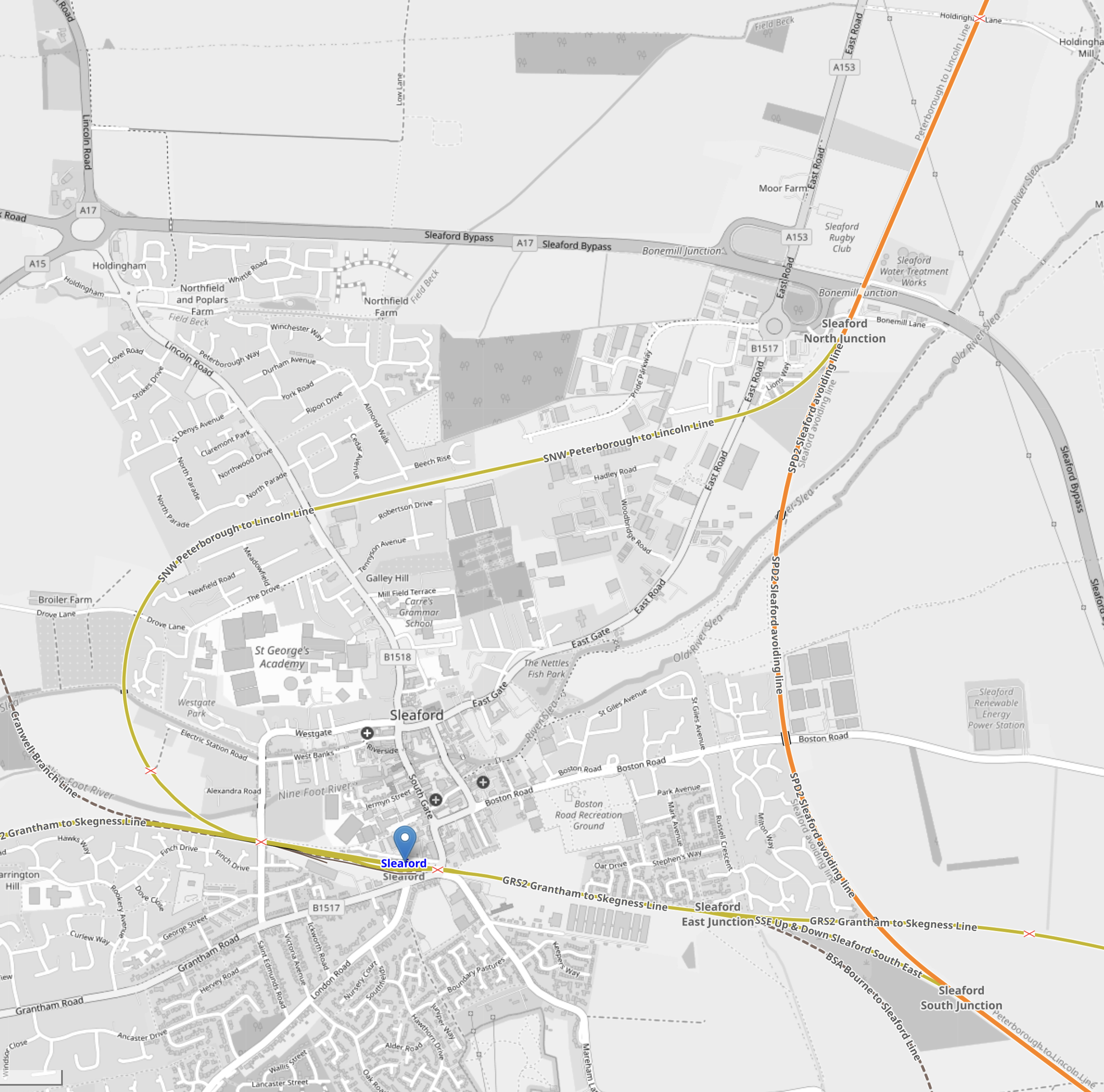
This OpenRailwayMap shows the lines at Sleaford.
Note.
- Sleaford station is marked with the blue arrow.
- The orange track is the Peterborough and Lincoln Line, that avoids Sleaford.
- The yellow track going East-West is the Grantham and Skegness Line.
- There is a loop from the Peterborough and Lincoln Line, so that passenger trains can go through Sleaford station.
I think that there are possibilities to improve the experience at Sleaford.
One possibility must be to build a Park-and-Ride station, where the two lines cross.
How Many Trains Would Be Needed For London King’s Cross and Cleethorpes Via Peterborough?
I estimate that the journey time could be around two hours and 45-50 minutes, so perhaps a six-hour round trip would be possible.
To run an hourly service would need six trains, with three needed for one tp2h.
New Infrastructure Required
The only new infrastructure required, might be some method of refuelling the CAF tri-mode long distance train at Cleethorpes.
LNER’s New Sunday Timetable
LNER’s new Sunday timetable, that starts on the 10th December 2023 is now available to view on this page of the National Rail web site, where this is said.
Sundays are now one of the most popular days to travel on LNER’s network.
To support this increase in demand, LNER is introducing three additional Sunday services into its timetable starting in December 2023 – two (one each way) between Leeds and London Kings Cross and one between Doncaster and London.
There will also be more seats added to some trains with eight existing Sunday services becoming longer trains. The current five carriage services will be replaced with either nine or ten carriage Azuma trains for destinations including Leeds, Harrogate and Lincoln.
This equates to more than 3,000 additional seats on a Sunday and will help reduce overcrowding and increase connectivity for more people between Yorkshire and London.
To provide additional Sunday seating capacity, due to the lengthening of some London Kings Cross to Harrogate services on Sundays, two northbound station calls at Horsforth need to be removed on Sundays only. The impacted services are the 09.05 and 17:05 London Kings Cross to Harrogate trains.
Note.
- Horsforth looks to have short platforms.
- Last Sunday, Harrogate to London services were three nine-car and three five-car trains.
- In September 2023, I wrote Yorkshire To See More LNER Services And Longer Trains.
LNER certainly seem to be fulfilling the last promise.
Additionally, in this article on Modern Railways, which is entitled LNER Orders CAF Tri-mode Sets, this is said.
Modern Railways understands the new fleet will be maintained at Neville Hill depot in Leeds and, like the ‘225’ sets, will be used predominantly on services between London and Yorkshire, although unlike the ‘225s’ the tri-modes, with their self-power capability, will be able to serve destinations away from the electrified network such as Harrogate and Hull.
So are LNER gradually moving towards the new timetable they will use after the CAF tri-mode trains are delivered?
Do Rolls-Royce mtu Have A Plan To Decarbonise Their Diesel Engines For Rail Applications?
Data Sheets For Rolls-Royce mtu Diesel Engines For Trains
These are data sheets for various Rolls-Royce mtu diesel engines that can be used in rail applications.
Rolls-Royce Releases mtu Rail Engines For Sustainable Fuels
The title of this section, is the same as that of this press release from Rolls-Royce.
These four bullet points, act as sub-headings.
- mtu Series 1300, 1500 and 1800 engines already released; Series 1600 and 4000 to follow shortly
- Up to 90% CO2 savings by operating existing engines with Hydrotreated Vegetable Oil (HVO/renewable diesel)
- Locally emission-free operation possible in combination with mtu Hybrid PowerPack
- Field tests with DB Cargo and RDC Autozug Sylt
This is the first paragraph.
Rolls-Royce is taking a significant step towards even more climate-friendly rail transport with the release of mtu rail engines for use with sustainable fuels. With synthetic diesel fuels of the EN15940 standard, CO2 emissions can be reduced by up to 100 percent compared to fossil diesel. Hydrotreated Vegetable Oil (HVO or renewable diesel), which is already commercially available today, reduces CO2 emissions by up to 90 percent. If the fuels are produced with the help of renewable energy and green hydrogen – through what is termed a Power-to-X process – existing rail vehicles can be operated in a completely CO2-neutral manner. The mtu Series 1800 engines which are used in mtu PowerPacks, as well as Series 1300 and 1500 for locomotives and multi-purpose vehicles, are already approved for use with synthetic fuels such as HVO. Series 1600 and versions of Series 4000 engines will follow in the near future. The release of engines for climate-friendly fuels requires a series of tests and trials and Rolls-Royce has found strong partners for this activity. DB Cargo and RDC Autozug Sylt have already tested or are currently testing mtu Series 4000 engines with HVO in their locomotives.
How Does That Fit With The UK’s Population Of Rolls-Royce mtu Diesel Engines?
These classes of train have Rolls-Royce mtu engines.
- Class 43 power cars – 6V 4000 R41R
- Class 168 train – 6R 183 TD 13H
- Class 170 train – 6R 183 TD 13H
- Class 172 train – 12V 1800 R83
- Class 195 train – 12V 1800 R85L
- Class 196 train – 12V 1600 R85L
- Class 197 train – 12V 1600 R85L
- Class 800 train – 12V 1600 R80L
- Class 801 train – 12V 1600 R80L
- Class 802 train – 12V 1600 R80L
- Class 805 train – 12V 1600 R80L
- Class 810 train – 12V 1600 R80L
Note.
- Class 168 and 170 trains seem to be powered by older model Rolls Royce mtu engines.
- Class 180, 220,221 and 222 trains are powered by Cummins engines.
- I can’t find what engines power Class 805 and 810 trains, but it is reasonable to assume they have the same engines as the other Hitachi trains.
- As CAF are building LNER’s new tri-mode trains, I suspect these trains will also have Rolls Royce mtu engines.
It would appear that all the Rolls-Royce mtu rolling stock in the UK, with the possible exception of the Class 168 and 170 trains will be able to run on sustainable fuels.
Rolls Royce mtu And Hydrogen
This press release from Rolls-Royce is entitled Rolls-Royce Successfully Tests mtu Engines With Pure Hydrogen.
This is the first paragraph.
Rolls-Royce today announces that it has conducted successful tests of a 12-cylinder gas variant of the mtu Series 4000 L64 engine running on 100% hydrogen fuel. The tests, carried out by the Power Systems business unit, showed very good characteristics in terms of efficiency, performance, emissions and combustion. These tests mark another important step towards the commercial introduction of hydrogen solutions to meet the demand of customers for more sustainable energy.
Engines of mtu’s 4000 family are used in Class 43 power cars, so surely these developments could lead to hydrogen-powered freight locomotives.
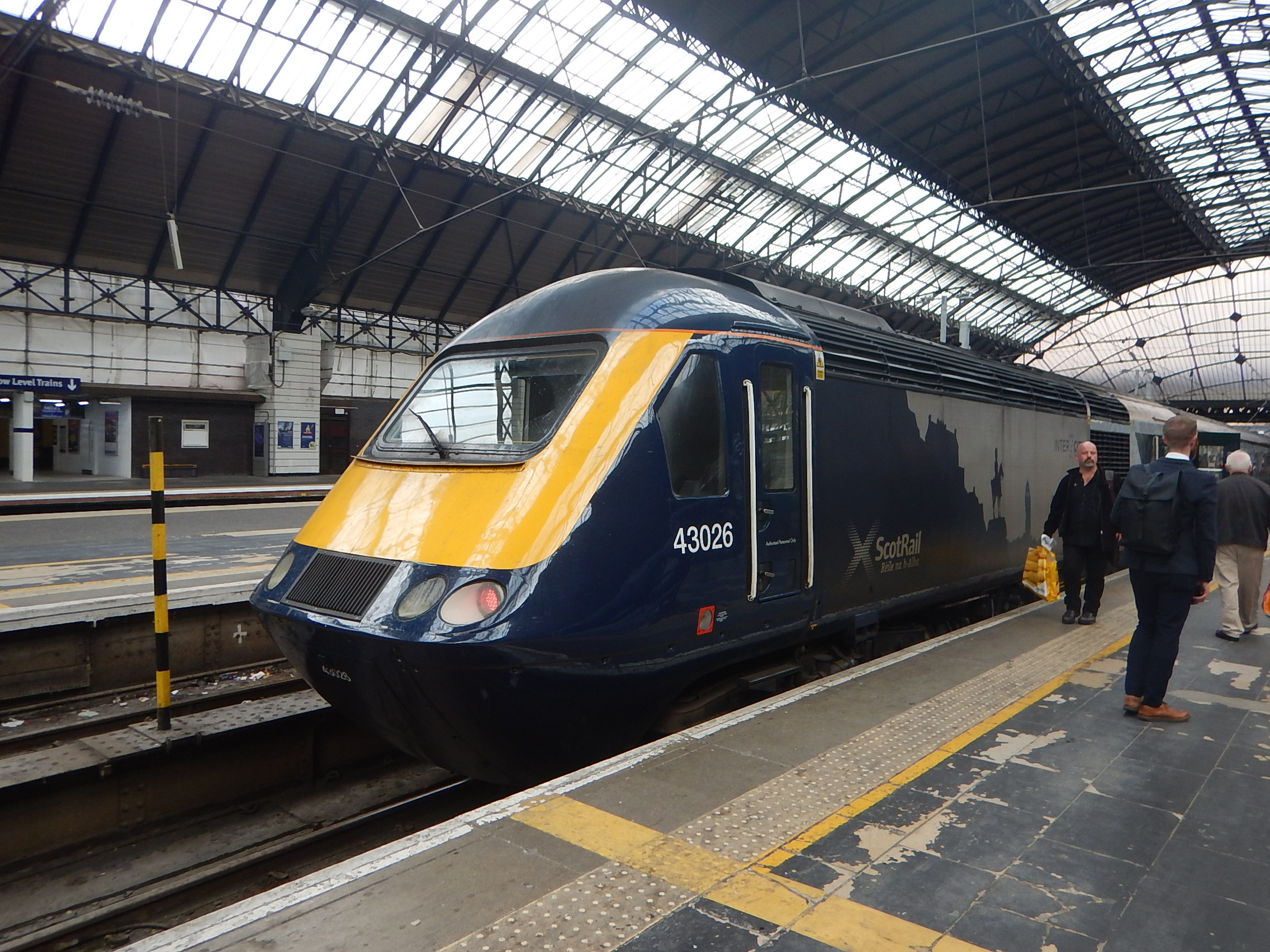
The picture shows a Class 43 power car at Glasgow Queen Street station.
Could Rolls-Royce mtu hydrogen power keep these iconic trains running for a few more years?
In ‘Spirit of Innovation’ Stakes Claim To Be The World’s Fastest All-Electric Vehicle, I look at Rolls-Royce’s Spirit of Innovation, which set the record for an electric vehicle at 555.9 km/hour.
As the InterCity125 already holds the record for the fastest diesel train, perhaps Rolls-Royce will attempt to set a record for the fastest hydrogen-powered train?
Decarbarbonising The CAF Class 195, 196 And 197 Trains
If Rolls-Royce mtu develop a hydrogen version of the 1800 diesel engine, then this could be used to fully decarbonise the CAF trains.
The operators may consider it’s not worth it and continue with using sustainable fuels.
But the possibility is surely there.
There must also be the possibility of developing a fuel cell replacement for the 1800 diesel, that can be slotted into the train.
Decarbarbonising The Hitachi Class 80x Trains
Hitachi are developing battery packs and the data sheet can be downloaded from this page on the Hitachi web site.
Decarbarbonising The CAF Tri-Mode Trains
I feel that as CAF usually use Rolls-Royce mtu engines, I suspect these trains will be designed, so they can be converted to hydrogen.
Conclusion
Rolls-Royce mtu appear to be on a path to decarbonise all their diesel engines.
 The Anonymous Widower