Council’s Boost To Aln Valley Railway Expansion Plan
The title of this post is the same as that of this news item from Northumberland County Council.
This is the body of the news item.
Northumberland County Council has agreed to assist the Aln Valley Railway in Alnwick to extend its rail line and expand its tourism offer in the town.
The county council has agreed to repair and adopt a bridge which is crucial to the expansion plans of the Aln Valley Railway Trust which is working towards the ultimate aim of extending the track from Alnwick to Alnmouth Station.
The Trust is wanting to continue laying track past Eden Hill Bridge which is currently owned by The Historic Railways Estate (part of Highways England). However, the Estate won’t allow the passage of trains under the bridge as it would impose maintenance obligations and costs onto them.
To overcome this hurdle and assist the popular tourist attraction , the county council, as the highways authority, has agreed adopt the bridge which has an unclassified road (U3203) running over it and to repair the bridge so that it can then give consent to the railway to lay track and ultimately operate trains under the bridge.
To bring this masonry arch bridge up to adoptable standards will cost in the region of £255k. One of the main areas of work that is needed is to install a waterproofing concrete overslab to eliminate the current water ingress. Extensive repointing together with masonry repair works are also needed on the bridge arch.
There is a Wikipedia entry for the Alnwick Branch Line, where this is the first paragraph.
The Alnwick branch line is a partly closed railway line in Northumberland, northern England. A heritage railway currently operates along one mile of the line, which originally ran from Alnmouth railway station, on the East Coast Main Line, to the town of Alnwick, a distance of 2+3⁄4 miles (4.4 km).
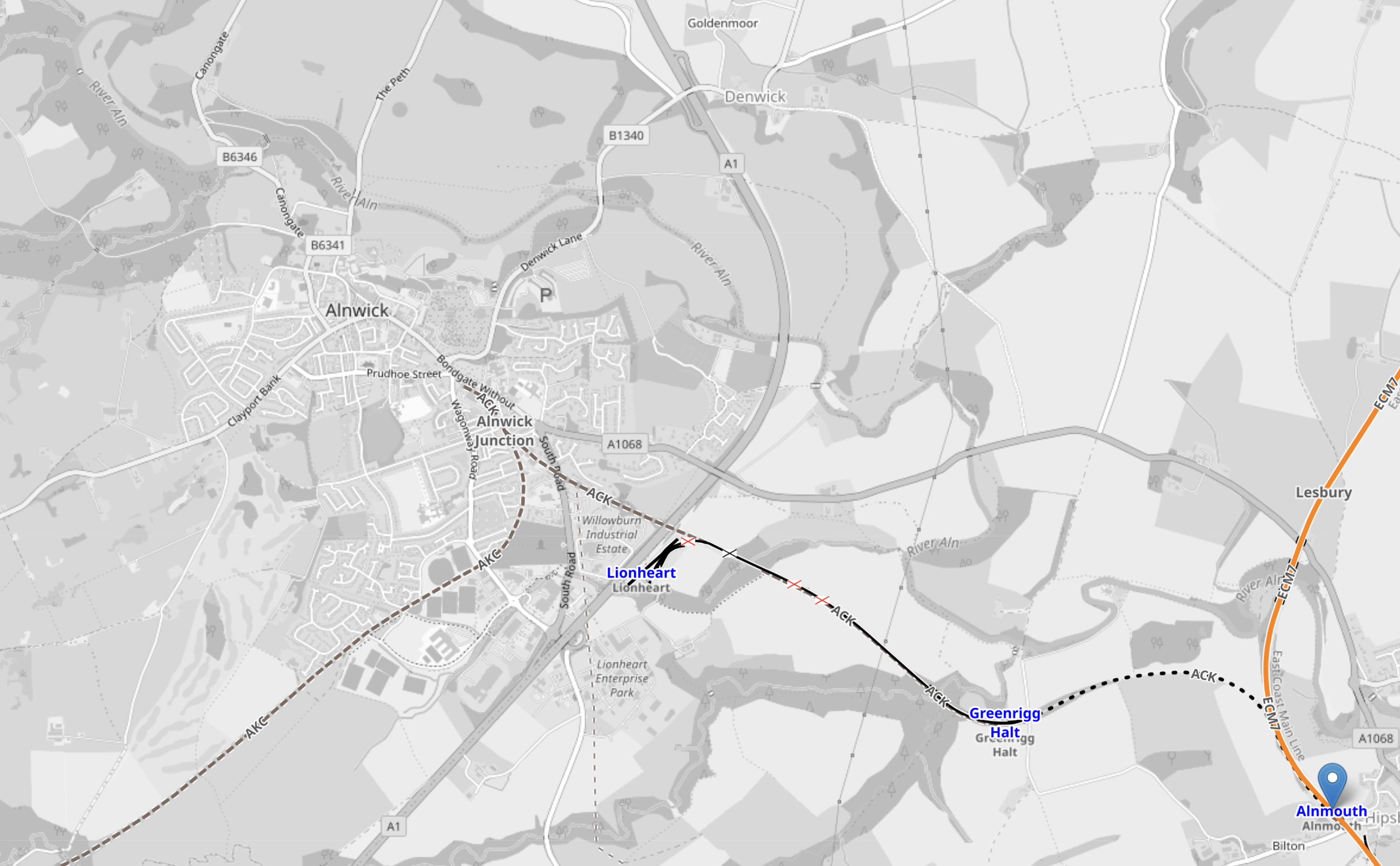
This OpenRailwayMap shows the route of the Alnwick Branch Line between Alnmouth and Alnwick.
Note.
The blue arrow in the South-East corner of the map indicates Alnmouth station.
The orange line curving through Alnmouth station is the electrified East Coast Main Line between Newcastle and Scotland.
The dotted line curving away North-West from the East Coast Main Line is the route of the AlnwickBranch Line, which leads to Alnwick in the North-West of the map.
The blue text indicates the the two stations of the Aln Valley Railway.
Greenrigg Halt is nearest to the East Coast Main Line and Lionheart is nearest to the town.
The road encircling the town of Alnwick is the A1 Alnwick By-Pass.
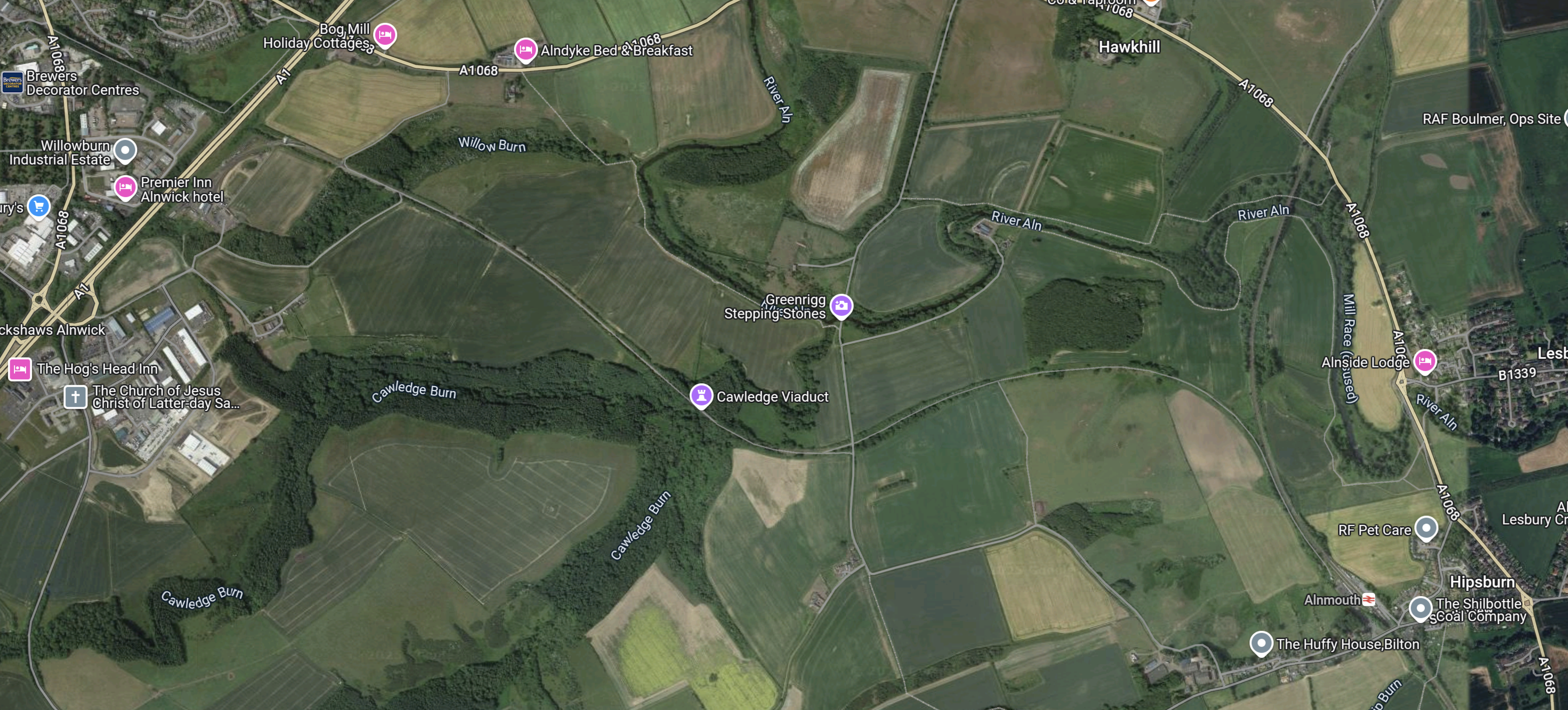
This Google Map shows the area between Alnmouth station and Alnwick.
Note.
- Alnmouth and its station is in the South-East corner of the map.
- Alnwick is in the North-West corner of the map.
- The A1 crosses the North-West corner of the map.
- The line of the Alnwick Branch Line can be picked out crossing the map diagonally.
Click on the map to show it to a larger scale.
The Wikipedia entry for Alnmouth station says this about the ambitions of the Aln Valley Railway to connect to the East Coast Main Line.
The Aln Valley heritage railway has long-term ambitions of extending its running line to Alnmouth station[10] from its current terminus at Greenrigg Halt.
This picture shows a Stadler RS-ZERO.
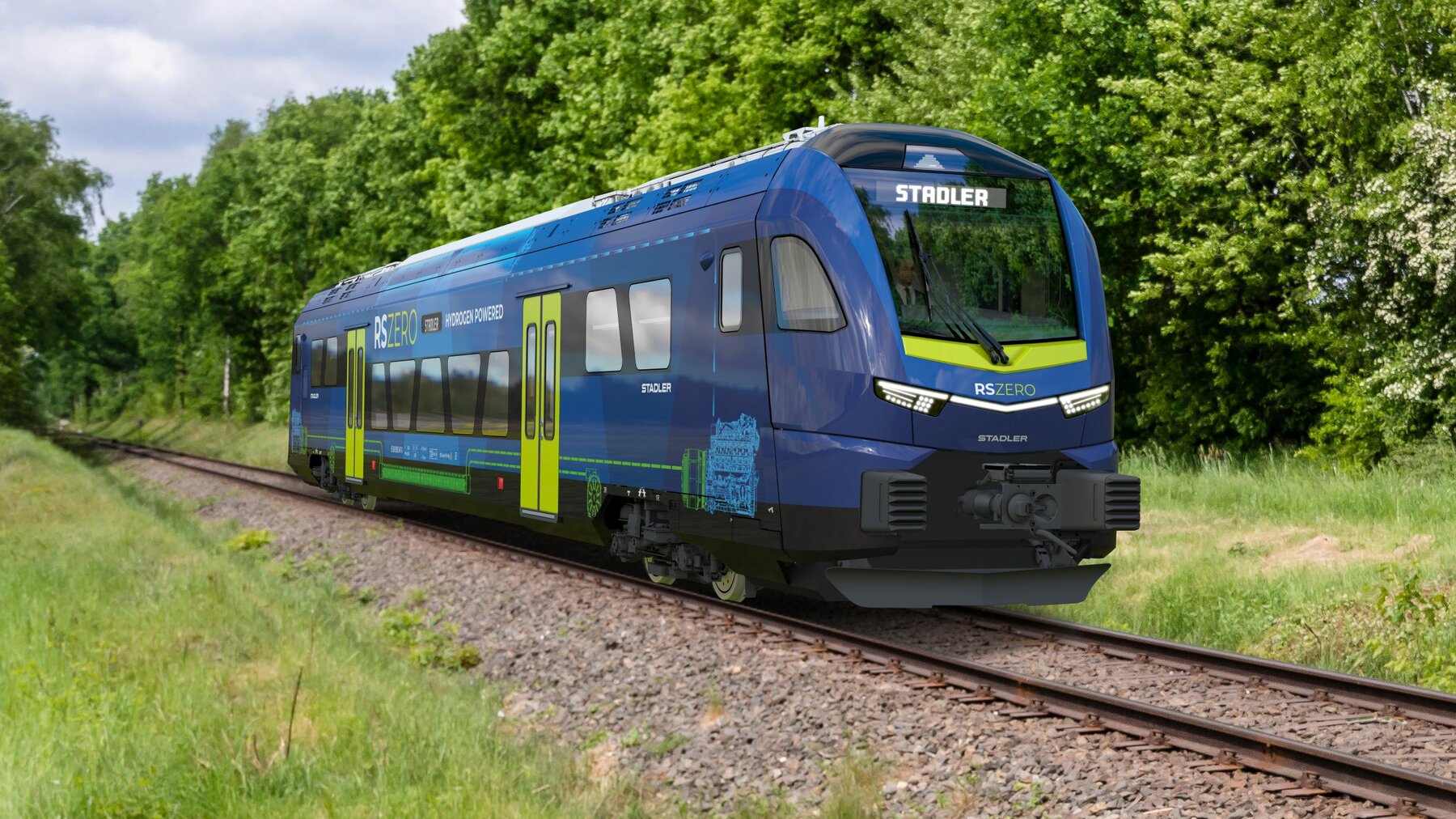
Could one of these powered by hydrogen shuttle between Alnmouth station and Alnwick? Probably, but it’s not powered by steam!
An Orange Pig
I found this on the Internet.
The Tamworth pig breed is known for its distinctive ginger or red-gold coat, making it a pig breed that can indeed be orange.
Where are the Tamworth Two these days?
SSE Files Plans For 100 MW Pumped Hydro Scheme
The title of this post is the same as that of this article on reNews.biz.
This is the sub-heading.
Proposal aims to convert iconic Sloy Power Station into storage facility by end of 2030
These three paragraphs outline the proposals.
SSE has submitted plans to the Scottish Government for the 100MW Sloy pumped storage hydro scheme.
The plans would see the existing Sloy Power Station – a conventional hydro power station – on the banks of Loch Lomond converted into a pumped storage hydro scheme with a pumping capacity of up to 100MW.
If given the green light, the converted Sloy scheme would be capable of delivering up to 16GWh of long-duration electricity storage capacity.
SSE intend to make an investment decision by late 2027 and this is said about increasing capacity.
As part of the planning application, SSE Renewables is also proposing to upgrade the existing 32.5MW G4 turbine to match its sister units, which would increase the station’s generating output by 7.5MW to 160MW.
This appears to be a world-class example of canny Scottish engineering.
The project would turn the current 152.5 MW hydroelectric power station into a 160 MW/16 GWh pumped storage hydroelectric power station.
Not a bad transformation, that was opened three years after I was born.
Arriva Group Invests In New Battery Hybrid Train Fleet In Boost To UK Rail Industry
The title of this post, is the same as that of this news item from Arriva Group.
These four bullet points act as sub-headings.
- Order worth around £300 million for fleet of new trains, which will increase seats by 20 per cent, improving capacity and connectivity.
- 45 rail cars to be manufactured at Hitachi Rail in the North East and financed by Angel Trains, helping secure highly skilled jobs and unlocking a new advanced manufacturing opportunity for rail.
- State-of-the-art ‘tri-mode’ train technology has proven its ability to cut emissions and fuel costs by around 30 per cent to support UK Government’s decarbonisation agenda.
- Announcement is made from Hitachi’s Newton Aycliffe factory and attended by the Secretary of State for Transport, Heidi Alexander MP.
These three paragraphs give more details.
Arriva Group announced today an order for nine cutting-edge battery hybrid trains to replace its entire Grand Central fleet, providing a major boost to regional economies and offering passengers more comfortable, greener travel options.
The order for 45 Hitachi Rail ‘tri-mode’ cars, which have the flexibility to run on electrified and non-electrified tracks, along with a 10-year maintenance contract, represents an investment of around £300 million. Tri-mode means the trains can be powered using electricity, battery or diesel.
It follows approval by the rail regulator for extended track access rights for Grand Central’s existing services through to 2038, with the investment underpinning Arriva’s long-term commitment to UK rail and to delivering sustainable public transport solutions to communities up and down the country and across Europe.
The trains will be built by Hitachi at Newton Aycliffe.
I have some further thoughts and questions.
What Distances Will The Trains Run Away From Electrification?
The distances that the various services will run away from electrification are as follows.
- King’s Cross and Bradford Interchange – Doncaster and Bradford Interchange – 52.1 miles.
- King’s Cross and Cleethorpes – Doncaster and Cleethorpes – 52.1 miles.
- King’s Cross and Sunderland – Longlands junction and Sunderland – 48.5 miles.
It would appear that a train with a range away from electrification of 55 miles would be enough, if there were to be charging at all the destinations.
Will The Trains Be Able To Take The Great Northern And Great Eastern Joint Line (GNGE) Diversion Via Lincoln On The East Coast Main Line?
I discussed using this diversion in detail in London And Edinburgh By Lumo Using the Joint Line Diversion.
In that post, I said this.
The January 2024 Edition of Modern Railways says that the diversion is approximately 90 miles or 145 kilometers.
If the trains have a 90 mile capability on batteries and/or diesel, they will be able to use the diversion.
As Hull Trains, LNER and Lumo all need this ability to take the GNGE Diversion, I suspect, it will be a tick-box on the order form for the trains.
When Will The Trains Be In Service?
The news item says this.
The trains will be delivered in 2028 under a 10-year leasing arrangement, in partnership and financed by Angel Trains.
Will The New Trains Be Faster?
They might save a couple of minutes, if Doncaster is the first stop.
Will The New Trains Be Quieter?
The news item says this about noise and emissions.
State-of-the-art ‘tri-mode’ train technology has proven its ability to cut emissions and fuel costs by around 30 per cent to support UK Government’s decarbonisation agenda.
Hitachi have said that the diesel engines will not run in stations.
Could The Trains Run Grand Central’s Routes Carbon-Free?
In The Data Sheet For Hitachi Battery Electric Trains, I came to these conclusions
- The battery pack has a capacity of 750 kWh.
- A five-car train needs three battery-packs to travel 100 miles.
- A nine-car train needs five battery-packs to travel 100 miles.
- The maximum range of a five-car train with three batteries is 117 miles.
- The maximum range of a nine-car train with five batteries is 121 miles.
As battery technology gets better, these distances will increase.
If I was choosing the trains for Grand Central, the trains would be able to operate these routes without using diesel.
- Doncaster and Bradford Interchange and return.
- Doncaster and Cleethorpes and return.
- Longlands junction and Sunderland and return.
Passengers might not like to have noisy passengers.
Probably, the best insurance policy to avoid running out of battery power, would be to have perhaps fifty metres of electrification at terminal stations. Hitachi claim they can offer a nice line in short lengths of electrification.
Quiet Trains Should Attract Passengers
I’ve seen it before and also with buses.
The Number Of Trains Ordered
The basic order is for nine trains, but Railway Gazette says this.
Arriva welcomed the ‘swift decision-making’ by ORR and the backing of the Department for Transport and Network Rail. It has also submitted applications to run more trains to Bradford and introduce services to Cleethorpes, and has an option to buy more trains if these are approved.
I’ve read somewhere that the option is for three extra trains.
So that’s a total of twelve, which would replace the ten Class 180 trains and two Class 221 trains, that Grand Central Trains currently run.
What About Chiltern Railways And CrossCountry?
Train operating companies Chiltern Railways, CrossCountry and Grand Central Trains are all wholly owned subsidiaries of Arriva Trains UK, who are described like this in the first paragraph of their Wikipedia entry.
Arriva UK Trains Limited is the company that oversees Arriva’s train operating companies in the United Kingdom. It gained its first franchises in February 2000. These were later lost, though several others were gained. In January 2010, with the take-over of Arriva by Deutsche Bahn, Arriva UK Trains also took over the running of those formerly overseen by DB Regio UK Limited
Arriva is ultimately owned by American infrastructure investment company; I Squared Capital.
Both Chiltern Railways and CrossCountry have trains, that are coming to the date, when they will need to be replaced and similar trains to those ordered by Grand Central could be suitable. to replace some.
Chiltern Railways have six rakes of Mark 3 coaches, that are hauled by diesel locomotives between London Marylebone and Birmingham Moor Street stations, These rakes of coaches could be replaced by Hitachi tri-mode trains, of perhaps five or six cars.
Chiltern Railways also have about sixty assorted diesel multiple units totalling up to about 150 carriages.
CrossCountry Trains have twenty-nine two- or three-car Class 170 trains and sixty-one four- or five car Class 220 or 221 trains. All these ninety trains were built this century and are diesel-powered.
The Government’s policy of net-zero by 2050, would probably mean a significant number of these smaller diesel multiple units need to be replaced by 2030.
If the Grand Central Trains new Hitachi trains are a success, then changing the longer four-, five- and six-car trains for similar Hitachi trains, would be a low-risk replacement strategy for I Squared Capital, that could be applied at Chiltern Railways and CrossCountry.
I can also see a need for a two-, three- or four-car tri-mode train for Chiltern Railways and CrossCountry.
Was The Date Of The Announcement Significant?
In October 2020, I wrote Hitachi Targets Export Opportunities From Newton Aycliffe and I believe that tri-mode trains like these that Grand Central have ordered could have export opportunities.
One country for exports has possibilities and that is the United States.
- Hitachi AT-300 trains like these don’t need expensive high-speed tracks and there are probably many lines in the United States, where these trains could fit existing tracks.
- This page on the Hitachi Rail web site is entitled Hitachi Rail in the USA and Canada.
- In the UK, companies like GWR, LNER, Southeastern and TransPennine Express effectively use theHitachi trains as fast commuter trains on some routes.
- Trump’s tariffs would only be 10 % on these trains.
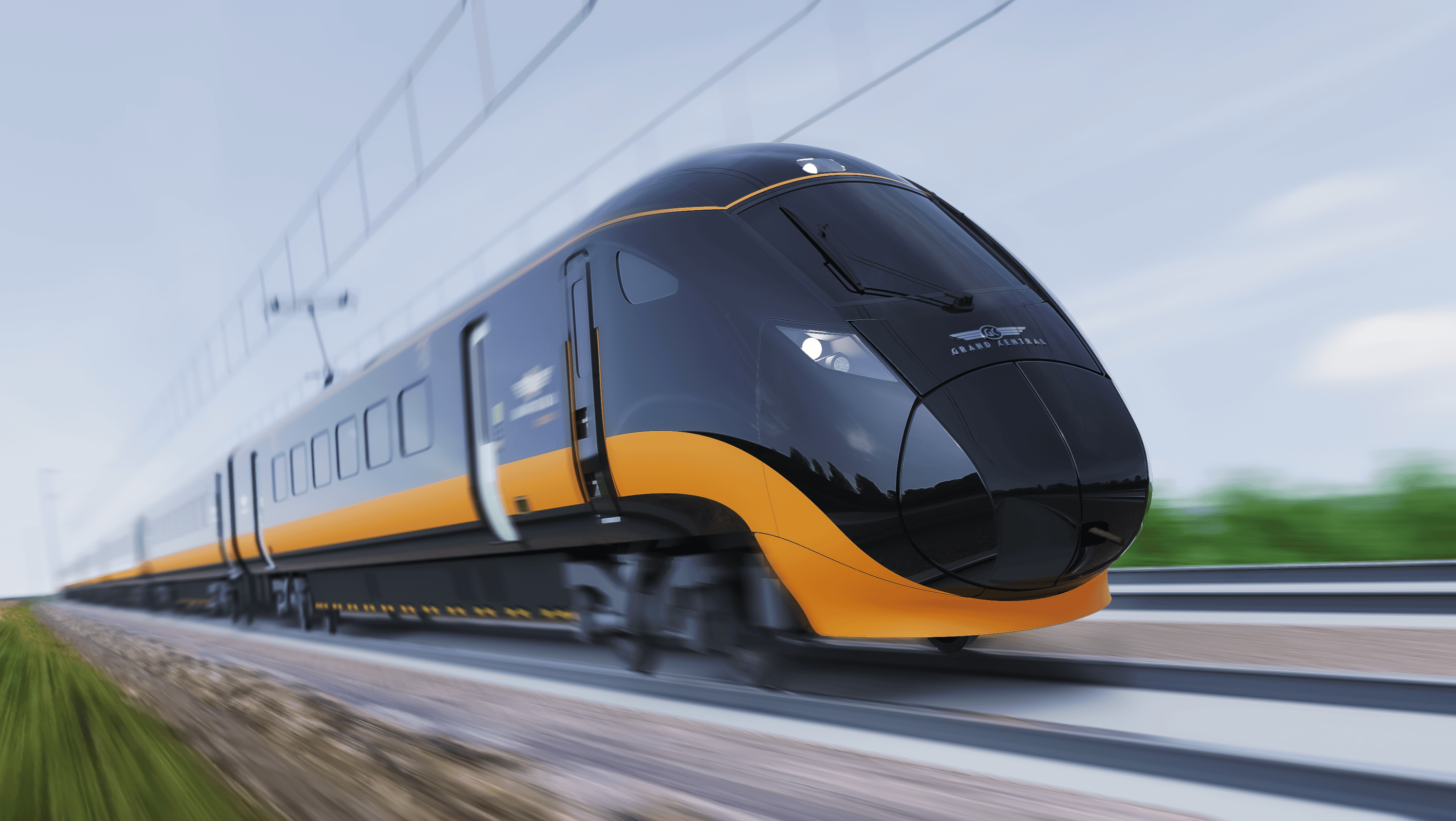
- The Grand Central version looks very stylish!
- Hitachi’s battery technology is owned by Turntide Technology, who are a US company.
- For some routes, the trains would probably only need to be battery-electric.
Has the experience of running Chiltern Railways, CrossCountry and Grand Central Trains convinced I Squared Capital, that running railways is a good investment?
Have I Squared Capital identified some railroads in the United States, that could follow a similar upgrade path to Chiltern Railways?
Was it significant that the order was announced the day after Trump’s tariffs?
.
 The Anonymous Widower