Great Yarmouth Terminal Set For Redevelopment Under Port Of East Anglia Name
The title of this post, is the same as that of this article on offshoreWIND.biz.
This is the sub-heading.
The UK’s Peel Ports Group has decided to invest a further GBP 10 million (approximately EUR 11.3 million) into its Great Yarmouth site, which is being rebranded as the Port of East Anglia.
These four paragraphs add details to the story.
The newly announced GBP 10 million brings this year’s total investment to GBP 70 million across the site and will be used to redevelop the port’s Northern Terminal, helping to accommodate the next generation of offshore wind projects across the region, according to Peel Ports.
Earlier this year, a substantial investment into its Southern Terminal was announced by the port, which has earmarked GBP 60 million to transform capacity and improve efficiencies.
This involves ensuring the port can support multiple hydrogen, carbon capture, offshore wind, and nuclear projects for decades to come.
Its existing terminals service a variety of construction customers, including infrastructure projects such as Sizewell C and offshore energy projects based in the southern North Sea.
Note.
- In Yarmouth Harbour To Be ‘Completed’ In £60m Project, I talk about the work to be done on the Southern Terminal.
- The work on the Southern Terminal includes a roll-on roll-off (RORO) lift ramp and a large storage area.
- Start on the work on the Southern Terminal will start in 2026.
With all the construction work mentioned in the last two paragraphs, I suspect that the Port of Great Yarmouth will be busy?
These are some further thoughts.
Why Is The Port Of Great Yarmouth Being Renamed?
The article says this.
The new name, which will come into effect in early 2026, also aligns with the creation of a new combined authority for Suffolk and Norfolk, according to Peel Ports.
Peel Ports name change is fairly sensible, but as I was conceived in Suffolk and I’m an Ipswich Town supporter, I don’t feel that the two counties should be merged.
Does The Mention Of Hydrogen Mean That The Port Of Great Yarmouth Will Be Hosting A Hydrogen Electrolyser, To Fuel Trucks And Ships?
I asked Google AI, “If A Hydrogen Electrolyser is To Be Built In The Port Of Great Yarmouth?”, and received this answer.
While there are no current public plans for an immediate construction of a large-scale hydrogen electrolyser within the Port of Great Yarmouth, significant port expansion and infrastructure upgrades are underway to ensure it can support future hydrogen projects and related clean energy initiatives.
Note.
- If technology to handle hydrogen, is copied from North Sea gas, there is certainly a lot of proven technology that can be used again.
- There may even be depleted gas fields, where captured carbon dioxide, hydrogen or North Sea gas can be stored.
I find the most exciting thing, would be to send hydrogen to Germany.
Why Would Anybody Export Hydrogen To Germany?
I asked Google AI, the question in the title of this section and received this answer.
Countries would export hydrogen to Germany because Germany has a large, growing demand for hydrogen to power its heavily industrialised economy and achieve its decarbonisation goals, but lacks sufficient domestic renewable energy capacity to produce the required amounts.
Germany also, uses a lot of bloodstained Russian gas and indigenous polluting coal.
How Could Anybody Export Hydrogen To Germany?
- Wilhelmshaven is one of the main import ports for hydrogen in North West Germany.
- Great Yarmouth is probably the closest larger port to Germany.
- Great Yarmouth and Wilhelmshaven are probably about 300 miles apart, by the shortest route.
- Great Yarmouth would need to build infrastructure to export hydrogen.
The easiest way to transport the hydrogen from Great Yarmouth to Wilhelmshaven, is probably to use a gas tanker built especially for the route.
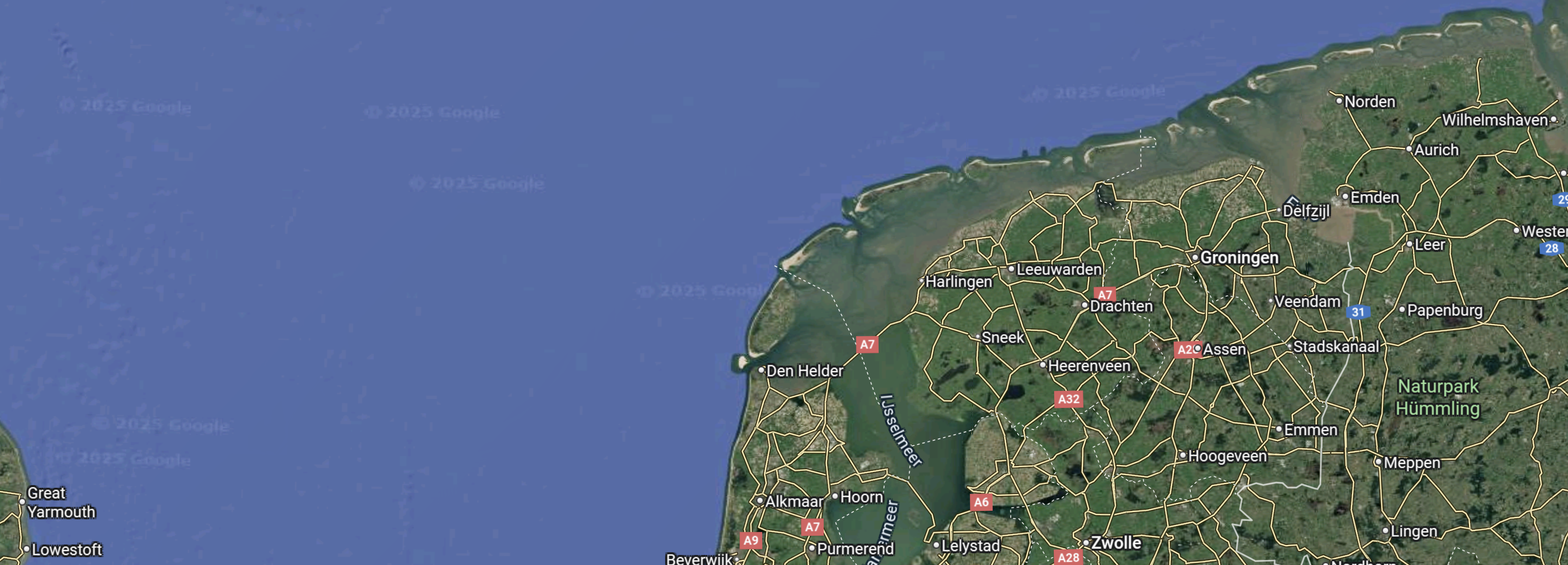
This Google Map shows the route between Great Yarmouth and Wilhelmshaven.
Note.
- The North-East corner of East Anglia with Great Yarmouth to the North of Lowestoft, is in the bottom-left corner of the map.
- Wilhelmshaven is a few miles inland in the top-right corner of the map.
- Could a coastal tanker go along the Dutch and German coasts to Wilhelmshaven?
I have no skills in boats, but would Great Yarmouth to Wilhelmshaven to take hydrogen to Germany?
RWE Are Developing Three Wind Farms To The North-East of Great Yarmouth
RWE are a large German Electricity company and the UK’s largest generator of electricity.
The company is developing three wind farms to the North-East of Great Yarmouth.
- Norfolk Boreas – 1.2 GW – 45 miles offshore
- Norfolk Vanguard West – 1.2 GW – 29 miles offshore
- Norfolk Vanguard East – 1.2 GW – 28 miles offshore
Note.
- The electricity for all three wind farms is to be brought ashore at Happisburgh South, which is about 22 miles North of Great Yarmouth.
- The original plan was to take the electricity halfway across Norfolk to the Necton substation to connect to the grid.
- The natives will not be happy about a 4.2 GW overhead line between Happisburgh and Necton.
- RWE have built offshore electrolysers before in German waters.
- Could an electrical cable or a hydrogen pipe be laid in the sea between Happisburgh South and the Port of Great Yarmouth?
- The electrolyser could either be offshore at Happisburgh or onshore in the Port of Great Yarmouth.
As I don’t suspect these three wind farms will be the last connected to the Port of Great Yarmouth, I would expect that RWE will put the electrolyser offshore at Happisburgh and connect it by a hydrogen pipeline to the Port of Great Yarmouth.
Could There Be A Connection To The Bacton Gas Terminal?
Consider.
The Bacton Gas Terminal, which feeds gas into the UK Gas Network, is only 4.2 miles up the coast from Happisburgh South.
Some climate scientists advocate blending hydrogen into the gas supply to reduce carbon emissions.
In Better Than A Kick In The Teeth – As C Would Say!, I disclosed that I now have a new hydrogen-ready boiler, so I’m not bothered, if I get changed to a hydrogen blend.
So could hydrogen from the Norfolk wind farms be fed into the grid to reduce carbon emissions?
Could The Port Of Great Yarmouth Become A Hydrogen Distribution Centre?
Thinking about it, the port could also become a distribution centre for green hydrogen.
Consider.
- Hydrogen-powered ships, tugs and workboats could be refuelled.
- Hydrogen-powered trucks could also be refuelled.
- Tanker-trucks could distribute hydrogen, to truck and bus operators, farms and factories, that need it for their transport and operations.
- I believe, that construction equipment will be increasingly hydrogen-powered.
In my life, I have lived at times in two country houses, that were heated by propane and there are about 200,000 off-grid houses in the UK, that are heated this way.
The two houses, where I lived would have been a nightmare to convert to heat pumps, but it would have been very easy to convert them to a hydrogen boiler and power it from a tank in the garden.
It should be noted, that the new boiler in my house in London is hydrogen-ready.
So the Port of Great Yarmouth could be the major centre for hydrogen distribution in Norfolk.
In the 1960s, I used to work in ICI’s hydrogen plant at Runcorn. If you ride in a hydrogen bus in England, it is likely that the hydrogen came from the same plant. Handled correctly, hydrogen is no less safe and reliable than natural gas or propane.
Toyota Leads Multi-Million-Pound Micromobility Research Project
The title of this post, is the same as that of this news item from the Advanced Propulsion Centre.
These five paragraphs introduce the project.
he Advanced Propulsion Centre UK (APC) has announced the latest project funded through the UK Government’s DRIVE35 Collaborate programme.
Toyota will lead a consortium to research and develop a new lightweight battery electric vehicle in Derbyshire.
The project aims to meet the evolving needs of urban populations while accelerating the shift to zero tailpipe emission transport by validating a novel, lightweight battery electric vehicle (BEV) in the L6e category.
Underlining Toyota’s commitment to investing in the UK’s R&D capabilities, it will be manufactured at Toyota Manufacturing UK’s (TMUK) Burnaston site.
The vehicle addresses the growing demand for sustainable micro-mobility solutions and includes an integrated solar roof, increased connectivity, and lightweight sustainable materials supporting recovery and recycling.
Note.
- The vehicle will be light in weight.
- Toyota is investing in UK R & D.
- The vehicle will be built in Derbyshire at Burnaston.
I asked Google AI, what is an L6e Car and received this reply.
An L6e car is a light quadricycle in the EU vehicle classification system, defined as a light, four-wheeled vehicle with a maximum speed of 45 kph}) (28 mph)) and an unladen mass of no more than 425 kg. (excluding batteries for electric versions). It can be powered by small internal combustion engines or electric motors, and vehicles in this category are often used for urban commuting or small delivery tasks.
Note.
- Sir Alec Issigonis’s famous ADO15 Mini, which was launched in 1962, weighed 580 Kg, seated four and had an initial top speed of 75 mph.
- Sir Alec also designed racing cars and high performance Mini Coopers.
- Another partner in the project specialises in urban delivery vehicles.
I always wonder what sort of electric vehicle, the great car designer would have designed.
These are some further thoughts.
Do Toyota Build Microcars In Japan?
I asked Google AI, the question in the title of this section and received this answer.
Yes, Toyota builds microcars in Japan, and the Toyota C+pod is one example. While Toyota previously focused on larger vehicles, it now manufactures ultra-compact electric vehicles like the C+pod for the Japanese market to meet customer demand for small city cars.
The Toyota C+Pod has this Wikipedia entry, which gives these details.
- Two seats.
- 9.2 KW electric motor.
- 670-690 Kg weight.
- 37 mph.
- 93 mile range.
- The car has air conditioning, air-bags and heated seats.
The number of seats, speed and range would appear to be ideal for a city-car.
Could The Vehicle Be Hydrogen Powered?
I asked Google AI, if small lightweight hydrogen fuel cells exist and received this answer.
Yes, small, lightweight hydrogen fuel cells do exist and are commercially available for various applications, ranging from educational kits to power sources for drones and portable electronics.
I wouldn’t be surprised if the project needed a hydrogen fuel cell of a particular weight, size and power, someone could built it, by scaling an existing design.
Could The Vehicles Be Self Driving?
Not probably now, but as the technology gets more sophisticated, I suspect that it will happen.
Could The Vehicles Replace The Invacar?
This article in The Times is entitled Bring Back Three-Wheeled Cars For Disabled Drivers, Reform Urges.
I would expect that, if Toyota, the Advanced Propulsion Centre and their partners did a comprehensive job, then Toyota’s new car could serve the same purpose as an Invacar, much better in a zero-carbon manner.
There Is This Video Of A Toyota C-Pod.
Conclusion
I believe this project could come up with something special.
 The Anonymous Widower