Worried For Clive
On a bus on Saturday, I sat next to a lady of about my age and we got talking about Russia’s illegal attack on Ukraine.
We then started talking about BBC’s news correspondent in Ukraine; Clive Myrie.
We were both worried about Clive.
This article on the BBC is entitled Racism In Russia: Stories Of Prejudice and it details a stories of a black student and others in the country. I also remember, when I went to see Ipswich play in Moscow, that a black fan told me he had been abused on the Moscow Metro.
I do wonder that if Kyiv falls, that Clive will not have an easy time.
Let’s hope Clive was born lucky!
Ukraine Crisis: Fifa And Uefa Suspend All Russian Clubs And National Teams
The title of this post, is the same as that of this article on the BBC.
This first paragraph says it all.
Russian football clubs and national teams have been suspended from all competitions by Fifa and Uefa after the country’s invasion of Ukraine.
It looks like it is a complete ban from both Fifa and Uefa.
Vlad the Invader/Mad/Poisoner (Delete as appropriate!), is reportedly not amused.
My father, who had something to do with the League of Nations, felt that we didn’t act soon enough over Hitler and Stalin and I could argue we should have acted with tough sanctions after Putin annexed Crimea in 2014.
Is This Weapon Helping The Ukranians?
In The Times today, there is an article, which gives a list of what weapons have been supplied to the Ukrainians.
Included are.
- Javelins from the US and Estonia
- Stingers from Germany and the Netherlands
- Panzerfaust 3 from the Netherlands.
But there is no mention of the MBT LAW. This is the introduction to the Wikipedia entry for the weapon.
The Main Battle Tank and Light Anti-tank Weapon (MBT LAW), also known as the NLAW, is a joint British and Swedish short-range fire-and-forget anti-tank missile system. Designed for use by infantry, the MBT LAW is shoulder fired and disposable, firing once before being disposed of. It is currently in use with the military forces of the United Kingdom, Finland, Luxembourg, Ukraine, and Sweden, among others.
There is a lot of interesting information in the Wikipedia entry.
- It is fired once and the launcher is thrown away.
- It has a soft-launch, which allows it to be fired from an enclosed space.
- It is designed to be fired at moving targets.
I also think, that it could be a weapon, where a dummy version could be built that would be a superb training simulator.
- The trainee would sit on the range with his dummy weapon and go through the process of identifying a target and pulling the trigger.
- The dummy could even simulate the forces of launching a real missile.
- The simulator would calculate the trajectory of the missile and tell the trainee and his instructor, if they had hit the target.
The missile would not be fired and there would be no damage to the target.
This is said about deliveries to Ukraine.
At least 2,000 NLAW units are known to be supplied to Ukraine by the United Kingdom by 19 January 2022 and more shipments, including by other supporters, can be assumed amid the Russian invasion of Ukraine.
The Times says this about the training of Ukrainian forces and British Army tactics.
Since 2015 about 22,000 Ukrainian troops have been trained by the British Army as part of Operation Orbital.
Price said anti-armour ambushes of the sort deployed by Ukrainian forces were pretty much the bread and butter of the British infantry, adding: “If you have a classic column of 10 to 20 tanks and you’ve got a wide field of fire then you can knock two or three of them out and then the rest are sitting ducks and they can’t reverse out. Then you finish them off,” he said.
Note that Price is Kevin Price a former British Army major.
It sounds like a few well-trained soldiers sitting in a protected bunker armed with this missile could play havoc with a tank formation.
Ukraine: Anger Over Russian Oil Tanker Due In Orkney
The title of this post, is the same as that of this article on the BBC.
This is the first two paragraphs.
Russian ships could have their access to UK ports restricted, under plans being considered at Westminster.
It follows concerns that a Russian-owned tanker is due at an Orkney oil terminal within days.
The tanker is going to pick up oil.
I can understand the anger, but as we are led to believe that the Russians have plenty of oil and gas does it matter that we sell them a tanker full, provided the cheque or transfer doesn’t bounce?
We should sell the Russians anything that has nothing to do with the war, but things like luxury goods will not help them in their takeover of Ukraine.
The list would include goods like expensive cars, but not trucks or 4 x 4’s, Scotch whisky, jewellery, chocolates and expensive clothes.
Thoughts On The Balliemeanoch Pumped-Hydro Scheme
I first talked about the Balliemeanoch Pumped-Hydro Scheme in ILI Group To Develop 1.5GW Pumped Storage Hydro Project, which I wrote earlier this month.
I was a bit unsure as to where the high-level reservoir would be sited, although, the original report said the low-level reservoir was Loch Awe.
I then found this in an article on The Scotsman.
Project Balliemeanoch will see Lochan Airigh turned into a headpond containing 58 million cubic metres of water.
This Google Map shows Lochan Airigh.
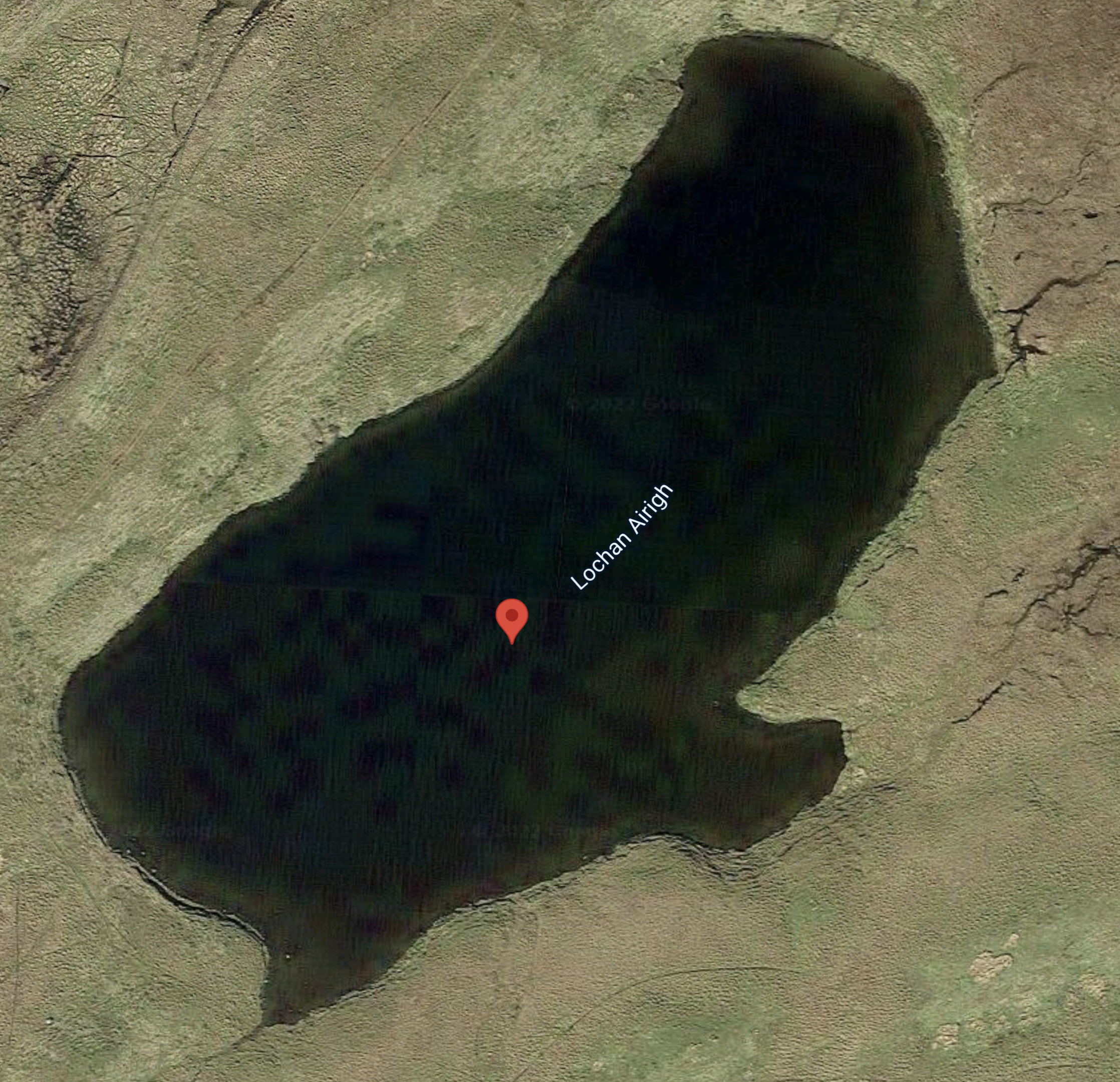
At not much more than a hundred metres across, you wouldn’t call Lochan Airigh a large loch.
But look at its position compared to the village of Ballimeanoch on the shore of Loch Awe in this Google Map.
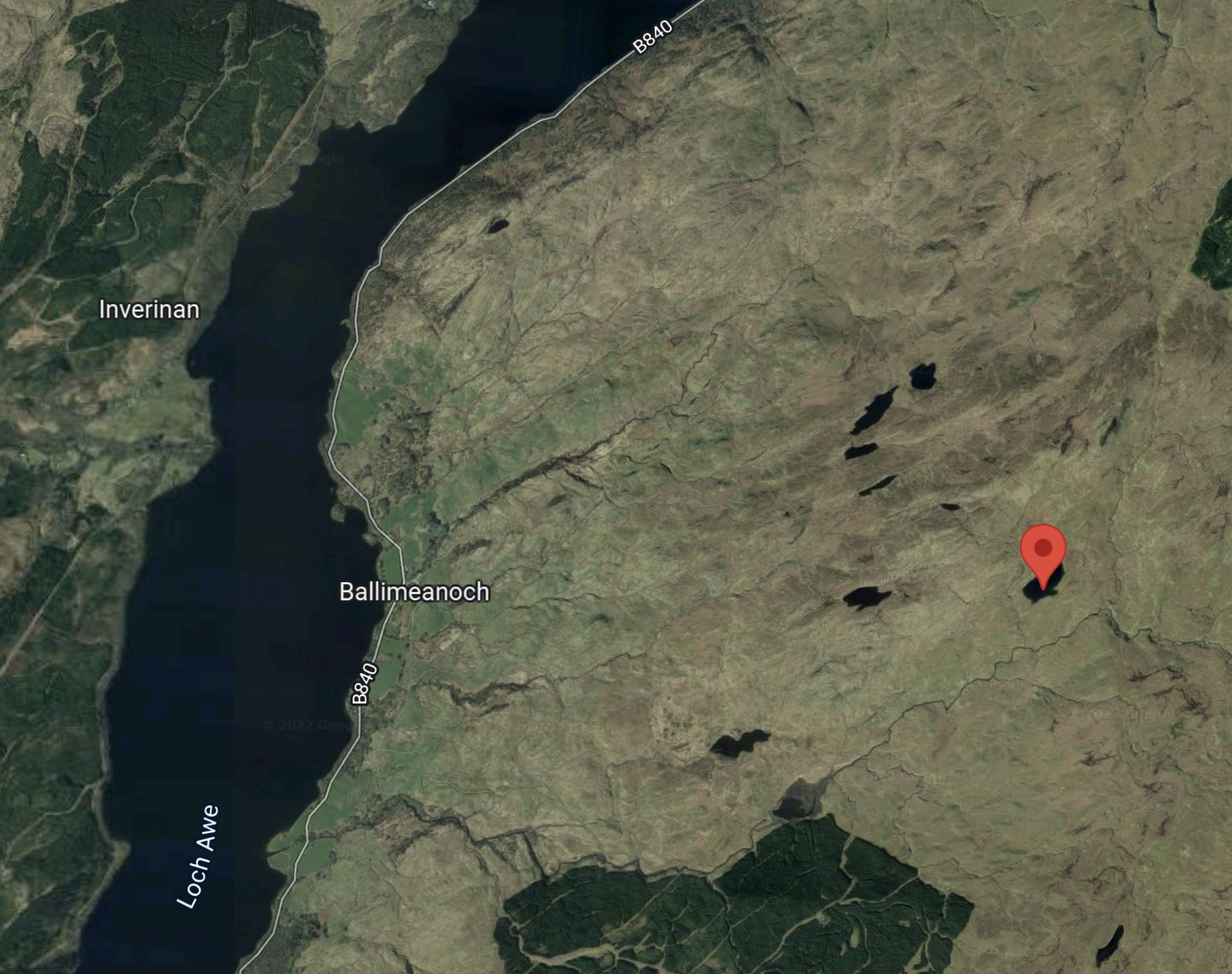
The North of Scotland Hydroelectric Board built Cruachan pumped-storage power station round the corner in Loch Awe in the early 1960s, so I would believe construction is possible.
But Cruachan is only a 7.1 GWh scheme, whereas Balliemeanoch is planned as a 45 GWh giant.
Fortescue Starts Building Hydrogen Electrolyser Plant That Will Double Global Production
The title of this post, is the same as that of this article on RenewEconomy.
These are the first two paragraphs.
Fortescue Future Industries has begun construction of what it says will be the world’s largest electrolyser manufacturing facility in Gladstone, Queensland, the first stage of a massive plant that could also make wind turbines, solar panels, batteries and cables.
Fortescue Future Industries, the newly created green energy part of Andrew Forrest’s iron ore empire Fortescue Metals, and a key component of his massive and highly ambitious green hydrogen plans, says the firsts electrolysers will roll off the factory floor in 2023.
Production is to be at a level of 2 GW per year.
Repurposing The Breadalbane Hydro-Electric Scheme
The Breadalbane hydro-electric scheme was built in the 1950s and early 1960s, by the North of Scotland Hydroelectric Board.
- The scheme is now owned by SSE Renewables and has a page on their web site.
- There are seven individual power stations; Lubreoch, Cashlie, Lochay, Finlarig, Lednock, St Fillans and Dalchonzie.
- There are five dams; Lawers, Breaclaich, Lednock, Lubreoch and Giorra.
This map from the SSE Renewables web site shows the layout of the dams and power stations.
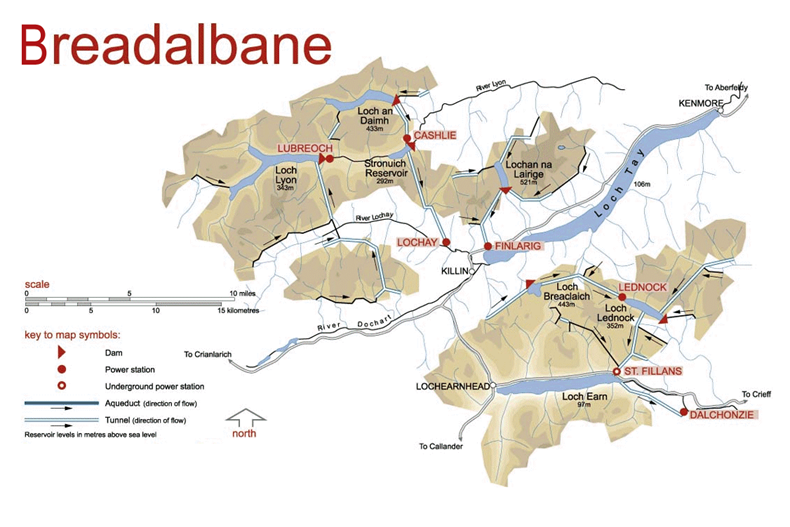
The sizes of the power stations in the scheme are as follows.
- Lubreoch – 4 MW
- Cashlie – 11 MW
- Lochay – 45 MW
- Finlarig – 16.5 MW
- Lednock – 3 MW
- St Fillans – 16.8 MW
- Dalchonzie – 4 MW
This gives a total power of 100.3 MW.
This Google Map shows Loch Tay.
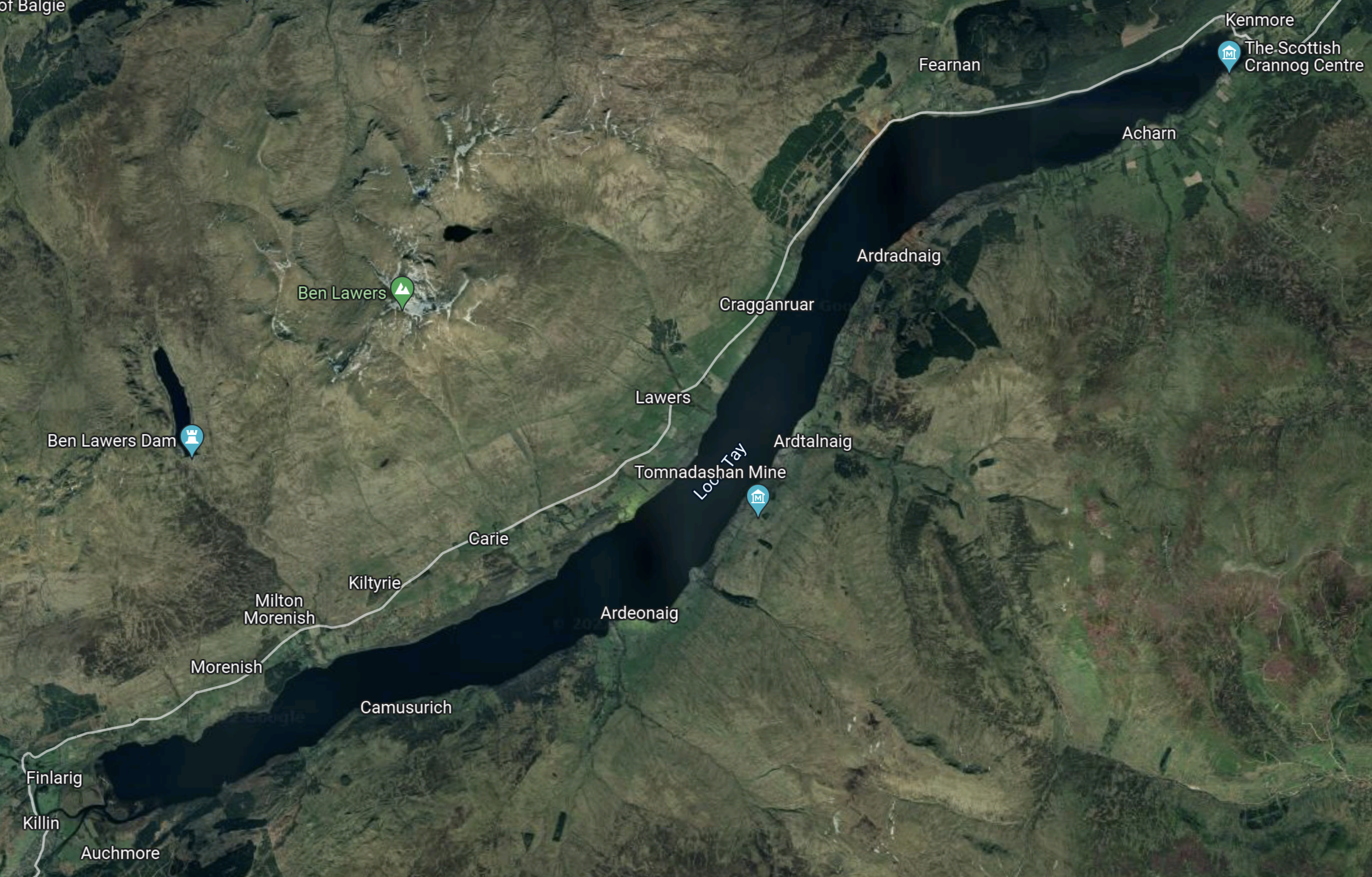
Note
- Finlarig. where there is a power station, with a capacity of 16.5 MW.
- Ben Lawers dam, is to the West of Ben Lawers and is marked by a blue arrow.
- The biggest power station in the scheme is Lochay power station, which has a capacity of 45 MW.
- Lochay power station is to the West of Finlarig power station and both appear to be fed from Ben Lawers dam and others to the North.
This Google Map shows Loch Earn.

Note.
- Loch Earn is South of Loch Tay
- The red arrow indicates Dalchonzie power station.
- Dalchonzie power station has a generating capacity of only 4 MW.
This Google Map shows the location of Loch Lednoch between Loch Tay and Loch Earn.
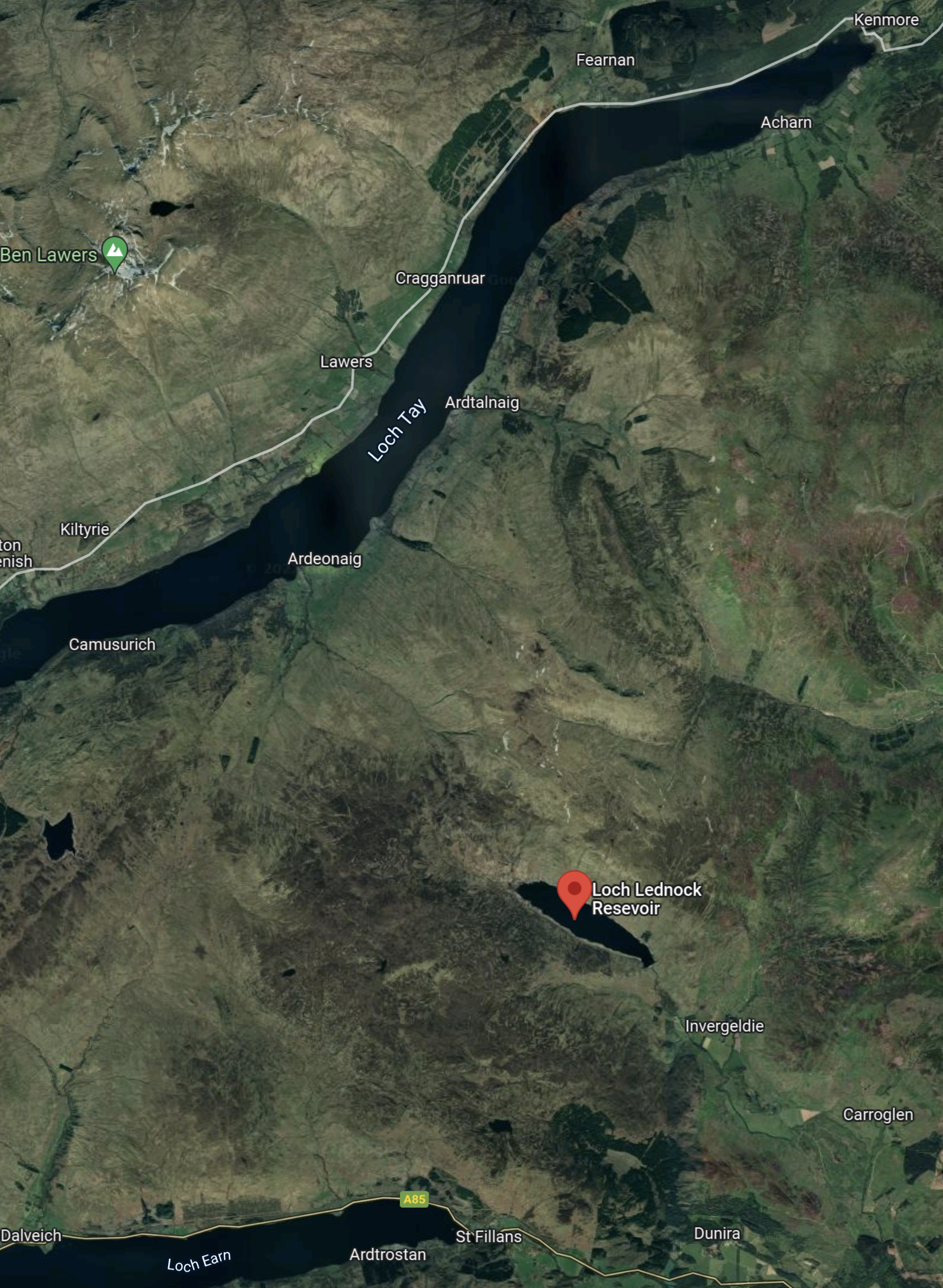
Note that Lednoch has the 3 MW Lednoch power station at its Northern end.
This map shows to the West of Ben Lawers.
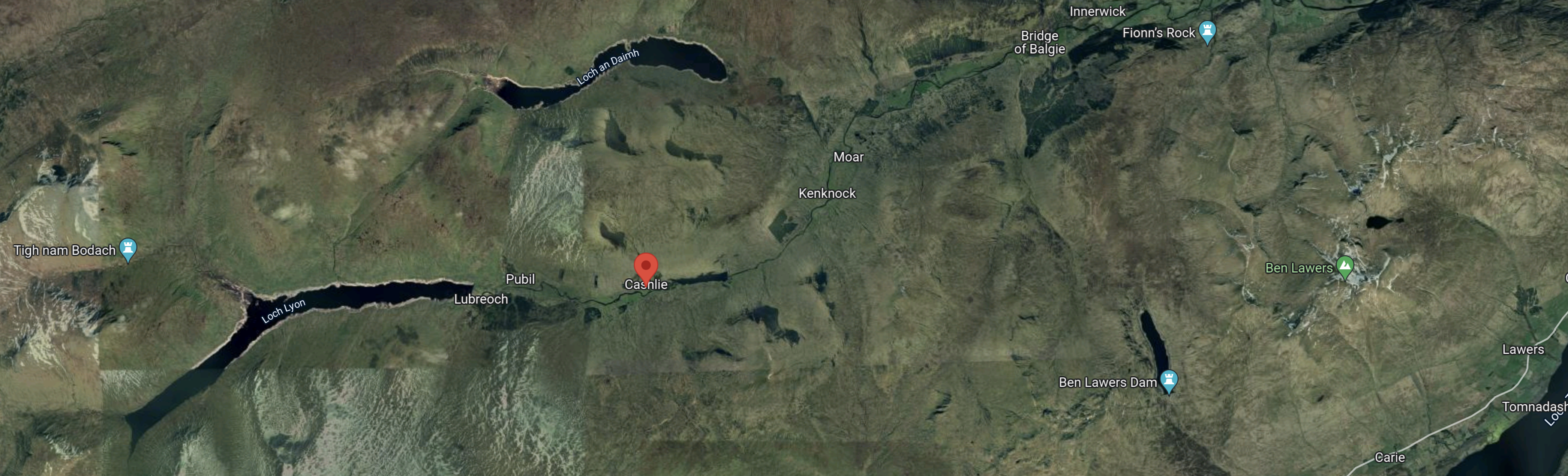
The red arrow indicate the rough location of the 11 MW Cashlie power station.
Is The Breadalbane Scheme Complete?
Looking at the dates of power station construction, I wonder if the dam builders concentrated in the early 1960s on the construction of Cruachan pumped storage station, which was constructed between 1959 and 1965.
Also to me, the Breadalbane scheme seems to have a lot of power stations and tunnels for just over 100 MW.
- At Rannoch, there is a 44 MW power station on the shores of Loch Rannoch, that was built in 1930.
- At Sloy there is a 152.5 MW power station on the shores of Loch Lomond, that was built in 1950.
I would have thought that a progression from Sloy, would have seen a large power station built on the shores of Loch Tay, whereas Lochay power station is only 44 MW.
This Google Map shows Lochan Breaclaich, which is a lake created by the construction of Breaclaich dam.
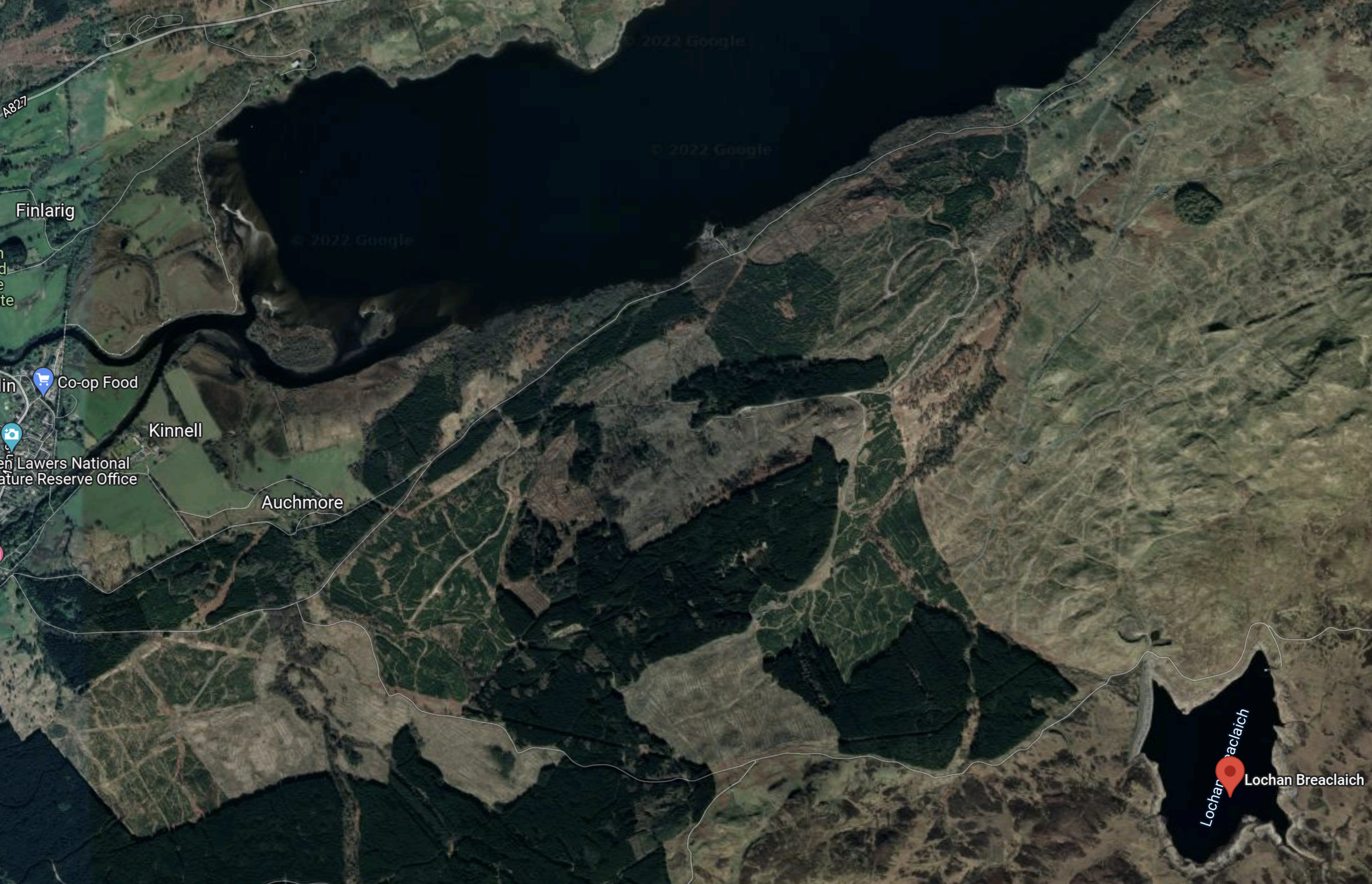
Lochan Breaclaich is marked by the red arrow and it is Loch Tay at the top of the map.
This page on the Canmore web site gives these details of Lochan Breaclaich and its dam.
Breaclaich dam is designed to prevent Loch Breachlaich and a number of other intakes from discharging into the Loch Tay catchment. A tunnel intake gatehouse is upstream of the dam and takes water via tunnel and pipeway through to Lednock power station.
The SSE map shows this tunnel to the North-Western end of Loch Lednoch, where the Lednoch power station is located.
It seems a lot of work was done to feed the power station, which has a capacity of just 3 MW.
Was it originally intended that Lochan Breaclaich would have fed a large power station on the Southern shore of Loch Tay?
Strathclyde University And Pumped Storage Power For Scotland
This page on the Strathclyde University gives a list of the pumped storage potential for Scottish hydrogen-electric dams and power stations.
These figures are given for the dams and lochs in the Breadalbane scheme.
- Ben Lawers – 12 GWh
It would appear that based on research from Strathclyde University, that the Breadalbane scheme could support 12 GWh of pumped storage.
Could this be augmented by a pumped-storage scheme from the Southern shore of Loch Tay to Lochan Breaclaich?
- Lochan Breaclaich is at an altitude of 443 metres.
- Loch Tay is at an altitude of 106 metres.
- Foyers pumped storage has a capacity of 300 MW and a head of 179 metres.
If a 12 GWh pumped storage system can be built on the North side of Loch Tay, I can’t see why with a head of 337 metres, one can’t be built on the South side of the Loch.
Was this the original plan?
Water Flows In The Breadalbane Scheme
Looking at the SSE Renewables map of the Great Glen scheme, water flows appear to be as follows.
- Loch an Daimh to Stronuich Reservoir via Cashlie power station
- Loch Lyon to Stronuich Reservoir via Lubreoch power station
- Stronuich Reservoir to Lochay power station
- Loch Ben Lawers to Finlarig power station
- Lochan Breaclaich to Loch Lednock via Lednoch power station
- Loch Lednock to Loch Earn via St. Fillans power station
- Loch Earn to Dalchonzie power station
It seems to be an expensive scheme with lots of tunnels and an underground power station at St. Fillans.
Refurbishing And Repurposing The Breadalbane Scheme
Perhaps as the power stations are now over fifty years old, one simple way to increase the generating capacity of the Breadalbane scheme, might be to selectively replace the turbines, with modern turbines, that can generate electricity more efficiently.
I suspect that SSE Renewables have an ongoing program of improvements and replacements for all of their hydro-electric stations in Scotland. Some turbines at Sloy power station have already been replaced with larger ones.
Adding Pumped Storage To The Breadalbane Scheme
In this list of Scotland’s lochs on Wikipedia, there is a short list of the largest and deepest lochs.
- The first five are Loch Ness, Loch Lomond, Loch Morar, Loch Tay and Loch Awe.
- Loch Ness has the Foyers pumped-storage scheme and others are in development.
- Loch Awe has the Cruachan pumped-storage scheme.
- Loch Lomond has the Sloy pumped-storage scheme in development.
- Loch Morar is used in the Lochaber hydro-electric scheme.
It seems to me, that Loch Tay could support some pumped-storage, just because of its size.
Strathclyde University have identified that Ben Lawers can support 12 GWh on the North side of Loch Tay.
Could a scheme involving Lochan Breaclaich add a similar amount of pumped-storage on the South side of Loch Tay?
I also suspect there are possibilities for adding pumped-storage to and from Stronuich Reservoir.
Conclusion
I believe that Breadalbane is an incomplete scheme and that pumped-storage could convert this scheme into a much more powerful and larger scheme.
There would appear to be two schemes, that could each add around 12 GWh of pumped storage.
One advantage is that the waters of Loch Tay can be used for the lower reservoir.
Shin Hydro Power Scheme
The Shin hydro-electric scheme was built in the 1930s and 1950s, by the North of Scotland Hydroelectric Board.
- The scheme is now owned by SSE Renewables and has a page on their web site.
- There are three individual power stations; Casseley, Lairg and Shin.
- There are two dams
This map from the SSE Renewables web site shows the layout of the dams and power stations.
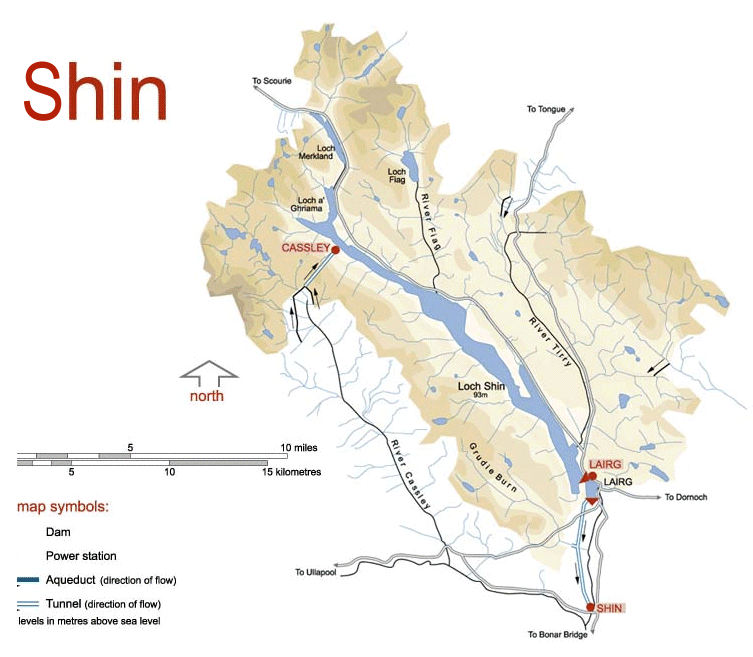
The sizes of the power stations in the scheme are as follows.
- Casseley – 10 MW
- Lairg – 3.5 MW
- Shin – 18.6 MW
This gives a total power of 32.1 MW.
This Google Map shows the same area as the SSE Renewables Map.
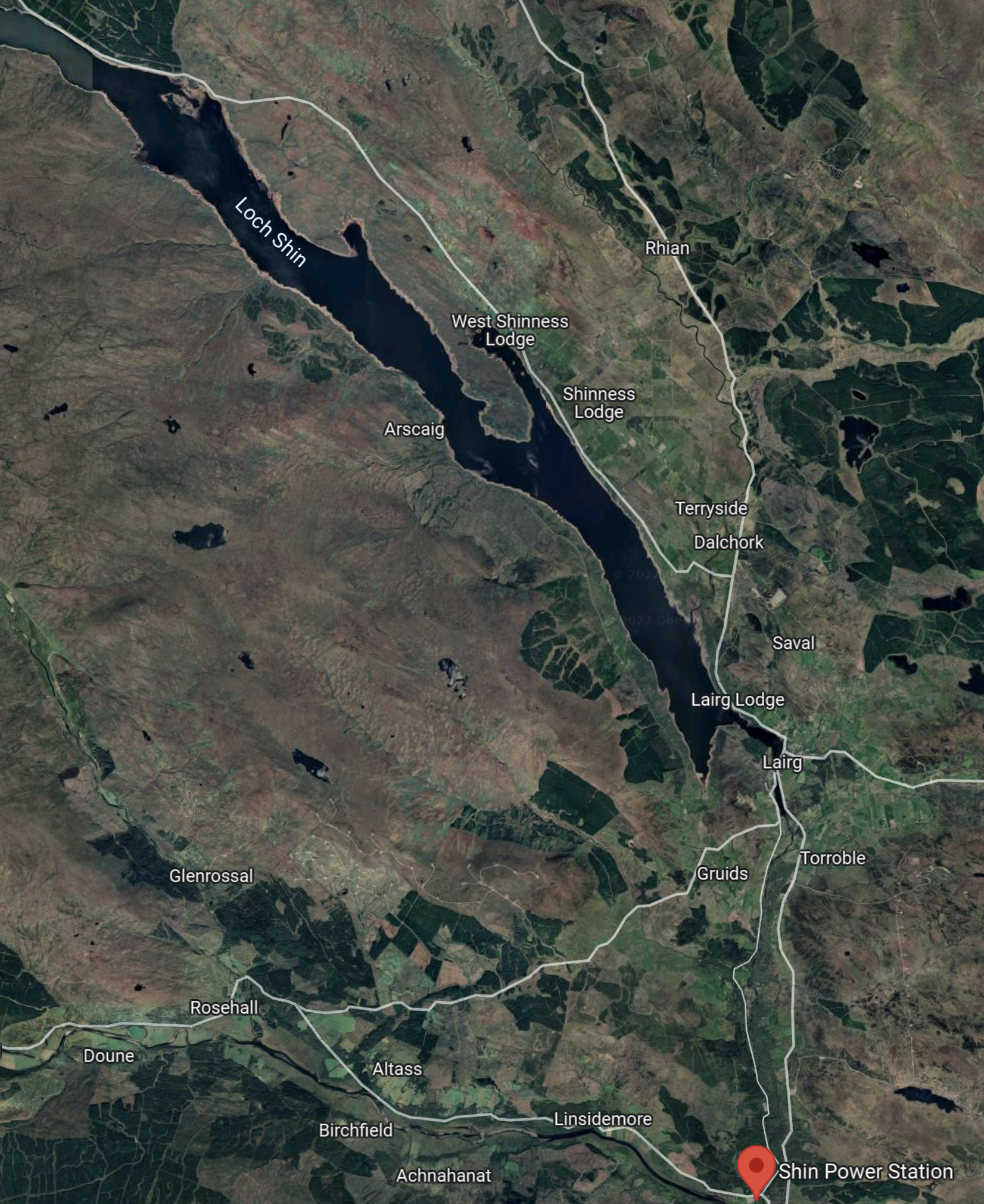
Note.
- Shin power station is in the South-West corner of the map.
- Loch Shin is the large area of water in the top half of the map.
- The village of Lairg is at the South end of Loch Shin.
This Google Map sows Shin power station in detail.
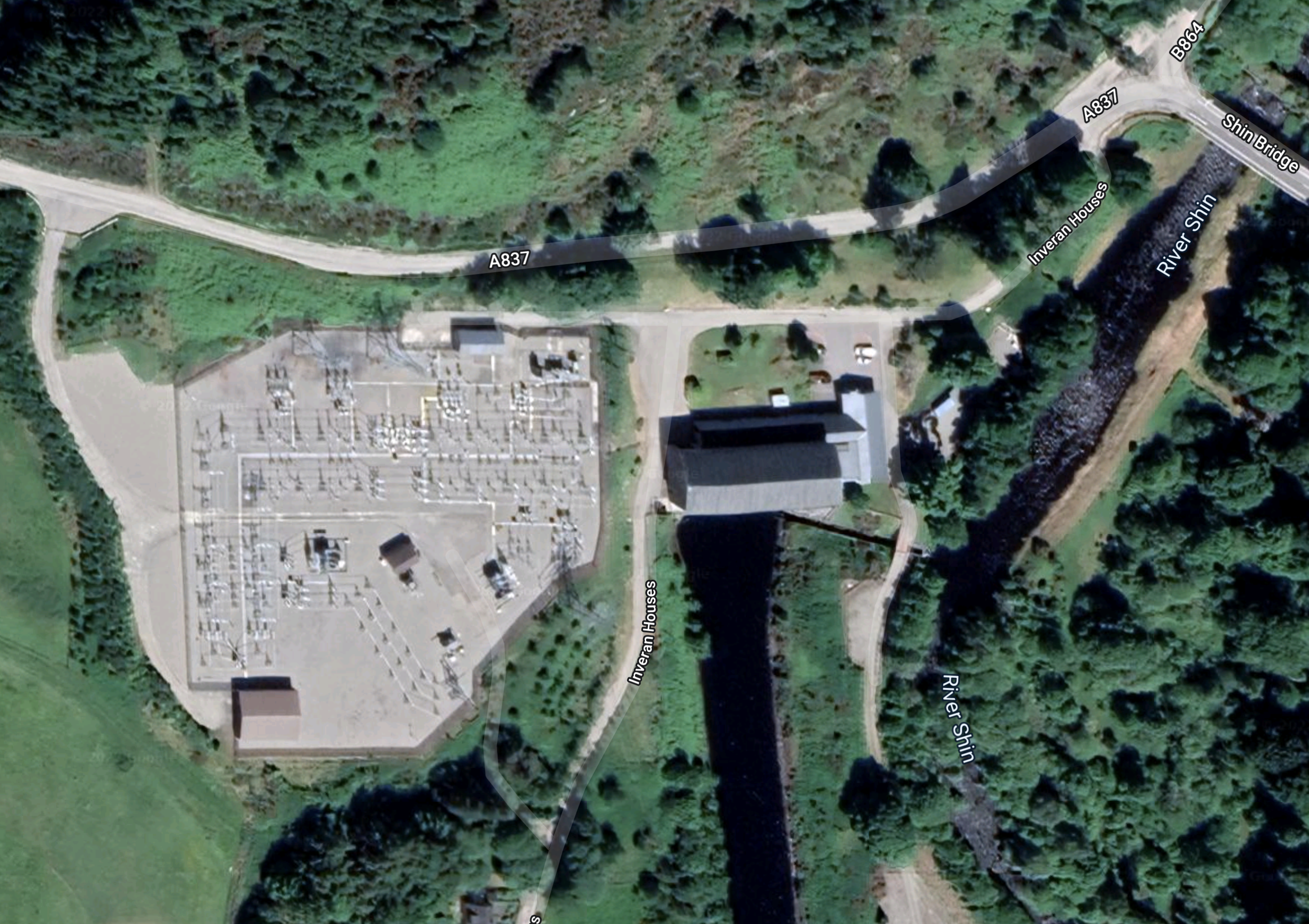
Note.
There is a large substation on the left side of the map.
Shin power station is the building straddling the water to the right of the substation.
I have found this informative press release on the SSE web site, which is entitled £5 m Investment In Shin Hydro Station.
These are a couple of paragraphs.
John McDonald, Hydro Manager for SSE said: “This is the first major overhaul of Shin Hydro Station in its 55-year history – a true testament to the reliability and longevity of hydro-electric power.
“There are few other industries that could claim to be making the same product with the same machines and same specifications as they were in the 1950s. This overhaul will mean that Shin will be producing clean, green electricity for decades to come.”
Surely, that is an argument for more hydro schemes.
This Google Map shows Lairg.
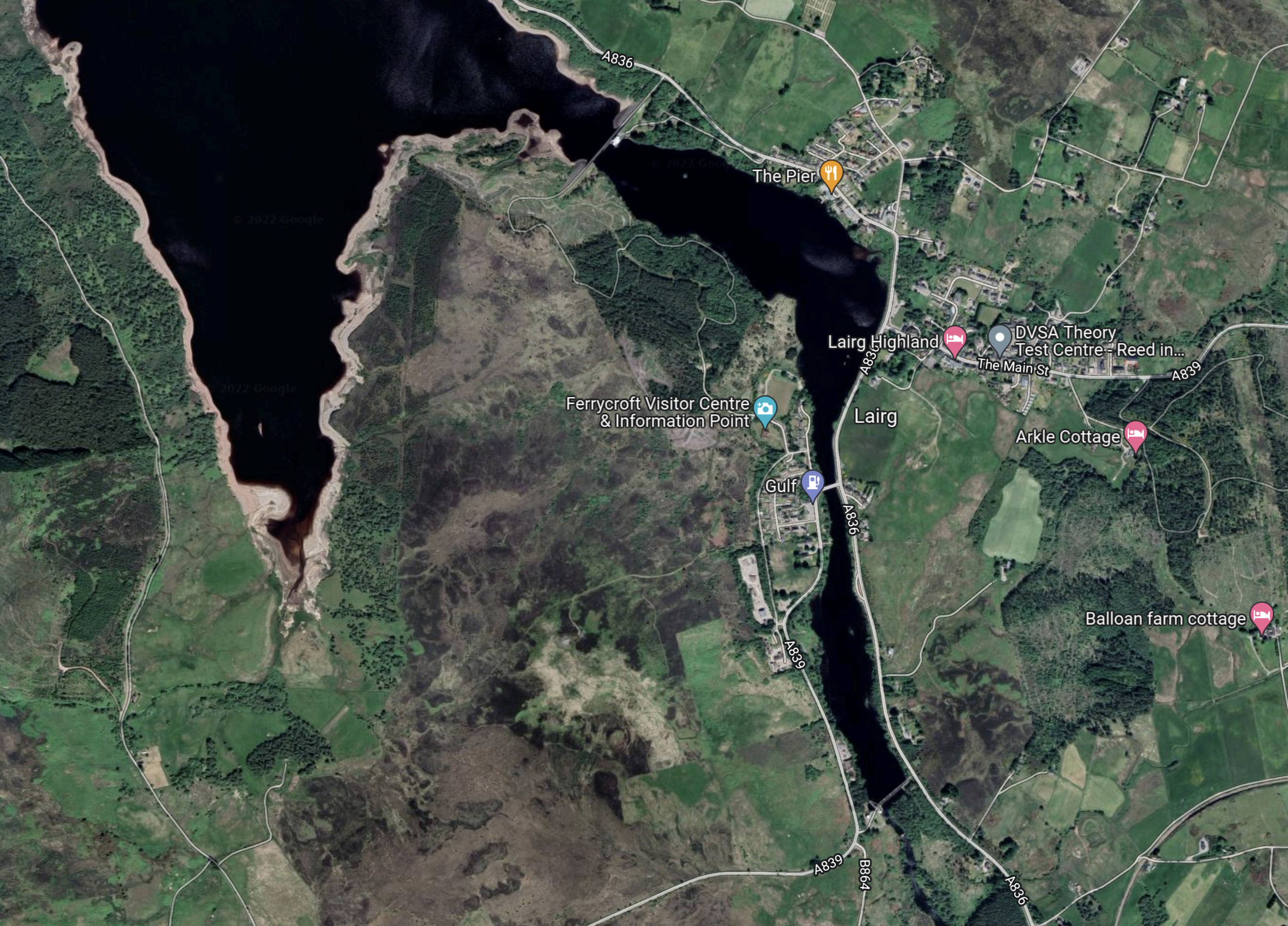
Note that there are two dams and a bridge across Loch Shin/River Shin.
This Google Map shows dam at the Southern end of the Loch.
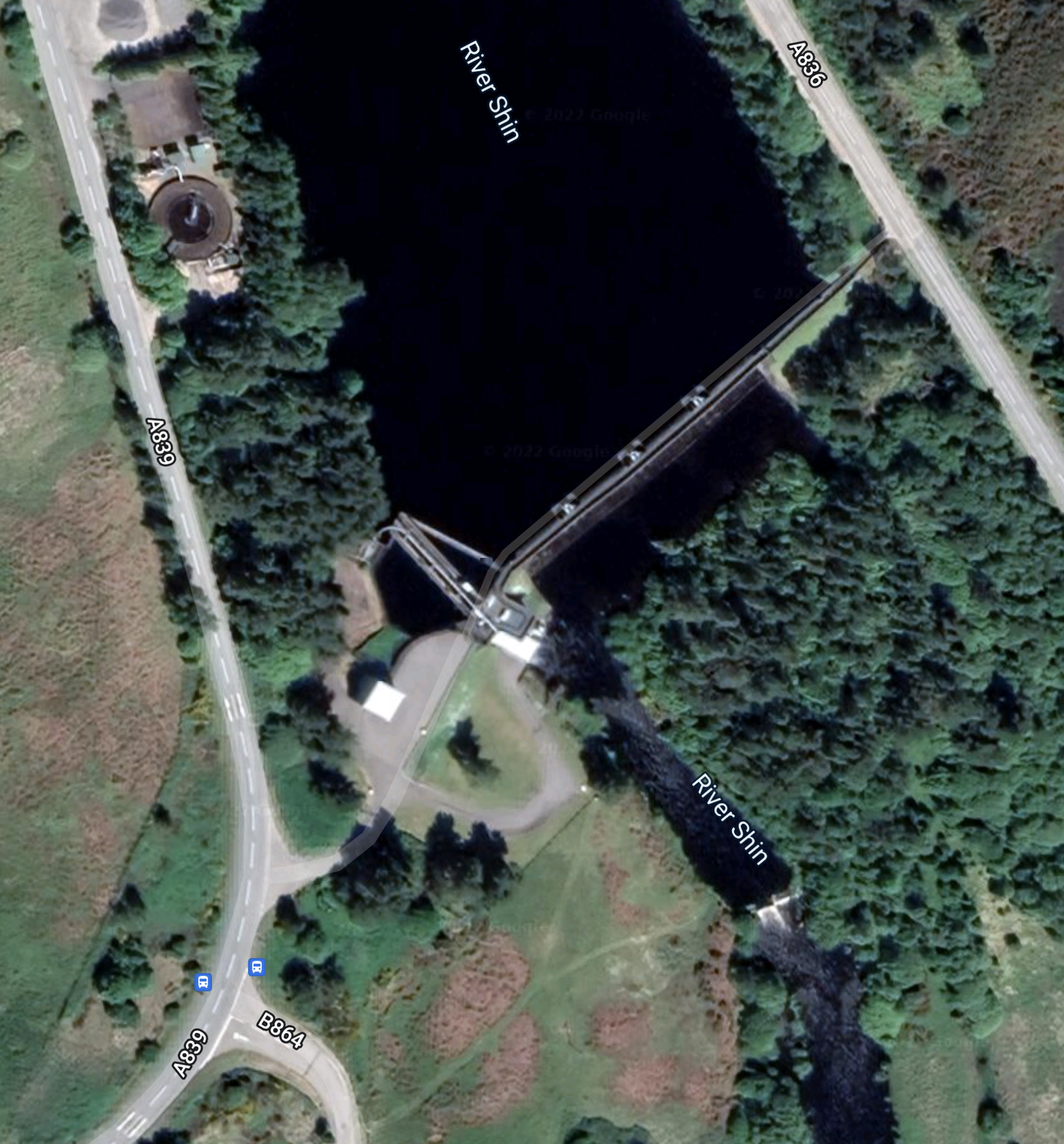
This Google Map shows Lairg dam and power station at the Northern end of the village.
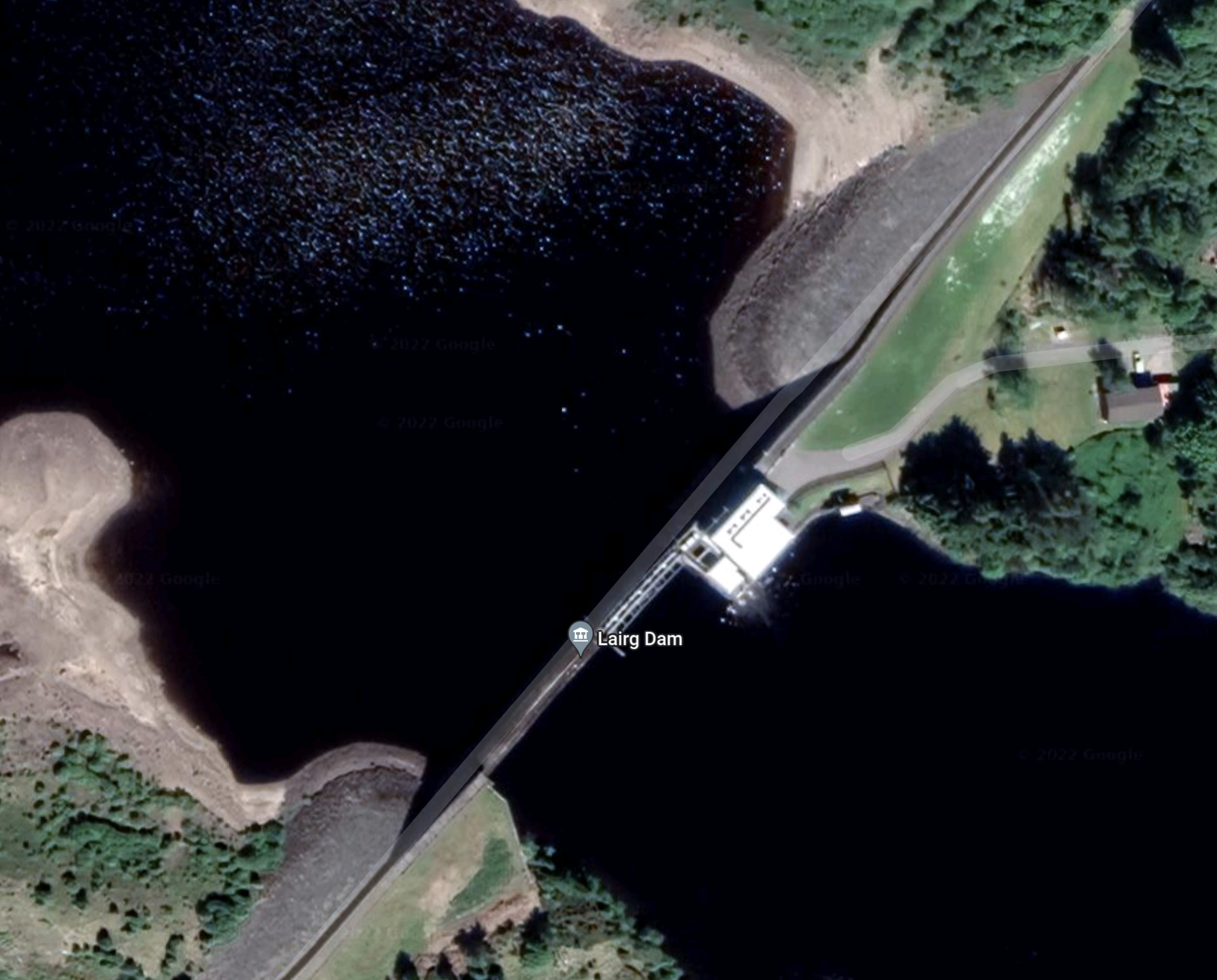
It would appear to be a much simpler scheme, than others I have examined.
Conclusion
I would be very surprised if any pumped storage were to be added to this scheme.
The Coire Glas Pumped Storage Scheme
The Coire Glas pumped storage scheme, which is being developed by SSE Renewables will be the first large scale pumped storage scheme to be developed in the UK for more than 30 years.
- It would have a power output of 1.5 GW.
- Compared to Dinorwig (Electric Mountain) in Wales at 9.1 GWh and Cruachan in Scotland at 7.1 GWh, it will be a giant.
- Planning permission has been obtained.
The Coire Glas project has a web site.
This is the introductory paragraph.
Coire Glas is a hydro pumped storage scheme with a potential capacity of up to 1500MW. Coire Glas is an excellent pumped storage site with a large lower reservoir (Loch Lochy) and a significant elevation of more than 500m between the lower and the new upper reservoir site over a relatively short distance.
There is also an explanatory video.
This map was clipped from this SSE planning document.
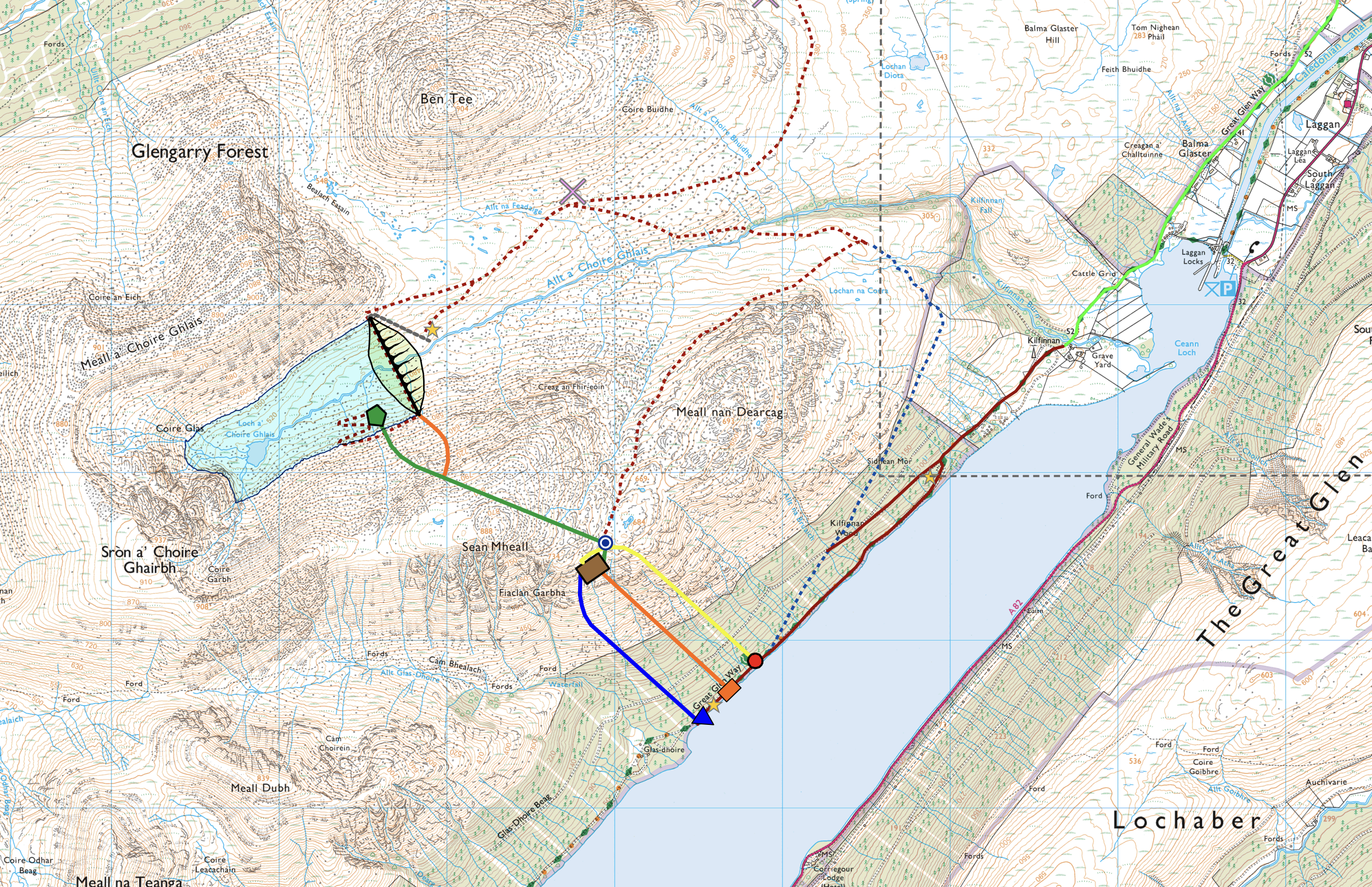
Note.
- Loch Lochy in the Great Glen will be the lower reservoir.
- Loch Lochy is a freshwater loch, that is up to seventy metres deep.
- The top reservoir is formed by building a dam across the stream, that runs into the Northern end of Loch Lochy.
- The green line leading from the pentagon in the lake behind the dam towards Loch Lochy is the headrace tunnel.
- It leads to the brown rectangle, which is the underground power station.
- The blue line leading from the power station, where water is discharged into the loch.
- The two orange lines are access tunnels.
- The yellow line is the emergency access tunnel.
It is a standard layout for a pumped storage power station.
- To store electricity, water is pumped from Loch Lochy and stored in the new lake.
- To generate electricity, water runs down the headrace tunnel, through the turbines and then down the tailrace into Loch Lochy.
- The power station would have a number of pump/turbines, that can do both tasks.
In addition, any water from rain or snow melt, that runs into the top lake gives low-cost extra electricity.
This layout of the dam and the upper lake was clipped from this SSE planning document.
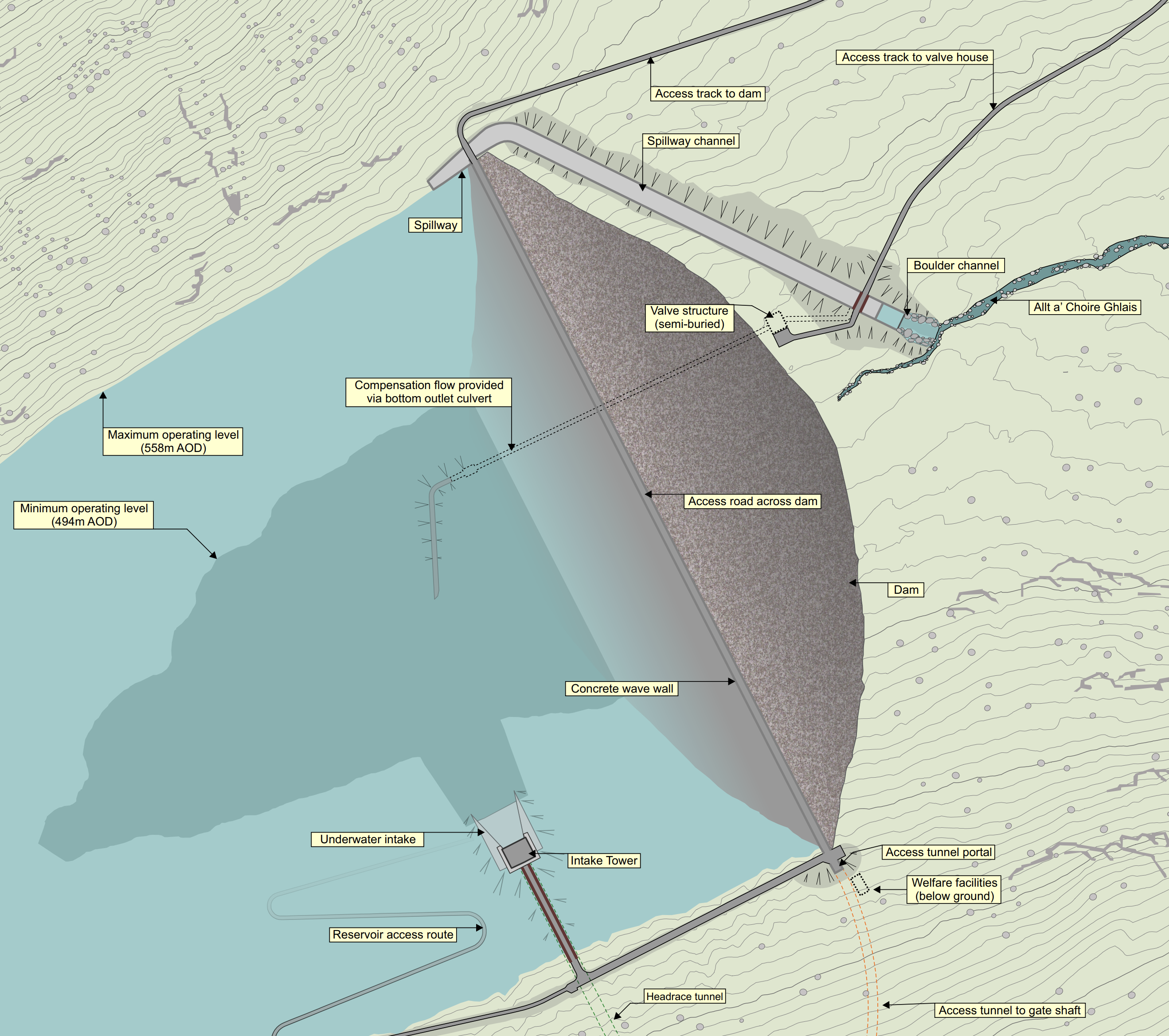
It would be an impressive structure.
Could this pumped storage scheme give the UK energy security?
Repurposing The Tummel Hydro-Electric Scheme
The Tummel hydro-electric scheme was built in the 1930s and 1950s, by the North of Scotland Hydroelectric Board.
- The scheme is now owned by SSE Renewables and has a page on their web site.
- There are nine individual power stations; Gaur, Cuaich, Loch Ericht, Rannoch, Tummel, Errochty, Trinafour, Clunie and Pitlochry.
- There are four dams; Gaur, Errochty, Clunie and Pitlochry.
This map from the SSE Renewables web site shows the layout of the dams and power stations.
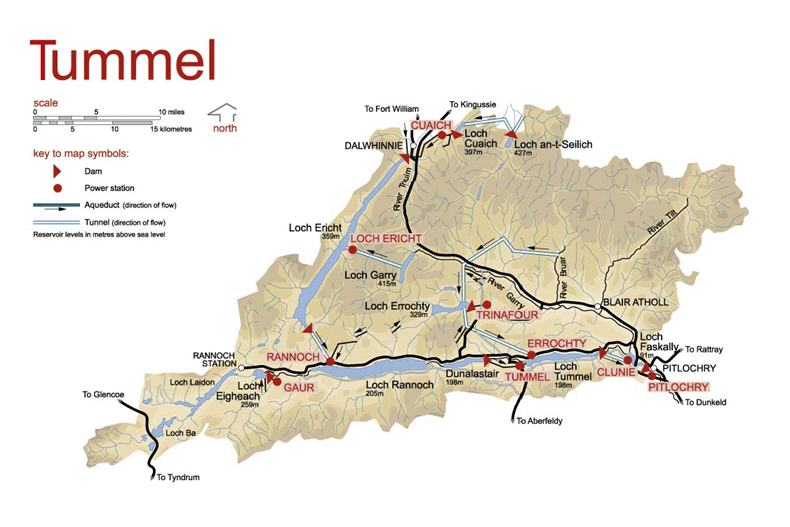
This description of the scheme is from Wikipedia.
The Tummel hydro-electric power scheme is an interconnected network of dams, power stations, aqueducts and electric power transmission in the Grampian Mountains of Scotland. Roughly bounded by Dalwhinnie in the north, Rannoch Moor in the west and Pitlochry in the east it comprises a water catchment area of around 1,800 square kilometres (690 sq mi)[1] and primary water storage at Loch Ericht, Loch Errochty, Loch Rannoch and Loch Tummel, in Perth and Kinross. Water, depending on where it originates and the path it takes, may pass through as many as five of the schemes nine power stations as it progresses from north-west to south-east. The scheme was constructed in the 1940s and 50s incorporating some earlier sites.
Note.
- There are no underground power stations.
- The scheme is what is known as a run-of-the-river hydroelectric scheme.
The sizes of the power stations in the scheme are as follows.
- Gaur – 75 MW
- Cuaich – 2.5 MW
- Loch Ericht- 2.2 MW
- Rannoch – 44 MW
- Tummel – 34 MW
- Errochty – 75 MW
- Trinafour – 0.5 MW
- Clunie – 61 MW
- Pitlochry – 15 MW
This gives a total power of 309.2 MW.
This Google Map shows the same area as the SSE Renewables Map.
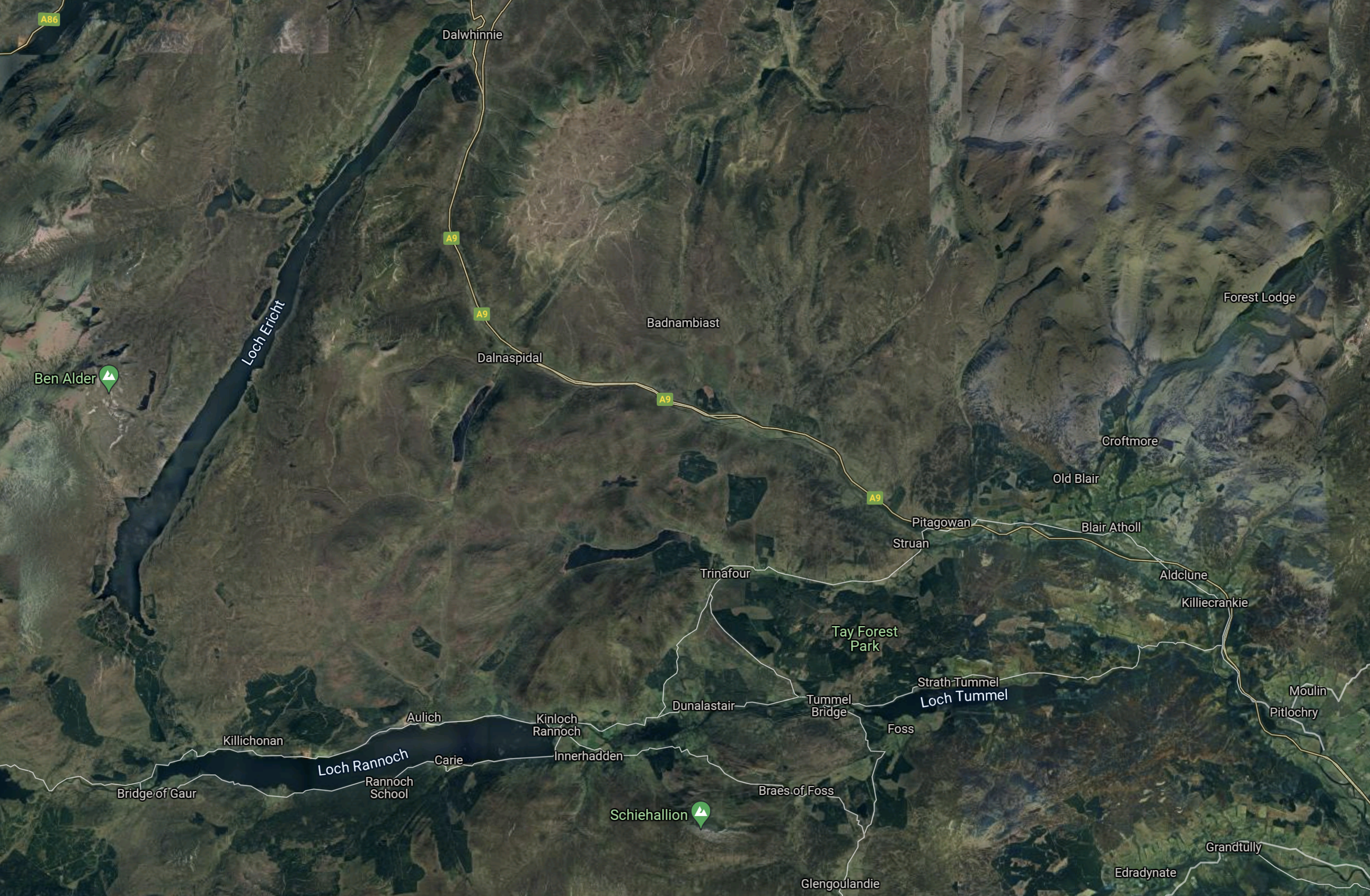
Note.
- Dalwhinnie is at the North of the map.
- Gaur is in the South-West corner of the map.
- Pitlochry is in the South-East corner of the map.
There are no underground power stations.
Strathclyde University And Pumped Storage Power For Scotland
This page on the Strathclyde University gives a list of the pumped storage potential for Scottish hydrogen-electric dams and power stations.
These figures are given for the dams and lochs in the Tummel scheme.
- Errochty – 16 GWh
- Clunie – 40 GWh
- Rannoch – 41 GWh
- Tummel – 38 GWh
It would appear that based on research from Strathclyde University, that the Tummel scheme could support over 120 GWh of pumped storage.
Water Flows In The Tummel Scheme
Looking at the SSE Renewables map of the Tummel scheme and reading this section in the Wikipedia entry for the Tummel scheme, which is entitled Water Route, water flows appear to be as follows.
- Loch an t-Seilich to Loch Cuaich
- Loch Cuaich to Loch Ericht via Cuaich power station and the Cuaich aqueduct
- Loch Garry to Loch Ericht via Ericht power station.
- Loch Ericht to Loch Rannoch
- Loch Eigheach to Loch Rannoch via Gaur power station
- Loch Rannoch to Dunalastair Water via Kinloch Rannoch weir
- Dunalistair Water to Loch Tummel via Tummel power station
- River Bruar and River Garry to Loch Errochty
- Loch Errochty to Loch Tummel via Errochty power station
- Loch Errochty to Trinafour power station
- Loch Tummel to Loch Faskally via Clunie power station
- Loch Faskally to Pitlochy power station
Note.
Water from Loch an t-Seilich can take various routes to Clunie and Pitlochry power stations.
Water from Loch Eigheach goes through Loch Rannoch, Dunalistair Water and Loch Tummel to Clunie and Pitlochry power stations.
It seems a complicated scheme but it does have a capacity of 307 MW, which compares with 389 MW of Bankside power station.
Refurbishing And Repurposing The Tummel Scheme
Perhaps as the power stations are now over fifty years old, one simple way to increase the generating capacity of the Affric/Beauly scheme might be to selectively replace the turbines, with modern turbines, that can generate electricity more efficiently.
I suspect that SSE Renewables have an ongoing program of improvements and replacements for all of their hydro-electric stations in Scotland. Some turbines at Sloy power station have already been replaced with larger ones.
In The Affric/Beauly Hydro-Electric Scheme, I wrote about the control system needs of that scheme, which I felt could be fairly challenging.
I suspect the control of the Tummel scheme is equally challenging.
Adding Pumped Storage To The Tummel Scheme
I’ll look at each possibility in turn.
Loch Errochty
Strathclyde University estimated that 16 GWh of pumped storage could be added to Loch Errochty.
This Google Map shows the Eastern end of Loch Errochty.
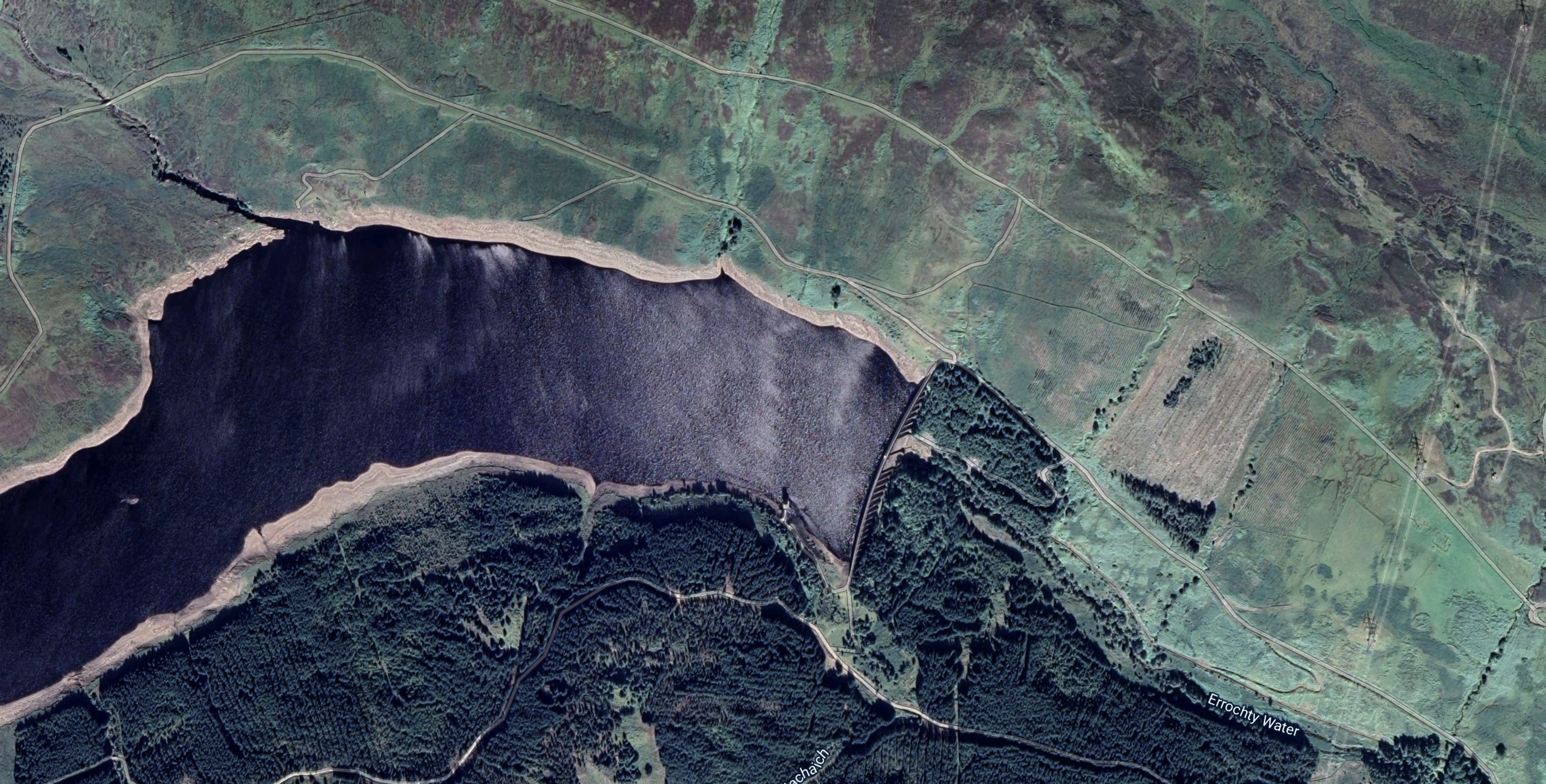
Note the dam at the Eastern end of the loch.
- The dam is 354 metres long by 49 metres high.
- The dam was built in 1957 and the lake is man-made.
- The loch stands at 330 metres above sea level.
- Water flows from the loch to the Errochty power station at the Western end of Loch Tummel, through a ten kilometre long tunnel.
This Google Map shows Errochty power station and Loch Tummel.
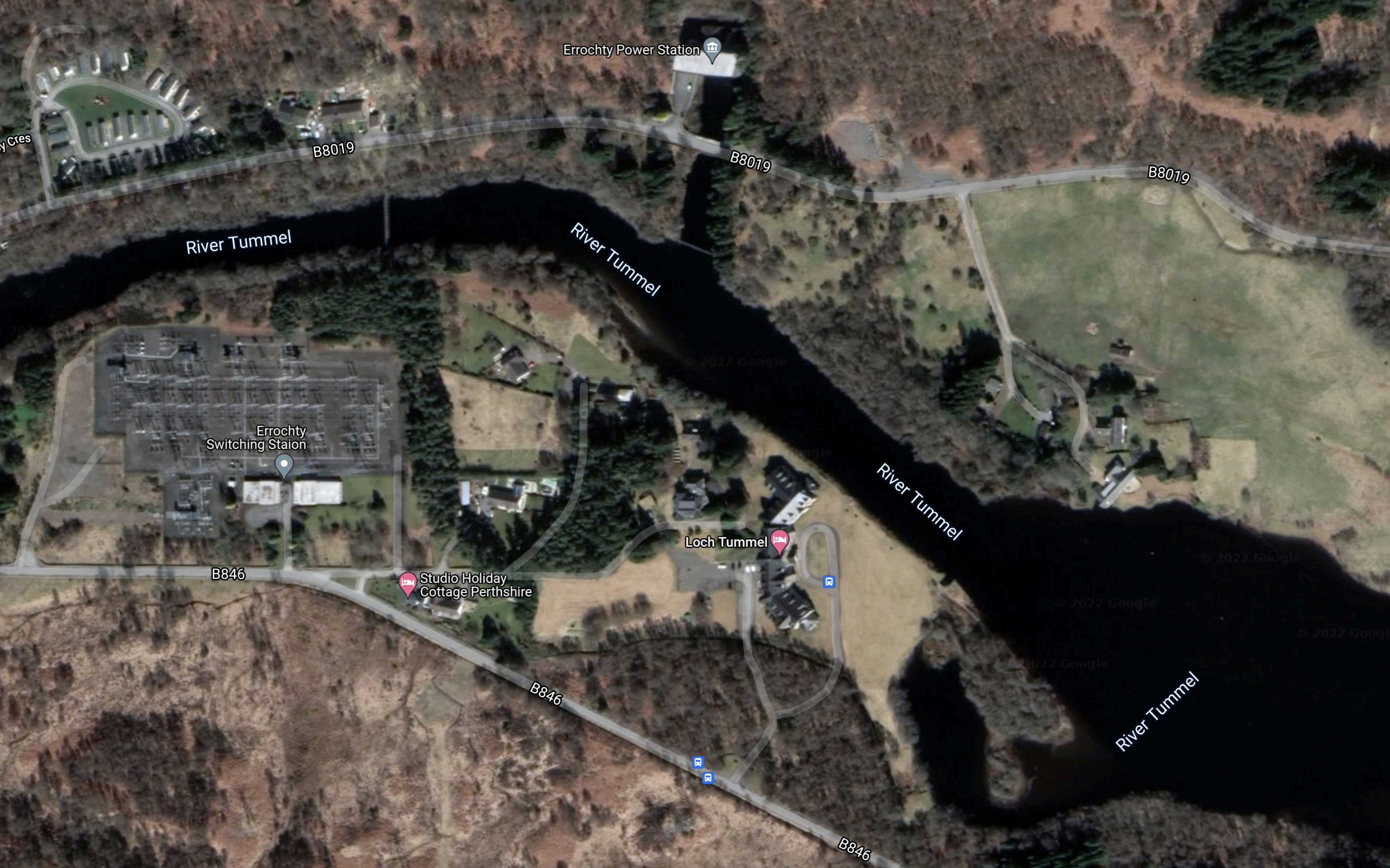
Note.
- Errochty power station is at the top of the map in the middle on the channel connecting it to the River Tummel.
- Errochty power station has two turbines and a maximum output of 75 MW.
- There is what appears to be a large switching station at the Western side of the map.
I obviously don’t know for sure, but I suspect this could be an easier scheme to convert, if the current turbines could be replaced with pump/turbines.
There is a section with the title; Water Supply To The Loch in the Wikipedia entry for Loch Errochty, where this is said.
Loch Errochty’s main feeder streams are the Allt Sléibh and the Allt Ruighe nan Saorach which both rise in the high ground to the west of the head of the loch. Other small streams flow directly off the 892-metre-high (2,927 ft) mountain of Beinn a’ Chuallaich which stands just to the south. Supplementary water is diverted into the loch from the east by the Errochty catchwater, a system of tunnels and surface pipelines at a height of approximately 380 metres which redirects water from five small tributary streams of the River Garry, and the Garry itself. The catchwater then goes through a tunnel in the hill which separates the Garry and Errochty valleys to join the loch. This method of re-directing water allows it to be used more often to generate electricity. Some of the water within the Tummel scheme passes through five of the power stations and thus generates electricity five times.
That strikes me as being very sophisticated for the 1950s and if the engineering and tunnels are up to a high standard, it might be that conversion of this power station to a 75 MW power station with 16 GWh pumped storage is a distinct possibility.
It might even be possible to increase the generating capacity of the power station.
Clunie
Strathclyde University estimated that 40 GWh of pumped storage could be added above Clunie power station.
This Google Map shows the River Tummel between Clunie and Pitlochry power stations.
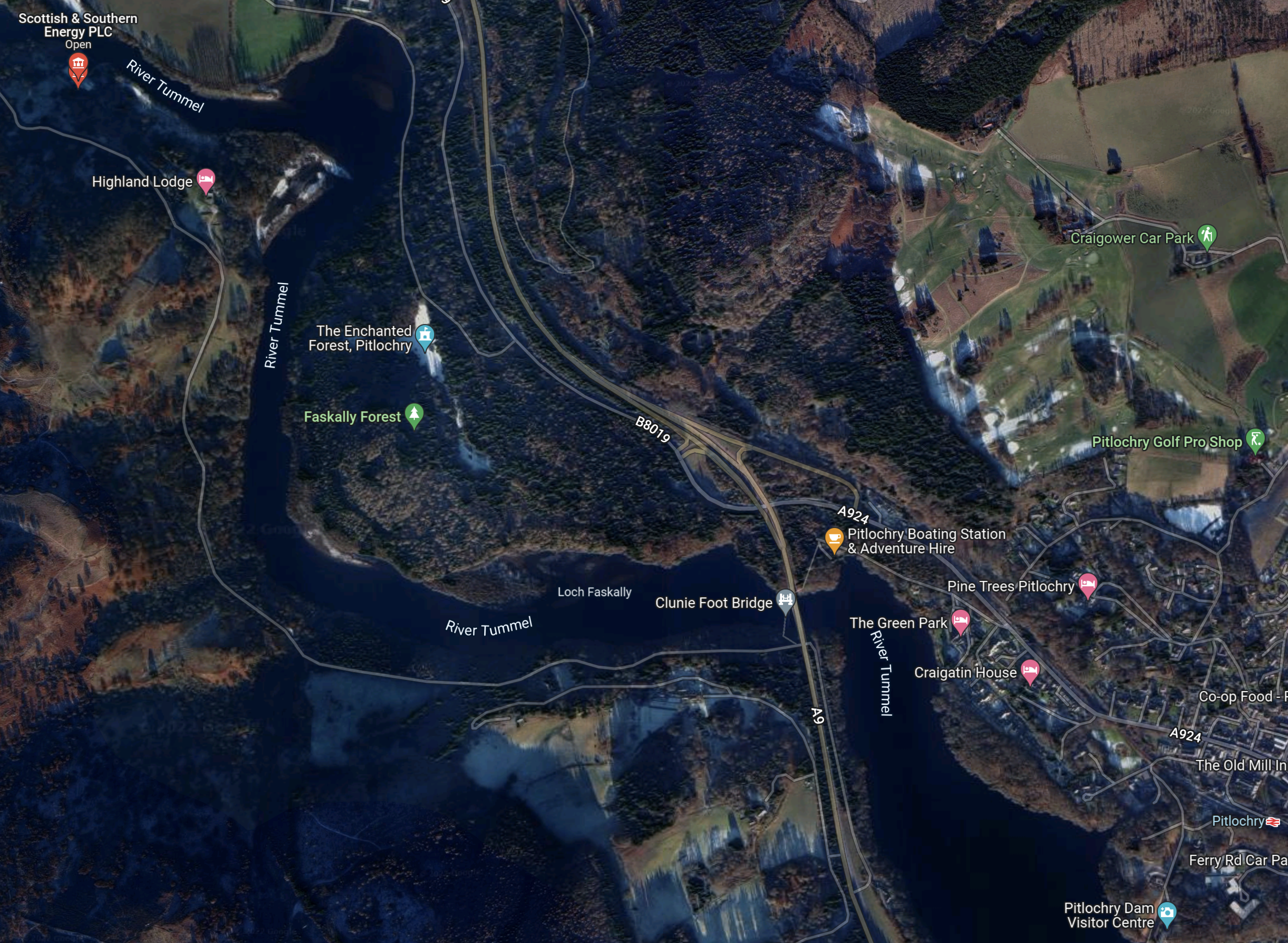
Note.
- Clunie dam and power station is marked by a red arrow labelled Scottish and Southern Energy in the North-West corner of the map.
- Pitlochry Dam and power station are in the South-East corner of the map.
- River Tummel and Loch Faskally link the two dams.
There is a large volume of water between the two dams.
In a pump-back hydro-electric water is pumped back from the lake below the dam into the reservoir above the dam. Such a system was added to the Grand Coulee Dam in the United States to increase its generating and storage capacity.
This Google Map shows how the water to the West of Clunie dam and power station stretches to the other end of Loch Tummel.
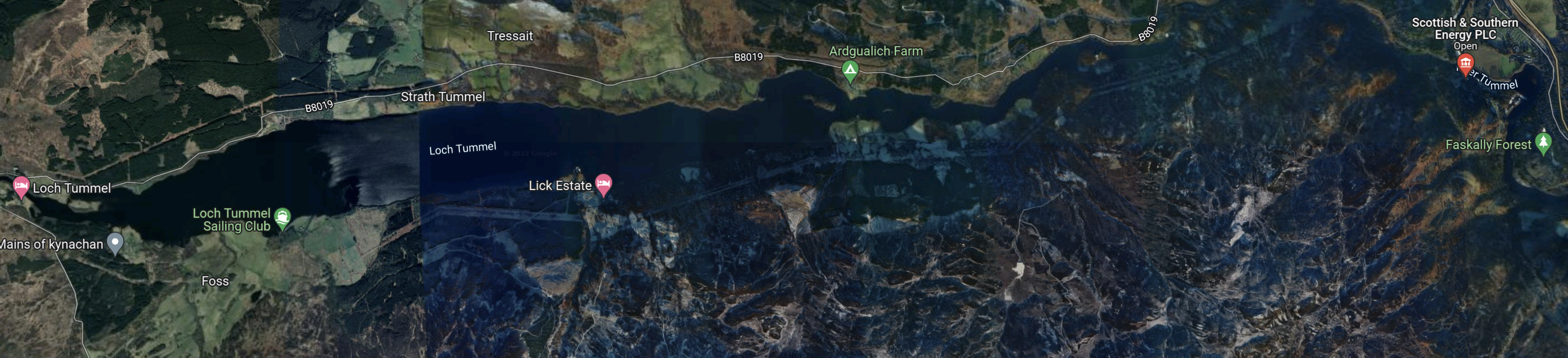
As there would be large volumes on both sides of the dam, I am fairly sure, that a pump-back system could be employed at Clunie power station.
Whether 40 GWh of storage could be added, would be one for the designers of the rebuilt dam and power station?
Tummel
Strathclyde University estimated that 38 GWh of pumped storage could be added above Tummel power station.
This Google Map shows the Eastern end of Loch Rannoch, Dunalastair Water, the River Tummel and Tummel power station.
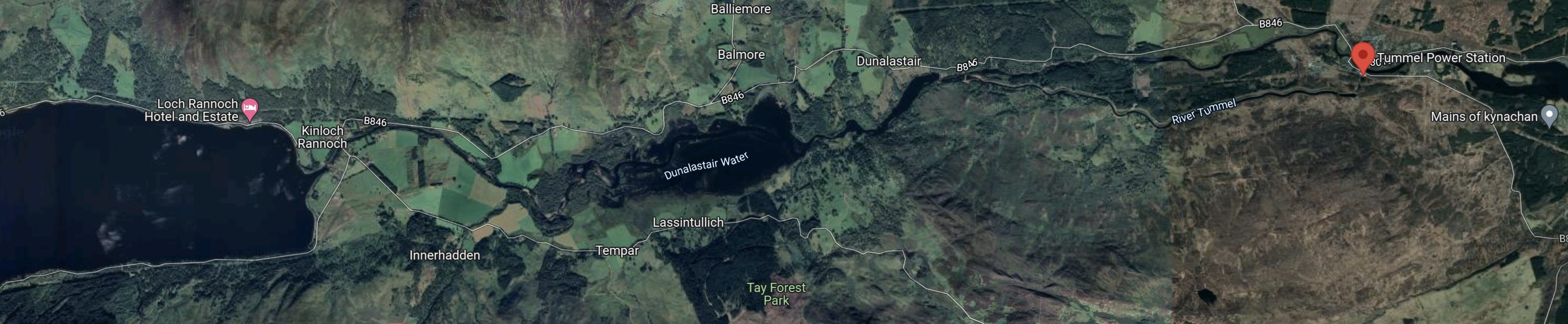
Note.
- Loch Rannoch is at the Western end of the map.
- Dunalastair Water is the smaller lake in the middle.
- Tummel power station is indicated by the red arrow at the East of the map.
This Google Map shows Tummel power station.
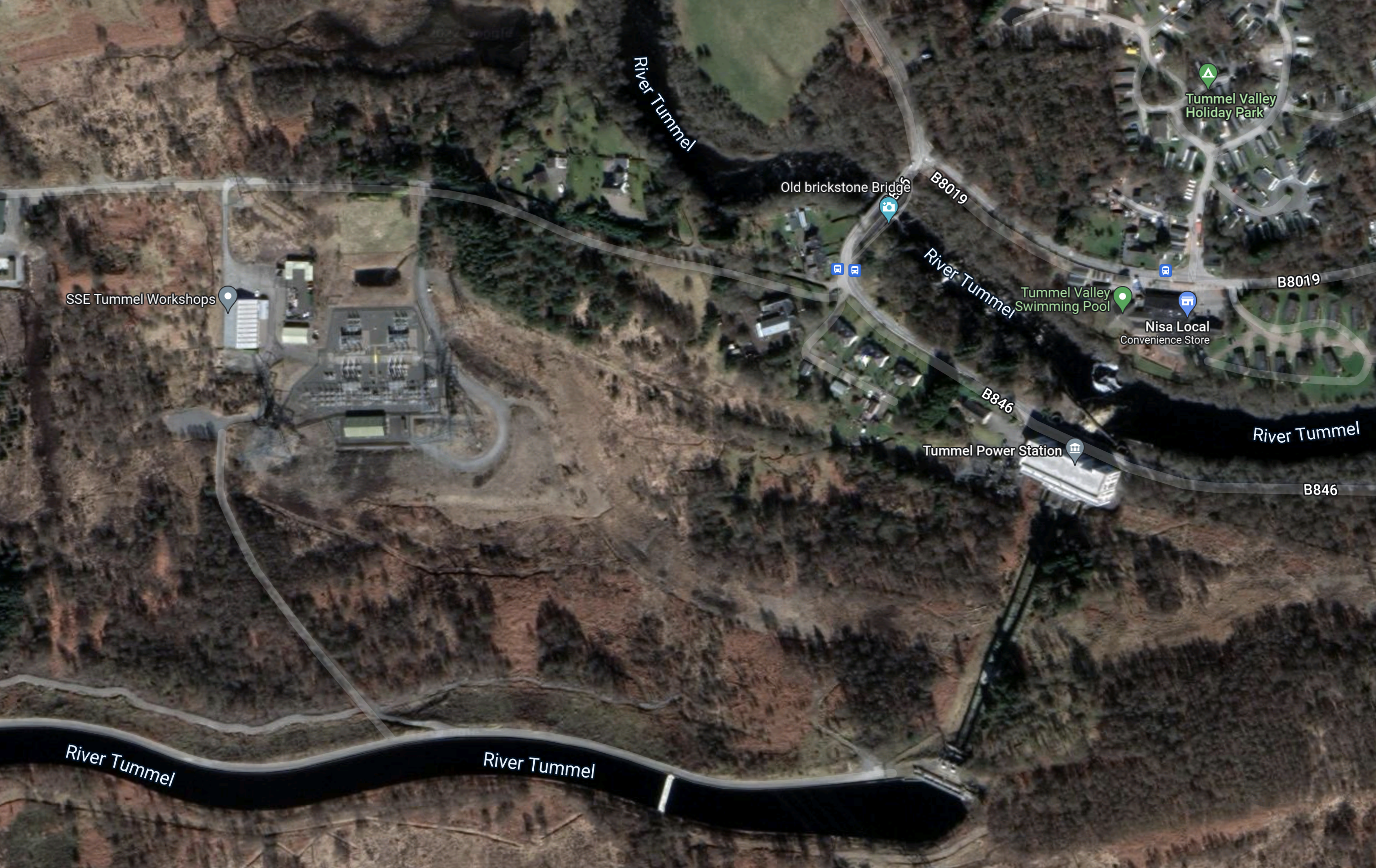
Note.
There appears to be two branches of the River Tummel.
- At the bottom of the map, it appears to be in an aqueduct and above the power station.
- Running across the top-right corner of the map, the second branch appears to be a low-level branch of the river.
- The height difference will mean that power station works well and generates its full 34 MW.
As with Clunie power station, I am sure there is scope for Tummel power station to pump water from Loch Tummel to Dunalastair water, when there is a surplus of wind-generated electricity.
But could space be found above Tummel power station to store enough water to create a massive 38 GWh pumped-storage power station?
Rannoch
This description of Lord Rannoch is from Wikipedia.
It is over 15 kilometres (9.3 mi) long in a west–east direction with an average width of about 1.2 kilometres (0.75 mi), and is deepest at its eastern end, reaching a depth of 130 metres (440 ft).
The loch could hold almost a half a billion tonnes of water.
This Google Map shows Loch Rannoch and Loch Ericht
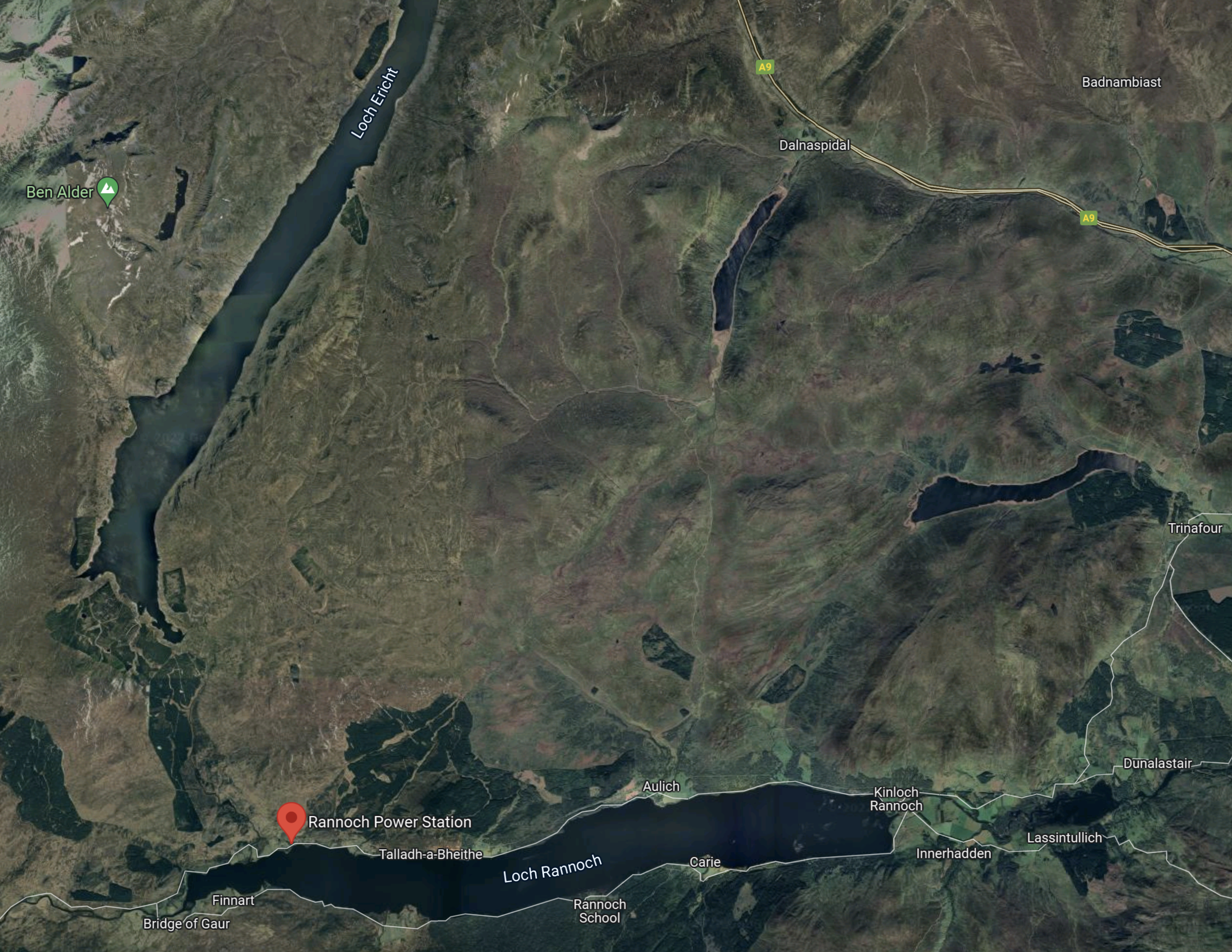
Note.
- Loch Rannoch is along the bottom of the map with Loch Dunalastair to the right.
- Loch Rannoch has an altitude of 205 metres.
- Rannoch power station is indicated by the red arrow.
- Rannoch power station was built in 1930 and the history of the power station is told in this page on the SSE web site, which is entitled A Real Gem In Hydro History.
- Loch Ericht runs to the North from above the power station.
- Loch Ericht has an altitude of 350 metres.
This Google Map shows Rannoch power station to a larger scale.
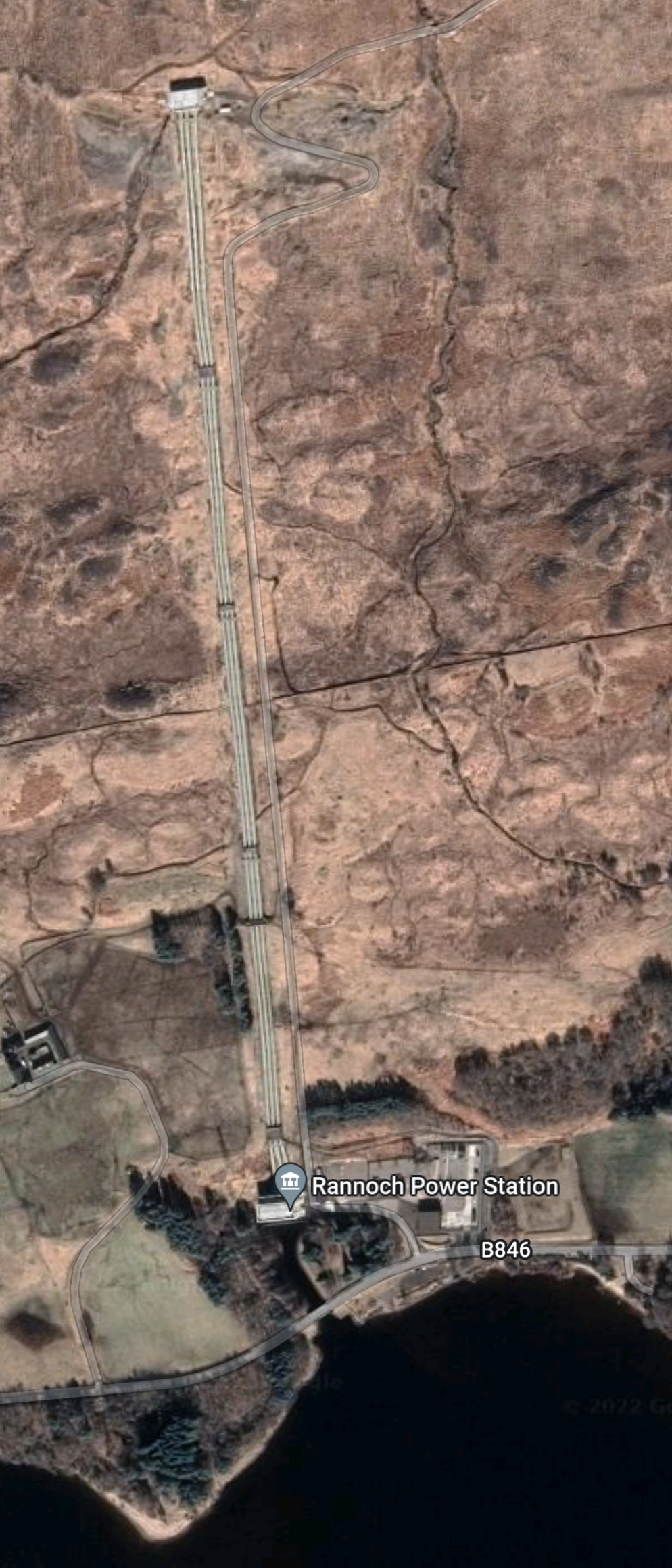
Rannoch power station is on the shore of Loch Rannoch and is described in this section in Wikipedia. This is said.
Rannoch Power Station, on the northern shore of the loch, is part of the Tummel hydro-electric power scheme, which is operated by SSE. The power station has a vertical head of 156 m (512 ft) and a total generating capacity of 44 MW, and uses water fed by pipeline and tunnel from Loch Ericht which is discharged into Loch Rannoch.
There are four pipes running down the hill from Loch Ericht, which deliver water to the power station.
The layout of Rannoch power station seems very similar to Sloy power station, which I described in A Lower-Cost Pumped Hydro Storage System.
- Both power stations sit on a large deep loch.
- Both have pipes to supply water going up the hill and then in a tunnel to a large loch over a hundred metres above the lower reservoir.
- Rannoch power station is a 44 MW power station built in 1930.
- Sloy power station is a 152.5 MW power station built in 1950.
SSE have been examining if a pumped-storage station could be added to Sloy power station.
Given the similarity of the layouts of the two stations, it could be that if it is possible to add pump storage to Sloy, that this could also be done at Rannoch.
Could 41 GWh be stored above Rannoch power station? I won’t say it is not possible.
Conclusion
Research at Strathclyde University gives these figures for possible storage capacity for these dams and lochs in the Tummel scheme.
- Errochty – 16 GWh
- Clunie – 40 GWh
- Rannoch – 41 GWh
- Tummel – 38 GWh
Adding these up gives a total of 135 GWh of stored energy for the Tummel scheme.
But that assumes every power station and dam is expanded to fit Strathclyde’s research.
SSE Renewables are currently calling for tenders for Coire Glas, as I wrote about in SSE Renewables Launches 1.5GW Coire Glas Construction Tender.
This was my conclusion in that post.
It looks to me, that it’s almost certain that Scotland will get a 1.5GW/30 GWh pumped-storage system at Coire Glas.
Coire Glas could supply slightly more power than Sizewell B nuclear power station for twenty hours.
Now that’s what I call backup!
But in the Tummel scheme, there could be three places, where a 30 GWh pumped-storage scheme could be developed and one where a 16 GWh scheme could be developed.
I would expect that a conservative figure of between 40-60 GWh of pumped-storage capacity could be added to the Tummel scheme.
 The Anonymous Widower