East Midlands Airport Offers £2.5m Fund To Boost Station Connections
The title of this post is the same as an article on Rail Technology Magazine.
If not desperation, there is an air of We Must Do Better about the title.
So I went to the Rail page on the EastMidlands Airport web site.
This is said.
With a choice of stations, it’s never been easier to travel by train to East Midlands Airport. Connections are available to the north and south of the country from Derby, Nottingham and Long Eaton, with bus services to each station possible through regular Skylink bus services to and from the airport.
It is possible to connect at East Midlands Parkway for journeys to and from destinations outside the East Midlands region. This station is now served by a Parkway Railink – a scheduled 6-seater operating every day from 6am to 7pm hourly.
I certainly haven’t seen many airports with worse rail access than that, so I can understand their £2.5million offer.
Their demands outlined in Rail Technology Magazine aren’t unreasonable, but they are short of direct access.
This Google Map shows East Midlands Airport.
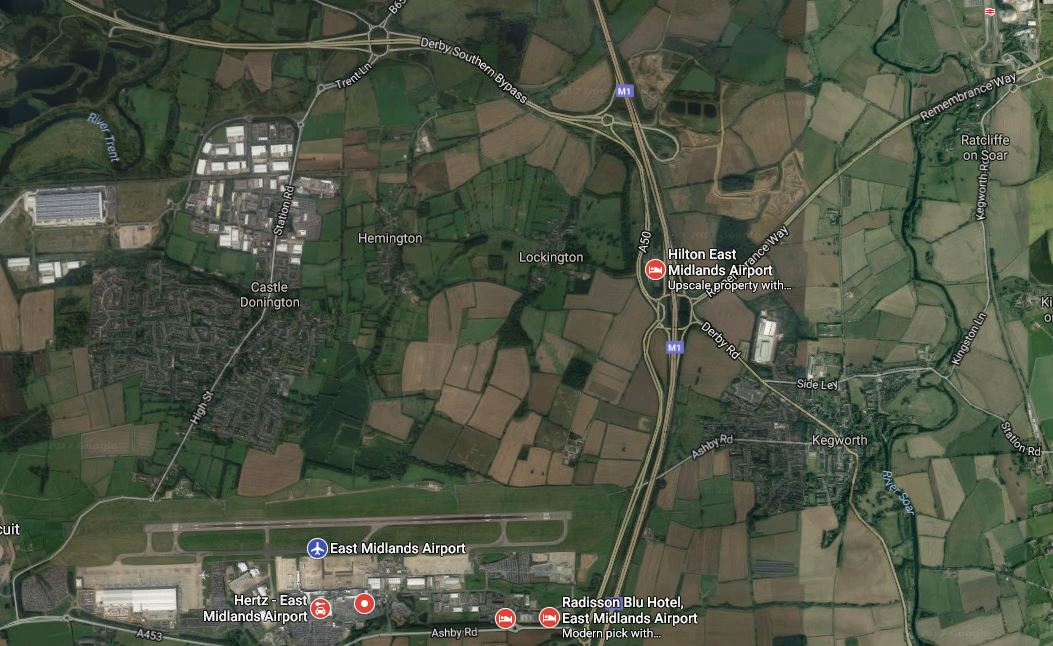
Note East Midlands Parkway station is in the North-East corner of the map.
Note that the runway at the airport is 2,893 metres long.
I think it’s true to say, unless your destination could only be reached from East Midlands Airport, those without cars, wouldn’t go near the place.
Does Northern See Wigan As A Class 769 Train Hub?
The Wikipedia entry for Northern, shows under their entry for eight Class 769 trains, that the routes they will cover include.
- Liverpool to Wigan
- Manchester to Wigan North Western via Bolton.
Wigan is a proud and friendly town and I wrote about it in Wigan On The Up.
The West Coast Main Line through Wigan North Western station is electrified and Northern run half-hourly electric services to Liverpool using Class 319 trains.
But the other station; Wigan Wallgate is not wired and is definitely Pacer territory.
Liverpool to Wigan
As Liverpool Lime Street to Wigan North Western is fully electrified, I would be very surprised if Northern would run a bi-mode Class 769 train on this route, except as a stand-in for a failed Class 319 train.
Routes to places North of Wigan North Western, like Blackpool, Lancaster and Preston will be fully-electrified, so these routes can be served by the Class 319 trains.
Northern could be thinking of running a service between Liverpool Lime Street and Blackburn/Burnley for which a Class 769 train would be ideal.
But I think more likely, is that they are thinking of using Class 769 trains on the Kirkby Branch Line, which currently links Kirkby and Wigan Wallgate stations.
Consider.
- There is talk of running this branch as a shuttle.
- Wigan Wallgate station already has a suitable bay platform for a shuttle.
- The route is double-track except between Kirkby and Rainford stations.
- Kirkby to Wigan Wallgate takes a convenient twenty-four minutes.
- Merseyrail have a long term ambition to built a new Headbolt Lane station, as an interchange between their Northern Line and services to Wigan and Manchester.
- Merseyrail want to serve Skelmersdale.
Could this route be the reason for the reported Battery EMUs For Merseyrail?
- The Class 769 trains are used between Kirkby and Wigan Wallgate stations as a shuttle.
- Two trains would be able to provide a two trains per hour (tph) service, without any new infrastructure.
- Merseyrail ascertain that their new Stadler trains can travel between Kirkby and Wigan Wallgate and back on battery power.
- Merseyrail determine if a fast charging station is needed in the bay platform at Wigan Wallgate for their Stadler trains.
If the Class 769 trains show the passenger traffic is there and the Stadler trains can handle the route on batteries, could we see some or all of the Merseyrail Northern Line services extended to Wigan Wallgate?
Because the Stadler trains will be fast modern trains designed to execute stops quickly, I suspect that even on the single track section of line between Kirkby and Rainford stations, they could run at the frequency of four tph, that is currently run all day between Kirkby and Liverpool Central stations.
- This would mean that the the current four tph to Kirkby would become four tph to Wigan Wallgate.
- The service would be run by brand-new Stadler trains.
- The track at Kirkby would have to be relaid to allow trains to run straight through.
- The signalling would probably need updating.
- Means to charge the trains at Wigan Wallgate might need to be provided.
- A new single-platform station could be built at Headbolt Lane.
- The four stations between Kirkby and Wigan Wallgate would get four tph in both directions.
It would give The Train To Wigan Pier a whole new meaning.
Once they had done their good works in proving the route, the Class 769 trains would be posted elsewhere to do more missionary work.
Manchester to Wigan North Western via Bolton
This is the other route mentioned in Wikipedia.
Consider.
- Bolton to Manchester will be electrified, by the end of the year.
- The route passes through Ince, Hindley, Westhoughton and Lostock.
Class 769 trains travelling this route, would open a second electrified route between Manchester and Preston via Wigan.
Manchester to Southport
Why was this route not mentioned?
- Manchester to Southport is a route run mainly by Pacers to a frequency of two tph.
- Some trains go via Bolton and some via Atherton.
- The route via Bolton will be partly electrified by the end of the year.
- The route via Atherton is not electrified.
I suspect that under current plans of just eight Class 769 trains, there aren’t enough to use them on this busy route.
Ideally, this route should be run with two tph going on each of the routes to Manchester from Wigan Wallgate.
The Future
Northern have ordered both diesel and electric Civity multiple units from CAF.
In Auckland Mulls Battery-Electric Train Order, I looked at how CAF had proposed battery-electric Civity trains for Auckland.
I’m sure CAF wouldn’t mind varying the order.
Cardiff To Gloucester And Cheltenham In A Class 769 Train
As the time gets nearer for the entry of the Class 769 train into service at the end of the year, speculation is mounting about how the trains will be used.
In the August 2017 Edition of Modern Railways, there is an article, which is entitled Class 769s For Wales.
After discussing how the trains will be used to deputise for the current Class 150 trains so that they can be made compliant with the Persons of Reduced Mobility regulations, the article goes on to say this.
None of the electrical equipment will be removed from ‘769s’ destined for Wales. After completion of Great Western Electrification to Cardiff, they could operate electrically from Cardiff to Severn Tunnel Junction, where they would switch to diesel operation for the rest of the route to Gloucester and Cheltenham.
The fastest direct trains take one hour fifteen minutes for the journey, so a round trip could be a few minutes under three hours, so that an hourly service would need three trains.
Battery EMUs For Merseyrail
The title of this post is the same as an article in the August 2017 Edition of Modern Railways.
This is the first paragraph.
Two of the new EMUs Stadler will build for the Merseyrail network will be fitted with batteries.
This is also said.
The initial benefits of the trial will be the energy recycling properties of the batteries, but with a larger battery the option could be to run the units away from the electrified Merseyrail network using battery power.
Other reports suggest that battery power could move the trains in depots.
Another report in the same edition of Modern Railways is entitled Class 769s For Wales.
It discusses the use of Class 769 trains on the Borderlands Line.
This is said.
Would safety regulations permit Class 769s, or other third-rail EMUs retrofitted with diesel engines, to operate the Wrexhm-Bidston Line and continue in the Mersey tunnels to Liverpool? No definite answer was available as Modern Railways went to press. Each bi-mode unit would displace pnly one two-car Class 150/2 unit from the line, but studies have predicted large growth in passenger numbers if the change of trains at Bidston were eliminated.
It is an interesting concept.
- Porterbrook have already talked about converting Class 455 trains into bi-modes.
- These third-rail units don’t have pantographs to snag in the tunnels.
- They have been refurbished to a high standard in recent years.
- The fuel safety problem in the tunnel, is something for which Formula One engineers may have a ready-made solution.
I’m sure if it does happen, Scouse humour will go into overdrive, about London cast-offs and old trains. But Class 455 bi-mode trains would have the last laugh.
Conclusion
It is encouraging to see in these two articles signs of radical but in my view totally sound thinking.
Finance For Crossrail
In the August 2017 Edition of Modern Railways, there is a Crossrail Update, with a section entitled Planning Cash Comes Good.
It starts with this paragraph.
How often do you come across a rail project that receives more funding than it budgeted for? well, an update to the TfL Finance Committee suggests Crossrail could be heading that way. Long, long ago when the Crossrail budget was nailed down it was agreed that £600million should be contributed in the form of planning obligations – the idea bing that property developers who benefit from the improved transport links that will be provided by the Elizabeth Line should contribute to the capital cost.
This is the current progress.
- So far £100million has been collected from Section 106 contributions, with £200million still to come.
- However, the Mayor of London’s Community Infrastructure Levy has contributed £400million to date.
- The forecast is that by the time the line opens receipts will have risen to £700million.
I suspect that other Mayors will be looking at Crossrail’s funding model.
Auckland Mulls Battery-Electric Train Order
The title of this post is the title of this article on the International Railway Journal.
This is the first paragraph.
Auckland Council is expected to decide next week whether to proceed with an order for 17 battery-electric multiple units, which would replace DMUs on services on suburban services to Pukekohe.
The trains are being offered by CAF and are designed to work the Southern Line between Britomart Transport Centre in Auckland and Pukekohe.
The route is in two sections.
- From Britomart to Papakura is electrified at 25 KVAC.
- From Papakura to Pukekohe is run by a diesel shuttle.
The diesel shuttle runs over a distance of 18.38 km.
The plan would appear to be for the new trains to run as follows.
- To Papakura using the current electrification, charging the battery as they travelled.
- At Papakura they would switch to battery power for the shuttle to Pukekohe.
- On return to Papakura, they would switch back to the electrification and return to Auckland.
This would be a distance of 36.76 km. or just under twenty-three miles.
Conclusion
I think that this proposal is very significant.
CAF have put their money where their mouth is in this proposal, as if the trains couldn’t fulfil the requirements, it would be Spanish omelettes all over the place.
From the picture in the article on the International Railway Journal, it would appear that the offered trains are a version of the Civity train, which is being supplied to Northern as Class 331 trains.
A 23 mile battery range would be handy, as it could probably handle the Windermere Branch from Oxenholme.
Capacity Crunch At Chester – Borderlands Line
The Capacity Crunch At Chester article in the July 2017 Edition of Modern Railways talked about the Borderlands Line.
The article says this about the line and the passenger service.
The line is currently worked by two ATW Class 150/2 Sprinter units, which do their best to maintain the clockface hourly frequency. The Wrexham-Bidston Rail Users Association told the Wales & Borders franchise inquiry performance is far from ideal, highlighting late running frequently leads to trains being turned back at Shotton, meaning they do not reach Bidston to connect with Merseyrail services to Liverpool and leaving lengthy gaps at intermediate stations in England.
The article then talks about electrifying the line, but Network Rail have indicated that this would cost £207million. Apparently, third-rail electriication now needs palisade fencing along the track.
Enter The Class 455 Flex Train
In The Class 319 Flex Units To Be Class 769, I commented on the report, that Porterbrook were also looking at converting Class 455 trains to bi-modes.
Consider.
- These trains could probably work Merseyrail’s tunnels, as they are closely related to the current trains.
- They have quality 2 x 2 interiors.
- They meet all regulations.
- Performance is similar to the current trains.
- They are four-cars.
- Porterbrook will have ninety-one trains to place, when South Western Railway replaces them with Aventras.
The only problem is that the interiors are very red, which might upset half of Merseyside.
But I think it is possible that we could see Class 455 Flex trains working the Borderlands Line.
- From Wrexham to Bidston, they would use their on-board diesel engines.
- At Bidston, they would change from diesel to third-rail electric power.
- From Bidston to Liverpool, they would join the queue of trains from the Wirral and go round the newly-rebuilt Loop Line.
I’m pretty sure, that if Merseyrail have signalled the Loop appropriately, that there would be enough capacity in the Loop to run two trains per hour (tph) between Wrexham and Liverpool.
Based on the following current timings.
- Liverpool Lime Street -to Bidston – 17 minutes
- Bidston to Wrexham – 1 hour
With a few performance tweaks, I suspect that a Class 455 Flex train could do the round trip in well under three hours.
So three trains could easily handle the current hourly service, but would give the following advantages.
- Direct access to Liverpool City Centre.
- Four-cars instead of two.
- A much better interior.
The only problem would be checking that the Class 455 trains would fit the tunnels in the Loop Line. But seeing, that the Class 455 trains, were built as a successor to the Class 508 trains used by Merseyrail, I suspect they fit.
Could Class 319 Flex Trains Be Used?
The reason I looked at Class 455 Flex trains first is that in a article in the June 2017 Edition of Modern Railways, which is entitled ‘319 Flex’ Units To Be Class 769, this is said.
The company reports considerable interest in the concept and expects further orders soon, while it is also considering transferring the concept to other rolling stock, such as Class 455 EMUs.
As Porterbrook will soon receiving around ninety of these trains from South Western Railway, these struck me as possibilities for the Borderlands Line.
If you look at Merseyrail’s current Class 507 and Class 508 trains, Class 455 trains and Class 319 trains, they all appear to have a similar 2.82 metre width and a 3.58 metre height.
So if Class 319 Flex trains could work the tunnels under Liverpool, what would this do to service on the Borderlands Line.
- Their 90 mph as opposed to 75 mph operating speed could bring the round trip under two and a half hours.
- Five trains would be needed for a 2 tph service.
- Wrexham to Liverpool times of under an hour and fifteen minutes should be possible.
- The better performance of the trains would allow extra stops to be made with ease.
- The trains can have First Class seats and fully-accessible toilets.
In Wales Orders Some Golden Oldies, I noted how Arriva Trains Wales are acquiring five Class 319 Flex trains as cover for the refurbishment of Class 150 and Class 158 trains on the Cardiff Valley Lines.
So once all of these diesel trains have been refurbished, will we be seeing the Class 319 Flex trains moved to the Borderlands Line?
TransPennine Electrification And Piccadilly Upgrade Now Also In Doubt
The title of this post is the same as this article in Rail Technology Magazine.
A Digression About The Next Generation Of Trains
After digging through the various pages on Hitachi’s web site, I wrote Do Class 800/801/802 Trains Use Batteries For Regenerative Braking?.
My conclusion was this.
I will be very surprised if Class 800/801/802 trains don’t have batteries.
Will the Class 385 trains for ScotRail have similar traction system?
But having thought about it more, I’m now convinced that by 2030, the average long distance train will have the following characteristics.
- Ability to work from 25 KVAC overhead wires.
- Ability if required to work from 750 VDC third rail.
- Ability to raise and lower pantograph and switch beween modes at line speed.
- Batteries to handle regenerative braking.
- A generator unit to power the train.
- A sophisticated control system to choose the appropriate power source and drive the train according to terrain, passenger load, weather and traffic.
The more I read about Hitachi’s Class 800, Class 801 and Class 802 trains, the more I’m convinced that the features I have listed, is their ultimate goal. I suspect too, that the suburban Class 385 train has the capability of meeting the same objectives.
I would be very surprised if Alstom, Bombardier, CAF, Siemens, Stadler and others are not thinking along the same lines, as this document from Hitachi entitled Development of Class 800/801 High-speed Rolling Stock for UK Intercity Express Programme has been freely available since 2014.
It contains this diagram of the traction system of a Class 800 train.

Note the generator unit and the battery charger.
I’ve ridden the new Class 345 trains for Crossrail, a few times and after a trip yesterday in the gold-standard train;a 1970s British Rail Mark 3 coach, I can honestly say that the ride, noise and vibration in ombardier’s new train, is the best I’ve ridden.
So are Bombardier using a new traction system to achieve this smoothness? I suspect they are.
I also can’t find anything to say how a train will be removed from the tunnel under London, in the event of a complete power failure. No sane engineer would allow a rescue involving diesel or hydrogen in an emergency. However, batteries on the train with the capability of getting passengers to a safe disembarking point would be an obvious solution..
TransPennine Electrification
The major rail route across the Pennines between Leeds and Manchester is the Huddersfield Line.
The following stations are open on the route.
- Leeds *
- Cottingley
- Morley
- Batley
- Dewsbury
- Ravensthorpe
- Mirfield
- Deighton
- Huddersfield
- Slaithwaite
- Marsden
- Greenfield
- Mossley
- Stalybridge *
- Ashton-under-Lyne *
- Manchester Victoria *
The stations marked with asterisks (*) have electrification or will do soon.
Note the following about the route.
- Stalybridge to Leeds is under forty miles by road, so it could be even shorter by rail.
- Huddersfield station is one of a select group of Grade I Listed railway stations..
- Greater Manchester is developing a suburban electric network.
- Greenfield is the last station in Greater Manchester towards Leeds.
- Leeds is developing a suburban electric network.
- Cottingley is the last station in Leeds towards Manchester.
- Currently, trains from Manchester Piccadilly to Leeds can take a diferent route to Stalybridge, that is electrified as far as Guide Bridge station.
- I counted four tunnels, including Standedge tunnel, and over twenty bridges between Stalybridge and Huddersfield.
- Electrification of this section, would probably mean closure for at least a year.
- Between Huddersfield and Leeds the electrification would be a lot easier with about fifteen bridges and Morley tunnel.
My philosophy for this route would be as follows.
- Electrification would not go anywhere near Huddersfield, as the heritage lobby and their lawyers would have a field day.
- Standedge and Morley tunnels are over 2,000 metres long, double track and Standedge is level. If they needed refurbishment in the future, perhaps they could be electrified with an overhead rail, so that bi-modes could have a couple of miles of electricity.
- Electrification might be extended at the Manchester and Leeds ends of the line, so that the two cities could improve their local suburban electric networks.
- An alternative would be that the Leeds and Manchester suburban electric networks were provided with a few Class 769 trains or even some brand new four-car bi-modes.
- Services between Leeds and Manchester would be run by fast bi-modes.
TransPennine Express are already planning to run Class 802 trains between Liverpool and Newcastle via Manchester and Leeds. It looks to me, that whoever plans their train policy, saw this electrification crisis coming.
The money saved on the electrification would be spent on improving track and stations.
Currently the fastest journeys between Manchester and Leeds take just under fifty minutes.
What time could a Class 802 train achieve if the following were done.
- Manchester to Stalybridge is fully electrified.
- Some extra electrification was installed at Leeds.
- The track is improved.
My money would be on thirty-five minutes.
Manchester Piccadilly Upgrade
I hate using the isolated island Platforms 13 and 14 at Manchester Piccadilly station.
They are just too crowded and the steps and escalators down to the platform aren’t well-designed.
The Frequency Of Trains Through Platforms 13/14
The two platforms can be considered equivalent to these busy two-platform stations.
- Canada Water on the East London Line.- 20 trains per hour (tph) from 2020
- St. Pancras on Thameslink – 24 tph from 2018
- West Ham on Essex Thameside – 8 tph
All of these stations handle more trains than Plstforms 13./14 at Manchester Piccadilly.
Provided the signalling can handle it, it should be possible to schedule more trains through these two platforms.
One piece of information I viewed seemed to show that some services terminate in these two platforms. Surely, that is a way to reduce capacity.
Ordsall Chord And Class 769 Train Implications
The Ordsall Chord should change the pattern of trains, when it opens later this year.
The main implication will be that cross-city services can be developed.
The new Class 769 trains will help too, in that current diesel and electric services can be run using one type of train across the city.
A simple example would be Buxton to Blackburn.
These services release platform space in Manchester Piccadilly and other stations, which can be used for new services.
Access To Platforms 13/14
I’ve felt for some time, that if the access to the platform was better designed that a lot of the problems could be reduced.
I sometimes wonder, if when people see that their train is leaving from Platform 13 or 14, that they go there immediately and instead of waiting upstairs in the lounge, they descend to the platform.
When the Ordsall Chord is opened, because of the pattern of services passengers will sometimes change at one of the string of stations on the line.
Perhaps Oxford Road or Deansgate should be designated the preferred interchange station and fixed up with wider platforms, various kiosks and a waiting room to encourage passengers to change away from Piccadilly.
This Google Map shows Oxford Road station.
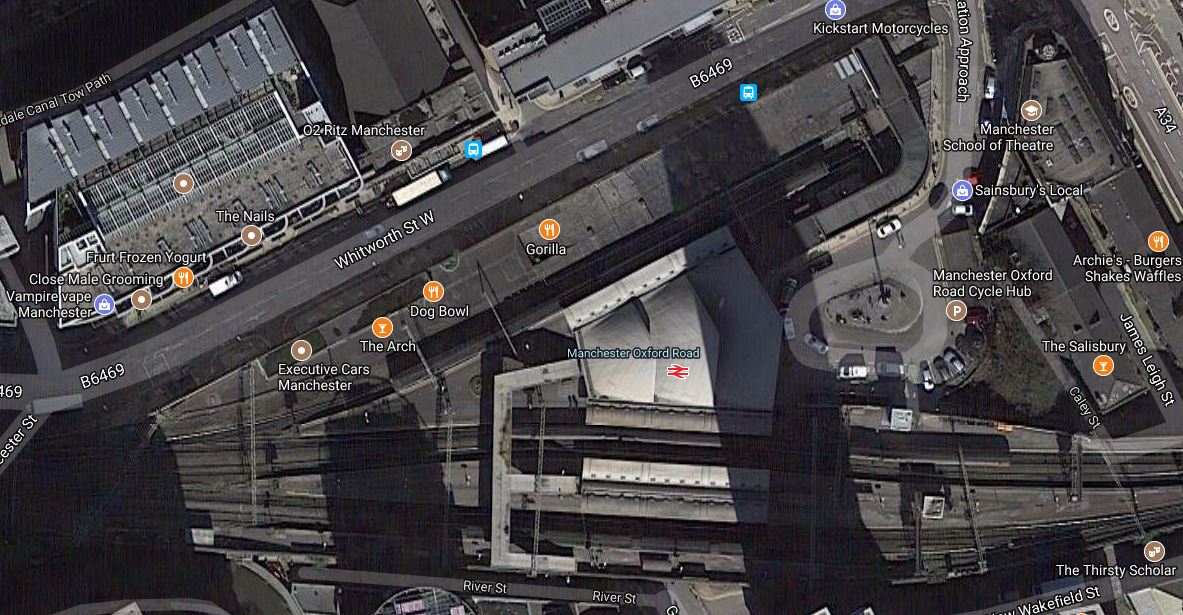
Oxford Road certainly seems to have space for passengers to use it as an exchange, when crossing the city.
But does Oxford Road have a stop on the Metrolink?
This Google Map shows Deansgate station.
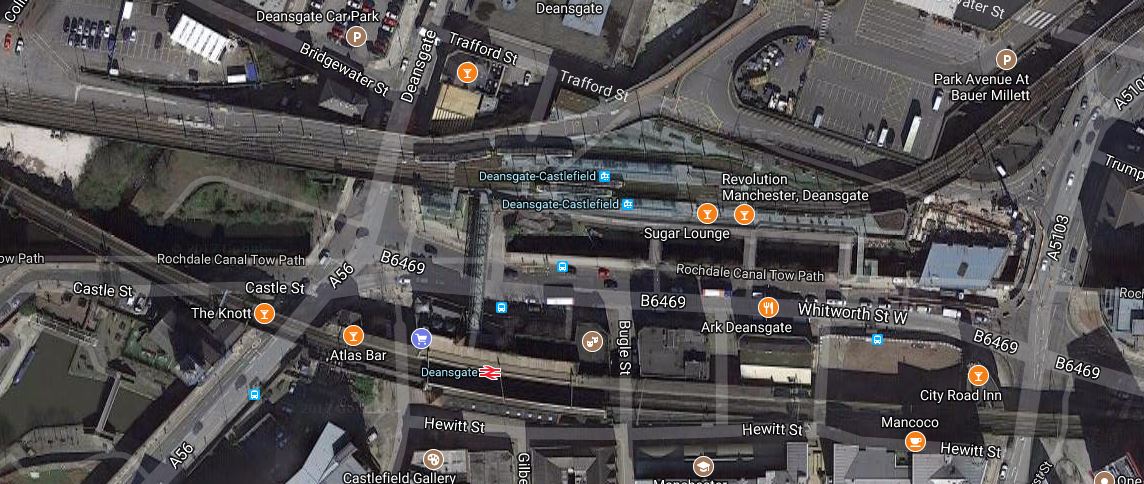
Deansgate doesn’t seem to have the space of Oxford Road. But it does have a good connection to the Metrolink.
The Forgotten Salford Stations
The other stations that could help are the two forgotten Salford stations; Salford Crescent and Salford Central.
This Google Map shows Salford Crescent station.
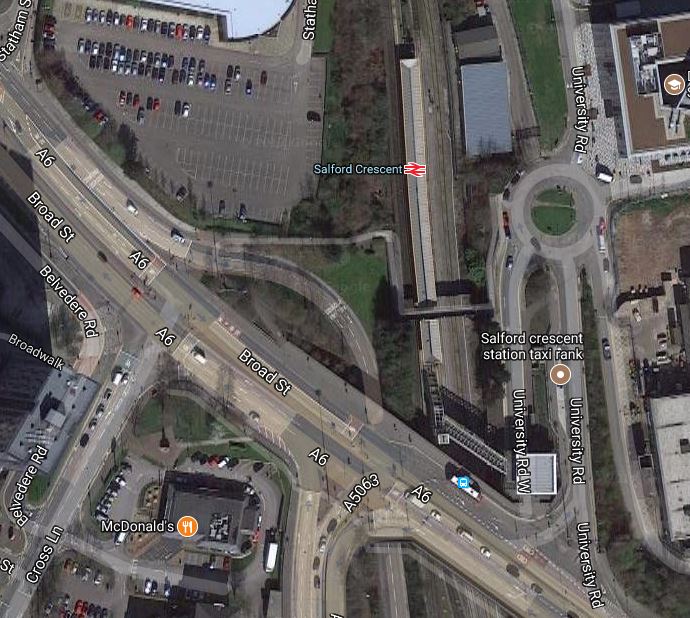
I believe that this station is going to get more platforms. Could it become a sort of triage station, where passengers from the North of Greater Manchester changed for.
- Trains for Manchester Victoria station.
- Trains for Manchester Piccadilly station.
- Metrolink to the city centre.
Surely, space could be found to run trams along Broad Street.
It would also look to be a station, where there is considerable scope to put housing or commercial developments above the station.
This Google Map shows Salford Central station.
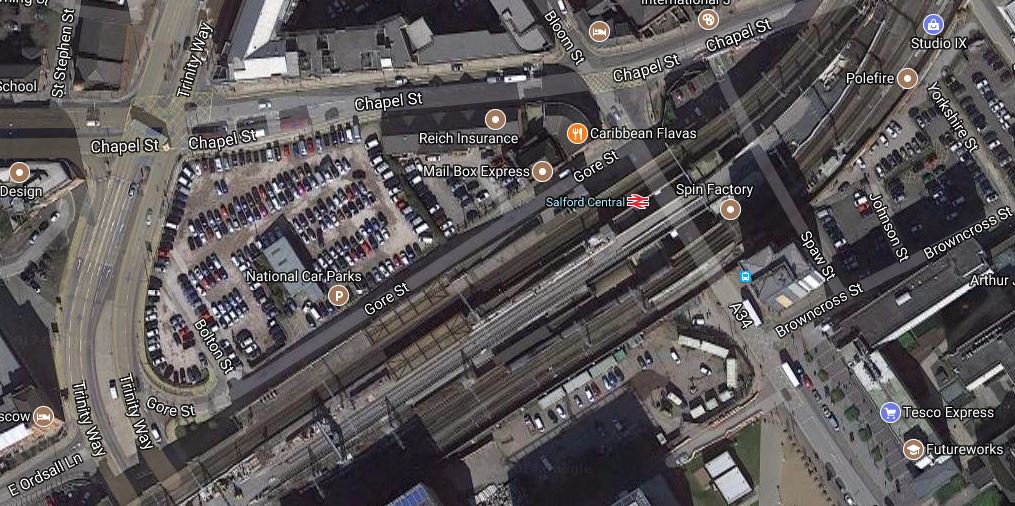
With a bit of thinking Salford Central must have interchange possibilities.
But as with Salford Crescent, this station doesn’t have a Metrolink connection.
The Wikipedia entry for Salford Central has a section called Future Development. This is said.
A Network Rail report suggests building platforms on the line to Liverpool (via Newton-le-Willows), the lines of which run through the station but are not provided with platforms. This scheme has since been adopted by Transport for Greater Manchester and included in their Capital Works Programme for 2015–16 to 2020–21. This will see three additional platforms built, at a cost of £20.5 million and will allow Liverpool, Chester & Manchester Airport-bound trains (using the Ordsall Chord) to call here.
I’ll believe it when I see it.
Conclusion About Manchester Piccadilly Upgrade
I am inevitably drawn to the following conclusions about the upgrade to Manchester Piccadilly.
The Ordsall Chord and the new electric services offered by the bi-mode trains will create a duckers-and-divers network across Manchester City Centre.
The following should be done.
- Access to Platforms 13/14 at Manchester Piccadilly should be greatly improved.
- Deansgate, Oxford Road, Salford Central and Salford Crescent should be improved with extra platforms, same- and cross-platform interchange.
- The Metrolink should be extended to both Salford stations.
- Greater Manchester should adopt a ticketing system based on bank cards to encourage use of the transport network.
Perhaps Mancunians need to be taught to duck-and-dive.
 The Anonymous Widower