Institutional Investors ‘See Energy Storage As Most Interesting Renewable’ Option
The title of this post is the same as that of this article on Energy Storage News.
This is the first two paragraphs.
A new poll has identified energy storage as the most promising technology for institutional investors keen on renewable assets, amid plans by many to ramp up allocations.
Nearly two-thirds of all asset owners and managers quizzed by the firm chose batteries and other energy storage technologies as the renewables subsector with the greatest potential.
I suggest you read the rest.
The last paragraph talks of Arlington Energy building a portfolio of 1GW of energy storage and gas peaker projects and has raised £200million for starters.
If I was an engineer involved in the development of nuclear power, I would be seriously thinking of looking for a new challenge.
An Automated Shuttle Train On The Slough-Windsor & Eton Line
The Slough-Windsor & Eton Line has the following features.
- It is 2.5 miles long.
- It is single-track.
- It is not electrified
- Trains on the route are two- or three-car diesel trains.
- There is a single platform station at either end with no intermediate stations.
- The service frequency is three tph.
- Trains take six minutes to go between the two terminals.
The service on this line, can get exceedingly full and needs greater capacity.
To run the ideal four tph, trains would need do a round trip between Slough and Windsor & Eton Central in fifteen minutes.
If we assume that the two end stops take a total of three minutes, then that leaves just twelve minutes to cover the five miles of the round trip.
This is an average speed of 25 mph.
As with the Greenford Branch, I think that an appropriate train would be able to run an automated shuttle, with a frequency of four tph.
The train (or tram-train) would have the following features.
- It would be battery-powered
- It would have an operating speed of perhaps fifty mph.
- It would have fast acceleration and deceleration.
- It would have three- or four-cars.
The only infrastructure works that would be needed, would be to provide a fast charging station at Slough station.
Would Batteries Help Voltage Change-over In A Dual Voltage Train Or Tram-Train?
Battery Power And Tram-Trains
Consider.
- The Class 399 tram-trains in Sheffield can work on both 25 KVAC and 750 VDC overhead electrification.
- Their German cousins in Karlsruhe can work on both 15 KVAC and 750 VDC overhead electrification.
In Karlsruhe, there is a ceramic rod between the two overhead cables with different voltages and the pantograph rides across. I suspect that clever power electronics on the tram-train measures the voltage and converts it automatically to that needed to power the tram-train.
I haven’t been able to see how Sheffield connects the two different voltages, but I wouldn’t be surprised if a similar system with a ceramic rod is used.
Look at this picture, I took of a Class 399 tram-train in Sheffield.
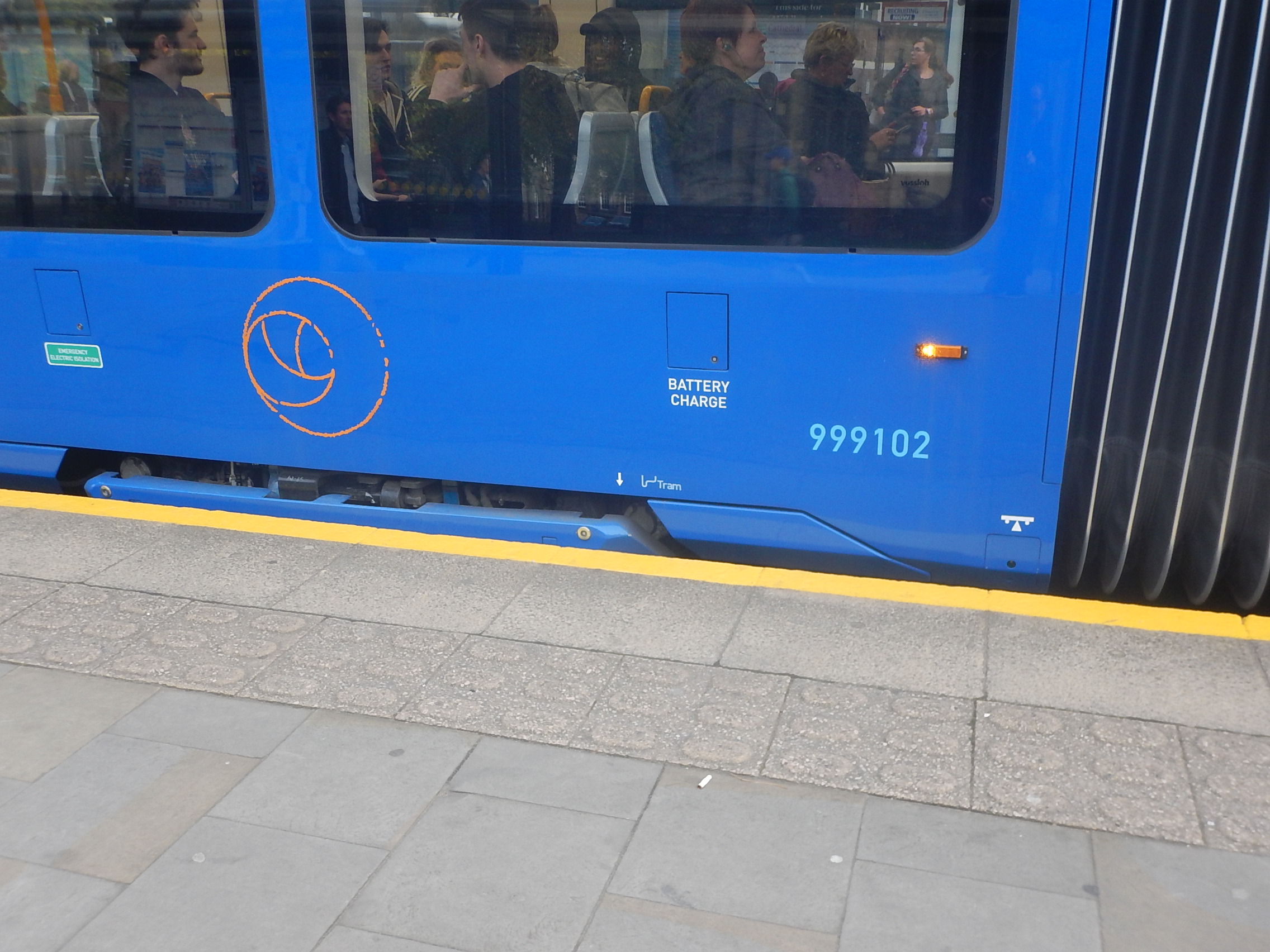
Note the BATTERY CHARGE socket to the left of the car number.
Why would an electrically-powered vehicle need a battery?
I suppose it could be to start up the tram-train in the morning and raise the pantograph.
But could it also be for emergency power, to move the tram-train short distances, such as in depots or to assist the vehicle through the dead sections, where the power supply changes from one voltage to another?
The Class 399 tram-trains ordered for the South Wales Metro will also have to cope with discontinuous electrification. So is the technology needed for this already installed in the tram-trains in Sheffield?
Battery Power And Dual Voltage Trains
Suppose you have a train like a Class 378 or Class 700 train, that can run on both 25 KVAC overhead and 750 VDC third-rail electrification.
Third-rail trains with contact shoes deal with discontinuous electrification all the time.
If a dual-voltage train had a battery that could take it say two hundred metres, then I believe that voltage changeover could be simplified and speeded up.
I have watched Class 717 trains change voltage at Drayton Park station and what changes would a limited battery capability make.
The third-rail electrification would stop several metres short of the station and would be removed in the station itself.
Going towards Moorgate, this would be the procedure.
- The train would stop in the station as it does now.
- The driver would drop the pantograph, whilst passengers unloaded and loaded.
- The driver would close the doors.
- The train would accelerate away on battery power.
- After a few metres the train would contact the third-rail and the train’s computer would change from battery to third-rail power.
Going away from Moorgate, this would be the procedure.
- The train would automatically disconnect from third-rail power, where that stopped to the South of the station.
- The train would automatically switch to battery power.
- The train would stop in the station as it does now.
- The driver would raise the pantograph, whilst passengers unloaded and loaded.
- The driver would close the doors.
- The train would accelerate away on overhead power.
The stops should be no longer, than a normal station stop without power changeover.
Conclusion
Batteries may well reduce the time taken to change voltage
Battery-Poweed Trams To Beat Congestion
The title of this post is the same as that of an article in today’s copy of The Times.
This is the first two paragraphs.
New tram networks could be rolled out in towns and cities across England under government plans to cut congestion and pollution.
The Department for Transport said that so-called light rail systems could help “reduce dependence on private cars”. A report published yesterday said that trams could carry 20,000 passengers an hour in each direction – about four times more than buses.
It goes on to discuss battery-powered trams and their advantages.
It then discusses the future and says that funding for new tram networks could come from the £2.5billion Transforming Cities Fund.
I’ve been trying to find the report, but it doesn’t appear to be on the Department for Transport web site.
Thanks to Peter, the report is called Light Rail And Other Rapid Transit Solutions In Cities And Towns: Call For Evidence and it is on this page of the Government web site.
Storage At Scale Competition
The title of this post is the same as that of this press release from the Department of Business, Energy & Industrial Strategy.
This is the details of the competition.
Innovative large-scale energy storage will play an important role in decarbonising industry, power, heat and transport.
This competition is looking for innovative, replicable solutions which could provide a market competitive alternative to conventional commercial large scale energy storage technologies, for example pumped-hydro or batteries (such as lithium ion, lead acid or sodium-sulphur).
A range of electrical energy storage technologies are within scope, with a target minimum output power of 30 MW or minimum capacity of 50 MWh. Power-to-X technologies (e.g. power-to-gas) with a target minimum input power of 5 MW are also in scope.
Up to £20 million will be available from 2019 to 2021. The competition will support up to 3 demonstration projects with build completion by March 2021 and operational testing to be completed December 2021.
Projects should be at a technology readiness level of 6 or above, which could result in lower capital or operating costs to the traditional storage technologies, or improved capacity, sustainability and response rates at a comparable cost.
A few thoughts.
The Minimum Output Power
A minimum output of 30 MW is specified.
To put this in context, the pumped-storage Dinorwig Power Station, has a maximum power output of 1,800 MW.
The Minimum Capacity
A minimum capacity of 50 MWh is specified.
Dinorwig has a capacity of 9.1 GWh
Power-to-X Technologies
As Power-to-gas is mentioned, I would feel that this refers to a process like electrolysis, where electricity is perhaps converted into hydrogen, which can be stored and then converted back to electricity using fuel cells or combustion and a steam turbine.
Conclusion
The competition looks to me to be a good idea.
Let’s hope it produces something worthwhile.
Wind Farms Sale Is Breath Of Fresh Air After Merger Setback
The title of this post, is the same as that as an article in the Business pages of The Times.
This is the first paragraph.
Selling stakes in two wind farms for £635million will provide funds to reduce debt and to launch up to £200million of share buybacks, SSE said yesterday.
Amongst the purchasers of the stake in the wind farms is an unnamed British pension fund.
So yet again, we’re seeing pension funds investing our future in wind farms.
It is a trend that will continue, as pension funds look for safe places to put the massive funds they have under management.
- We need the electricity the farms produce.
- The engineering of wind farms will get better, and farms will be more reliable and produce electricity economically for years longer.
- The farrms will probably get the best of maintenance, as pension funds will protect their investment.
In addition to wind, I suspect pension funds and insurance companies will invest in other large renewable energy schemes like solar and wave power and energy storage.
Schemes, such as those I mentioned in Exciting Renewable Energy Project for Spennymoor, will surely be ones that will appeal to the funds.
Conclusion
Pension funds and insurance companies with their massive funds are becoming a major force in vutting carbon emissions.
I suspect that this is not just a UK trend, but one with a world-wide dimension, that includes a lot of the EU, the Far East, North American and Australia.
Pan Up And Pan Down At Drayton Park Station
The years and decades go by and the new Class 717 trains, just like their predecessors; the Class 313 trains, continue to change between 25 KVAC overhead and 750 VDC third rail electrification at Drayton Park station.




There appears to have been little noticeable development in the forty years since the Class 313 reains were introduced. But the operation of the Class 717 trains appears smoother and quieter.
I would have thought, that for safety reasons, the new trains would have used battery power between Drayton Park and Moorgate stations.
After all it’s only two and a half miles, that is run using third-rail electrification.
I’d be very interested to see how much power is used by the new Class 717 trains South of Drayton Park.
In Weight And Configuration Of A Class 717 Train, I showed that the kinetic energy of a jam-packed Class 717 train at 85 mph is 56.15 kWh.
- I doubt that this sort of speed is achieved in the tunnels.
- At 60 mph, the energy would be 28 kWh
- At 40 mph, the energy would be just 12 kWh.
Obviously, hotel power for air-conditioning and lights will be needed for the train, but even at 5 kWh per car per mile, that would only be 150 kWh.
To carry 200 kWh of batteries on a six-car train is a very practical proposition.
- Vivarail have done it in a three-car train.
- There could be a short length of third-rail electrification to top up the batteries at Moorgate station, if required.
- Battery power could be used in depots to move trains, which would mean depots could have less electrification.
- Trains could be moved to the next station, if the electrification should fail.
The route between Moorgate and Drayton Park stations, is probably one of the best and easiest in the UK for battery operation.
Could A Class 399 Tram-Train With Batteries Go Between Manchester Victoria And Rochdale/Bury Bolton Street/Rawtenstall Stations?
In Rossendale Reopening Prospect, I looked at a proposal to run a new service between Manchester Victoria and Bury Bolton Street stations.
Could this route be run by a Class 399 tram-train with a battery capability?
These tram-trains would be very similar to the Stadler Citylink Metro Vehicles, that have been specified for the South Wales Metro.
- Wikipedia gives the weight of the vehicle as 66 tonnes.
- Manchester Victoria has an altitude of 44 metres
- Bury has an altitude of 100 metres.
- Rochdale has an altitude of 137 metres.
- Rawtenstall has an altitude of 174 metres.
- I will assume 200 passengers at 90 Kg. each, which gives a weight of 12 tonnes.
Using Omni’s Potential Energy Calculator gives the following.
- Manchester Victoria to Bury Bolton Street has an increase in potential energy of 12 kWh.
- Manchester Victoria to Rochdale has an increase in potential energy of 20 kWh.
- Manchester Victoria to Rawtenstall has an increase in potential energy of 28 kWh.
When you consider that a Class 230 train has 400 kWh of batteries in a two-car train, I don’t think that there will be any problem fitting batteries big enough to take a Class 399 tram-train from Manchester Victoria to Bury Bolton Street, Rochdale or Rawstenstall stations under battery power with a full load of passengers.
- The batteries would be charged in Manchester Victoria station.
- Returning to Manchester Victoria station would use a small amount of battery power, with some assistance from Newton’s friend; gravity.
- The batteries would get a certain amount of charge from the regenerative braking of the tram-trains.
This Google Map shows the Eastern approaches into Manchester Victoria station.
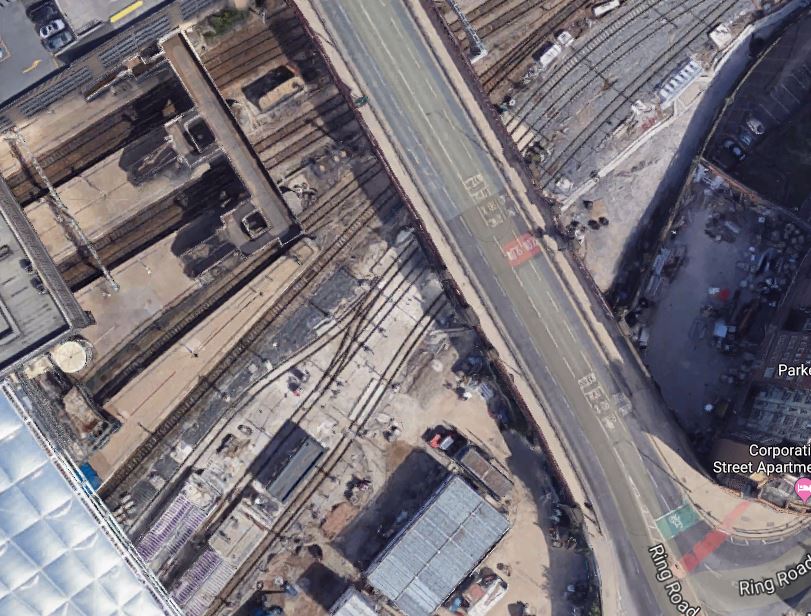
Note.
- The four through platforms numbered 3 to 6.
- The two bay platforms numbered 1 and 2.
- The four platform faces and three tracks of the Metrolink.
Having seen several tram-train systems all over Europe, I believe it would be possible to connect tram-trains running on batteries on the Calder Valley Line to the Manchester Metrolink at Manchester Victoria station.
- Going from Manchester to Bury Bolton Street, Rochdale or Rawtenstall, the tram-train would stop in the Manchester Victoria tram-stop, drop the pantograph and then continue on its way under battery power.
- Returning from the North, the tram-train would stop in the Manchester Victoria tram-stop, raise the pantograph and then continue on its way using power from the overhead wires.
- Batteries would be charged whilst running through Manchester.
There couldn’t be too many tram-train systems that would be easier to build than this?
It is interesting to note that Hebden Bridge station is just twenty-three miles from Manchester Victoria station and has an altitude of 190 metres.
So would it be possible for a Class 399 tram-train to reach Hebden Bridge station on battery power? I very much think it would be!
Class 399 Tram-Trains And Class 156 Trains
Class 156 trains are one of the better workhorses of the railways in the North and despite their age, they scrub up well.
If their performance is compared to that of a Class 399 tram-train, they are not that different.
- Noise and vibration of the electric tram-train is obviously much lower.
- The modern interior of the tram-train is geared to the needs of passengers.
- Passenger capacity of the two vehicles is also about the same.
- In Karlsruhe, tram-trains travel for up to 100 miles from the centre of the city.
Both Karlsruhe and Sheffield use three-car tram-trains, but Valencia uses much longer ones, so on heavily-used routes larger tram-trains could be used.
I doubt there would be many complaints, if a Class 156 service were to be replaced with one run by Class 399 tram-trains.
Electrification Of The Calder Valley Line
Electrifying the Calder Valley Line with 25 KVAC overhead wires as far as Rochdale station, would certainly make running to Hebden Bridge station possible.
- That electrification would also mean that electric trains could be turned-back at Rochdale station, just as diesel trains are now!
- I have flown my helicopter along the route and it looks like of the seven or eight bridges on the route, mostly appear to be modern structures for new roads or motorways.
- As 25 KVAC overhead electrification is currently being erected between Manchester Victoria and Stalybridge, a spur to Rochdale would be very much a simple addition.
It could be a very useful short length of electrification.
Tram-Trains In Manchester
This article on Rail Technology Magazine was puiblished yesterday and is entitled Plans For Tram-Trains In Manchester Unveiled As Grayling And Burnham Mull Expansion Of Metrolink.
Conclusion
Could we see tram-trains running from Bury Bolton Street, Hebden Bridge, Rawtenstall and Rochdale into Manchester Victoria and then taking to the existing tram network?
If you’ve ever been to Karlsruhe, as I have to see the Class 399 tram-trains German cousins, you wouldn’t rule out anything.
That would include tram-train services to Blackburn, Buxton, Chester, Glossop, Hebden Bridge, Sheffield, Southport and Wigan.
Seabed Rocks Could Act As Green Energy Stores
The title of this post is the same as that of this press release from the University of Strathclyde.
This is the first four paragraphs.
Rocks in the seabed off the UK coast could provide long-term storage locations for renewable energy production, new research suggests.
An advanced technique could be used to trap compressed air in porous rock formations found in the North Sea using electricity from renewable technologies.
The pressurised air could later be released to drive a turbine to generate large amounts of electricity.
Using the technique on a large scale could store enough compressed air to meet the UK’s electricity needs during winter, when demand is highest, the study found.
I read about this in today’s copy of The Times, which also says the following.
- There are suitable areas in the North and Irish Seas that can be used.
- The rocks could store fifty percent more energy than we used January and February.
As similar technology is being used in salt caverns in Germany and the United States, I feel that the idea has possibilities.
 The Anonymous Widower