We Need More Electricity
Everything we do, seems to need more and more electricity.
- We are greening our transport and every electric train, car, bus and truck will need to be charged.
- Unless it is hydrogen-powered, in which case we’ll need electricity to split water into hydrogen and oxygen.
- Computing and the Internet needs more electricity and is leading to companies putting server farms in countries like Iceland, where there are Gigawatts of low-cost electricity.
- We’re also using more energy hungry equipment like air-conditioning and some household appliances.
- And then there’s industry, where some processes like metal smelting need lots of electricity.
At least developments like LED lighting and energy harvesting are helping to cut our use.
Filling The Gap
How are we going to fill our increasing energy gap?
Coal is going and rightly so!
A lot of nuclear power stations, which once built don’t create more carbon dioxide, are coming to the end of their lives. But the financial and technical problems of building new ones seem insoluble. Will the 3,200 MW Hinckley Point C ever be built?
That 3,200 MW size says a lot about the gap.
It is the sort of number that renewables, like wind and solar will scarcely make a dent in.
Unfortunately, geography hasn’t donated us the terrain for the massive hydroelectric schemes , that are the best way to generate loe-carbon electricity.
Almost fifty years ago, I worked briefly for Frederick Snow and Partners, who were promoting a barrage of the River |Severn. I wrote about my experiences in The Severn Barrage and I still believe , that this should be done, especially as if done properly, it would also do a lot to tame the periodic flooding of the River.
The Tilbury Energy Centre
An article in The Times caught my eye last week with the headline of Tilbury Planned As Site Of UK’s Biggest Gas-Fired Power Station.
It said that RWE were going to build a massive 2,500 MW gas-fired power station.
This page on the RWE web site is entitled Tilbury Energy Centre.
This is from that page.
RWE Generation is proposing to submit plans to develop Tilbury Energy Centre at the former Tilbury B Power Station site. The development would include the potential for a Combined Cycle Gas Turbine (CCGT) power station with capacity of up to 2,500 Megawatts, 100 MW of energy storage facility and 300MW of open Cycle Gas Turbines (OCGT). The exact size and range of these technologies will be defined as the project progresses, based on an assessment of environmental impacts, as well as market and commercial factors.
The development consent application will also include a 3km gas pipeline that will connect the proposed plant to the transmission network which runs to the east of the Tilbury power station. The proposed CCGT power station would be located on the coal stock yard at the site of the former power station, but would be physically much smaller than its predecessor (a coal/biomass plant).
I will now look at the various issues.
Carbon Dioxide
But what about all that carbon dioxide that will be produced?
This is the great dilemma of a gas-powered power-station of this size.
But the advantage of natural gas over coal is that it contains several hydrogen atoms, which produce pure water under combustion. The only carbon in natural gas is the one carbon atom in methane, where it is joined to four hydrogen atoms.
Compared to burning coal, burning natural gas creates only forty percent of the carbon dioxide in creating the same amount of energy.
If you look at Drax power station, which is a 3,960 MW station, it produces a lot of carbon dioxide, even though it is now fuelled with a lot of imported biomass.
On the other hand, we could always eat the carbon dioxide.
This document on the Horticultural Development Council web site, is entitled Tomatoes: Guidelines for CO2 enrichment – A Grower Guide.
This and other technologies will be developed for the use of waste carbon-dioxide in the next couple of decades.
The great advantage of a gas-fired power station, is that, unlike coal, there are little or no impurities in the feedstock.
The Site
This Google Map shows the site, to the East of Tilbury Docks.
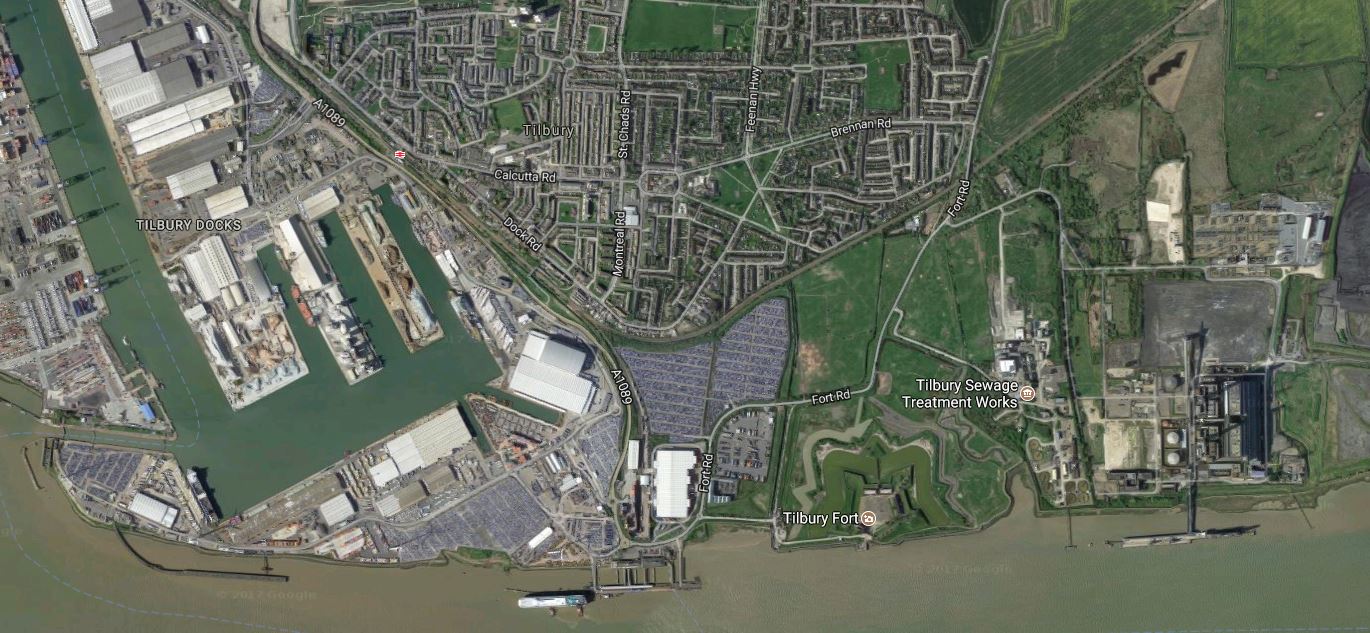
Note that the site is in the South East corner of the map, with its jetty for coal in the River.
These pictures show the area.
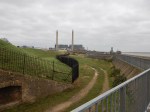
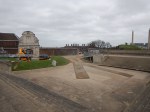

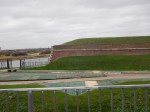
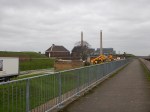
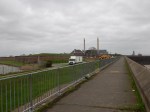
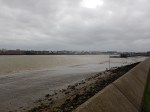
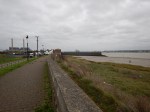
The CCGT power station would be built to the North of the derelict Tilbury B power station. I’ll repeat what RWE have said.
The proposed CCGT power station would be located on the coal stock yard at the site of the former power station, but would be physically much smaller than its predecessor (a coal/biomass plant).
Hopefully, when complete, it will improve the area behind partially Grade II* Listed Tilbury Fort.
Another development in the area is the Lower Thames Crossing, which will pass to the East of the site of the proposed power station. As this would be a tunnel could this offer advantages in the design of electricity and gas connections to the power station.
What Is A CCGT (Combined Cycle Gas Turbine) Power Station?
Combined cycle is described well but in a rather scientific manner in Wikipedia. This is the first paragraph.
In electric power generation a combined cycle is an assembly of heat engines that work in tandem from the same source of heat, converting it into mechanical energy, which in turn usually drives electrical generators. The principle is that after completing its cycle (in the first engine), the temperature of the working fluid engine is still high enough that a second subsequent heat engine may extract energy from the waste heat that the first engine produced. By combining these multiple streams of work upon a single mechanical shaft turning an electric generator, the overall net efficiency of the system may be increased by 50–60%. That is, from an overall efficiency of say 34% (in a single cycle) to possibly an overall efficiency of 51% (in a mechanical combination of two cycles) in net Carnot thermodynamic efficiency. This can be done because heat engines are only able to use a portion of the energy their fuel generates (usually less than 50%). In an ordinary (non combined cycle) heat engine the remaining heat (e.g., hot exhaust fumes) from combustion is generally wasted.
Thought of simply, it’s like putting a steam generator on the hot exhaust of your car and using the steam generated to create electricity.
The significant figures are that a single cycle has an efficiency of say 34%, whereas a combined cycle could be possibly as high as 51%.
In a section in the Wikipedia entry called Efficiency of CCGT Plants, this is said.
The most recent[when?] General Electric 9HA can attain 41.5% simple cycle efficiency and 61.4% in combined cycle mode, with a gas turbine output of 397 to 470MW and a combined output of 592MW to 701MW. Its firing temperature is between 2,600 and 2,900 °F (1,430 and 1,590 °C), its overall pressure ratio is 21.8 to 1 and is scheduled to be used by Électricité de France in Bouchain. On April 28, 2016 this plant was certified by Guinness World Records as the worlds most efficient combined cycle power plant at 62.22%. The Chubu Electric’s Nishi-ku, Nagoya power plant 405MW 7HA is expected to have 62% gross combined cycle efficiency.
There is also a section in the Wikipedia entry called Boosting Efficiency, where this is said.
The efficiency of CCGT and GT can be boosted by pre-cooling combustion air. This is practised in hot climates and also has the effect of increasing power output. This is achieved by evaporative cooling of water using a moist matrix placed in front of the turbine, or by using Ice storage air conditioning. The latter has the advantage of greater improvements due to the lower temperatures available. Furthermore, ice storage can be used as a means of load control or load shifting since ice can be made during periods of low power demand and, potentially in the future the anticipated high availability of other resources such as renewables during certain periods.
So is the location of the site by the Thames, important because of all that cold water.
But surely using surplus electricity to create ice, which is then used to improve the efficiency of the power produced from gas is one of those outwardly-bonkers, but elegant ideas, that has a sound scientific and economic case.
It’s not pure storage of electricity as in a battery or at Electric Mountain, but it allows spare renewable energy to be used profitably for electricity generators, consumers and the environment.
The location certainly isn’t short of space and it is close to some of the largest wind-farms in the UK in the Thames Estuary, of which the London Array alone has a capacity of 630 MW.
Wikipedia also has a section on an Integrated solar combined cycle (ISCC), where a CCGT power station is combined with a solar array.
I can’t see RWE building a new CCGT plant without using the latest technology and the highest efficiency.
Surely the higher the efficiency, the less carbon dioxide is released for a given amount of electricity.
Building A CCGT Power Station
The power station itself is just a big building, where large pieces of machinery can be arranged and connected together to produce electricity.
To get an idea of scale of power stations, think of the original part of Tate Modern in London, which was the turbine hall of the Bankside power station, which generated 300 MW.
Turbines are getting smaller and more powerful, so I won’t speculate on the size of RWE’s proposed 2,500 MW station.
It will also only need a gas pipe in and a cable to connect the station to the grid. There is no need to use trains or trucks to deliver fuel.
Wikipedia has a section entitled Typical Size Of CCGT Plants, which says this.
For large-scale power generation, a typical set would be a 270 MW primary gas turbine coupled to a 130 MW secondary steam turbine, giving a total output of 400 MW. A typical power station might consist of between 1 and 6 such sets.
I feel that this raises interesting questions about the placement of single unit CCGT power stations.
It also means that at somewhere like Tilbury, you can build the units as required in sequence, provided the services are built with the first unit.
So on a large site like Tilbury, the building process can be organised in the best way posible and we might find that the station is expanded later.
RWE say this on their web site.
The exact size and range of these technologies will be defined as the project progresses, based on an assessment of environmental impacts, as well as market and commercial factors.
That sounds like a good plan to me!
100 MW Of Energy Storage At Tilbury
RWE’s plan also includes 100 MW of energy storage, although they say market and commercial factors could change this.
Energy storage is the classic way to bridge shortages in energy, when demand rises suddenly, as cin the classic half-time drinks in the Cup inal.
In Wikipedia’s list of energy storage projects, there are some interesting developments.
The Hornsdale Wind Farm in Australia has the following.
- 99 wind turbines.
- A total generating capacity of 315 MW.
Elon Musk is building the world’s largest lithium-ion battery next door with a capacity of 129 MwH
But those energy storage projects aren’t all about lithium-ion batteries.
Several like Electric Mountain in Wales use pumped storage and others use molten salt.
Essex doesn’t have the mountains for the former and probably the geology for the latter.
But the technology gets better all the time, so who knows what technology will be used?
The intriguing idea is the one I mentioned earlier to make ice to cool the air to improve the efficiency of the CCGT power station.
What Is The Difference Between A CCGT (Combined Cycle Gas Turbine) And An OCGT (Open Cycle Gas Turbine) Power Station?
RWE have said that they will provide 300 MW of 300MW of Open Cycle Gas Turbines, so what is the difference.
This page from the MottMacdonald web site gives a useful summary.
OCGT plants are often used for the following applications:
- Providing a peak lopping capability
- As a back- up to wind and solar power
- As phase 1 to generate revenue where phase 2 may be conversion to a CCGT
CCGT plants offer greater efficiency.
I’ve also read elsewhere, that OCGT plants can use a much wider range of fuel. Used cooking oil?
Conclusion
There is a lot more to this than building a 2,500 MW gas-fired power station.
RWE will be flexible and I think we could see a very different mix to the one they have proposed.
Do Class 800/801/802 Trains Use Batteries For Regenerative Braking?
I ask this question, because I think that it could be key to the announcements about electrification yesterday, as reported in this article in Global Rail News, which is entitled UK Ditches Electrification Plans In Wales, The Midlands And The North.
If you look at all these Wikipedia entries for Hitachi trains being built for the UK.
You will find no reference to regenerative braking.
If you type “Class 800 regenerative braking” into Google, you will find this document on the Hitachi Rail web site, which is entitled Development of Class 800/801 High-speed Rolling Stock for UK Intercity Express Programme.
The only mention of the R-word is in this paragraph.
An RGS-compliant integrated on-train data recorder (OTDR) and juridical recording unit (JRU), and an EN-compliant energy
meter to record energy consumption and regeneration are fitted to the train.
If you search for brake in the document, you find this paragraph.
In addition to the GU, other components installed under the floor of drive cars include the traction converter, fuel tank, fire protection system, and brake system.
Note that GU stands for generator unit.
Traction System
I will start by having a detailed look at the traction system as described in the document.
The document provides this schematic of the traction system.

Note BC which is described as battery charger.
This is said in the text.
The system can select the appropriate power source from either the main transformer or the GUs. Also, the size and weight of the system were minimized by designing the power supply converter to be able to work with both power sources. To ensure that the Class 800 and 801 are able to adapt to future changes in operating practices, they both have the same traction system and the rolling stock can be operated as either class by simply adding or removing GUs. On the Class 800, which is intended to run on both electrified and non-electrified track, each traction system has its own GU. On the other hand, the Class 801 is designed only for electrified lines and has one or two GUs depending on the length of the trainset (one GU for trainsets of five to nine cars, two GUs for trainsets of 10 to 12 cars). These GUs supply emergency traction power and auxiliary power in the event of a power outage on the catenary, and as an auxiliary power supply on non-electrified lines where the Class 801 is in service and pulled by a locomotive. This allows the Class 801 to operate on lines it would otherwise not be able to use and provides a backup in the event of a catenary power outage or other problem on the ground systems as well as non-electrified routes in loco-hauled mode.
This is all very comprehensive.
But nothing is said about how regenerative brake currents from the traction motors are handled.
Any trained Control Engineer, of which I’m a life-expired example, can see all sorts of questions to ask.
- Could it be that all regenerative brake currents are fed into the Auxiliary Power Supply and then used for hotel power and to charge the battery?
- Is the generator unit switched on and off by a sophisticated control system, that uses GPS, train velocity, train weight, battery level etc.?
- Can battery power be used to move the train?
- How big is that mysterious battery?
In 2010, I wrote Edinburgh to Inverness in the Cab of an HST, after taking a memorable trip.
One memory of that trip is of the skill of the driver as he adjusted the twin throttles of the power cars and used the brakes, as the train travelled up hill and down dale.
This line will be Class 800 territory and I suspect that it will be worked by two five car units working as a ten-car train.
As I think that each five-car unit will have three generator units, does this mean that the driver will have six throttles?
Control Engineering has moved on in the forty years since the InterCity 125 entered service and I suspect that like an Airline Pilot, the driver of a Class 800 train, will have little control about how power is delivered. Except probably in a supervisory role.
So on routes like the Highland Main Line, the Class 800 will come into its own, using the generator units and stored energy as appropriate.
Obviously, the less the generator unit is used the better, as this minimises noise and vibration, and cuts carbon emissions.
Other features in the train design have been disclosed.
All Class 801 Trains Have At Least One Generator Unit
All Class 801 trains have at least one GU (generator unit), so it can obviously provide hotel power and probably enough power to limp to the next station, in case of overhead line failure.
Third Rail Class 800/801 Trains Are Possible
The layout of the traction system surely makes a third rail or even a dual-voltage version of the trains possible.
After all, their first cousin; the Class 395 train is a dual voltage train.
Locomotive Haulage Is Possible
As I said, the specification is comprehensive.
The document is also forthcoming in other areas.
Train Configuration
This is said.
Trains have a unit configuration of up to 12 cars, including the ability to add or remove standardised intermediate cars and the generator units (GUs)
(generators with diesel engines) needed to operate commercial services on non-electrified lines.
So if say GWR wanted an eleven-car train, it would be possible.
Automatic Coupling And Uncoupling
This is said.
Because the coupling or uncoupling of cars in a trainset occurs during commercial service at an intermediate station, the automatic coupling device is able to perform this operation in less than 2 minutes.
This is definitely in line with Class 395 train performance.
Automatic Train Identification Function
This is said.
To simplify the rearrangement and management of train configurations, functions are provided for identifying the train (Class 800/801), for automatically determining the cars in the trainset and its total length, and for coupling and uncoupling up to 12 cars in
normal and 24 cars in rescue or emergency mode.
I suspect most modern trains can do this.
One Twelve-Car Train Can Rescue Another
See the previous extract.
Flexible Interior Layout
This is said.
The rolling stock is designed to facilitate changes to the interior layout to accommodate changes to services or to the number of cars in the train.
I suspect that was expected.
An Interim Conclusion
In answer to the question, I posed with this post, I suspect that the answer is in the affirmative.
Extra Evidence
I also found this article on the Hitachi Rail web site, which is entitled Hybrid Propulsion with a sub-title of Energy-saving hybrid propulsion system using storage–battery technology.
This is the introductory paragraph.
As a step toward producing environmentally friendly propulsion systems, Hitachi has supplied a hybrid propulsion system that combines an engine generator, motor, and storage batteries. This system provides regenerative braking which has not been previously possible on conventional diesel-powered trains, and enables increased energy savings via regenerated energy.
They list the advantages as.
- 10% improvement of fuel consumption
- 60% reduction of the hazardous substances in engine exhaust
- 30db reduction of noise in stopping at the station
They also give various links that are worth reading.
All of these pages seem to have been published in 2013.
Conclusion
I will be very surprised if Class 800/801/802 trains don’t have batteries.
Looking at the schematic of the electrical system, the energy captured will at least be used for hotel power on the train.
Will the Class 385 trains for ScotRail have similar traction system?
Seville’s Elegant Trams
Seville’s tramway; the MetroCentro, by the cathedral is powered without using traditional overhead catenary.




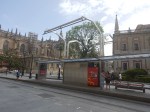





Each double-sided stop has a high electrified rail on each side.
When the tram stops, it puts up a pantograph and then for a minute or so, it charges the batteries.
Seville’s Urbos trams are the same as in Birmingham, so will the Midland Metro be using the same elegant system to charge the batteries, that are now been fitted, so trams can run to Centenary Square in Birmingham and the railway station in Wolverhampton?
|Edinburgh also has another version of Urbos trams, so if Birmingham battery trams are successful, will we be seeing them North of the Border?
There’s only one thing wrong with Seville’s trams. Every one is wrapped in advertising, which makes it difficult to see out and look at the outstanding buildings.
How Does The Battery System Work?
CAF , who built the Urbos trams, have this page on their web site, which is entitled Greentech Tram.
The system uses two methods of storing electricity.
Supercapacitor Modules
A supercapacitor has the advantage that it can be quickly charged and discharged.
So as a tram only takes perhaps fifteen seconds to stop from full speed, the fast charging allows the regenerative braking energy to be stored.
On starting again, this energy can be discharged quickly from the supercapacitor to accelerate the tram.
This charging/discharging cycle does degrade the supercapacitor and they would have to be replaced periodically.
Lithium-Ion Batteries
Lithium-ion batteries can hold greater amounts of electricity, but their charge and discharge rate is slower.
They can provide smaller amounts of power to keep the tram going at a constant speed after it has been accelerated.
A Sophisticated Control System
The page talks about a sophisticated control system that optimised the driving of the tram and the minimisation of energy.
The System Can Be Licenced From CAF
It should be noted that CAF will licence the system to other manufacturers.
Conclusion
By using two different storage systems with different characteristics, CAF are able to drive the tram along its 1.4 km route, charging at each stop.
An Appropriate Story For Today
On Page 58, The Times has an article entitled Frictionless Flywheels Hold Balance Of Power.
This is the first two paragraphs.
Flywheels will be used to balance supply and demand on Britain’s electricity grid in a £3.5million project that could help the country to cope with more wind and solar power.
Sophisticated flywheels that can store electricity for long periods of time are to be installed next to the University of Sheffield’s battery storage facility at Willenhall near Wolverhampton, in the first project of its kind in the UK.
By using batteries and flywheels together, this makes a responsive battery that can fill in demand and overcome the degradation problems of lithium-ion batteries.
It looks a promising way of creating an affordable and reliable energy storage system.
Who needs coal? Trummkopf obviously does to buy votes!
In the United States, with its massive mountain ranges, it would be better to create construction jobs by creating hydro-based energy storage systems, as we did in the 1970s at Dinorwig and the Americans, themselves did at Bath County Pumped Storage Station a few years later.
To gauge the size of these plants, Bath County has about the same generating capacity as the UK’s largest power station at Drax, with Dinorwig being about 55% of the size.
Bath County and Dinorwig are big bastards, but their main feature, is the ability to pump water to store the energy.
Energy is like money, the best thing to do with excess is to put it in a secure storage facility.
Hitachi Class 385 Trains, Batteries And Charging Stations
This article in the International Railway Journal is entitled JR Kyushu battery EMU to enter service in October.
This is said.
JAPAN’s Kyushu Railway Company (JR Kyushu) announced on August 24 that its pre-series Dual Energy Charge Train (Dencha) battery-assisted EMU will enter revenue service on the 11km Orio – Wakamatsu section of the Chikuho Line on October 19.
The two-car 819 series set draws power from the 20 kV ac 60Hz electrification system to feed a bank of onboard batteries, which give the train a wire-free range of up to 90km.
At least it can do 11 km. This is said about the train’s manufacture.
The 819 series is based on the existing 817 series EMU and was built by Hitachi at its plant in Kudamatsu in Yamaguchi prefecture.
Note the word Hitachi!
Hitachi call it a BEC819 train and it is one of their ubiquitous A-trains.
On the Hitachi Rail Europe web site, three new trains are mentioned.
All are A-trains and on all pages, the word battery is mentioned under power supply.
So will Scotrail’s new Class 385 trains have a battery capability?
Probably not initially!
But Hitachi have obviously been doing a lot of research into battery trains and the JR Kyushu is the first practical application.
Scotland’s rail system outside Edinburgh and Glasgow is not electrified, but it is well-known that Scotland’s Government would like more electrified services and also links to places like Leven and St. Andrews.
Both of these places, and there are probably others as well, are a few miles from a main line, that is very likely to be electrified.
So could we see a battery train charged as the JR Kyushu train on a main line, serving these branch lines on battery power?
I feel that the chance of this happening is very high.
Put a charging station, like a Railbaar at the terminal station and it could be done as soon as the train is built.
Could There Be A Battery-Powered Class 319 Flex Train?
In the advance copy of the brochure for the Class 319 Flex train, that Porterbrook have sent me, there is a few comments about using batteries on the train.
This strong statement is Porterbrook’s view on a battery-option for the train.
A large battery option was shown to be heavy, would require a lot of space and have long recharge times.
But Porterbrook are also quoted in the article in Rail Magazine, which is entitled Flex… and flexibility, as saying.
Batteries are definitely doable, but rail will have to overcome the current range limitations for traction power. We think traction battery technology will give you a range of around 20km to 30km [12-18 miles] before needing recharging, and this is not enough for most operators.
But a lot of uses of a battery train are for very short distances.
- Moving a train in a depot.
- Moving a train to an electrically-dead siding for overnight parking.
- Moving a train to a safe evacuation place like the next station after an electrification failure.
- Moving a train over an electrically-dead section of line.
- Running on very short branch lines without electrification.
- Running to a temporary station.
- Remote start-up of the train.
As the Class 319 train is a DC train, fitting batteries would not need an expensive voltage converter.
Electrically-Dead Stations
The new Health and Safety regulations as regards electricity in stations are causing Network Rail serious problems and great expense with electrification.
A train with a limited battery option may offer significant safety advantages in that if it had a range of six mile or so on full batteries then stations could be built without electrification.
Third rail systems are often broken in stations for a short distance, so that staff can safely cross the tracks. They are also broken at level crossings.
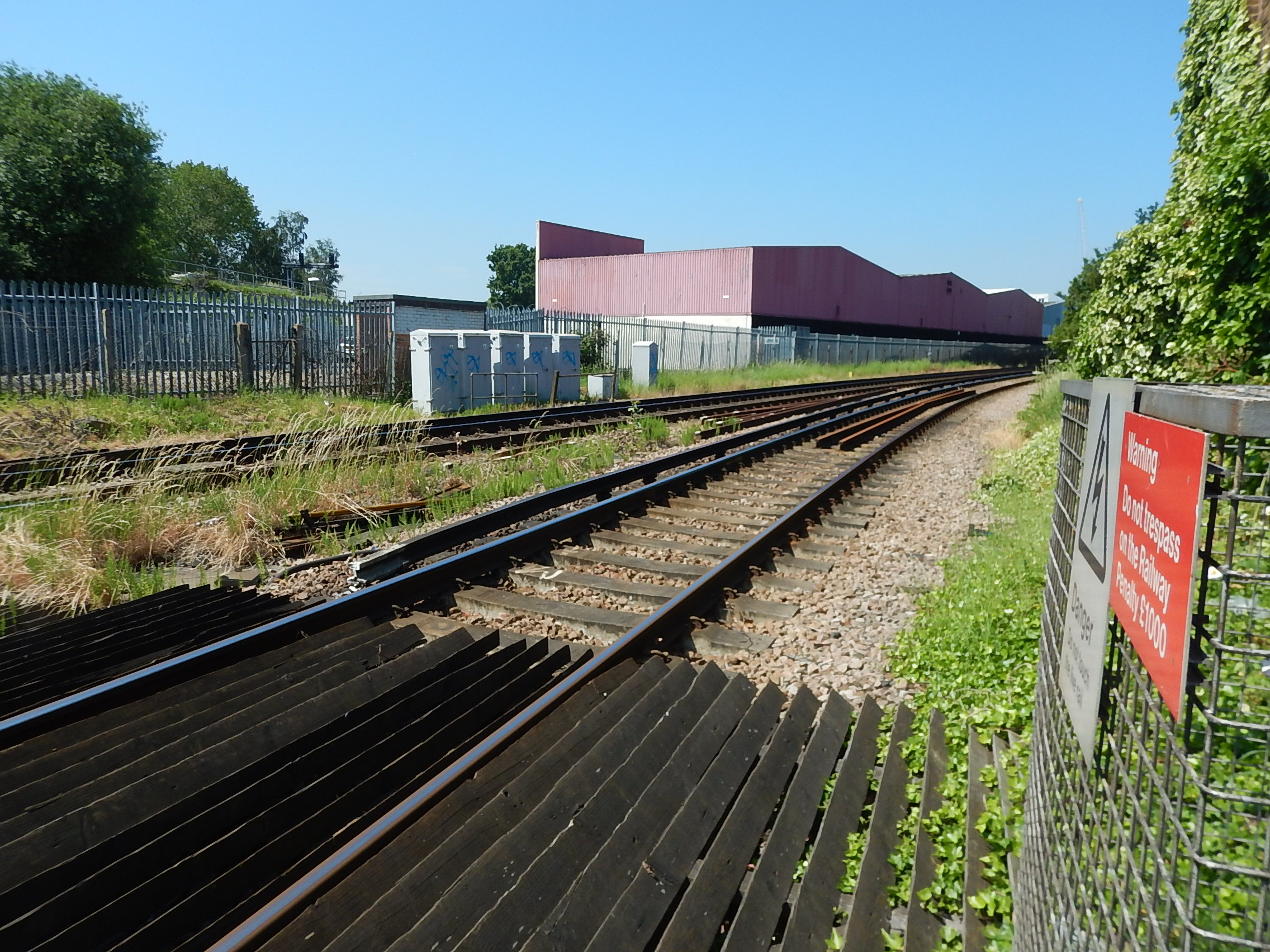
Most trains including all Class 319 trains have contact shoes at both end of the train and can bridge a short gap.
An onboard battery would allow the trains to bridge larger gaps.
The problem with overhead electrification is that the pantograph must be lowered and raised at the correct times. But this is one of those problems that could be done automatically and safely by systems linked to GPS.
There’s certainly a patent with the name of Pantograph Control Via GPS.
No overhead wires in a station with a rich architectural heritage, may lead to easier and more affordable electrification.
Think Hebden Bridge!
Very Short Branch Lines
Several branch lines that have been proposed for electrification are less than six miles in length.
- Brentford – 4 miles
- Greenford – 2.7 miles
- Henley – 4.5 miles
- Levenmouth Rail Link – 5 miles
- Windsor – 2.5 miles
So if 20 to 30 km. (12-18 mile) range mentioned by Porterbrook is serious, a Class 319 Flex train with batteries instead of diesel engines should be able to handle short branch lines with ease, provided that the batteries could be charged on the main line or in an electrified bay platform.
As electrificastion procedes more opportunities will present themselves.
This Google Map shows the distance between Leeds Bradford Airport and the Harrogate Line.
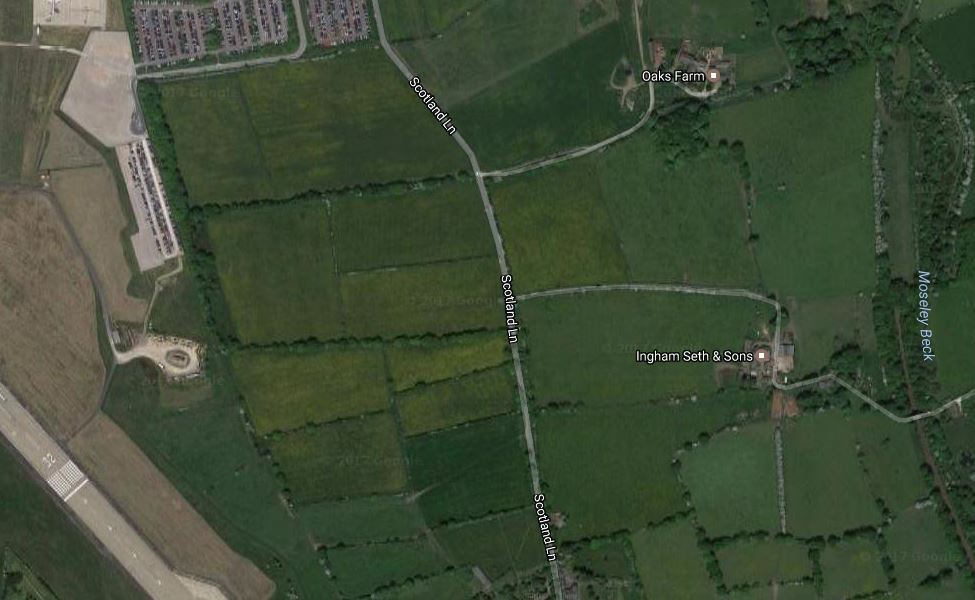
The Harrogate Line is likely to be electrified in the next tranch of electrification, as most of the other suburban lines from Leeds are already electrified.
The distance between the Airport and the Harrogate Line is probably about a mile, so Class 319 trains fitted with an affordable battery could manage this line.
Battery Technology Will Improve
It should be born in mind that battery technology will get better, thus range will increase for a battery if a given physical size.
A guaranteed twenty mile range would bring these routes into the list of possible routes for a Class 319 train with batteries.
- Braintree – 6.4 miles
- Coventry to Nuneaton – 10 miles
- Marlow – 7.25 miles
- Windermere – 10 miles
Braintree is interesting, as it needs a passing loop and the cheapest way to do this would be to remove the electrification, update the track and signalling and use an independently-powered train.
Battery Technology On Other Trains
Simpler battery systems like this will be able to be applied to a large number of modern electric trains on UK railways.
- Class 321 trains
- Class 375 trains
- Class 377 trains
- Class 378 trains
- Class 379 trains
- Class 387 trains
Note that I haven’t included the Alstom, CAF, Hitachi, Siemens and Stadler trains running now or in the future.
Will they sit on their hands and watch the other manufacturers’ trains get more efficient? You bet they won’t!
It is also worth noting that some of these trains, unlike the Class 319 trains, have regenerative braking, which could store their braking-generated energy in the battery, rather than returning it to the electrification.
Conclusion
Porterbrook have let a big genie out of the bottle.
Business As Usual: Vivarail Begins Testing Of New Battery Train
The title of this post is taken from this article in Rail Technology Magazine.
So it would appear that Class 230 trains are now running on batteries.
Apparently you can swap batteries for diesel power-packs.
The train certainly has a low-cost paint job!
Tram 18, Where Are You?
This article in Rail echnology Magazine is entitled Midland Metro tram shipped to Spain for battery fit-out ahead of OLE-free operation.
It describe how Tram 18 is on its way to Zaragoza to be fitted with lithium-ion batteries, so that the UK’s first battery tram can start running in 2019, after the track is laid to Victoria Square in Birmingham and the railway station in Wolverhampton.
Exploring The Route Of The Midland Metro Extension To Victoria Square
The extensions at both ends of the Midland Metro in Birmingham and Wolverhampton City Centres will be a first for the UK, in that they will be catenary-free and the trams will run on battery power.
This Google Map shows the area, where the initial extension will go in Birmingham City Centre.
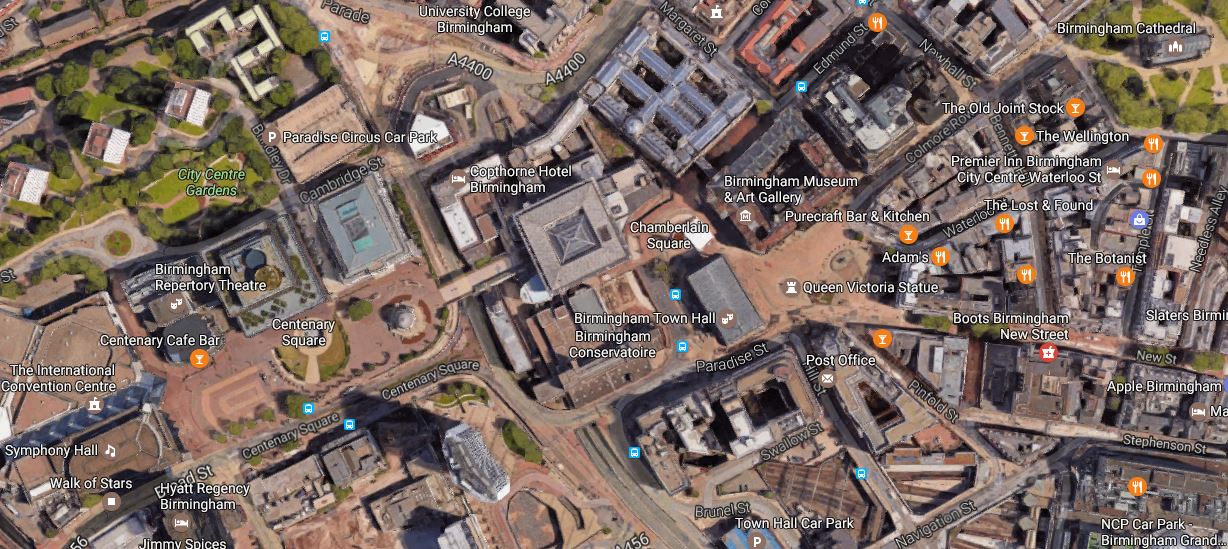
Places of interest are.
- The cathedral is in the North-East corner.
- New Street station is in the South-East corner.
- Victoria Square and the Town Hall are just to the East of the middle.
- Centenary Square is towards the West side.
This description comes from this page on the Metro Alliance web site.
840m of twin track from Birmingham Grand Central at Stephenson Street, up Pinfold Street through Victoria Square, Paradise St, past Paradise Circus into Centenary Square at Broad St.There will be an intermediate stop outside the Town Hall in Victoria Square, and we will interface with the Navigation Street link.
One of the problems at the moment, is that the development of Paradise Birmingham, seems to sit in the middle of the route.
These pictures show the area of Victoria Square and the route up from New Street station.






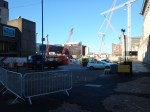





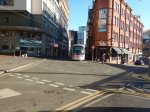

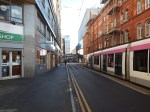

Note.
- The steep hill of Pinfold Street.
- The route seemed to have been prepared ready for the track to be fitted into the road surface.
- Utilities seemed to have been moved.
- When I took the pictures, the Midland Metro had parked a tram at the limit of the current track at the bottom of Pinfold Street.
Climbing The Hill
You can’t accuse Birmingham of lacking ambition, as Pinfold Street is a proper hill.
But then!
- It is the only steep hill on the route to Centenary Square.
- The tram will start the ascent with full batteries.
- There will be no problems coming down.
- This extension is only 840 metres in length.
- The MetroCentro in Seville has used similar technology on a 1.4 km. route since 2007.
- CAF have technology that charges batteries fast.
- Battery technology has moved on in the last ten years.
If in practice, it does prove a difficult climb, overhead wires could be put on sufficient of the lower part of the up-track on Pinfold Street.
These wires wouldn’t be visible from Victoria Square, so wouldn’t effect the architectural integrity pf the area.
Onward to Edgbaston
According to this article in Rail Technology Magazine, the further four kilometre extension to Egbaston, is also intended to be catenary-free.
As the trams could be charged at Edgbaston, I think this could be possible.
But I doubt CAF would propose the use of batteries, if they hadn’t already proven the range, which is not outrageous.
The Next Step
I looked at a lot of the route of the first section to Victoria Square today, and it would appear that the roadway has been prepared for fitting the track.
So could we see an accelerated development of the first part of the extension?
It would be a good test of the technology, with little risk to the Midland Metrolink!
If the trams can’t make the hill on baqtteries, it would need to be wired, but you could always blame Spanish engineering.
Conclusion
It is a very well-designed scheme.
I wonder, if we’ll see Edinburgh batteries on their CAF trams?
The Cost Of Tram Batteries
This article in Rail Technology Magazine is entitled Midland Metro tram shipped to Spain for battery fit-out ahead of OLE-free operation.
One Midland Metro tram has been sent back to the factory in Zaragoza to be fitted with two roof-mounted lithium-ion cells and after testing it will be returned to the West Midlands in the Autumn, where more testing will be performed, prior to starting running on the catenary-free streets of Birmingham and Wolverhampton.
After a successful completion of testing on the first tram, the other twenty trams will be converted.
This is said in the article about costs.
The total cost to the WMCA of fitting out the fleet will be £15.5m, but the authority says that it will save £9.24m on infrastructure costs on the first four extensions to the Metro network alone, with further infrastructure savings planned as future extensions take place.
So the savings can go a long way to help pay for the trams to run on the four extensions.
The cost of the modifications to each tram is £738,000, but if the infrastructure savings are factored in, the modifications cost just £298,000 per tram.
I also wonder if the layout of the Midland Metro, with a fairly long wired central section and a catenary-free section at either end is ideal for battery operation, as the trams will have a long section to fully charge the batteries.
But it looks like trams will reach Victoria Square and Wolverhampton station in 2019, Edgbaston in 2021 and the Eastside extension to Curzon Street will be completed in 2023.
Perhaps, the most interesting section in the article is this paragraph.
The WMCA is also evaluating a proposed Wednesbury to Brierley Hill extension to identify the viability of catenary-free sections.
Could this mean that the South Staffordshire Line, which will be used for the extension will be without catenary? As the tram does small detours into Dudley and at the Merry Hill Shopping Centre, then these sections could be wired to charge the batteries, leaving the South Staffordshire Line without any wires. I estimate that the distance the tram would travel would be about seven miles each way.
As Network Rail want to run both trams and freight trains on the South Staffordshire Line, this might allow both to share an unelectrified line, if they have the right wheel and track profiles.
There certainly seems to be some very innovative ideas around, when it comes to using trains and trams in City Centres.
 The Anonymous Widower