Port Of Açu And Fortescue To Explore 300MW Hydrogen Plant In Brazil
The title of this post, is the same as that of this article on H2Bulletin.
This is the first paragraph.
Brazilian ports have been attracting foreign investors to benefit from its abundant renewable resources. Porto do Açu Operações SA has recently started exploring opportunities to become a hydrogen production hub in Brazil, which H2Bulletin exclusively covered in its recent article.
The location of the Superport of Açu is shown on this Google Map.
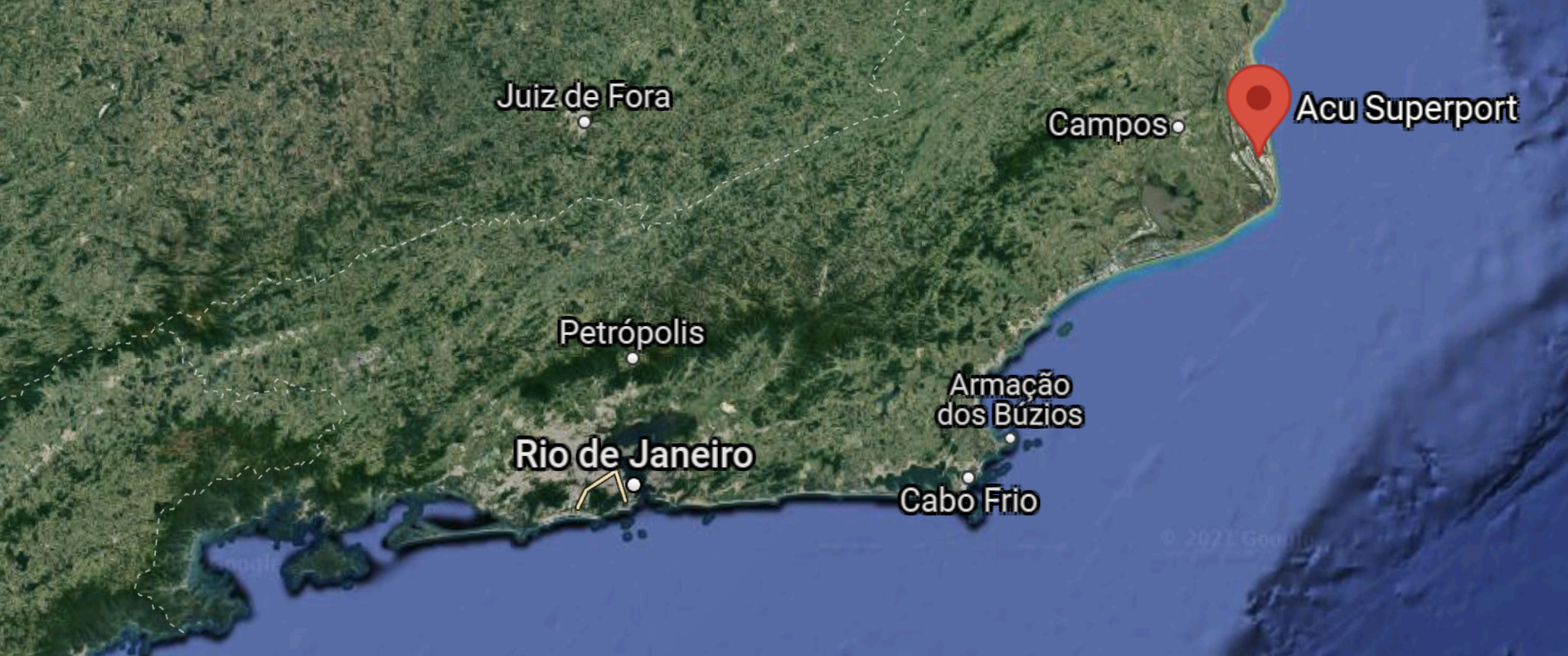
Açu is marked by the red arrow and is about 300 km. from Rio de Janeiro.
Over the last year or so, I’ve noticed several ports declare the intention of becoming hydrogen hubs.
- Hydrogen can be used to power dock vehicles, tugs, work-boats and ships.
- Hydrogen can be used to support local businesses with high energy needs.
- In the future hydrogen may power freight trains to and from the port.
Do ports feel hydrogen is a good way to decarbonise?
Do Ports Make Good Hydrogen Hubs?
Consider.
- Ports and their staff are used to handling cargoes of all types including gases, chemicals, liquids and liquified gases.
- They generally have space for the tanks to store hydrogen.
- They have a good electrical connection for an electrolyser to create green hydrogen.
- They have lots of uses for hydrogen.
Any excess hydrogen can be exported to someone who needs it.
It seems to me, that a port is a good place for a hydrogen hub.
Fortescue Expands Green Energy Into PNG
The title of this post is the same as that of this article on Perth Now.
This is the first paragraph.
Mining magnate Andrew “Twiggy” Forrest’s Fortescue Future Industries plans to develop more than a dozen hydropower and geothermal energy projects in Papua New Guinea.
Other points from the article include.
- Green hydrogen and ammonia will be created.
- This will create a domestic and export industry for a country that relies heavily on imported oil.
- Papua New Guinea will become a leader in the world’s renewable energy transition.
- The target is 2.3 million tonnes of green hydrogen a year.
There is also a commitment to the various communities of Papua New Guinea of training, employment and business development opportunities.
I estimate that to produce 2.3 million tonnes of green hydrogen a year, would need around 600 MW of electricity twenty-four hours a day on every day of the year.
Eden Project: Geothermal Heat Project ‘Promising’
The title of this post, is the same as that of this article on the BBC.
This is the first paragraph.
A three mile-deep (4.8km) borehole has shown “promising” prospects for a geothermal heat plant in Cornwall.
Eden estimates the borehole can produce enough heat for 35,000 homes.
Geothermal energy is only at the beginning in the UK, but just because we don’t have any active volcanoes, we shouldn’t discount it.
On the other hand, we do have a lot of water-filled abandoned coal mines, which in former mining areas of the UK can and will provide a substantial amount of district heating, as I wrote in Exciting Renewable Energy Project for Spennymoor.
And then there’s one-off project’s like Bunhill 2 in Islington, which I wrote about in ‘World-First’ As Bunhill 2 Launches Using Tube Heat To Warm 1,350 Homes.
Conclusion
The UK may not be an Iceland, Indonesia, Italy, New Zealand, Philippines or the USA, but according to Wikipedia we have a good potential.
- Deep geothermal resources could provide 9.5GW of baseload renewable electricity.
- Deep geothermal resources could provide over 100GW of heat.
I think my most significant post on geothermal energy is Schlumberger New Energy And Thermal Energy Partners Form Geothermal Development Company STEP Energy.
Schlumberger and the other oilfield services companies have a very serious problem.
With countries abandoning oil and gas, they have lots of engineers, geologists and other staff, who will not be needed by the oil and gas industry.
But their expertise and skills can be transferred to the geothermal heat and power industry. This will benefit the staff, the companies and the world!
The other place there expertise can be used is in the storage of captured carbon dioxide.
Harmony Energy Income Trust Eyes IPO To Develop 213.5MW Of Tesla Battery Storage
The title of this post, is the same as that of this article on Solar Power Portal.
The article is a very detailed look at Harmony and their development of energy storage, using Tesla hardware and software.
It also has things to say about the energy storage market in general.
This is a paragraph.
Paul Mason, managing director of the Investment Adviser, said battery energy storage offers exciting growth potential, with an expected requirement of up to 43GW by 2050 from just 1.2GW now.
It is certainly looking that companies like Harmony Energy Income Trust will be important in funding this extreme growth of energy storage.
‘Unique’ Solar-Storage Solution Providers Plot 300MW / 3.6GWh Australia Project
The title of this post, is the same as that of this article on Energy Storage News.
The first two paragraphs outline the system.
A 1,200 hectare site in South Australia has been secured by a developer hoping to use it to build a 300MW solar power site with 3.6GWh of energy storage, based on a novel technology solution.
Europe-headquartered renewables company Photon Energy is working to roll out the technology created by Australian company RayGen. It combines a kind of concentrating solar power (CSP) + solar photovoltaics (PV) hybrid that RayGen calls ‘PV Ultra’, paired to a long-duration energy storage tech dubbed ‘thermal hydro’.
Thermal hydro appears to be an interesting concept, which uses hot and cold water reservoirs to store energy. Electricity is retrieved using a Rankin cycle engine and the claimed roundtrip efficiency is seventy percent.
This power plant might seem to be very futuristic, but a 4MW solar with 3MW / 50MWh of energy storage project is already under construction and should go on-line in the middle of next year.
The developer; Photon Energy hopes to get the giga-plant ready-to-build by the end of 2023.
This concept could be a very useful one, where there is enough sun for concentrating solar power.
Blue Hydrogen Is Not Clean Energy, Says Mining Tycoon
The title of this post, is the same as that of this article on The Times.
This is the first paragraph.
Producing “blue hydrogen” from natural gas is not a clean energy source and is being wrongly promoted as one by the oil and gas industry, a billionaire mining mogul has claimed.
The mining mogul is Andrew Forrest, who is the second richest person in Australia.
I feel he is only partly right, as there are processes coming through that use a catalyst to split the hydrogen from the carbon.
But like the taxi in the picture at the top of the article with Mr. Forrest, his words are all good publicity.
Incidentally, I do believe that in a few years, we’ll have the technology to use so much carbon dioxide efficiently, that we may see gas-fired power stations used to create both energy and carbon dioxide.
Hydrophilic Polymers: The Key To A Green Future
The title of this post, is the same as that of this article on Tech Xplore.
This is the first paragraph.
Researchers from the University of Surrey and the University of Bristol are working on innovative devices to tame and store carbon-free renewable energy from unpredictable sources such as wind and solar.
That got me interested and I read the whole article.
This abstract on SpringerLink gives a definition of hydrophilic polymers.
Hydrophilic polymers are those polymers which dissolve in, or are swollen by, water. Many compounds of major technical and economic importance fall within this definition, including many polymers of natural origin. Many foodstuffs—containing substantial amounts of carbohydrate and protein— can be classified as hydrophilic polymers, and some have important technical and industrial uses, apart from their nutritional value. For example, although over 95% of the starches produced from corn (maize), wheat, potato, tapioca, and other vegetable sources are used as foods (human or animal), the remaining quantity represents an important part of the technical polymer market. In fact, more than two-thirds of hydrophilic or water-soluble polymers used in industry are derived from polymers of natural origin, so coming from renewable resources (harvested crops, trees, waste animal products and so on), rather than petrochemical sources of finite availability.
This paragraph from the Tech Xplore article describes the research.
The Chemistry Department at Surrey is working with collaborators at Bristol, Professors Ian Hamerton and David Fermin, and Superdielectrics Ltd., an innovative British Research Company located at the Surrey Research Park to transform simple hydrophilic polymers which were originally developed for use as contact lenses, to realize a second critical energy storage process.
This could lead to the next generation of supercapacitors.
Conclusion
This is fascinating technology and it could save the world.
Long Duration Energy Storage Council — A New Global Industry Body — Launched At COP26
The title of this post, is the same as that of this article on Recharge News.
This is the first paragraph.
The CEO-led organisation aims to ensure that fossil-fuel back-up is replaced with long-lasting zero-carbon alternatives by 2040.
The membership includes major players in energy and energy storage.
Hopefully, they’ll ensure the world has enough energy storage.
Read the article.
Financial Incentive Needed To Drive UK Energy Storage
The title of this post, is the same as that of this article on pv Magazine.
This is the first paragraph.
The lack of an incentive regime for battery projects and the like – whether a fixed feed-in tariff or market-driven contracts-for-difference program – is likely to see the COP26 host miss its 100%-clean-power-by-2035 commitment, according to K2 Management.
As a Control Engineer, I would go for a market-driven contracts-for-difference program, which if properly setup should give feedback, so that eventually, storage and renewable energy production are in equilibrium with the power needed.
It’s not as if, we’re short of ideas for energy storage in the UK.
I think the breakthrough will come, when one of the big energy storage funds like Gresham House or Gore Street decides to back one of the viable environmentally-friendly energy storage concepts, that are currently under development.
I am watching energy storage, as I suspect there could be a big announcement at COP26.
New $1 billion-plus Project In Queensland To Double World’s Green Hydrogen Production Capacity
The title of this post is the same as that of this article on ABC News.

