GE Vernova To Build Up To 18 MW Offshore Wind Test Turbine In Norway
The title of this post, is the same as that of this article on offshoreWIND.biz.
This is the sub-heading.
The Norwegian Water Resources and Energy Directorate (NVE) has granted GE Vernova’s subsidiary Georgine Wind permission to build and operate an 18 MW test turbine in Gulen municipality.
These first three paragraphs add more detail.
The project, which is part of a test programme to advance offshore wind technology, will feature an up to 18 MW turbine, with a maximum tip height of 275 metres and up to 250 metres in rotor diameter.
The turbine is expected to have an annual electricity production of 55 GWh, which corresponds to the annual energy consumption of approximately 2,750 Norwegian households.
The unit is planned to undergo testing for up to five years, after which it will remain on land and generate electricity for an additional 25 years.
Note.
- It is the largest wind turbine to be licensed in Norway.
- The turbine will be erected atSløvåg, which is a few miles North of Bergen.
- It is the first wind power plant in Norway to be licensed within an existing industrial area.
- Research will be done to see how the giant turbine interacts with existing industry.
- I can see a lot of research being done during the 25-year lifetime of the turbine to the reactions of those living and working near the turbine.
I do feel that as GE are an American company with worldwide interests, under normal political circumstances, this turbine would have been erected at a site in the United States.
But with Trump in charge and his opposition to renewable energy, it may be that the Norwegian tax regime makes the installation in Norway, a better financial proposition.
On the other hand, the Norwegians may be looking at decarbonising remote rural areas with single large turbines.
mtu Engines From Rolls-Royce Provide Emergency Power On Offshore Wind Platforms In The UK
The title of this post, is the same as that of this press release from Rolls-Royce.
These two bullet points act as sub-headings.
- Four engines from the mtu Series 4000 provide emergency power for two converter platforms
- Norfolk wind farm will generate electricity for demand from more than four million households
This opening paragraph adds more detail.
Rolls-Royce has received a second order from Eureka Pumps AS to supply mtu Series 4000 engines to power emergency power generators for the Norfolk Offshore Wind Farm on the east coast of the United Kingdom. Rolls-Royce will thus supply a total of four mtu engines for the first and second phases of the large wind farm, which is operated by energy supplier RWE. The engines will be installed on two converter platforms at sea and onshore, which are the heart of the offshore grid connection: they ensure that the electricity generated at sea can be fed into the power grid. With a total capacity of 4.2 GW, the wind farm is expected to generate electricity for more than four million households during the course of this decade. It is located 50 to 80 kilometers off the east coast of the UK.
In some ways I find it strange, that a diesel generator is used to provide the necessary emergency power.
But when I asked Google if mtu 4000 generators can operate on hydrogen. I got this answer.
Yes, mtu Series 4000 engines, specifically the gas variants, can be adapted to run on hydrogen fuel. Rolls-Royce has successfully tested a 12-cylinder mtu Series 4000 L64 engine with 100% hydrogen fuel and reported positive results. Furthermore, mtu gas engines are designed to be “H2-ready,” meaning they can be converted to operate with hydrogen, either as a blend or with 100% hydrogen fuel.
That seems very much to be a definite affirmative answer.
So will these mtu Series 4000 engines for the Norfolk wind farms be “H2 ready”? The hydrogen needed, could be generated on the platform, using some form of electrolyser and some megawatts of electricity from the wind farms.
Will The Norfolk Wind Farms Generate Hydrogen For Germany?
Consider.
- Germany needs to replace Russian gas and their own coal, with a zero-carbon fuel.
- Germany is developing H2ercules to distribute hydrogen to Southern Germany.
- Germany is developing AquaVentus to collect 10 GW of hydrogen from wind-powered offshore electrolysers in the North Sea.
- The AquaVentus web site shows connections in the UK to Humberside and Peterhead, both of which are areas, where large hydrogen electrolysers are bing built.
- In addition Humberside has two of the world’s largest hydrogen stores and is building a 1.8 GW hydrogen-fired powerstation.
- The Norfolk wind farms with a capacity of 4.2 GW, are not far from the border between British and German waters.
- To the North of the Norfolk wind farm, RWE are developing the 3 GW Dogger Bank South wind farm.
- 7.2 GW of British hydrogen would make a large proportion of the hydrogen Germany needs.
I clipped this map from a video about Aquaventus.

Note.
- The thick white line running North-West/South-East is the spine of AquaVentus, that will deliver hydrogen to Germany.
- There is a link to Esbjerg in Denmark, that is marked DK.
- There appears to be an undeveloped link to Norway, which goes North,
- There appears to be an undeveloped link to Peterhead in Scotland, that is marked UK.
- There appears to be a link to just North of the Humber in England, that is marked UK.
- Just North of the Humber are the two massive gas storage sites of Aldbrough owned by SSE and Brough owned by Centrica.
- Aldbrough and Rough gas storage sites are being converted into two of the largest hydrogen storage sites in the world!
- There appear to be small ships sailing up and down the East Coast of the UK. Are these small coastal tankers, that are distributing the hydrogen to where it is needed?
When it is completed, AquaVentus will be a very comprehensive hydrogen network.
It will also be a massive Magic Money Tree for the UK Treasury.
So why is this vast hydrogen system never mentioned?
It was negotiated by Clair Coutinho and Robert Habeck, back in the days, when Boris was Prime Minister.
Heathrow Shutdown Caused By Problem Found Seven Years Ago
The title of this post, is the same as that of this article on the BBC.
This is the sub-heading.
Issues at an electrical substation which caused a fire that resulted in Heathrow Airport closing were first detected seven years ago but not fixed, a report has found.
These two paragraphs, explain the problem.
The National Energy System Operator (NESO) said moisture entering electrical components at the North Hyde substation caused the blaze at the site that supplies the UK’s biggest airport with power.
It revealed an elevated moisture reading had been first detected in July 2018, but that “mitigating actions appropriate to its severity were not implemented”, with basic maintenance cancelled.
This was a failure of National Grid’s management and I suspect the company will received a severe punishment.
But what worries me, is that power networks are built from a series of standard components.
So how many other North Hydes are waiting to happen?
25-Year-Old Danish Offshore Wind Farm Gets Approval To Operate For 25 More Years
The title of this post, is the same as that of this article on offshoreWIND.biz.
This is the sub-heading.
After approving the production permit extension for the Samsø offshore wind farm earlier this month, the Danish Energy Agency (DEA) has now granted extended permits to two more of Denmark’s oldest offshore wind farms, Middelgrunden and Nysted.
These first two paragraphs add more details.
To support its decisions, the DEA has requested that the applicants for the production permit extensions deliver an impartial analysis of the remaining lifetime. After receiving the extensions, the owners are now obliged to carry out comprehensive annual service inspections.
The Middelgrunden offshore wind farm was built in 2000 and received its electricity production permit the same year, before full commissioning in March 2001. The DEA has now approved Middelgrunden to operate for 25 more years.
This must be a very good thing, if with a good well-planned maintenance regime, engineers can get a productive life of fifty years out of an offshore wind farm.
With nuclear power stations, engineers seem to be able to predict their life expectancy fairly well, so if we can do the same with wind farms, it must make the planning of future power capacity a lot easier.
I asked Google for an answer to how long do nuclear power stations last and got this AI Overview.
Nuclear power plants are typically designed to operate for 40 to 60 years, but some can be extended to 80 years or even longer with upgrades and maintenance. Early plants were often designed for 30 years, but many have been refurbished to extend their operational life, according to the World Nuclear Association. The actual lifespan can also depend on factors like financial viability, operating costs, and the need for decommissioning, according to the National Grid Group.
As I suspect that solar farms could remain productive for fifty or sixty years, a mix of nuclear, solar and wind should serve us well in the future. Especially, as every next generation of nuclear, solar and wind power should be better than the last.
As a very experienced mathematical modeller, I like it.
Centrica And PTT Sign Heads Of Agreement For Long-Term LNG Supply
The title of this post, is the same as that as this press release from Centrica.
These two paragraphs add details to the deal.
Under the agreement, PTT will supply LNG to Centrica for a 10-year period across a range of destinations in Asia, with deliveries expected to begin in 2028.
This agreement marks a significant step forward in Centrica’s strategic efforts to grow its LNG portfolio. The agreement provides access to diverse markets in Asia, whilst deepening Centrica’s relationship with PTT, an important partner in Asia. For PTT, this deal represents its first, long-term, international LNG sale.
I wonder if this is a much wider deal than it first appears.
There are a lot of small nations in Asia and it looks as the press release talks about a range of destinations in Asia, that Centrica are setting themselves up as a major supplier of LNG to the smaller nations in Asia.
Centrica are also building up a portfolio of products, that they could offer to these small nations.
- LNG terminals from their own engineering resources.
- Domestic client management software.
- Hydrogen production from HiiROC, which they have backed.
- Carbon black for soil improvement from HiiROC.
- Liquid Air energy storage from Highview Power, which they have backed.
- Gas-fired power stations perhaps based on Rolls-Royce mtu diesel engines running on natural gas or hydrogen.
Countries could get these products and services from China, but at what price?
The British Mini Nuclear Fusion Reactor That Actually Works
The title of this post, is the same as that as this article in The Times.
This is the sub-heading.
The only functional model in the world is so small it fits on a table and is set to help diagnose and cure cancer
These are the first two paragraphs, which add more details.
There are a few things that mark this nuclear fusion reactor out as unusual. For one, it is rather small: it could fit on a table top. For another, this research model currently has a little more gaffer tape than you might expect of the energy technology of the future.
But the biggest difference between it and its competitors is that this nuclear fusion reactor, in a warehouse north of Bristol, is actually working. And it is on the cusp of doing something more unusual still: making money.
It almost makes you think, that it should be filed under Too Good To Be True!
In the late 1960s, I shared an office at ICI Mond Division in Runcorn, with a guy, who was working on a process to make acetylene by a revolutionary route.
The process never worked, but now it has turned up being used by a company called HiiROC to make hydrogen.
They are also backed by some big names like Centrica, Hyundai, Kia and others.
I wonder how many other old ideas are finally ripe for developing, due to improvements in manufacturing and systems to control them.
Offshore Solar Farm Ready For Tow Out To Hollandse Kust Noord Wind Project
The title of this post, is the same as that of this article on offshoreWIND.biz.
This is the sub-heading.
What is described as the “world’s first” offshore solar farm integrated within a wind farm has completed assembly at the Port of Amsterdam and is ready for deployment at the Hollandse Kust Noord (HKN) offshore wind farm in the North Sea.
These two paragraphs give more details about the project.
Dutch company Oceans of Energy assembled the floating solar farm in three days. The system will be towed 18.5 kilometres offshore this summer to be installed at the HKN site, operated by CrossWind, a joint venture (JV) between Shell and Eneco.
According to Oceans of Energy, the project uses prefabricated floating solar units designed for offshore conditions and is seen as a step toward scaling hybrid wind-solar developments.
There are several ways to generate renewable energy.
As wind, solar, tidal and wave power are often out of phase with each other, if you are using two together in a hybrid setup, then it is probably not a bad idea to add a BESS or other form of storage to the mix.
In Oceans of Energy To Build Offshore Solar Array At Hollandse Kust Noord Offshore Wind Park, I said that the Dutch were putting batteries in the design of Hollanse Kust Noord offshore wind farm.
Japanese Company Takes Part In Spain’s Floating Wind Demonstration Project
The title of this post, is the same as that of this article on offshoreWIND.biz.
This is the sub-heading.
Japan’s Electric Power Development, also known as J-Power, has joined the WHEEL floating offshore wind demonstration project in Spain.
These three paragraphs add more details.
The WHEEL demonstration project is led by the Madrid-headquartered company Esteyco. WHEEL will feature one turbine installed three kilometres off the eastern coast of Gran Canaria, Spain.
Through this project, J-Power aims to acquire knowledge in the manufacturing, assembly, installation, and operation of floating offshore wind power, contributing to the development of floating offshore wind projects in Japan and abroad, the company said.
A floating offshore wind turbine, with a capacity of 6.17 MW, will be constructed and tested using WHEEL, which combines the advantages of barge-type foundations and spar-type foundations.
There is a visualisation of the WHEEL project in the linked article.
Conclusion
I like the concept of WHEEL.
In Norwegians Developing Monopile Foundation For 100-Metre Depths, I write about my involvement with a company called Balaena Structures in the 1970s, who were trying to develop a reusable oil and gas platform. I have a feeling, that WHEEL and the Balaena have dynamic and floating properties in common.
National Grid Pioneers UK-First Trial Of 3D Printed Technology For Low-Carbon Substations
The title of this post, is the same as that of this press release from National Grid.
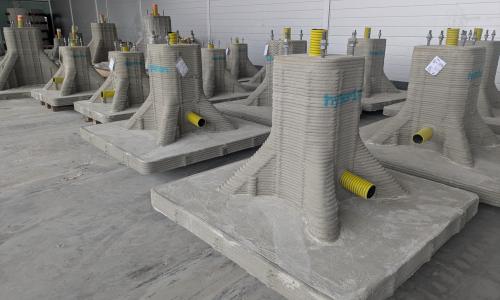
These three bullet points act as sub-headings.
- Collaboration with Hyperion Robotics and the University of Sheffield will trial low-carbon 3D-printed concrete foundations including at National Grid’s Deeside Centre for Innovation in North Wales
- Innovation could reduce waste, carbon emissions and costs to consumers of network construction
- If rolled out across National Grid substations the technology could save up to 705 tons of concrete and 323 tons of CO2 and deliver £1.7 million in consumer savings versus traditional methods over a 10-year period
These two paragraphs give more details.
National Grid is working with Hyperion Robotics and the University of Sheffield on a UK-first trial to manufacture, install and test 3D-printed substation foundations, which have the potential to reduce construction-driven carbon emissions and reduce costs to consumers of network construction. This is part of National Grid’s commitment to leverage innovation to future-proof the network.
If the project is successful and the technology is rolled out across all National Grid substations, it is estimated it could save up to 705 tons of concrete and 323 tons of CO2 over a 10-year period, and deliver £1.7 million in consumer savings versus traditional methods.
The foundation design will deliver significant savings across the entire value chain.
- 70% reduction in concrete usage
- 80% less soil displacement
- 65% decrease in embodied carbon emissions
- 70% weight reduction compared to typical foundations
- 50% reduction in site operative hours, streamlining production
The foundations will be designed and produced in Finland by Hyperion Robotics, and tested at full-scale by the University of Sheffield. Further field testing will then be carried out at National Grid’s state-of-the-art testing facility, the Deeside Centre for Innovation in North Wales, later in 2025.
Conclusion
I like this technology and I suspect there are many other applications of 3D Concrete Printing.
Project To Demonstrate 15+ MW Turbine On Ocergy’s Floating Platform Kicks Off
The title of this post, is the same as that of this article on offshoreWIND.biz.
This is the sub-heading.
The Reduced Commercial Risks with Demo of 15+ MW (RECORD15) joint industry project, which aims to install a latest generation turbine with a rated power over 15 MW on Ocergy’s floating platform in 2028, has been launched
The visualisation of the 15 MW turbine on its float in the article is impressive.
These two paragraphs add more details.
The Front-End Engineering Design (FEED) contract for this pilot project was recently signed between Ocergy and three offshore wind developers: EnBW Energie Baden-Württemberg AG, Kyuden Mirai Energy, and TEPCO Renewable Power.
Ocergy’s platform, the turbine agnostic OCG-Wind, is a modular design supporting an optimised assembly process from pre-fabricated steel sub-assemblies, allowing serial production using today’s existing supply chain and infrastructure, said the company.
Note.
- The average size of onshore wind turbine in the UK is 1.6 MW.
- Whitelee wind farm in Scotland, which is the largest onshore wind farm in the UK, uses 215 x 2.5 MW turbines.
- The Dogger Bank wind farm used 13 and 14 MW turbines on fixed foundations.
A 15+ MW turbine on a floating foundation will surely give Ocergy’s technology a very good test.
But it will be needed.
This is the overview of the Bowdun wind farm in Scotland, taken from the project’s web site.
The Bowdun Offshore Wind Farm will be located in the E3 leasing zone, which lies 44km off the coast of Aberdeenshire.
The zone, awarded to TWP under the ScotWind leasing round in January 2022, covers an area of 187km.
With water depths below 70m, it is highly suitable for fixed-foundation turbines, which will most likely sit on jacket foundations.
TWP plans to develop a 1GW offshore wind farm at the site. The base case is that the farm will number between 40-60 turbines, using ‘next-generation’ models with a capacity
between 18 MW and 25 MW. Construction is anticipated to commence in 2029 with commissioning planned for 2032-2033.This project base case will evolve as we gain knowledge from our site investigations and conduct technology research.
If turbines between 18 MW and 25 MW are to be used on fixed foundations, I can see a need to develop floats that will handle them.
 The Anonymous Widower