Seabed Rocks Could Act As Green Energy Stores
The title of this post is the same as that of this press release from the University of Strathclyde.
This is the first four paragraphs.
Rocks in the seabed off the UK coast could provide long-term storage locations for renewable energy production, new research suggests.
An advanced technique could be used to trap compressed air in porous rock formations found in the North Sea using electricity from renewable technologies.
The pressurised air could later be released to drive a turbine to generate large amounts of electricity.
Using the technique on a large scale could store enough compressed air to meet the UK’s electricity needs during winter, when demand is highest, the study found.
I read about this in today’s copy of The Times, which also says the following.
- There are suitable areas in the North and Irish Seas that can be used.
- The rocks could store fifty percent more energy than we used January and February.
As similar technology is being used in salt caverns in Germany and the United States, I feel that the idea has possibilities.
Funding Nemo: £600m Power Cable Connects UK And Belgium
The title of this post is the same as this article in The Guardian.
This is the first paragraph.
A £600m cable connecting the UK and Belgium’s energy systems is about to be switched on, becoming the first of a new generation of interconnectors that will deepen the UK’s ties to mainland Europe just as it prepares to leave the EU.
It runs between Richborough in Kent and Zeebrugge in Belgium and is the fifth interconnector to be connected to Great Britain.
Other interconnectors connect to Ireland, Northern Ireland, France and the Netherlands.
In Large Scale Electricity Interconnection, I discuss the rest of the interconnectors, that are being constructed or planned.
We could see up to fifteen in operation in a few years.
As to Nemo, it was originally thought that the UK would be importing energy from Belgium, but as Belgium needs to service its nuclear power stations and will be shutting them in the next few years, the power will sometimes be flowing the other way. Especially, as more large wind farms come on stream in the UK!
It is my view that Icelink could change everything and Belgium’s possible future power shortage, makes Icelink far more likely.
Wikipedia describes the interconnector between Iceland and Scotland like this.
At 1000–1200 km, the 1000 MW HVDC link would be the longest sub-sea power interconnector in the world.
As more interconnectors are built between the UK and the Continent, including a possible link between Peterhead in North-East Scotland to Stavanger in Norway, which is called NorthConnect, the UK will begin to look like a giant electricity sub-station, that connects all the zero-carbon power sources together.
- Denmark will supply wind power.
- France will supply nuclear power.
- Iceland will supply hydro-electric and geothermal power.
- Norway will supply hydro-electric power.
- The UK will supply nuclear and wind power.
Other sources like wind power from France and Ireland and tidal and wave power from the UK could be added to the mix in the next decade.
The Consequences For Gas
Our use of gas to generate electricity in Western Europe will surely decline.
If projects, like those I discussed in Can Abandoned Mines Heat Our Future?, come on stream to provide heat, the role of gas in providing heating in housing and other buildings will decline in the UK.
We also shouldn’t forget the role of hydrogen, which could also replace natural gas in many applications. It would be created by electrolysis of water or as a by-product of some industrial processes.
Hydrogen could also become a valuable way of storing excess electricity produced by tidal, wave and wind power.
It is unlikely, we will develop a totally gas-free economy, as methane is a valuable chemical feedstock to produce other chemical products we need.
Conclusion
Not many people will be sorry, except for President Putin and a few equally nasty despots in the Middle East.
EDF Energy Targets Solar Homes With Discounted Battery Offer
The title of this post, is the same as that of this article on Solar Power Portal.
The title shows the way things are going. Although, I doubt, I would use EDF, as they are one of the companies who have ripped us off for a long time.
I have said that I will fit a battery in this house to go with the solar panels on my roof. I will also fit an electric car charging point in the garage, so that when I sell the house in a few years, the house will have more buyer appeal.
At around seven thousand pounds, the 8.2 kWh battery mentioned in the article, would be within my price range, but I suspect that price will decrease.
19MW Storage Capacity To Participate In Three UK Flexible Markets
The title of this post is the same as that of this article on Smart Energy.
in Batteries On The Boil As Fund Attracts Investors, I talked about energy storage funds, which are a way of investing in energy storage to add capabilities to electricity grids.
This article talks about how the Gore Street Energy Fund is investing in two energy storage facilities at the Port of Tilbury and Lower Road in Essex
I have also found this article on Solar Power Portal, which is entitled Gore Street Fund Makes New Battery Acquisitions With New 19MW Pair From Origami Energy.
The second article has a picture of a 4 MW/4.8 MWh Tesla battery at Cenin Renewables.
The link to Tesla gives a well-presented page of applications of these batteries.
One example given is Renewable Integration, where this is said.
Smooth and firm the output of a renewable power generation source such as wind or solar.
This will be a large application for these types of large batteries, as although we don’t have masses of sun, we do have a lot of wind.
Big financial institutions like Pension Funds and Insurance Companies need secure long term investment to place their money and these energy storage devices, would appear to offer a sensible return, that enables them to pay their investors, like anybody who has a pension. Traditionally,these financial institutions have invested in property and government bonds for example.
Lately, they have been investing in railway rolling stock, which have a life of up to forty years. These energy storage systems should offer a reasonable life, if well-maintained and updated.
As there will large numbers of energy storage systems installed in the UK in the next decades, I think they could be a big area for investment.
At an individual level, we will also see houses built or refurbished with solar panels and batteries.
We are at the start of an exciting revolution!
Batteries On The Boil As Fund Attracts Investors
The title of this post is the same as that of an article in the Business section of today’s Times.
This is the first two paragraph.
Investors have sunk £100million into a new listed company that aims to use shipping containers packed with lithium-ion batteries to buy, store and sell electricity.
Gresham House Energy Storage Fund claims that it will make a return of 15 per ceent a year by providing electricity when surges in demand coincide with periods when the wind is not blowing or the sun is not shining.
Gresham House Energy Storage Fund is the second listed energy storage fund in London, after Gore Street Energy Storage Fund , launched in May.
I think we’ll see more of these funds and use of the technology.
Suppose you were a farmer with a windy hill top farm, that had a heavy electricity bill.
Realistically, sized, priced and financed a wind-turbine and a container full of batteries, might be just what your finances wanted.
All you’d need now would be an electric Range-Rover and a fleet of electric tractors!
What Are Greater Anglia Going To Do With A Problem Like The Crouch Valley Line?
This post is effectively a series of sub-posts describing the problems of the Crouch Valley Line.
Platform 1 At Wickford Station
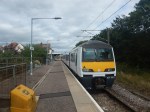
These pictures show Platform 1 at Wickford station, where services on the Crouch Valley Line terminate.
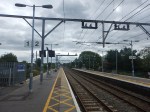



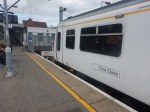
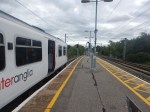


The train in the platform is a four-car Class 321 train, which is almost exactly eighty metres long.
After Greater Anglia has renewed the fleet, the shortest electric train they will have will be a five-car Class 720 train, which is over one hundred and twenty metres long.
I don’t think one of these shiny new trains will fit into the current platform.
Electrification
These pictures show the electrification at Burnham-on-Crouch station.
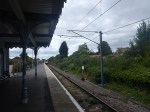



And these show Southminster station.


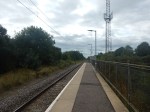
The overhead electrification on the Shenfield to Southend Line is being renewed and this section is supposedly finished. But it does look very similar to pictures I took in 2016, that are posted in Wickford Station. As the 25 KVAC overhead electrification was installed in 1979, when the line was converted from 6.25 KVAC, I do wonder about the age of some of the gantries.
On the trip, where I took these pictures staff were still complaining about the unreliability of the wires, as they have done before.
There doesn’t appear to have been any work done on the Crouch Valley Line, although the conductor did say that the route was being closed at times for work in the near future.
I do question, whether the overhead wires on the Crouch Valley Line are of a sufficient high and modern standard to be both reliable and easy and affordable to maintain.
Can the electrification handle regenerative braking?
The Timetable
The timetable East of Shenfield is as follows.
- Three trains per hour (tph) between Liverpool Street and Southend Victoria stations.
- A train every forty minutes between Wickford and Southminster stations.
- There are also some direct services between Southminster and Liverpool Street in the Peak.
Every time, I go use the line it seems, I always have a long wait at Wickford station.
Current services take thirty minutes between the two end stations with generous turnround times of about ten minutes at each end of the route.
Two trains are needed for the service, which are single-manned with a conductor checking and selling tickets appearing to float between the trains.
A New Nuclear Power Station At Bradwell
There is a possibility of building.of a new nuclear power station at Bradwell.
This Google Map shows the area.
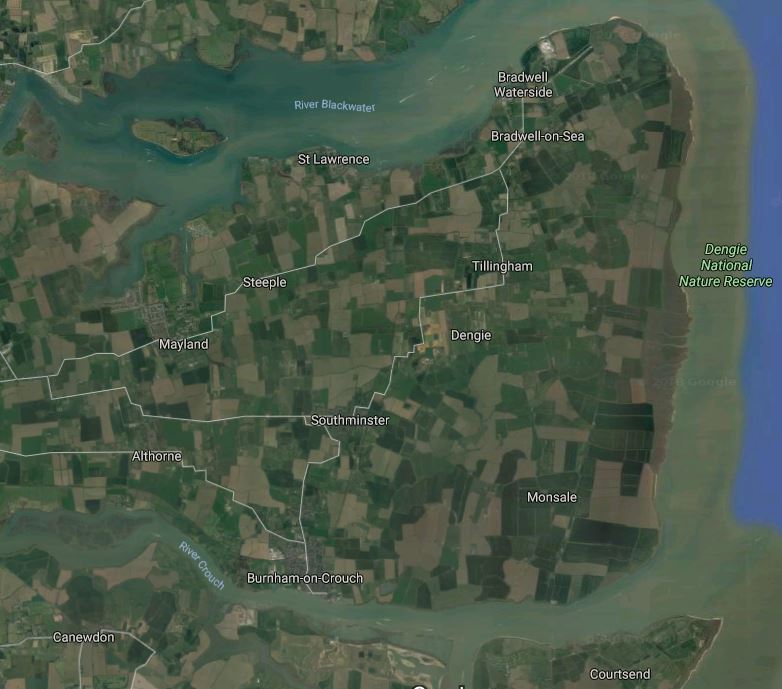
Note.
- Burnham-on-Crouch is the large village on the North Bank of the River Crouch.
- Southminster is a couple of miles to the North of Burnham on Crouch.
- Bradwell is in the North-East corner of the map alongside the River Blackwater.
- You can just see the World War 2 airfield, which was the site of the original Bradwell nuclear power station.
If a new power station is built at Bradwell, I doubt that it will require rail freight access at Southminster, as did the original station.
Transport technology has moved on and heavy goods will surely be taken in and out by barge from the River Blackwater.
But a new station or more likely ; a cluster of small modular reactors will require transport for staff, contractors and visitors.
Although, on balance, with the growth of renewable energy, I don’t think that many more nuclear power stations will be built.
A Battery Storage Power Station At Bradwell
I also wouldn’t rule out the use of Bradwell for a battery storage power station for the electricity generated by wind farms like Gunfleet in the Northern section of the Thames Estuary.
The number and size of these wind farms will certainly increase in the coming years.
Battery storage power stations are ideal partners for wind farms, as they help turn the intermittent wind power into a constant flow of electricity.
Currently, the largest battery storage power station is a 300 MWh facility that was built in 2016, at Buzen in Japan.
Energy storage technology is moving on fast and I would not be surprised to see 2000 MWh units by the mid-2020s.
Bradwell could be an ideal place to put a battery storage power station.
Passenger Numbers
Passenger numbers on the line over the last few years seem to have been fairly level although there appears to have been a drop in the last year or so. But this drop has happened in lots of places!
Various factors will effect the passenger numbers on the Crouch Valley Line in the future.
- New housing along the route.
- A large energy-based development at Bradwell will atract passengers.
- New trains will attract passengers.
- Will the Internet and new working practices affect passenger numbers?
- A two tph clock-face service will attract passengers.
- Faster and more frequent services between Liverpool Street and Wickford will make the line easier to access.
There is also the possibility of more visitors and tourists to the area. The RSPB have spent a lot of money developing Wallasea Wetlands, which is opposite Burnham-on-Crouch.
In future years, how many people will reach Wallasea, by ferry from Burnham-on-Crouch?
Adding up all these factors, I come to two conclusions.
Predicting the number of passengers will be difficult..
There will always be passengers who need this rail service.
It looks to me that Greater Anglia will have to plan for all eventualities from very low numbers of passengers to a substantial increase.
New Trains
Shenfield-Southend services and those on the Crouch Valley Line will be run using new Class 720 trains.
Bettween Liverpool Street And Southend Victoria
Currently, this service on the route is as follows.
Trains have a frequency of three tph.
- Each train takes an hour for the journey.
- All trains stop at the seven stations between Shenfield and Southend Victotria, Shenfield and Stratford.
- One train in three has an extra stop at Romford.
The new trains have a faster acceleration of 1 metre per second², as opposed to the current trains which can only manage 0.55 metre per second².
This property and their modern design, probably means that the new trains, can do a complete round trip between Liverpool Street and Southend Victoria stations in under two hours.
- The journey time between the two stations will be around fifty minutes.
- A three tph frequency will need a fleet of six trains.
- A four tph frequency will need a fleet of eight trains.
This service will be faster than the fastest services between Fenchurch Street and Southend Central stations.
I can certainly see a time, when the frequency between Liverpool Street and Southend Victoria stations is increased to four tph.
Passenger numbers are rising strongly at Southend Victoria station.
Southend Airport have big expansion plans and would welcome a better rail service, to and from their very convenient station.
At present times to their London termini from various airports are as follows.
- Gatwick Airport – 31 minutes (Express)
- Luton Airport – 28 minutes
- Southend Airport – 53 minutes
- Stansted Airport – 46 minutes
I think that Southend Airport times with the new trains could be about 43 minutes or less, which because of the closeness of the station to the terminal building could allow Southend Airport to claim faster times to Liverpool Street than Stansted Airport.
If the service does go to four tph, there will be a massive increase in capacity.
There will be 1145 seats in the new trains, as opposed to 927 in the current Class 321 trains.
With four tph. this would mean an increase in capacity of 40%.
I don’t think anybody in Southend will be complaining.
Between Wickford And Southminster
As I said earlier, the new longer Class 720 trains will have difficulty running the current service, as they don’t fit into Platform 1 at Wickford station.
Working the same timetable the new trains with their 544 seats will offer a 76% increase in train capacity.
Trains take thirty minutes with five intermediate stations.
Given the better acceleration and modern nature of the new trains, I wonder, if they will be able to do a round trip in an hour.
If they can do this, then it would be possible to run a two tph service on the route.
But it will be a tough ask!
That still leaves the problem of turning back the trains at Wickford.
Currently, trains between Liverpool Street and Southend Victoria going in opposite directions, pass at Wickford station.
If this could be arranged with four tph, then there would be up to fifteen minute windows, where no train was passing through Wickford station.
Suppose the Liverpool Street and Southend services passes through at XX:00, XX:15. XX:30 and XX:45.
Would it be possible for the Southminster trains to leave Wickford at XX:10 and XX:40 and arrive back at XX:05 and XX:35, thus giving five minutes for the driver to get to the other end.
As I said, it would be a tough ask!
But I suspect there is a plan to get two tph between Wickford and Southminster.
- The track could be improved.
- Some level crossings could be closed.
- Operating speed could be faster.
- Better step-free access could probably be arranged at the intermediate stations.
- A step-free bridge could be built at Wickford.
If two tph can be achieved, then this would increase capacity on the route by 134 %.
The Passing Loop At North Fambridge Station
This Google Map shows the station and passing loop at North Fambridge station.

Measuring from the map, I estimate the following.
- The length of the platforms are 160 metres.
- The length of the passing loop is in around 400 metres.
I also suspect that to save money was the line was singled in the 1960s, British Rail made the passing loop as short as possible to cut costs.
The current loop can handle eight-car Class 321 trains, so it can certainly handle a five-car Class 720 trains.
I do wonder if the passing loop were to be lengthened, this would ease operation on the line.
There might even be a length, that enable a two tph service with the current four-car Class 321 trains.
Thoughts On Speed Limits
The speed limit on the line is 60 mph between Battlesbridge and North Fambridge stations and 50 mph at both ends of the line.
Summarising sections of the line, their length and speed limits give.
- Wickford and Battlesbridge – 2 miles 38 chains = 4356 yards = 3983 metres – 50 mph
- Battlesbridge and North Fambridge – – 5 miles 67 chains = 10274 yards = 9395 metres – 60 mph
- North Fambridge and Southminster – 8 miles 15 chains = 14410 yards = 13177 metres – 50 mph
This gives totals of 17160 metres with a 50 mph limit and 9395 metres with a 60 mph limit.
- At 50 mph, the train would cover the 17160 metres in 12.8 minutes
- At 60 mph, the train would cover the 17160 metres in 10.7 minutes
- At 75 mph, the train would cover the 17160 metres in 8.5 minutes
Increasing the speed limit to 60 mph would save two minutes.
Network Rail must have all the figures and costs, but this could be a cost-effective way to save a couple of minutes.
But it does seem if the operating speed of the line were to be increased, time saving could be achieved, that would make a two tph timetable a reality.,
Could Electrification Be Removed From The Crouch Valley Line?
If the track is going to be improved with respect to line speed, level crossings and passing loops, then there will have to be changes to the layout of the overhead electrification.
Most of the serious changes that could be carried out, would be to the East of North Fambridge station.
Would it be sensible if the Class 720 trains have a battery capability, to remove the electrification to the East of North Fambridge station?
- 13.2 km. of single-track would have the electrification removed.
- Some of this electrification will need replacing soon.
- Trains could swap between power sources in North Fambridge station.
- The batteries would be charged between Wickford and North Fambridge stations.
- Only 16 miles in each round trip would be on batteries.
Removing some electrification would cut the cost of any works.
Conclusion
I’m sure Greater Anglia have a solution and it’s probably better than my rambling.
Better Phone Battery Invented By Accident
The title of this post, is the same as that as an article in today’s copy of The Times.
Discussing phone batteries this is said.
Now researchers think they may have found a remedy – a new form of carbon that could double lithium battery capacity, increase the number of charging cycles and significantly reduce the risk of explosion.
Reading the article, it could be that the researchers at Lancaster University may have found the Holy Grail of battery technology.
The Times even gives OSPC-1, as they’ve called the carbon., a leading article.
There’s more on OSPC-1 in this news item on the Lancaster University web site, which is entitled New Carbon Could Signal Step-Change For The World’s Most Popular Batteries.
Huisman Weighs Into Storage
The title of this post is the same as thia article in RENews.
This is the first two paragraphs.
Edinburgh start-up Gravitricity is teaming up with Dutch lifting specialist Huisman to develop gravity-fed energy storage projects at the sites of disused mines in Scotland.
The partners plan to develop a 250kW demonstration project and test it early next year, and ultimately aim to scale up to 20MW commercial systems.
I think that this idea has a chance to be a success.
As an aside, one of my first experiences of industry was working at Enfield Rolling Mills. On one of their rolling mills, there was a ninety-three tonnes two-metre ring flywheel, which was attached to the mill. The flywheel was spun to 3000 rpm, before the copper wirebar was passed through the mill. You could see the flywheel slow, as it passed it’s energy to the mill, as it turned the wirebar into a thinner strand of copper, so that it could be drawn into electrical cable.
I think, that flywheel had an energy storage of over a MwH. Shimatovitch, the Chief Engineer reckoned that if had come of its mountings at full speed, it would have gone a mile before the houses stopped it.
Gravitricity Sets Sights On South Africa To Test Green Energy Tech
The title of this post, is the same as that of this article on ESI Africa, which describes itself as Africa’s Power Journal.
This is the first two paragraphs.
Disused mine shafts in South Africa have been identified as an ideal location to test UK-based energy start-up Gravitricity’s green energy technology.
The company announced plans to transform disused mine shafts into hi-tech green energy generation facilities through a system that uses gravity and massive weights.
This is surely a classic fit, as Africa has plenty of sun and some of the mine shafts in South Africa, like the TauTona mine are getting towards two miles deep.
A weight of 1,000 tonnes in a two mile deep shaft would store nearly nine MWh. By comparison, Dinorwig Power Station or Electric Mountain, has a capacity of 500 MWh.
But Electric Mountain was built in the 1970s, cost £425 million and took ten years to construct.
Funding Gives Weight To Idea For Storing Electricity
The title of this post, is the same as that of an article on Page 45 of today’s copy of The Times.
It talks of a company called Gravitricity, which has used the same principle as every weight-operated clock to store energy and especially energy generaed from intermittent sources like wind and solar power.
The company has just secured a £650,000 grant from Innovate UK.
In Solar Power Could Make Up “Significant Share” Of Railway’s Energy Demand, I looked at how solar farms and batteries could be used to power third-rail railway electrification.
Because of energy losses, third-rail electrification needs to be fed with power every three miles or so. This gives a problem, as connection of all these feeder points to the National Grid can be an expensive business.
A series of solar farms, wind turbines and batteries, controlled by an intelligent control system, is an alternative way of providing the power.
In an article in the October 2017 Edition of Modern Railways, which is entitled Celling England By The Pound, Ian Walmsley says this in relation to trains running on the Uckfield Branch.
A modern EMU needs between 3 and 5 kWh per vehicle mile for this sort of service.
If I assume that trains are five cars and will be efficient enough to need only 3 kWh per vehicle mile, then to power a train along a ten mile section of track will take 150 kWh.
As the control system, only powers the track, when a train needs it, the whole system can be very efficient.
So why will Gravitricity battery ideas be ideal in this application?
Appropriate Size
By choosing the right weight and depth for the Gravitricity battery , appropriate energy storage can be provided at different points on a line.
Some parts of a journey, like accelerating away from stations will need more electricity than others, where trains are cruising along level ground.
Supposing my five-car example train is travelling at 60 mph, then to cover ten miles will take 10 minutes, with 15 kW being supplied in every minute.
If the train weighs 200 tonnes, then accelerating the train to 60 mph will need about 20 kWh.
I’m sure that a Gravitricity battery could handle this.
I would suspect that batteries of the order of 100 kWh would store enough power for the average third-rail electrified line.
A proper dynamic simulation would need to be done. I could have done this calculation in the 1960s, but I don’t have the software now!
Response Time
For safety and energy-efficiency reasons, you don’t want lines to be switched on, when there is no train present.
I suspect that if there is energy in the battery, response would be fast enough.
Energy Efficiency
The system should have a high efficiency.
How Big Would A 100 kWh Gravitricity Battery Be?
A quick calculation shows the weight would be 400 tonnes and the depth would be 100 metres.
Installing the batteries
Each battery will need a 100 metre deep hole of an appropriate diameter.
This sequence of operations would be performed.
- A rail-mounted drilling rig would drill the hole.
- The heavy weight of the battery would arrive by train and would be lifted into position using a rail-mounted crane.
As the equipment will generally be heavy, doing all operations from the railway will be a great help.
 The Anonymous Widower