Equinor, EDF-ESB Joint Venture Secure 1.5 GW Sites In UK Floating Wind Leasing Round
The title of this post, is the same as that of this article on offshoreWIND.biz.
This is the sub-heading.
The Crown Estate has selected Equinor and Gwynt Glas, a joint venture between EDF Renewables UK and ESB, as preferred bidders in the seabed leasing round for floating wind projects in the Celtic Sea.
These two paragraphs give more details.
Selected on 12 June, each of the two developers was awarded 1.5 GW of capacity in their respective project development area (PDA) for an annual option fee of GBP 350/MW (approximately EUR 410/MW).
The Crown Estate launched the floating wind leasing round (Offshore Wind Leasing Round 5) in February 2024, offering three areas off the coasts of Wales and South West England for a total of up to 4.5 GW of installed capacity.
Note.
- It looks like the Crown Estate are working to get a contract for the third site.
- The ports of Bristol and Port Talbot could be handling the assembly of the floating turbines.
- The Crown Estate has also established a new strategic approach with the National Energy System Operator (NESO).
Given the problems some wind and solar farms have had to get connected, the Crown Estate’s link up with NESO could be attractive to developers?
Conclusion
This looks a good bit of business by the Crown Estate in the Celtic Sea.
Did they get NESO to be helpful, by asking senior people for tea with Charles and Camilla at Highgrove?
E.ON Invests £4 million In Allume Energy To Boost Solar Rollout For Flats
The title of this post, is the same as that of this article on Solar Power Portal.
These three paragraphs explain the deal and say a small amount about Alume’s SolShare system.
Energy supplier E.ON UK has today (17 June) announced that it has signed a strategic investment agreement with Australian firm Allume Energy to help the firm expand into the UK.
E.ON UK has invested £4 million into Allume Energy to enable Allume to expand the reach of its SolShare technology within the UK market. SolShare allows solar energy from a single rooftop solar PV installation to be fairly shared amongst multiple homes in the same building in order to allow residents of flats to access solar PV energy.
Residents are supplied their energy when they are using by a pre-determined allocation, allowing them to lower their energy bills. Many blocks of flats that do have solar panels fitted currently only use this energy to power the common areas of the building while residents still pay their full electricity bill. According to Allume, a shared rooftop solar PV system can reduce resident energy bills by between 30% and 60%.
I must say, that when I read this article, it had something of the too-good-to-be-true about it.
But.
- My solar installation on a fair-sized roof cost me about £6,000 and I am constantly surprised at how much electricity it provides.
- If you have fifty flats, they all won’t do their weekly washing at the same time each week.
- I wouldn’t be surprised to see a big battery somewhere or a small battery in each flat.
- The batteries could soak up any excess electricity or charge on cheap-rate overnight electricity.
- Do Allume’s engineers go through every flat and make suggestions about saving energy?
- Is the pattern of electricity usage in a block of flats predictable from past usage and factors like weather, the time of the year and what’s on television?
- I wouldn’t be surprised that Allume have performed extensive mathematical modelling on blocks of flats.
I think this deal could be a winner foe E.ON, Allume and their customers.
I have some ideas about the use of the system.
Would It Work On A Small Housing Estate?
A small housing estate would be a number of solar roofs feeding a number of houses, whereas with flats it will be one roof feeding a number of dwellings.
I suspect that with a well-designed sharing and pooling system, a lot of features of the flat-powering system could be used to power houses.
How Does The System Handle Electric Vehicles?
The system could use these to store electricity, so that they are always charged at the cheapest rate.
And when there is a shortage of electricity, the electricity could be borrowed by the Allume system.
Conclusion
If you have community sharing their own source of electricity, you can probably make ideas work, that wouldn’t in a single application.
My nose says Allume’s idea has legs.
Newport To Swindon Via Gloucester – 14th June 2025
Because of engineering works, we came home from Newport via a diversion through Gloucester.
I took these pictures.
















































Note.
- I had sat on the right side of the train facing forward.
- We were accompanied my the thud, thud, thud of an underfloor diesel engine, as most of the route is not electrified.
- Newport and Gloucester is 44.8 miles.
- Gloucester and Swindon is 36.7 miles.
- Newport and Swindon is 81.5 miles.
- Newport and Swindon are fully-electrified stations.
- The first four pictures show Trains for Wales Premier Service.
- The Gloucester and Newport Line joins the South Wales Main Line at Severn Tunnel Junction station.
- As you travel towards Gloucester, the bridges over the Severn and the Wye can be clearly seen.
- There are two former nuclear power stations ;Berkeley and Oldbury, on the far bank of the River Severn.
- The large white wind turbine is close to Berkeley.
- Oldbury is further down the river.
As yesterday, the route is commonly used as a diversion route, when engineering works close the electrified main line through the Severn Tunnel.
I have some further thoughts.
Electrification Of Newport And Swindon
The distances involved are as follows.
- Newport and Gloucester is 44.8 miles.
- Gloucester and Swindon is 36.7 miles.
- Newport and Swindon is 81.5 miles.
As Hitachi’s Intercity Battery Trains are likely to have a range of around a hundred miles, they should be able to handle the diversion.
A short length of electrification could be erected in Gloucester station to charge any battery-electric trains, that needed a boost.
I believe full electrification is not needed.
Flotation, Vargronn Complete NorthConnect Deal
The title of this post, is the same as that of this article on Renews.biz.
This is the sub-heading.
1.4GW Cenos floater backers seal ‘productive partnership’ with interconnector acquisition
These three paragraphs add more details to the deal.
Flotation Energy and Vargronn have closed their acquisition of the NorthConnect interconnector project between Scotland and Norway.
The developers said the deal had followed close collaboration on shared transmission infrastructure and a common grid connection point for the interconnector and the proposed 1.4GW Cenos floating wind farm off east Scotland.
NorthConnect already has consent for an offshore and onshore cable route to a substation near Boddam, Aberdeenshire, that will link to SSEN’s Peterhead substation.
This looks like a clever use of the permissions for the interconnector to connect the Cenos wind farm to the grid.
Underground Hydrogen Storage Pilot Gets Funding Boost
The title of this post is the same as that of this article on Energy Live News.
This is the sub-heading.
New hydrogen storage tech could boost grid resilience and emissions cuts
These first three paragraphs add some details.
National Gas and Gravitricity have secured £500,000 from Ofgem to develop a new type of underground hydrogen storage.
The H2FlexiStore system, designed by Edinburgh-based energy storage firm Gravitricity, aims to store up to 100 tonnes of green hydrogen in lined geological shafts.
The technology, which could see a demonstrator built in 2026, is intended to offer a flexible, resilient solution to future hydrogen network needs.
The article also has an excellent graphic.
Note that it takes 55.2 MWh of electricity to generate a tonne of hydrogen, so a hundred tonnes of hydrogen would store 5.52 GWh of electricity as hydrogen.
Centrica And Equinor Agree Major New Deal To Bolster UK Energy Security
The title of this post, is the same as that as this news item from Centrica.
This is the sub-heading.
Centrica and Equinor have today announced a £20 billion plus agreement to deliver gas to the UK. The new deal will see Centrica take delivery of five billion cubic meters (bcm) of gas per year to 2035.
These three paragraphs add more detail to the deal.
The expansive ten-year deal continues a long-term relationship with Equinor that dates back to 2005 bringing gas from Norway to the UK.
In 2024, the UK imported almost two-thirds (66.2%) of its gas demand, with 50.2% of the total imports coming from Norway1. This is an increase from the UK importing around a third of its gas requirements from Norway in 20222 and underlines the strategic importance of the Norwegian relationship to UK energy and price security.
The contract also allows for natural gas sales to be replaced with hydrogen in the future, providing further support to the UK’s hydrogen economy.
I believe there is more to this deal than, is stated in the news item.
These are my thoughts.
Where Does AquaVentus Fit In?
The AquaVentus web site has a sub heading of Hydrogen Production In The North Sea.
This video on the web site shows the structure of the project.
I clipped this map from the video.

Note.
- The thick white line running North-West/South-East is the spine of AquaVentus, that will deliver hydrogen to Germany.
- There is a link to Esbjerg in Denmark, that is marked DK.
- There appears to be an undeveloped link to Norway, which goes North,
- There appears to be an undeveloped link to Peterhead in Scotland, that is marked UK.
- There appears to be a link to just North of the Humber in England, that is marked UK.
- There appears to be an extra link, that would create a hydrogen link between Norway and Humberside.
- Just North of the Humber are the two massive gas storage sites of Aldbrough owned by SSE and Brough owned by Centrica.
- Aldbrough and Rough gas storage sites are being converted into two of the largest hydrogen storage sites in the world!
- There appear to be small ships sailing up and down the East Coast of the UK. Are these small coastal tankers, that are distributing the hydrogen to where it is needed?
When it is completed, AquaVentus will be a very comprehensive hydrogen network.
RWE
I should add that AquaVentus is a project of German energy company; RWE.
It should be noted that RWE are the largest generator of electricity in the UK.
They will soon be even larger as they are developing these offshore wind farms in British waters.
- Dogger Bank South – 3 GW
- Norfolk Boreas – 1.4 GW
- Norfolk Vanguard East – 1.4 GW
- Norfolk Vanguard West – 1.4 GW
Note.
- This is 7.2 GW of electricity.
- The three Norfolk wind farms wwere possibly acquired at a bargain price from Vattenfall.
- None of these wind farms have Contracts for Difference.
- RWE are developing large offshore electrolysers.
- East Anglia is in revolt over pylons marching across the landscape.
I wonder, if RWE will convert the electricity to hydrogen and bring it ashore using AquaVentus, coastal tankers or pipelines to existing gas terminals like Bacton.
The revenue from all this hydrogen going to Germany could explain the rise in Government spending, as it could be a Magic Money Tree like no other.
HiiROC
HiiROC is a Hull-based start-up company backed by Centrica, that can turn any hydrocarbon gas, like chemical plant waste gas, biomethane or natural gas into turquoise hydrogen and carbon black.
I asked Google about the size of Norway’s chemical industry and got this reply.
Norway’s chemical industry, including oil refining and pharmaceuticals, is a significant part of the country’s economy. In 2023, this sector generated sales of NOK 175 billion (approximately €15.2 billion), with 83% of those sales being exports. The industry employed 13,800 full-time equivalents and added NOK 454 billion (approximately €3.9 billion) in value.
Isn’t AI wonderful!
So will Norway use HiiROC or something similar to convert their natural gas and chemical off-gas into valuable hydrogen?
If AquaVentus were to be extended to Norway, then the hydrogen could be sold to both the UK and Germany.
A scenario like this would explain the option to switch to hydrogen in the contract.
Aldbrough And Brough
Earlier, I said that just North of the Humber are the two massive gas storage sites of Aldbrough owned by SSE and Brough owned by Centrica.
I have read somewhere, that Germany is short of hydrogen storage, but I’m sure Centrica and SSE will help them out for a suitable fee. Centrica are also thought to be experts at buying energy at one price and selling it later at a profit.
Conclusion
I have felt for some time, that selling hydrogen to the Germans was going to be the Conservative government’s Magic Money Tree.
Has this Labour government decided to bring it back to life?
Glen Earrach Energy (GEE) To Give £20m Per Year To Highland Communities
The title of this post, is the same as that of this article on the Inverness Courier.
These two paragraphs introduce the article.
The announcement is underpinned by the publication of a new developer-led research report, the first of its kind in the UK energy sector, which brings together national polling, public consultation, and direct input from communities.
The report marks a major step in the development of the fund, setting out emerging priorities, design principles and governance themes that reflect what GEE has heard to date and will help guide the next phase of engagement.
Other points from the article include.
Size And Delivery
This is said about the size and delivery of the project.
Subject to planning, the project will provide up to 34GWh of long-duration energy storage in 2030.
All these projects seem to be on course for delivery by 2030. Mr. Ed. Milliband will be pleased.
The Community Wealth Fund
This is said about the Community Wealth Fund.
The fund will be rooted in the communities that share the key water resource underpinning the scheme, with scope to contribute to wider regional projects, including contributions to a Strategic Fund for the Highlands as a whole.
“The GEE Community Wealth Fund is about more than sharing the benefits of clean energy, it is about creating long-term value for the communities who make this project possible.
As the grandmother of all pumped storage hydro in the UK; Electric Mountain, started storing energy and producing power in 1984, the Community Wealth Fund should last a few years.
National Grid Starts Work On New Substation In Buckinghamshire To Power Data Centres
The title of this post, is the same as that of this press release from National Grid.
These three bullet points act as sub-headings.
-
New substation site at Uxbridge Moor in Buckinghamshire will power new data centres –delivering economic growth and enabling UK digitalization
-
Site to feature two SF6-free gas-insulated switchgear (GIS) substations to minimise environmental footprint
-
Work comes as National Grid is planning £35 billion investment in its transmission network between 2026 to 2031
This is the first paragraph.
National Grid is starting work on its new Uxbridge Moor substation in Buckinghamshire which will connect over a dozen new data centres to its network.
This Google Map shows the current Iver substation.
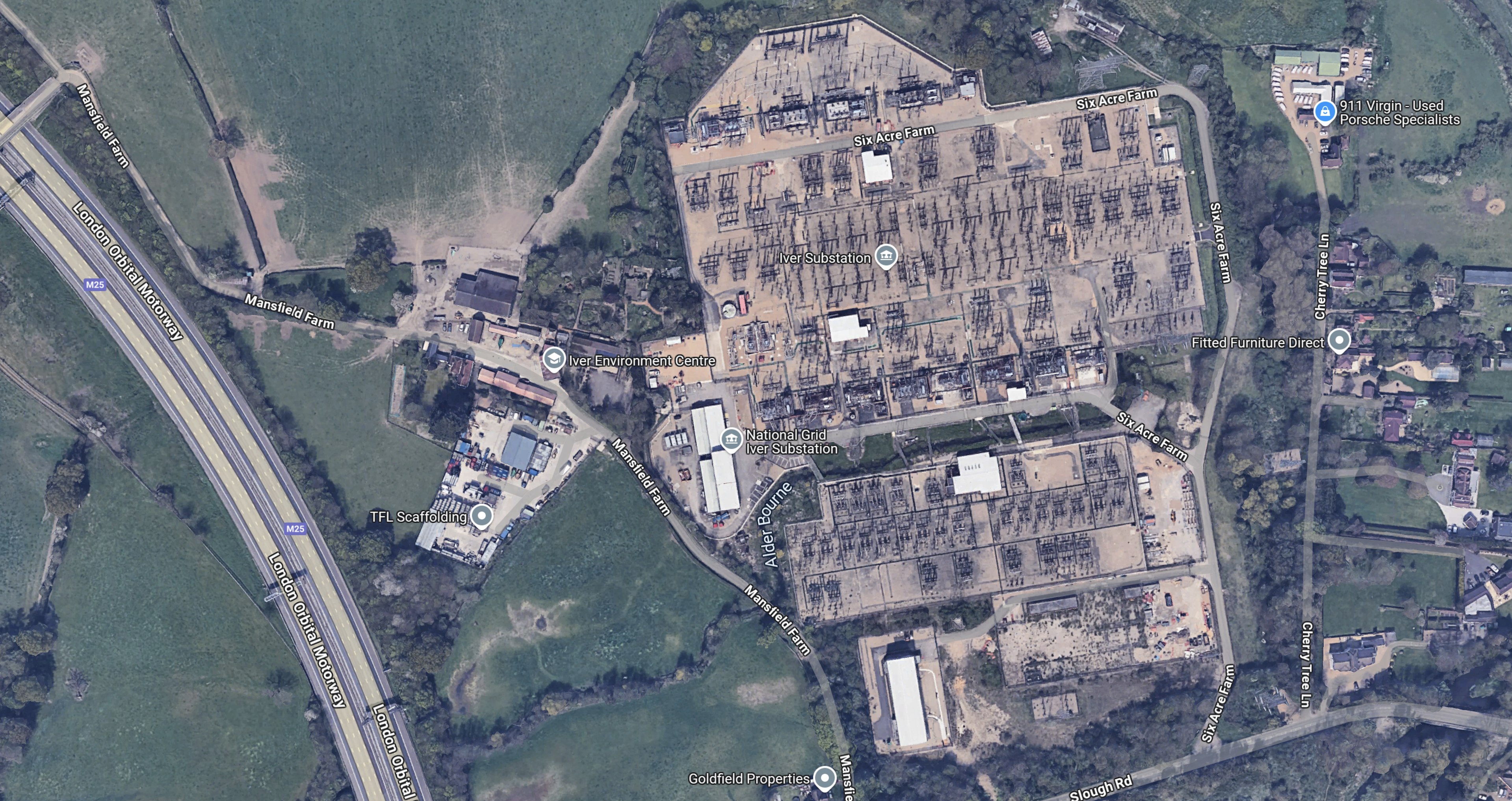
The road on the left is Western section of the M25, which gives an idea of the size of the substation.
These two paragraphs give more details of the new Uxbridge Moor substation.
The requests from data centres to connect at Uxbridge Moor will require around 1.8GW of new capacity, equivalent to adding a mid-sized city to the grid on the outskirts of London. When built, it will be the largest new substation on National Grid’s network by gigawatt capacity.
The new substation site borders National Grid’s existing Iver 400kV substation in Buckinghamshire, which has reached capacity and cannot be expanded to meet the demand from data centres and other customers for connections in the area.
Nothing about the new substation appears small!
The cost of the Uxbridge Moor substation does not appear to have been disclosed by National Grid, but they do say this about their projected total spend in the next few years.
National Grid is planning £35 billion of investment between 2026 to 2031 to connect both large sources of demand such as data centres and gigafactories, and new sources of electricity generation such as wind and solar.
But then it’s not their fault, that the UK is a superb place for renewable energy and we generally speak English.
UK To Launch Seventh CfD Auction In August, Offshore Wind Has Its Own AR7 Timeline
The title of this post, is the same as that of this article on offshoreWIND.biz.
This is the sub-heading.
The UK government has published an indicative timeline for the Contract for Difference (CfD) Allocation Round 7 (AR7), stating that it expects to open the auction in August and announce the results between late 2025 and early 2026. The timeline for offshore wind projects is now separate from that for other technologies, which will enable the confirmation of results as soon as possible, according to the Department for Energy Security and Net Zero (DESNZ).
These first two paragraphs give more details of the Contract for Difference Auction.
The planned AR7 timeline for offshore wind, including both fixed-bottom and floating wind, sets the auction opening date between 7 to 27 August 2025, with results expected to be in from the second half of December 2025 to the second half of February 2026, depending on non-qualifying applicants requesting a Tier 1 review and/or Tier 2 appeal.
Before the launch of the seventh CfD allocation round, the government will publish Clean Industry Bonus results. This is scheduled for June.
I think this is going to be a very different Contract for Difference Auction to those held under the previous Conservative government.
- Will prices be as high?
- Will some regular companies in the auctions not bother to bid?
- Will there be bids for onshore wind in England?
It will be quite, if not very interesting!
 The Anonymous Widower