Hinkley Point C Fish Protection Plans Attacked By Environmental Organisations
The title of this post, is the same as that of this article on New Civil Engineer.
This is the sub-heading.
Revised plans to protect fish from water intake tubes for the Hinkley Point C nuclear power plant on the Severn Estuary have come under fresh criticism from environmental organisations.
These three paragraphs outline the story.
EDF recenrly proposed plans to create a saltmarsh at the Somerset nuclear plant site as an alternative to an acoustic fish deterrent. This followed the Environment Secretary having ruled in 2021, in line with Environment Agency recommendations, that the plant should install an acoustic fish deterrent.
The plant is scheduled to circulate 120,000l of water per second from the Bristol Channel to the nuclear power station through 8km underground tunnels to provide cooling for the power station’s systems.
A group of environmental non-governmental organisations (eNGOs) issued a statement coordinated by Somerset Wildlife Trust saying Hinkley Point C “will have a significant impact on marine and migratory fish including already vulnerable Atlantic salmon, twaite shad and European eel over its lifetime”.
This Google Map shows Lake Michigan, which was where I came across another tale of fish and nuclear power.
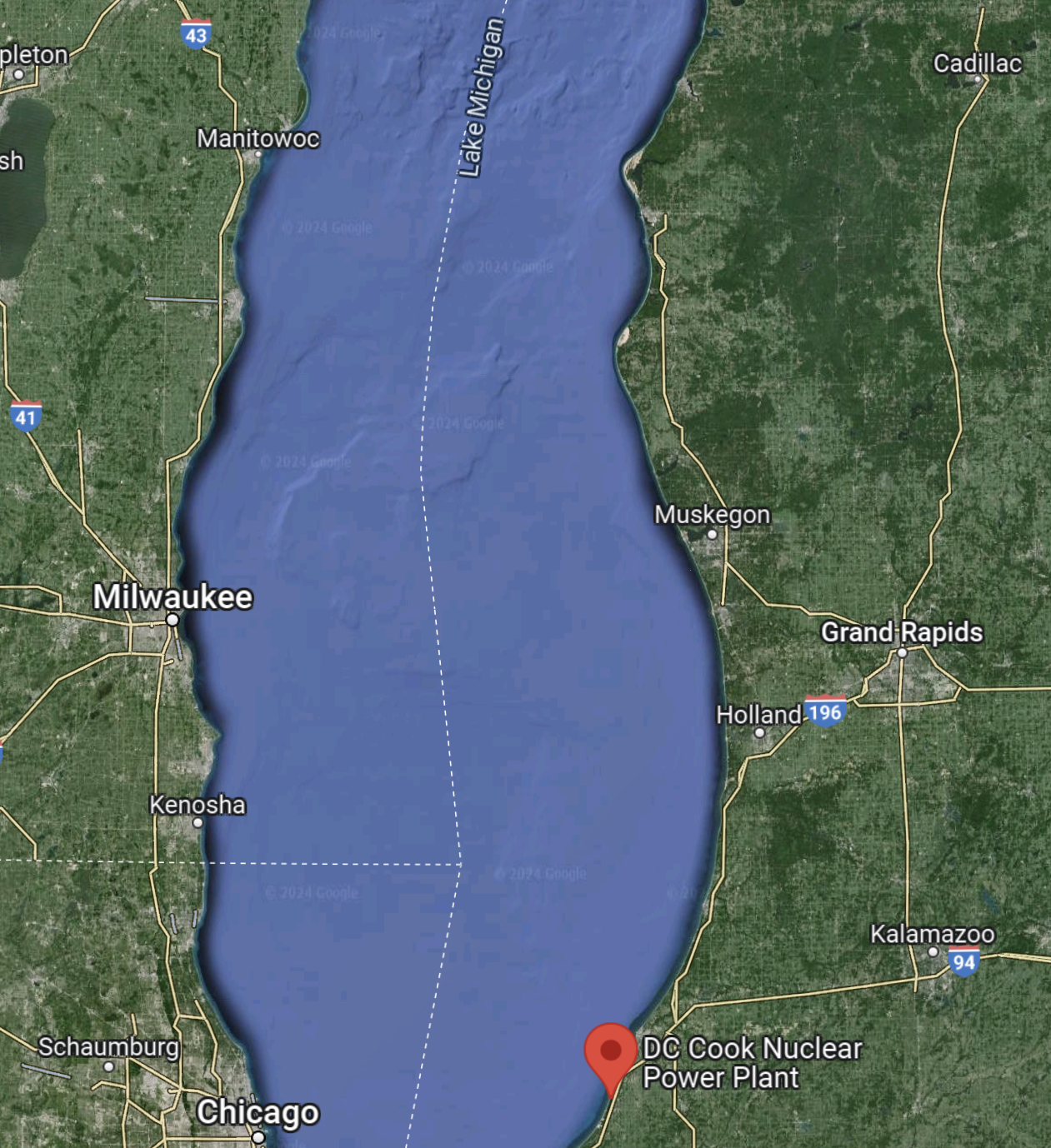
Note the red arrow, which marks the DC Cook Nuclear Power Plant.
This second Google Map shows a close-up of the plant.
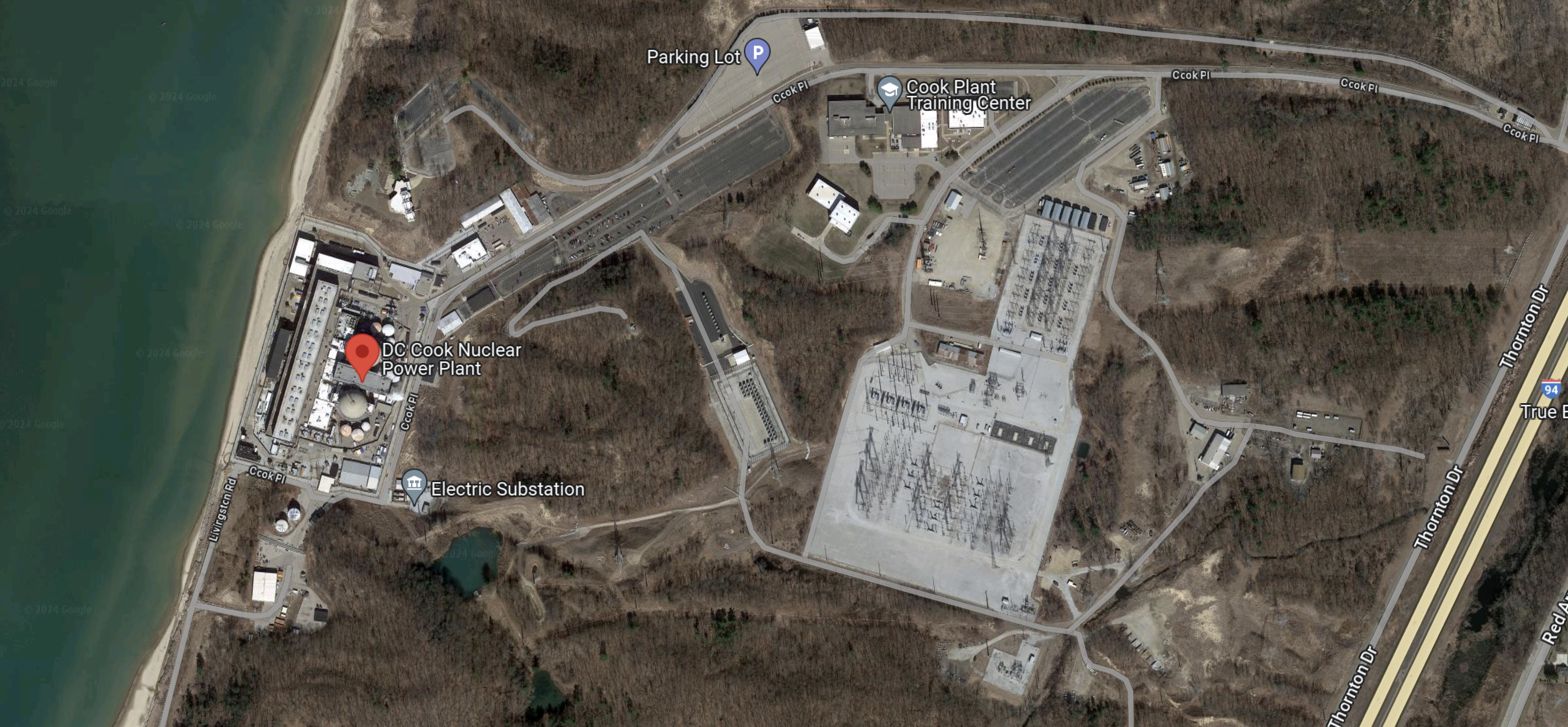
The power plant sits on the shores of Lake Michigan, from which it gets its cooling water.
In the early 1980s, after the Three Mile Island accident in 1979, I was given a tour of two nuclear power stations of which this plant was one and Shippingport or Beaver Valley was the other. Both were Artemis customers and one of the projects they were using the software on, was to plan and document all the Three Mile Island modifications or TMIs.
But it’s the Cook power plant that I remember.
- I’d turned up at Benton Harbor Airport on a very cold, snowy evening and I remember that the Hertz representation had got all the cars running so customers could drive away in the warm.
- DC Cook was impressive and very well run, and it was a very good customer visit.
- The fishy tale, I heard there was that the warm water from the power station attracted the fish and that some locals in the winter took to fishing through the ice of Lake Michigan. Occasionally, they fell through the ice.
- I was told, that some locals felt that the plant should be shut because of this, but it’s still running forty years after my visit.
- Lunch was interesting, as we went to a Michigan version of the famous Rook restaurant in the Two Ronnies. Except that every dish on the menu had something to do with beans, as that is the area of the US, where navy (baked) beans are grown. They even had a bean savoury for afters!
This article from the Huron Daily Tribune is entitled Fish Force Michigan Nuke Plant Shut Down, where these are the first two paragraphs.
Officials shut down a nuclear power plant on the eastern shore of Lake Michigan on Thursday after a large number of fish swam into the plant’s cooling-water system.
The two reactors at Donald C. Cook Nuclear Plant were idled as workers removed the fish and monitored the cooling system. It wasn’t clear when the reactor would be restarted, owner and operator American Electric Power Co. Inc. said in a statement.
It does appear that Cook was suffering from fish in the system.
I hope this doesn’t predict more delays for Hinckley Point C.
Rio Tinto Signs Australia’s Biggest Renewable Power Deal As It Works To Repower Its Gladstone Operations
The title of this post, is the same as that of this press release from Rio Tinto.
These three paragraphs outline the deal.
Rio Tinto has signed Australia’s largest renewable power purchase agreement (PPA) to date to supply its Gladstone operations in Queensland, agreeing to buy the majority of electricity from Windlab’s planned 1.4GW Bungaban wind energy project.
The agreement, which follows the announcement last month of a PPA for the Upper Calliope solar farm in Queensland, will make Rio Tinto the biggest industrial buyer of renewable power in Australia and is another major step in the work to repower the company’s Gladstone production assets – Boyne aluminium smelter, Yarwun alumina refinery and Queensland Alumina refinery.
Under the new PPA with Windlab, Rio Tinto will buy 80% of all power generated from the Bungaban wind energy project over 25 years. The project, which is currently in early development, will be built and operated by Windlab at a site in Queensland about 40 kilometres from the town of Wandoan, and 290 kilometres south-west of Gladstone, subject to development and grid connection approvals.
This Google Map indicates the position of Gladstone on the coast of Queensland.
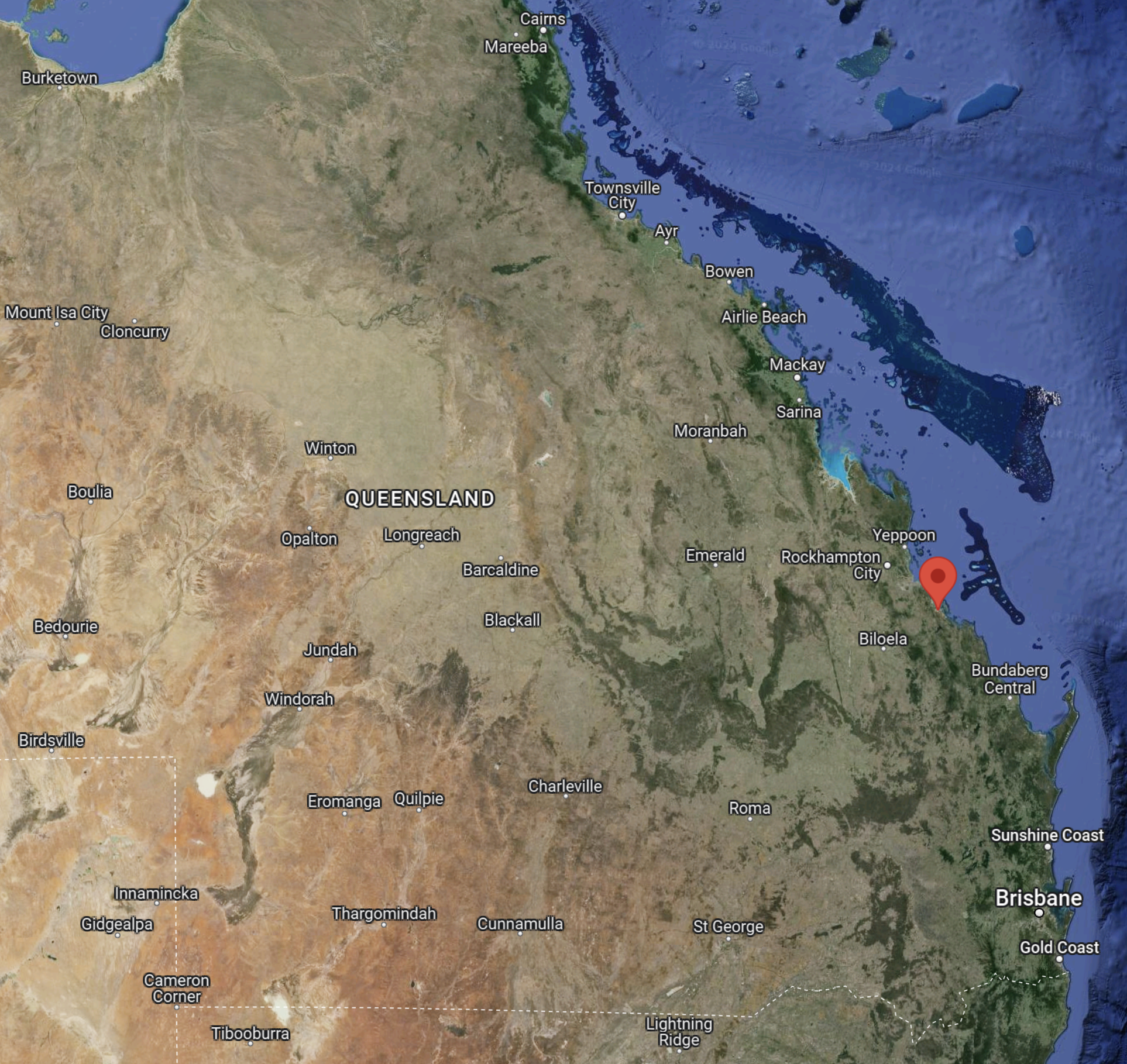
This map brings back memories.
I had hired a Piper Arrow from Sydney and I flew my late wife via Mildura, Adelaide, Coober Pedy, Yulara to Alice Springs taking about a week for it.
From Alice, I flew via Mount Isa to Cairns, which is at the top of the map on the coast.
I remember on leaving Aloce, I asked Air Traffic Control, what time it was in Queensland. The reply was “They’re half-an-hour ahead and twenty-five years behind!”
Mount Isa was infamous on the trip, as it was there we met the only disagreeable Aussie on the whole adventure. Unfortunately, he was in charge of the fuel and didn’t want to serve us. Probably, because he was drunk.
Finally, we got away and spent a couple of nights at Cairns, where we drove up the coast and explored the Daintree.
It was then a short hop for the plane onto the Battier Reef, where we stayed at a resort called Bedarra, which was probably the most exclusive place we ever stayed.
After a few days it was back in the plane and down the coast to Brisbane. That was a strange flight, as all Australian airline pilots were on strike, so we had the airspace to ourselves. At Mackay, the refuellers were so lacking in business, they were all too happy to fuel the plane.
After a couple of days in Brisbane, we flew the plane to Goondawindi, where we picked up our eldest son, before flying back to Sydney, where we took a flight home.
It was a memorable trip and I now wish, that we’d extended it by a couple of weeks.
Conclusion
Australia is a land of boundless solar energy, which is why we went there on holiday and Rio Tinto will be doing all there aluminium smelting by the use of renewables.
I can see in the future that the UK’s boundless wind energy will attract high energy businesses to the UK.
A World First For Liverpool
This article on The Engineer is entitled ABB Grid Balancing Facility Comes Online.
This is the sub-heading.
A significant new project to provide vital inertia across the UK’s electricity grid has gone live at the Lister Drive Greener Grid Park in Liverpool.
This Google Map, shows the Lister Drive Greener Grid Park.
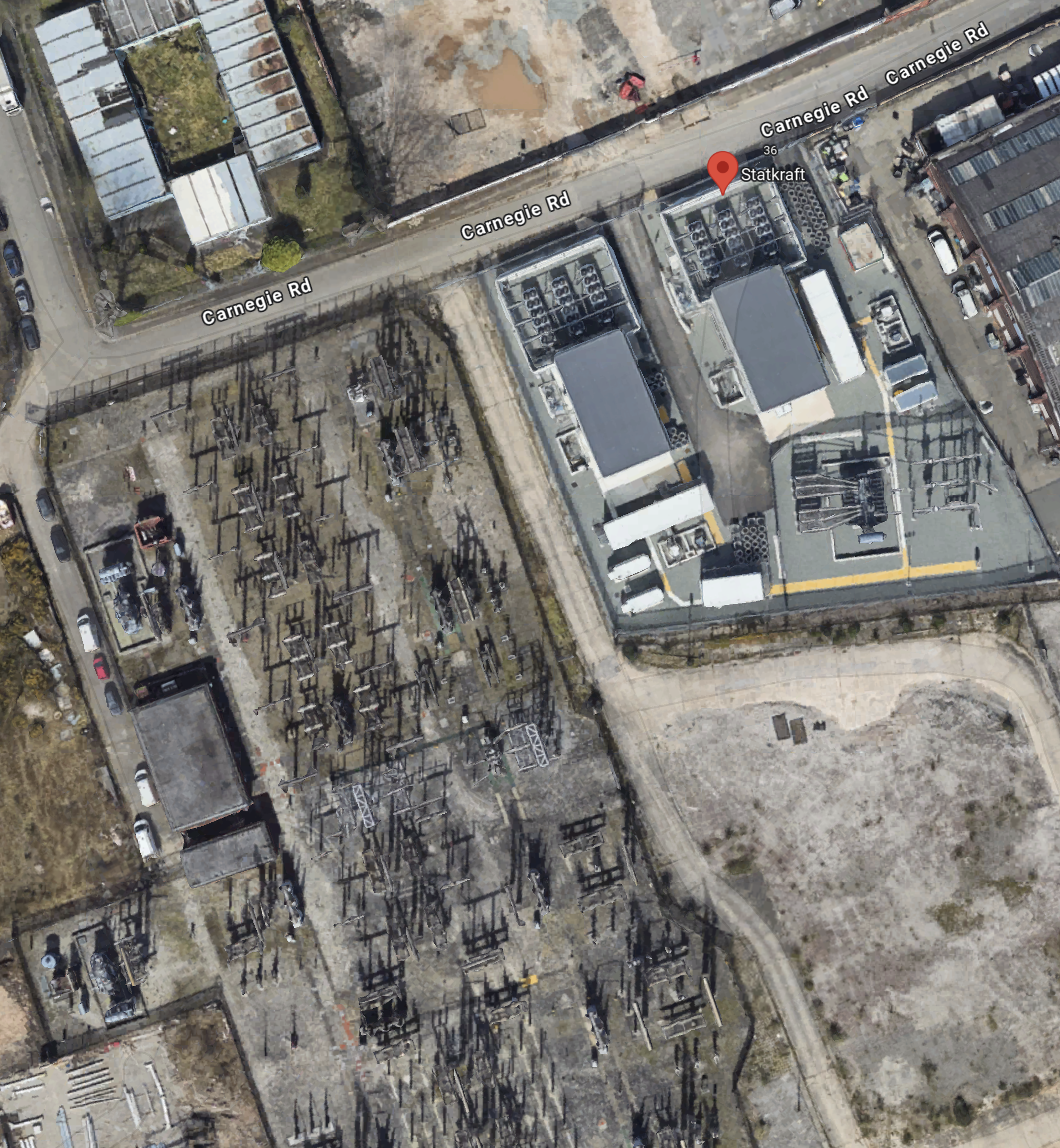
Note.
- The red arrow indicates the location of the pair of synchronous condensers.
- The metal forest to the West of the Statkraft site, looks like a large substation.
These are the first two paragraphs.
Featuring two ABB synchronous condensers, the facility is designed to replicate the inertia currently provided by spinning turbines at coal and gas-fired plants. This inertia is essential for maintaining the correct frequency and voltage across electricity grids, so an alternative source must be installed as thermal generation is replaced by wind and solar, which provide no inertia.
Developed for Norwegian renewable energy firm Statkraft, Lister Drive is the first project anywhere in the world to feature a high-inertia configuration that couples a synchronous condenser with a 40-tonne flywheel. According to ABB, this approach increases the instantaneously available inertia by 3.5 times, ensuring the network frequency and voltage are held stable within the tight limits essential to maintain grid reliability.
In my Electrical Engineering degree course at Liverpool University, I opted out of power engineering, as I preferred Electronics and Control Engineering. So I am indebted to this Wikipedia entry for what a synchronous condenser is and does.
Statkraft seem to be developing several of their Greener Grid Parks, in various places in the UK.
Form Energy To Begin Manufacturing Iron Air Batteries In Weirton To Stabilize Electrical Grid
The title of this post, is the same as that of this article on wesa.fm.
These three paragraphs detail the story.
A company pioneering electrical grid batteries that will provide days of backup power for power plants reliant on renewable energy is building out its manufacturing arm throughout the greater Pittsburgh region.
Form Energy is on track to begin manufacturing the new kind of grid asset this spring, one the company says is sorely needed in a destabilized climate. As bonuses, it’s cheap — made of earth-abundant and predominantly domestically sourced materials — and Form needs a large, maker workforce to pull it off.
This is a welcomed development in the community of Weirton, West Virginia, which has seen population and industry decline steadily since the 1970s. Most recently, Cleveland-Cliffs — a neighbor company in the small town — announced it would idle its tinplate production plant and lay off up to 900 employees.
I like Form Energy’s iron-air batteries.
They would appear to be a direct replacement for lithium-ion batteries in stationary applications likeBattery-Energy Storage Systems (BESS).
I suspect they will work eoth the grid-balancing software developed for lithium-ion batteries.
- They use rust and air to store energy.
- The science came out of MIT.
- The venture is well-backed by the likes of Bill Gates.
There’s more about this factory on this page of their web site.
- The web site talks of innovative software, like grid modelling software.
- They aim to start production in the second half of this year.
- At full production the factory will employ 750 people.
- The annual production will be 500 MW of batteries.
This is a company to watch.
Fire Safety Of Battery-Electric Vehicles
I notice that there has been talk of fires in battery-electric vehicles on this blog.
So I thought I’d put up a post with an appropriate topic.
There are some things that already could worry me.
- Vivarail had a fire early on.
- The Merseyrail Class 777 trains go in the tunnels under Liverpool.
- The new Piccadilly Line trains will have batteries.
- Did electric vehicle batteries contribute to the ferocity of the fire in the Luton Airport car park?
- Fire brigades are getting very worried about e-scooter and e-bike fires.
- This page on the Internet gives details of recent BESS fires.
- Do we investigate fires and publish the results properly?
I have some questions.
- Would it be sensible to have nationwide database of all batteries?
- Should we use more non-lithium methods in large stationary batteries?
- Should we use more capacitors?
- Should we make it a criminal offence to build or use a non-compliant e-bike or e-scooter?
- Should installing a battery in your house, need a safety certificate?
One half of me says yes and the other says no, to some of these questions.
The UK’s Pumped Storage Hydroelectricity
This post is a simple list of the UK’s pumped storage hydroelectricity.
- Balliemeanoch – 1500 MW/45 GWh – In Development
- Coire Glas – 1500 MW/30 GWh – Under Construction
- Corrievarkie – 600 MW/14.5 GWh – In Development
- Cruachan – 1000 MW/7.1 GWh – In Operation
- Fearn – 1800 MW/37 GWh – In Development
- Dinorwig – 1800 MW/9.1 GWh – In Operation
- Earba – 900 MW/33 GWh – In Development
- Foyers – 305 MW/10 GWh – In Operation
- Ffestiniog – 360 MW/1.44 GWh – In Operation
- Loch Kemp – 600 MW/9 GWh – In Development
- Loch Sloy – 152.5 MW/25 GWh – In Operation
- Red John – 450 MW/2.8 GWh – Under Construction
Note.
- Cruachan is only 440 MW and is being upgraded.
- The storage capacity at Foyers may be wrong, as I can’t find my original source.
When fully developed the total will be 10969.3 MW/223.94 GWh.
Wylfa: UK Government In Talks To Buy Nuclear Site – Report
The title of this post, is the same as that as this article on the BBC.
This is the sub-heading.
The UK government is reportedly in talks to take control of a site in north Wales where a planned nuclear project was scrapped in 2019.
These paragraphs outline the story.
State-owned Great British Nuclear is “in early discussions” with Hitachi, which owns the land at Wylfa, on Anglesey, the Financial Times reported.
A government spokesman said Wylfa was one of many “potential sites” that could host nuclear projects.
Hitachi abandoned its plans there in January 2019.
An unnamed minister told the FT that “tentative negotiations” with Hitachi had already begun, but said a deal might not be reached until after a general election expected later this year.
Tom Greatrex, chief executive of the Nuclear Industry Association and Virginia Crosbie, MP for Ynys Môn both welcomed the talks.
These are my thoughts.
Where Is Wylfa?
This Google Map shows Anglesey.
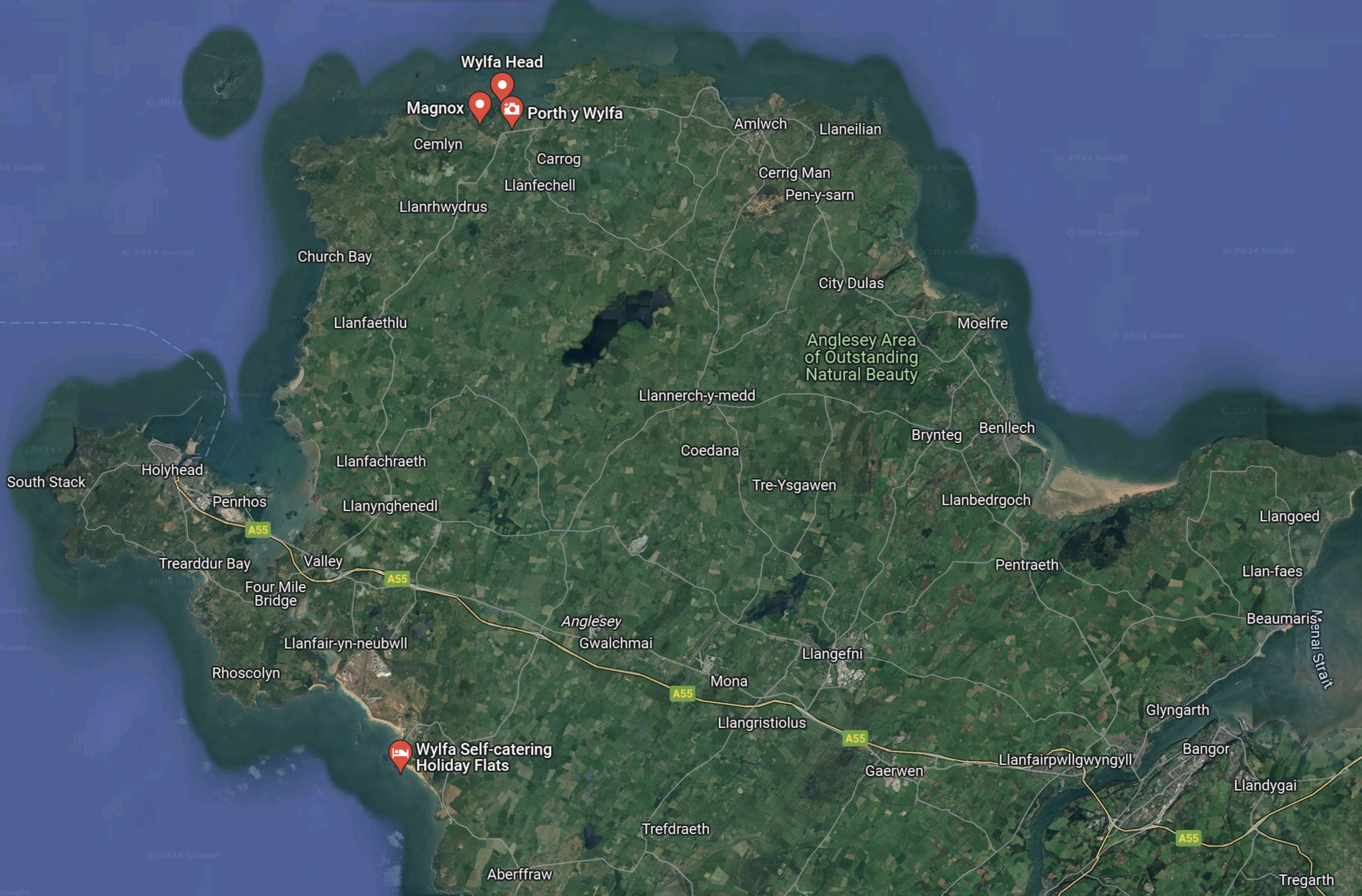
Wylfa power station is near Wylfa Head at the top of the map, where they are indicated by the cluster of red arrows.
This Google Map shows the power station to a larger scale.
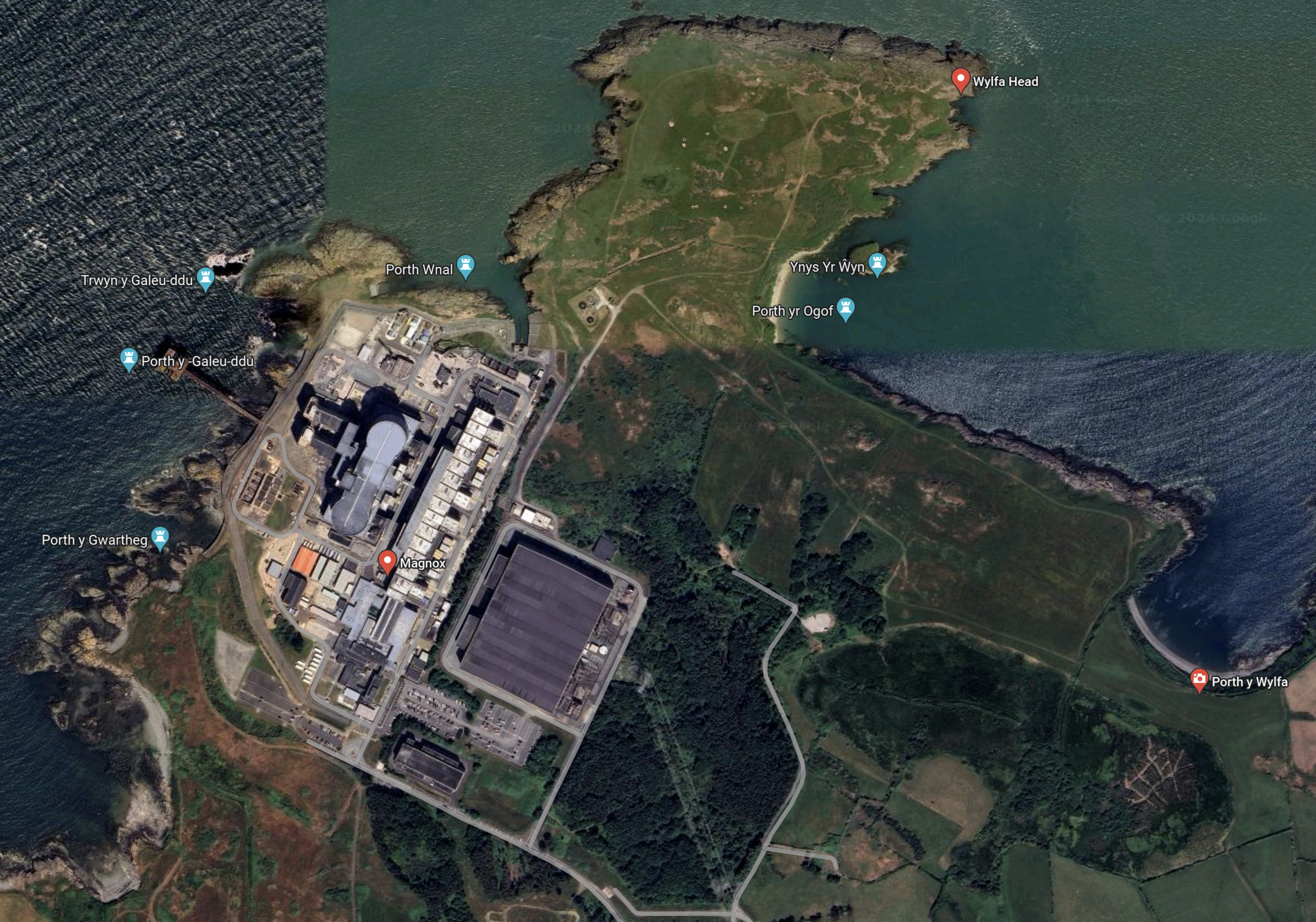
Note.
- The red arrow named Magnox marks the decommissioned Magnox power station.
- The topmost red arrow marks Wylfa Head.
- The rightmost red arrow marks Porth y Wylfa, which looks like a small harbour.
- On some maps the square building to the East of the power station is marked as Wylfa sub-station.
- There certainly appears to be an overhead transmission line leading South from the power station complex.
Virginia Crosbie, MP for Ynys Môn, also said this according to the BBC article.
The nuclear industry is unanimous that Wylfa is the best site in Europe for large-scale nuclear,” she said, adding that it would be “the largest inward investment” in Welsh history and “transformational” for the people of north-west Wales.
But I do wonder, if when you have cleared the Wylfa site leaving the sub-station, that it could be a site where renewables could come ashore and be fed into the grid.
Why Is Wylfa The Best Site In Europe For Large-Scale Nuclear?
Given the protests about putting new power transmission lines across Norfolk and Suffolk, I feel that Wylfa’s largest asset could be its high capacity connection to the UK’s grid.
According to the Wikipedia entry for Wylfa power station, this is said about Wylfa B.
Horizon Nuclear Power, originally an E.ON and RWE joint venture, bought by Hitachi in 2012, announced in 2009 intentions to install about 3,000 MWe of new nuclear plant at Wylfa. Horizon planned to build two advanced boiling water reactors (ABWRs) at a site to the south of the existing Wylfa station.
It would seem that the high capacity connection to the UK’s grid, is capable of handling a 3 GW power station at Wylfa, which could be very useful in the grand scheme of things.
This is also said in the Wikipedia entry for Wylfa power station.
On 4 April 2017, Horizon submitted a Site Licence Application to the Office for Nuclear Regulation. The scheme was extended to include a tunnel under the Menai Strait to carry the power cables to protect the conservation worth of the Strait and the Area of Outstanding Natural Beauty.
Horizon certainly seemed to try hard to get Wylfa B under construction.
As I said earlier, the Wylfa site could be an ideal site to connect offshore renewables to the grid.
Teesside Private SMR Nuclear Power Station To Be Built
The title of this post, is the same as that of this article on the BBC.
This is the sub-heading.
An agreement has been reached to build a privately financed nuclear power station in Teesside.
These are the first three paragraphs.
Community Nuclear Power (CNP) has announced plans to install four small modular reactors (SMRs) in North Tees.
CNP said it aims to be up and running in ten years’ time and will supply “roughly a gigawatt of energy”.
With other similar power stations planned, hundreds of jobs are expected to be created in the north-east of England.
A CNP spokesperson said the four North Tees reactors will generate clean, always-on energy which will be used to help develop a green energy and chemical hub, also within the North Tees Group Estate, on the north bank of the River Tees near Stockton.
These are my thoughts.
The Westinghouse AP300™ SMR
This SMR has its own web page.
This is the sub-heading.
Only SMR based on Licensed, Operating & Advanced Reactor Technology
These paragraphs introduce the reactor.
The Westinghouse AP300™ Small Modular Reactor is the most advanced, proven and readily deployable SMR solution. Westinghouse proudly brings 70+ years of experience developing and implementing new nuclear technologies that enable reliable, clean, safe and economical sources of energy for generations to come.
Our AP1000® reactor is already proving itself every day around the globe. Currently, four units utilizing AP1000 technology are operating in China, setting performance records. Six more are under construction in China and one AP1000 reactor is operating at Plant Vogtle in Georgia while a second nears completion.
Our AP300 SMR leverages that operating experience, as well as tens of millions of hours on AP1000 reactor development.
Gain the benefits of the record-setting Westinghouse AP1000 PWR technology in a smaller power output to augment the backbone of your community energy system.
The AP300 SMR complements the AP1000 reactor for a cleaner energy mix, energy security, and grid flexibility and stabilization.
Westinghouse seem to have taken a very professional and scientifically correct approach and downsized something that works well.
Where Will The Reactors Be Built?
This is a paragraph from the BBC article.
Small reactors, built in a factory by the American power giant Westinghouse, will be transported to Seal Sands near Billingham, coming on stream in the early 2030s and going some way to providing part of the big rise in nuclear capacity the UK government wants to see by 2050.
This Google Map shows the mouth of the River Tees.
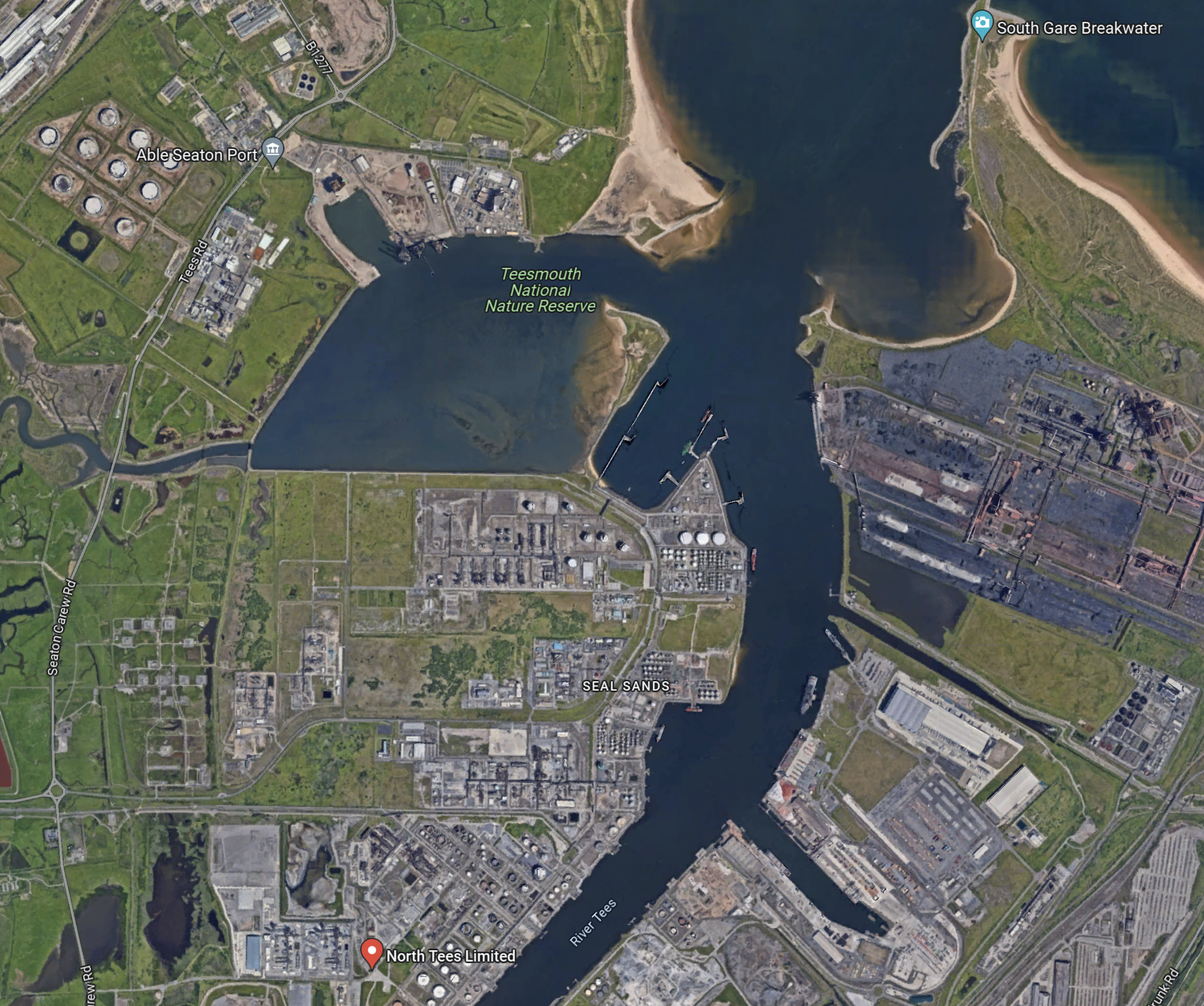
Note.
- The red arrow at the bottom of the map indicates the location of North Tees Group Estate.
- Follow the river to the North and a capitalised label indicating the position of Seal Sands can be seen.
This second Google Map shows the Seal Sands area in a larger scale.
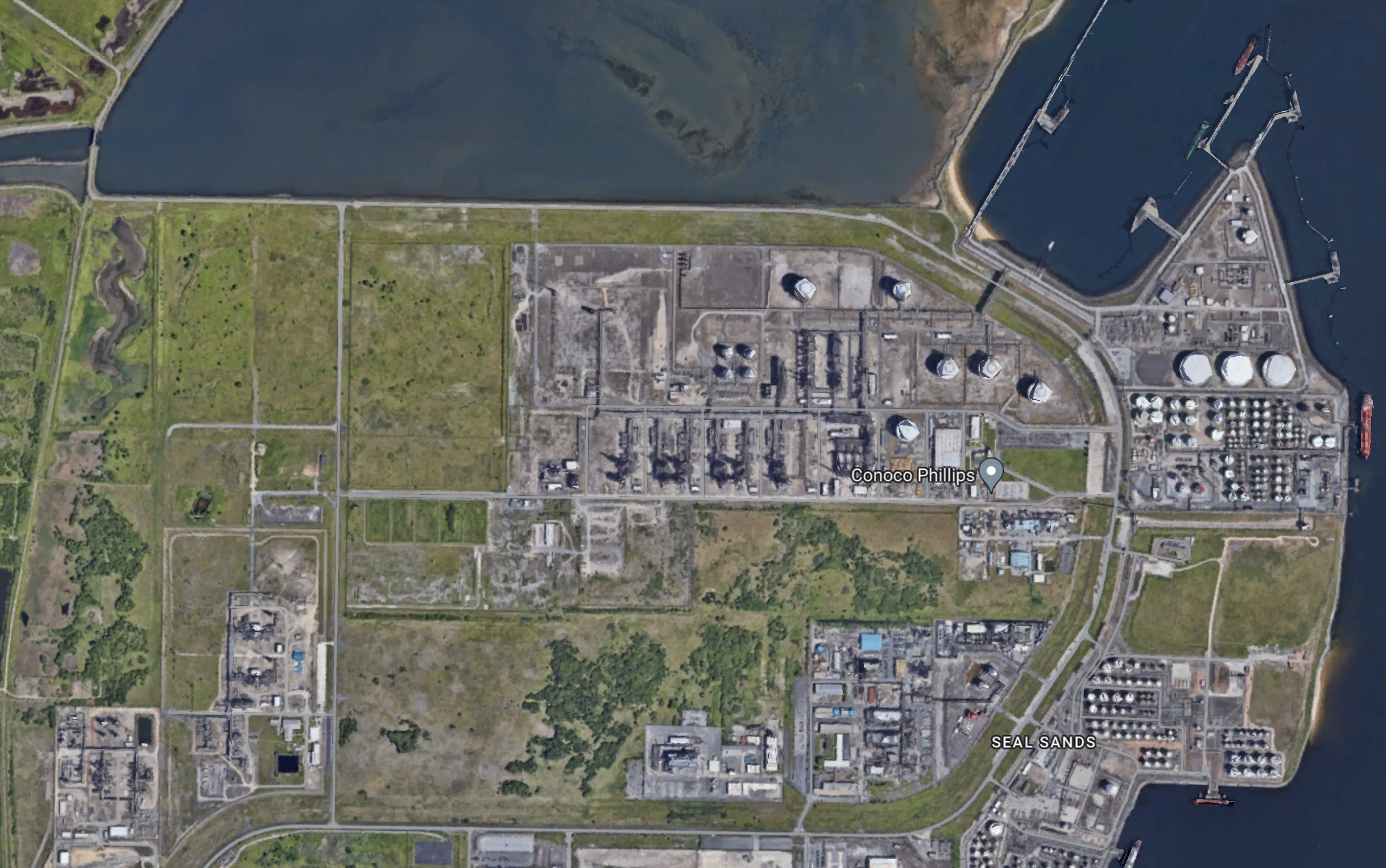
There seems to be several spaces, where the reactors could be located.
Would It Be Safe To Locate A Nuclear Reactor Or Reactors In a Cluster Of Oil Refineries And/Or Chemical Plants?
Consider.
- In the 1970s, when I worked at ICI, there were companies like Westinghouse advocating nuclear steelmaking.
- We did discuss the concept a couple of times over coffee but no one, I worked with, ever looked at it officially or seriously, as far as I know.
- In addition to requiring large amounts of electricity, oil refineries and chemical plants often use a lot of steam.
- Nuclear reactors generate steam to produce electricity, so some could be diverted to oil refineries or chemical plants
- To decarbonise some processes might switch to hydrogen.
- In Westinghouse And Bloom Energy To Team Up For Pink Hydrogen, I talk about how to use a nuclear reactor to efficiently produce pink hydrogen.
It looks like for efficiency, building the various plant close together could be a good thing.
But is it safe?
I suspect the level of safety will be that of the least safe plant.
So provided all plants are designed to the highest standards, it should be OK, as nuclear plants, oil refineries and chemical plant don’t regularly explode.
The Donald C Cook Nuclear Plant
The Donald C Cook Nuclear Plant in Michigan is a 2.2 GW nuclear plant, that was built by Westinghouse and commissioned in the mid-1970s.
They were clients for Artemis, the project management system that I wrote.
Soon after the Three Mile Island accident on March 28th, 1979, I visited the Donald C Cook Nuclear Plant to see how they were coping with the aftermath of the accident.
I remember being told by the operators of the plant, who were American Electric Power, that as it was their only nuclear plant, they were going to do everything by the book and Artemis was helping them to do that.
Reading about the plant, which is now licenced to operate until 2034 for one reactor and 2037 for the other, it seems to have performed impeccably so far for nearly fifty years.
It is a credit to both Westinghouse, who built it and American Electric Power who own it.
Now that is what I call high-class engineering and I’d be happy to have a cluster of SMRs to the same standard in my back yard.
Sizewell B
I used to live a few miles from Sizewell B, which is another Westinghouse reactor.
- This is the Wikipedia entry for the power station.
- Sizewell B was based on a proven Westinghouse design.
- It seems to have performed well since it was commissioned in 1995.
It looks like it will be operating until 2055, which will make its working life similar to those of the reactors at the Donald C Cook Nuclear Plant.
Westinghouse And Hinckley Point C Compared
Consider.
- Sizewell B was built in approximately seven years.
- This compares well with the two units at the Donald C Cook Nuclear Plant, which took six and nine years respectively
- It looks like Hinckley Point C will take between twelve and fourteen years to build.
- Sizewell B and the two units at Donald C Cook Nuclear Plant seem to be looking at a sixty year operating lifetime.
- Sizewell has a rail connection and Hinckley Point does not.
- Sizewell B seems to have been signed off, when John Major was Prime Minister.
- Hinckley Pont C seems to have resulted from a government white paper when Gordon Brown was Prime Minister.
Westinghouse seem to design nuclear power stations, that can operate for a long period and can be built within a decade.
Westinghouse And Rolls-Royce
Consider.
- Rolls-Royce also have an SMR design.
- Rolls-Royce and Westinghouse are both world-class companies.
- Rolls-Royce have the advantage they are British.
- I also suspect, that both Westinghouse and Rolls-Royce will use the same subcontractors and sub-assembly manufacturers.
- The Rolls-Royce SMR has a power output of 470 MW.
- The Westinghouse SMR has a power output of 300 MW.
I suspect the choice between the two, will be like choosing between top-of-the-range British and American products.
Conclusion
I wonder why we ended up with an unproven new French design at Hinckley Point, when sitting in Suffolk was a traditional Westinghouse design, that was performing to its design specification?
But for the SMR, we need to buy the reactors, which are financially best for Britain. If Westinghouse choose to manufacture large sections in the UK, they could be the better bet, as I suspect, if SMRs are successful, we’ll be seeing exports from the UK.
Tregoss Passing Loop On The Atlantic Coast Line
To increase the frequency of trains on the Atlantic Coast Line between Par and Newquay stations, from two-hourly to hourly, Network Rail are proposing to add a passing loop at Tregoss Moor.
This OpenRailwayMap shows the railway as it runs across the moor.
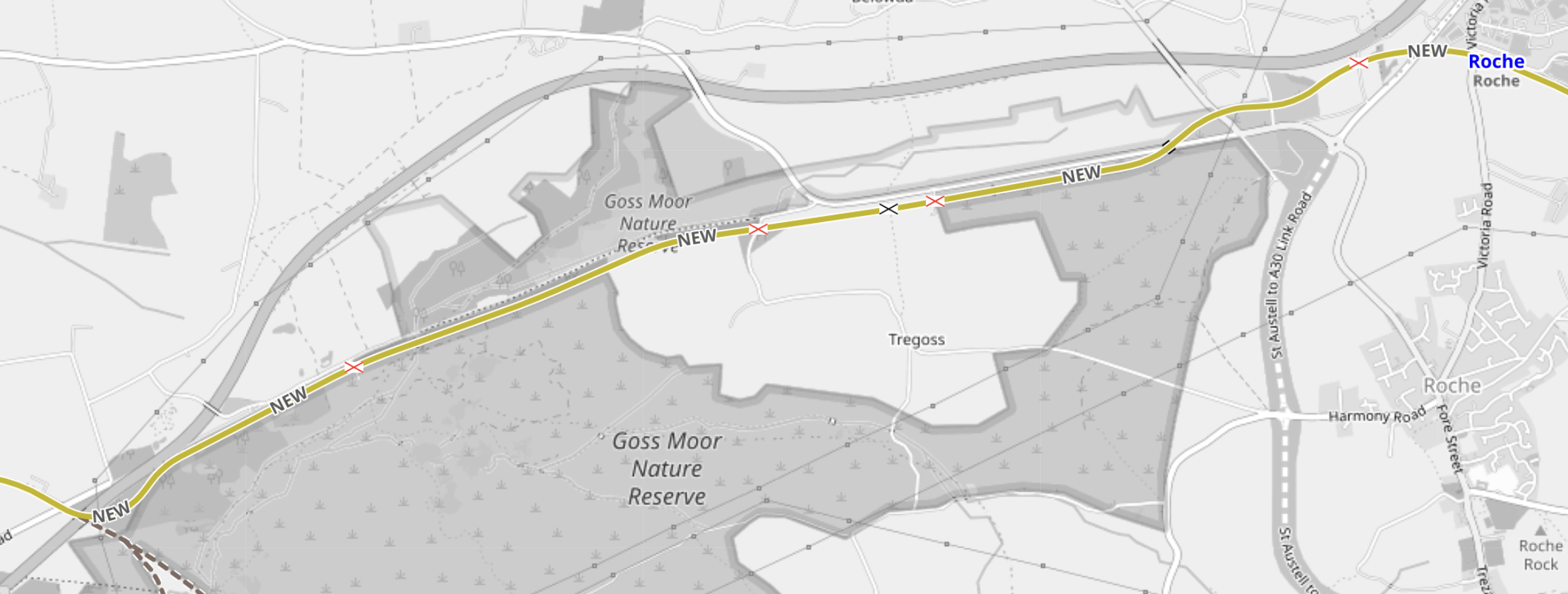
Note.
- Roche station in the North-East corner of the map.
- The red and blue crosses indicating level crossings on the route.
- The map seems to indicate a number of power cables.
I took these pictures from the train, as I came down to Par station.





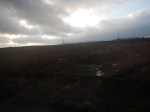
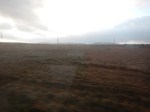
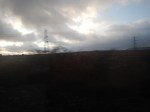

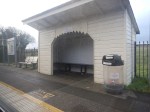

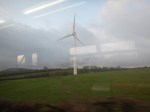
Note.
- I was sitting on the right-hand-side of the train, looking West.
- In addition to the cables, there are about half a dozen wind turbines.
- Roche station is typical of the intermediate stations on the line – Small, functional and tidy, with a few car parking spaces.
On past form, I suspect that Network Rail could squeeze in a passing loop, that wouldn’t stir up too many antis.
I have one thought,
The St. Austell Link Road
This Google Map shows where the A30 to St. Austell Link Road is being built.
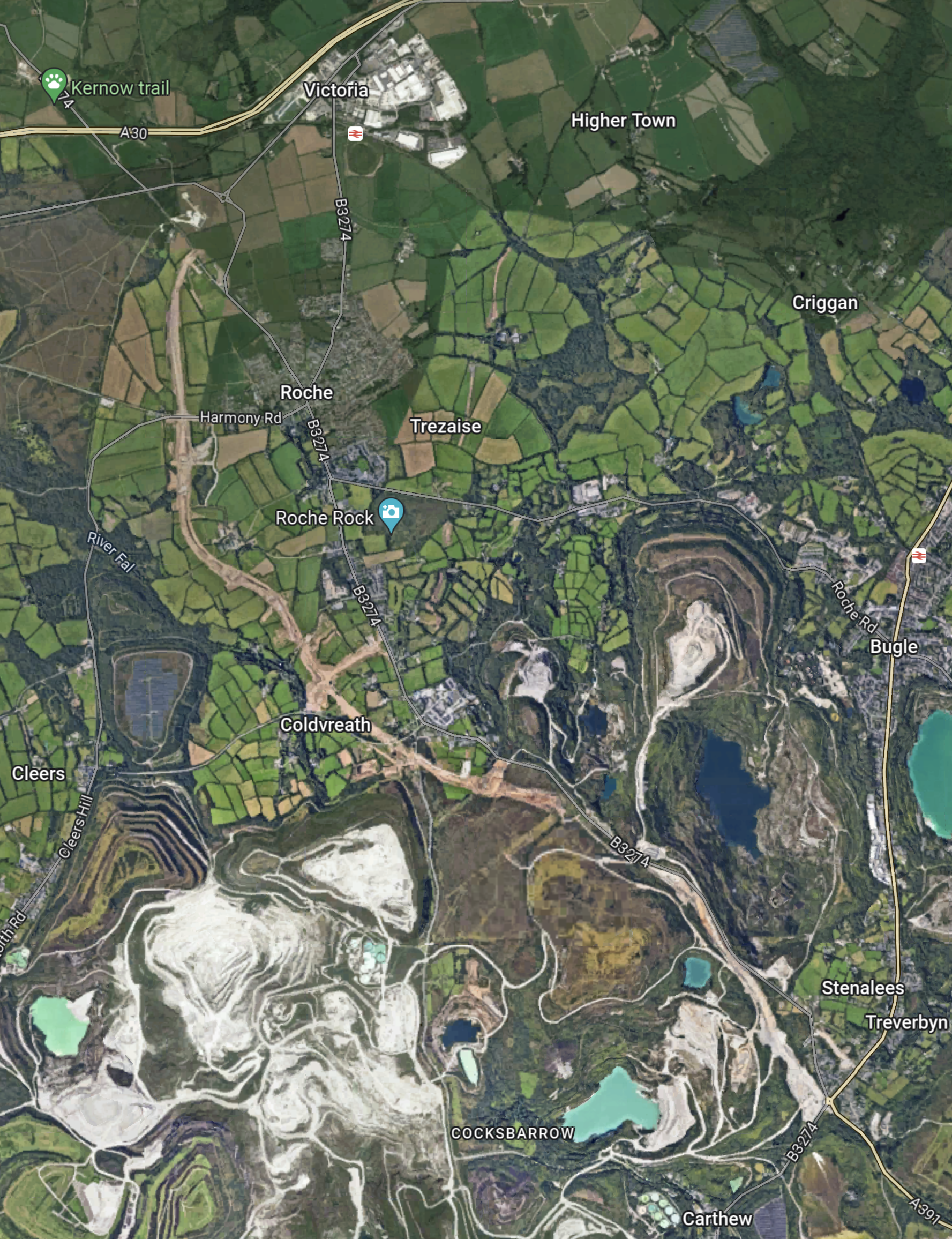
Note.
- The station at the top of the map by the area called Victoria and to the West of Higher Town is Roche station.
- The station at the right edge of the map about halfway down is Bugle station.
- The South of the map is covered by white china clay workings.
- Running diagonally across the map is the A30 to St. Austell Link Road.
This page on the Cornwall web site, says this about the road.
The St Austell to A30 link road will connect the old A30 near Victoria to the north and the A391 at Stenalees roundabout to the south. It will be a new 3.9 mile single carriageway road. It is a vital link to bring opportunities to the area.
This Google Map shows the area, where the Link Road will connect to the A30.
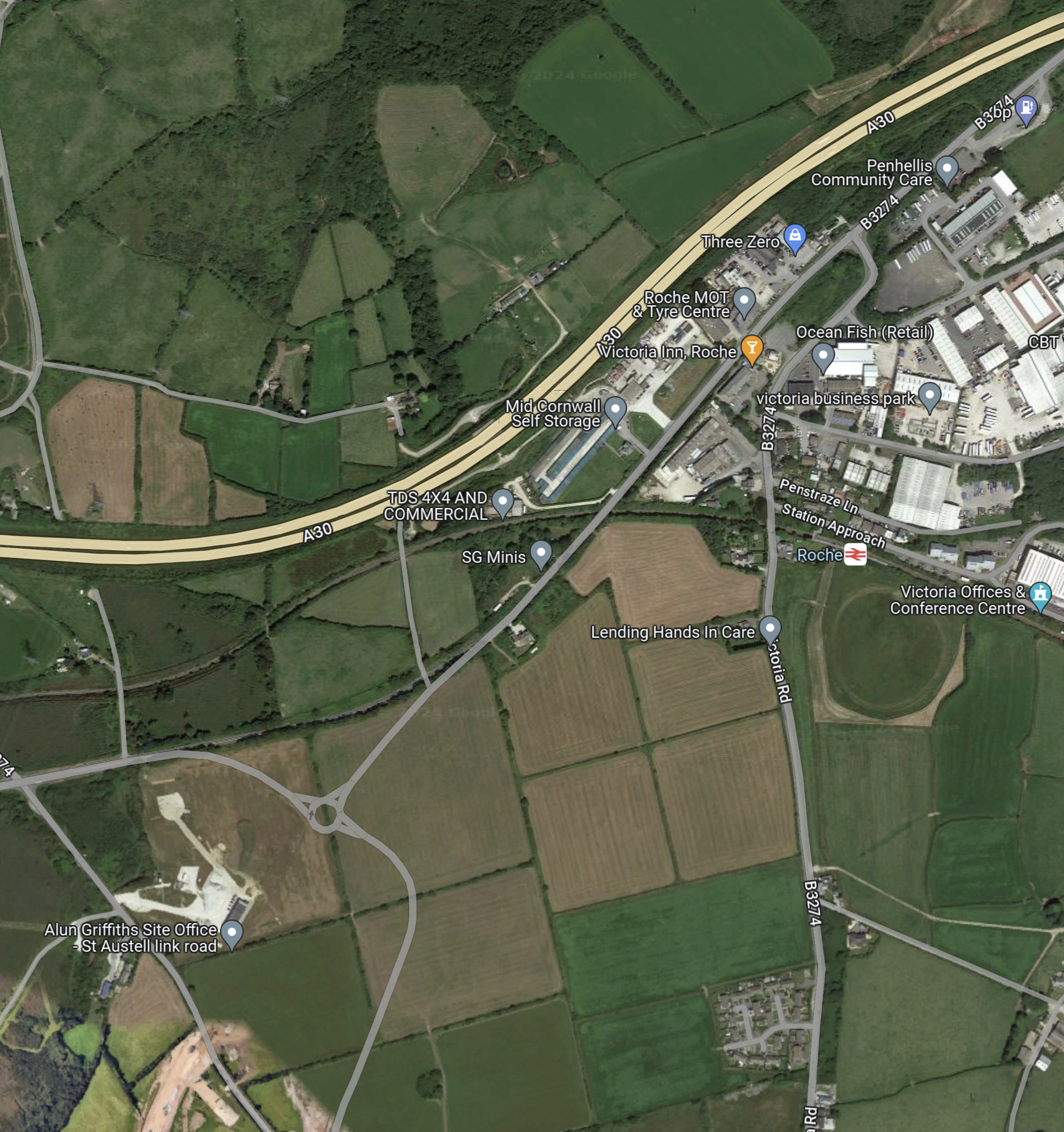
Note.
- The A30 running across the top of the map.
- The Victoria area and Roche station in the North-East corner of the map.
- In the South-West corner of the map their is the site office of the Link Road.
- The current end of the construction scar of the Link Road can be seen at the edge of the map.
- I would assume that the new road joins the roundabout to the North-East of the Construction Office.
- Traffic could be routes North-East from here along the B3274 to join the A30 at Cornwall Services.
- The railway sneaks between the A30 and the construction site.
I hope there’s been a bit of joined up thinking here and the road and the railway have been given the best joint design possible.
ICE Report Shows Majority Open To Net Zero Changes
The title of this post, is the same as that of this article on The Engineer.
This is the sub-heading.
A new report has found that a majority of the UK public is amenable to the behavioural changes needed to hit the country’s net zero targets.
These two paragraphs summarise the findings of the report.
Published by the Institution of Civil Engineers (ICE) and the All-Party Parliamentary Group on Infrastructure (APPGI), the report was based on a survey of 1,000 respondents. It found that 57 per cent were open to change, with 23 per cent described as net zero enthusiasts who were likely to have already altered their behaviours, and 34 per cent wanting change, but feeling they needed further empowerment to achieve it.
However, there is far from universal agreement when it comes to behavioural change around climate action. The report found that 30 per cent of people were ‘reluctant followers’, largely acknowledging that the UK must act on emissions, but not feeling personal responsibility for that action. This segment will likely only change their behaviours if forced to do so or seeing a majority of others doing it first. Finally, 13 per cent of those surveyed were classed as ‘net zero resistors’, people who don’t believe action is necessary and have no intention of doing so.
Summing the figures up gives us.
- Net-Zero Enthusiasts – 23 %
- Wanting Change – 34 %
- Reluctant Followers – 30 %
- Net-Zero Resistors – 13 %
All politicians should be forced to read the full report.
What Would I Need To Do To Achieve a Personal Net-Zero?
My circumstances probably cover a lot of people.
- I am a widow living alone.
- My house is well-insulated with solar-panels on the roof, but heated by gas.
- I don’t have or need a car.
- I do nearly all my shopping by public transport and carry it home.
- When I go away in the UK I use trains.
- If I go to Europe, I either go or come back by train.
- I am coeliac, which means I need to eat some meat to stay healthy.
My largest carbon-emitted is probably my house, but it would be unsuitable for most current solutions.
I would put myself in the Wanting Change group, but I could move to a Net-Zero Enthusiast, if the right technology came along.
- I have seen one bolt-in electric replacement for by boiler and when the right one arrives, I’ll probably fit one.
- An affordable battery to work to with my solar panels and also allow me to use Off Peak electricity would be nice.
- As I’m coeliac, I tend to buy in the same food each week from Marks and Spencer to eat in. I might be able to cut my carbon footprint by getting Ocado to deliver. Especially, as some deliveries seem to be bike.
- If TfL decarbonised the bus, that I use most days to and from Moorgate would that lower my carbon footprint?
I suspect the largest amount of carbon outside of my house’s heating, that I’ll emit, will be tomorrow, when I take a train to Newquay.
How Do We Convert The 13 % Net-Zero Resistors?
The recent protests by French and Belgian farmers indicate, that these farmers are probably in this group. And there are other forthright groups!
The only way, that they’ll be converted, is if technology allows them to earn the same amount of money and have the same outgoings, as they do now!
 The Anonymous Widower