After The Robin Hood Line Will Nottingham See The Maid Marian Line?
This article in the Nottingham Post is entitled Hopes HS2 could see ‘Maid Marian Line’ opened to passengers.
There is a freight only line between Kirkby-in-Ashfield station on the Robin Hood Line and Pye Bridge on the Erewash Valley Line.
The proposal would allow trains to go between Kirkby-in-Ashfield via Pinxton and Selston to Langley Mill and Ilkeston and then on to Nottingham.
I’ve been here before in September 2015 in a post called Expanding The Robin Hood Line.
But the new baby elephant in the room is the new Ilkeston station, which hopefully opens on the 2nd of April 2017.
Given Chris Grayling’s thoughts, that I wrote about in Government Focuses On New Stations And Trains, could it be that if extra trains can be found, that to provide a second train per hour between Nottingham and Ilkeston, a second route to Kirkby-in-Ashfield and on to to Mansfield and Worksop, is opened up the Erewash Valley Line.
The route could even terminate on the proposed extension of the Robin Hood Line to Ollerton.
The route from Nottingham to Ollerton would be.
- Nottingham
- Toton for HS2
- Ilkeston
- Langley Mill
- Selston – New station
- Pinxton- New station
- Kirkby-in-Ashfield
- Sutton Parkway
- Mansfield
- Mansfield Woodhouse
- Shirebrook
- Warsop- New station
- Edwinstowe – New station
- Ollerton – New station
I think it is likely that this route could be developed.
- The track is all there and is used by freight trains and/or for driver training.
- An hourly service on this route would mean additional services for many of the stations on the route.
- The only problem would be finding some suitable diesel trains for the route.
- It could probably be trialled to Mansfield or with a simple station at Ollerton.
- The track from Ollerton appears to be intact all the way to Lincoln.
But the clincher is that it would provide connectivity for HS2 all the way from Worksop and Mansfield to Lincoln and Grimsby.
HS2 is needed, but we must make sure that the benefits of the line are spread to all parts of the country.
If this route to Lincoln could be developed as a 100 mph line, the time from Lincoln to London with a change to HS2 at Toton could be likely to be under two hours.
In Government Focuses On New Stations And Trains, Chris Grayling mentioned the route from Grimsby to Sheffield. Surely creating this route from Lincoln to Toton via Ollerton for HS2, is what really improves train transport in North Lincolnshire.
Building Railways In The UK Is Easy
I have just read this article on Global Rail News, which is entitled French Senate approves Lyon-Turin rail link.
That sounds easy until you read this from the Wikipedia entry.
Test drilling found some internally stressed coal-bearing schists that are poorly suited for a tunnel boring machine, and old-fashion Drilling and blasting will be used for the short corresponding sections.
It is not going to be a simple tunnelling job. It is more akin to some of the eighteenth and nineteenth century tunnels through the Pennines. Except that the tunnel will be 57 kilometres long and modern explosives are better.
It will carry a lot of freight, in addition to passengers from Paris and Lyon to Northern Italy.
But I doubt, I’ll ever be able to take a High Speed Train from London to Milan, as I’ll be long gone before everything is completed.
Development At The Royal Arsenal
The historic Royal Arsenal site at Woolwich is being developed.
Wikipedia gives a good summary of present day developments.
This is the summary.
The sprawling Arsenal site is now one of the focal points for redevelopment in the Thames Gateway zone, but the links to its historic past are not lost. Many notable buildings in the historic original (West) site are being retained in the redevelopment; the site includes Firepower – The Royal Artillery Museum telling the story of the Royal Artillery, and Greenwich Heritage Centre which tells the story of Woolwich, including the Royal Arsenal. Parts of the Royal Arsenal have been used to build residential and commercial buildings. One of the earliest developments was Royal Artillery Quays, a series of glass towers rising along the riverside built by Barratt Homes in 2003.
Underneath the latest developments is the new Woolwich station for Crossrail.
These are some pictures I took.
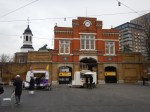
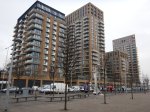



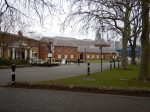
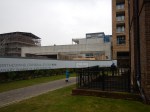

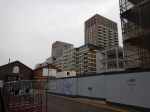

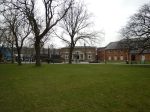
According to Wikipedia it is one of the biggest concentrations of Grade I and Grade II listed buildings converted for residential use.
This aerial picture shows the site from the South East.
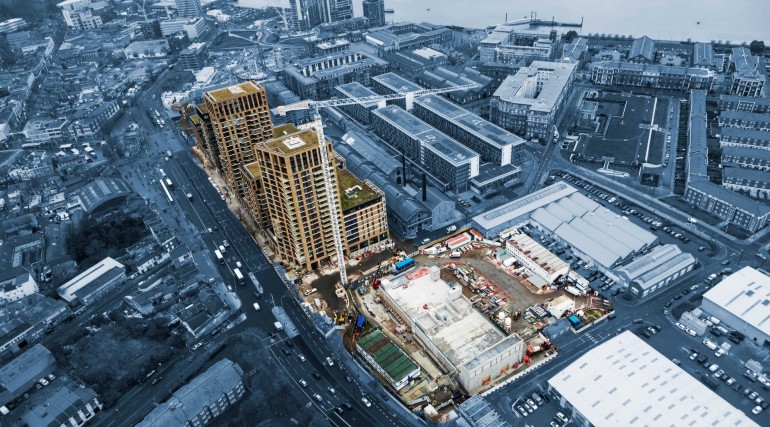
The station is behind the towers along the main road.
Woolwich Station As An Interchange
Woolwich station has not been designed as an intended interchange, but it is only a short walk away from Woolwich Arsenal station, which has connections to Southeastern and DLR services.
As the walking connection passes several useful shops including a large Marks and Spencer food store, who knows how people will use the interchange?
Crossrail Release Aerial Views Of Stations
This page on the Crossrail web site has several up-to-date aerial views of stations.
This image shows the Crossrail station at Paddington station.
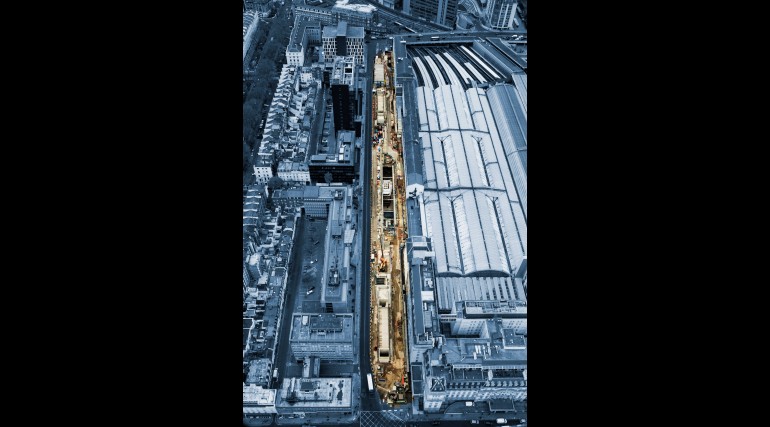
Crossrail have said this about the station.
The Elizabeth line station runs along the full length of the existing Paddington Main Line station. A 90 metre clear opening – a unique feature for an urban underground station design – will be covered by a dramatic steel and glass canopy eight metres above the ground that will allow natural light to flood down to the station platforms.
This Google Map shows Paddington station and where Crossrail comes to the surface to the West of Royal Oak station.
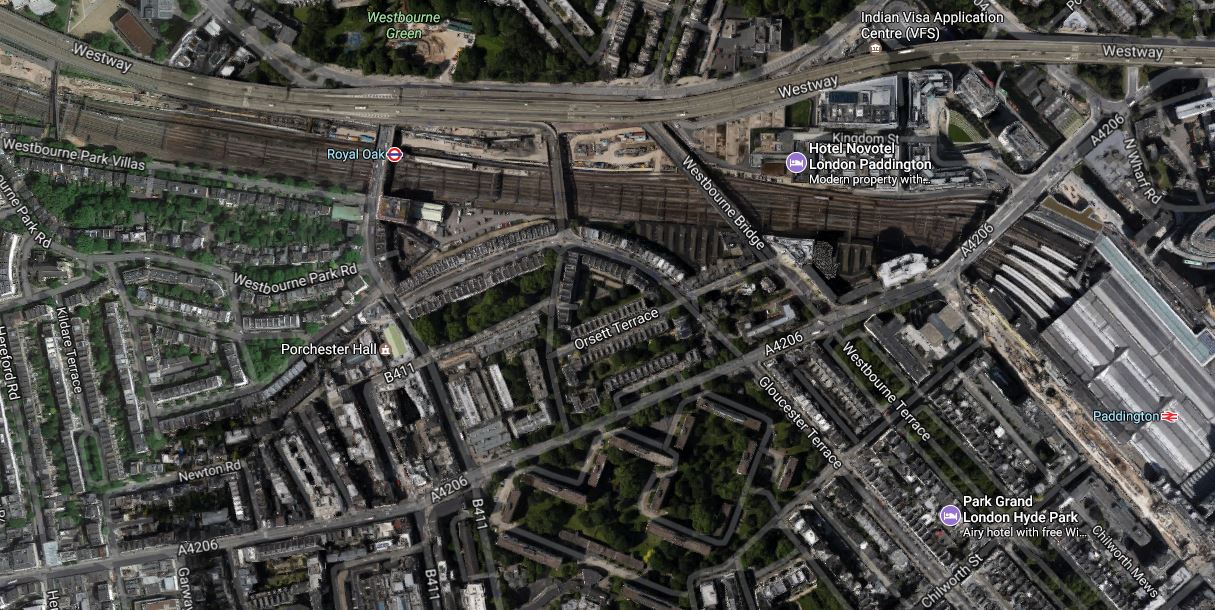
If you look in the top-left corner of the map, you can see a road named as Westbourne Park Villas. The foot-bridge across the railway from this road is the one in The Footbridge At Westbourne Park, from which I took pictures of the Crossrail tunnel portal at Royal Oak.
This map from carto.metro.free.fr shows the layout of Crossrail and the Underground Lines at Paddington station.
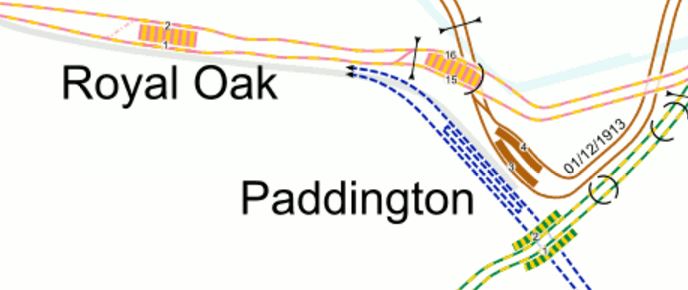
So it looks like the Crossrail lines go under all the lines into Paddington and then they surface by the Westway, before going under the footbridge and linking with the main line out of Paddington.
A link between the Bakerloo Line and Crossrail is being constructed, which I wrote about in Paddington Is Operational Again, but is there going to be a link between the Circle/District Lines and Crossrail?
Custom House Station – 26th January 2017
Custom House station will close on the DLR on February 3rd until late December 2017, so I went to take some pictures to see how far the builders have got.


It would appear that not to much has changed since I last visited and wrote this post called Custom House Station – 24th July 2016.
What Is Happening At Old Oak Common?
I ask this question as I have just read this article on the New Civil Engineer web site which is entitled Old Oak Common Megadeck Momentum Slows.
This is said.
Momentum for the 7ha deck to be built over the Crossrail depot in the new Old Oak and Park Royal development in west London has slowed according to the chief executive of the regeneration body in charge of the work.
Sadiq Khan is blaming Boris, as any politician would.
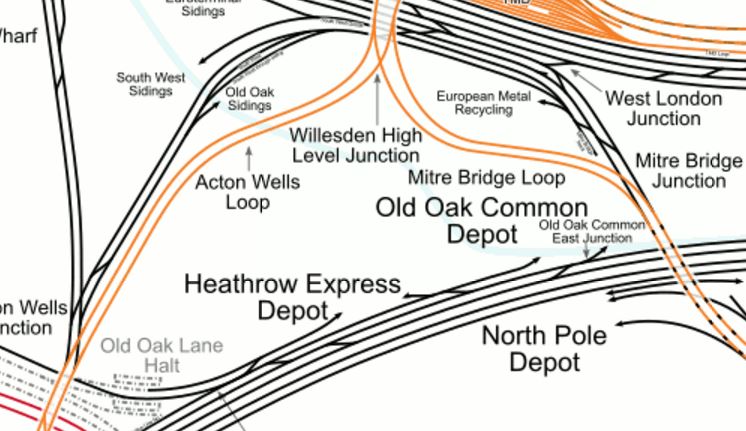
It is truly a massive site, as this Google Map shows.
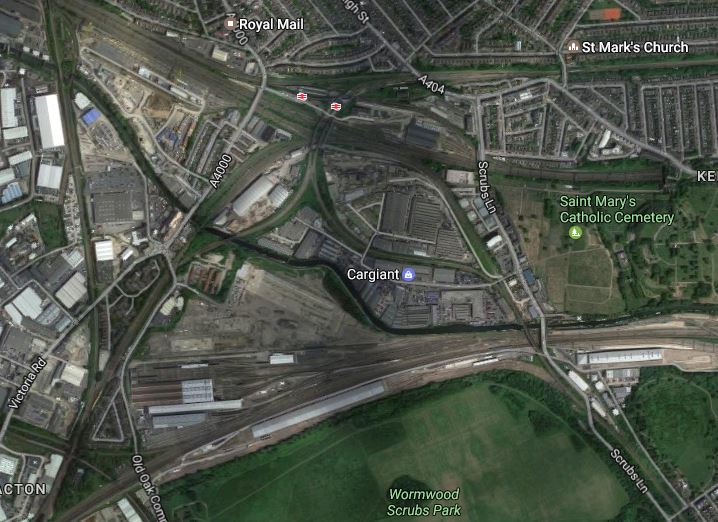
The two stations at the top of the map is Willesden Junction station.
Running across the map is the Great Western Main Line, with the various depots and Cargiant to the North.
This map from carto.metro.free.fr shows the lines in the area.
This aerial view of the area is from Crossrail.
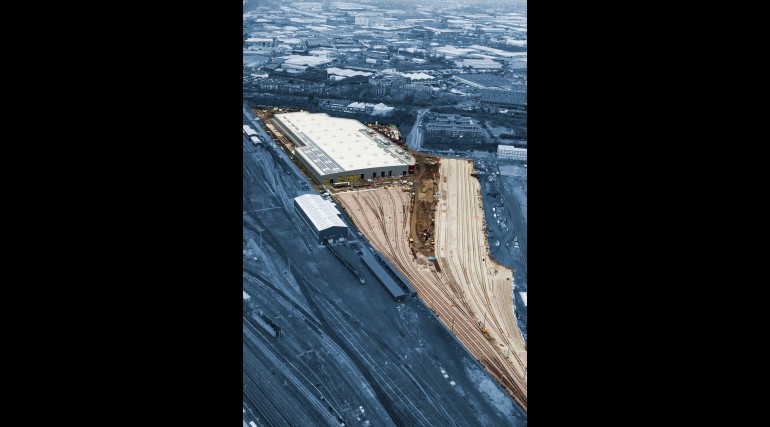
The megadeck is needed to go over much of this area, so that housing and other developments can be built.
Modern Trains From Old
In the February 2017 Edition of Modern Railways, there are several articles about the updating of old trains to a modern standard.
- Class 321 trains being given a Renatus treatment.
- Class 319 trains being converted into a bi-mode Class 319 Flex.
- Class 220, 221 and 222 trains being converted to bi-modes.
There was also an article about the revival of locomotive hauled trains called Long Live The Loco!
The Class 321 Renatus
Note the following about the Class 321 trains.
- There are a total of 117 of the four-car trains.
- ,The trains have a 100 mph capability.
- Many of them are in need of a refurbishment after nearly thirty years in service.
So train leasing company; Eversholt, has come up with a plan to create thirty Class 321 Renatus for Greater Anglia as a stop-gap until their new Aventras arrive in a couple of years time.
The updated trains will feature.
- New air-conditioning and heating systems
- New, safer seating throughout
- Larger vestibules for improved boarding and alighting
- Wi-Fi enabled for passengers and operator
- Improved space allocation for buggies, bicycles and luggage
- Passenger power sockets throughout
- New, energy efficient lighting
- One PRM compliant toilet and a second controlled emission toilet on each unit
- Complete renewal and remodelling of all interior surfaces
The trains will also be given an updated traction package, which is described on this page on the Vossloh Kiepe web site.
This is said.
In 2013, Eversholt Rail and Vossloh Kiepe embarked on the pre-series project to demonstrate modern AC traction on a Class 321 unit. The key objectives were to reduce journey time for passengers, improve reliability and maintainability, and reduce the total cost of operation through a combination of reduced energy consumption and regenerative braking.
The prototype certainly looks good in the pictures.
Eversholt is stated as believing that if the market likes these trains, then other operators could be interested and other trains might be converted.
The Class 319 Flex
I like this concept and I wrote about the Class 319 Flex in Porterbrook Launch A Tri-Mode Train.
I felt one of the first routes would to be to Windermere and Modern Railways says the same.
Northern are quoted as saying, that after the concept is proven, the trains will be made available to a wide range of operators.
Consider.
- There are 86 of the four-car units.
- They are 100 mph trains.
- They are Mark 3-based, so ride well.
- They can work on 750 VDC or 25 KVAC electrification.
- With diesel alternators, they can go virtually anywhere.
If the trains are a success, I think we’ll be very surprised as to the routes they work.
I also think that Porterbrook could keep a small fleet ready for immediate lease for the purposes, like the following.
- Proving the economics of new routes.
- Blockade busting.
- Extra capacity for special events.
- Replacement capacity after train problems or accidents.
I suspect Porterbrook have got lots of ideas. Some of which could be quite wacky!
Bi-Modus Operandi
This is the title of an article by Ian Walmsley in the magazine, who makes the case for adding an extra coach with a pantograph to the Class 220, 221 and 222 and effectively creating a bi-mode train.
The idea is not new and I wrote about it in The Part-Time Electric Train, after a long editorial comment in Modern Railways in 2010.
If anything, the case for convcersion is even better now, as quality high-speed bi-mode trains are desperately needed.
As the article suggests, they could sort out some of the other problems with the trains.
There are quite a few suitable trains.
- Class 220 trains – 34 trains of four cars.
- Class 221 trains – 43 trains of a mix of four and five cars.
- Class 222 trains – 27 trains of a mix of four, five and seven cars.
All are 125 mph trains.
The Vivarail Class 230 Train
The magazine also has an extensive report on the fire in a Class 230 train.
The report says that the definitive report will be published before the end of January, but on reading the detailed report of the damage, I think it will be some months before the rebuilt train is ready to roll.
In a post entitled Class 230 And Class 319 Flex Fight It Out, I came to this conclusion.
Vivarail will have a struggle to sell large numbers of trains, against a larger, faster, more capable train of proven reliability.
I stand by what I said.
Long Live The Loco!
This article describes the various uses of locomotive-hauled passenger trains on the UK rail network.
The title could be read another way, as it talks about the following locomotives.
- Class 37 locomotive – Built 1960-65
- Class 47 locomotive – Built 1962-68
- Class 68 locomotive – Built 2013-present
- Class 73 locomotive – Built 1962-67
- Class 90 locomotive – Built 1987-90
- Class 91 locomotive – Built 1988-91
- Class 92 locomotive – Built 1993-96
Some could not be considered modern, but they perform.
The article goes on to detail how TransPennine Express will use their new Mark 5A carriages.
- Wikipedia says each set will be composed of 1 first class car, 2 Standard class cars, 1 brake standard class car and a standard class driving trailer.
- Sets will be able to be lengthened if required.
- The trains will be worked push-pull between a Class 68 locomotive and a driving trailer.
- The coaches will have a 125 mph design speed for future-proofing reasons.
It is also said, that a Class 88 locomotive is not powerful enough under diesel power to operate on the TransPennine route.
So the article speculates, that there may be a place for a bi-mode locomotive with full diesel capability, given the success of the Hitachi bi-mode concept.
The article finishes by saying that as Chiltern and TransPennine have shown that push-pull operation is viable, could the concept become more widespread?
Upgrading Waterloo Station
Some reports are giving Network Rail a good kicking over a month-long closure in August of Waterloo station.
I will point readers to this article on Time Out, which is entitled Passengers have been told to avoid Waterloo station for a whole month during major re-building works, as it gives facts rather than emotion.
I have found this video on this page of the South West Trains web site.
It explains the problem well.
South West Trains summarise the work at Waterloo as follows.
- Create a spacious, modern and accessible station concourse by rebuilding the former Waterloo International Terminal.
- Increase services by bringing platforms 20–24 back into use and introducing modern facilities along with new track and signalling.
- Allow longer ten-carriage trains to run to suburban routes by extending platforms 1–4.
Time Out finish their article like this.
All the chaos is down to an £800 million upgrade of Waterloo and South West, which aims to provide 30 percent more space for passengers as well as faster, more frequent services. If anything, it could be a decent excuse to book a holiday somewhere sunny. That’s how we’re taking the news, anyway.
It is probably good advice.
An Upbeat View Of Hackney Wick
Hackney Wick is the sort of area of London, where traditionally it has dumped things that most people don’t want to know about. Although, the area does have a thriving artistic and indistrial community, much of the latter has moved out.
But this article in Building Design and Construction, which is entitled 25 Million Pounds Devoted to Hackney Wick For Upgrades, paints a very different upbeat view of the area.
So where has the money for the work come from?
- A million from Tower Hamlets Council.
- A million from Hackney Council.
There is also a sizeable donation from the London Legacy Development Corporation.
But then an updated Hackney Wick station, will provide much better access to the Olympic Stadium and all the housing being built around the Olympic Park.
The article finished like this.
Through this, the infrastructure of this particular area of North London will be greatly improved, allowing for better property conditions, better employment opportunities and of course better transport conditions for its locals. Mister Jon Fox of Transport for London also put in a word in for the advancement of Hackney Wick Overground, which will improve the conditions of millions of people from all over the capital.
We need a lot more well-designed and much better stations to generate growth.
Exploring The Route Of The Midland Metro Extension To Victoria Square
The extensions at both ends of the Midland Metro in Birmingham and Wolverhampton City Centres will be a first for the UK, in that they will be catenary-free and the trams will run on battery power.
This Google Map shows the area, where the initial extension will go in Birmingham City Centre.
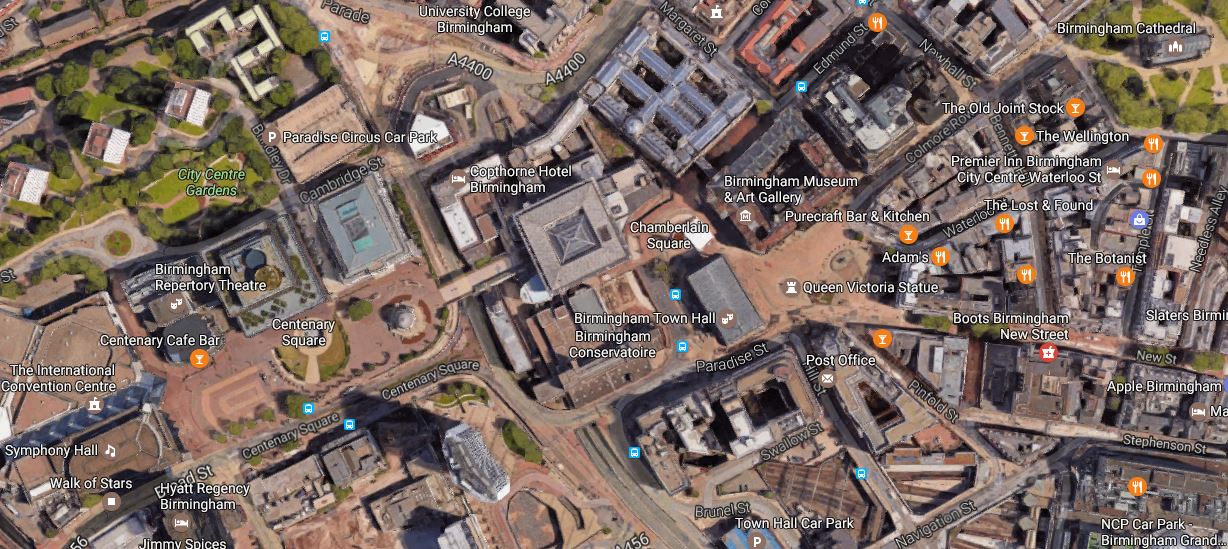
Places of interest are.
- The cathedral is in the North-East corner.
- New Street station is in the South-East corner.
- Victoria Square and the Town Hall are just to the East of the middle.
- Centenary Square is towards the West side.
This description comes from this page on the Metro Alliance web site.
840m of twin track from Birmingham Grand Central at Stephenson Street, up Pinfold Street through Victoria Square, Paradise St, past Paradise Circus into Centenary Square at Broad St.There will be an intermediate stop outside the Town Hall in Victoria Square, and we will interface with the Navigation Street link.
One of the problems at the moment, is that the development of Paradise Birmingham, seems to sit in the middle of the route.
These pictures show the area of Victoria Square and the route up from New Street station.







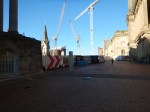
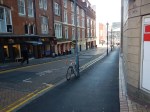
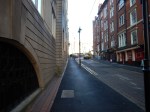
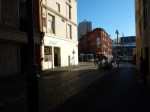
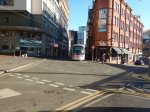
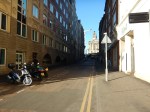
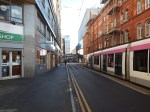
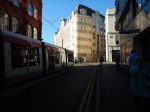
Note.
- The steep hill of Pinfold Street.
- The route seemed to have been prepared ready for the track to be fitted into the road surface.
- Utilities seemed to have been moved.
- When I took the pictures, the Midland Metro had parked a tram at the limit of the current track at the bottom of Pinfold Street.
Climbing The Hill
You can’t accuse Birmingham of lacking ambition, as Pinfold Street is a proper hill.
But then!
- It is the only steep hill on the route to Centenary Square.
- The tram will start the ascent with full batteries.
- There will be no problems coming down.
- This extension is only 840 metres in length.
- The MetroCentro in Seville has used similar technology on a 1.4 km. route since 2007.
- CAF have technology that charges batteries fast.
- Battery technology has moved on in the last ten years.
If in practice, it does prove a difficult climb, overhead wires could be put on sufficient of the lower part of the up-track on Pinfold Street.
These wires wouldn’t be visible from Victoria Square, so wouldn’t effect the architectural integrity pf the area.
Onward to Edgbaston
According to this article in Rail Technology Magazine, the further four kilometre extension to Egbaston, is also intended to be catenary-free.
As the trams could be charged at Edgbaston, I think this could be possible.
But I doubt CAF would propose the use of batteries, if they hadn’t already proven the range, which is not outrageous.
The Next Step
I looked at a lot of the route of the first section to Victoria Square today, and it would appear that the roadway has been prepared for fitting the track.
So could we see an accelerated development of the first part of the extension?
It would be a good test of the technology, with little risk to the Midland Metrolink!
If the trams can’t make the hill on baqtteries, it would need to be wired, but you could always blame Spanish engineering.
Conclusion
It is a very well-designed scheme.
I wonder, if we’ll see Edinburgh batteries on their CAF trams?
 The Anonymous Widower