Something Must Be Done About Cambridge Station
Cambridge station used to be an easy station to use, in that, when you arrived, you either got a taxi from outside the station or walked across the road to get a bus to the centre.
Since the dreaded busway has been built, the buses are about as well-organised as the Labour Party, with information designed to confuse visitors.
Yesterday, it was particularly bad, when I decided to pop in to the City to have a coffee with a friend, on my way to football at Ipswich. There wasn’t a bus in sight and the queue for the taxis was totally blocking pedestrians wanting to get out of the station.
In fact, I took about five minutes to actually get off the platform as it was so busy.
In the end, I walked into the City Centre.
Getting back, I was running late, so I decided to take a bus. But could I find one? No!
So in the end, I took a taxi, which had to take a very roundabout route. Getting into the station was just as bad as getting out had been, but I caught my train with a couple of minutes to spare.
The train is the big improvement on the line between Cambridge and Ipswich.
In 2010, this was a typical train on the route.

Gerald Fiennes and Delia Smith at Dullingham
At least that day, it was two Class 153 trains, when often it was just one crowded carriage.
Yesterday, the train was a comfortable three-car Class 170 train.

The First Ipswich-Cambridge Class 170 at Cambridge
This is a lot better and with the new franchise in October, I think it could be signalled, as getting better again.
But all of this increase in capacity, is straining Cambridge station even further.
At present, the problems at Cambridge seem to be caused by too many people going in different directions, whose routes seem to conflict with each other. Many of these are first time visitors and foreign topurists, who just wander aimlessly around, causing even more conflict.
Cambridge North station, when it eventually opens, might help, as many will cycle and drive to the new station. It will also make it a lot easy to get to the North of the City.
I think, that if most Cambridge trains serve both stations in the future, I’ll go to Cambridge North and get a bus into the City Centre to avoid the scrum at Cambridge station, which I’m sure will get worse, as more and more trains are scheduled between London and Cambridge. At least Thameslink have decided to go to Cambridge North.
One of the problems is that Cambridge station is on a cramped site, which is not an easy walk to the City Centre for the average visitor.

Cambridge Station
The walking route to the centre is along Station Road and then Hills Road, where the payments are crowded and not very wide.
It is my view that something radical needs to be done.
But Cambridge’s problem is not unique and getting from the station to the town or city centre is a problem in many places like Bristol, Leicester, Norwich and Oxford to name just four. Nottingham and Sheffield have used trams to solve the problem, but I don’t think that would work for everyone, as the disruption of building would be just too much.
So what would I do at Cambridge?
It must be a nightmare living on the South-East side of the station opposite to the main station buildings. An entrance on the other side of the station would surely help.
If you take Euston, Kings Cross, Liverpool Lime Street, Sheffield and a few other stations, the area in front of the station has been turned into a public space, so that people can gather their thoughts and plan their next move. It would appear from the amount of building at Cambridge station, that this is now impossible.
A decent walking and cycling route to the centre must be created.
In the future, I feel that Cambridge probably needs an innovative Street Tram, as do many other places.
It would have the following characteristics.
- It would be battery-powered and charged at each end of the route.
- It would be double-ended, so it would just reverse at the end of the route.
- It could be on rails or rubber tyres on a single-line segregated track.
- The vehicle would have three or four segments to give a high capacity.
- It doesn’t have to be single-deck vehicles.
- Why not double-deck vehicles with panoramic windows for tourists?
- It would be free.
If a passing loop could be built at half-way then the route could be run by two vehicles. Or in Cambridge’s case perhaps a different route could be used in each direction.
The nearest thing to what I have described is the 1.4 km long MetroCentro in Seville.
I would feel that a track-less solution based on bus-technology might be better, as in a congested City Centre ;like Cambridge the route could be flexible.
More On The Class 88
The Class 88 locomotives will be arriving soon in the UK.
I have found this article on the inCumbria web site, which gives more details of their introduction by the Cumbrian-based company; DRS.
This is a quote from Stadler, who manufacture the Class 88 locomotive.
“As our first dual locomotive, new functionalities of control software have been validated as dynamic mode changing between electrical operation to diesel operation (and vice versa) and fine tuning of automatic speed control.
So it would appear that a Class 88 from Felixstowe could use diesel power on the branch and then once on the Great Eastern Main Line, switch to electric power without stopping.
It is certainly a locomotive for the UK, with its multitude of lines without electrification.
I do wonder, if we’re going to see Class 88s working passenger trains in East Anglia. After all two of their sister Class 68 locomotives and a rake of coaches are currently providing cover for a Class 170 train, damaged in a level crossing accident.
Years ago, when the London Norwich expresses were steam and diesel hauled, some of the services were extended to Great Yarmouth. But that line was not electrified.
There also used to be direct expresses to Norwich via the West Anglia Main Line and the Breckland Line, which is a route that is only electrified to Ely.
The Class 88 locomotive is a 160 kph locomotive with regenerative braking, whereas the current Class 90 locomotives working the Norwich trains, are a less powerful 180 kph locomotive without regenerative braking.
The rakes of coaches on the Norwich route will have to be scrapped or updated to meet the new regulations, but as Chiltern Railways have shown, the classic Mark 3 coaches have more lives than the most streetwise of cats.
So could we see, just a few moths into the new franchise, Class 88s being used in East Anglia to provide new services.
If nothing else, the appearance of an appropriately liveried brand-new Class 88 on a London-Norwich service on Day 1 of the new franchise, would be an important statement of intent.
As the new TransPennine franchise is going to use new rakes of Mark 5 coaches pulled by Class 68 locomotives, as I wrote about in TransPennine Express Buys Spanish Trains, I wonder if instead of buying new electric multiple units for London to Norwich, that the new franchise will use Class 88 locomotives and Mark 5 coaches.
I’m All For More Of This!
This article from Global Rail News is entitled Toronto park plan for downtown railway.
The article describes how Toronto wants to purchase the air rights over a 21-acre railway through the City Centre and put a park on the top.
There are certainly places in the UK, where this approach can be used to create parts, housing or commercial buildings over the railway.
Especially in Londom, where land is so expensive.
Look at this Google Map of the rail lines into Liverpool Street as they pass Shoreditch High Street station on the East London Line.
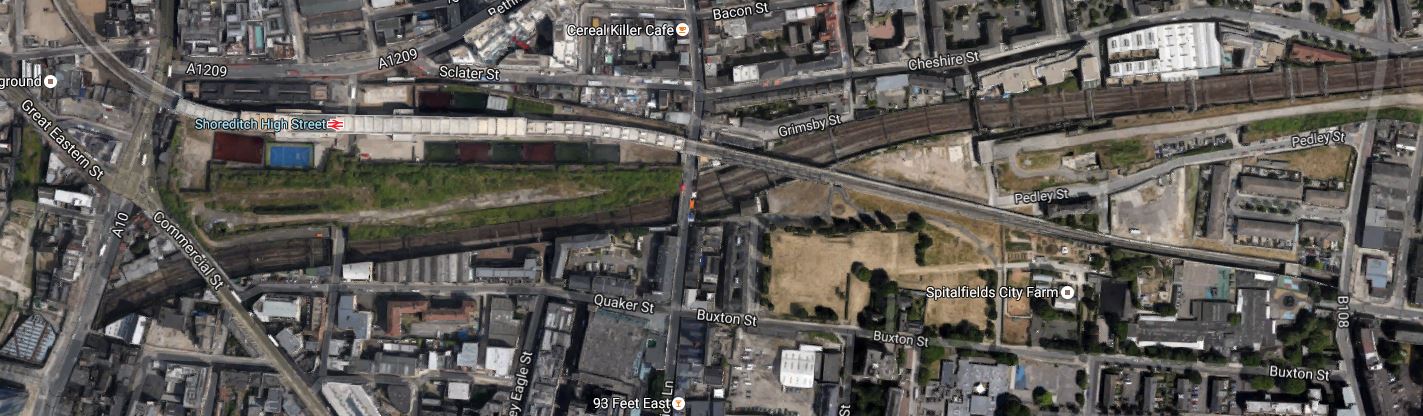
Lines Through Shoreditch
Surely, a better use could be found for the space above this railway. I estimate this space must be about ten hectares and if properly developed could contain lots of buildings and a green walkway connecting Shoreditch High Street station to Liverpool Street station.
And what about the waste of space that is Euston station?
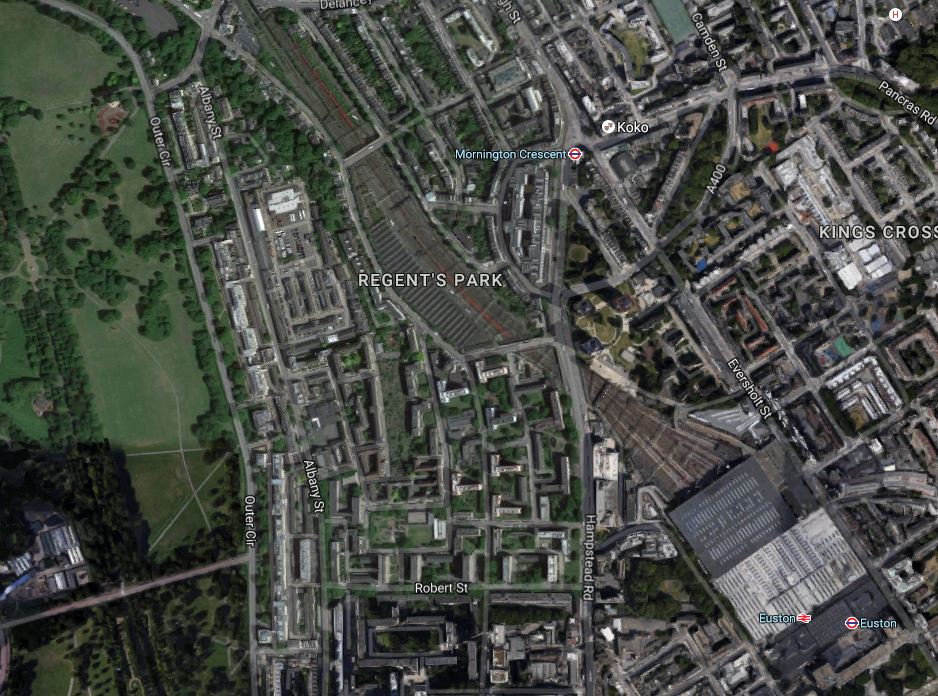
Euston Station And The Approach Lines
Hopefully adding HS2 to the station will improve things.
Now ASLEF Joins In!
I take the headline from this article on Rail News, which is entitled Southern dispute: now ASLEF joins in.
This Southern dispute and the related one in Scotland, appear that they may continue until 2017 at least.
I used to travel up to London in the 1990s with a driver-supervisor on the Central Line. We would discuss various technical subjects and the questions of efficient operation of trains and driver only operation came up.
Nothing he said, ever gave me any hint that driver only operation was anything but totally safe, if you have good communication with those on the platform. In fact, he did give the impression, that when problems did occur, it was because communication between driver and platform staff failed. I can remember him saying that with trainees, he always impressed on them, the dangers of not checking properly before starting when platforms are long and curved, as at Bank.
My view as someone, who has seen a lot of industrial automation at work in factories and industrial plants, is that the safest way to drive a train, is let the computer do the driving and the train driver should monitor what is happening.
Effectively, that is what has happened on the Victoria Line since 1967.
It’s about time that the UK’s trains joined the twentieth century, instead of clinging to the nineteenth.
Improving Services To Lincoln
Lincoln is one of those places, where, companies have promised better train services for years and they’ve never appeared.
The Wikipedia entry for Lincoln station under Future Services reads like a catalogue of broken promises and very little progress.
I think that it is time to think out of the box to provide a better service for the City.
Sorting Out Newark
Newark is an important interchange to get good services to and from Lincoln.
Because of the notorious Newark Flat Crossing, the railways around the town need improving.
Currently there are two fast trains to and between Lincoln and London a day in both directions, an hourly service to Newark and various other random services.
To make matters worse, the change at Newark Northgate station is often fifteen minutes or so.
These pictures were taken as I changed trains at the station for Lincoln on a fine day.
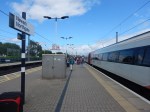
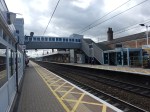
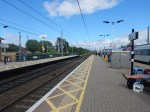
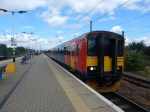
Is an hourly single coach Class 153 train between Lincoln and Newark Northgate an adequate service?
There are other services to Newark Castle station, but the two stations are separated by the notorious flat junction at Newark, which slows services on the East Coast Main Line.
I think in a well-thought out solution, the following will be achieved.
- Trains on the Nottingham to Lincoln Line will pass Newark without inconveniencing trains on the East Coast Main Line, possibly by means of a flyover or a dive-under.
- These trains would ideally call at both Newark stations.
- Hopefully lifts and stairs will make the changebetween the two lines step-free.
I wouldn’t be surprised to see a very unconventional solution to the problem.
Newark Northgate station could be closed and a flyover could take the Nottingham to Lincoln Line over the East Coast Main Line to the North of the town, where a new out-of-town station could be built, which had platforms on all lines and they were connected by lifts. I have called this arrangement A Four-Poster Station in the past.
The new station could also be a transport hub, with lots of car parking.
I changed twice at Newark Northgate today and in both instances I waited nearly fifteen minutes.
So why not just build a simple single-track flyover or dive-under and provide a comfortable electric shuttle bus between Northgate and Castle stations, that meets all trains and does the journey in less time, than the current wait?
Remember that Castle station is closer to the town centre.
It would be a cheaper flyover and the money saved might purchase some bigger new trains.
The service from Nottingham could even be run by tram-trains or like in Zwickau by diesel multiple units, which left the Nottingham to Lincoln Line at Castle station and then went walkabout in Newark.
The only certainty about the sorting of Newark, is that there are innumerable ways to do it and some could be unusual.
I doubt though, that we’ll see much improvement at Newark until after 2020.
The Great Northern And Great Eastern Joint Line
In Project Managers Having Fun In The East, I talked about hoe the Great Northern And Great Eastern Joint Line (GNGE) has been upgraded to be a valuable diversion route for freight trains travelling up and down the East Coast Main Line.
£230million has been spent to create a high-quality railway from Werrington Junction just North of Peterborough to Doncaster via Spalding, Sleaford and Lincoln.
Given the increasing traffic on the East Coast Main Line and the long wait for any relief in the shape of HS2 to Leeds, the North East and Scotland, I think we will see further development of the GNGE.
- I reported in To Dive Or Fly At Werrington, how plans are ongoing to improve the Southern connection of the line to the East Coast Main Line.
- The latest details on Werrington Junction are here on the Network Rail web site and talk about a 2020 completion.
- Could a new Lincoln Avoiding Line be built, so that freight trains avoid going through Lincoln Central station and the level crossings?
- The GNGE has lots of closed stations and some have been reopened in the last few years. Could more be reopened?
All these developments lead me to the conclusion, that there will be improved passenger services on the Peterborough to Doncaster route via Lincoln.
As the GNGE is now a high-class modern route, the single coach Class 153 train will be replaced by something like a two-car Class 158 train or Class 170 train.
The speeds of the three trains are.
- Class 153 – 120 kph
- Class 158 – 140 kph
- Class 170 – 160 mph
As Inter-City 125s are released by the arrival of new Class 800 trains, could we even see shortened versions running between Kings Cross and Yorkshire via Peterborough, Lincoln and Doncaster? These magnificent trains certainly perform well on secondary routes, as anybody, who has ridden in the cab between Edinburgh and Inversion can testify.
I wonder what times a well-driven Class 170 train could achieve. Currently Peterborough to Lincoln takes eighty minutes and Lincoln to Doncaster takes two hours.
I estimate that a Class 170 train could do the journey between Lincoln and Peterborough in about an hour, which is about the fastest time that can be achieved changing at Newark.
An estimate for the time between Lincoln and Doncaster could be about ninety minutes.
All of this speed improvement could probably be obtained without any major infrastructure improvements, but updating Werrington Junction and creating a new Lincoln Avoiding Line would improve things further.
Faster connections to Doncaster and Peterborough would bring various benefits.
- At Doncaster, it would give access to the East Coast Main Line services to the North East and Scotland.
- From 2018, at Doncaster, it would give access to the the improved TransPennine services to Leeds, Liverpool, Manchester and Manchester Airport.
- At Peterborough, it would give access to services to London, East Anglia and the South Midlands.
- From 2018, at Peterborough, there will be a connection to Thameslink, to take passengers all over London and the South East.
Surely these connections will benefit Lincoln most, but a fast service to Peterborough would also do something to improve connectivity at places like Sleaford and Spalding.
I suspect that when the new East Midlands Franchise is announced next year or when suitable trains are procured, we will see significant speed, frequency and comfort improvements on this route.
Reinstating The Complete Great Northern And Great Eastern Joint Line
With the next East Anglian Franchise, it is rumoured that there will be a marked improvement in train services in the region with new and refurbished trains everywhere, running many more services.
One possibility, is that the Bramley Line to Wisbech will be served by passenger trains, as a network of local services are improved and created around Cambridge with expansion and development needs and its soon-to-be-two stations.
I think that the possibility exists that the line between March and Sleaford might be reinstated to give freight trains to and from Felixstowe, direct access to the GNGE to get to Doncaster, avoiding Peterborough and the East Coast Main Line South of Yorkshire.
If you look at Google Maps, then the old rail line is clearly visible for most of the way between March and Sleaford. However, Whitemoor Prison has been build over the route.
If this Southern part of the GNGE were to be reinstated, could we see passenger services between Cambridge and Lincoln?
I think we would, as the engine of growth that is Cambridge, would then be directly connected by train to all the cities and larger towns of East Anglia and Lincolnshire.
I should say, that just as London dominates the South East, I believe that Cambridge with all its skills, ambition and success will dominate the East of England.
Lincoln to Cambridge could be about ninety minutes using a fully developed GNGE, as opposed to two hours now.
Conclusions
I have come to the following occlusions.
- The record of train companies in getting more direct services to Lincoln says a lot and I’d be very surprised if Lincoln sees more direct services to London.
- Newark is a basket case and sorting it will be difficult and probably expensive
- The best bet for improved services is to put faster trains on the upgraded Great Northern And Great Eastern Joint Line between Peterborough and Doncaster, which could mean Peterborough in an hour and Doncaster in ninety minutes from Lincoln.
- The trains for this should be available in 2018.
In the long term, I can see benefits in connecting March and Sleaford.
Ironically, the GNGE was built to bring coal to East Anglia from Yorkshire and it could be used to bring freight between Felixstowe and the North, in an efficient ,manner.
The Victorians seem to have got the route of the GNGE correct.
Just as they did the Varsity Line and the Borders Railway.
Lincoln’s Tower Bridge
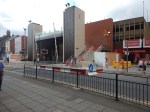
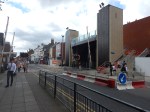
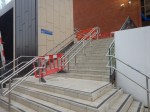
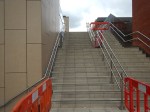
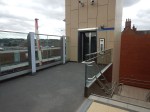
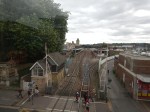
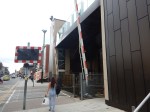
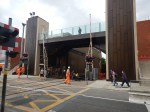
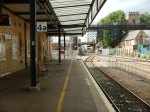
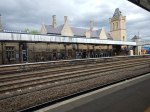
I took these pictures of the new bridge over the railway by one of Lincoln’s notorious level crossings.


Note.
- The bridge may mean that pedestrians can get across easily when the level crossing is closed, but it doesn’t do anything for the vehicles.
- One of the reasons for the height, is to clear the wires, if the line should be electrified.
- This article in Rail Engineer describes how it was built.
- Reportedly, the bridge is the first part of a £12million scheme, which includes a second bridge over another nearby level crossing.
It’s certainly a striking footbridge.
A High Speed Brew
I took this picture, as my train to Newark for Lincoln was somewhere around New |Southgate. We were just twelve minutes out of Kings Cross

A High Speed Brew
The steward had served it almost before we moved off at Kings Cross, with a very full train of passengers.
Enthusiasm For Class 345 Trains
I have read several articles on the new Class 345 trains for Crossrail.
This article from Railway Technology Magazine, which is entitled There has never been a ‘better designed’ train than Crossrail, is particularly enthusiastic.
This is said.
There has never been a train “better prepared or better designed” in the UK than theCrossrail train, London Underground’s managing director Mark Wild told RTM at a visit to Bombardier’s testing facility in Derby.
Speaking to RTM after the first Crossrail train, Class 345, was unveiled and taken for a ride across the Bombardier test track for the first time, Wild sang the many praises of the state-of-the-art vehicle, calling it a “world-class train” for passengers.
“It’s a sensational train. I’m so pleased to see it – it’s so exciting,” he said. “I’ve been lucky enough to be involved with other train procurements in my career and this is definitely the best. This will be a big success – obviously it has to be tested thoroughly, but it is already looks great.”
But of course the proof of the train, will be in the riding.
I can’t wait, until May 2017, when they will start running between Liverpool Street and Shenfield.
I think that Bombardier, Crossrail and TfL are handling the introduction of the trains into service in a way, that means they can handle any teething troubles.
Consider.
- Liverpool Street to Shenfield is a self-contained line.
- By the end of this year, Liverpool Street to Shenfield will have had the extended platforms completed and the power systems upgraded for Crossrail.
- Bombardier have a facility for servicing trains at Ilford, so the testing will be on their door-step.
Bombardier are also introducing the trains as seven cars, as the platforms at Liverpool Street are too short. But after their lengthening of the Class 378 trains on the Overground, this process probably has no fears for the company.
It will also mean, that when the platforms are lengthened, this can be done at a time, when all the trains are going through the central tunnel.
But to me, the platform lengthening at Liverpool Street has more to it.
The Services section for Crossrail in Wikipedia is saying that only four trains to Gidea Park in the Peak will use Liverpool Street.
Lengthening the platforms for just four trains does seem a lot of work just to allow the standard trains to enter Liverpool Street.
Obviously, if there is a problem like a broken-down train in the tunnel, the ability to use Liverpool Street station as an alternative destination will be valuable.
Or could it be that there are other plans to perhaps run Crossrail trains to Southend Victoria?
I feel the latter would make a lot of sense.
- The Southend Victoria route, gets much needed new trains.
- Southend Airport gets a premium service.
- The use of the upgraded Crossrail route is increased.
- These trains could perhaps just stop at Stratford, Ilford, Romford, Gidea Park and Shenfield.
- They could be mechanically and electrically identical to the Crossrail trains, but with a more appropriate interiror.
This is only the same as is happening on the Western Branch, where other services are using Crossrail’s tracks to go to Paddington.
Crossrail is going to be a lot bigger than a cross-London railway called the Elizabeth Line.
Every Local Politician Should Read This
I have never seen such a powerful argument for improving local transport links and especially trains than this article in the National.
It is written by a train driver turned local politician and he is talked about Glasgow.
But his arguments can be applied to any city in the world.
Read the article.
 The Anonymous Widower